Tillotson’s orphan designs of the 1940s gave way to popular elevator plans

DSC_2297

This Mayer-Osborn oddity in Cordell, Okla. was only built once for a customer with specialized needs

Story and photos by Kristen Cart

In the last post, we checked out two of Tillotson Construction Company’s earliest designs and their derivatives. In the 1940s, many elevator plans departed substantially from Tillotson’s first efforts, and they had plan names of their own. Some of those elevators were one-of-a-kind.

I will examine the orphan designs and a few that were used more than once, but failed to catch on, in the next two posts.

Orphan designs were unique storage plans, made to meet unusual customer needs. Non-standard-sized elevators were built to mimic Tillotson’s more basic offerings. Annexes were custom built. If an elevator and annex were built together, certain features were unique.

Here are the orphans of the 1940s.

Peterson Plan:

Peterson 01Peterson, Iowa (1944) was “storage, mainly,” with no driveway, a “x spout to leg,” and 12 1/2-foot-diameter tanks. It had a conveyor belt and a wooden, hand-operated man-lift. Its capacity was only 37,550 bushels. This was one of the smallest elevators Tillotson ever built, though a few were even smaller.

Farnsworth Plan:

Farnsworth, Tex. (1945) was the largest elevator Tillotson built to date, with a 350,000 bushel capacity. It had 19 bins with six 20-foot-diameter tanks, and a tunnel with a conveyor belt. A semi-truck driveway was built with a machine room directly overhead. Projects of this size were uncommon.

Peterson 02Farnsworth, Tex. will require a site visit, because we don’t know if a Tillotson elevator still stands. Three large elevators exist in Farnsworth, but none is typical of Tillotson’s style–two have hexagonal bins (the design made a big media splash in 1949), and the other could be a Tillotson, but looks more like a Chalmers and Borton elevator.

Dalhart Plan:

Dalhart, Tex. (1947) was a bit of an oddball, having an attached driveway rather than a center driveway. It had no basement and no distributor floor, but sported the “standard cupola.” It had four 20-foot-diameter tanks and could hold 150,000 bushels of grain. A 98,000-bushel annex was built alongside it at nearly the same time, which could explain the oddities: direct cross-spouts from the elevator provided gravity flow to the annex pit.

A second elevator was built in Dalhart, Tex., in 1949, which also gave is name to a plan: this “Dalhart Plan” described a large elevator with 310,000-bushel capacity.

Eva Plan:

Eva, Okla. (1947) was a very small elevator with only a 13,500 bushel capacity. The description says “cupola in D.F. [draw-form] wall.” The driveway was attached. It had two 14-foot bins, a “rope drive” and motor room.

Moscow Plan:

Moscow, Kan. (1948) is featured in an earlier post on this blog. It was a smallish elevator of 100,000 bushel capacity, four 14 feet-diameter tanks, and a 13 x 17 foot driveway with six bins directly overhead. It incorporated a dust bin.

DSC_0288

Minneapolis, Kan., mill building, elevator, and annex

Mill Building:

Minneapolis, Kan. (1948) is a site that fooled me on first examination. No manhole covers were evident on any structures except for the mill building. I didn’t expect an elevator with a rectilinear headhouse to be a Tillotson creation, so when we featured the mill building in our post (follow link), I added specifications which describe the elevator beside it! We will publish the mill building specifications in a later post.

Greenwood 01

Greenwood, Neb. ca. 1951 with attached Tillotson annex

Hordville Plan:

Hordville, Neb. (1949) was a 70,000 bushel capacity elevator with four twelve-foot-diameter tanks, a driveway, and eight bins directly above the driveway. Its rounded headhouse, by 1949, was already standard on Tillotson elevators.

Hordville’s outward appearance is a miniature version of Tillotson elevators of the same vintage–a style that continued into the early 1950s. Greenwood, Neb. (1951), which was built using the Churdan plan, circa 1949, is a larger-scaled example of the type.

Pierson Plan:

Pierson, Iowa (1949, storage) had a 80,200 bushel capacity, four 15 1/4 foot-diameter tanks, a dump pit, one way scale, a spout floor below the bin roof, and cross spouts. It was designated “storage,” a structure more like an annex than a self-contained elevator.

Clare Plan:

Clare, Iowa (1949) was built to hold 88,800 bushels of grain with four 15 1/4 foot-diameter tanks. It had a spout floor below the bin roof and an attached drive.

The artists of the Tillotson Construction Company–architects and engineers, those creative, ingenious men–were prolific producers during the 1940s when elevator technology bloomed. The flower of their achievements can be seen scattered across the prairies, either finding useful work, or passing into idleness, while curious onlookers snap their pictures and move on.

After the 1940s, almost all of the first Tillotson designs were dropped or modified as technology advanced. Only two designs (Churdan and Jackson) of the late 1940s carried into the 50s, and they were rapidly replaced after that, as will be seen in the next post.
Tillotson’s design plans consolidated the trends in elevator form and function

Photo by Gary Rich

Photo by Gary Rich

Story by Kristen Cart

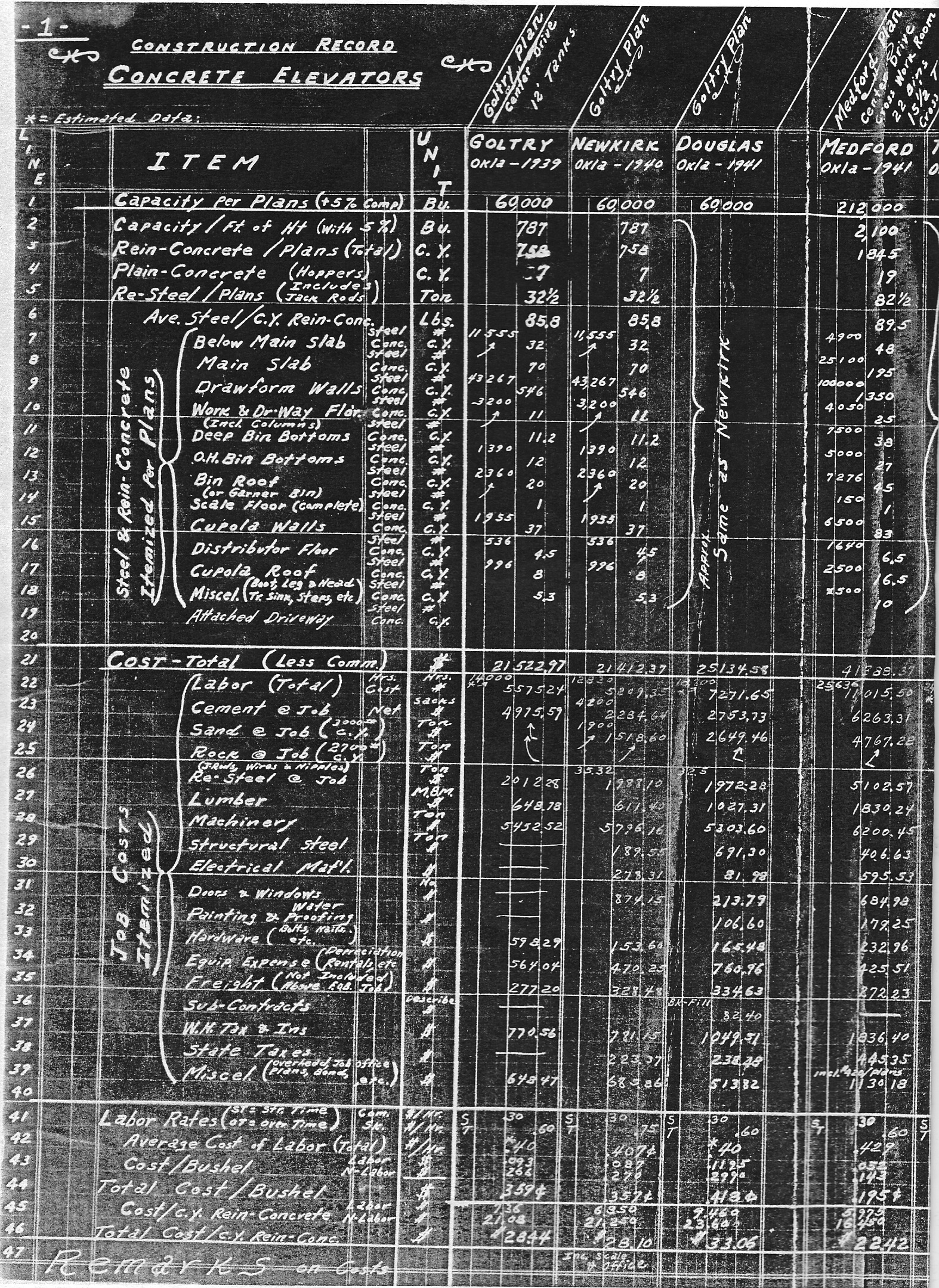
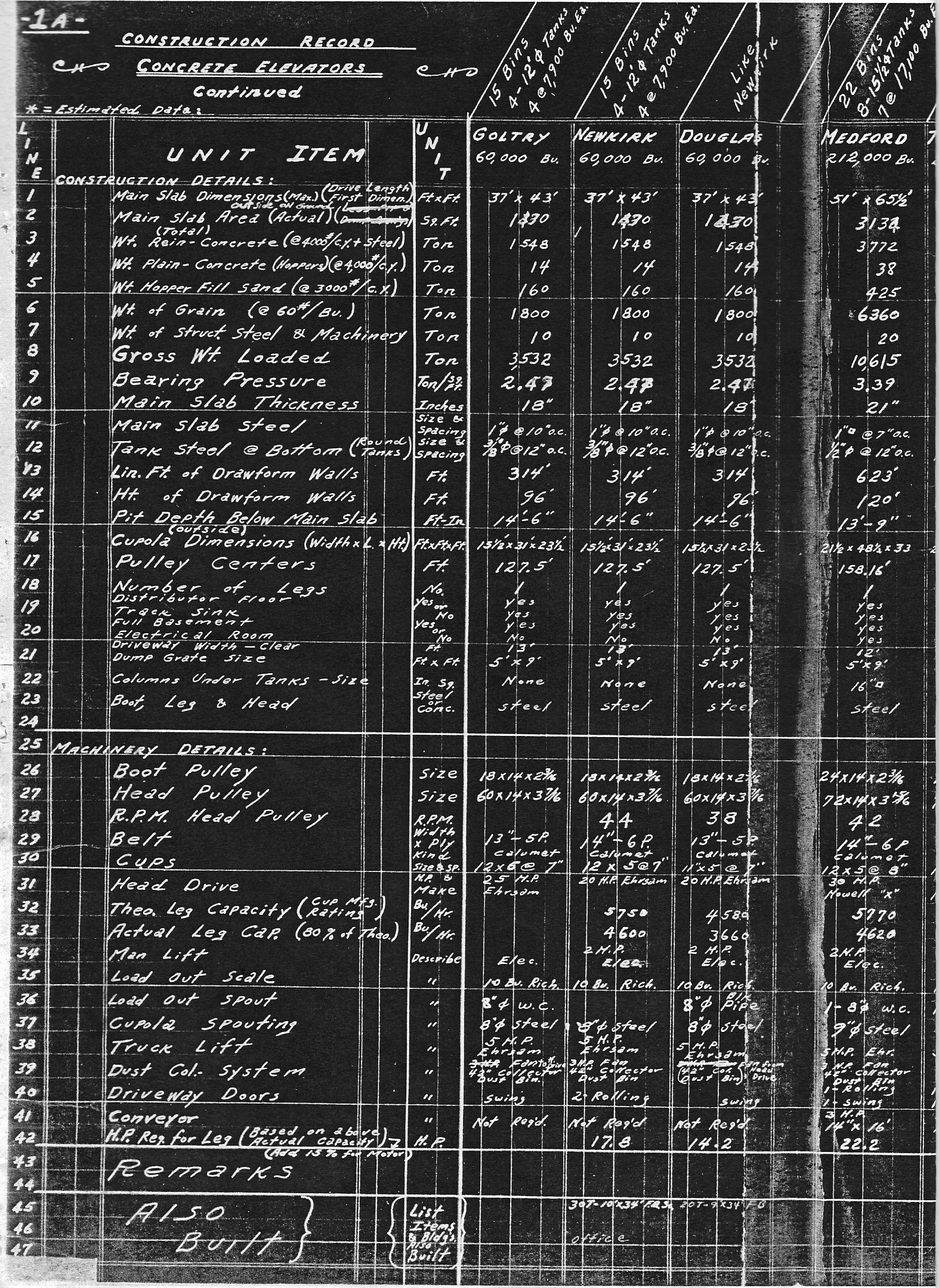
The concrete elevator construction records of the Tillotson Construction Company display data in columns, each column headed with the location of the project, and the date it was built. Specifications follow. Above the header is the name of the plan used to build the elevator. A short description accompanies the plan name.

For instance, in 1955, the Boyden, Iowa, elevator was built using the Palmer, Iowa, plan of 1950, with eight bins, each being 18 feet in diameter and 117 feet high. The driveway measured 13×17 feet.

You might discover, on review, how many of each elevator type were built based upon the plan names. This exercise will show us how the elevator plans evolved, and which were successful over the years of the elevator boom. Over the next few posts, I will attempt to spot trends over the span of our records, starting at the beginning. The elevators will be referenced by their locations.

Richland,_Nebraska_Front_from_Tilden_1

Richland, Neb.: Front Street, looking east from about Tilden Street, taken on 21 October 2013, by Ammodramus via Wikipedia Commons

Goltry plan:

Goltry, the first elevator of its type, was built with a center drive and four 12-foot-diameter tanks. The Goltry plan specified an elevator in the 60,000-bushel class, the smallest Tillotson built:

Goltry, Okla. (1939); Newkirk, Okla. (1940); Douglas, Okla. (1941); Wellsburg, Iowa (revised plan, 1946); Polk, Neb. (1948–“Wellsburg plan” was another heading used for this elevator, just to make it confusing); and Richland, Neb. (1948).

From the photographs we were able to find, this elevator type was a small, four-square design with a rectilinear headhouse. Several of the type were still standing in recent photographs.

Medford Plan:

Medford 01Medford, the first elevator of its type, was built with a center drive, a cross work room, and 22 tanks of 15 1/2 feet in diameter. These old elevators had rectilinear headhouses, a feature that was later abandoned in favor of a rounded design. The plan represented a big jump in size from Goltry, having a 212,000-bushel capacity. Later, a revised Medford plan had a capacity of 140,000 bushels, and an expanded plan pushed the capacity to 240,000 bushels:

Medford, Okla. (1941); Thomas, Okla. (1941); Burlington, Okla. (revised plan, 1945); Cherokee, Okla. (revised plan, “like Burlington,” 1945); Lamont, Okla. (revised plan, 1945); Blackwell, Okla. (revised plan “like Lamont,” 1945); Booker, Tex. (revised plan, 1945); Follett, Tex (revised plan, 1945); Elkhart, Kan. (revised plan, 1946); Kingfisher, Okla. (expanded plan, later designated the Kingfisher plan, 1946); Thomas, Okla. (expanded plan, “similar to Kingfisher,” 1946); Ensign, Kan. (expanded plan, “similar to Kingfisher,” 1946); Manchester, Okla. (revised plan, later designated the Manchester plan, 1948); Montezuma, Kan. (1948)

The two daughters of the Medford plan, Manchester and Kingfisher, follow:

Manchester Plan:

Medford 02Manchester, Okla. (1948); Rolla, Kan. (“like Manchester,” 1948)

Kingfisher Plan:

Hooker, Okla. (1949)

More analysis is needed to determine exactly when the transition to a rounded headhouse occurred–but we think it did occur sometime after the Manchester plan was first designated as such, unless some of these elevators were modified at a later date.

What is clear from photos of Goltry and Medford plan elevators is that the rounded headhouse design was not used in Tillotson’s earliest elevators, and was likely adopted sometime in 1948–both plans made the transition in that year. Other details are bound to emerge as we study the other elevator plan types as they entered the Tillotson Company’s repertoire.


Will the 1949 Tillotson elevator in Paullina, Iowa, please stand up?

DSC_0508

Story and photos by Kristen Cart

We know that the Tillotson Construction Company of Omaha built an elevator in Paullina, Iowa, but we are not certain which one. We have only newspaper accounts to guide us. The company records list all of their concrete construction projects until 1956 (albeit missing one page), but omit Paullina. A visit to the location provided no clue.

Perhaps the elevator they built was not concrete? There is a precedent in Hawarden, Iowa, where the company built a wooden elevator in the tradition of Charles Tillotson, the patriarch of the family elevator business. But that elevator went up in 1940. Paulina was built in 1949, well after the company had changed its construction method to slip-formed concrete. On review, indeed, we found that the newspaper account said the Tillotson elevator was to be concrete.

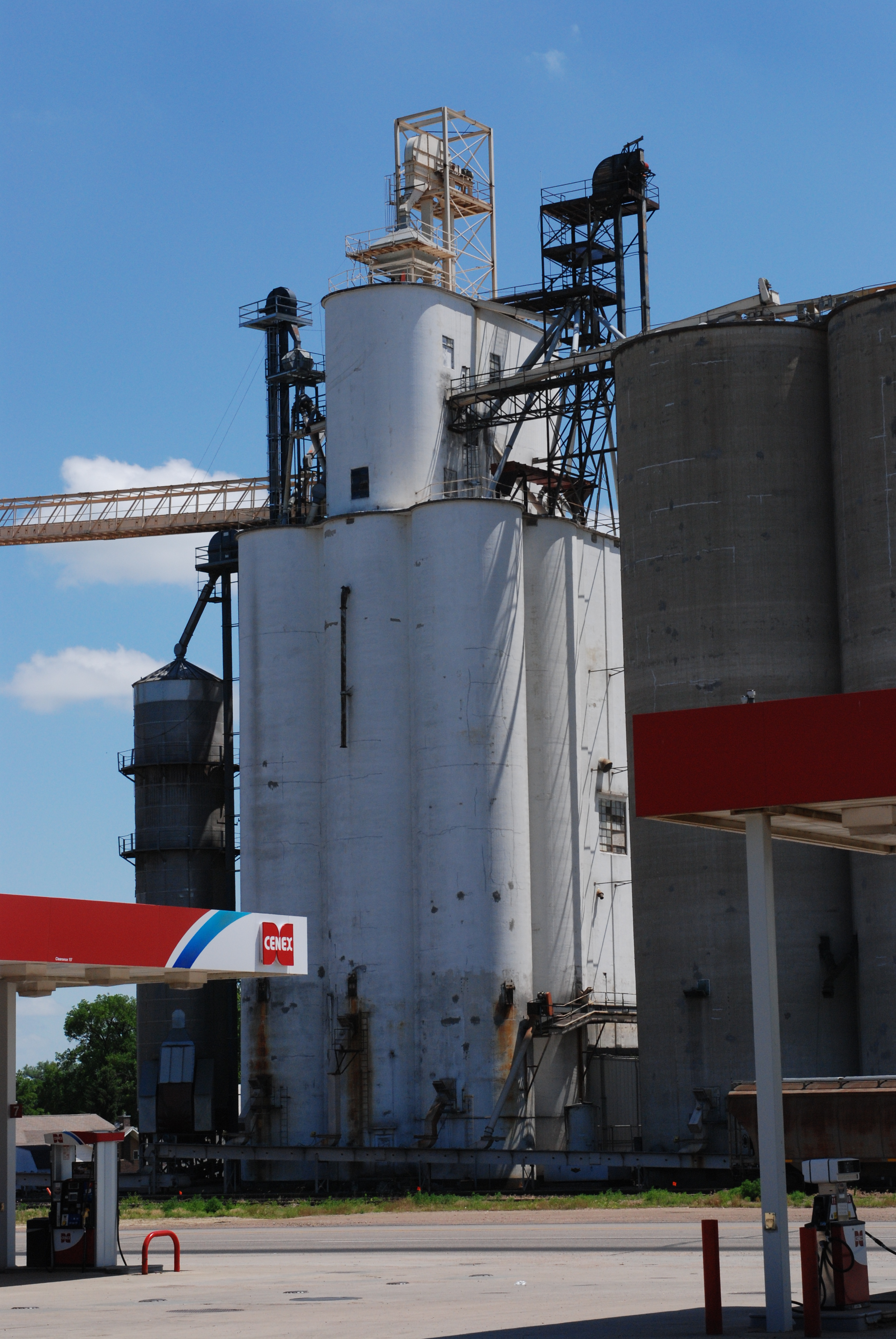
My family rolled through Paullina on a Sunday when the co-op was closed. Grain trucks were parked, and the facility was quiet except for the drone of circulation fans. We found no identifying manhole covers, so I had to content myself with photos. I took at least one image of each elevator on the site. None of the elevators followed the familiar Tillotson style, which may not have been fully developed by 1949 in any case.

Let the reader be the judge from the photos presented here.

These appear to be more modern construction than seen in 1949.

These appear to be more modern than elevators built in 1949.

The two older elevators at Paullina are concrete, but they do not seem to follow the protocol of a continuous pour. The newer-looking elevators deserve a closer look, in spite of their unfamiliar lines–particularly the smaller one on the left. Tillotson Construction set a precedent in 1947, when they built a rectilinear-styled elevator at Minneapolis, Kan.

Perhaps the old Tillotson elevator outlived its usefulness and no longer stands? We don’t know.

Reader input is welcome!


This elevator resembles some of Tillotson's early efforts, and seems to be a good candidate

This elevator resembles some of Tillotson’s early efforts and seems to be a good candidate

Abraham Tillotson, who fought in the Revolution, was too wealthy for a pension


The Tillotson family was adept at seizing opportunities such as the demand for grain storage in the 1940s.

The Tillotsons were adept at seizing opportunities, such as the demand for grain storage in the 1940s.

Story by Kristen Cart

Abraham Tillotson, the direct ancestor of Charles H. Tillotson, the builder of wooden grain elevators, joined the Continental Army in 1775 and served for more than a year, earning the grateful thanks of our new nation. After the war he became a farmer, but in old age he asked for a pension based upon his service.

In 1818, Congress authorized pension payments for veterans who had fallen on hard times. It was not until the 1830s that the pensions were offered to widows and orphans. Veterans had to prove their service (inconveniently, the British burned all of the Revolutionary War service records held in Washington during the War of 1812). To that end, they had to produce witnesses to their service. They also had to prove that they were poor and unable to care for themselves.

Sometimes, veterans navigated the rules adroitly and obtained their pensions without much trouble, and retired in relative comfort. Sometimes it took years for them to prove their service. And sometimes, many letters flew back and forth before a grudging pittance was approved–enough to usher the elderly veteran quietly to his grave.

Abraham’s pension file, digitally preserved at Fold3.com, provides an amusing counterpoint to the usual, sorrowful packet of letters.

Page 4-1

On Oct. 9, 1819, Abraham Tillotson, a resident of Casenovia, aged 63, appeared before the Court of Common Pleas in Madison County, New York to make his statement of service. He said he enlisted on Dec. 18, 1775, serving in Capt. Levi Wells’ company, Col. Samuel Wylie’s Regiment, in the 22nd Connecticut Line of Continental Establishment. He was discharged at Fishkill, New York, on Jan. 1, 1777. He had fought in the Battles of Flatbush and Long Island, and at the taking of General Burgoyne. He produced a witness to his service in the person of Henry Champion.

According to the court, Abraham’s statement averred that “he is in reduced circumstances and stands in need of assistance from his country for support.” Apparently, Abraham had no trouble getting onto the pension rolls. His trouble came later.

Abraham’s consternation was evident in the letter he wrote on July 11, 1822:

“… I am informed of the suspension of my pension until I produce satisfactory evidence doing away [with] information received at the War Department of my being ‘worth more than five to six thousand dollars.’ From whatever source this information may have been received, it is totally false, without a shadow of foundation, and must have been engendered in the brain of some malicious and corrupt villain. The information indirectly charges me with false swearing and if I knew the malicious informant, I would (as I did the enemies of my country) chastise him for his audacity, old and infirm as I am.”

He went on, protesting his honesty: “In obtaining the bounty of my country, for which I fought and bled (when, probably, your informant was in his cradle), I pursued an honest correct course and such as prescribed by the love of my country…”

He was up against a formidable stack of evidence to the contrary.

The Honorable E. Litchfield was the first to alert authorities to Abraham’s wealth, after he learned that Abraham Tillotson was worth between five and six thousand dollars. Abraham’s pension was suspended from that date, Dec. 6, 1821.

Page 42

Further investigation yielded more.

“State of New York,

We, the subscribers, freeholders and inhabitants of the town of Cazenovia in the County of Madison and of the town of Pompey in the County of Onondaga and state aforesaid, do certify–that we have been acquainted with Abraham Tillotson of said Cazenovia for a number of years–that we have lived and do still live [as] neighbors to him–that we have considered him one of our most independent farmers, one who has money to loan, whenever he can obtain extravagant interest, or dispose of some property at a high price and obtain good security–that his property year before last was valued by the assessors at about eighteen hundred dollars–and further we consider him the said Tillotson abundantly able to support himself and family–and under the existing law authorizing the payment of pensions do not think him entitled to a pension–given under our hands this 21st day of August 1822.

Rufus Lyon, Joseph Atwell, Daniel Allen, James McCluen, Joseph Atwell Jr., Elijah Hill.”

Whoops.

Other affidavits contain the same sort of accusations. Needless to say, Abraham never recovered his pension. He died two years later in 1824. His widow tried to reinstate his pension in the 1830s, also to no avail.

Page 33

Abraham offered to pay Rufus Lyon, one of his accusers, to testify in his favor

So began a Tillotson tradition of success and wealth, of sharp business dealings, and of a willingness to partner with the U.S. Government when advantageous–a perfect template for the private/public partnership that became the grain elevator boom of the 1940s and 50s. I would be quite proud of such a clever ancestor, notwithstanding a bit of shading of the truth. His neighbors (debtors?) might not quite agree.


The Atlanta, Kan., elevator suggests our grandfathers’ signature designs


AtlantaKansas

Photo by Brad Perry

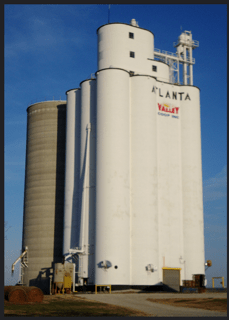
Editor’s note: Contributor Brad Perry sent this photo of Valley Coop’s elevator in Atlanta, Kan. The rounded, stepped headhouse suggests Tillotson and Mayer-Osborn design influences. A call to the elevator put us in touch with Katherine Grow, who runs it with her husband Darren.

“I think it’s a Johnson house. I remember when they built it. All the men in the community helped when they started pouring. Markle was the head of the crew that did it. I think it was ’58 or ’59 when it was constructed. In fact, it’s better designed than a lot of places. We added an outside leg. We used to load out on the rail but don’t any more. We’ve done maintenance and made safety updates. We’ve had it painted once. We were told it is the kind of concrete that has to be kept painted. It’s easy to work with, the way it’s put together with the inside leg. We’ve been pleased with it. I was a teenager or preteen when they built it. Once started, they kept pouring. With the lights at night, it reminded you of when you see a riverboat all lit up going down the river. It was cool. When we built this other bin and they could do it in sections, it was kind of different. They just pour so much and go round and round with a little cart, and come night, why, they’d quit and go home.”

The Pocahontas, Iowa, elevator remains a lovely monument to Tillotson ingenuity

DSC_6547

Story and photos by Kristen Cart

The Tillotson elevator at Pocahontas, Iowa, first came to our attention as the site of a tragic accident where a young construction worker lost his life. Larry Ryan fell to his death because he tripped while crossing from the elevator to the annex on a makeshift wooden walkway, according to fellow workers. He wore brand new work boots and some speculated that they contributed to the accident. The young hoist operator was twenty years old when he fell 130 feet to his death from the top of the nearly completed annex in 1954.

I finally had the opportunity to see the site for myself this past summer. We took a wide detour north of our regular route from Nebraska to Illinois–it added a good four hours driving time, not counting the stops. My young cheering section (the kids) were not cheering about the extra road time.

DSC_0637

Upon our arrival in Pocahontas, a town along Lizard Creek in north central Iowa miles away from any major state thoroughfares, we immediately noticed the Tillotson elevator and its trademark rounded headhouse. The annex stood beside the original elevator, rising higher (by 10 feet) than its 120 foot companion, and gleaming with clean whitewashed concrete. It showed no sign of its sorrowful beginnings.

Later additions, including an elevator with headhouse, a flat storage shed, old steel hoppers, and modern steel bins with external legs, surrounded the two concrete structures.

The Tillotson elevator and annex were flanked on one side by a quiet street with an old church and ancient maple trees. The bustle of grain trucks was absent on the Sunday afternoon of our visit, and the co-op office was closed. Only the elevator exhaust fans pierced the silence.

We circled the complex, taking a number of photographic views, before going on our way.

We have the specifications for both the 1949 elevator and its 1954 annex. The annex construction record is detailed here.

DSC_0616

The Pocahontas annex was built with six 18-foot diameter, 10-foot spread by 130-foot high bins; with a basement; the bins were flat bottomed, built with 30-inch belt conveyors and tripper.

Planned capacity (with pack) was 222,440 bushels; translating to 1,863 bushels of capacity per foot of height. The total reinforced concrete, per plans, was 1,366 cubic yards. Plain concrete for hoppers, per plans, was 9.5 cubic yards, and reinforcing steel used, including jack rods, was 69.59 tons.

The design specified the average quantity of reinforcing steel used for the whole annex, which was 101.89 pounds per cubic yard of concrete.  Actual planned amounts were then itemized for various components of the structure:

Main slab: 27,017 lbs. steel/219 c.y. concrete

Drawform walls: 30,708 lbs. steel/990 c.y. concrete

Overhead bin bottoms: 9,957 lbs. steel/70.5 c.y. concrete

Bin roof and extension roofs: 6,740 lbs. steel/44 c.y. concrete

Cupola walls: 3,747 lbs. steel/33 c.y. concrete

Cupola roof: included in walls

Bridge/Tunnel: 1,020 lbs. steel/9.5 c.y. concrete

DSC_6510

Dimensions and weight of the annex and its components were laid out also. The main slab was 52′ x 60′, for an actual outside area on the ground of 2,946 square feet.

The weight of reinforced concrete, calculated at 4,000 pounds per cubic yard of concrete plus steel, was 2,801 tons. The plain concrete was also calculated at 4,000 pounds per cubic yard and totaled 19 tons. The weight of the hopper fill sand was 177 tons.

When the weight of grain was added to the specifications, at 60 pounds per bushel (for Pocahontas, the grain load would total 6,660 tons), the planned gross weight of the annex could be predicted. Twelve tons of steel and machinery were added to the total, for a planned gross weight, loaded, of 9,669 tons.

From these figures, bearing pressure was calculated to be 3.28 tons per square foot.

To handle all of that pressure, the main slab was made 24 inches thick. It was built with #8 steel, placed at 6″ c.c. spacing. Tank steel and bottoms (for round tanks) used #4 steel at 9″ c.c. spacing.

The drawform walls, with extension, measured 411 linear feet, and 130 feet in height. Cupola dimensions were 16′ x 56′ x 8 1/3′.

Since this was an annex, distribution of grain was accomplished through the main elevator leg and thence by belt conveyors and a tripper. Many of the items expected for elevator specifications were absent for an annex. For machinery, the annex had top and bottom belts, rated at 600’/min or 3,000 bushels per hour. 7 1/2 horsepower drives were used for a total load rate of 9,000 bushels per hour.

Loading rates are key for grain storage operations, since they determine how quickly trucks or rail cars can unload and be on their way. Slow elevators become obsolete. The Pocahontas operation was at the leading edge of technology with its shiny new 1954 annex, and to this day it provides quick, efficient service.


Elevator investigations move farther afield with a side trip to Alta, Iowa

DSC_0579

The trademark rounded headhouse identifies the Tillotson elevator, shown here behind the office and truck scale.

Story and photos by Kristen Cart

It is getting harder to visit our grandfathers’ elevators. All of the elevators within a half hour either side of the I-80 corridor have already been exhausted, so a stop for photography requires real planning and extra gas, time, and effort, even when piggybacked on our normal family visit to Nebraska.

The trip to Alta, Iowa, required just such an extra investment in driving time. The town and its Tillotson elevator is just north-west of Storm Lake in the northwestern corner of the state, and is not, quite frankly, on the way to anywhere.

DSC_6488

The Tillotson elevator in Alta, Iowa, where the old structure is mostly obscured by later bins.

I wonder how our kids put up with it. This trip in particular required over an hour’s northward jaunt before angling generally east-northeast, with a 30-minute divot or two along the Nebraska-to-Illinois route. Each detour took in wayward sites, including Alta.

DSC_0593

A look up the rail line opposite the Tillotson elevator revealed the historical trappings of town, with a backdrop of new grain bins.

It is normally a 10-hour drive to get home from visiting their grandparents, but this elevator excursion would tax my children’s patience for several more hours. To be fair, we got an extra early start. But that meant the serious backseat fidgeting would start sooner.

You would think that I would study Tillotson records first, and inject some discipline and efficiency into planning our route.

But no, that task was left for after the trip, so I could see how closely we approached several sites without seeing them.

I don’t think the kids minded the near misses–but they’ll get to see the countryside again when we go through to mop up the strays.


As we sensed during our visit, the Tillotson elevator in Hinton, Iowa, was part of big doings

Hinton by Brad

After our recent post on Tillotson Construction Company’s elevator at Hinton, Iowa, reader Brad Perry sent in one of his own photos of the location, which you see above. We believe the concrete elevator was built in 1954.

Brad also alerted us to some news.

On July 1, the Farmers Cooperative Company, of Hinton, merged its operation that includes the Tillotson elevator with Central Valley Ag, which he calls “a very large” co-op from York, Neb.

Indeed, chief executive Carl Dickinson welcomed FCC in a statement on CVA’s website.

Photo by Kristen Cart

Photo by Kristen Cart

“As we get to know FCC better, my excitement builds around what we can accomplish together,” Dickinson said. “I would like to thank all of the FCC member-owners for their votes (sic) we are thrilled that you have chosen Central Valley Ag for your future.”

Adding Hinton gives CVA some unique advantages. As Brad Perry explains: “Hinton can load 110-car shuttles on three different railroads—UP, CN, and BNSF. It may be the most strategic grain location in the Midwest.”

See CVA’s website for a superb aerial view of Hinton.

As Kristen wrote in her post, “The entire complex has become a far greater enterprise than our grandfathers, builders of the original structures, ever envisioned.”

A long-time elevator man sends greetings from Hardy, Iowa, and shares some lore

GilmoreCity01

Story and photos by Larry Larsen

In response to a recent post about Odebolt, Iowa, we heard from Larry Larsen, who works for Gold Eagle Cooperative’s facility in Hardy, Iowa. Larry says Tillotson Construction Company’s elevator, built there in 1956, is “still operating and used daily!”

GilmoreCity08Larry graduated from high school in Gilmore City, Iowa. His father managed an elevator from 1958 to 2008, and Larry remembers high school summers spent cleaning out and painting silos.

After getting in touch with us, Larry took an excursion and delivered some photos of the Gilmore City elevator. It was built in 1949, a year when Tillotson also built elevators in Dalhart, Tex., Hooker, Okla., Hordville, Neb., West Bend, Iowa, and Montevideo, Minn., among other places.

Larry, who served 25 years in the United States Army, shared these additional reminiscences:

“I know a lot of the facilities in my old stomping grounds are [built by] Todd & Sargent. The facilities built in the 1980s and 1990s were done by Lambert & Hamlin.

“Interesting thing–I found out through my dad in early 2000s that Lambert & Hamlin built or started to build two concrete tanks in the town of Rutland, Iowa, and about halfway into that project they went bankrupt, causing Pro Cooperative to find a contractor mid-pour to finish the project.

GilmoreCity06“Pro Cooperative then became receiver of Lambert & Hamlin’s property in Sioux City.

“A lot of interesting history in many of the small towns all around the Midwest with the construction of elevators. Some communities had their population double when crews came to town.

“Reading the blogs, there was also a lot of tragedy involved, with people falling off the partially completed structures. I remember, in the early ’80s, Lambert & Hamlin was doing a slip in the tiny town of Pioneer, Iowa.

“They had a laborer who was smoking pot as he was tying rebar on the night shift. Said individual stopped tying rebar to light a joint, lost his balance, and fell 80 or so feet to his death.

“Slipping never paused for that.”

GilmoreCity04

Looking inside and outside of Tillotson’s elevator in Cavalier, N.D.

IMG_6980

Story by Ronald Ahrens with photos by Scott Hansen

While looking at the specifications for Tillotson Construction Company’s concrete elevator built at Cavalier, N.D., in 1948, we gave a call to CHS, Inc. and reached Scott Hansen, who oversees operations at the 460,000-bushel facility there.

South view.

South view. Click on the image to enlarge it.

Hansen said the Tillotson elevator is mainly used for extra capacity during harvest. The operation mainly handles wheat, he said in a subsequent text message, “but also a lot of soybeans and corn.”

He offered to take some pictures, and we present them here, along with repeating the specs from our post of July 27.

This elevator was built according to the plan used for an elevator at Sheldon, Iowa, in 1941. It featured a center driveway and four tanks, each being 14.5 feet in diameter and rising 102 feet. Total capacity was 93,700 bushels.

The job required 1,027 tons of reinforced concrete and 55.13 tons of steel.

At 18 inches thick and covering 1,768 square feet, the main slab supported a gross weight as as high as 5,321 tons. Eight bins were overhead in the 12-by-17-foot driveway.

Crowning the main house was a cupola, or headhouse, of 15.5 x 32 x 22.5 feet, and the pulley center in this single-leg elevator was 127.0 feet above the floor.

North view.

North view. The blue conveyor fills the structure; the gray one on the ground empties it.

Boot and head pulleys were 60 x 14 inches, but the head pulley’s axle diameter of 3-7/16 inches was 1.25 inches greater than the boot’s.

The 14-inch, 6-ply Calumet belt had cups of 12 x 6-inches spaced 10 inches apart. A 20-hp Howell motor supplied the drive in the headhouse. Actual leg capacity was 4500 bushels per hour.

A 2-hp motor operated the man lift. (Lifts in some Tillotson elevators of this era were still hand-operated.)

Cavalier was a fully accessorized elevator, with a 10-bushel load-out scale, an 8-inch load-out spout of 10-gauge steel, and 14-gauge cupola spouting. There was a 7.5-hp truck lift and a dust collection system consisting of a fan, column, and bin.

In the space for remarks at the page’s bottom, we find written, “One end round on cupola.” Yet the photo shows both ends are rounded.

IMG_6981