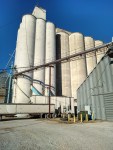
In Richland, Neb., Tillotson made a handsome, early experiment with a curved headhouse

IMG_20200104_113826329_HDR

By Ronald Ahrens

Located between Schuyler and Columbus on U.S. 30, Richland is a blowing-away little hamlet with nothing of interest save for the handsome grain elevator at 310 E. Front Street. Rose Ann Fennessy and I pulled in just before lunch on Jan. 4 to look it over.

Nebraska 2020Cooperative Supply Inc. operates the location, and the elevator appears to be in good working order. 

Records show this as one of the first four elevators Tillotson Construction Co., of Omaha, put up in Nebraska. Minatare, in Scotts Bluff County, was built in 1941. It has been documented in our blog by Kristen Cart.

To the far northwest, Rushville came along in 1947.

Polk and Richland, built in 1948, were based on the plan of Goltry, Okla.–Tillotson’s first elevator of reinforced concrete, put up nine years earlier.

IMG_20200104_112850693

Other Tillotson elevators of 1948 were in Moscow, Rolla, and Montezuma, Kan.; Manchester, Okla.; Springfield, Colo.; and Cavalier, N.D. 

The Goltry plan as modified for Richland included four tanks (silos) 12 feet in diameter rising 86 feet in height. (The tanks at Polk were 10 feet taller.) Richland’s shorter tanks meant 52,000 bushels capacity instead of 60,000. This is one of Tillotson’s smallest elevators. Eva, Okla., of 1947, is the smallest at 13,500 bushels.

But Richland, unlike Cedar Bluffs, Neb., was a full-featured elevator. The center driveway measured 13 x 18 feet, and six bins were positioned over the drive. In all, there were 14 bins and a dust bin.

A full basement, electrical room, and motorized manlift were included. One curiosity is that we did not find manholes on the outside of the tanks, so there were no embossed plates to offer their confirmation of the builder’s identity. We suspect the cleanout holes are located on the interior, as at Booker, Tex., and elsewhere.

After 1946, our records omit information about cost, but we do know that Goltry (without an electrical room) was a $21,522.97 total-cost job less commission.

One note on Richland says only, “Water.” In the Platte Valley, this is no surprise and means that the modest pit depth of 10 feet 6 inches was likely an ordeal to achieve, requiring much pumping.

A second note is significant for architectural progress. “One End Round on Cup.,” it says. As we see, indeed, the cupola (headhouse) does have a rounded end on the south. We have tried to pin down the origin of Tillotson’s signature design, and now we know Richland is a contender for the honor.

The cupola’s windows each have a lintel to add character.

Cavalier, also a 1948 job, was “Winter Const.,” according to a note, leading us not only to shudder at the thought of a continuous pour in a northern Great Plains winter but also to surmise that what was learned at Richland was applied in full at Cavalier. The photo shows a fully rounded cupola.

It was rewarding to find the significant Richland elevator in good condition. The next post will include more specifications.

A quick look at the Aurora, Neb., elevator built by Tillotson Construction in 1950

Our friend Rose Ann Fennessy passed through Aurora, Nebr., recently and stopped to take photos of the Tillotson elevator there.

Aurora was built at 246,070 bushels following the Palmer, Iowa, plan established that same year of 1950. This entailed eight tanks (silos) of 18-foot diameter and rising 120 feet.

There were 22 internal bins and a dust bin.

The cupola (headhouse) was 23 feet wide, 60 feet long, and 40 feet high. Being so tall, the elevator had a leg with pulley centers at 160.5 feet apart, and it could move a lot of grain–7,500 bushels per hour in theoretical capacity, 6,000 bushels per hour when running at 80 percent.

It’s obvious that additional storage has been built since the main house went up.

We thank Rose Ann for the photos.

Tillotson’s Cedar Bluffs, Neb. elevator did without such luxuries as a central driveway or full basement

IMG_20200104_101247106_HDR

By Ronald Ahrens

The reinforced-concrete elevator that Tillotson Construction Co. built for Farmers Union Cooperative Association for $60,000 in 1950 did without expensive options like an integrated central driveway, a full basement, and an electrically operated manlift. But it was still a substantial and well-made structure that continues in operation in Cedar Bluffs, Neb.

Nebraska 2020Today, according to Randy Carlholm, the co-op’s general manager and CEO, an electrically driven manlift serves in place of the original hand-operated one. Farmers deposit grain in the external enclosure, and it is conveyed below ground to the leg.

Our records say this elevator had four tanks, or silos, of 16 feet in diameter and rising 120 feet. Storage capacity was 130,675 bushels. There were nine internal bins. From outside it appears there are more tanks. Without a walk-through, we are unable to reconcile this discrepancy. Are we talking apples and apples here?

The construction process consumed 1,024 cubic yards of reinforced concrete and 44.19 tons of steel.

Another 2.3 yards of plain concrete went for the hoppers.

The main slab was 21 inches thick and covered an area 46×46 square feet to support a gross loaded weight of 6,365 tons. The pit was 16 feet 7 inches deep.

Atop the tanks, the cupola, or headhouse, measured 14 feet wide, 24 3/4 feet long, and 21 1/2 feet high.

This is a single-leg elevator with the boot and head pulleys spaced 150 feet apart. The boot pulley was 60 x 12 x 2 3/16 inches while the head pulley was 1 1/4 inches wider. The head turned at 40 rpm thanks to a 25-horsepower Howell motor. The pulleys carried an 11-inch, 6-ply Calumet belt with cups 10 inches wide and 6 inches deep spaced 7 1/2 inches apart.

IMG_20200104_100430644_HDRTheoretical leg capacity rated at 5,972 bushels per hour; actual capacity was 80 percent of theoretical, which rounded off to 4,780 (4,777.6) bushels per hour. This required just 22.3 horsepower.
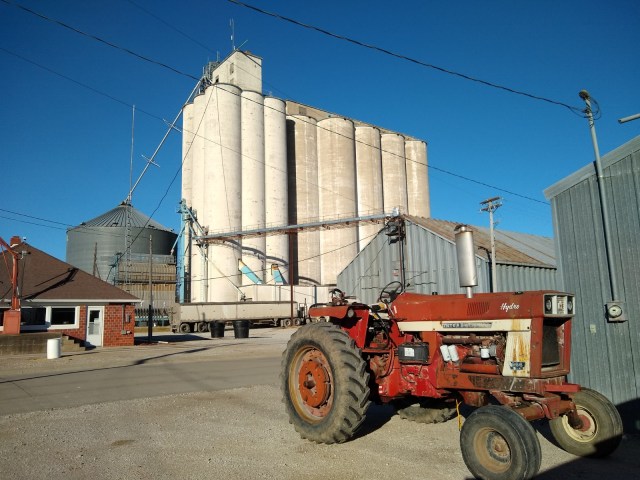

J.B. Ehrsam and Sons Manufacturing Co. provided the hand-operated manlift.

The dump grate was 6 x 5 feet.

With the 10-bushel load-out scale and 8 1/4-inch spout, we can’t guess how long it would take to fill a rail car with corn, but a fascinating document we found suggests that filling a car with wheat would take about 80 minutes.


Farmers Union Cooperative operates a well-preserved Tillotson elevator in Cedar Bluffs, Nebr.

IMG_20200104_095524269

By Ronald Ahrens

Ace scout Rose Ann Fennessy and I visited five Tillotson elevators in Nebraska’s Saunders and Butler Counties on Jan. 4. 

IMG_20200102_163303436The first was at Cedar Bluffs, a village of 600 overlooking the Platte River. The Farmers Union Cooperative Association location was quiet when we arrived around 9.30 a.m., so we invited ourselves to walk the site and take photos.

Cedar Bluffs is a smart-looking operation, as might be expected from “Nebraska’s Oldest Cooperative Since 1888.” The main house, about to celebrate its 70th birthday, and the annex that came along nine years later appear to be in fine shape.

Tillotson Construction Co., of Omaha, completed this 130,675-bushel elevator in 1950–a big year in eastern Nebraska: my grandfather Reginald’s company also built elevators in Bellwood, Aurora, Omaha, and Wahoo.

Nebraska 2020The Cedar Bluffs job is noteworthy for its rectangular headhouse. The company’s graceful signature, the oval headhouse, was still to be perfected.

Other elevators built in this same year–namely, Wahoo and Richland–reflect the movement toward ovalization.

Another unusual circumstance is the lack of a central driveway going through the structure. A note with the entry says, “Truck Dump Grate No Dr’way.”

A history on the co-op’s website shows that “Elevator C, the first concrete elevator” was built in 1950 for $60,000. The co-op, which dates from 1888, had paid $10,000 for a steam-powered elevator and sheds in 1915. In 1934, the 40,000-bushel Elevator A was constructed. Six years later, Elevator B was acquired from Updike Grain Co. for $5,000 but was “disposed of” later.

The co-op lists capacity of Elevator C at 110,000 bushels–a discrepancy when compared to Tillotson records.

IMG_20200104_100517742

Without an integral central driveway, an outside dumping grate serves the elevator, now starting its eighth decade.

Cedar Bluffs was built on an original plan that included four storage tanks of 16 feet in diameter and reaching 120 feet in height.

In 1950, a concrete elevator was a big splurge for a small co-op. Besides no central driveway, Cedar Bluffs did without the luxury of an electrically operated manlift–it was hand-operated.

The 300,000-bushel annex and the grain dryer were added in 1959 for $150,000. It is unknown who did this job; the manhole plates are blank. We do know that Tillotson was pretty much finished with new construction by then.

We hope to learn more. Meantime, this is the first of two posts from Cedar Bluffs. Complete specs will follow.


An old letter reveals some details about the Tillotsons’ early days in wooden elevators

Charles H. Tillotson

By Ronald Ahrens

A letter from my grandmother Margaret Irene McDunn Tillotson reveals some details about the early nomadic life of my grandfather Reginald Oscar Tillotson. As we have documented in this blog, Charles H. Tillotson (seen in the photo above), who was Reginald’s father, built wooden elevators.

When Charles H. died in 1938, Reginald and his brother Joe took the helm of the family’s construction company and learned how to build elevators by slip-forming concrete. That positioned Tillotson Construction Company to advance as the new method served to meet demand for greater storage capacity at rural cooperatives.

My grandmother’s missive of Oct. 6, 1978 gives a few details of those early days.

Charles_Tillotson_Obit__The_Nebraska_State_Journal__Lincoln__Nebr___19_June_1938“When they moved from place to place with the construction company they had many funny places for a home. Your grandfather moved ten times one school term. They built cribbed elevators during those days. This was made by placing a two by four on a two by four to build the walls for the outside and to make the bins. The fields of corn and grain were used by the farmers so they had no great need for storage or grain elevators. So many jobs were to add on to bins or repair them. This made small jobs and many changes in places to live.
“One time they lived in a school house. Many times when it was a small job they lived in the elevator office. During the cold weather they got to live in parts of others’ homes and tried not to have to move. Construction those days was almost nil during the cold weather. They wished many times they were farmers when they had big snow storms.

“After his grade school days they settled in Omaha. Reginald worked in stores. His recreation was sports which I mention (tennis, baseball, football).”

Uniqeness in an early Cargill elevator in northeastern South Dakota

Early Cargill 02

Brad Perry shares another photo of an early Cargill elevator, this one at Athol, S.D.

Athol and yesterday’s Ashton are twin towns in Spink County, a ways south of Aberdeen. Together they must have about 180 people.

We hope those people appreciate the uniqueness of their elevators.

An early Cargill country elevator complex at Ashton, S.D.

Early Cargill 01

Brad Perry shares another photo of an early Cargill elevator, this one at Ashton, S.D. As the Dakota Territory surrendered its prairie to agriculture in the 1880s, grain traders like Cargill expanded north and west. The initial heavy harvests from the rich earth raised demand for storage.


The trading partnership of Bagley & Cargill in South Dakota

Bagley

Our friend, Brad Perry, saw the recent posts about Cargill history and was prompted to send some of his photos.

“The Bagley name still shows up in South Dakota along U.S. 12,” Perry notes. This elevator turns up in an online source that says the location is Andover, just east of Aberdeen.

“George C[olt]. Bagley was a member of a grain-trading family in eastern Wisconsin,” Wayne G. Broehl, Jr. writes in his massive history of Cargill. 

In the early 1880s, Wisconsin farmers were moving out of wheat and into livestock, so Bagley betook himself to South Dakota and partnered with Sylvester Cargill, one of the five Cargill brothers.

Broehl continues:

Most of the Bagley & Cargill operations were in that part of the Dakota territory that later became the northeastern section of South Dakota. Similar to Jim Cargill’s larger-capacity operations in the Red River Valley, the Bagley & Cargill’s 13 structures at the firms 10 locations were more substantial (although only one was classified as an elevator.) This elevator, at Aberdeen, had a capacity of 25,000 bushels; the Andover warehouse had the same; the Groton operation had an 18,000-bushel capacity and the Bath warehouse, 15,000.

An extensive biography of Bagley says the company concentrated on towns along the Chicago, Milwaukee, St. Paul and Pacific Railroad.

The partnership lasted “only a short time.” Bagley’s wife, Cornelia, would later recall, “Ves Cargill [Sylvester] was a partner but George could not put up with his suspicion of all deals and bought him out.”


One of Cargill’s early concrete elevators found in southern Minnestota

Elmore

Our friend, Brad Perry, saw the recent posts about Cargill history and was prompted to send some of his photos.

Here he shows us one of Cargill’s early concrete elevators. It’s located in Elmore, Minn., a tiny town in Faribault County, in the south-central part of the state right on the Iowa line.

As railroads pushed west in the 1870s, Will Cargill expanded his grain storage along the lines through northern Iowa and southern Minnesota.

And as the era of reinforced-concrete elevators unfolded, Cargill’s successors continued building.

We don’t know a thing about this elevator’s dimensions or who might have built it, but how impressive is the wooden elevator on the right? It stands almost shoulder to shoulder with the more modern concrete one. 

American Colossus, the blog, recounts a century of early grain elevators

Screen shot 2018-08-20 at 10.11.43 AM

By Ronald Ahrens

One thing leads to another, and somehow we found ourselves looking at someone else’s blog about grain elevators. “This blog hosts information about American Colossus: The Grain Elevator 1843 to 1943, written by William J. Brown and published by Colossal Books in February 2009,” says the blog’s introduction.

Then Brown generously includes the introduction to the book. Among other things, it mentions the work of Barbara and Bruce Selyem:

Brown writes: “One of the striking things about Barbara and Bruce Selyem’s The Legacy of Country Elevators: A Photo Essay, Kansas History, Spring/Summer 2000, is that it includes so many pictures that show traditional country elevators built out of wood standing next to modern country elevators built of reinforced concrete. The latter are often twice the height of the former and distinctly ‘urban’ in character.”

Screen shot 2018-08-20 at 10.12.47 AM

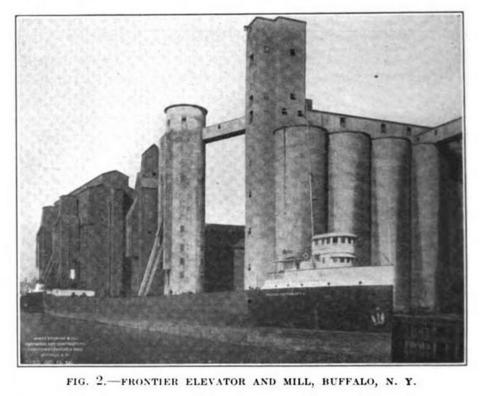
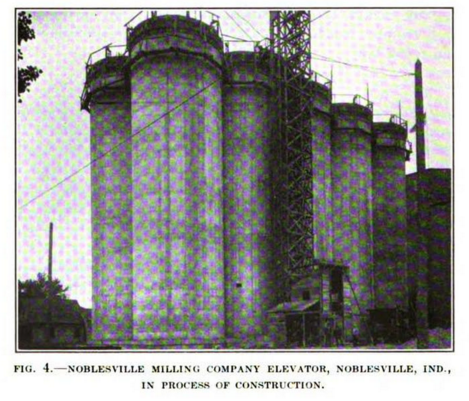
There’s also a citation for “Concrete Elevators,” a 1913 article by Barney I. Weller (from which we took screenshots). The abstract, which is the first paragraph of Weller’s article, says:

“Elevators as a means of housing and handling grain did not make their appearance until the latter part of the last century. The first real elevator of which there is any record is the ‘cribbed’ wood type and there are still a good many of these elevators in existence. This type is interesting when it is considered that at one time an elevator of nearly 4,000,000-bushels capacity was erected complete, and almost totally filled with grain in a period of forty-four days. Of course, lumber was plentiful, no expense was spared and no restrictions were put on the builder. As the price of lumber advanced it became necessary to look for other material; the elevator operator and owner seeking a material which would lower appreciably the very high insurance rate on wood.”

Thanks to Google Books, we find the entire article by using this link.