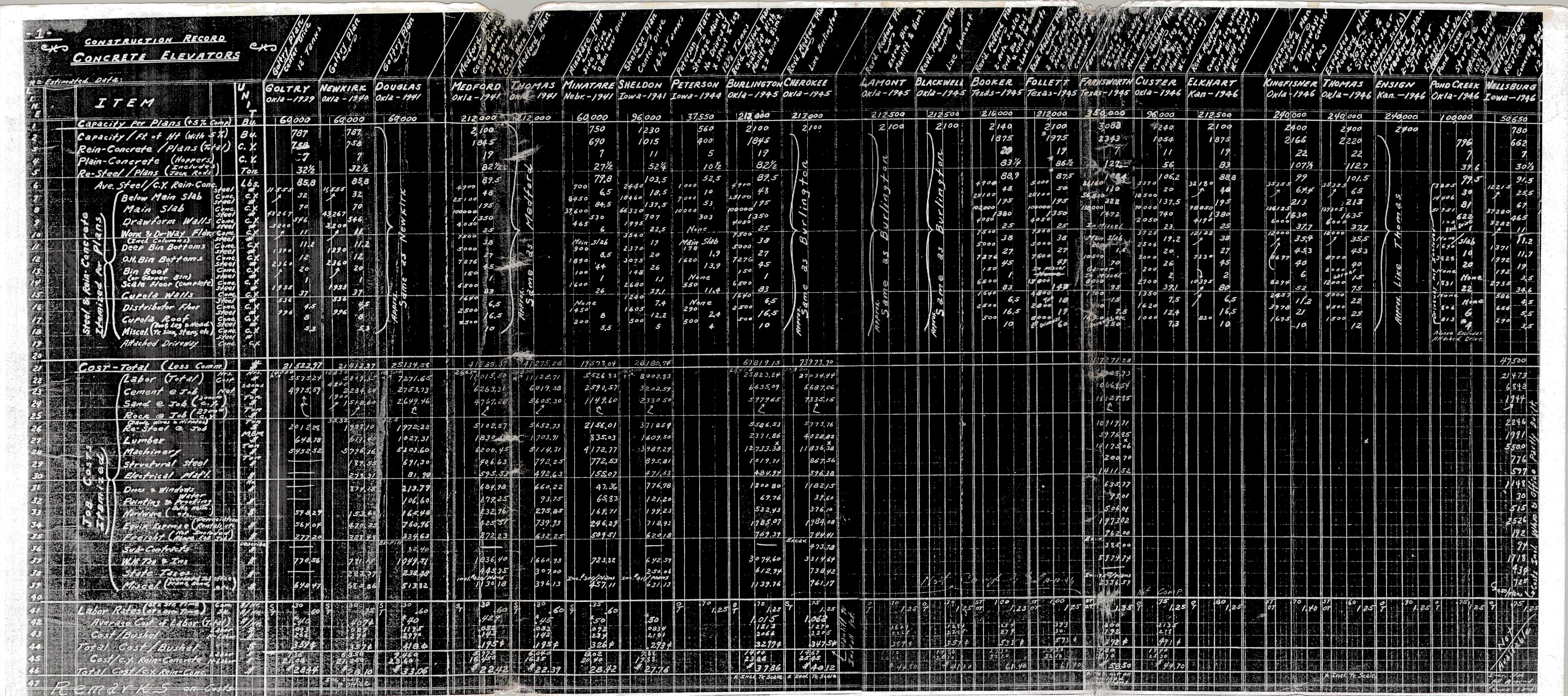
Page 1 of Tillotson Construction record, with specs, Goltry, Okla. to Wellsburg, Iowa

Here at last we present a digitized page of the Tillotson Construction Co. record the late Tim Tillotson duplicated in 2012. Kristen Cart took the whole load of dupes to a copy center, and her effort leads to a batch of pages to be shared over the next few weeks. In that service, we’ve created a new subcategory of the blog for the records’ easy location.

Tillotson Construction Co. was formed in Omaha by Reginald and Joe Tillotson in 1938. Their first concrete elevator, listed on this page, was a 60,000-bushel job in Goltry, Okla. We visited that location in 2018.
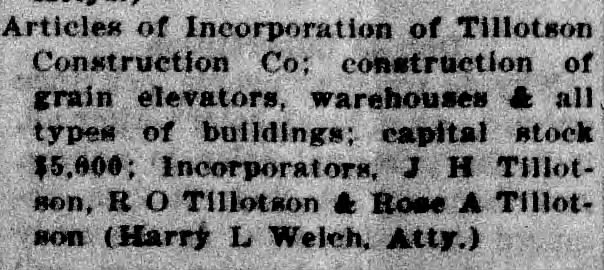
Rose A. Tillotson was widow of Charles H. Tillotson and mother to Joe and Reginald.

The reader will note the company got off to a fast start until 1941 when World War Two intervened. There is a three-year gap until the next job in 1944. The page lists more from then until 1946. The jobs got much bigger–up to 350,000 bushels at Farnsworth, Tex. (Good luck squeezing “Farnsworth” into a narrow column heading!

Besides Goltry, we find details from Newkirk, Okla.; Douglas, Okla.; Medford, Okla.; Thomas, Okla.; Minatare, Nebr.; Sheldon, Iowa; Peterson, Iowa; Burlington, Okla.; Cherokee, Okla.; Lamont, Okla.; Blackwell, Okla.; Booker, Tex.; Follett, Tex.; Farnsworth, Tex.; Custer, Okla.; Elkhart, Kan.; Kingfisher, Okla.; Thomas, Okla. (another job); Ensign, Kan.; Pond Creek, Okla.; and Wellsburg, Iowa.
We visited some of these locations on our 2018 Texas-Oklahoma road trip.

Job sites are written atop the page with the year of construction. Most note which plan the elevator follows and extra information such as location of the driveway or diameters of the tanks. Zooming in splendidly reveals meticulously written entries. Uncle Tim told us the name of the employee who started this record. Maybe it’s in one of our early posts.

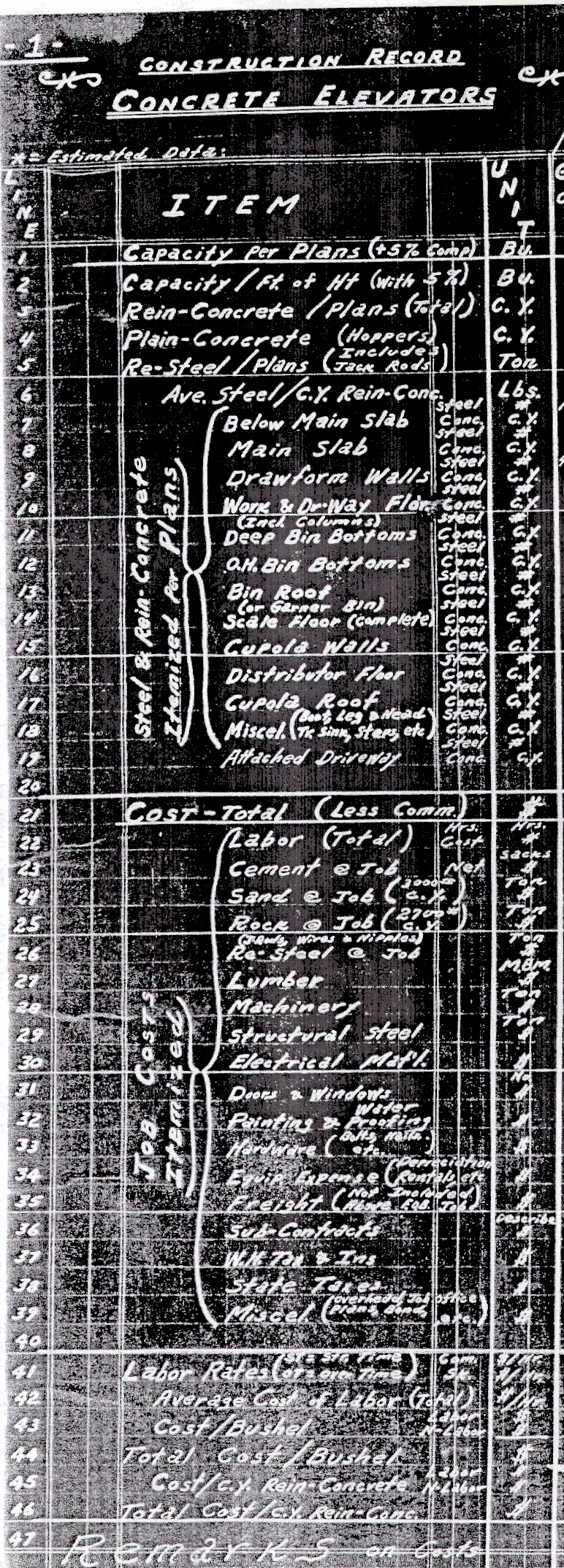
A key to reading this table: The left-hand column headed by “Item” lists various specifications such as gross capacity of the elevator and amount of rebar used per cubic yard of concrete in varying locations throughout the structure.

The middle section is devoted to costs (less commission) for labor and materials and even includes a line for state taxes. Only a few of Tillotson’s subsequent records include costs.

The bottom block has more info about total dollars and labor rates. At the very bottom, the notes are ad-libbed. They elaborate mundane points. One, for example, indicates total cost included a scale and office.

All in all, it’s a direct connection to answers on a great many points of Tillotson elevators.
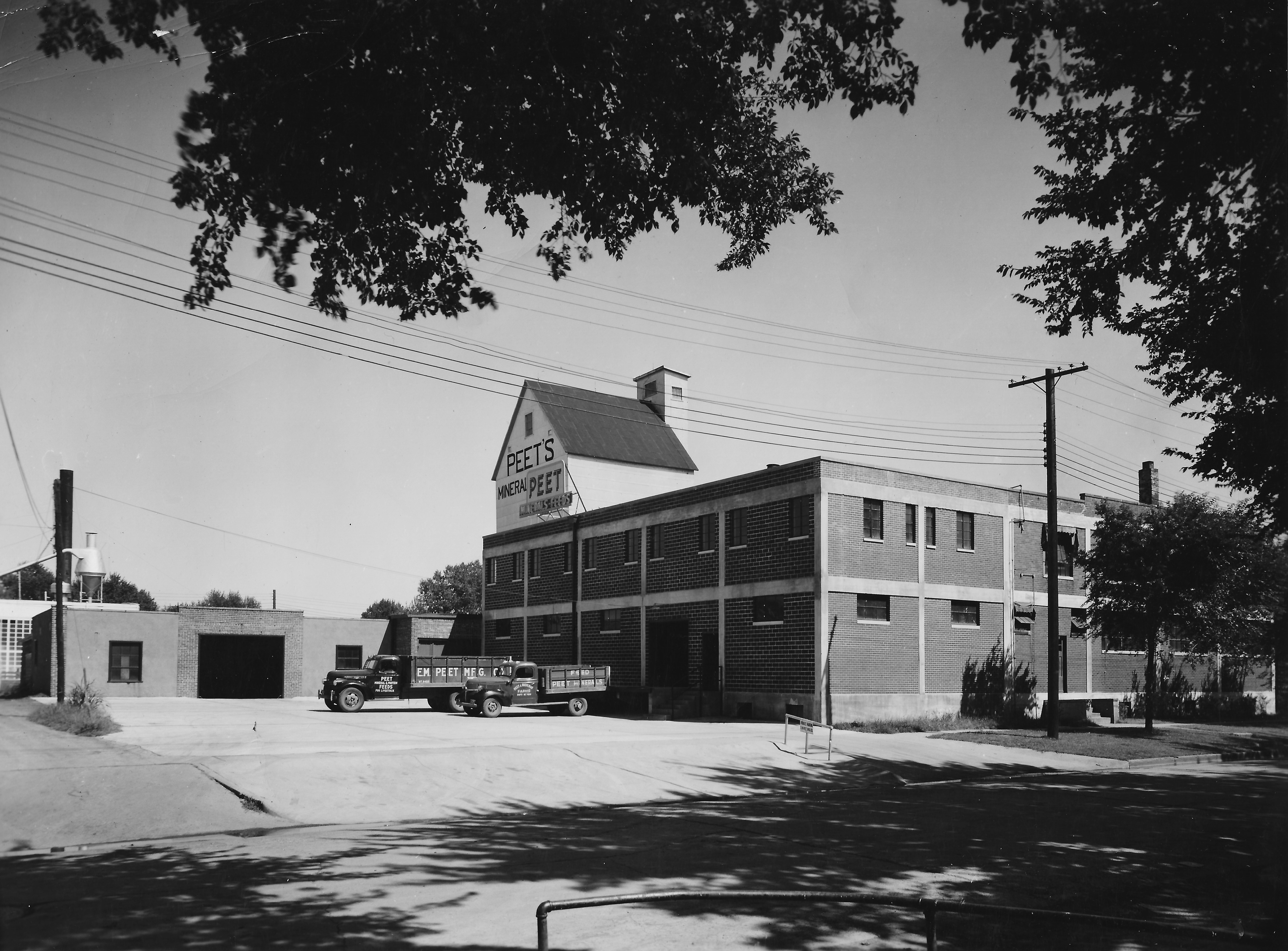
A Tillotson warehouse, 1,000 bells, and a cat round out the legacy of Peet’s Feeds

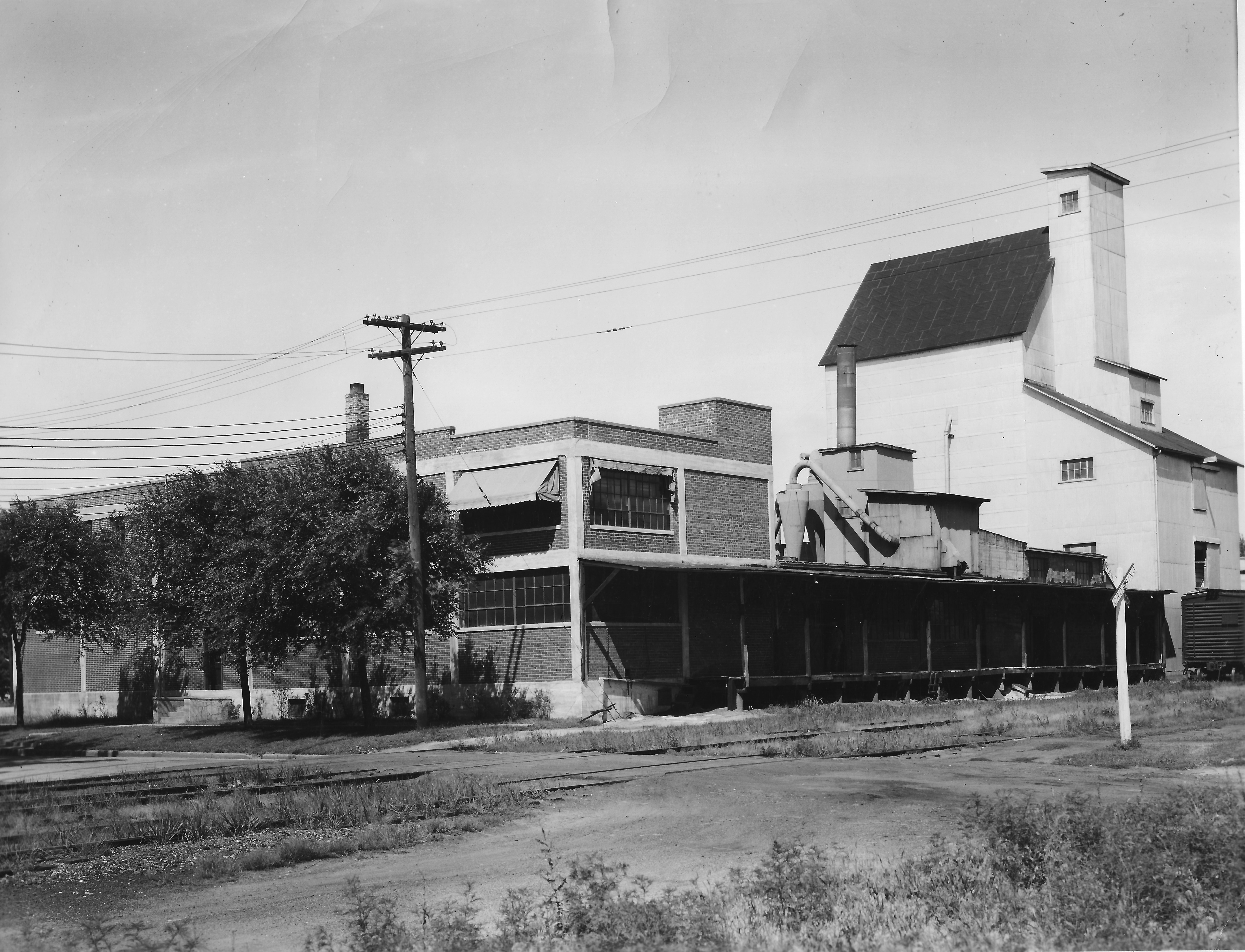
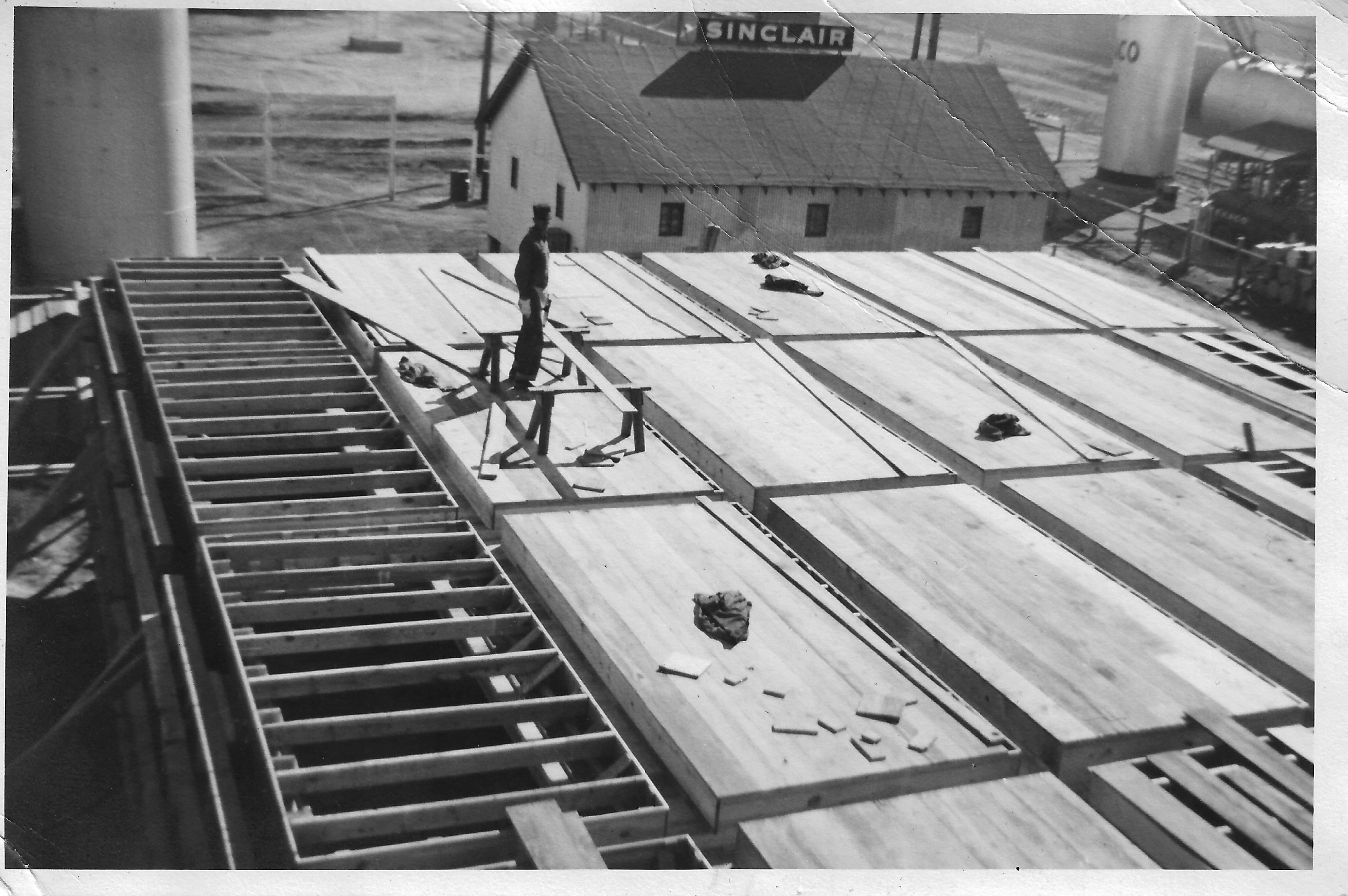
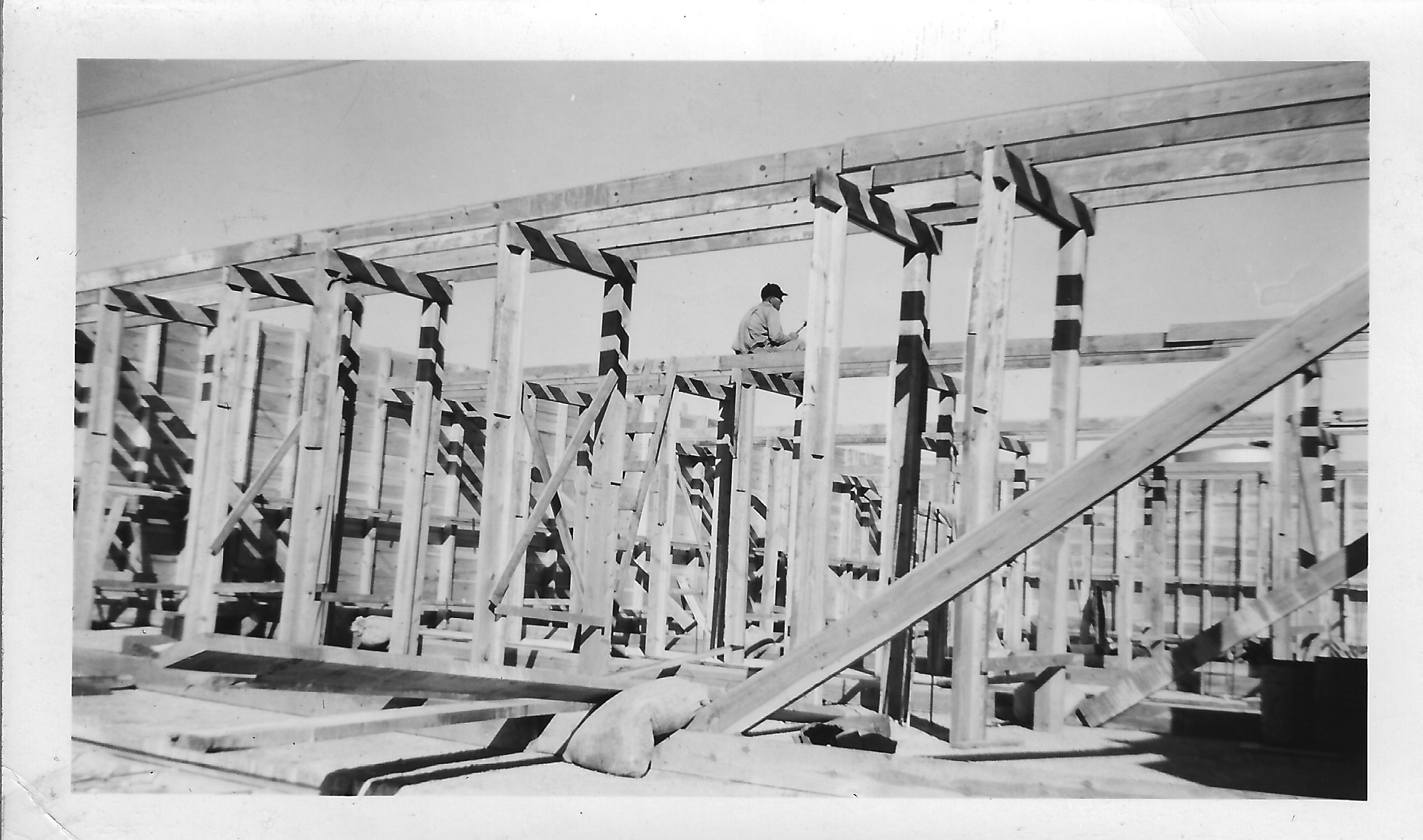
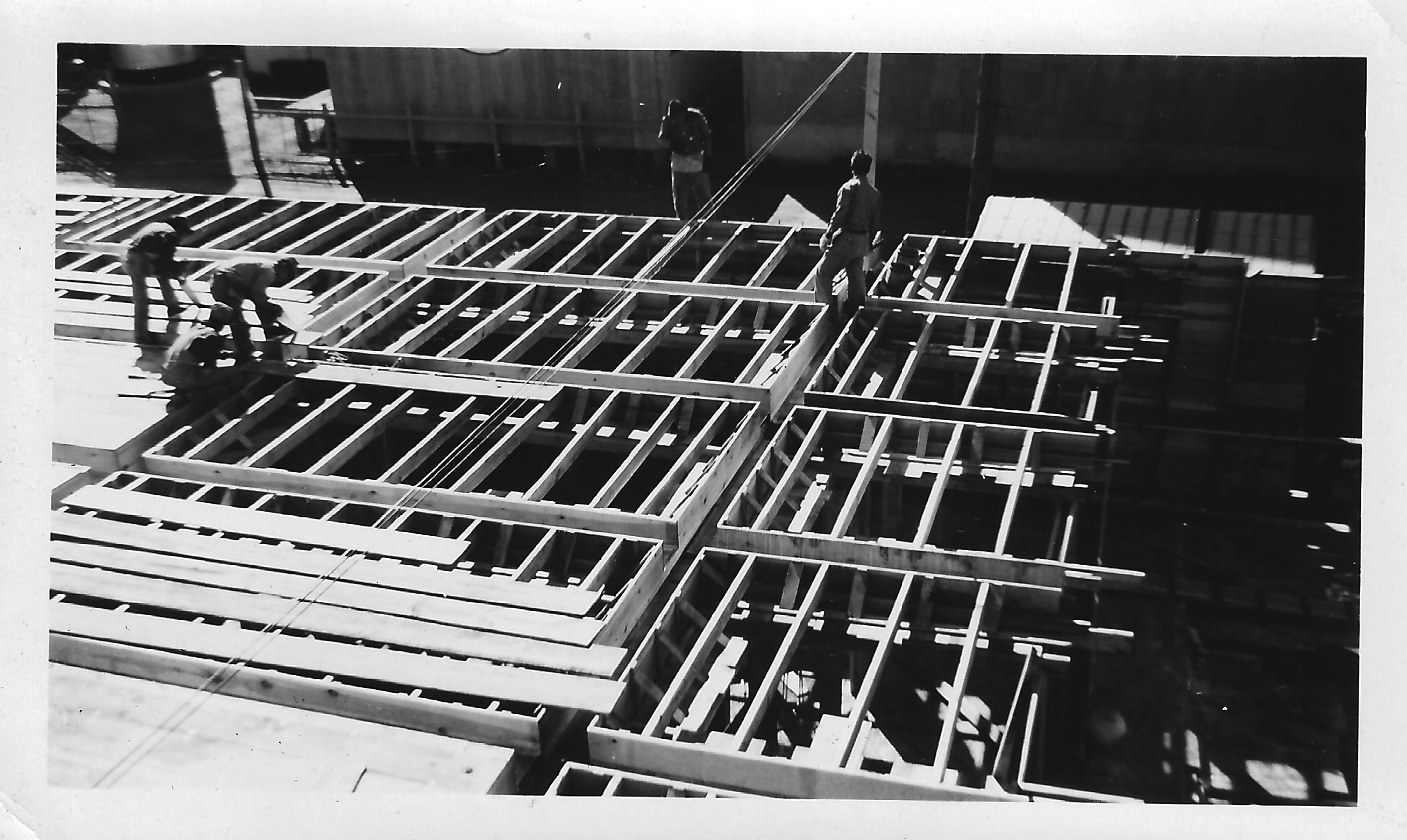
This much is known: Tillotson Construction Co. performed a job for E.M. Peet Manufacturing Co. in Council Bluffs, Iowa. It’s with apparent disinterest, or at best indifference, that the backs of two photos are marked “Warehouse.” No record of the job itself can be located, so we have to guess the date and what exactly was built. A 5,000-square-foot addition was done in 1958 to increase sacking and storage capacity as Peet’s joined the trend of adding bulk-storage bins, six in all. But that small job went to Ranch Construction Co., with Grain Storage and Construction Co. getting the machinery contract. 

The photos suggest Tillotson Construction did a bigger project. We estimate the width of the two-story building at 80 feet. Could 15,000 square feet be too high for the total volume? 

We’re trying to identify the two trucks and their model years, which could be pre-World War Two.

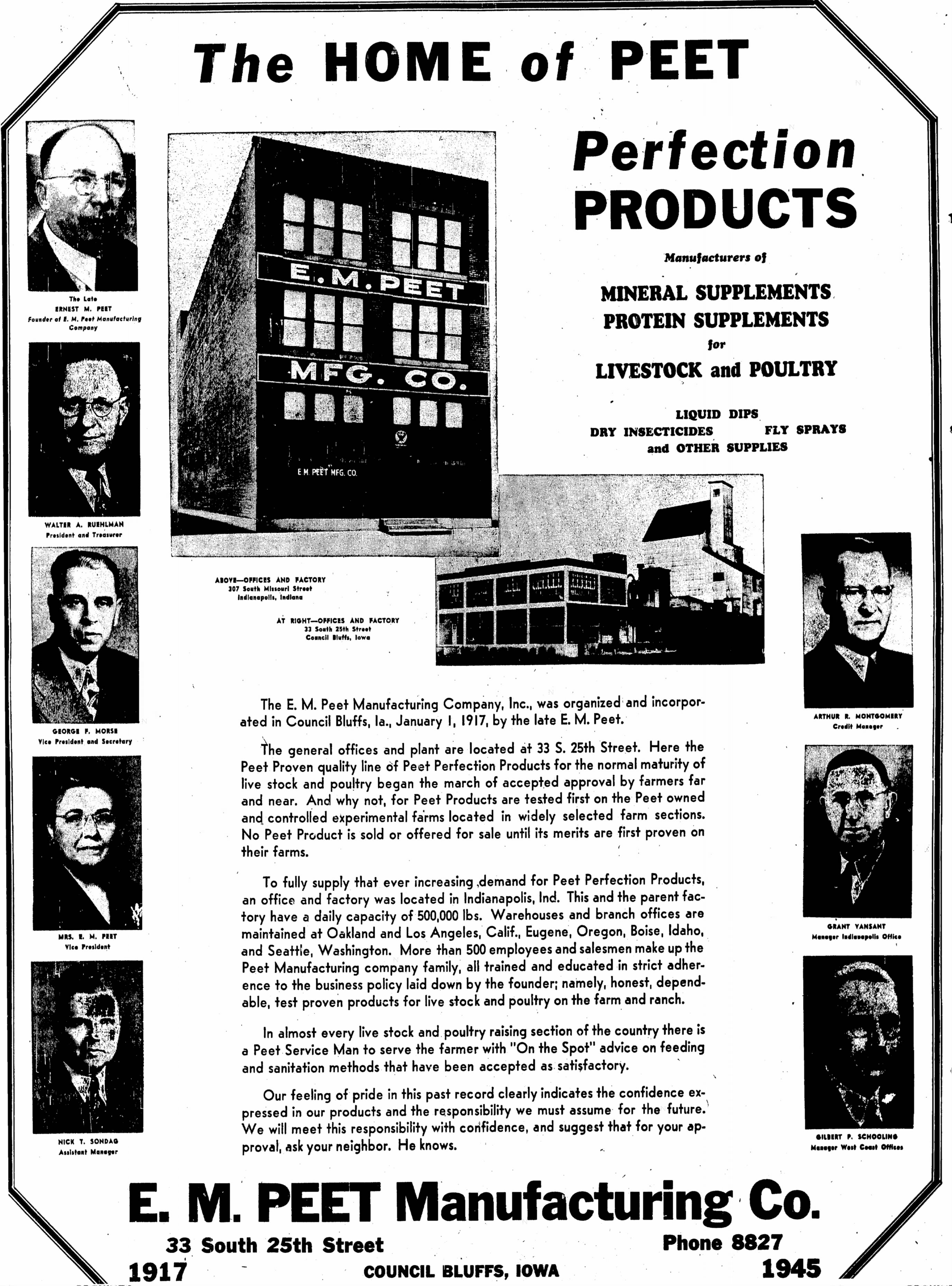
The next best clue for the date of Tillotson’s job is a Peet’s newspaper ad. 

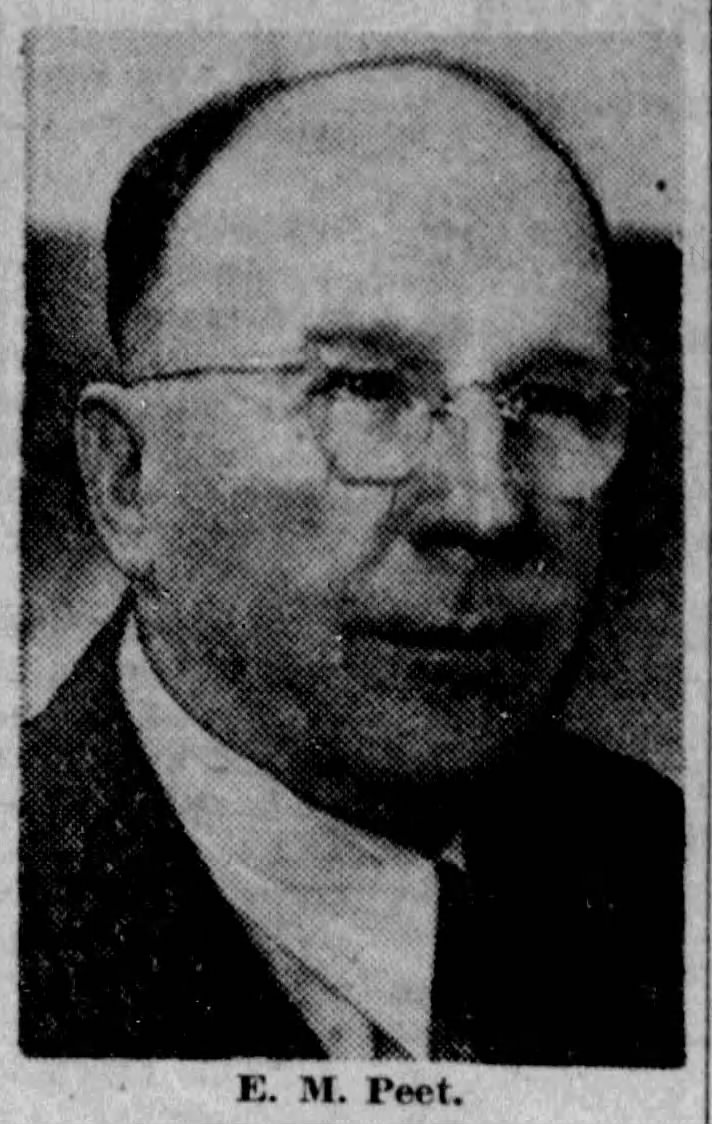
E.M. Peet Manufacturing Co. was founded in 1917 by Ernest M. Peet and W.A. Ruehlman. It was Peet who ran the company as president, making livestock and poultry feeds. Besides their home location at 33 S. 25th St., Peet’s had branches in several states. They also had test farms. 

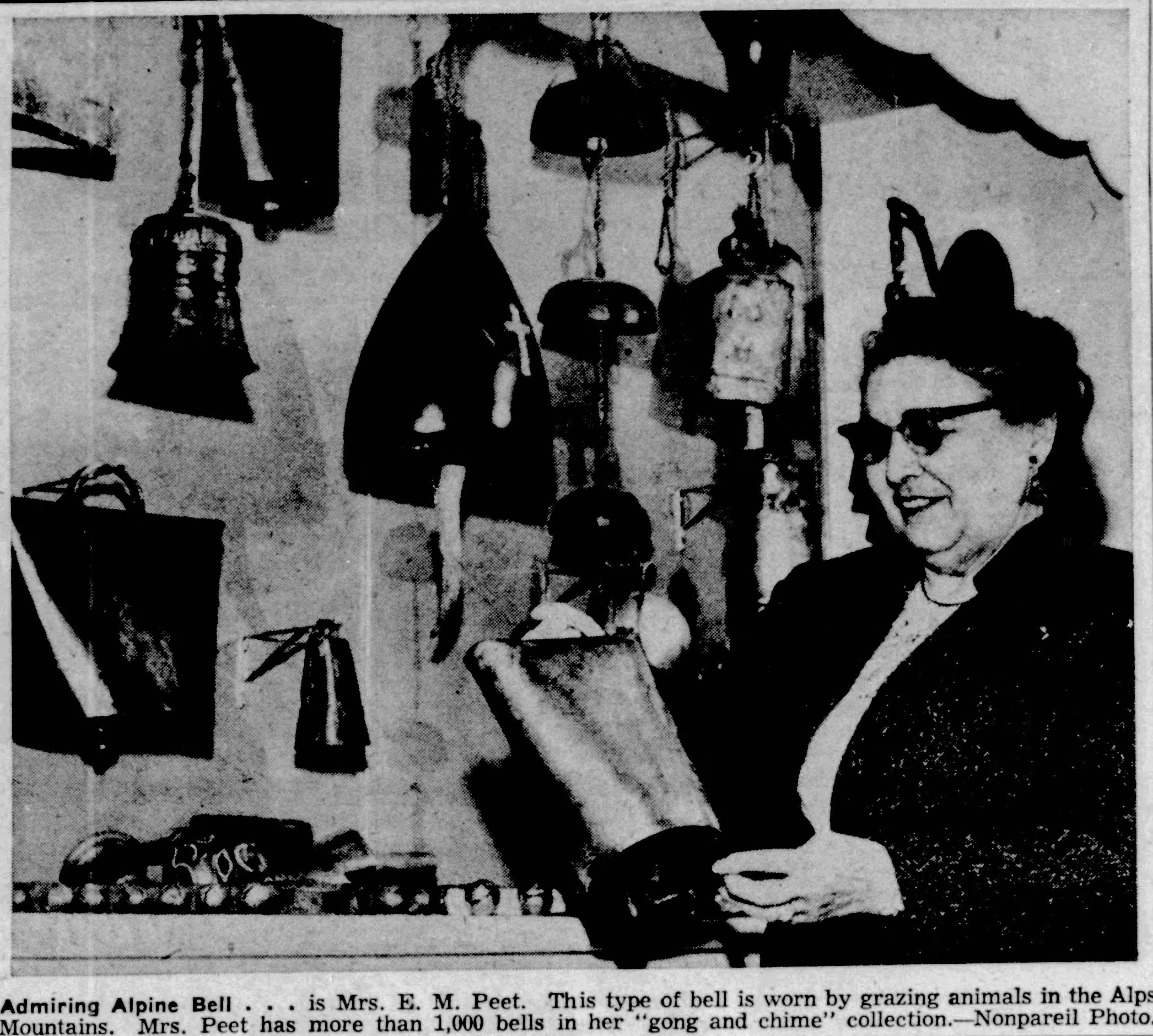
Pete was a Christian Scientist and belonged to fraternal lodges in the Bluffs. He and his wife Ethel lived at 163 Glen Avenue. Their daughter was Mrs. Dorothy Bammann. Ethel proved to be a ding-a-ling. She belonged to the American Bell Association and collected more than 1,000 bells. She used to drag out her suitcase and pack her dress, the one with bells sewn on it, and go to the ABA’s annual conventions in different cities.

“Everybody comes dressed with bell accessories in some manner,” she told the Daily Nonpareil’s “What’s Your Hobby?” column.  

Ernie Peet was 63 years old when he died Dec. 10, 1944—a shock to the community. More than 500 people including 75 of his salesmen attended the funeral, and there were truckloads of flowers. The Daily Nonpareil lamented: 

The death of E.M. Peet has left Council Bluffs without one of its best established and well-known business leaders. His loss will be felt for a long time.” 

The revealing newspaper ad we referred to ran on February 11, 1945.

Until Reginald Tillotson speaks from his own grave, we have no way of pinning down whether the warehouse was done in Peet’s lifetime, but it’s interesting that the archival photo (top of post) matches the photo of Peet’s operation in the ad. All this indicates an early job for Tillotson Construction, one they finished well before Ernie Peet’s death.

Peet’s was big enough that its sales staff would congregate for special presentations on the latest advances. In 1951, for example, a group of 75 convened for three days at the Hotel Chieftain and, among other things, heard a University of Minnesota professor report new measures in animal nutrition such as adding Vitamin B-12, select minerals, and even antibiotics to the feed.

All that was for bovine and porcine types. But an amusing anecdote expands the Peet’s legacy in a feline way. 

In 1955, the warehouse cat, Lily, received publicity from a Daily Nonpareil story, which led to her selection as winner of the national Puss’n Boots Bronze Award. (Puss’n Boots was a brand of pet food.) The citation purred: 

Amusing mascot, loyal friend, doting mother—that’s Lily. Born in a manufacturing plant (now raising her family there), this affectionate feline endeared herself to fellow workers by her fondness for riding on the company tractor. No day is complete for her friends until Lily comes riding by. To loyal, adaptable Lily, a tractor-riding tabby, this tribute. 

Letter offers young Mike Tillotson consolation and guidance after Reginald’s death

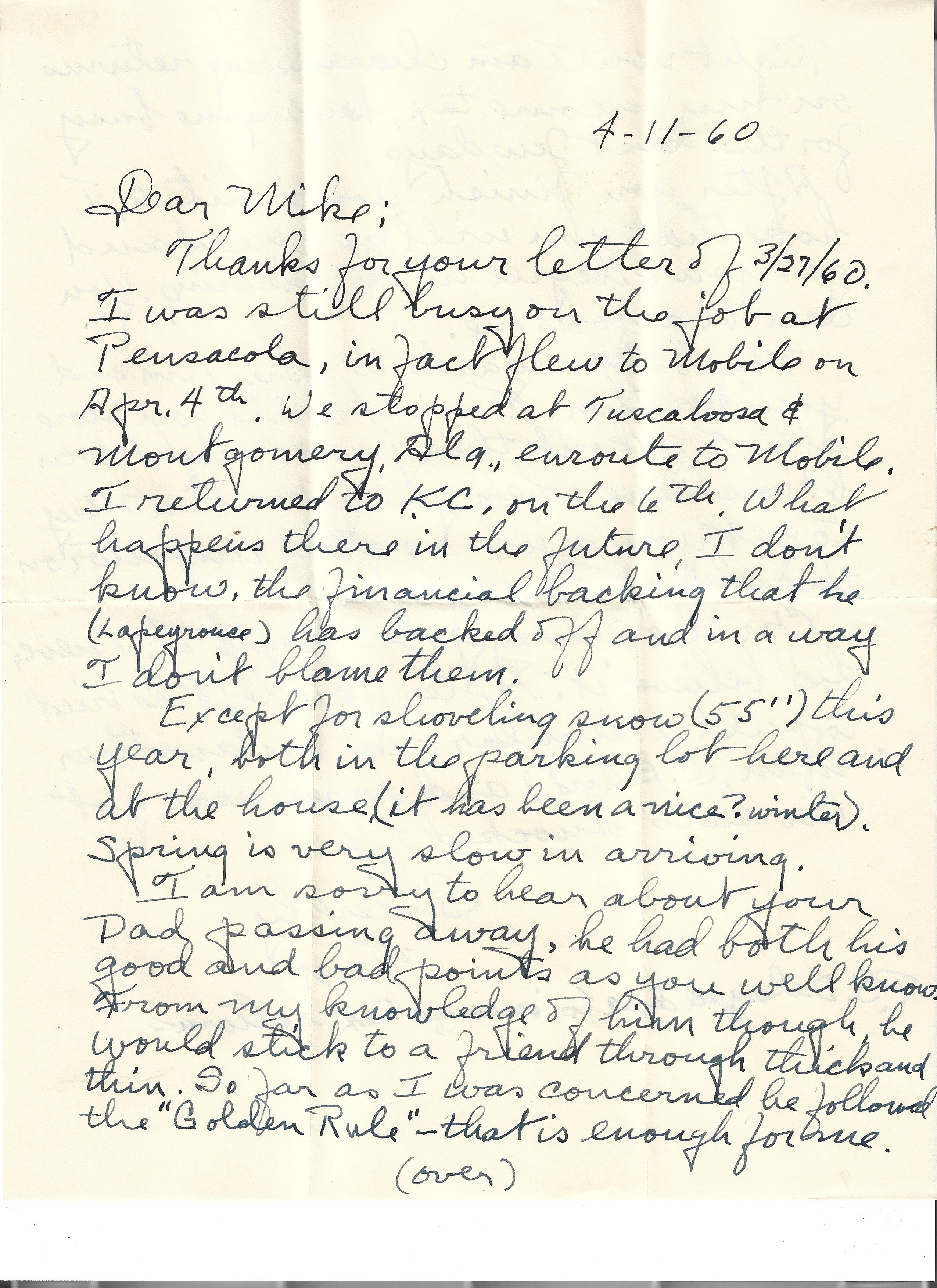
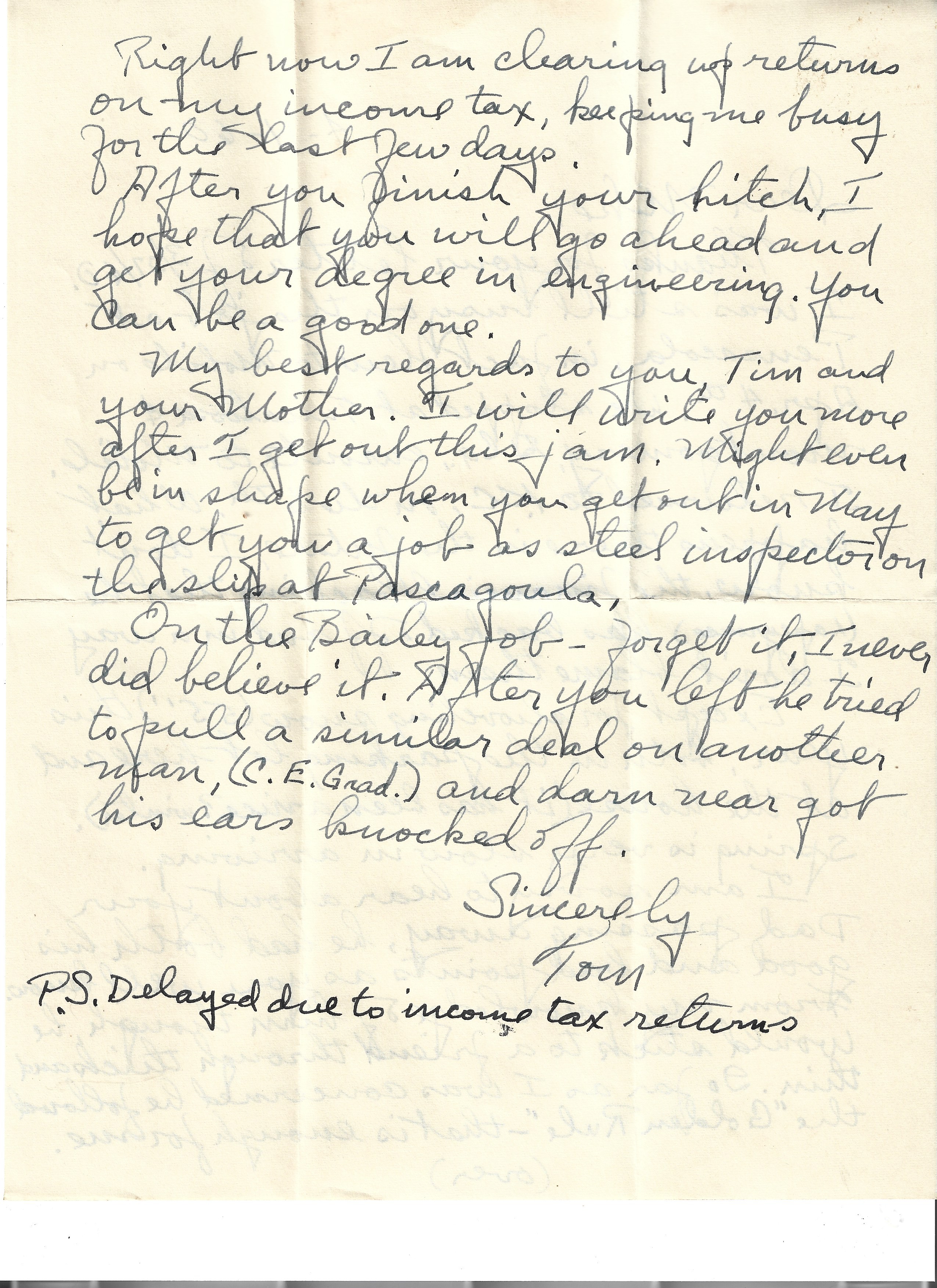
Soon after Reginald Tillotson’s unexpected death early in 1960, his younger sons Tim and Mike helped their Aunt Mary Tillotson to wind down the business of Tillotson Construction Co. Mike was 20 years old and serving in the army. We don’t know who the writer was other than to assume he was probably a former employee and is the same referred to in a recent post.

Here again, guidance is offered in regard to Mike’s future.

Dear Mike;

Thanks for your letter of 3/27/60. I was still busy on the job at Pensacola, in fact flew to Mobile on Apr. 4th. We stopped at Tuscaloosa and Montgomery, Ala., enroute to Mobile. I returned to KC on the 6th. What happens there in the future, I don’t know, the financial backing that he (Lapeyrouse) has backed off and in a way I don’t blame them.

Except for shoveling snow (55″) this year, both in the parking lot here and at the house (it has been a nice? winter). Spring is very slow in arriving.

I am sorry to hear about your Dad passing away, he had both his good and bad points as you well know. From my knowledge of him though he would stick to a friend through thick and thin. So far as I was concerned he followed the “Golden Rule”–that is enough for me.

Right now I am clearing up returns on my income tax, keeping me busy for the last few days.

After you finish your hitch, I hope that you will go ahead and get your degree in engineering. You can be a good one.

My best regards to you, Tim and your Mother. I will write you more after I get out of this jam. Might even be in shape when you get out in May to get you a job as steel inspector on the ship at Pascagoula.

On the Bailey job–forget it, I never did believe it. After you left he tried to pull a similar deal on another man (C.E. Grad.) and darn near got his ears knocked off.

Sincerely, Tom

P.S. Delayed due to income tax returns

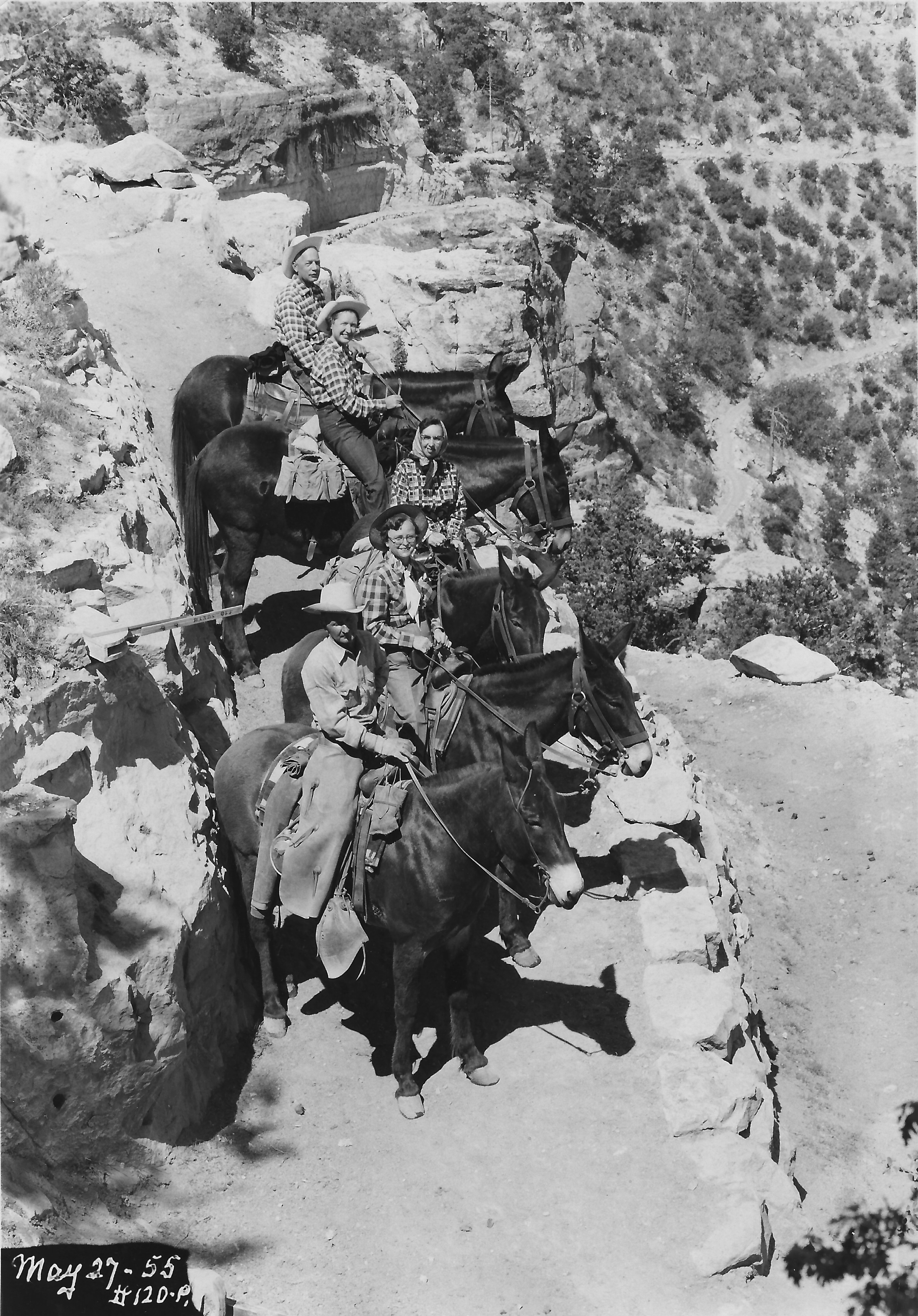
Away from the office, Reginald and Mary Tillotson rode horseback amid the piñons

Laying off from work in their Omaha office, Reginald Tillotson and his sister Mary Tillotson knew how to play, too. Here we see them on horseback, going down a cliffside with three others who cannot be identified. Reginald wore the white hat and ample chaps, Mary flourished the white tie. It was an adventure that Reginald’s wife Margaret would never have attempted. The Tillotsons owned a New Mexico ranch, so we guess this trail’s location is nearby. We’re also guessing the ponies knew just where to stop for the photo, and that’s not only because of the way they’re lined up. Note the marker that’s jabbing into the center of the picture. Lettering stenciled on the arm says “HANDS OFF.” We welcome guesses about it.

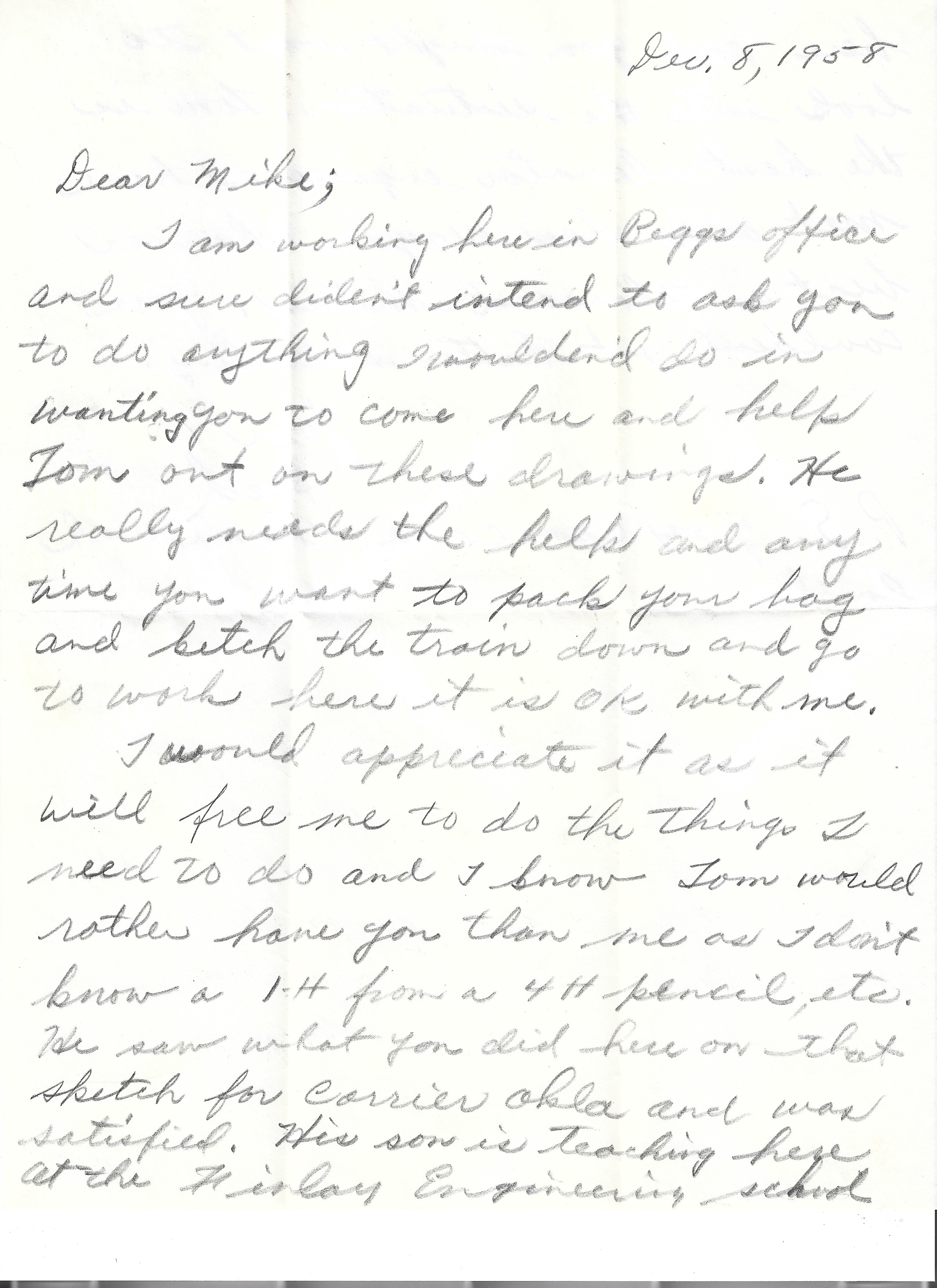
In 1958 letter, Reginald Tillotson seeks son Mike’s pencil prowess on new project

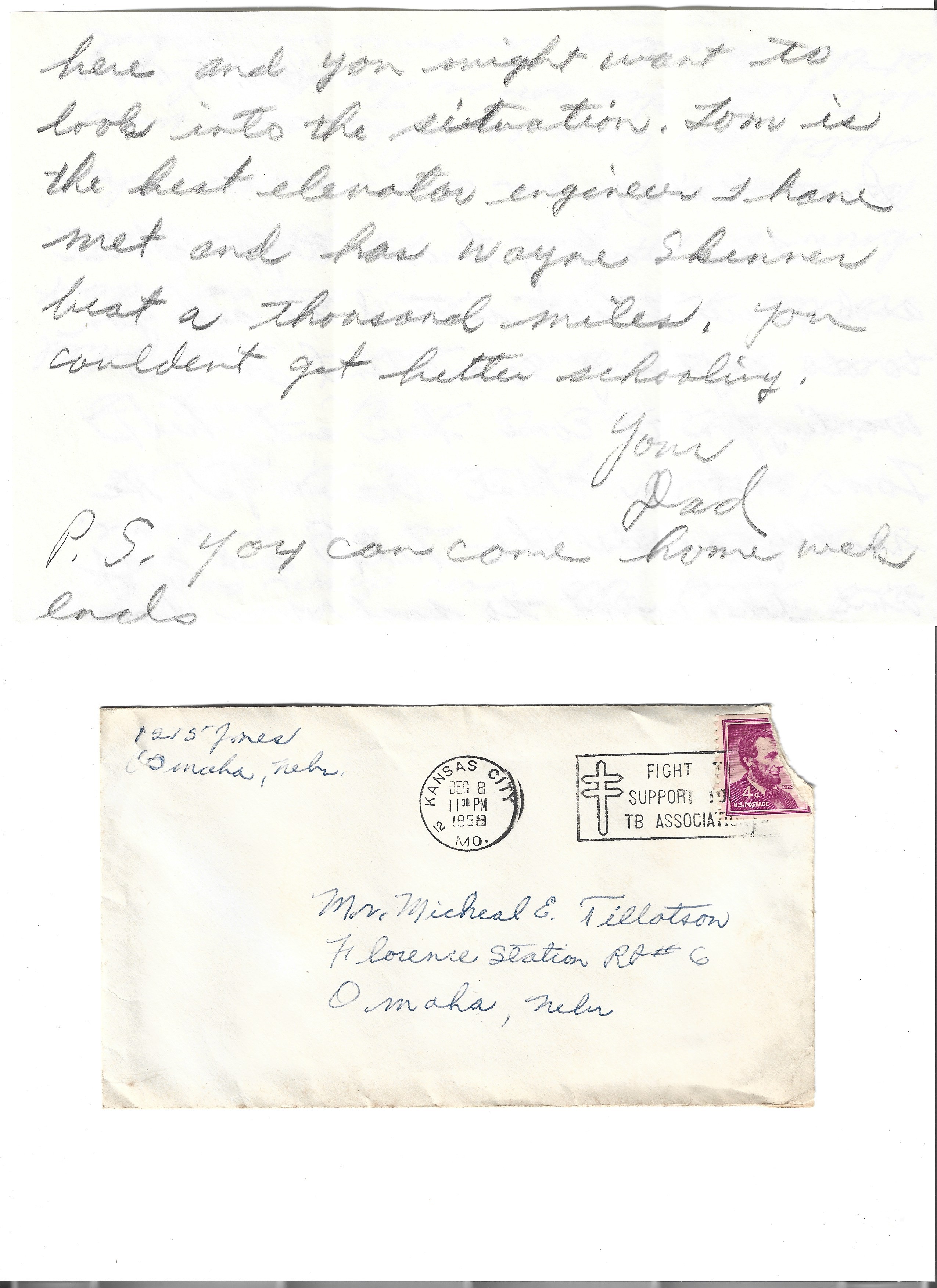
In December of 1958, Reginald Tillotson, president of Tillotson Construction Co., was working on a project in Kansas City, Mo. and was apparently a guest in the office of another company when he invited his youngest son, Michael, to make the 185-mile journey from Omaha and join the team.

Besides the purpose he expressed, it’s interesting to note the intentional jokey misspellings in a midcentury-comix style of writing, namely, “wouldend” for “wouldn’t” and “ketch” for “catch.”

Dear Mike;

I am working here in Beggs office and sure didn’t intend to ask you to do anything I wouldend do in wanting you to come here and help Tom out on these drawings. He really needs the help and any time you want to pack your bag and ketch the train down and go to work here it is OK with me.

I would appreciate it as it will free me to do the things I need to do and I know Tom would rather have you than me as I don’t know a 1-H from a 4-H pencil, etc. He saw what you did here on that sketch for Carrier, Okla. and was satisfied. His son is teaching here at the Finlay Engineering school here and you might want to look into the situation. Tom is the best elevator engineer I have met and has Wayne Skinner beat a thousand miles. You wouldn’t get better schooling.

Your Dad

P.S. You can come home week ends.

The “Beggs office” that Reginald refers to was probably Beggs Engineering, and more is to be learned about that concern and its relationship to Tillotson Construction Co. For now, though, the major takeaway is Reginald’s genial paternal tone and his droll way of praising and encouraging his son.

About five months before this letter, Mike was a passenger in a bad car accident with my father driving, my mother and I in the backseat, all of us flying out of a tiny little convertible, a Nash Metropolitan, in the night on a country road.

According to my mother Mary Catherine, who was Mike’s older sister, he suffered a fractured shoulder and, in consequence, lost his wrestling scholarship at University of Nebraska. From fragmented sources, we piece together the rest of his story. In 1959 and 1960, Mike served in the army. He then returned to Lincoln and attained a bachelor’s degree in education. No career as a schoolteacher or coach followed. Nor a career at Tillotson Construction Co.–it went out of business after Reginald’s death in 1960.

Mike had learned his carpentry skills building formwork for elevators, and it led to his long career as a carpenter.

Rich lode of archival material means Our Grandfathers’ Grain Elevators will grow

By Ronald Ahrens

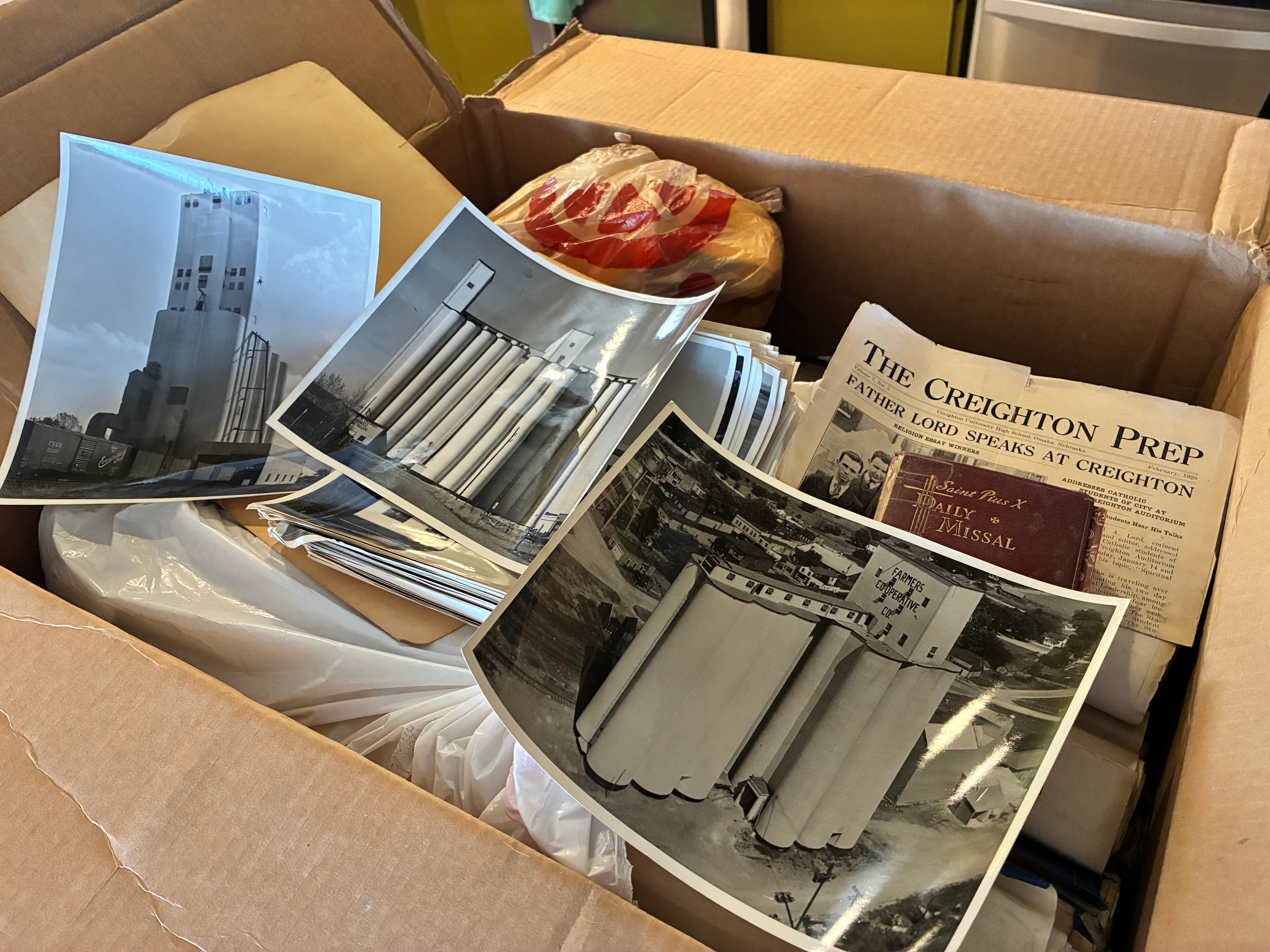
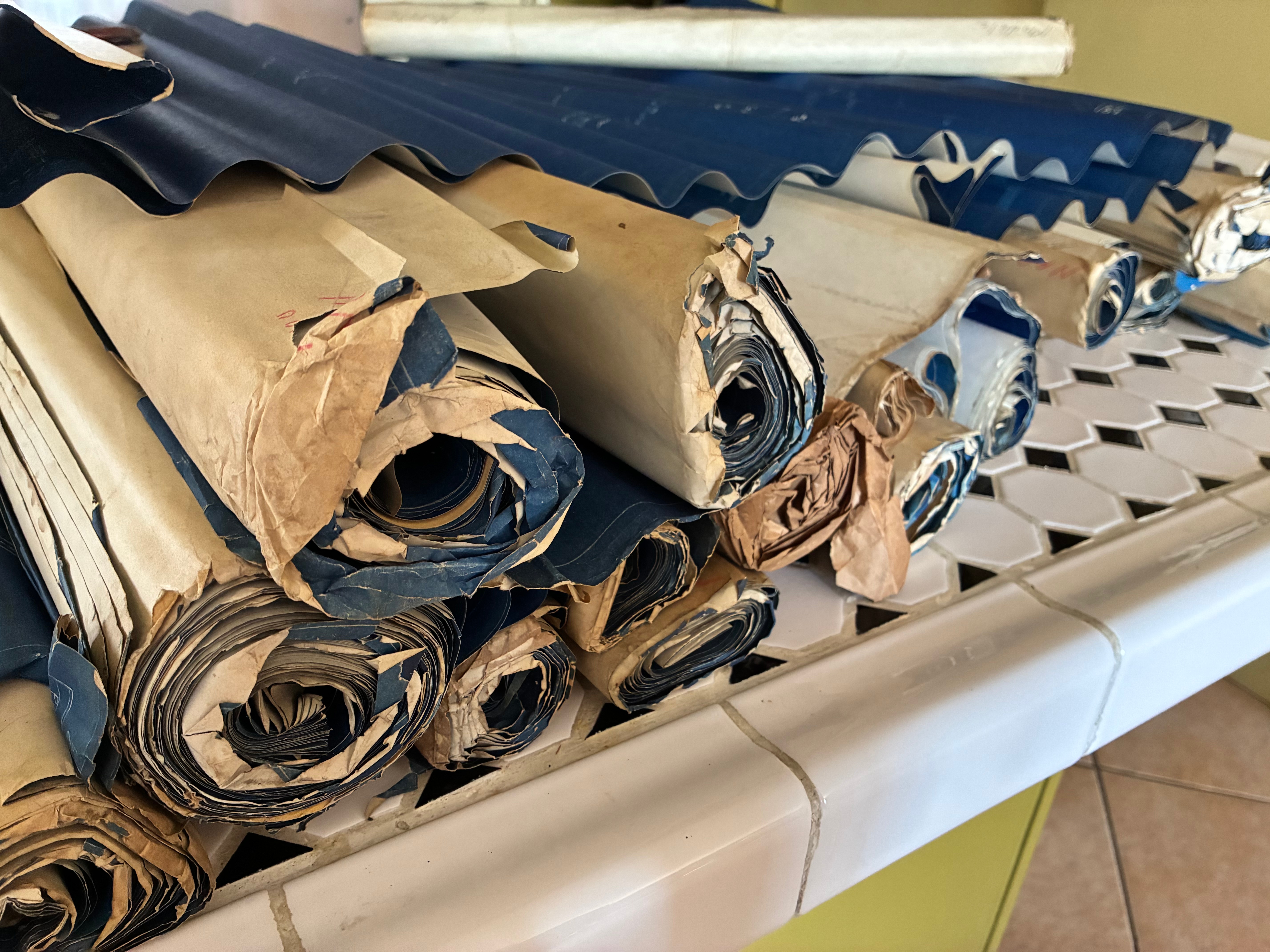
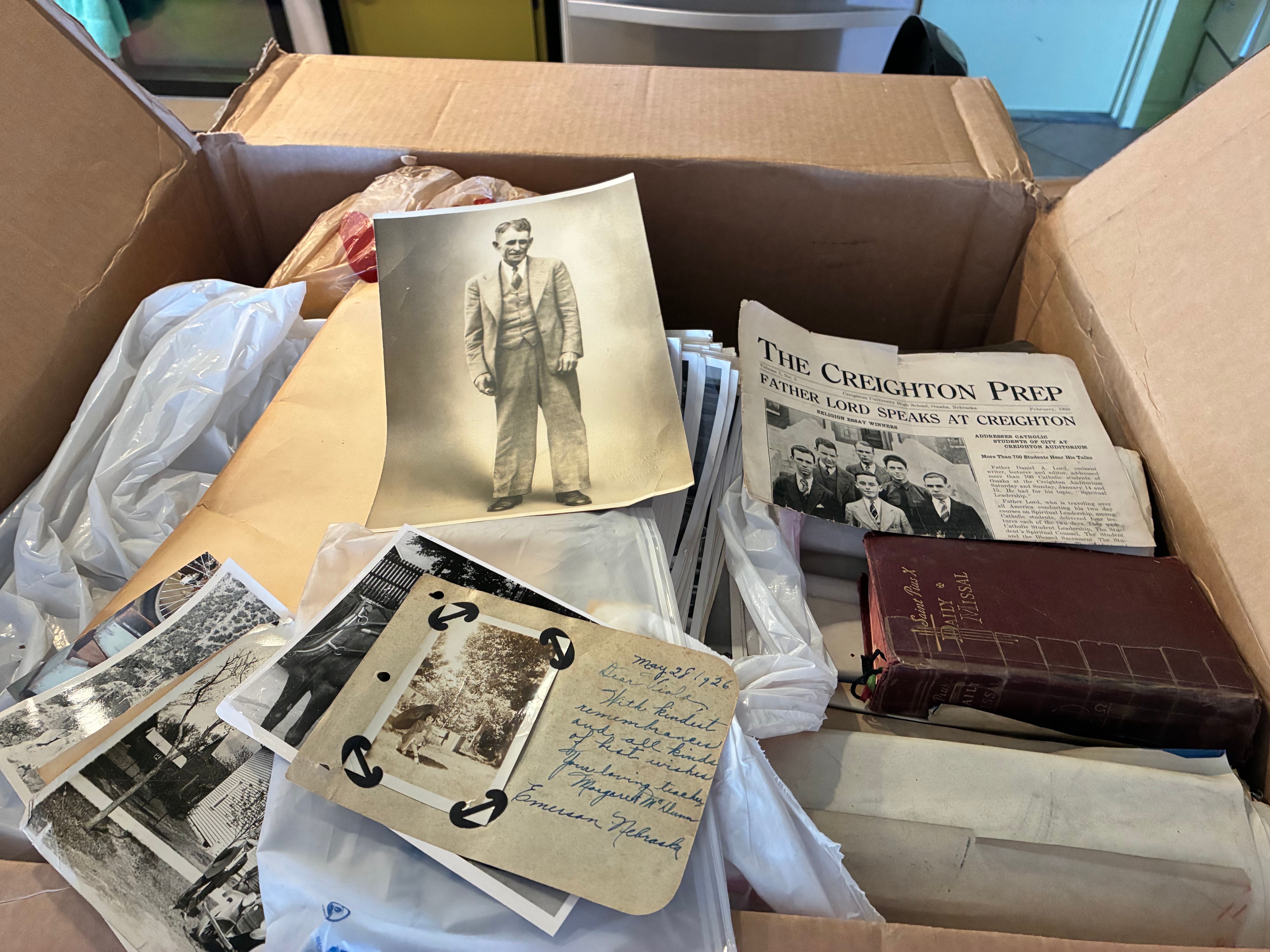
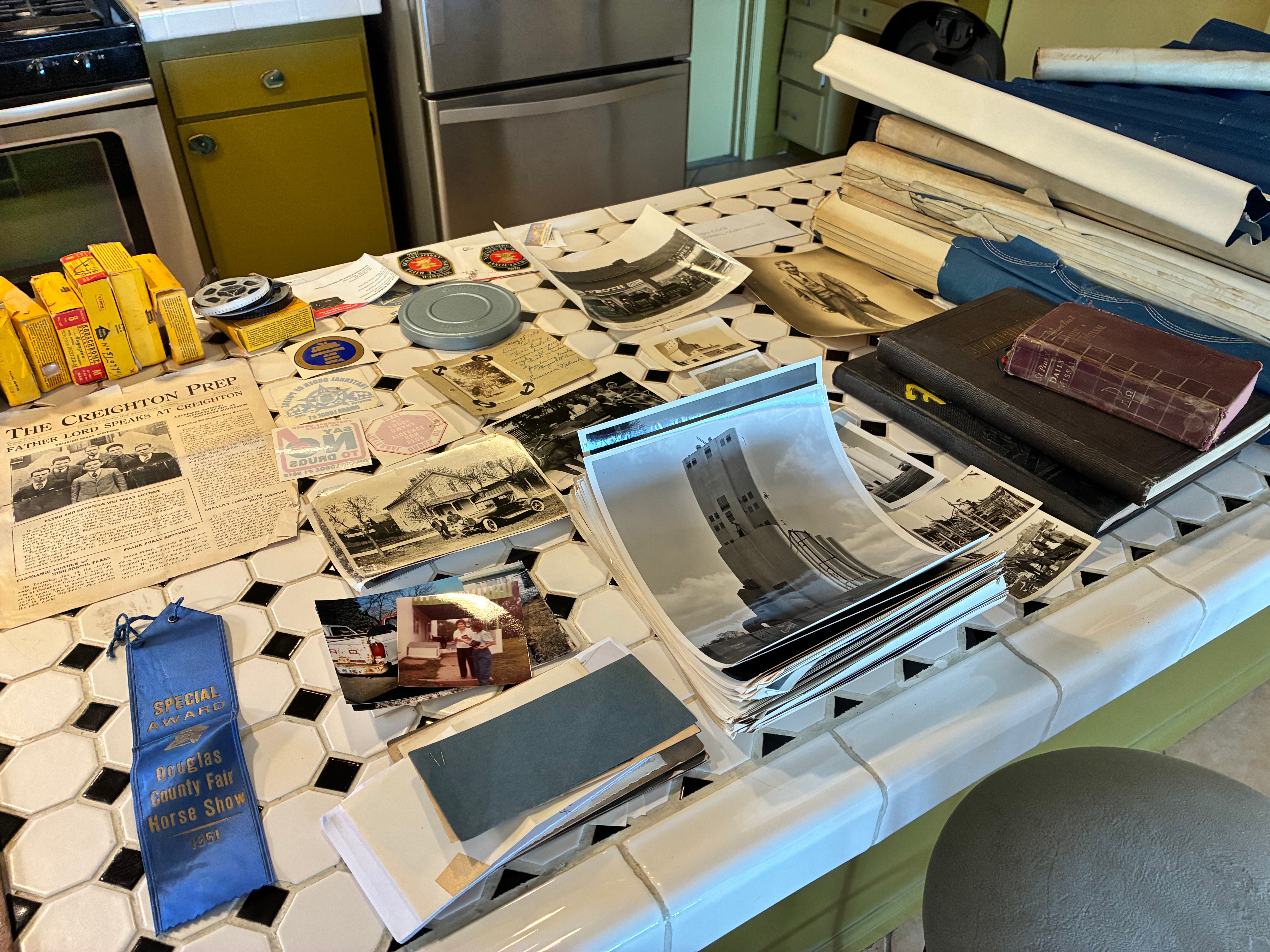
Our Grandfathers’ Grain Elevators is thrilled to report wonderful news. A benefactor has sent us 36 pounds of records salvaged from the Tillotson homestead north of Omaha. The carton includes five-dozen 8×10 black-and-white photos, most of them nice aerial shots, and many from locations that are new to us. Really? We built a warehouse for Peet’s Feeds in Council Bluffs? Along with all this, there are dozens of rolls of blueprints. It’s enough to keep us at the grindstone for a long time. 

As our more than 300 subscribers know, the Tillotson brothers—Reginald and Joe—founded Tillotson Construction Co. after the 1938 death of their father, Charles H. Tillotson. Reginald and Charles H. had spent years building wooden elevators for Van Ness Construction Co., but upon the death of Charles H., the sons launched their new company. They intended to use reinforced concrete and put up larger elevators.

Reginald and Joe split up in the late-1940s. Joe moved from Omaha to Denver and set up his own operation, but he died in a car accident not long afterwards. Tillotson Construction Co. flourished through the 1950s, building elevators from North Dakota to South Carolina. It also spawned offshoots such as Mayer-Osborn Construction Co., in which Kristen’s grandfather, William Osborn, was a partner. 

Kristen Cart and I launched Our Grandfathers’ Grain Elevators in November of 2011. When our careers would permit, we blogged away and have created more than 500 posts. This has resulted in a small but steady audience. The last three weeks have brought 1,005 pages views, which we think is pretty good. They come from all over the world. We weren’t posting very often in the last few years because we ran out of material. For us, it’s either site visits or archival records that lead to posts. Site visits are tough because I live near Palm Springs–not a single elevator!–and Kristen might not want me to say where but there are cowboys and elk and petroleum.

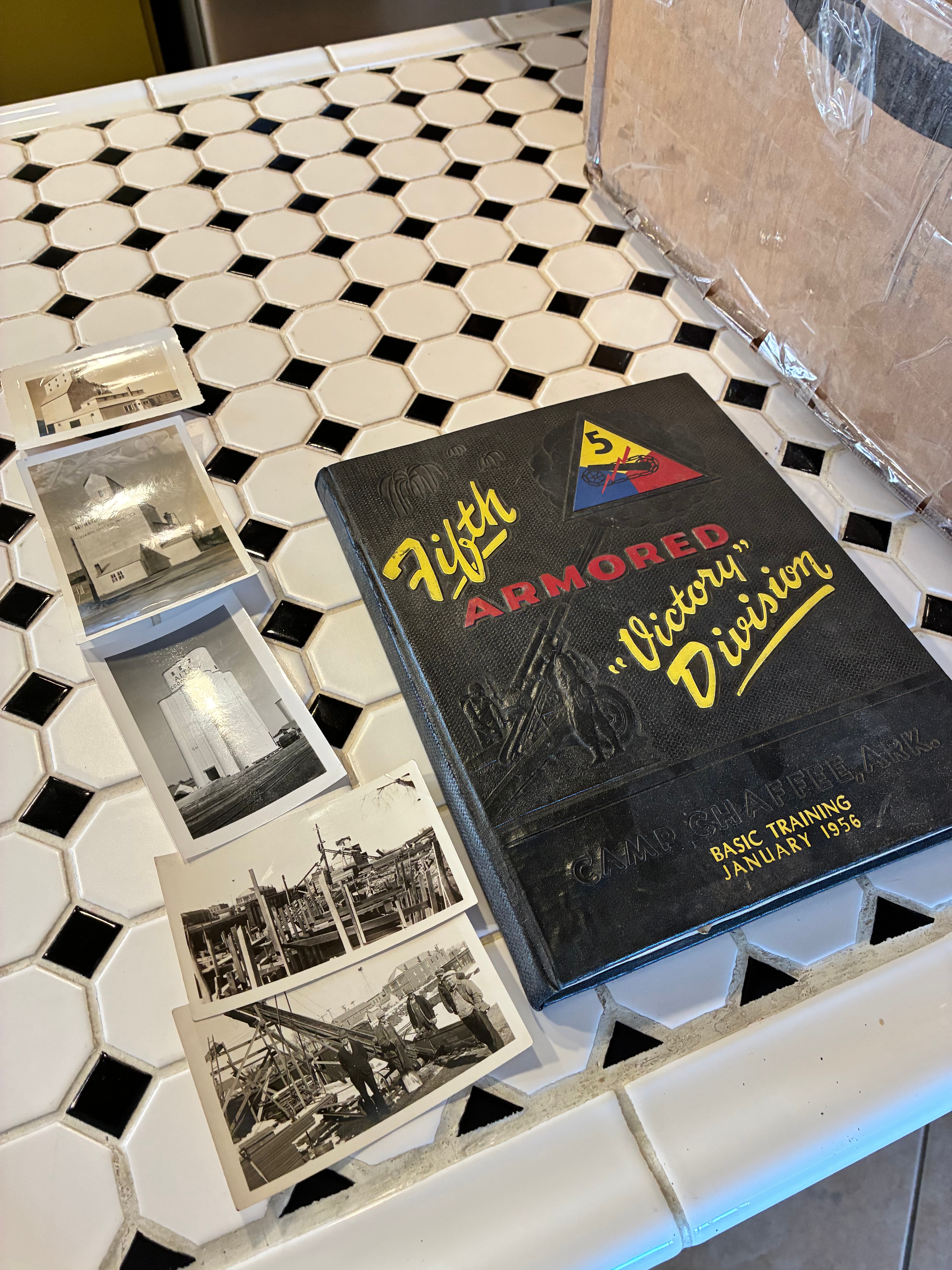
Things have changed as my Uncle Mike no longer lives in the Tillotson home, which Reginald built of reinforced concrete in 1952. Sorry to say, the home had become what authorities described as a “hoarder’s nightmare.” Pleased to say, the folks who purchased it in 2025 were diligent about salvaging the good stuff. Their shipment also includes my grandmother Margaret McDunn Tillotson’s copy of the Wayne Spizzerinktum yearbook from her Wayne State College Class of 1925. There is a St. Pius X Daily Missal, which is a puzzle because the Tillotsons went to St. Philip Neri; it was my family that went to St. Pius X but I don’t know anything about that book. And here’s Uncle Tim’s Fifth Armored “Victory” Division basic training almanac from his army service in Camp Chaffee, Ark. Inside it, inexplicably, I found a snapshot print of three nuns wearing all-white, and there’s a five-story parking garage in the background.

I called up the librarian at Wayne State, who says he’ll take the yearbook. The army almanac is another question. It has an elaborate, stamped leather cover but the volume sustained water damage. The missal is falling apart. Maybe I will return it to St. Pius X and hope it makes up for my poor performance as a student. 

All this is a roundabout way of saying Our Grandfathers’ Grain Elevators is about to experience a growth spurt, although we’ll see if it’s akin to the growth spurt from wooden elevators that held 20,000 bushels to concrete ones that held 120,000 bushels. Timing is great because our careers are not the hindrance they used to be, so we will be able to work on new posts.

It’s great to have all this source material, but things are pretty lopsided in favor of Tillotson Construcdtion Co. We would love to get our hands on an equivalent archive from Mayer-Osborn and from J.H. Tillotson, Contractor. 

We invite first-time and casual readers to join with our subscribers and receive email notifications of new posts. All should watch this space for a renewed effort in telling the grain elevator story at the most basic level. It’s turned out a richer topic than we ever figured, and now comes this opportunity to groove on it and grow the blog. 

Farmers Union decides to demolish and rebuild in 1934 at Cedar Bluffs, Nebr.

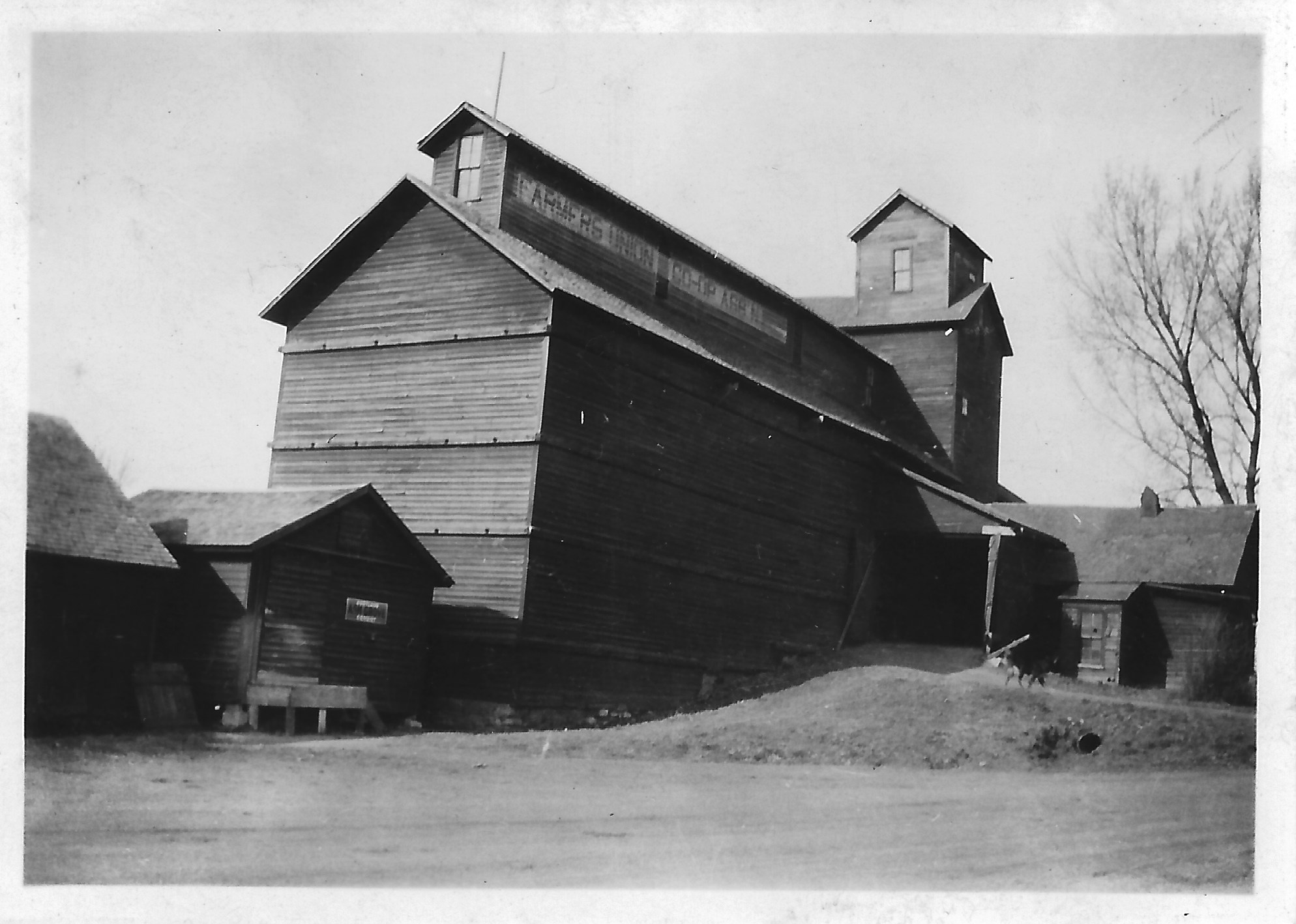
It was January of 1934, still the depths of the Great Depression, but optimism led the stockholders of Farmers Union Co-Operative Association, of Cedar Bluffs, Nebr., to decide the time had come to tear down and replace their old elevator. 

Organized in 1888, Farmers Union claimed to be “the oldest cooperative elevator in the United States,” according to the New Cedar Bluffs Standard weekly newspaper. There were 200 stockholders with capital stock in the total of $50,000. 

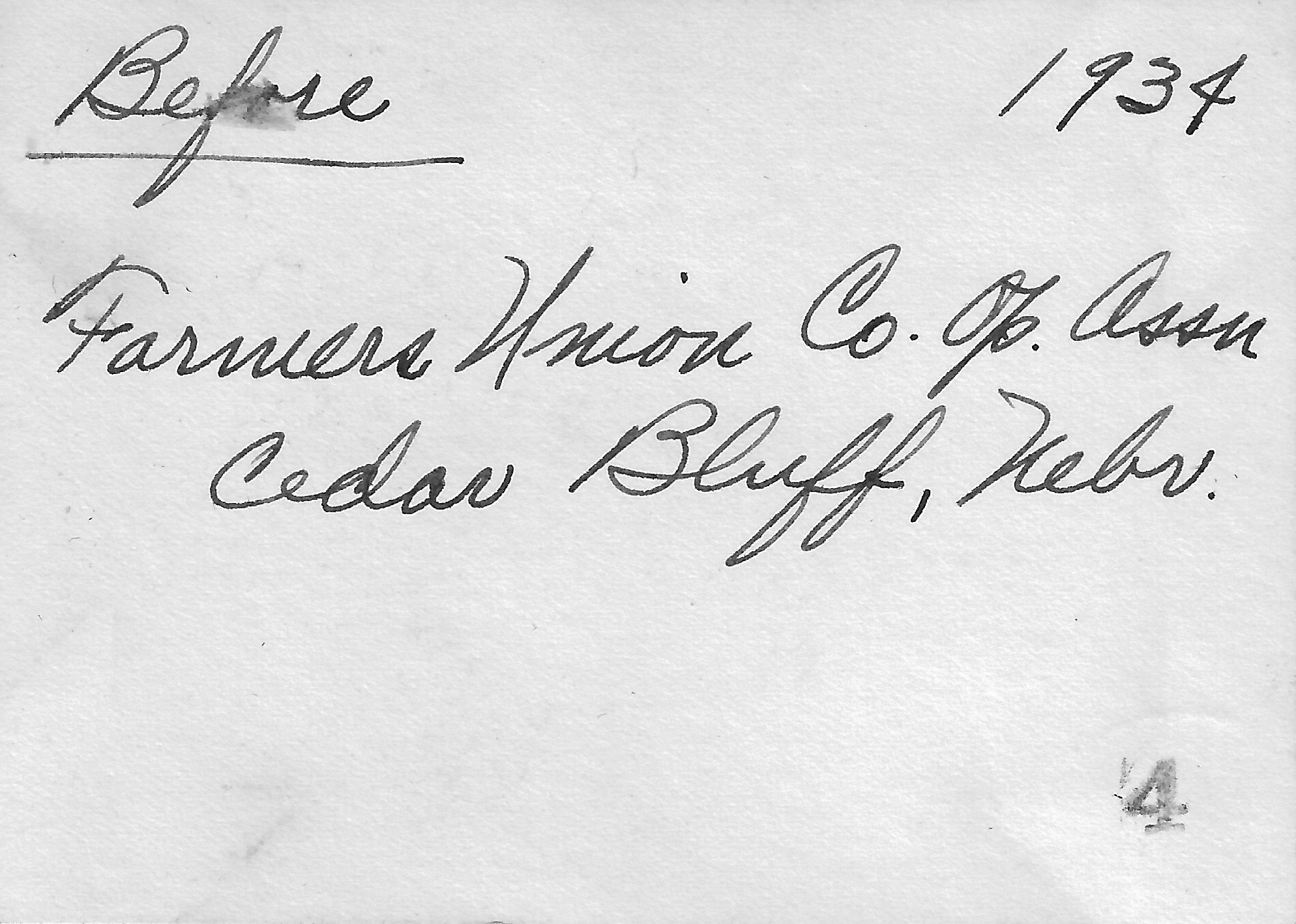
Reginald Tillotson’s neat script on the back of his photo.

At the same annual meeting, the Association announced payout of stock dividends at eight percent and patronage dividends of one percent. The newspaper remarked that “considering the times [it’s] a mighty fine showing.” 

The old elevator was to be dismantled, with as much material as possible being salvaged for re-use. The new elevator would be steel-covered. The initial report stated capacity at 80,000 bushels, which is a lot for a cribbed wooden elevator. A subsequent report put it at 30,000 bushels—a more realistic figure. 

The photo above shows the weathered main house with its peaked headhouse, and a storage annex with the upper structure enclosing the run being labeled Farmers Union Co-Op Assn. The shed on the left bears a sign saying Ash Grove Portland Cement.

A selling point on the rebuild was the prospect of local help getting employment in the construction. 

Van Ness Construction won the job, as will be seen in a follow-up post. Tillotson Construction, which evolved from Van Ness, returned to Cedar Bluffs in 1950 to build a 130,000-bushel reinforced-concrete elevator, which we visited in 2020.

Tillotson returns in 1941 to Alliance, Nebr. as independent contractor with a familiar client

Four years after their 1937 call to remedy fire loss at George Neuswanger’s elevator in Alliance, Nebr., the Tillotsons returned to that Panhandle town with the commission to build more storage and a feed mill.

The Alliance Times-Herald reported as follows:

Construction work has begun on a large warehouse and feed processing plant here by the J.H. Tillotson contracting company of Omaha for George Neuswanger of Alliance. 

We are unsure how “J.H. Tillotson contracting company” got the credit. The brothers Reginald and Joseph Tillotson formed Tillotson Construction Co. in 1938. We believe a rupture between then led to the founding of Joseph H. Tillotson, Contractor in 1948. Joe Tillotson died not long afterward in a car accident. There could be more to learn on this question, but until then we rely on existing records and previous verbal accounts.

The newspaper continued:

The building will be located just north of the Neuswanger elevator. The warehouse will be 148 feet long and 50 feet wide, and the feed processing mill will be 32 feet square. Total cost of the project has been listed at $12,000. 

According to Neuswanger, some difficulty is being experienced in the obtaining of material, and he has no idea when the building which will be of reinforced concrete construction, will be completed. At this time much of the excavation work has been completed by a dragline which has been in operation this week. 

The newspaper added these details:

Concrete mixing machinery is already in place at the site, a tool and supply shed has been erected, and some of the forms are being built. Much of the gravel which will be needed has been hauled to the site also. 

When the feed processing plant is put into operation, mixing and grinding of many types of livestock feed will be carried on here, Neuswanger said.

In part because of the large barley crop, grain storage facilities were at a premium in those months just before the United States entered World War Two. Nebraska farmers were expected to harvest 33 million bushels of grain.

While there was sufficient capacity for 55 million bushels in total, space was available for only 13.5 million.

The federal government allowed farmers seven cents per bushel towards putting up new storage silos on their farms.

Otherwise, a state official had this suggestion: “Another way to store the coming harvest is to bind and stack it. Stacking is becoming a lost art, but it is still an excellent method.” 

First look at archive of 1930s photos shows back-to-business after wooden elevator repair in North Dakota

The Tillotson homestead north of Omaha was sold in 2025, and as a consequence Our Grandfathers’ Grain Elevators has received a few leaves from a photo album with snapshots of 1930s jobs. Together, these pictures comprise the earliest documentation we’ve ever seen of Van Ness Construction and Tillotson activities. 

After the sudden passing of Charles H. Tillotson in 1938, his sons Reginald and Joseph built Tillotson Construction Company’s first concrete elevator, located in Goltry, Oklahoma. Prior to that, they worked for Ralston Van Ness out of Omaha. The photos we received appear to show jobs done for that company earlier in the 1930s. 

Most of the photos are inscribed on the back with a name, location, and date. 

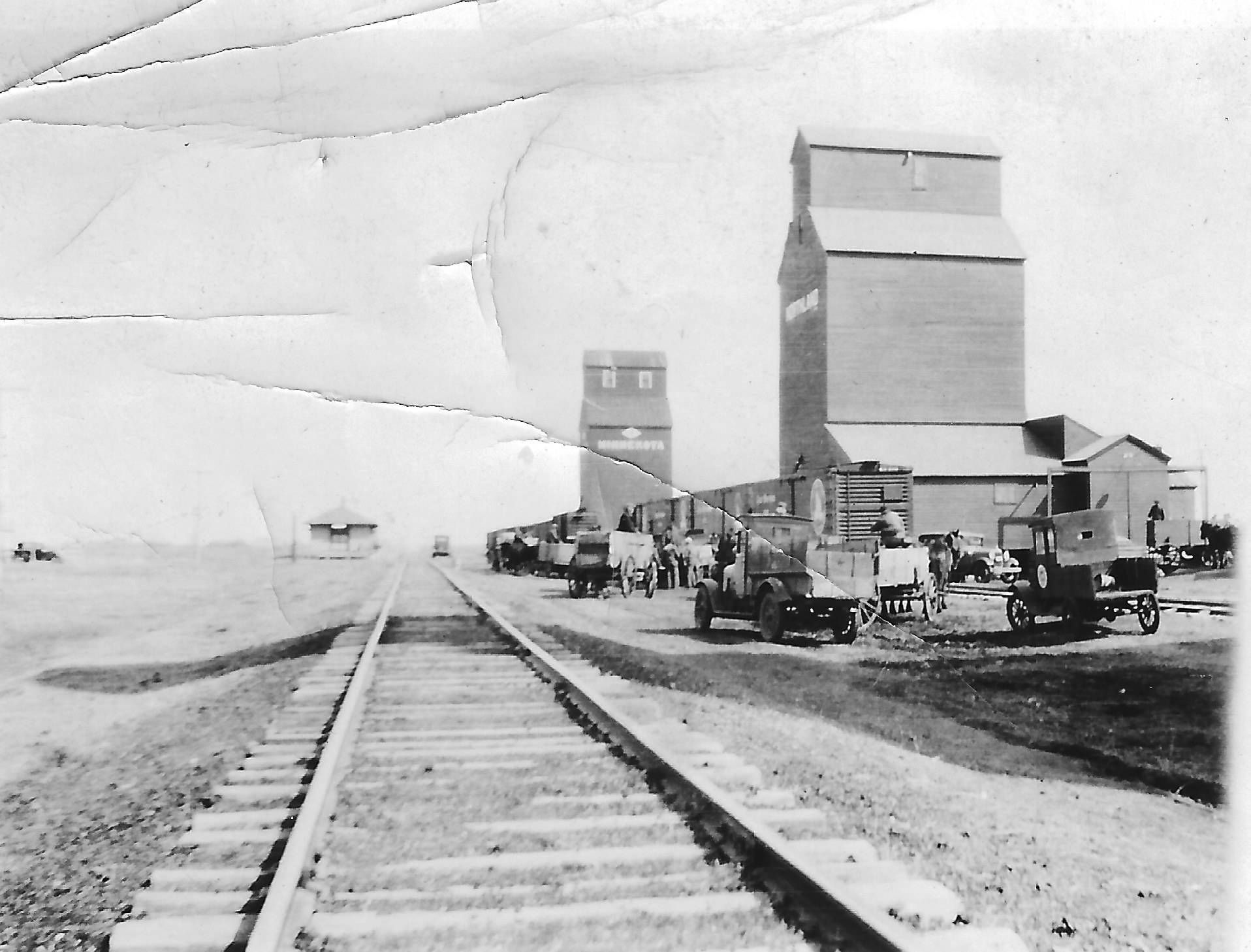
The above photo depicts a 1933 scene at a twin-elevator complex in Norma, North Dakota. Norma is a dot on the map in Renville County northwest of Minot and twenty or so miles south of the Canadian province of Saskatchewan. A note on the album page says “Rebuilt Fire Loss 1933.” 

Searching through a newspaper archive turns up no more details, so we can only look at the image and suppose the relief felt by local farmers who had limited options for grain disposition. Especially at a country location like this, a damaged elevator was an unhappy circumstance that would have required hauling grain over an extended distance. 

On a sunny day at Norma, a few motor vehicles converge at the complex with at least four horse-drawn farm wagons. It’s illuminating to see wagons still in use at that time. Their limitations surely gave farmers a sense of urgency about acquiring a motor truck.

An old pickup with wooden artillery-style wheels in the right foreground was likely a Ford. It has an emblem on the driver’s door, but we can’t determine anything more about it. 

Under close examination of the photo, the elevator tower in the distance appears to be labeled “Minnekota.” The sign on the near tower can’t be read at all. 

A number of men are going about their business, whether they’re still seated on wagon perches, standing inside a wagon, or on the ground. In the mix of trucks and cars, note the silhouette of an automobile way down the sidetrack.

Several boxcars await service. Norma is on a secondary road leading south from North Dakota Route 5, and it seems likely the rail line was a spur. This could have been part of Soo Line operations. 

We lack additional information about the event that led to the reconstruction. Newspaper pages often had stories of grain elevator fires in 1932 and 1933, with casualties in Chicago at a 200,000-bushel elevator on the river there, and with lesser tolls at smaller elevators in prairie locations. 

The Bismark Tribume reported on Aug. 24, 1933 that a 20,000-bushel Minnekota Grain Co. elevator had burned at Butte, North Dakota, to the southeast of Minot. It also claimed a 14,000-bushel carload of wheat. Butte was left with three elevators after the disaster.

We invite our readers to stay with us as we post the rest of the thirty photos in the newly obtained archive.

Newly discovered photos emerge of a 1950 blowout at a Tillotson ‘clone’ elevator in Bird City, Kansas

For a 2013 post, we visited the elevator at Bird City, Kan. to learn more about its provenance. Bird City (pop. 447) is in Cheyenne County, in the northwestern corner of Kansas. The county population is about 2,500.

“It has been demonstrated that the curved headhouse was a Tillotson signature,” we wrote after the site visit. “Did someone leave the Tillotson operation and branch out on his own, or were the plans sold to Vickroy-Mong?”

Later, we followed up with the story of a blowout that occurred there in 1950, not too long after the elevator was built by Vickroy-Mong Construction Co., of Salina, Kan.

Thanks to reader Steve Wilson, who grew up in St. Francis some 15 miles from Bird City, we have new views of the aftermath of that blowout, and these give a clue as to why the name Vickroy-Mong has otherwise disappeared from history.

The elevator was announced in January of 1950. The Omaha World-Herald reported as follows:

The Bird City Equity has voted to build a 250-thousand bushel storage elevator this spring. The government will assist in the finance to the extent of 80 per cent of the cost. It will also guarantee storage income for a three-year period. A drive to raise 50 thousand dollars in capital will be staged. Total cost of the elevator is estimated to be around 160 thousand dollars.

Photos courtesy of Steve Wilson

Soon after the tanks were loaded with grain, the blowout occurred. On Aug. 24, 1950, The Herndon (Kan.) Nonpareil reported: 

Approximately 15,000 bushels of the 1950 Cheyenne County wheat crop spilled out on the ground about 6 a.m. Friday when a 30′ by 8′ section of the newly constructed Bird City Equity elevator caved in. The section of wall giving way was over the loading bins on the railroad. A train was in Bird City at the time and was sent to St Francis to be turned after wheat augers brought in from the surrounding countryside had cleared a path through the grain on the tracks. More than six boxcars of wheat were loaded with the augers after the engine returned, but between 6,000 and 7,000 bushels of wheat still remained on the ground the next day, A.A. Gillispie veteran St. Francis newspaperman reported. The elevator which has a capacity of 250,000 bushels was finished shortly before harvest this year.

Chalmers & Borton received the contract for the repair work. In 1958, they also won the contract for an addition of 241,000 bushels.

W. Stephen “Steve” Wilson retired as professor of mathematics at Johns Hopkins University and lives in Baltimore. His father, Charles Wm. Wilson, M.D., served the people of Cheyenne County “doing everything from glasses to babies to surgery.” And Dr. Wilson was a photography buff. Steve Wilson provides this addendum regarding the blowout:

I was only 4, or almost 4, but it was a big deal. Lots of grain elevators in that part of the country, and they don’t usually fall apart. Worth the drive to see it!

In 2009, I took my kid out to see where I was from (the year before he graduated from high school). We went out to one of the elevators in St. Francis, the county seat. This was an elevator [where] they would take us kids up to the top, and we would throw model airplanes with cherry bombs in them.

However, when my son and I started walking towards the elevator, someone ran out of the office and told us we couldn’t get close to the elevator. Homeland security rules. What a waste of resources! If a terrorist wants to blow up a grain elevator in a town of 1,500 where you still have to drive 175 miles to get to a town of 25,000, that’s not a bright idea. Spending money to prevent it is even stupider.