A tale from the Johnson Construction elevator at Galatia, Kansas

DSC_0582 copy Blencoe

Blencoe, Iowa

Story by Kristen Cart

Once again, one of our readers has supplied a fascinating glimpse into the construction of an elevator.

Emily Frank is the granddaughter of Darrell Greenlee, a foreman for Johnson and Johnson-Sampson. She related a story about the beginnings of the Galatia, Kan., grain elevator:

The Post Crescent 26 Mar 1959My grandfather built slipform concrete grain elevators while my mom was little. My grandparents moved around every three to six months from the time they were married until my mom (the third of six children) was in third grade. I find a lot of your stories remind me of the ones my mom told or my grandmother tells. You did one where a man fell to his death from an elevator during construction. Unfortunately that happened on a job where my grandfather was the foreman, as well…

My grandfather worked for Virgil Johnson. At the time the company was Johnson Elevator Company.

At a job in Galatia, Kan., in 1959, while Darrell was stabilizing the family trailer, it fell and he was hit across his back and shoulders. Rosina took him to the hospital. The hospital wasn’t going to see him until she could pay. She didn’t have insurance. She told them instead, “I’ve got enough money to buy this damn hospital.” When they left two days later, she paid cash.

Rosina called Virgil to tell him that Darrell had been hurt–not bad but he was pretty bruised up. Rosina wasn’t sure what they were going to do. She told Virgil she wanted to know what he was going to do because if Darrell didn’t work, he didn’t get paid. Virgil asked if his butt was bruised and then pointed to a chair and said “See that chair right there, he can park his ass right there and supervise from his chair.”

When the elevator was just about completed a man fell from the top of the elevator. Darrell was a witness to the fall. The guy opened the door at the top and the wind caught him and blew him over the side of the elevator. He fell 120 feet to his death. The man was Arthur Kronberg, 42, originally from Menasha, Wisconsin.

Rosina said when they called the man’s brother to tell him he could come pick up his belongings, he didn’t seem very interested, except he asked if there was anything of value. They had told him his brother had a truck. The man reluctantly agreed to get the truck.

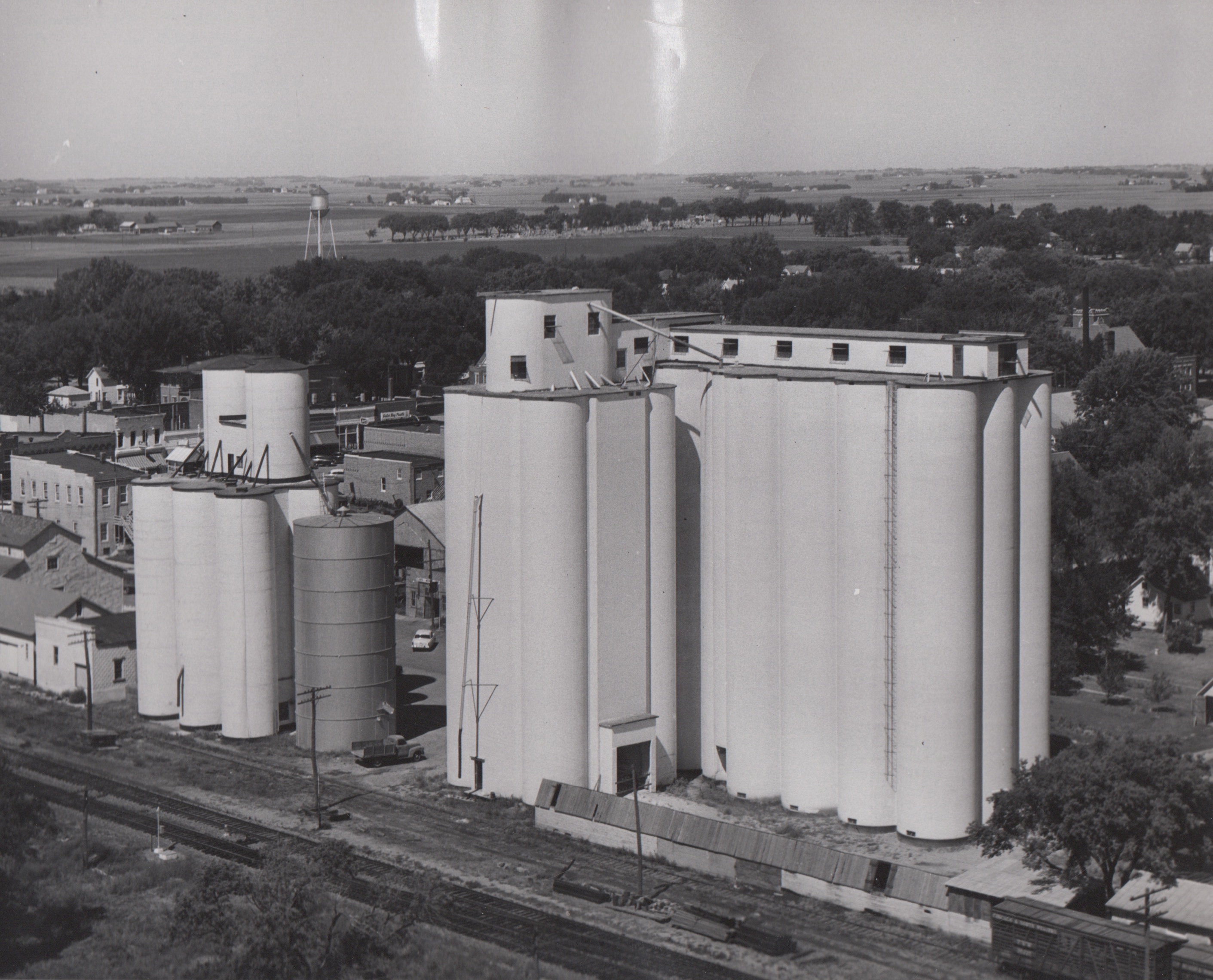
Emily filled in some of the details of her grandfather’s career. The history of Johnson Elevator Company that she shared intrigued us, because the company took up where Mayer-Osborn Company left off and built strikingly similar elevators. The Galatia elevator is a close copy of the Mayer-Osborn elevators at McCook, Neb., and Blencoe, Iowa. Because of the similarities between them and a number of other Johnson elevators, we have speculated whether designer Gene Mayer continued his career with Virgil Johnson and brought his designs with him. Emily continued:

DSC_0574(1)

Page City, Kan.

The elevator at Galatia is on one of Johnson’s business cards.

Johnson used to work with some brothers with the last name Sampson. They were Virgil Johnson’s brothers-in-law. They worked together for a while, too, under the name Johnson-Sampson.

My grandfather worked constructing concrete elevators from 1947 to about 1963. He worked for several different people.

DSC_0526

Mitchellville, Iowa.

Johnson was the man he worked for most, on and off over the years. When Virgil and his brothers-in-law split, my grandfather went to work for Dewey Construction and then Young Love. Then Virgil found a partner, and my grandfather worked for Johnson & Bratcher. Then Virgil went off on his own as Johnson Elevator Company.

When Virgil went broke after a missile base job in the 1960s, my grandfather worked for a guy by the name of Guy James. He did two jobs for him until he finally settled in Rushville, Ill. He never built another elevator, but he had his own company and they did a lot of elevator repair work.

My own grandfather William Osborn’s experience followed a similar trajectory–after he was done with elevator construction, he went on to elevator repair and maintenance. We always attributed the cancer that took him at age 75 to the dust he breathed during those years, though some of the damage could have been from smoking, a habit he dropped ten years before he died.

The hazards of the business were sometimes obvious, but often stealthy and unexpected. From dust, to wind, to new boots, to heedless roofers, many things in elevator construction took lives–but the monuments built by these mortal men remain, withstanding tornadoes, floods, hail, and every natural disaster.
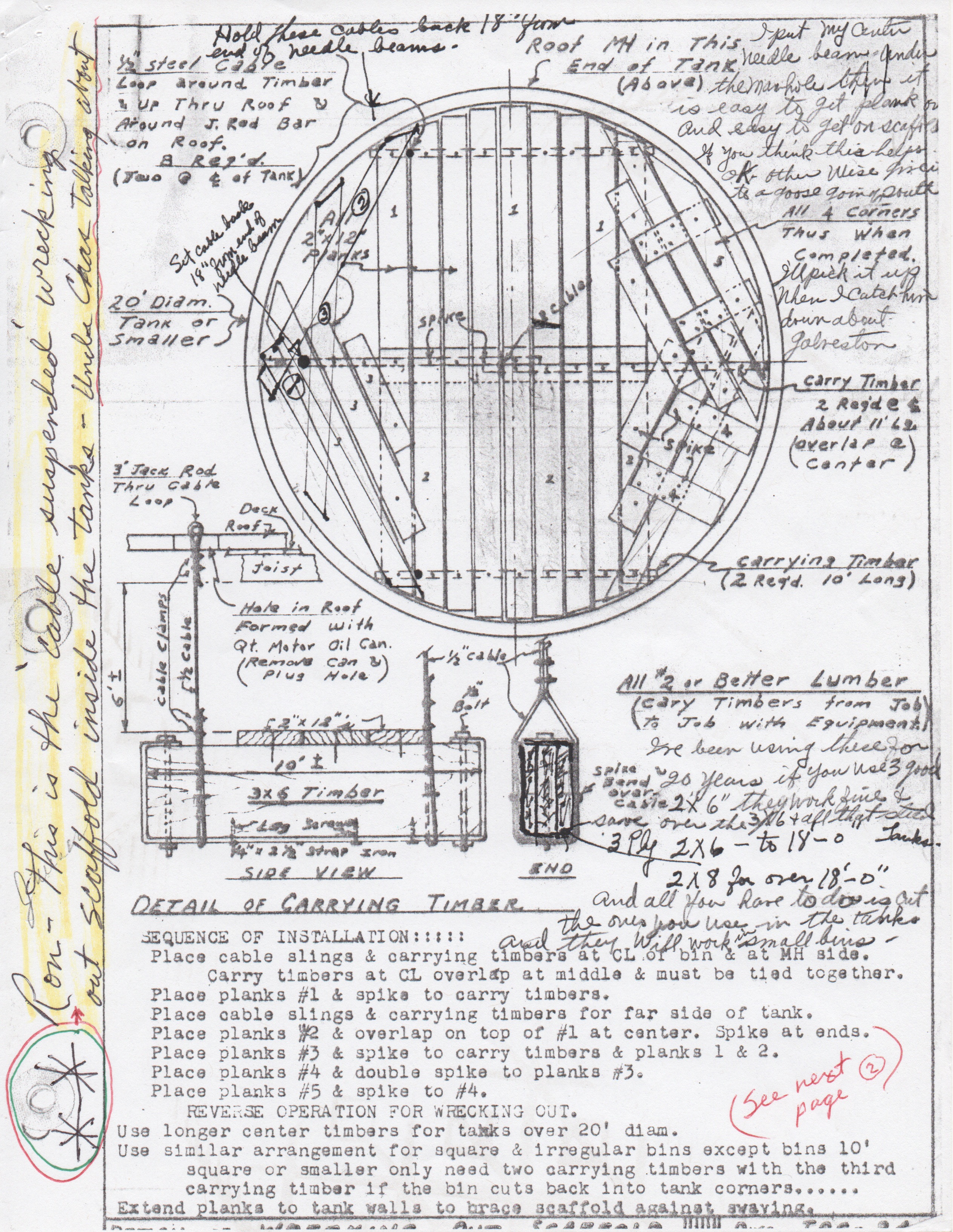
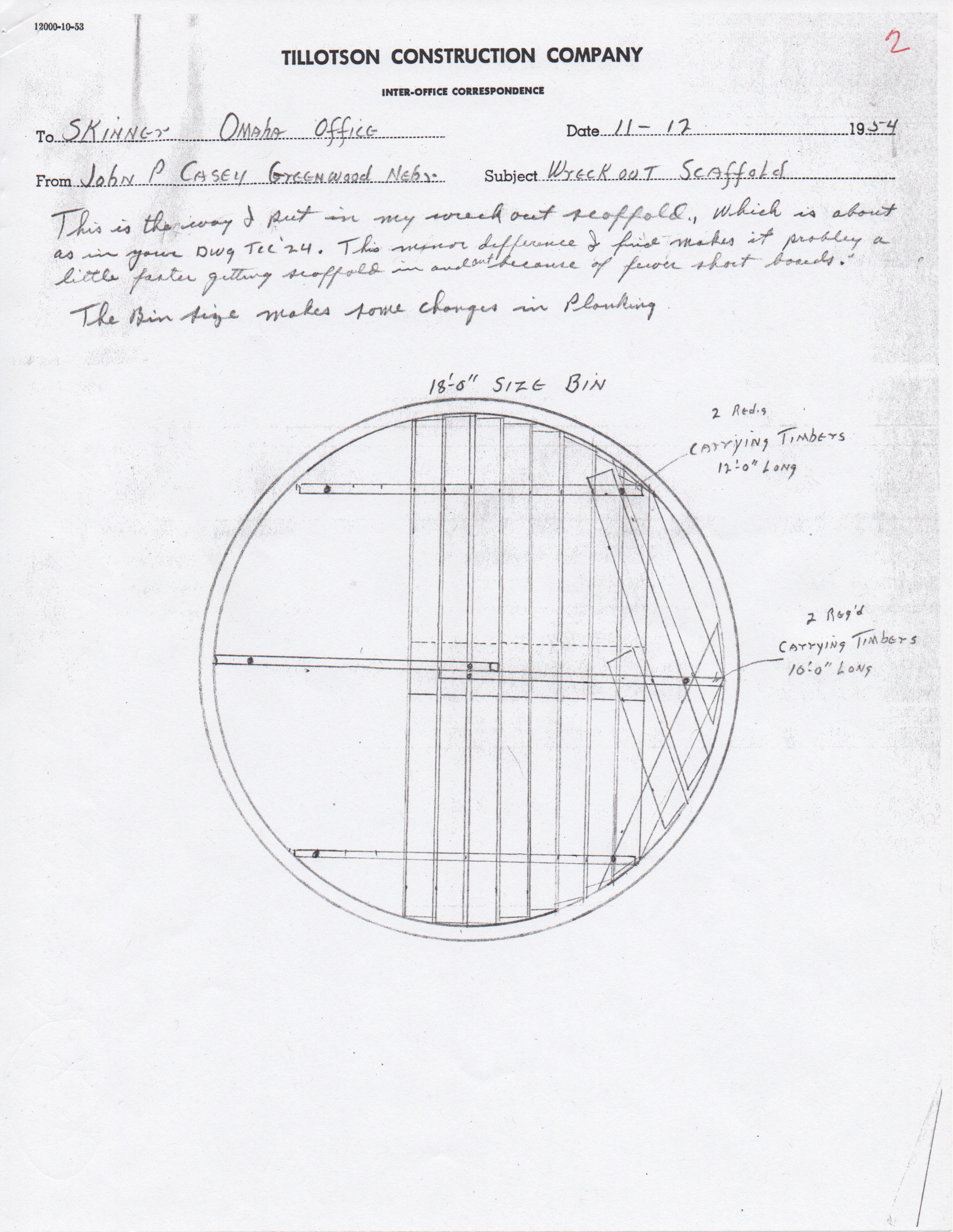
 

Wrecking out details are provided in drawings from Tillotson records

Charles H. Tillotson

By Ronald Ahrens

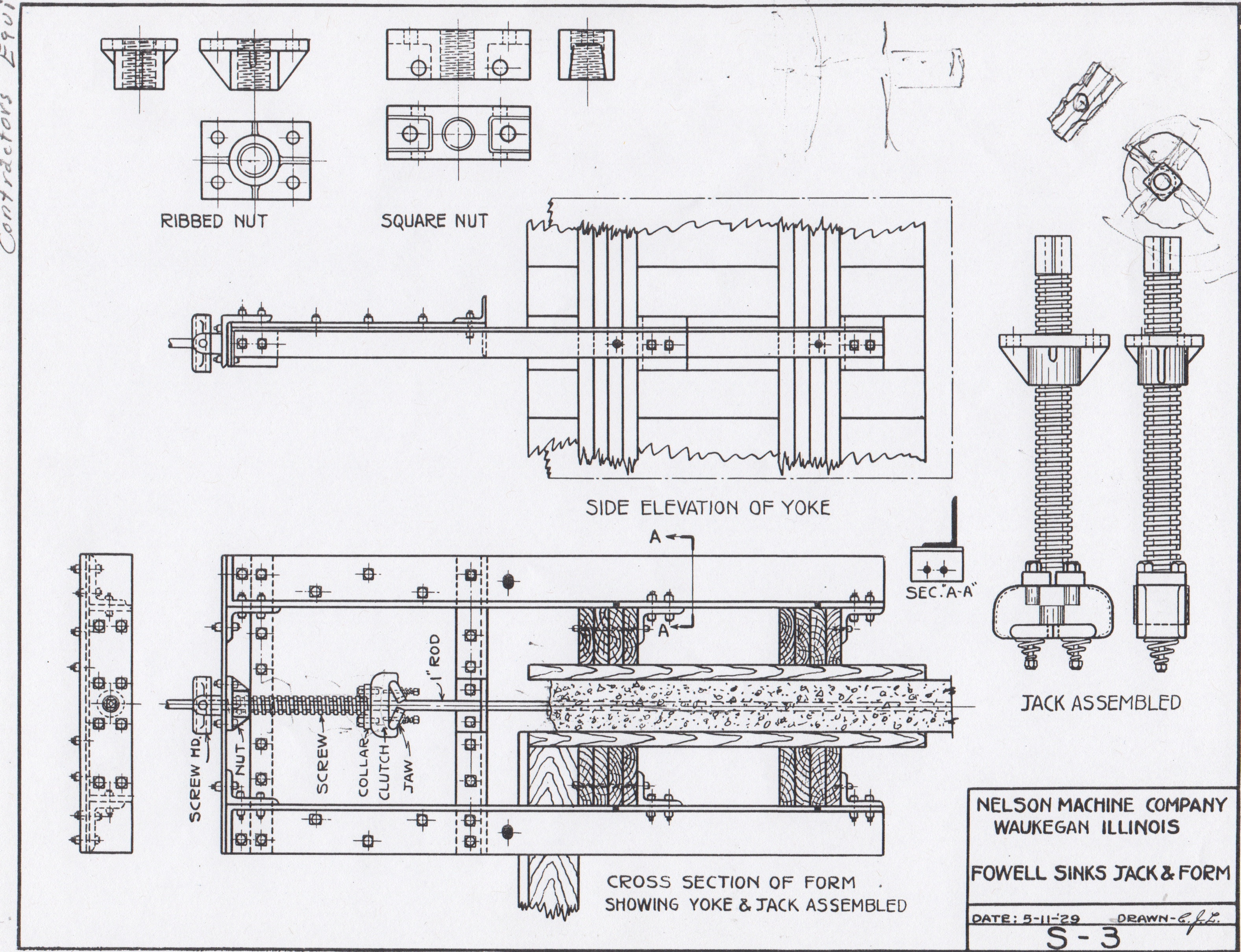
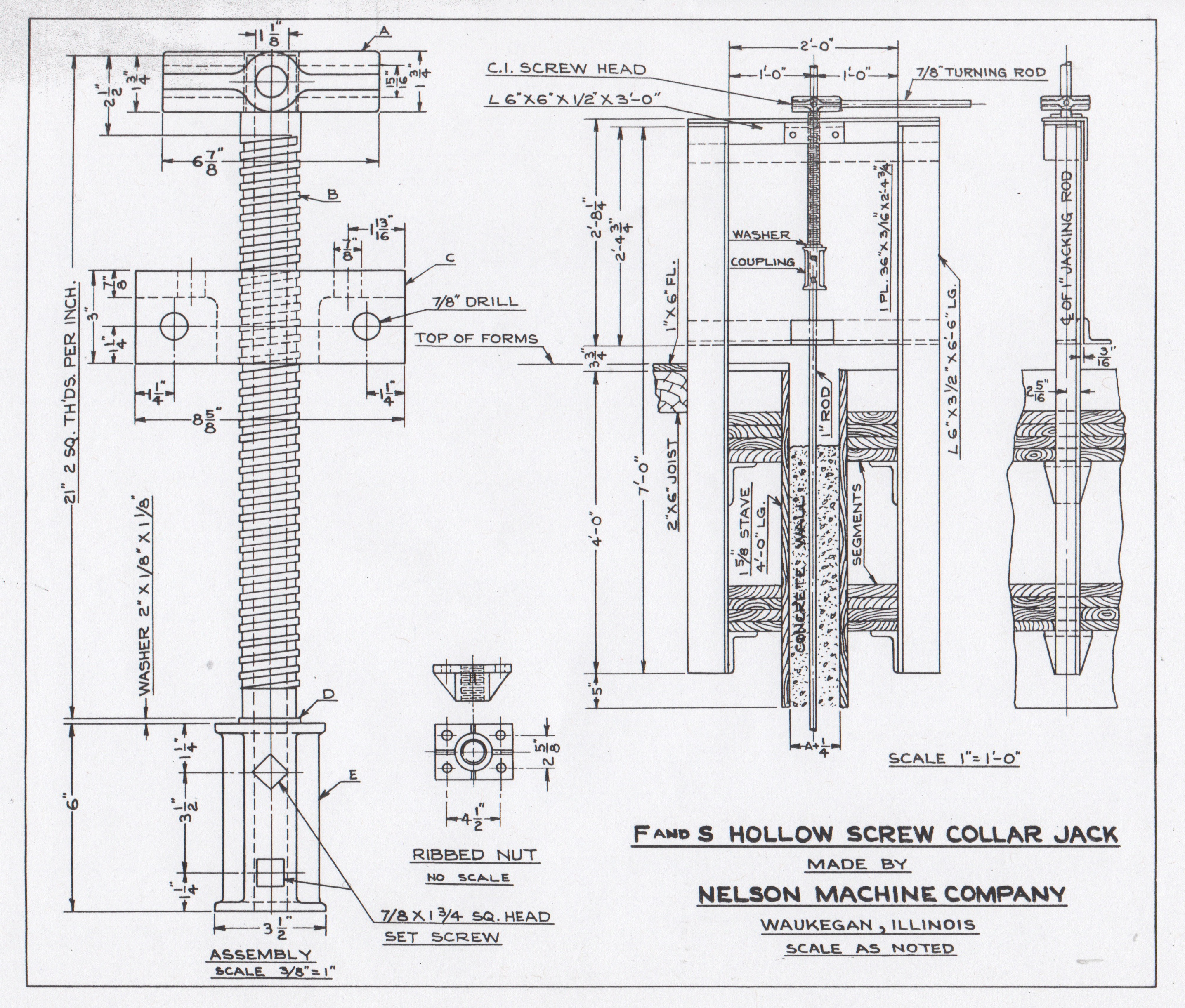
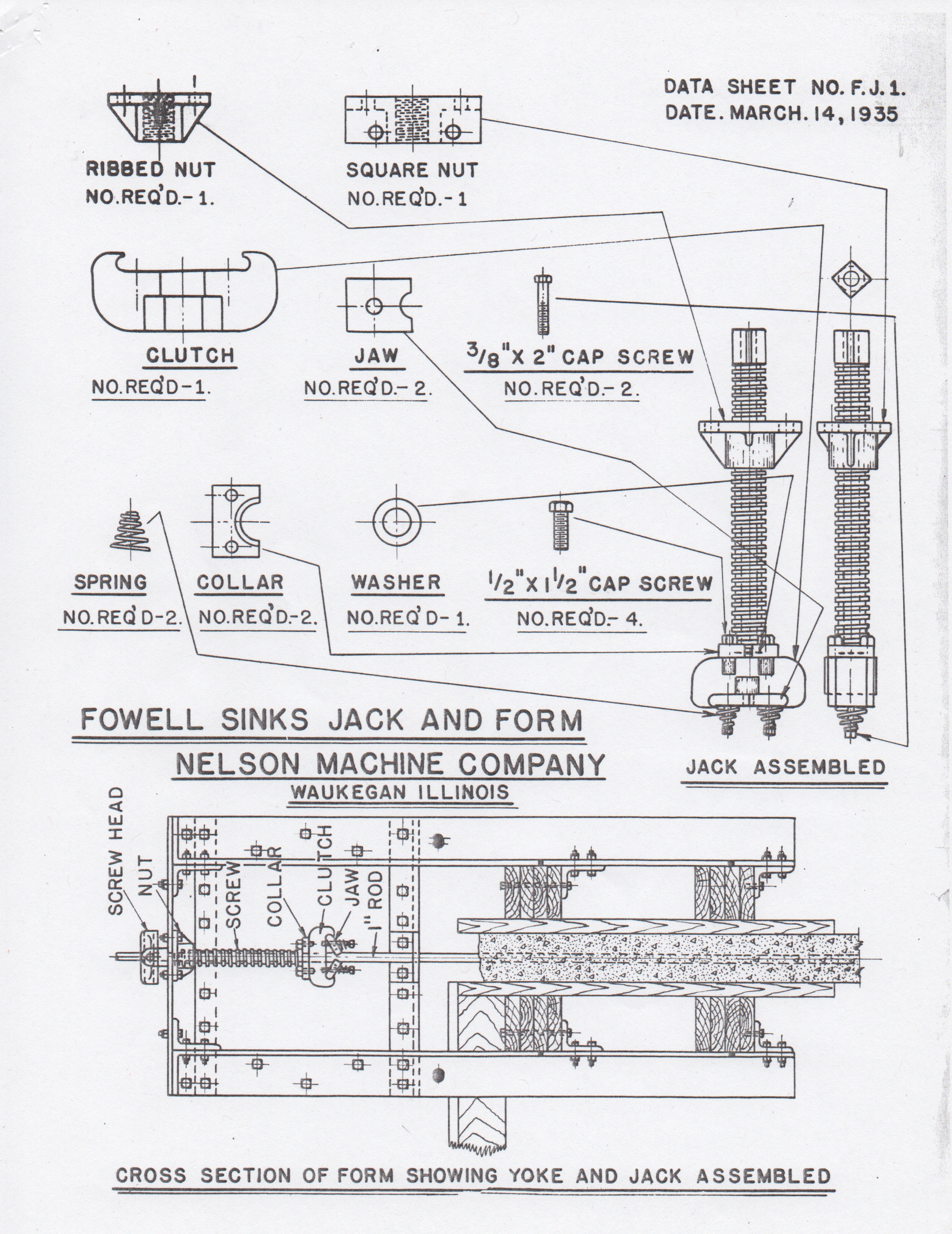
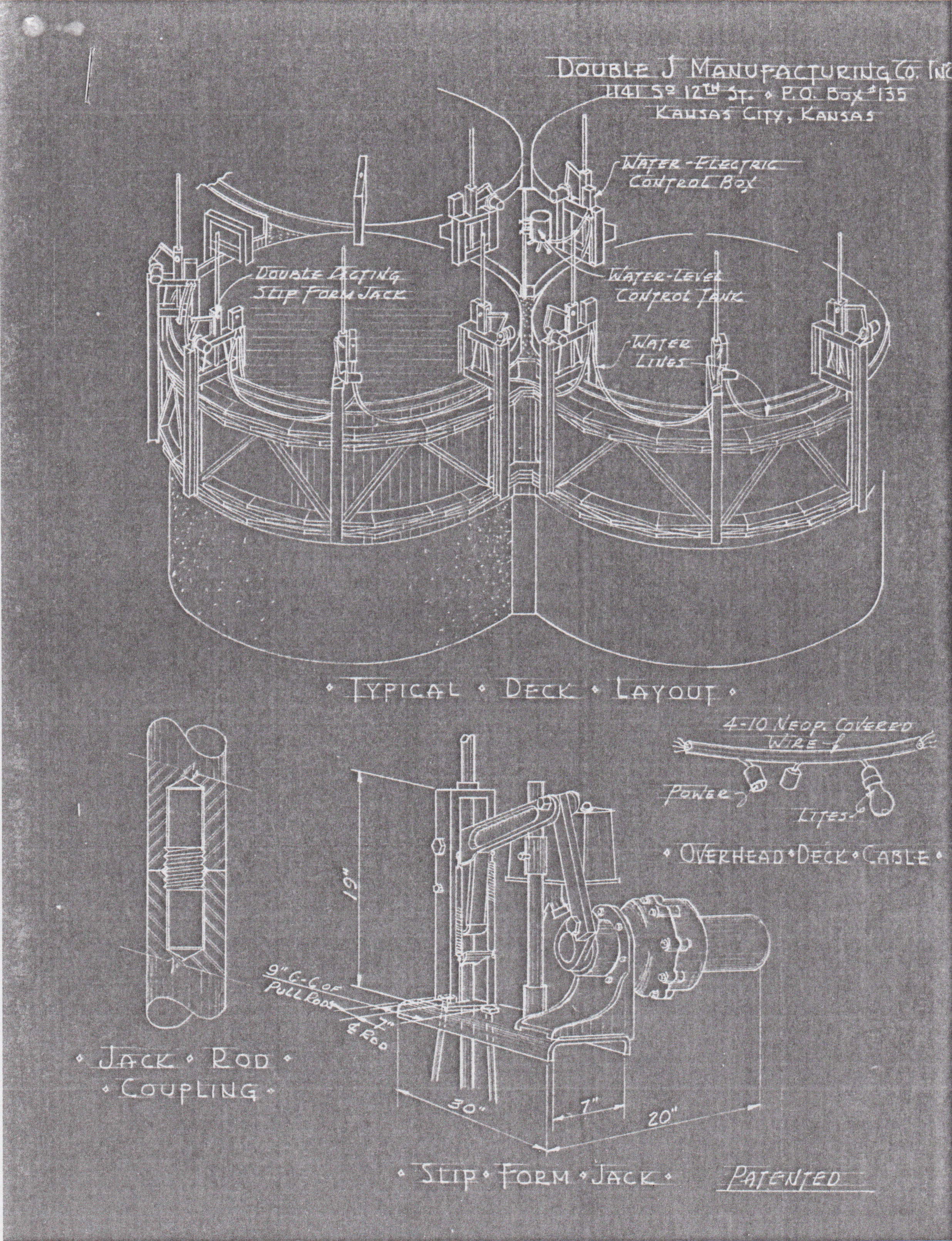
The papers we received from my Uncle Tim Tillotson included not only the record of Tillotson Construction Company’s building activities, but also these pages showing details of building a wrecking-out platform as well as jack rod assemblies and formwork details. Page two is dated November 12, 1954.

A wrecking-out platform was needed as workers disassembled the formwork on the inside of the completed elevator.

Charles H. Tillotson 1

Uncle Charles Tillotson has previously written about his close call when cable clamps failed.

In that post he described a wrecking-out platform this way:

The final scaffold then becomes a square platform suspended in a round tank.

The void on each side of the scaffold is used for lowering or throwing the wood material into the tank’s dark abyss. After all the overhead wrecking has been accomplished, another team gains access to the tank’s bottom via a manhole in the side of the tank at or near ground level.

Charles H. Tillotson 3

The drawings and details presented in the notes included here are invaluable. For example: The hole in the roof is formed with a one-quart motor oil can. (“Remove can & plug hole,” the addendum reminds.)

Charles H. Tillotson 5

The handwritten note in the upper right corner of the first page says, “I put my center needle beam under the manhole then it is easy to get plank on and easy to get on scaffold. If you think this helps O.K. other wise [illegible] to a goose going south.”

“I’ll pick it up when I catch him down about Galveston,” this section concludes.

Charles H. Tillotson 4

Another note is on the quality of timbers: “I’ve been using these for 20 years if you use 3 good 2 x 6 they work fine and save over the 3 x 6 & all that steel and all you have to do is cut the ones you use in the tanks and they will work in small bins.”

We look forward to readers’ comments on the pages.

Charles H. Tillotson 7

A gleaming elevator and annex with distinctive headhouses in Glidden, Iowa

Glidden, Iowa

Tillotson’s 122-foot-tall elevator, center, was built at Glidden, Iowa, in 1949. The company added the 112-foot, 331,000-bushel storage annex in 1954. Photo: Tillotson Construction Company archive.

By Ronald Ahrens

On April 11, 1949, the Daily Times Herald, of Carroll, Iowa, reported a new elevator  under construction in Glidden for the Farmers Co-operative Company.

“About 20 feet higher than the present buildings, the new elevator will be situated east of them,” the newspaper reported. “With the additional storage space the company, for several years the largest co-operative elevator owned and operated in Iowa, will be able to take care of a large amount of corn and beans grown extensively in the Glidden area.”

The bins had quickly risen to 100 feet in height.

Tillotson Construction Company, of Omaha, was using a crew of about 35 men, who worked 10 hours per day, the report continued, perhaps leaving out at this late stage that a continuous pour would have require successive shifts in order to reach 100 feet.

Completion of the 100,000-bushel elevator was expected by July or August, the report said.

Through the company’s construction record, we now know more about the elevator. It is the twin of another elevator built that year in Churdan, about 22 miles away on county and main highways.

Those elevators had an exact capacity of 102,000 bushels. They used 1083 cubic yards of reinforced concrete and 57.72 tons of steel, including jack rods. The 24-inch-thick main slabs were 48×48 feet in area. The overall weight of the reinforced concrete, rated at 4000 pounds per cubic yard plus the steel, was 2224 tons.

Each elevator could hold 3060 tons of grain, averaging 60 pounds per bushel. Including all machinery and the hoppers, the gross loaded weight was 5709 tons, for a bearing pressure of 2.52 tons per square foot.

The curved cupola, or headhouse, which was the important signature of a Tillotson elevator, stood 17 feet wide, 34 feet long, and 22 feet high.

These were single-leg elevators, each with a full basement and an electrical room. Pulley centers were at 125.67 feet.

Each boot pulley was 60 x 14 x 2 3/16 inches while each head pulley differed only by having an axle shaft 1 3/4 inches greater in diameter.

The six-ply Calumet belt supplied for each leg was, of course, 14 inches wide. Cups of 12 x 6 inches were to be set nine inches apart, although a note under “Remarks” somewhat ominously says, “Cups @ 12″ O.C. @ Glidden” and adds “Job Error.”

A 30-horsepower Howell electric motor drove the head pulley. The theoretical leg capacity according to manufacturer ratings was 6540 bushels per hour, but running at a conservative 80-percent of capacity meant a more realistic take-up of 5230 bushels per hour.

The remarks make one distinction between Churdan and Glidden, saying the former had a split bin for the drier while no bin was fitted at the latter.

The driveway was 13 feet wide. There were two dump grates of 9 x 5 1/2 feet and 9 x 15 feet.

Later entries show a 331,000-bushel storage with flat-bottom tanks was added at Glidden in 1954. The next year, Churdan was expanded with 198,960 bushels of new capacity. They used 2318 and 1351 cubic yards of reinforced concrete, respectively, and 116.5 and 79.5 tons of steel.

Other specs for Glidden’s storage:

Main slab: 33 1/2 to 49 x 127 feet for 5481 square feet in total

Weight of reinforced concrete: 4752.5 tons

Weight of grain: 9930 tons

Gross weight loaded: 15,007.5 tons

Bearing pressure: 2.97 tons per square foot

Main slab thickness: 24 inches

Height of drawform walls: 104 feet

Cupola (headhouse) dimensions (W x L x H): 14 x 98 1/4 x 8 1/3 feet

Top and bottom belts: 24 inches @ 600 feet per minute

Cross belts: 24 inches @ 600 feet per minute

The Kansas City firm of Horner & Wyatt, Engineers, designed grain terminal giants

DSC02466Story and photo by Kristen Cart

Often a reader will turn our blog in a whole new direction by revealing a facet of the grain business we had not explored. In the case of Horner & Wyatt, an engineering and design firm out of Kansas City, reader David Chatt piqued our interest by asking us to locate some of their work. His grandfather, Oliver Howard Horner, a partner in the company, died  in the late 1930s.  David wanted to know more about the sites he had helped design. The quest seemed to be right up our alley.

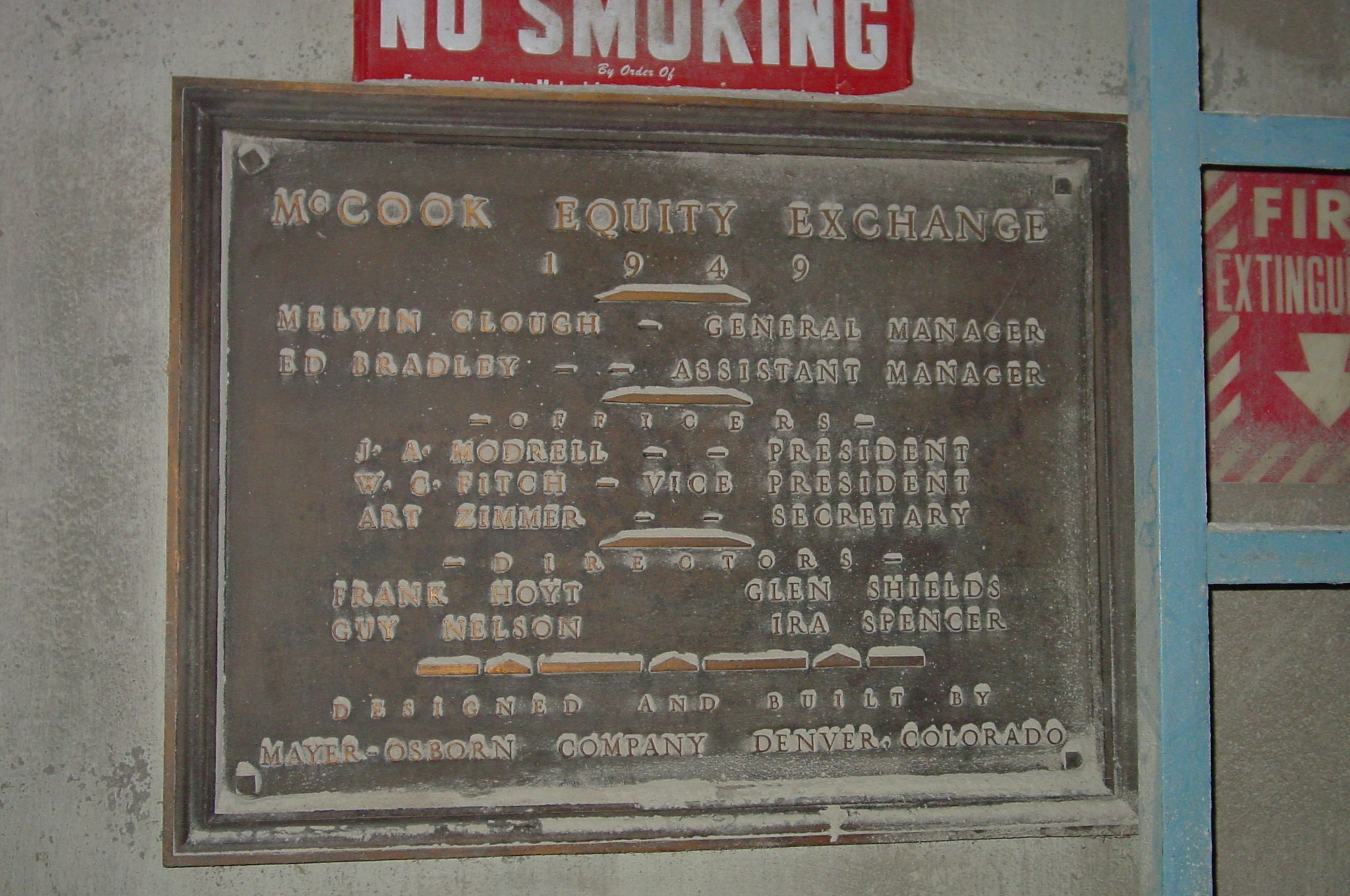
It might be possible to discover the identity of the architects at elevator offices, but the common method of checking for the builder’s name on elevator manhole covers would only reveal the guys who poured the concrete. At McCook, Neb., a plaque inside the elevator names the designers. But newspaper accounts, journals, or local histories are the best way to learn about the architects of most elevators, especially for the large projects that changed the face of their communities.

David told us  the Galveston elevator, which was destroyed some years ago, was the only Horner & Wyatt site he could find. Further investigation revealed the company as a major player in elevator architecture, active as early as the 1920s. Our search for their projects revealed a completely different side of grain storage requirements: the end of the logistics trail, or the terminal elevator. We located a few of them, and most appeared to be massive.

Oliver H. Horner was an electrical engineer working for Black & Veach at the time he registered for the draft in 1917. By 1921, he was a partner in his own firm, based in Kansas City. In the 1930s he was engineering some of the biggest elevator projects in the country. He was still listed in that capacity in the city directory as late as 1939. Newspaper accounts described Horner & Wyatt as “consulting engineers” on various projects, which became increasingly complex as time went on.

Some of the sites we found, which were completed during Oliver’s lifetime, were elevators at El Reno, Okla., the Gooch Feed Mill at Lincoln, Neb., and the levee terminal at Kaw Point in Kansas City, Kan. The company continued to design massive elevators into the 1950s at sites such as Happy and Lubbock, Tex., and the port terminal at Corpus Christi, Tex. Doubtless the designs for the later projects built upon the experience and ideas that went before and bore the unmistakable imprint of the company’s earlier engineers.

Oliver H. Horner left a legacy to be proud of, with elevators and mills still standing and operating in premier locations around the country. Horner and Wyatt was one of the top engineering companies working during the twentieth-century elevator boom. It’s very nice that one of our readers took the time to point them out.

In 1954, near the boom’s end, Albert City, Iowa, had a gleaming concrete elevator

Albert City, Iowa

By Ronald Ahrens 

Looking at this photo of Tillotson Construction Company’s 252,000-bushel elevator, completed in 1954, it’s easy to imagine the pride and awe of a small town’s few hundred residents.

Albert City is in northwest Iowa on a spur from Route 3, not far from Storm Lake in Buena Vista County. The Tillotson’s had also built that same year in nearby Pocahontas, where there was tragedy.

The Albert City job went more smoothly as the structure rose far above the tallest elms, although Uncle Charles Tillotson, who recently dug up this photo, has written about his frightening dismount from the formwork during a storm.

Uncle Michael Tillotson has also recollected about working here:

“The following summer (1954) we went to Albert City, Iowa, 75 miles North of Council Bluffs. We rented rooms in a private home. We worked with a 20 something guy that ran the winch pulley bucket to the top of the elevator as it progressed, and brought building materials down. We also rode the bucket up and down to get on deck. The elevator bens were 125 feet to the top with a Head-House of 75 on top of that.”

Company records show the elevator was built according to the same plan used in Pocahontas. This entailed eight outer bins that were eighteen feet in diameter and, contrary to Uncle Mike’s reckoning, 120 feet tall. Altogether, some 2091 cubic yards of concrete were reinforced by 106.57 tons of steel.

The bins rose from a main slab 21 inches thick and 60 x 72.5 square feet in area. It supported a gross loaded weight of 12,974 tons.

The cupola, or headhouse, was 23 feet wide, 58 feet tall, and 40 feet long.

Albert City was a single-leg elevator. Its head pulley was 72 inches in diameter and turned at 42 rpm. A 40-horsepower Howell motor supplied more than enough energy to turn it.

Twelve-inch-wide cups on a six-ply, 14-inch-wide belt carried up the grain that was dumped by incoming trucks. The 12-foot-wide driveway had two dump grates: 9 x 6 feet and 9 x 14 feet.

In 1954, Tillotson also built in Dacoma, Lahoma, Orienta, and Weatherford, Okla.; Booker, Tex.; Ensign and Montezuma, Kan.; Bellwood, Neb.; and Glidden, Goldfield, Newell, Manson, Pocahontas, and Iowa Falls, Iowa.

These were among Tillotson’s last elevators–the records close out with work in 1955–and they represented nearly everything the company knew about building.

A visit to Google Maps shows the elevator is still standing, which is to be expected given the Herculean effort needed to knock down all that reinforced concrete. But it appears idle. Given what we’ve learned about the limitations of midcentury elevators and today’s need for greater storage capacity and quicker unloading, that would make sense.

Nevertheless, it endures as a handmade monument, and a rich human history goes with it.

This ‘continuous pour’–and the marching band–would delight our grandfathers

By Ronald Ahrens

Photo by AC Martin.

Photo by AC Martin.

A  USA Today insert in my Feb. 6 edition of the Desert Sun newspaper carried this story about the new tower under construction in Los Angeles. The news will be of interest to the concrete enthusiasts among our readers.

The report on the 1100-foot Wilshire Grand project describes how the the foundation slab will be laid on Feb. 15: “The project will attempt to set a Guinness World Record with the largest continuous concrete pour ever… More than 2,100 truckloads will deliver 21,200 cubic yards of concrete weighing 82 million pounds.”

A typical Tillotson elevator–for example, Albert City, Iowa–needed 2091 cubic yards of reinforced concrete. That’s just under one percent of what’s going into the 100-foot-deep hole on Wilshire Boulevard. I’m trying (without success) to picture 100 grain elevators compressed in there.

The USC band will precede the first truck to the site.  It is not recorded that any band ever marched to the opening of an elevator job.

Nor is it believed a swimming pool topped any elevator, as will be the case at Wilshire Grand.

Technical complications will arise during the pour, and a quite amazing means of addressing them has been devised, as you will read in the story.

I mentioned all this to Uncle Chuck Tillotson and shared the clipping with him. He said that my grandfather Reginald had foreseen for Tillotson Construction Company a commercial future beyond elevator construction.

Applying their expertise with concrete in different applications would only have been natural, but it’s doubtful  he foresaw anything quite this big.

And I’m sure he didn’t think about anyone taking a dip while 1100 feet above the city.

With their works in Estill, South Carolina, Tillotson built big in cotton country

Freshly harvested cotton field in central South Carolina

Freshly harvested cotton field in central South Carolina.

Story and photos by Kristen Cart

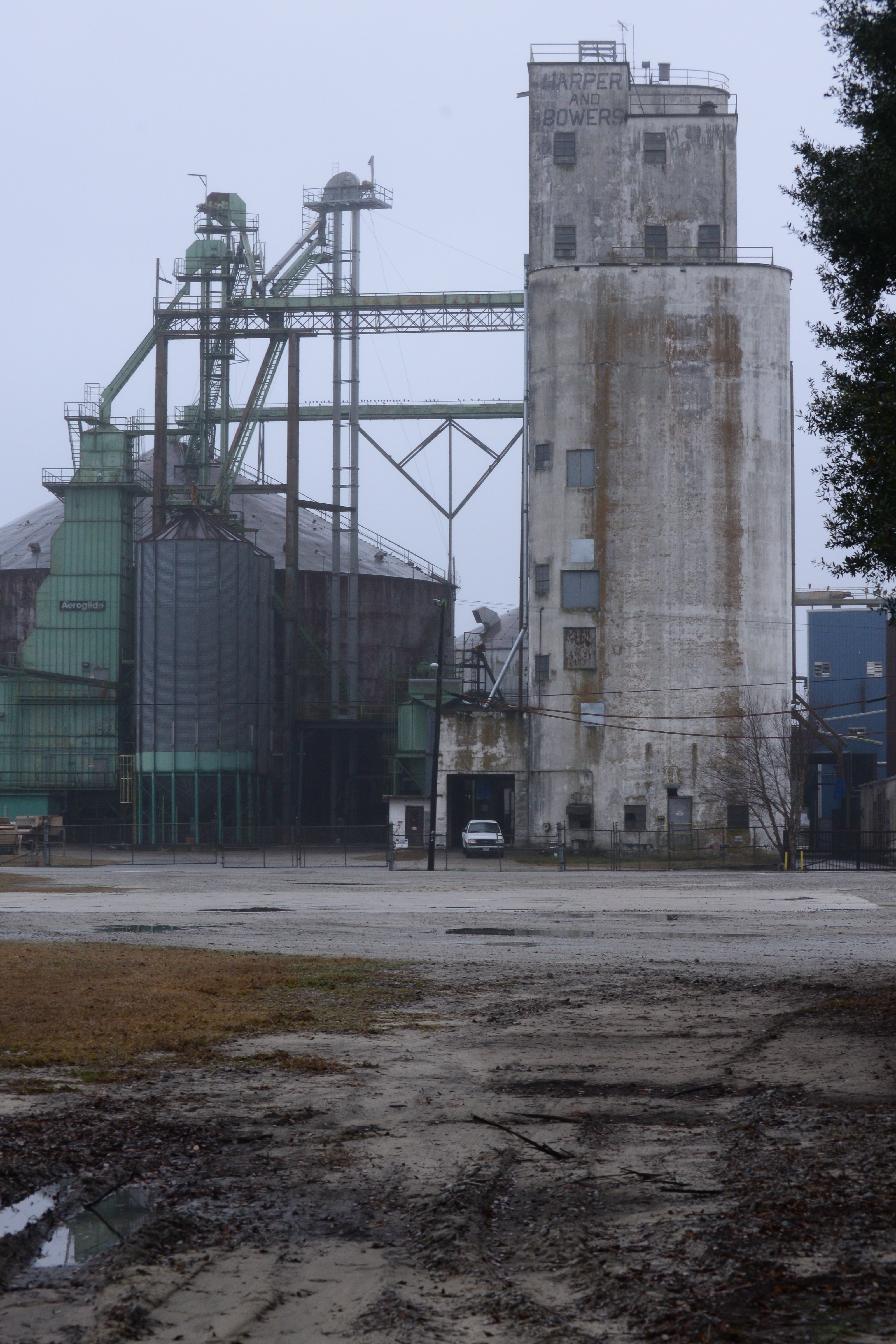
The brightly wrapped cotton bales highlighted an otherwise drab landscape as I traveled the 91 miles south from Columbia to visit the Estill elevator, originally built in 1947. Rain and haze flattened the view. Since it was Sunday when I visited the elevator, few people appeared to be about. It was going to be a photography outing, for better or for worse.

DSC_3487

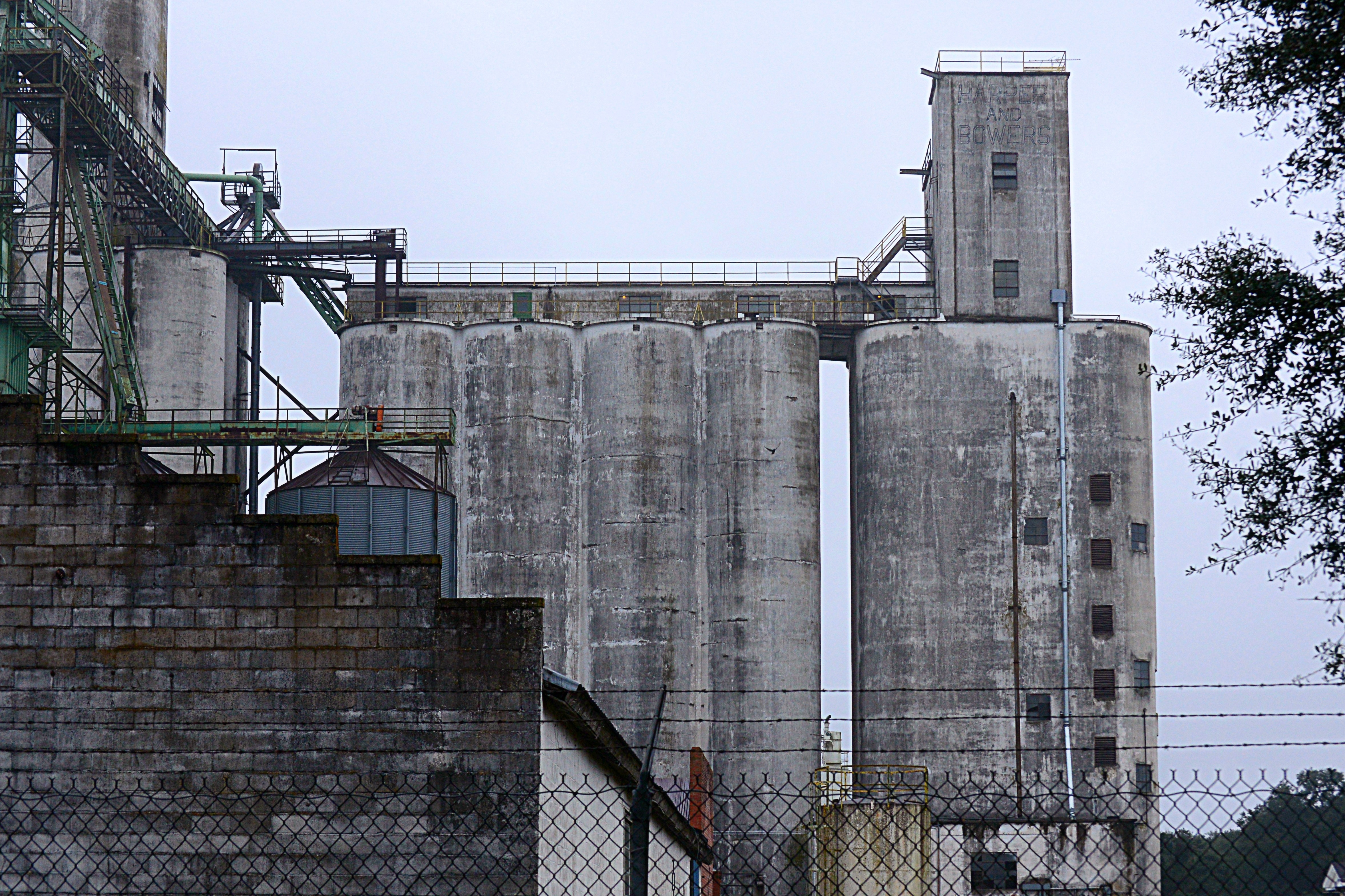
The Estill elevator, greatly expanded since it was built in 1947, was secured behind barbed wire.

I graduated high school in South Carolina. My impression of the place, after growing up in the western desert, was one of endless dark pine woods, with a brief gaudy display of azaleas and dogwood blooms in springtime.  I didn’t appreciate the raw beauty at the time. Now, on a soggy day, it had a mysterious appeal.

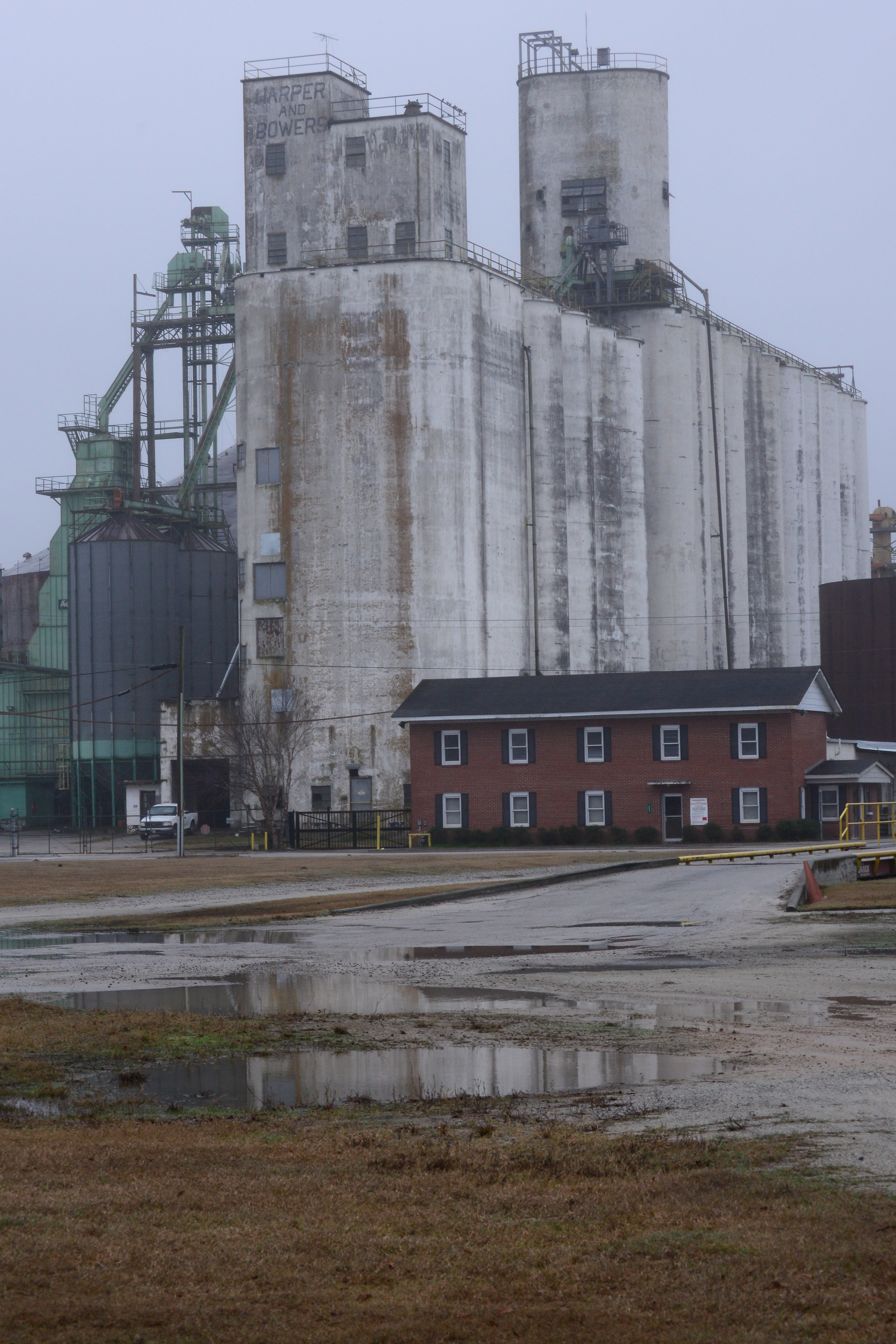
DSC_3431When I learned that the Tillotson Construction Company built an elevator in the state, it came as a surprise. We do not know who built the original house in 1947. Tillotson, according to company records, built the 225,000-bushel annex and a second, larger elevator, in 1952 and 1953, respectively. The trademark rounded headhouse rises above the 350,000 bushel elevator, built to finish the concrete elevator complex.

Michael M. DeWitt, Jr. outlined the history of the Estill elevator in his article for the Hampton County Guardian published on December 14, 2010. The article was written to herald the purchase of Carolina Soya by ADM. During its heyday, the elevator stored soybeans for soybean processing, which was part of the operation. Now it is strictly a storage facility for ADM, focusing on soybeans but also accepting corn.

The company laid off staff upon acquiring the facility in 2010, shrinking from 45 to 14 workers, heralding a loss to the community in a time of slow economic growth. ADM promised to hire from the laid off worker pool as needed.

DSC_3406I noticed that the good times had passed during my drive down. The decline of the area was evidenced by empty store fronts and decrepit gas stations, ancient closed restaurants, and tired houses–all along the highway south from Columbia, it was apparent that development chose another corridor and not this one. I wondered if there was one open gas station anywhere along the route.

The histories neglect one of the Estill elevator’s darker episodes. In the ’40s and ’50s, construction safety was not mandated as it is now. In one of the accidents that was all too common for elevator construction, Wayne Eugene Baker lost his life in a fall while working on the storage addition, or annex, built in 1952. For all of the heartache, Wayne helped build a thing of beauty that sustained its neighborhood for many years and still brings economic benefit to its region.

How a 1950 elevator matches advanced farming practices in Cordell, Oklahoma

DSC_2318Story and Photos by Kristen Cart

Once we discovered that the Cordell, Oklahoma elevator was built by Mayer-Osborn, it became a priority to pay a visit.  Luckily an opportunity presented itself when I went shopping for an Australian Shepherd puppy for my son Jesse. Deadra Buffing breeds lovely pups at Horse Creek Aussies right there in Cordell, and we found the right dog, so off I went on a puppy mission, first flying to Oklahoma City then driving two hours west to Cordell. (I’m sure there were breeders closer to home, but this coincidence was too good to pass up.)

DSC_2335But the first stop was the Mayer-Osborn elevator. After a quick tour around the outside with my camera, I stepped inside the Wheeler Brothers Grain Company office. There, Jim Balzer greeted me. He was more than happy to share his insights and long experience with the Cordell elevator. His stint at the elevator spanned a number of owners, beginning in 1979 with General Mills.

General Mills sold their Oklahoma operations in about 1984, including elevators at Cordell, Bessie, Carrier, Reading, and the terminal at Enid. Logan Farms bought the Cordell elevator from General Mills, then Johnson’s Grain bought it. Goodpasture, out of Texas, owned it for awhile. Wheeler Brothers finally bought it in 1996 or 1997.

After 1984, a truck spout was added on the west side of the elevator, and the train spout on the east side was remodeled using salvaged parts. The old wooden doors were also replaced with metal ones. Jim said the elevator is holding corn for the first time, an atypical crop for the area, but a sign of the times due to ethanol subsidies.

DSC_2333

Jim Balzer has worked at the Cordell elevator since 1979. The small elevator has stood as long as he can remember.

The structure is completely unique, having two driveways. It’s special features are its two legs, each rated at 5,000 bushels per hour, to achieve an unload rate of 10,000 bushels per hour. Most elevators of this size and age have long since retired because of limitations in their loading rates, if not for their lack of capacity. Jim said their newer, larger elevator at Cordell, when running “full out” with its single leg, only surpassed the old elevator by a little bit at 11,500 bushels per hour.

In the past, all manner of vehicles would line up to unload their grain at Cordell. The earliest were horse-drawn wagons, used in the old wooden elevator days (before Jim’s time, he noted), where the farmers would scoop the grain manually into the pit. Jim showed me a bit of concrete foundation by the tracks where the wood elevator used to be. A slow leg was no problem then, because the choke point of the process was the farmer’s shovel.

Years later, after the concrete elevator was built, farmers drove their trucks in and unloaded them much more quickly. They would queue up in the hot sun and wait their turn, while Jim’s young daughter brought them cold pop from a wagon.

Now, nothing much smaller than a semi-tractor trailer will bring grain, and the leg speed is much more crucial. Rail cars are also serviced at the small elevator. The Cordell elevator was far ahead of its time, able to keep up with advances in farming practices. It is a testament to the forethought of the original designers that the Mayer-Osborn elevator still meets the need.

The Mayer -Osborn Construction Company is identified on the manhole cover

The Mayer-Osborn Construction Company is identified on the manhole cover.

Dennis Russell reflects on his brother Jim’s tragic death on the Murphy, Neb., elevator

This photo, provided by Kurtis Glinn, shows Tillotson Construction's Murphy elevator in the early 1960s. Note the ground storage of grain sorghum on the right.

This photo, provided by Kurtis Glinn, shows Tillotson Construction’s Murphy, Neb., elevator in the early 1960s. Note the ground storage of grain sorghum on the right, and the old wooden elevator on the left.

By Ronald Ahrens  

A recent telephone conversation with Dennis Russell, who lives in Plano, Tex., revealed more details about the Russell family and his brother Jim, who died in an accident during construction of the Murphy, Neb., elevator. Dennis was the youngest of eight brothers: Bob, Roger, Jim, Jack, Byron, Bill, and Mark.

Their father William, born in 1900, had done construction on ammunition depots during World War Two, Dennis recalled. William, known as Bill, went to work for Tillotson Construction Company at an unknown date after the War.

“He worked for them a long time,” Dennis said. “He left Tillotson’s and started Mid States Construction Company with Gordon Erickson and another individual. I think he was a partner for a brief period and then ran jobs for them as a superintendent until his retirement.”

The name was changed to Mid States Equipment Company. Grain elevators and feed mills were the main specialties. Bill Russell retired in 1972, but he “always had fond memories working for Tillotson, I know that,” Dennis said. “I remember he was awful fond of Mary.”

Jim Russell’s promising future cut short 

Dennis was born in 1949. “My whole life was elevators. We moved every year from ’59 till I graduated high school.”

All the Russell brothers worked on elevators, Dennis recalled. “I worked on those quite a bit myself every summer.”

“Jim, he was third-oldest, he died in, like, ’58 in Murphy, Neb., right outside of Aurora. There was an article about that in the Aurora paper at the time. We lived in Vermillion, South Dakota, but that summer I was in Aurora, we were staying with Dad. I remember Mom taking that phone call.”

At the time of his death in a freak accident (the links below tell the story), Jim was married to Shirley, a nurse, and had one year of law school remaining at the University of South Dakota.