The Pocahontas, Iowa, elevator remains a lovely monument to Tillotson ingenuity

DSC_6547

Story and photos by Kristen Cart

The Tillotson elevator at Pocahontas, Iowa, first came to our attention as the site of a tragic accident where a young construction worker lost his life. Larry Ryan fell to his death because he tripped while crossing from the elevator to the annex on a makeshift wooden walkway, according to fellow workers. He wore brand new work boots and some speculated that they contributed to the accident. The young hoist operator was twenty years old when he fell 130 feet to his death from the top of the nearly completed annex in 1954.

I finally had the opportunity to see the site for myself this past summer. We took a wide detour north of our regular route from Nebraska to Illinois–it added a good four hours driving time, not counting the stops. My young cheering section (the kids) were not cheering about the extra road time.

DSC_0637

Upon our arrival in Pocahontas, a town along Lizard Creek in north central Iowa miles away from any major state thoroughfares, we immediately noticed the Tillotson elevator and its trademark rounded headhouse. The annex stood beside the original elevator, rising higher (by 10 feet) than its 120 foot companion, and gleaming with clean whitewashed concrete. It showed no sign of its sorrowful beginnings.

Later additions, including an elevator with headhouse, a flat storage shed, old steel hoppers, and modern steel bins with external legs, surrounded the two concrete structures.

The Tillotson elevator and annex were flanked on one side by a quiet street with an old church and ancient maple trees. The bustle of grain trucks was absent on the Sunday afternoon of our visit, and the co-op office was closed. Only the elevator exhaust fans pierced the silence.

We circled the complex, taking a number of photographic views, before going on our way.

We have the specifications for both the 1949 elevator and its 1954 annex. The annex construction record is detailed here.

DSC_0616

The Pocahontas annex was built with six 18-foot diameter, 10-foot spread by 130-foot high bins; with a basement; the bins were flat bottomed, built with 30-inch belt conveyors and tripper.

Planned capacity (with pack) was 222,440 bushels; translating to 1,863 bushels of capacity per foot of height. The total reinforced concrete, per plans, was 1,366 cubic yards. Plain concrete for hoppers, per plans, was 9.5 cubic yards, and reinforcing steel used, including jack rods, was 69.59 tons.

The design specified the average quantity of reinforcing steel used for the whole annex, which was 101.89 pounds per cubic yard of concrete.  Actual planned amounts were then itemized for various components of the structure:

Main slab: 27,017 lbs. steel/219 c.y. concrete

Drawform walls: 30,708 lbs. steel/990 c.y. concrete

Overhead bin bottoms: 9,957 lbs. steel/70.5 c.y. concrete

Bin roof and extension roofs: 6,740 lbs. steel/44 c.y. concrete

Cupola walls: 3,747 lbs. steel/33 c.y. concrete

Cupola roof: included in walls

Bridge/Tunnel: 1,020 lbs. steel/9.5 c.y. concrete

DSC_6510

Dimensions and weight of the annex and its components were laid out also. The main slab was 52′ x 60′, for an actual outside area on the ground of 2,946 square feet.

The weight of reinforced concrete, calculated at 4,000 pounds per cubic yard of concrete plus steel, was 2,801 tons. The plain concrete was also calculated at 4,000 pounds per cubic yard and totaled 19 tons. The weight of the hopper fill sand was 177 tons.

When the weight of grain was added to the specifications, at 60 pounds per bushel (for Pocahontas, the grain load would total 6,660 tons), the planned gross weight of the annex could be predicted. Twelve tons of steel and machinery were added to the total, for a planned gross weight, loaded, of 9,669 tons.

From these figures, bearing pressure was calculated to be 3.28 tons per square foot.

To handle all of that pressure, the main slab was made 24 inches thick. It was built with #8 steel, placed at 6″ c.c. spacing. Tank steel and bottoms (for round tanks) used #4 steel at 9″ c.c. spacing.

The drawform walls, with extension, measured 411 linear feet, and 130 feet in height. Cupola dimensions were 16′ x 56′ x 8 1/3′.

Since this was an annex, distribution of grain was accomplished through the main elevator leg and thence by belt conveyors and a tripper. Many of the items expected for elevator specifications were absent for an annex. For machinery, the annex had top and bottom belts, rated at 600’/min or 3,000 bushels per hour. 7 1/2 horsepower drives were used for a total load rate of 9,000 bushels per hour.

Loading rates are key for grain storage operations, since they determine how quickly trucks or rail cars can unload and be on their way. Slow elevators become obsolete. The Pocahontas operation was at the leading edge of technology with its shiny new 1954 annex, and to this day it provides quick, efficient service.


As we sensed during our visit, the Tillotson elevator in Hinton, Iowa, was part of big doings

Hinton by Brad

After our recent post on Tillotson Construction Company’s elevator at Hinton, Iowa, reader Brad Perry sent in one of his own photos of the location, which you see above. We believe the concrete elevator was built in 1954.

Brad also alerted us to some news.

On July 1, the Farmers Cooperative Company, of Hinton, merged its operation that includes the Tillotson elevator with Central Valley Ag, which he calls “a very large” co-op from York, Neb.

Indeed, chief executive Carl Dickinson welcomed FCC in a statement on CVA’s website.

Photo by Kristen Cart

Photo by Kristen Cart

“As we get to know FCC better, my excitement builds around what we can accomplish together,” Dickinson said. “I would like to thank all of the FCC member-owners for their votes (sic) we are thrilled that you have chosen Central Valley Ag for your future.”

Adding Hinton gives CVA some unique advantages. As Brad Perry explains: “Hinton can load 110-car shuttles on three different railroads—UP, CN, and BNSF. It may be the most strategic grain location in the Midwest.”

See CVA’s website for a superb aerial view of Hinton.

As Kristen wrote in her post, “The entire complex has become a far greater enterprise than our grandfathers, builders of the original structures, ever envisioned.”

A long-time elevator man sends greetings from Hardy, Iowa, and shares some lore

GilmoreCity01

Story and photos by Larry Larsen

In response to a recent post about Odebolt, Iowa, we heard from Larry Larsen, who works for Gold Eagle Cooperative’s facility in Hardy, Iowa. Larry says Tillotson Construction Company’s elevator, built there in 1956, is “still operating and used daily!”

GilmoreCity08Larry graduated from high school in Gilmore City, Iowa. His father managed an elevator from 1958 to 2008, and Larry remembers high school summers spent cleaning out and painting silos.

After getting in touch with us, Larry took an excursion and delivered some photos of the Gilmore City elevator. It was built in 1949, a year when Tillotson also built elevators in Dalhart, Tex., Hooker, Okla., Hordville, Neb., West Bend, Iowa, and Montevideo, Minn., among other places.

Larry, who served 25 years in the United States Army, shared these additional reminiscences:

“I know a lot of the facilities in my old stomping grounds are [built by] Todd & Sargent. The facilities built in the 1980s and 1990s were done by Lambert & Hamlin.

“Interesting thing–I found out through my dad in early 2000s that Lambert & Hamlin built or started to build two concrete tanks in the town of Rutland, Iowa, and about halfway into that project they went bankrupt, causing Pro Cooperative to find a contractor mid-pour to finish the project.

GilmoreCity06“Pro Cooperative then became receiver of Lambert & Hamlin’s property in Sioux City.

“A lot of interesting history in many of the small towns all around the Midwest with the construction of elevators. Some communities had their population double when crews came to town.

“Reading the blogs, there was also a lot of tragedy involved, with people falling off the partially completed structures. I remember, in the early ’80s, Lambert & Hamlin was doing a slip in the tiny town of Pioneer, Iowa.

“They had a laborer who was smoking pot as he was tying rebar on the night shift. Said individual stopped tying rebar to light a joint, lost his balance, and fell 80 or so feet to his death.

“Slipping never paused for that.”

GilmoreCity04

Looking inside and outside of Tillotson’s elevator in Cavalier, N.D.

IMG_6980

Story by Ronald Ahrens with photos by Scott Hansen

While looking at the specifications for Tillotson Construction Company’s concrete elevator built at Cavalier, N.D., in 1948, we gave a call to CHS, Inc. and reached Scott Hansen, who oversees operations at the 460,000-bushel facility there.

South view.

South view. Click on the image to enlarge it.

Hansen said the Tillotson elevator is mainly used for extra capacity during harvest. The operation mainly handles wheat, he said in a subsequent text message, “but also a lot of soybeans and corn.”

He offered to take some pictures, and we present them here, along with repeating the specs from our post of July 27.

This elevator was built according to the plan used for an elevator at Sheldon, Iowa, in 1941. It featured a center driveway and four tanks, each being 14.5 feet in diameter and rising 102 feet. Total capacity was 93,700 bushels.

The job required 1,027 tons of reinforced concrete and 55.13 tons of steel.

At 18 inches thick and covering 1,768 square feet, the main slab supported a gross weight as as high as 5,321 tons. Eight bins were overhead in the 12-by-17-foot driveway.

Crowning the main house was a cupola, or headhouse, of 15.5 x 32 x 22.5 feet, and the pulley center in this single-leg elevator was 127.0 feet above the floor.

North view.

North view. The blue conveyor fills the structure; the gray one on the ground empties it.

Boot and head pulleys were 60 x 14 inches, but the head pulley’s axle diameter of 3-7/16 inches was 1.25 inches greater than the boot’s.

The 14-inch, 6-ply Calumet belt had cups of 12 x 6-inches spaced 10 inches apart. A 20-hp Howell motor supplied the drive in the headhouse. Actual leg capacity was 4500 bushels per hour.

A 2-hp motor operated the man lift. (Lifts in some Tillotson elevators of this era were still hand-operated.)

Cavalier was a fully accessorized elevator, with a 10-bushel load-out scale, an 8-inch load-out spout of 10-gauge steel, and 14-gauge cupola spouting. There was a 7.5-hp truck lift and a dust collection system consisting of a fan, column, and bin.

In the space for remarks at the page’s bottom, we find written, “One end round on cupola.” Yet the photo shows both ends are rounded.

IMG_6981

The Tillotson elevator in Hinton, Iowa, is fully upgraded to fulfill today’s mission

DSC_0444

Story and photos by Kristen Cart

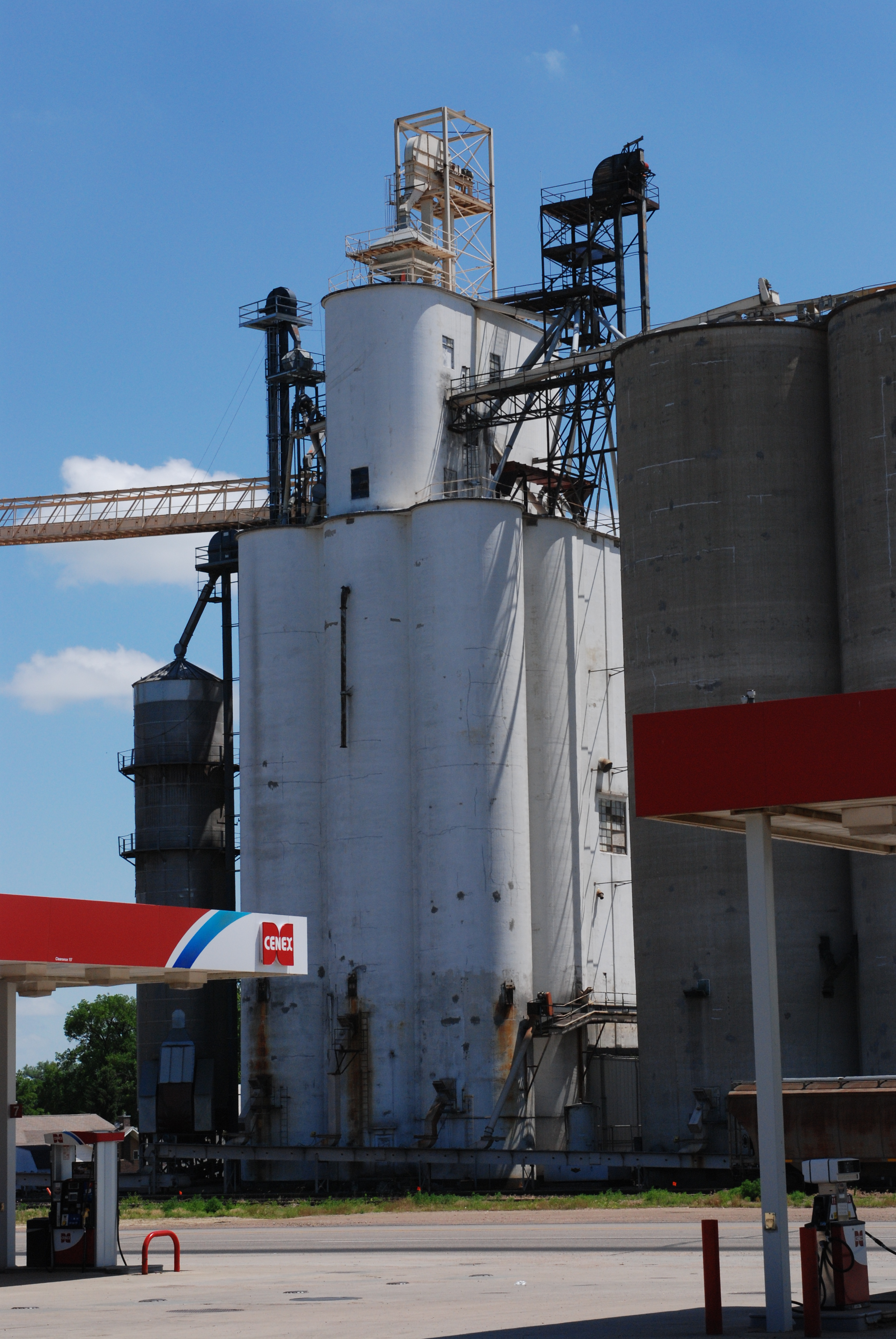
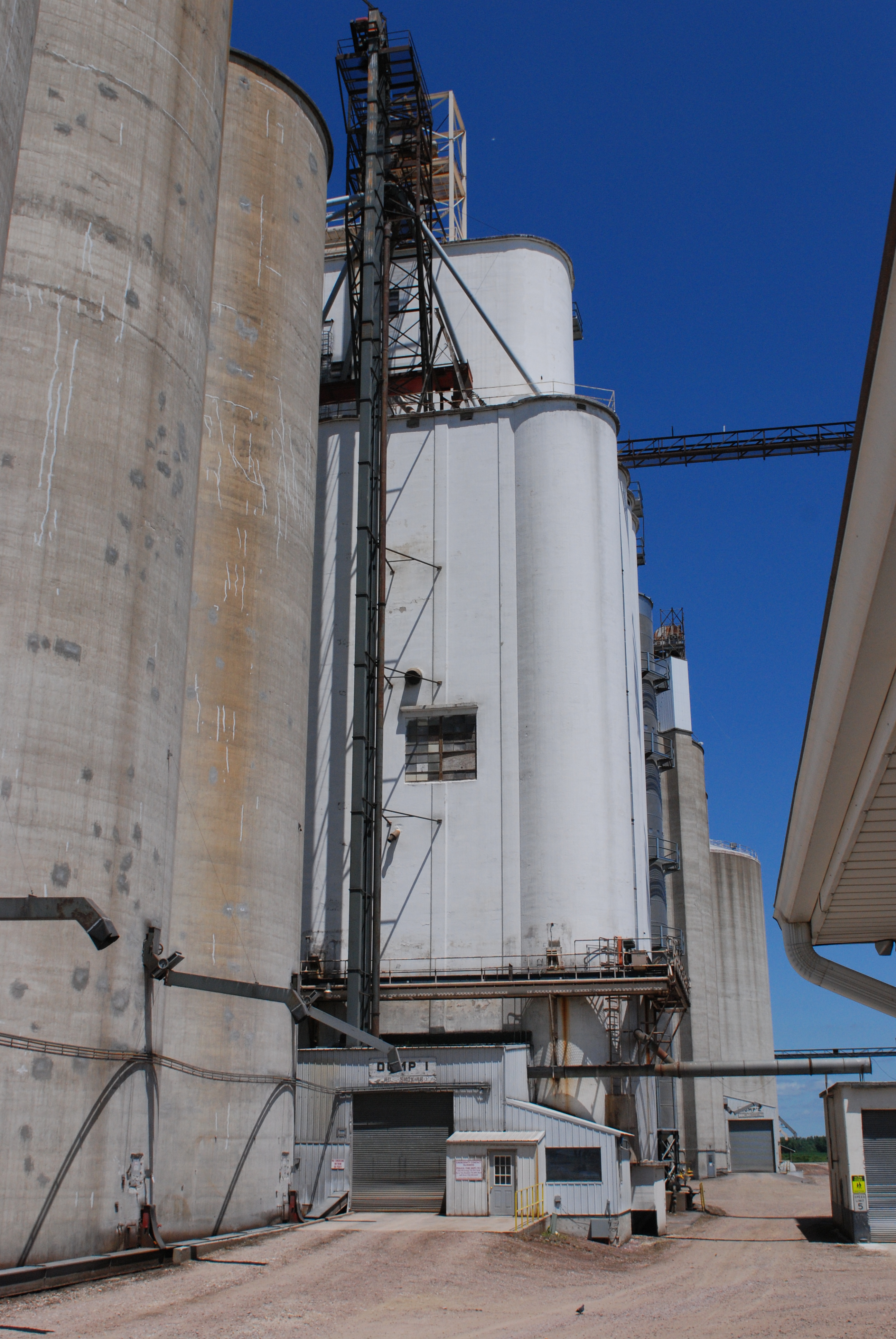
The Hinton, Iowa, grain elevator, anchoring the eastern verge of town along U.S. 75 in western Iowa, looks very little like it did when it first rose in a continuous pour over the flat surrounding farmland. Conveyors and legs and platforms stick out at odd angles from the headhouse–distribution central for the sprawling complex of elevator, drier, and annexes. The long row of grain storage bins and equipment deeply overshadows the eastern side of the highway, which zips past the center of town without a nod to the businesses along the main streets to its west.

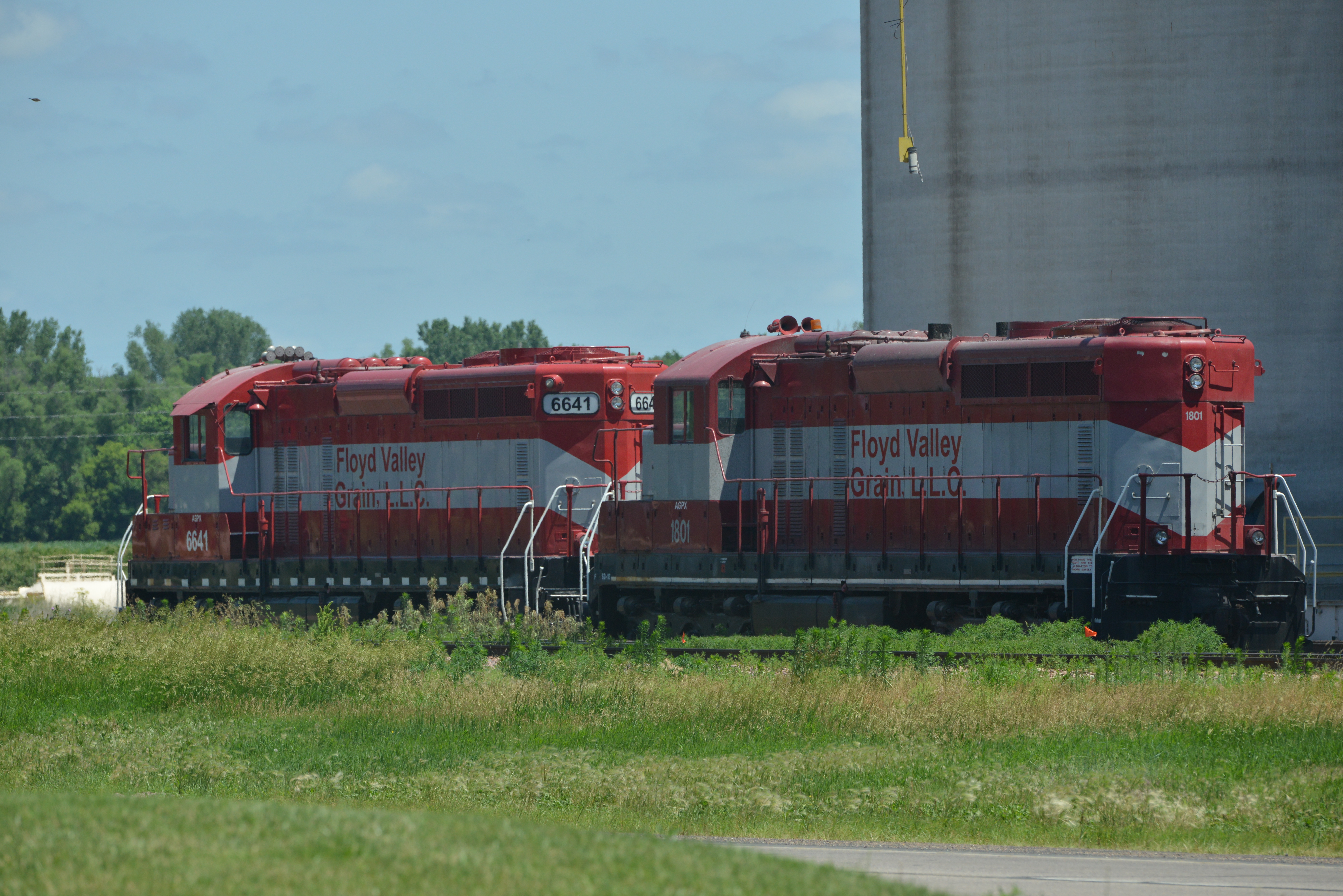
An elevated conveyor crows in red lettering, “Floyd Valley Grain, L.L.C.,” where it may be easily read from the road. To drive the point home, two dedicated locomotives parked upon the nearby rails are painted bright red in the company colors and sport the company name. This cooperative, the advertising seems to say, is the true center of town.

DSC_6412Innovation and modernization bristle from every side of the old Tillotson elevator. The externally installed legs (the parts of an elevator that lift the grain during the loading process) are a later modification taken to prevent grain dust fires: the moving parts that may heat up, such as bearings and motors, are no longer confined in an enclosed space with combustible grain dust. The various conveyors connect to newer annexes that were built when the storage demand outgrew the original elevator. The entire complex has become a far greater enterprise than our grandfathers, builders of the original structures, ever envisioned.

I paged through the Tillotson Construction Company records, preserved in handwritten and carefully photocopied pages, looking for the building specifications for the original Hinton elevator. Unfortunately they were not preserved with the rest. But we know it is a Tillotson elevator from a news item about an accident at the construction site where a man fell to his death in 1954. Perhaps records pertaining to the subject of a potential lawsuit were not with the rest of the file.

The elevator follows a well-tested design, and like the majority of the later Tillotson elevators we have studied, it still serves. It is a fitting testament to the engineering pioneer that was Tillotson Construction Company.

DSC_0455

A Tillotson elevator, fully accessorized when new, remains on call for extra capacity in Cavalier, N.D.

My uncles have said Tillotson Construction Company built elevators in a swath extending from Alberta, Canada, to the southeastern United States. Records show activity in Estill, S.C. and Millet Ville [sic], S.C., for example, but we haven’t seen anything to substantiate the claim about Alberta.

IMG_6962Tillotson was active in North Dakota, though. In 1948, the company built an elevator in Cavalier, N.D. Named for the early settler Charles Cavileer, this town of about 1,300 people–the seat of Pembina County–is located in the extreme northeastern part of the state, about 20 miles from the United States-Canada border.

After finding the elevator on Google Maps, we made a phone call to the CHS, Inc., on Airport Road, in Cavalier. Scott Hansen, who answered, said the complex, pictured above, has capacity for 460,000 bushels, and the old concrete elevator is used for extra space during the harvest.

The record shows it was built on Tillotson’s Sheldon, Iowa, plan with four tanks, each being 14.5 feet in diameter and standing 102 feet tall. Overall capacity was rated at 93,700 bushels.

The job required 1,027 tons of reinforced concrete and 55.13 tons of steel.

At 18 inches thick and covering 1,768 square feet, the main slab supported a gross weight as as high as 5,321 tons. Eight bins were overhead in the 12-by-17-foot driveway.

IMG_6961Crowning the main house was a cupola, or headhouse, of 15.5 x 32 x 22.5 feet, and the pulley center in this single-leg elevator was 127.0 feet above the floor.

Boot and head pulleys were 60 x 14 inches, but the head pulley’s axle diameter of 3-7/16 inches was 1.25 inches greater than the boot’s.

The 14-inch, 6-ply Calumet belt had cups of 12 x 6-inches spaced 10 inches apart. A 20-hp Howell motor supplied the drive in the headhouse. Actual leg capacity was 4500 bushels per hour.

A 2-hp motor operated the man lift. (Lifts in some Tillotson elevators of this era were still hand-operated.)

Cavalier was a fully accessorized elevator, with a 10-bushel load-out scale, an 8-inch load-out spout of 10-gauge steel, and 14-gauge cupola spouting. There was a 7.5-hp truck lift and a dust collection system consisting of a fan, column, and bin.

In the space for remarks at the page’s bottom, we find written, “One end round on cupola.” Yet the photo shows both ends are rounded.

How we would love to know the job’s cost! Alas, a call to the Pembina County historical society revealed that all old copies of the Cavalier Chronicle are out of our reach on microfilm.

A mystery unfolds at the Tillotson elevator of Blencoe, Iowa

This elevator is attributed to the Tillotson Construction Company of Omaha, but evidence points elsewhere

This elevator is attributed to the Tillotson Construction Company, but evidence points elsewhere.

Story and photos by Kristen Cart

In an earlier post, we showed that the elevator built by the Tillostson Construction Company in the northwest Iowa town of Blencoe had a structural failure prior to completion. A photo provided by Tim Tillotson showed that the concrete slumped over the driveway after the slip-form pour had progressed considerably past the point of failure. Construction would have halted there. The question of how the elevator was completed was never answered.

In the company records we have, the specifications log ended by 1956, while the company continued to build elevators beyond that date. So later records are lost to us. Tim Tillotson estimated that this mishap occurred in about 1955. I discovered, on review, that Blencoe was not in the specifications at all. Why?

A photo of the manhole cover on the rail side of the elevator could provide the answer. It is not typical for Tillotson elevators to have exterior manhole covers on elevators of this type, so the existence of these was a little surprising. More shocking was the identity of the company that placed them.

"Grain Storage Const. Co, 1959, Council Bluffs, Iowa" is embossed on the manhole cover

“Grain Storage Const. Co, 1959, Council Bluffs, Iowa” is embossed on the manhole cover.

The Grain Storage Construction Company of Council Bluffs, Iowa, is not familiar to us. It may be the company called in to repair the damage when the failure occurred.

We don’t know if Tillotson Construction was fired on the spot. But it is also possible that Tillotson was given a second chance–the design of the elevator clearly follows the trademark Tillotson design, whether copied by some one or built by the original contractor.

I wonder if the original repair destroyed the structural integrity of the elevator, and Grain Storage Construction was brought in to replace two of the bins. We know it was a later job because of the 1959 date on the manhole covers. Unfortunately, I made my visit on a Saturday, and the co-op was closed, so there was no one there to ask.

It is a beautiful, functional elevator today. It stands beside the older Mayer-Osborn elevator, which is also clearly in use sixty years after it was built. Both elevators had problems during construction, but the capacity was urgently needed, so both projects were finished. How the Tillotson elevator ultimately became a Grain Construction Company branded elevator is a mystery we will try to solve in a future post.

DSC_0427

A low-wing airplane sped up business for Tillotson Construction Company

Navion

Commentary by Tim Tillotson

Note: What follows is from a phone interview on May 14. Here, Uncle Tim recalls flying with Tillotson Construction Company’s pilot Ted Morris.

I remember taking a few trips in that Navion with him. It was one of the last planes Dad bought, the only one with a low wing. That Navion was fast, too, a faster plane. I remember being with him somewhere–where the hell were we?–trying to find a spot to land and picked a spot that looked absolutely wonderful from up there. We didn’t realize till we were almost on the ground that the spot had three-foot-tall grass. We went plowing through that grass and also an electric fence that was in the middle. We had to plow our way out.  

Dad [Reginald “Mike” Tillotson] could never get a license because he had double hernia and all that. Ted was our pilot and we also had Marvin Melia, he flew dad, too. Marvin was giving me flyin’ instructions. We’d go out there to the airport, North Omaha. Marvin’s the one that flew Dad around. They didn’t fly every day, or every week necessarily. He’d been flying Dad two years before. 

Ted came back from KS one time in that Navion, and he said something about, “Let’s go home fast.”

So he’s flying like 200 feet off the ground, really a lot of fun. He radioed in to get clearance for landing, and the communication that came back said, “Where the hell are you? We cant pick you up on the radar!”

Ted said, “I guess we better get up off the deck so they can see it.” 

Neglecting to lag an elevator’s head pulley led to disaster in Bellwood, Neb.

Commentary by Tim Tillotson

Note: What follows is from a phone interview on May 14. He tells of a grain elevator repair job undertaken for Ted Morris, who by 1959 was a former employee of Tillotson Construction Company.

From left, Tim and Chuck Tillotson and La Rose Tillotson Hunt in 2012.

From left, Tim and Chuck Tillotson and La Rose Tillotson Hunt in 2012.

Ted Morris was the pilot. He worked in the office with Wayne doing the drawing and getting the specs together. He flew Dad when Dad would go out to the jobs. Ted used to take me flying out to the job. He was a fun guy, good natured. He tried going into business himself. Matter of fact, when Mart and I got married, we went out to York, Nebraska, to do a repair job that he had a contract on, in the dead of the winter. That was in ’59. It was Bellwood–the one that had the explosion. It blew the damn headhouse apart. Mart and I were married in November ’59 and we went out.

They were dumping grain in the drive pits to feed it up to the tanks. It was cold and also windy, I believe. When they rolled the damn overhead doors down to shut off the wind tunnel through the drive, the dust built up and that was also a job … I don’t know who decided not to lag the head pulley; it’s like putting a tire on a steel wheel. I don’t know what the hell was supposed to be such a big savings. I don’t know we were the only ones that did it, the other grain elevator contractors did, too, they quit lagging the head pulley. That big pulley would slip for a little bit till it got some speed up. Eventually, they found out the hard way, it was taking the facing off the back of the belt and exposing the fiber web in it. The damn web spots would get hot and start on fire.

Conveyor_head_pulley_lagging_for_V_shaped[1]They called it lagging because they’d fasten or wrap a lag of grain elevator belt around real tight like a rubber tire to give it grip.

When I say we would lag the pulley, we didn’t do it. Where we purchased the pulley, they did it before they shipped. There was supposed to be some kind of cost savings. When you’re trying to pull 110, 120 foot of belt, with grain, it takes quite a bit to get thing rolling.

I guess because of the wind, they closed the overhead doors. The dust built up from the trucks just dumpin’ that grain, you can imagine, and it built up, The fire actually started in the boot pit. They were running that grain up, and I think they stopped the belt for a little bit because somebody went down into the pit to grease the bearing, and there was a fire and it exploded. It slammed him into the little steel ladder. The fire went right up the leg well, which was full of dust, and it just blew out in the headhouse.

The distributor floor was quite a height off the roof deck in the headhouse, and of course it was up overhead. You had to have some heights for the spider legs that went out to the tubes. That’s where it did its big explosion. It had enough force to actually bulge the headhouse walls. The distributor floor was concrete but held in place by a key way in the headhouse wall. They call it a key way when you slip the headhouse walls at a certain level. You put tapered two-by-four blocks in the forms that you could peel out later like teeth, so when you poured the floor it went into the keyways and that’s what held the distributor floor walls up. The explosion bulged the headhouse walls out so that they turned loose that distributor floor, which left it standing on the feed pipes that went into the tanks.

I’m trying to remember if Bellwood was the one with the galley out to the annex blowing the windows out of it, and it knocked the tripper–a little feeder that went out across the annex building and would fill whatever tanks you wanted–off its tracks.

The Bellwood Gazette reported the Holland Brothers' elevator fire in 1902.

The Bellwood Gazette reported the Holland Brothers elevator fire in 1902. It was the third elevator that had burned “inside of a year,” and as the town was gaining such notoriety, the Gazette was considering becoming a daily paper.

They were doing the repair on it. I think we pulled off because the temperature was so damn low you couldn’t put your bare hand on a piece of metal; it would stick. I remember we come back into Omaha and wasn’t out there that long. Mart and I came back to Omaha, stayed at my Uncle Ralph (Hassman’s) house, Johnny’s dad, before we got that apartment on the second floor of an old house that was turned into an apartment on Izard Street. That’s when I went to work for Leo A. Daly, the architects, in Omaha, for $300 a month. I went to work for them on the drawing table.

We were actually in York. It might have been a different repair job. Now that I think about it, I’m not even sure it was one of Dad’s elevators. We were married on Armistice Day of ’59. We had to be out there in December. I was working for Daly maybe a week when Dad passed on January 5, 1960.

The York job was a repair, and it was a repair from an explosion but nothing compared to Bellwood. I remember we were up in the headhouse when were there. The one asshole I didn’t know, and either did the other guy. He loaded, like, a shoebox on the floor with acetylene ’cause it’s a heavy gas, and it laid down in that box, and he turned around and threw a match over there and that that box blew up. I damn near ran off the frigging roof to get out of that headhouse. He thought that was so damn funny. I was about ready to bust him. I don’t like his sense of humor.  

Ted wasn’t doing well at the business. I remember a time or two he called Mother. He was distraught, he wasn’t making it. I don’t remember what happened to Ted.

Making sense of a chimney near a wooden elevator in Alta, Iowa

scan0018

Commentary by Tim Tillotson, photo from the Neil A. Lieb archive

Note: What follows is from a phone interview on May 14. Uncle Tim is speculating about the reason why some Tillotson Construction Company employees stayed behind for this small job after completing the concrete elevator at Alta, Iowa, in the summer of 1950.

That chimney is probably about 30 inches in diameter. They’ve got a mortar mixer down there for masonry, a hand line going up, and the framework is scaffolding. The building in front is eight-inch block. Every three blocks is two feet. The building is 12 foot to the eaves.

There’s a reason for that damn stack, and it’s got to have something to do with fire down below. [Brother] Charles [Tillotson] said it could’ve been an iron-working shop.

Why does that car have chock blocks front and rear? Is it some kind of an anchor? It’s a 1935 or 1936, possibly DeSoto.

If you were burning coal, you wouldn’t get sparks. Maybe they were baking bread, cornbread. They’re carrying that stack high enough to get above the wooden elevator. What the hell it could be made of to be that thin and not be braced?

I don’t understand what’s with the masonry mixer down there. If that stack, for example, was a heavy metal tube, I don’t know that you could plaster it.