Texas and Oklahoma road trip takes us to 20 elevators (so get ready)

By Ronald Ahrens

This Ford Ranger violated Tesla parking en route to Texas and Oklahoma.

Get ready for a series of posts on Our Grandfathers’ Grain Elevators.

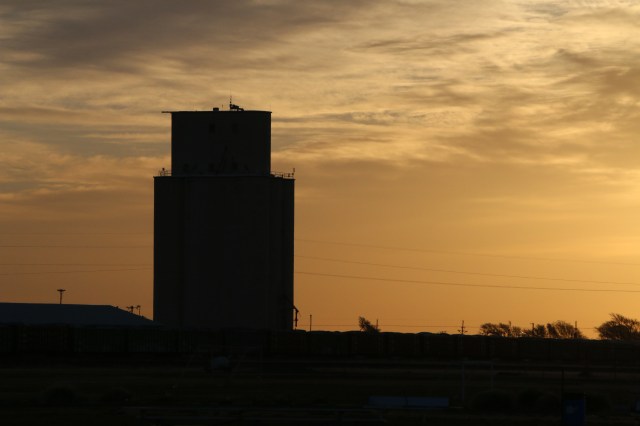
On April 15, I set out on a road trip to the Texas Panhandle and Oklahoma to see elevators built there between 1939 and the mid-1950s by Tillotson Construction Co.

This was a long-desired destination, as my grandfather, Reginald Tillotson, and his brother Joe Tillotson (until their partnership dissolved), built at least 10 reinforced-concrete elevators in the Panhandle and closer to 20 in Oklahoma. 

Texas-Okla Logo 04The company’s first concrete elevator, dating to 1939, was built in Goltry, Okla., and I was able to visit it.

So as I say, get ready.

I have 410 photos on one memory card and haven’t even counted those on the other card that’s still in the camera.

I saw a nice range of elevators including a surprise Mayer-Osborn one in Follett, Texas–built by my partner Kristen Osborn Cart’s grandfather after he worked for my grandfather.

Our Grandfathers’ Grain Elevators gets inside the main house at Booker, Texas.

I got inside some elevators, met interesting people whom you will also meet, and even have a few trip notes to share.

For example, avoid the Hereford Inn, in Hereford, Texas. Yes, it’s right across the street from the Tillotson elevator. No, you shouldn’t stay there. The owners have done nothing to update the rooms; flimsy mattress, wilted pillow, skimpy towel. And it sounded like the trains were coming through the room. At least there was hot water.

For the same $60 price, I stayed the next night at the Nursanickel Motel in Spearman, Texas. That place was quite nice and cast its shadow on the dump in Hereford.

And here’s a culinary tip: Smrcka’s Dairy Shack, in Medford, Oklahoma, serves a fantastic Czech sausage sandwich with sauerkraut. And the fries are incredible.

The Czech sausage sandwich in question.

With limeade, it came to $8.38.

If you have the same counter-attendant that I had, don’t try to make small talk because she’s super-crabby.

So stay with us for our Texas-Oklahoma series over the next few weeks.

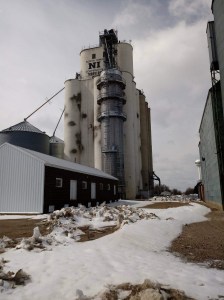
Our correspondent visits the 1955 Tillotson elevator at Thornton, Iowa

IMG_4663

Photos by Rose Ann Fennessy.

So windy it was in Thornton, Iowa, Rose Ann Fennessy was sidestruck by the blast.

“I could barely hold the phone still,” she reported.

Rose Ann had asked about any Tillotson elevators on the route from Omaha to Minneapolis, where the Twins opening day awaited. Maybe Ames, Iowa, for example?

A quick check of records found Thornton (it’s by Swaledale) along I-35. Rose Ann decided to stop there on the way back.

The Thornton elevator offered capacity of 252,000 bushels. The main slab is 62 ft x 74.5 ft, making it 4,360 sq ft in area and 21 inches thick. Altogether, 2,111 cubic yards of concrete were used. 

Gross weight loaded was rated at 12,956 tons. This was a big elevator for the period.

Today the elevator, located at 105 S. 1st St., is operated by North Iowa Cooperative.

Tall, too. The draw-form walls of the silos are 120 feet high. The house is capped by a cupola, as the Tillotsons always said, while others say headhouse. This feature is 23 x 58 x 40.5 ft.  It makes the whole structure 178 ft tall.

IMG_4664

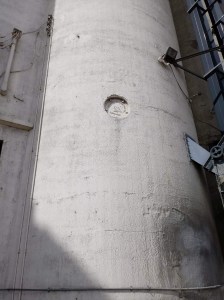
The manhole cover is embossed with Tillotson Construction Co.’s name.

“Very bitter cold winds and lowering gray clouds,” Rose Ann said when heading back from Minneapolis. Nevertheless, from the stop at Thornton, as promised, she delivered a fine portfolio of views.

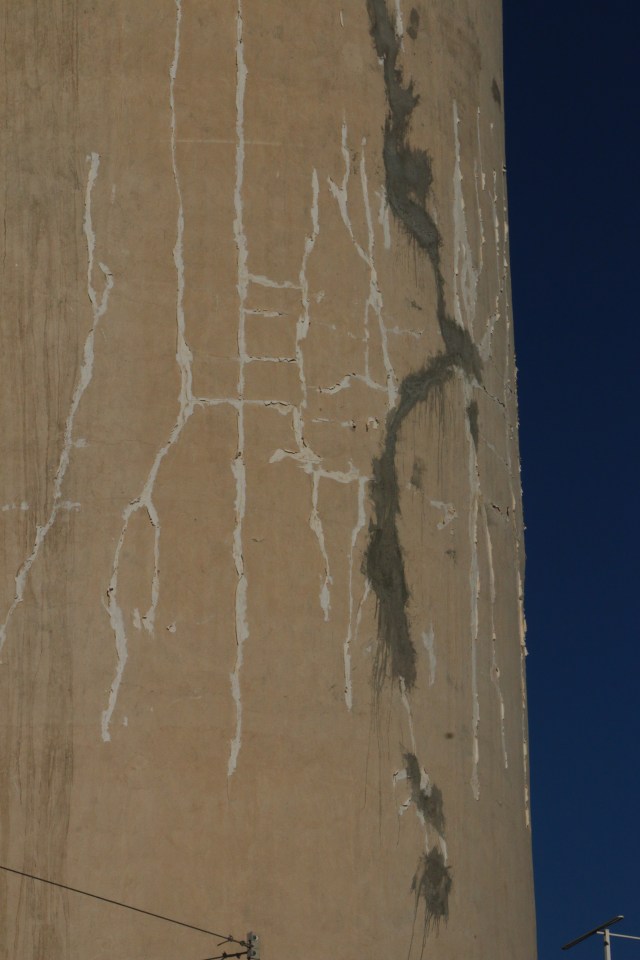
The Tillotson elevator appears to have withstood a nasty case of measles. Otherwise, what a fine bright-faced elevator.

“I’m sorry they are not better,” Rose Ann said, sounding like she’s trapped in a Jane Austen novel. “It was so so windy that I quite truly was almost blown off my feet.”

A little spring gale between Omaha and Minneapolis.

“Home,” she next said. “Snow! 2 inches on the ground here! My poor crocuses are buried!” 


Home-built travel trailers and the demise of a tricked-out ’53 Ford in Iowa

HomemadeThe topic of staying in a travel trailer while working at grain elevator construction sites has prompted Charles J. Tillotson (“Uncle Chuck”) to do some reminiscing and dig through his archive of photos.

He writes:

The first one is a photo of the last trailer Dad built in 1937, which was an upgrade to the one that your mom and I are standing in the doorway of. He had covered the exterior of this trailer with some kind of protective fabric, which doesn’t seem to be attached very well.

The previous trailer had an exposed plywood exterior that was either stained or painted and it evidently didn’t hold up. The focus should be on the small size of the trailers which were probably about 15 feet long, much like the size of the early camper trailers of the 1950s and 1960s. If you allow room for the stove, toilet, closet and even a fold-down tabletop with a little settee, where did we all sleep?

The photo [below] was taken in late summer in Albert City, Iowa, and shows my Dad and me standing along side of my 1953 Ford with another older gentleman who I assume was the Albert City superintendent packing something into the trunk. We had finished up our work on Albert City, and Dad had assigned the three of us to travel across the state to a job he was starting in Clinton, Iowa.

Reg&Chas

Soon after the photo was taken we three boys [Chuck, Tim, and Mike] left Albert City and took along with us a couple of men who wanted to continue working for Tillotson Co. We took off in my beautiful ’53 Ford, which I had modified with a two-tone paint job, a Continental fake-spare-tire kit (remember those?) and lowering blocks among other things. I was driving very fast and in a pattern learned from my Dad, taking short cuts via the old one-mile graveled country roads through the tall cornfields. Zooming along and approaching an intersection ahead I spotted a dust trail from a vehicle approaching the same intersection on my right. With the road being gravel I decided that rather than stop for the oncoming vehicle (that had the right of way) to instead outrun it.

I had almost made it through the intersection when the oncoming vehicle clipped my rear bumper and put me into a sideways spin. I countered the spin by yanking the wheel in the opposite direction which brought me out of the spin, but the action was so fast it put me into another spin in the opposite direction. We zigzagged back and forth for a bit and eventually headed into a huge irrigation ditch, which we entered, rolled over, and flipped upside down. I remember my bro Mike standing up in the back seat hollering at me to ‘straighten out the car’ but to no avail. I think there were five of us in the car including my bros, none of which had seat belts fastened but by some miraculous ending, we were all able to crawl out of the car without a scratch.

The farmer who hit me was a local fellow, and he rounded up a tractor with an operator and the car was pulled back upright and out of the ditch, whereby it was towed off to a local mechanic’s shop.

I don’t remember who came to rescue us, but somehow we continued on to the Clinton job where we put in some closing days of the summer, laboring there. 

Ford&trailer

When it came time to go home, my bro Tim and I went and picked up the Ford which still was operable (a testimonial to Ford), but the vehicle had multiple dents and bruises including missing a windshield which had been knocked out in the crash.

Tim and I bought a pair of goggles and proceeded to hit the trail (in a light drizzle) to Omaha with the wind and rain in our hair and elsewhere. My Dad knew of the accident but he had never seen the car until we got home whereby he came out of the house and I’m sure almost had a heart attack when he viewed the pile of junk that once was my beautiful ’53 Ford. As I recall, he had the car towed away to the junk yard.

It’s funny how viewing old photos can bring back memories of both the exciting and dull days gone by. It’s too bad the photographs taken today are no longer hard-copied by most people and their memories no longer documented to tell the stories of days gone by for both their own revisitation as well as their offspring.

A postcard reveals Tillotson elevator activity before the big changes of 1938

Post Card 01

We have found what may be a rare record of the Tillotson construction enterprise as it existed before 1938. Back then, Charles H. Tillotson led the company, which specialized in wooden elevators. After he died in ’38, his sons Reginald and Joe partnered in Tillotson Construction Co., and started to experiment, and then build, with reinforced concrete.

This card from July 2, 1936 is penned by Sister Mary Concepta, the older sister of Margaret Irene McDunn Tillotson (my grandmother) and sister-in-law to Reginald.

Sr. M. Concepta, born on Sep. 27, 1901, in Emerson, Nebraska, and christened Catherine McDunn, was the second of nine children. (Margaret, born Feb. 9, 1903, was third.) Sr. M. Concepta belonged to the Sisters of the Presentation of the Blessed Virgin Mary, with a motherhouse at Mount Loretto in Dubuque, Iowa.

The parents were William McDunn (b. Feb. 4, 1871, Des Moines, Iowa) and Bridget Loretta Dorcey McDunn (b. March 27, 1872, Luken or Lucan, Ontario). Records show William as a laborer in Omaha in 1891. He became a conductor on the Nebraska Division of the Chicago, St. Paul, Minneapolis & Omaha Railway, and the family became established in Emerson, the town named for Ralph Waldo Emerson, which had come into being in 1881 at a junction on the CSPM&O (known as the Omaha Road). 

The family history comes from These U.S. McDunns: Family Tree of Patrick McDunn and Mary O’Donnell, compiled by John McDunn, of Lodi Wisc., in April 1989. The McDunns homesteaded in Pennsylvania in 1835. 

My Uncle, Charles J. Tillotson, whose name appears in many of this blog’s posts, had kept his grandfather William’s railroad watch–a Hamilton, of course–until a burglar struck in the late-1980s.

Post Card 02Uncle Charles notes that in the mid-1930s Reginald and Margaret lived with the elder Tillotsons at 624 N. 41st Street. They towed a travel trailer to job sites. In early July of 1936 they would also have towed along Uncle Charles, then 18 months old, and my mother Mary Catherine, who was nearly five months old.

On this postcard Sr. M. Concepta addresses her sister Margaret (Mrs. Reginald Oscar Tillotson) at Carlyle, Neb.

Carlisle–note the difference in spelling–is an unincorporated town in Fillmore County.

“I know the name because Mom used to talk about it,” Uncle Charles says.

We presume there was a wooden elevator. Carlisle is an unincorporated community in Fillmore County, about 135 miles southwest of Omaha. It doesn’t appear on our Rand McNally page nor does Google Maps seem to know anything about it. 

MapThe USGS gives coordinates for Carlisle on its Davenport Quadrangle map (named for a town in neighboring Thayer County), and we see a speck on Road X, west of Little Sandy Creek, that could be Carlisle. We called the Fillmore County sheriff’s office, in Geneva, and asked. “Nope,” a very nice woman said. “We don’t have a Carlisle.” 

Whatever.

“Dear Margaret + Reginald + babes,” Sr. M. Concepta begins.

Post Card 03“This card tells you where we are. Saw your Mother and Mary, Reginald. Mary is truly a nice girl and your mother surely is not strong. Won’t be leaving here now until Sat. morning. Just thought you might be coming in for the 4th. Don’t try it just for me though. Love, Sr. M. Concepta.”

Mary Tillotson was Reginald’s sister who became important to the family business and also is named in many posts here.

It’s hard enough to find a trace of Carlisle, but we would love to know if any remnant of a wooden elevator exists there.


Conversation with Sherman Johnson, scion of Johnson Construction, of Salina, Kansas

We were happy to be able to give Sherman Johnson a call the other day. Sherman, a flooring contractor in Shawnee, Kansas, is one of Virgil Johnson’s six sons. Johnson Construction, Virgil’s contracting firm, operated out of Salina, Kansas, and built a whole lot of elevators. We have speculated about the existence of a strong link, perhaps a common architectural designer, between Johnson Construction and Mayer-Osborn Construction. Johnson Construction sometimes acted in partnership with Rex Bratcher, and we know something about Johnson & Sampson. The design themes spread through those channels.

AtlantaKansas

Brad Perry took this photo in Atlanta, Kansas. “I think it’s a Johnson house,” he said. The rounded and stepped headhouse suggests Mayer-Osborn and Tillotson design influences.

Sherman was born in 1945 and went to elevator construction sites as a kid. “I remember going to Texas and Oklahoma. We lived in Salina, but most of the jobs were in Oklahoma and Texas, in the Panhandle of Nebraska, and in Iowa.” 

We had many other questions for Sherman, and he tried to help as much as possible. One thing he seemed pretty certain of was that Virgil talked about Tillotson Construction Company, of Omaha. “I heard my dad talking about them!” he said. “My father, he worked for Tillotson, I think. I don’t know for sure. I heard the name Tillotson, Chalmers and Borton, people like that.” 

Kristen Cart: Do you remember being on any job sites when you were a kid?

Sherman Johnson: Oh, yeah.

KC: Are there any memories you’d like to share?

SJ: Oh, like I said, I was just a kid. I remember going to Texas and Oklahoma–Newkirk (Okla.) and Blackwell and Conlon, Texas.

Ronald Ahrens: How long was Johnson Construction active?

SJ: As near as I can tell, at first it was my father and my uncles. And then Rex Bratcher was his partner for a while.

KC: The Sampsons were your uncles?

SJ: My dad’s wife’s brothers, Darwin and Sherman. I’m named after one.

RA: Do you remember the name Darrell Greenlee?

SJ: Darrell and Rosina. They were very, very nice people, great people. They had six girls.

RA: He was a foreman for your dad’s construction company, right? 

SJ: Superintendent.

RA: Can you characterize him?

SJ: In the summertime I had to work for him, and he worked me pretty hard. He was a good guy: a hard worker, a smart guy. We’d go out in the summertime, I don’t remember what the jobs were, they had me doing all the grunt work. I guess that’s why I’m not a contractor. 

KC: My dad described installing rebar.

SJ: Laying it and tying it. And it seemed like you always had a shovel in your hand doing something. 

KC: We had comments from Emily Frank, whose grandparents were Darrell and Rosina.

SJ: He built an elevator in Rushville, Illinois, and he retired there. If she’s still alive, she’s there. I don’t know if she’s still alive or not. 

Editors’ note: Here is the link to Rosina’s obituary.

KC: A couple of jobs, I’m going to ask if they’re familiar. Grand Island?

SJ: I don’t know.

KC: Atlanta, Kansas?

SJ: That rings a bell but I wouldn’t tell you that we did.

KC: One of the things we do is visit the elevators, and right on the manhole covers is the name of the company.

SJ: Oh, yeah. They used to make those at Wyatt Manufacturing in Salina. There was a foundry for a long time.

Records for Tillotson’s Minatare, Neb., job include specs, give total cost picture

Story by Ronald Ahrens, photos by Kristen Cart

The small concrete elevator in Minatare, Nebr., is the oldest we have visited that was built by Tillotson Construction. After forming in 1938 as a partnership between Reginald and Joe Tillotson, and with their sister Mary also involved, Tillotson Construction built their first concrete elevator in 1939 and another in 1940. Both were in Oklahoma. But 1941 was a big year with five elevators, a pair of which, also in Oklahoma, were quite large with capacity of 212,000 bushels.

The Minatare elevator in this town in eastern Scotts Bluff County was built according to a plan original to the site. Company records show it had a side driveway with bins over the drive, 11 bins, two tanks with capacity of 16,000 bushels and two with capacity of 15,300 bushels.

The elevator and dryer stand idly by the Minatare rail siding.

Construction details show 690 cubic yards of reinforced concrete were used and 27.5 tons of reinforcing steel.

Gross weight when loaded was 3,377 tons.

The drawform walls rose 100 feet, and the cupola’s dimensions were 15 feet wide, 28 feet long, and 18 feet high. The center of the head pulley was at 116.16 feet above the ground.

This was a single-leg elevator. The head pulley was 48 x 14 x 3 7/16 inches, which was an inch and a quarter wider than the boot pulley. A 15-horse Ehrsam motor turned the head at 48 rpm. Leg capacity isn’t listed.

What is listed, though–and we find this quite exciting!–is information about costs that the company records exclude after World War Two.

The grand total for Minatare was all of $19,578.04 less commission. Here is a breakout of individual categories:

  • Labor: $5,526.83 at the rate of 35 cents per hour straight time and 60 cents for overtime
  • Cement: $2,590.75
  • Sand (30,000 cubic yards): $1,149.60
  • Reinforcing steel (J-rods, wires & nipples): $2,156.01
  • Lumber: $835.03
  • Machinery: $4,172.77
  • Structural Steel: $$772.53
  • Electrical materials: $155.07
  • Doors & windows: $47.36
  • Painting & waterproofing: $65.83
  • Hardware (bolts, nails, etc.): $169.71
  • Equipment Expense (depreciation, rentals, etc.): $246.29
  • Freight (not included above F.O.B. job): $509.51
  • W.H. tax & Ins.: $723.82
  • Miscel. (overhead, job office, plans, bond, etc.): $457.11

Double-checking the numbers, we find the total of 19,578.22. That’s 18 cents higher than the amount stated in the records.

The co-op office attached to the elevator. Grain weight and quality were assessed here.

What we would like to learn next is how Tillotson Construction landed those early jobs like Minatare. And how much was the commission?

We have the sense there are more records available at the locations to help us learn about our grandfathers’ grain elevators. One of these days, we want to visit Goltry, Newkirk, Douglas, and Medford, Okla., just for starters, to learn what we can about those early days.

A slip-formed lesson in character-building at Blencoe, Iowa

Mayer-Osborn pay stubs from August, 1954

Mayer-Osborn pay stubs from August, 1954.

Story by Kristen Cart

Just when you think you know all there is to know about your parent, you find a document that tells you something more. In this case, I found the pay stubs for when my dad, Jerry Osborn, worked for Mayer-Osborn Construction Company in 1954. He wedged a few weeks of hard labor between school in the spring and football in the fall.

The project was a large elevator similar to the first elevator Bill Osborn built with his partner, Gene Mayer, in McCook, Nebraska, in 1949. This example of the type went up in Blencoe, Iowa–and not without incident, as we have related in this blog.

It struck me that his pay rate was just that of a laborer. No cushy job for the son of the boss was offered–he laid steel rebar down during the uninterrupted concrete pour, working his way around the bin top as workers jacked the forms and scaffolding ever higher. Dad mentioned that when he worked for his father, he was paid the same as everyone else–a dollar an hour for back-breaking labor. Not a few times, laborers walked off the job after the first paycheck. It wasn’t easy.

Dad managed to find something to do on the job that was worth even less–he put in a fair amount of time at fifty cents an hour. I can only imagine what that job entailed.

kimberly-osborn188

Jerry Osborn had interests other than building elevators for his dad. He was a champion golfer at Midland College. It seems odd that a good golfer, while cultivating the skill and concentration such sport required, would take time out to heave rebar for a summer job.

I’m not sure which year they won the championship, but I like the juxtaposition between the brutality of the labor and the finesse of golf.

kimberly-osborn186

The summer job added up to a tidy sum for the time. Perseverance paid off.

These days, many of our college-educated young people seem too delicate for such work, especially in exchange for such a meager reward. It would make no sense to them.

But my grandfather, William Osborn, might say that this kind of work built character. Especially if you showed up for that second and third week.

Part of the latest craze, grain elevators get mysterious visitors at all hours

A van drives up, hesitates, and pulls into the lot in front of the town’s towering elevator complex. The vehicle has been seen in town before, roving the streets aimlessly, only stopping in odd spots long enough to be noticed. At the elevator, it pauses in the parking lot for thirty seconds, then it drives off.

Pokemon Elevator 01Not long afterward, a pair of local high school students walk up, dawdle for a moment, then walk on. Then a couple of twenty-somethings perch on a park bench across the street. They stay for about half an hour, studying their smart phones intently, while a few more cars come by and park. No one gets out of their cars, but they stay for awhile. A few more pedestrians gather.

Pretty soon you can count fifteen or twenty people on the sidewalk in front of the elevator, under the trees across the street, or parked here and there. Then, as if an invisible timer went off, the people leave in twos and threes. A similar gathering starts up a few blocks away, at the post office. What in the world is going on?

You guessed it, Pokemon-go has arrived in your town. For those of you who have not encountered it before, it’s a virtual-reality pocket-monster hunt, sort of like a treasure hunt, where people go to designated points to get the needed items to catch the little critters that appear on the screens of their smart phones. If a “lure” is set up at one of those points, the little Pokemon appear on the phones in that geographic vicinity, and people start to congregate to catch them for the half-hour that the lure lasts.

That is the short version. It’s easy to play and gets kids out of the house–which makes it a good thing, in my book.

If you sit back and watch the action in any little town you will see players roving the streets or driving in circles. It can be quite fun to watch (or play, if not taken to extremes).

What does this game have to do with a grain elevator? Not very much, except that a grain elevator makes a mighty big landmark, and a tempting spot for the game makers to place a Poke-point. So, players: take this as a warning–watch out for grain trucks, and don’t wander around the property with your face planted in your cellphone.

I confess that catching the little critters is somewhat like driving around the country hunting for interesting elevators. But you don’t have to burn as much gas.

Another look around Wahoo, Neb., yields treasure beyond reinforced concrete

Story by Ronald Ahrens and photos by La Rose Tillotson

The bend on Route 92 as it entered Wahoo, Nebraska, from the east was always welcome. Here, the road dipped down and crossed Sand Creek at the edge of town, then turned into leafy neighborhoods. It was the first shade for us after more than 30 miles under the sun on the flat prairie.

Wahoo was a frequent waypoint when our family visited relatives in David City farther west.

A site of interest in Wahoo was the Saunders County Courthouse, where a torpedo was displayed near the curb. Even when I was eight and nine years old, the torpedo seemed incongruous, being so far from the sea. But we Nebraskans were starved for variety, and leftover munitions from a distant war were deemed tasty morsels.

Tillotson Wahoo 01

Never did it occur to me that the Wahoo grain elevator had been built by my grandfather’s company. We knew he built elevators but assumed they were in far off places like Iowa.

Kristen Cart has already visited Wahoo and written one post.

But there’s new reason to think about the town after Aunt La Rose Tillotson drove there on a recent tour of the countryside. She forwards the pictures you see here.

As a young woman, Aunt La Rose lived in Wahoo for a short time. While going about her daily business, she never gave much thought to the elevator that stands along North Chestnut Street between Fifth and Sixth.

This isn’t a surprise, as a form of amnesia touched many family members after the family business faded out. Grandfather Reginald died in 1960.

Tillotson Wahoo 02

Here are some particulars of the Wahoo elevator:

Tillotson Construction Company used the same plan as from Imo, Okla., which had also been built in 1950. That meant a 150,000-bushel elevator rose from a 54- by 51-foot slab over a pit nearly 16 feet deep. The drawform walls were 120 feet high, and the cupola topped out after another 26.5 feet.

From atop of the Wahoo elevator, you could probably see all the way to Swedeburg, looking south, and Malmo, looking northwest. (Prague–home of Czech Heritage Days–was just a bit northwest of there.) It’s doubtful, though, you could see as far as Valparaiso, in southwestern Saunders County. Ulysses, way to hell and gone in Butler County, was out of the question.

Some other noteworthy aspects of the Wahoo’s single-leg elevator were its use of 3,056 tons of reinforced concrete and its gross weight, when loaded with as much as 4,500 tons of grain, of 8,216 tons.

I don’t see anything else in the specifications that distinguish the Wahoo elevator all that much from Imo, or for that matter, David City, which was built the next year because whatever Wahoo did had to be done in David City, too.

But no other place was like Wahoo. Wikipedia says the name comes from an Indian word for the shrub Euonymus atropurpureus, which yields arrow wood. But who believes it? I think they’re covering up for the day in 1870 when two large casks of beer fell off the delivery wagon.

Remember these four things about Wahoo:

  1. Wahoo Sam Crawford came from Wahoo, played outfield from 1899 to 1917 for the Reds and Tigers, and still holds the Major League record for most triples (309). He was elected to the Hall of Fame in 1957.
  2. A wahoo (Acanthocybium solandri)  is a sport fish in the tropical oceans, but as far as I can tell it isn’t the official fish of Wahoo. Lake Wanahoo is barren of wahoos.
  3. Wahoo was a long-running gag on Letterman.
  4. Pulitzer Prize-winning composer Howard Hanson (b. 1896), three-time Academy Award-winner Darryl F. Zanuck (b. 1902), and Nobel Prize-winning geneticist George Beadle (b. 1903) came from Wahoo.

How many towns of Wahoo’s size–about 4,500 souls today–have produced a Hall of Famer as well as Pulitizer Prize, Academy Award, and Nobel Prize winners?

Beyond all that, Wahoo has a Tillotson elevator.

A tour of Odebolt, Iowa, reveals much about its historic Mayer-Osborn elevator

The Mayer-Osborn elevator in Odebolt, Iowa was one of the few they built that was never painted white.

The Mayer-Osborn elevator in Odebolt, Iowa was one of the few they built that was never painted white.

Story and photos by Kristen Cart

Recently, I took a detour quite out of the way of the Interstate system to visit the town of Odebolt, where my grandfather, William Osborn, built an elevator. I introduced the western Iowa site in a previous post.

Tim pointed out the bin diagram for the elevator.

Tim pointed out the bin diagram for the elevator.

Tim Gunderson made a great tour guide for the site and the town. The part-time elevator worker and full-time farmer wanted to know the age of the Mayer-Osborn elevator as much as I did. It was an old stepped-headhouse, slip-formed, concrete elevator in the style of earlier Mayer-Osborn efforts in McCook, Neb., and Roggen, Colo., and it stood at the center of a sprawling grain operation.

During our inspection of the elevator, we saw tantalizing details that indicated mid-1950s architecture. The mechanical workings (never altered during renovation) recalled intact examples of my grandfather’s previous work. The reliance on mechanical controls was a clue to the early design.

The big wheel controls grain distribution to the bins. It is a simple, elegant solution to a mechanical problem.

The big wheel was a simple, elegant (mechanically speaking), way to distribute grain to the bins.

Most of the standard clues to an elevator’s age were absent or misleading. The manhole-covers inside the elevator bore no date (usually they do), but perhaps Mayer-Osborn ordered a quantity of manhole-covers, embossed with only their name, toward the end of their operations in the mid-1950s.

The "blue leg" is an original, painted in Mayer-Osborn's standard color

The “blue leg” is original, painted in Mayer-Osborn’s standard trim color

The elevator showed no signs of exterior paint. This was a deviation from the norm, and a sign of more modern construction. I began to suspect the elevator was built after Mayer-Osborn ceased operations, using left-over parts. But answers would come from elsewhere, in town, where we looked for a witness to the elevator’s beginnings.

Our next stop was the library, where we perused daily papers from 1955. As I thumbed through a number of pages, I realized I didn’t know which year to search, much less what day. It would not be an effective use of time–I could only stay a couple of hours before heading to the next elevator on my route.

Tim was looking up friends who might know more. We crossed the street to the bank, where Renae Babcock referred us to an insurance office nearby. There we met Dick Duffy, and he told us a story.

Dick Duffy was in high school when the elevator went up–he thought it was in 1954 or 1955. On dark evenings while spending time with a friend (who graduated in 1955), he watched construction activity at the brightly lit elevator site. Flood lights illuminated every corner of the scene. He recalled that the concrete pour went day and night, and as he shared some personal reminiscences, he said, “You won’t write that, will you?”

Dick Duffy shares memories of 1954

Dick Duffy shared memories of 1954.

One detail he did mention, which tightened the time range further, was a tragedy that happened during the fall of the year the elevator was built. It was 1954 when a young boy was run over by a car and killed in town. Dick thought the child’s name was Kevin Bower. The event was traumatic–it fixed the time of the year’s events forever in the minds of residents.

“Was that the year that boy Kevin died?”

“Yes, I believe it was.”

We have pegged the construction date for the Odebolt elevator to the spring and summer of 1954. At the same time, the Mayer-Osborn elevator at Blencoe, Iowa, was built under supervision of my dad’s brother, Dick. The concrete there was improperly mixed and two days of work were wasted. Shortly afterward, Mayer-Osborn ceased operations, and Grandpa Bill Osborn left Denver behind and returned to Nebraska to his family.

Heartfelt thanks go to the residents of Odebolt–those mentioned and unmentioned here–for their kindness and helpfulness. I don’t think I have ever experienced a friendlier reception while pursuing historical elevators.

The town deserves a good historical expose that goes beyond the scope of the blog. It is a town with a fascinating history, great civic pride, and a strong sense of identity from its days as a ranch property to today. I hope to learn all about it and to come back again.IMG_2256