A model Tillotson grain elevator is part of Lauritzen’s Model Railroad Garden

12596192_672606939548995_1690921303_n

Photo courtesy of Lauritzen Gardens

We were happily surprised to hear from Rosemary Lebeda, director of development at Omaha’s Lauritzen Gardens, which is located along the Missouri River at 100 Bancroft St. She found her way to Our Grandfathers’ Grain Elevators when searching for information about Tillotson Construction Company’s Vinton Street elevator. She wrote:

“I thought you might like to know that a model of the grain elevators is a part of our Model Railroad Garden. This particular garden includes miniature sculptures of historical buildings in Omaha built from natural materials. They are on display throughout the summer and then they are brought inside and displayed as part of our Poinsettia show.

“Families really enjoy seeing the buildings, and the grain elevators are easy to spot. I drive by them almost every day! It was neat to discover your historical page on the web and learn more about the company that built them.

“The Garden is fairly new in comparison to other community attractions such as the zoo or museums. The visitors center opened in 2001 and before that it was pretty much open space.

“Lauritzen Gardens is uniquely positioned as the region’s premier botanical center and garden resource. Situated on 100 acres of lush grounds, the garden exemplifies visionary efforts to provide a quiet, tranquil and serene setting for the study, preservation, and pure enjoyment of some of the region’s most precious resources and flora. Beginning with a grassroots effort to build a garden for the Omaha community, the garden has quickly become a regional destination and has substantiated its position as a major Omaha-area attraction.

“Today, more than twenty themed gardens invite guests to immerse themselves in the beauty of the Nebraska landscape. At Lauritzen Gardens, a diverse palette of plant life combines with fine art, architectural components and water features to create an incredible sensory experience. The grounds change with the seasons and are open year-round for exploration and enjoyment.

“In addition to horticultural displays that inspire, events that entertain and educational programs that cultivate minds of all ages, the garden works to conserve the endangered plants of the Great Plains and to advance the understanding and stewardship of the region’s biological diversity.”


Tillotson Construction kicks off the 1950s with ubiquitous designs

Albert City, Iowa, ca. 1954

Albert City, Iowa, circa 1954.

Story by Kristen Cart

In the last post we studied the oddball Tillotson elevators that sprouted during the 1940s, the most creative period of elevator design. It was a time of multiple plans and innovations, and as the 1950s dawned, unworkable plans were dropped and popular designs emerged.

A surprising number of elevator ideas survived however, some with new names, as the Tillotson brand retained its distinctive features. Advances in engineering dominated the 1950s as elevator styles settled into lines that typified their makers.

DSC_0732-1

Dallas Center, Iowa. Photo by Kristen Cart.

You can generally spot a Tillotson elevator by its rounded headhouse. Other subtle details are also telling trademarks. These style points became so common because a large portion of Tillotson’s building in the 1950s followed established designs, tweaked here and there for individual customers, without deviating greatly from the most popular plans.

We will examine the first of these enduring plans, which crossed over from the late 1940s, in this post.

Flagler by Gary Rich

Photo by Gary Rich.

Dike Plan:

This design was rolled out in 1947 with the elevator at Satanta, Kan., which had a 250,000-bushel capacity. No corresponding Dike, Iowa elevator is mentioned in our records, but presumably it was built (although I speculate whether the original Dike proposal sat on a desk without ever being approved, while Satanta’s updated elevator proceeded, thus the naming convention).

DSC_0638

Photo by Kristen Cart.

The basic Dike elevator, with 252,000-bushel capacity, was built at Randall, Iowa (1949); West Bend, Iowa (1949); Pocahontas, Iowa (1949); Bushland, Tex. (1950); Pond Creek, Okla. (1950); Seibert, Colo. (1950); and Flagler, Colo. (1950). They all look like the typical Tillotson elevator, but with a larger-than-usual rounded headhouse.

The Satanta, Kan. (1947), and Gruver, Tex. (1947) elevators were built with a revised Dike plan, which was renamed the Satanta plan. They could be filled to a capacity of 250,000 or 265,000 bushels, respectively–the two elevators differed by five feet of draw-form height. Springfield, Colo. (1948); and Kildare, Okla. (1950); were also built with 250,000-bushel capacity using the Satanta (variously named Dike) plan.

The Pocahontas, Iowa, elevator, built using the Dike plan, got its own plan designation also. Into the mid-’50s, several elevators were built using the Pocahontas plan specifications: Albert City, Iowa (1954); Goldfield, Iowa (1954); Rockwell City, Iowa (1954); Thornton, Iowa (1955); and Dallas Center, Iowa (1955). Each could hold 252,000 bushels of grain.

Pocahontas, Iowa

Pocahontas, Iowa. Photo by Kristen Cart.

Because we are missing a page of the specifications for elevators built in 1954-1955, we do not know whether other elevators followed this plan, though I suspect some did.

The Tillotson Construction Company of Omaha continued to build for at least four years after our records ended. But reconstructing those records is a project for another time. In the next post, we will look at the Churdan and Jackson plans that originated in the late 1940s.


Tillotson’s orphan designs of the 1940s gave way to popular elevator plans

DSC_2297

This Mayer-Osborn oddity in Cordell, Okla. was only built once for a customer with specialized needs

Story and photos by Kristen Cart

In the last post, we checked out two of Tillotson Construction Company’s earliest designs and their derivatives. In the 1940s, many elevator plans departed substantially from Tillotson’s first efforts, and they had plan names of their own. Some of those elevators were one-of-a-kind.

I will examine the orphan designs and a few that were used more than once, but failed to catch on, in the next two posts.

Orphan designs were unique storage plans, made to meet unusual customer needs. Non-standard-sized elevators were built to mimic Tillotson’s more basic offerings. Annexes were custom built. If an elevator and annex were built together, certain features were unique.

Here are the orphans of the 1940s.

Peterson Plan:

Peterson 01Peterson, Iowa (1944) was “storage, mainly,” with no driveway, a “x spout to leg,” and 12 1/2-foot-diameter tanks. It had a conveyor belt and a wooden, hand-operated man-lift. Its capacity was only 37,550 bushels. This was one of the smallest elevators Tillotson ever built, though a few were even smaller.

Farnsworth Plan:

Farnsworth, Tex. (1945) was the largest elevator Tillotson built to date, with a 350,000 bushel capacity. It had 19 bins with six 20-foot-diameter tanks, and a tunnel with a conveyor belt. A semi-truck driveway was built with a machine room directly overhead. Projects of this size were uncommon.

Peterson 02Farnsworth, Tex. will require a site visit, because we don’t know if a Tillotson elevator still stands. Three large elevators exist in Farnsworth, but none is typical of Tillotson’s style–two have hexagonal bins (the design made a big media splash in 1949), and the other could be a Tillotson, but looks more like a Chalmers and Borton elevator.

Dalhart Plan:

Dalhart, Tex. (1947) was a bit of an oddball, having an attached driveway rather than a center driveway. It had no basement and no distributor floor, but sported the “standard cupola.” It had four 20-foot-diameter tanks and could hold 150,000 bushels of grain. A 98,000-bushel annex was built alongside it at nearly the same time, which could explain the oddities: direct cross-spouts from the elevator provided gravity flow to the annex pit.

A second elevator was built in Dalhart, Tex., in 1949, which also gave is name to a plan: this “Dalhart Plan” described a large elevator with 310,000-bushel capacity.

Eva Plan:

Eva, Okla. (1947) was a very small elevator with only a 13,500 bushel capacity. The description says “cupola in D.F. [draw-form] wall.” The driveway was attached. It had two 14-foot bins, a “rope drive” and motor room.

Moscow Plan:

Moscow, Kan. (1948) is featured in an earlier post on this blog. It was a smallish elevator of 100,000 bushel capacity, four 14 feet-diameter tanks, and a 13 x 17 foot driveway with six bins directly overhead. It incorporated a dust bin.

DSC_0288

Minneapolis, Kan., mill building, elevator, and annex

Mill Building:

Minneapolis, Kan. (1948) is a site that fooled me on first examination. No manhole covers were evident on any structures except for the mill building. I didn’t expect an elevator with a rectilinear headhouse to be a Tillotson creation, so when we featured the mill building in our post (follow link), I added specifications which describe the elevator beside it! We will publish the mill building specifications in a later post.

Greenwood 01

Greenwood, Neb. ca. 1951 with attached Tillotson annex

Hordville Plan:

Hordville, Neb. (1949) was a 70,000 bushel capacity elevator with four twelve-foot-diameter tanks, a driveway, and eight bins directly above the driveway. Its rounded headhouse, by 1949, was already standard on Tillotson elevators.

Hordville’s outward appearance is a miniature version of Tillotson elevators of the same vintage–a style that continued into the early 1950s. Greenwood, Neb. (1951), which was built using the Churdan plan, circa 1949, is a larger-scaled example of the type.

Pierson Plan:

Pierson, Iowa (1949, storage) had a 80,200 bushel capacity, four 15 1/4 foot-diameter tanks, a dump pit, one way scale, a spout floor below the bin roof, and cross spouts. It was designated “storage,” a structure more like an annex than a self-contained elevator.

Clare Plan:

Clare, Iowa (1949) was built to hold 88,800 bushels of grain with four 15 1/4 foot-diameter tanks. It had a spout floor below the bin roof and an attached drive.

The artists of the Tillotson Construction Company–architects and engineers, those creative, ingenious men–were prolific producers during the 1940s when elevator technology bloomed. The flower of their achievements can be seen scattered across the prairies, either finding useful work, or passing into idleness, while curious onlookers snap their pictures and move on.

After the 1940s, almost all of the first Tillotson designs were dropped or modified as technology advanced. Only two designs (Churdan and Jackson) of the late 1940s carried into the 50s, and they were rapidly replaced after that, as will be seen in the next post.

Will the 1949 Tillotson elevator in Paullina, Iowa, please stand up?

DSC_0508

Story and photos by Kristen Cart

We know that the Tillotson Construction Company of Omaha built an elevator in Paullina, Iowa, but we are not certain which one. We have only newspaper accounts to guide us. The company records list all of their concrete construction projects until 1956 (albeit missing one page), but omit Paullina. A visit to the location provided no clue.

Perhaps the elevator they built was not concrete? There is a precedent in Hawarden, Iowa, where the company built a wooden elevator in the tradition of Charles Tillotson, the patriarch of the family elevator business. But that elevator went up in 1940. Paulina was built in 1949, well after the company had changed its construction method to slip-formed concrete. On review, indeed, we found that the newspaper account said the Tillotson elevator was to be concrete.

My family rolled through Paullina on a Sunday when the co-op was closed. Grain trucks were parked, and the facility was quiet except for the drone of circulation fans. We found no identifying manhole covers, so I had to content myself with photos. I took at least one image of each elevator on the site. None of the elevators followed the familiar Tillotson style, which may not have been fully developed by 1949 in any case.

Let the reader be the judge from the photos presented here.

These appear to be more modern construction than seen in 1949.

These appear to be more modern than elevators built in 1949.

The two older elevators at Paullina are concrete, but they do not seem to follow the protocol of a continuous pour. The newer-looking elevators deserve a closer look, in spite of their unfamiliar lines–particularly the smaller one on the left. Tillotson Construction set a precedent in 1947, when they built a rectilinear-styled elevator at Minneapolis, Kan.

Perhaps the old Tillotson elevator outlived its usefulness and no longer stands? We don’t know.

Reader input is welcome!


This elevator resembles some of Tillotson's early efforts, and seems to be a good candidate

This elevator resembles some of Tillotson’s early efforts and seems to be a good candidate

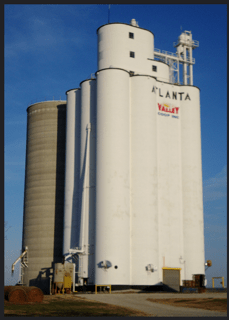
The Atlanta, Kan., elevator suggests our grandfathers’ signature designs


AtlantaKansas

Photo by Brad Perry

Editor’s note: Contributor Brad Perry sent this photo of Valley Coop’s elevator in Atlanta, Kan. The rounded, stepped headhouse suggests Tillotson and Mayer-Osborn design influences. A call to the elevator put us in touch with Katherine Grow, who runs it with her husband Darren.

“I think it’s a Johnson house. I remember when they built it. All the men in the community helped when they started pouring. Markle was the head of the crew that did it. I think it was ’58 or ’59 when it was constructed. In fact, it’s better designed than a lot of places. We added an outside leg. We used to load out on the rail but don’t any more. We’ve done maintenance and made safety updates. We’ve had it painted once. We were told it is the kind of concrete that has to be kept painted. It’s easy to work with, the way it’s put together with the inside leg. We’ve been pleased with it. I was a teenager or preteen when they built it. Once started, they kept pouring. With the lights at night, it reminded you of when you see a riverboat all lit up going down the river. It was cool. When we built this other bin and they could do it in sections, it was kind of different. They just pour so much and go round and round with a little cart, and come night, why, they’d quit and go home.”

Our Grandfathers’ Grain Elevators mourns the passing of contributor Neil A. Lieb

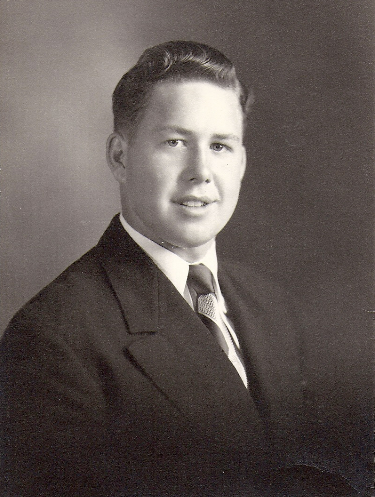
Neil A. Lieb, left, and Blaine Bell .

Neil A. Lieb, left, and Blaine Bell .

We have learned with regret of the recent passing of our contributor Neil A. Lieb. His son Neil, Jr. sent an email on Sunday, Oct. 25, and it includes these details.

At about 10 a.m., Saturday morning, my father Neil Lieb passed away.

He recently battled a case of pneumonia and although it appeared he was able to recover, it probably weakened his body beyond repair. While we won’t know exactly what caused his death, the doctors we spoke with said he may have been suffering over the last few days from a leaking heart valve which manifested itself as severe back pain. 

unnamed-1As you may know, he battled many illnesses later in life including COPD, high blood pressure, high cholesterol, and diabetes to name a few. He was a such strong fighter it seemed like he would live to 100 and beyond…but alas it was not in the cards.

After losing his wife and the love of his life just over three years ago, he was never quite the same. I’m sure he is happy now that he is reunited with his bride of 59 years. 

The story of how Neil met his wife Jolene while on the job for Tillotson Construction Company is documented in this blog.
Neil first contacted us in July 2014:

My name is Neil A. (Anderson) Lieb. I graduated from Pocahontas High School in May of 1949. I worked on the original concrete elevator from June until its completion. I also worked on the one built in Clare the same summer. I continued to work for Tillotson Construction Company until August of 1951.

Neil Lieb later in life While employed by Tillotson I helped build similar structures in Bushland and Cannon, Texas; Alto and West Bend, Iowa: and Marshall, Missouri. I am currently working on my autobiography and would like to have some data on these structures (capacity, specifications, etc.). 

The message led to several enjoyable hours of phone conversations with Neil and his supplying dozens of photos from Tillotson jobs. He said that he didn’t take the photos and didn’t know who did, but as far as we were concerned, it was no matter because we had a new wealth of documentary details.

We salute Neil Lieb for his great contribution to our blog and extend our condolences to his family.

Travel notes from a Wyoming hunting trip

DSC_0346

Cozad, Nebraska

Story and photos by Kristen Cart

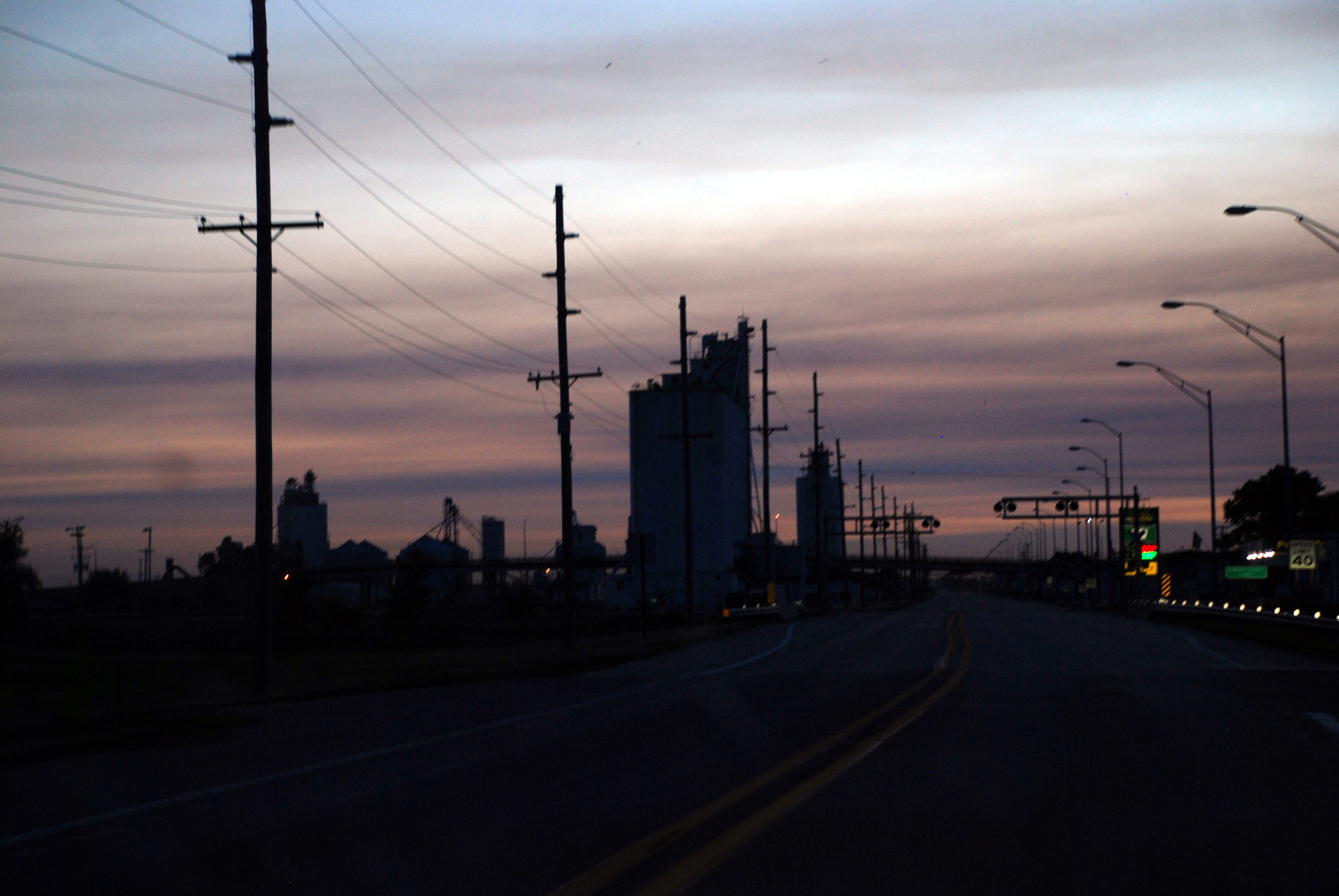
How do you start an essay about the places you miss while traveling? Rolling along a two-lane highway as it becomes dark is a good way.

As you slip beyond the scenes of daylight, your awareness imperceptibly closes in on you until the oval of light from your headlights is your entire world. The highway center-line stripes brighten as they slide by your left knee, keeping a hypnotic rhythm as you fight to stay alert. You see the occasional shadow of a grayish body slipping across, almost out of sight on the edge of your pavement pool save for a momentary flash of eyes, cautiously regarding your progress, shimmering like a pair of reflectors in the ditch.

The rhythm lulls you and you reach for the chewing gum and start looking for a friendly gas station with a tolerable cup of coffee.

Then you know you are missing things.

If it were not for a fortuitous change in our schedule on the way out, when of course we had no time to stop, I would not have known that this inconvenient sunset would obscure two elevator sites. Usually on this trip, this highway is where we stretch the mileage after dark until we can go no further. It is true whether we are starting from camp and stretching the return trip past Ogallala, or rolling from Ashland and hoping to make it as far as Torrington, on the way our hunting spot beyond Lysite.

DSC_0981

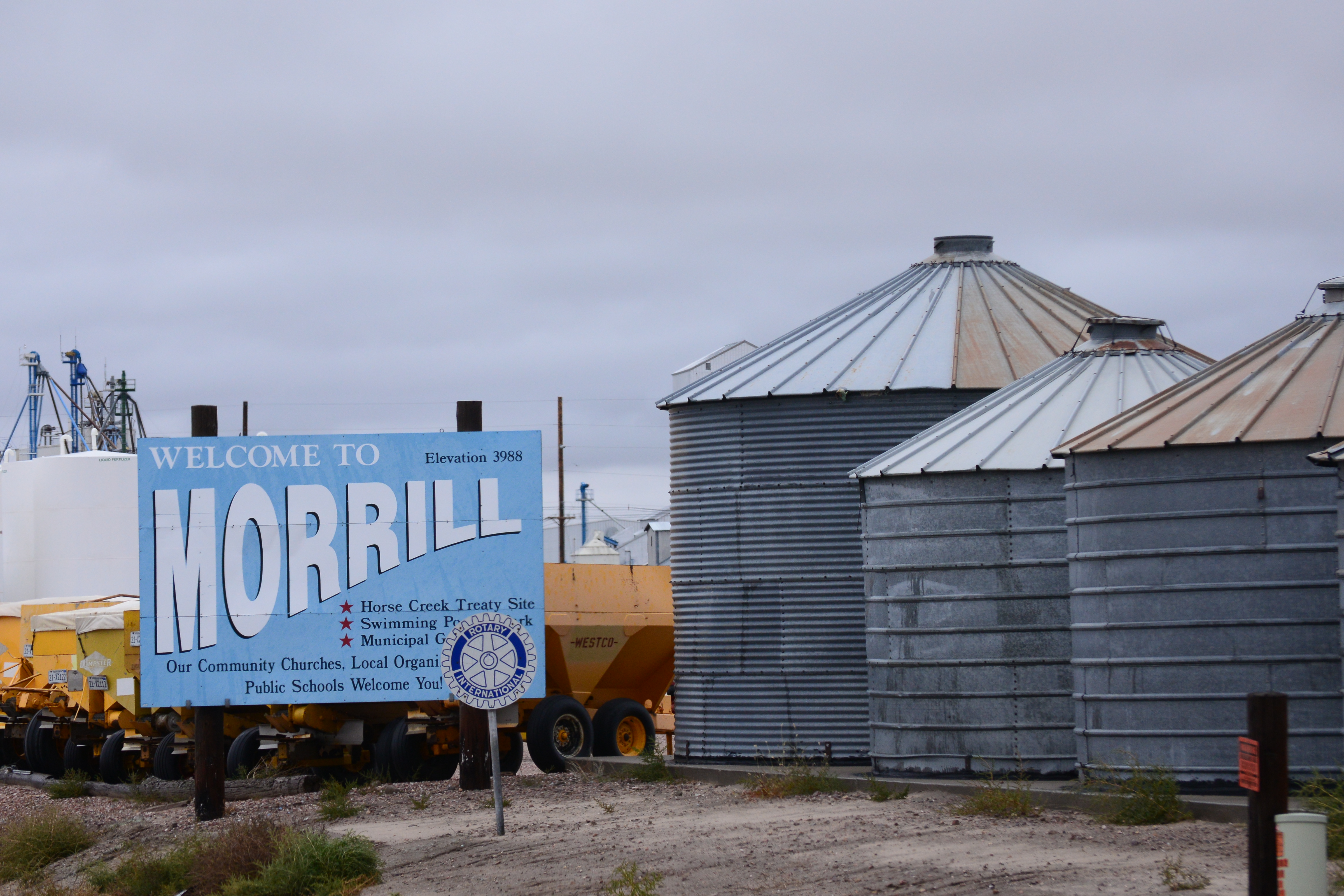
Morrill, Nebraska

Somehow, the view on this road is only as wide as the pavement, every time.

On other trips the stopping spot has been Sidney, where we stay the night, then in the morning we drop into the Cabelas on the way toward Casper for last minute items like socks and bb’s. On our return trip, we overnight in Sidney again to visit Cabelas to get the stuff we forgot so we have it for next year (of course by that time, the new stuff has been misplaced and we go through the whole routine again).

On those occasions we bypass this road altogether.

DSC_1031

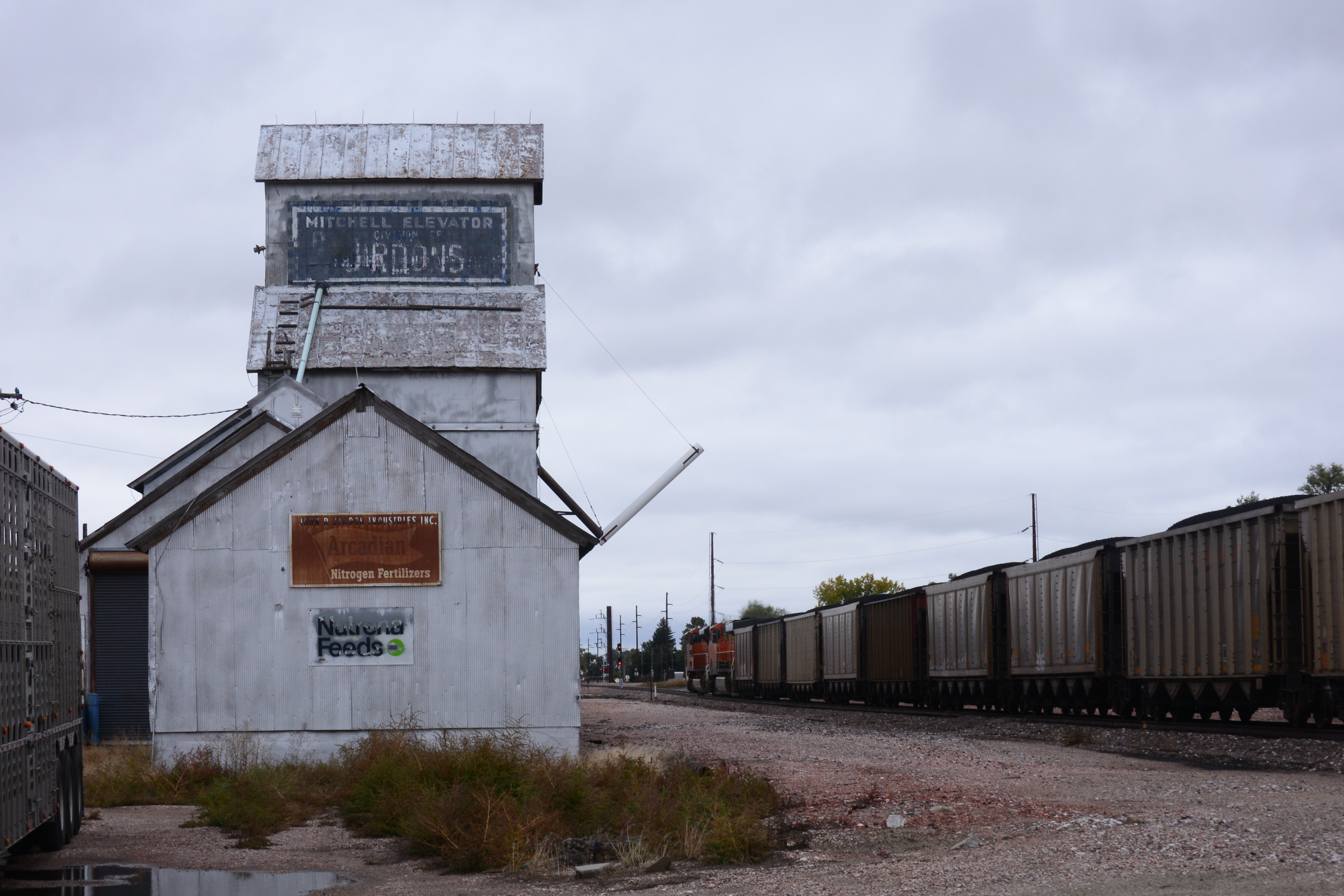
Mitchell, Nebraska

On our way back through–this time, after dark, Llewellyn is the first newly discovered elevator site we see. The old wooden house stands hard by the road with bins lined up on either side. A Purina checkerboard shows faintly in the darkness, but a photograph is out of the question. We are pushing the miles, and the setup for this dark building would be time consuming and the results would be marginal, so we pass it by. I note the town for future reference, for that imaginary trip when we will be rolling through in full sun with all the time in the world.

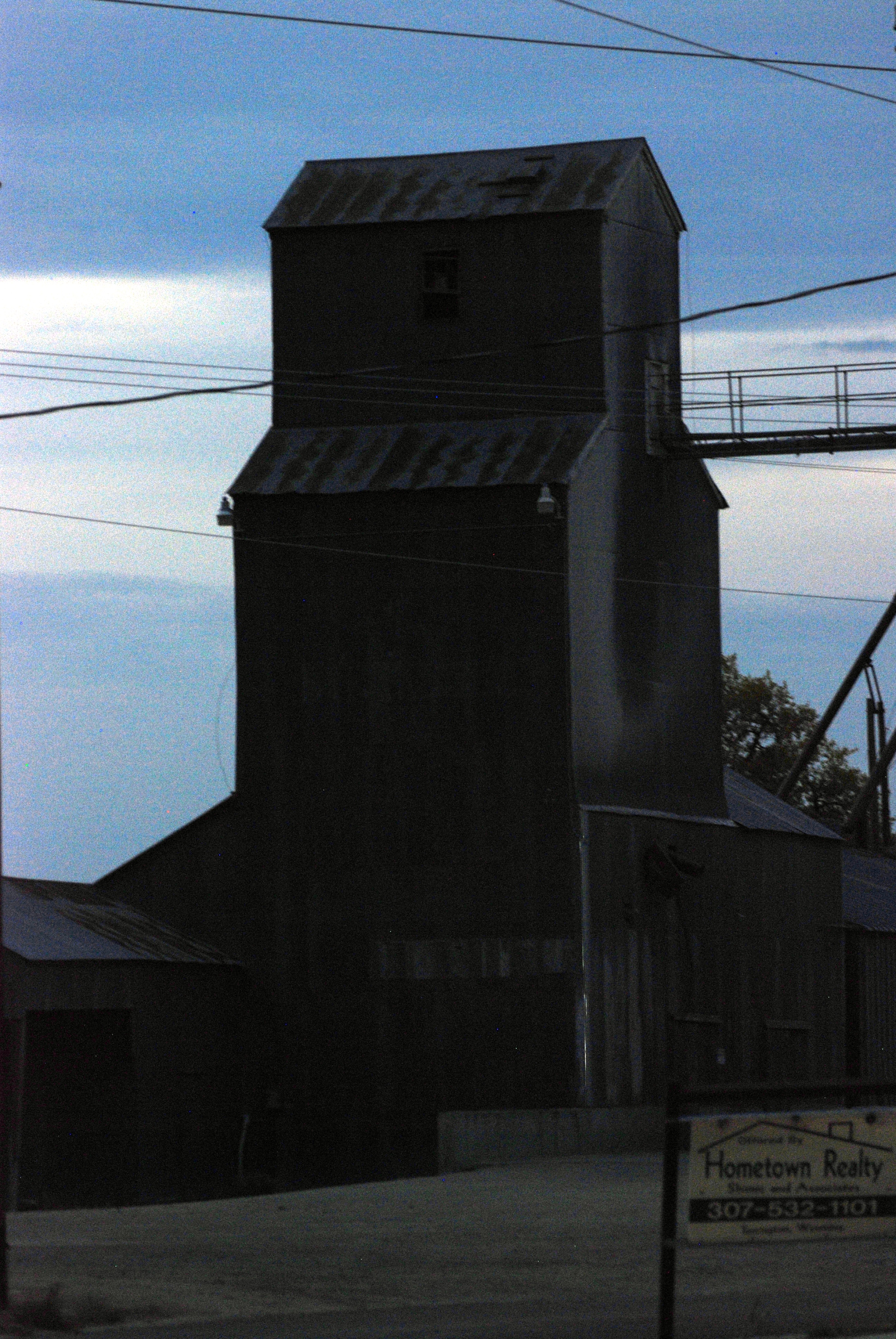
The second elevator location comes into view when we are just about at the end of our rope in Ogallala. I have gone through a pack of gum, and I have made reservations for a motel somewhere nearby for the night. We are stumbling in past midnight. One old wooden elevator displays a Nutrena sign from it’s spot at the end of a short lane, where it nestles among round bins and bathes in dimly yellowish artificial light. As we roll across the viaduct in town, which takes us over the tracks, we see another silvery old-timer on our left which looks intriguing. I will have to check these elevators later.

Of course.

DSC_0968

Morrill, Nebraska

In the morning, all is forgotten as we get on our way toward Ashland.

This is how you leave a patch of geography perpetually obscured in darkness, and scarcely notice its absence. The absence doesn’t breach your consciousness until you notice what is missing, and that can take a long time.

I spend my professional life flying across the continent in the dark, with things like the Grand Canyon and the Rocky Mountains passing below unremarked. A scattering of lights strewn across the land are all the clues to life below—like droplets of water on black velvet, illuminated by an unseen light, they twinkle and tease.

DSC_0164

Lingle, Wyoming

The familiar cockpit lights are my entire world with little else to distract—the gum to keep me alert, or coffee sometimes, and a cozy hotel to look forward to.


Hunting trips afford opportunities for two types of photography

DSC_0889Story and photos by Kristen Cart

We live far from the preponderance of the nation’s grain elevators. Time and money are not unlimited, so it takes a good excuse to go look at elevators when the family has other things on the agenda. Western hunting expeditions are a splendid source for such excuses, so once or twice on each trip, I sneak in an elevator stop.

On a typical trip west, when you have a camera and the inclination to take pictures, vistas of country living make you suddenly pull over, disentangle the camera strap from the seatbelt, and send snack wrappers tumbling to the floor. A few epithets escape your lips when you find the ISO is still set for the moon shot of the night before, but unless a fleeing bird made you stop, the problem is quickly fixed.

DSC_0502In the hotel at night you eagerly page through the day’s images, occasioning a few more blue words, but often great satisfaction. You have elevators and neat old buildings, and you also have scenery. The rest of your family members roll their eyes and talk about elk and pheasants and bird dogs.

The fruits of your labor make it worth the effort–especially if you come home with beautiful pictures and meat for the freezer.

On the eve of another hunting trip, here are a few photos from earlier trips, including the odd elevator picture or two that slipped into the mix.

DSC_0501

DSC_0967 DSC_1009 DSC_1026 DSC_1038 DSC_1168 DSC_1180 DSC_1215

The Pocahontas, Iowa, elevator remains a lovely monument to Tillotson ingenuity

DSC_6547

Story and photos by Kristen Cart

The Tillotson elevator at Pocahontas, Iowa, first came to our attention as the site of a tragic accident where a young construction worker lost his life. Larry Ryan fell to his death because he tripped while crossing from the elevator to the annex on a makeshift wooden walkway, according to fellow workers. He wore brand new work boots and some speculated that they contributed to the accident. The young hoist operator was twenty years old when he fell 130 feet to his death from the top of the nearly completed annex in 1954.

I finally had the opportunity to see the site for myself this past summer. We took a wide detour north of our regular route from Nebraska to Illinois–it added a good four hours driving time, not counting the stops. My young cheering section (the kids) were not cheering about the extra road time.

DSC_0637

Upon our arrival in Pocahontas, a town along Lizard Creek in north central Iowa miles away from any major state thoroughfares, we immediately noticed the Tillotson elevator and its trademark rounded headhouse. The annex stood beside the original elevator, rising higher (by 10 feet) than its 120 foot companion, and gleaming with clean whitewashed concrete. It showed no sign of its sorrowful beginnings.

Later additions, including an elevator with headhouse, a flat storage shed, old steel hoppers, and modern steel bins with external legs, surrounded the two concrete structures.

The Tillotson elevator and annex were flanked on one side by a quiet street with an old church and ancient maple trees. The bustle of grain trucks was absent on the Sunday afternoon of our visit, and the co-op office was closed. Only the elevator exhaust fans pierced the silence.

We circled the complex, taking a number of photographic views, before going on our way.

We have the specifications for both the 1949 elevator and its 1954 annex. The annex construction record is detailed here.

DSC_0616

The Pocahontas annex was built with six 18-foot diameter, 10-foot spread by 130-foot high bins; with a basement; the bins were flat bottomed, built with 30-inch belt conveyors and tripper.

Planned capacity (with pack) was 222,440 bushels; translating to 1,863 bushels of capacity per foot of height. The total reinforced concrete, per plans, was 1,366 cubic yards. Plain concrete for hoppers, per plans, was 9.5 cubic yards, and reinforcing steel used, including jack rods, was 69.59 tons.

The design specified the average quantity of reinforcing steel used for the whole annex, which was 101.89 pounds per cubic yard of concrete.  Actual planned amounts were then itemized for various components of the structure:

Main slab: 27,017 lbs. steel/219 c.y. concrete

Drawform walls: 30,708 lbs. steel/990 c.y. concrete

Overhead bin bottoms: 9,957 lbs. steel/70.5 c.y. concrete

Bin roof and extension roofs: 6,740 lbs. steel/44 c.y. concrete

Cupola walls: 3,747 lbs. steel/33 c.y. concrete

Cupola roof: included in walls

Bridge/Tunnel: 1,020 lbs. steel/9.5 c.y. concrete

DSC_6510

Dimensions and weight of the annex and its components were laid out also. The main slab was 52′ x 60′, for an actual outside area on the ground of 2,946 square feet.

The weight of reinforced concrete, calculated at 4,000 pounds per cubic yard of concrete plus steel, was 2,801 tons. The plain concrete was also calculated at 4,000 pounds per cubic yard and totaled 19 tons. The weight of the hopper fill sand was 177 tons.

When the weight of grain was added to the specifications, at 60 pounds per bushel (for Pocahontas, the grain load would total 6,660 tons), the planned gross weight of the annex could be predicted. Twelve tons of steel and machinery were added to the total, for a planned gross weight, loaded, of 9,669 tons.

From these figures, bearing pressure was calculated to be 3.28 tons per square foot.

To handle all of that pressure, the main slab was made 24 inches thick. It was built with #8 steel, placed at 6″ c.c. spacing. Tank steel and bottoms (for round tanks) used #4 steel at 9″ c.c. spacing.

The drawform walls, with extension, measured 411 linear feet, and 130 feet in height. Cupola dimensions were 16′ x 56′ x 8 1/3′.

Since this was an annex, distribution of grain was accomplished through the main elevator leg and thence by belt conveyors and a tripper. Many of the items expected for elevator specifications were absent for an annex. For machinery, the annex had top and bottom belts, rated at 600’/min or 3,000 bushels per hour. 7 1/2 horsepower drives were used for a total load rate of 9,000 bushels per hour.

Loading rates are key for grain storage operations, since they determine how quickly trucks or rail cars can unload and be on their way. Slow elevators become obsolete. The Pocahontas operation was at the leading edge of technology with its shiny new 1954 annex, and to this day it provides quick, efficient service.


Bruce Selyem, an old hand in elevator photography, is still in the game

DSC_0065

Ione, Oregon

Story and photos by Kristen Cart

An eagerly awaited package arrived in the mail the other day. I opened it to find Bruce and Barbara Selyem’s 2016 elevator calendar–a vivid sampling of the photography work that Bruce has done over the years. Barbara Selyem called me to see if I would like one this year–I am an old customer, and I get one every year. So of course I asked her to send it.

Thirteen carefully selected images grace the calendar, and it does not disappoint.

DSC_0697

Indus, Alberta, Canada

Selyem Enterprises also produces framed elevator images for home and business, and if I bought everything I liked, I would run out of wall space very quickly. Bruce has documented many beautiful old wooden elevators in the United States and Canada that have gradually disappeared. Over the 20-plus years Bruce has been shooting elevators, most of the structures have only his photos to remember them by.

DSC_0557

Mossleigh, Alberta, Canada

If my kids had anyone to blame for the numerous side trips, excursions, and stops we have made to take pictures of wooden elevators in the wild, Bruce Selyem would top their list. I have studied his website carefully to plan for elevator photography trips in Idaho and Oregon. Many times the kids have admonished me for the odd elevator stop on the way to Nebraska. I can’t help it. They are beautiful.
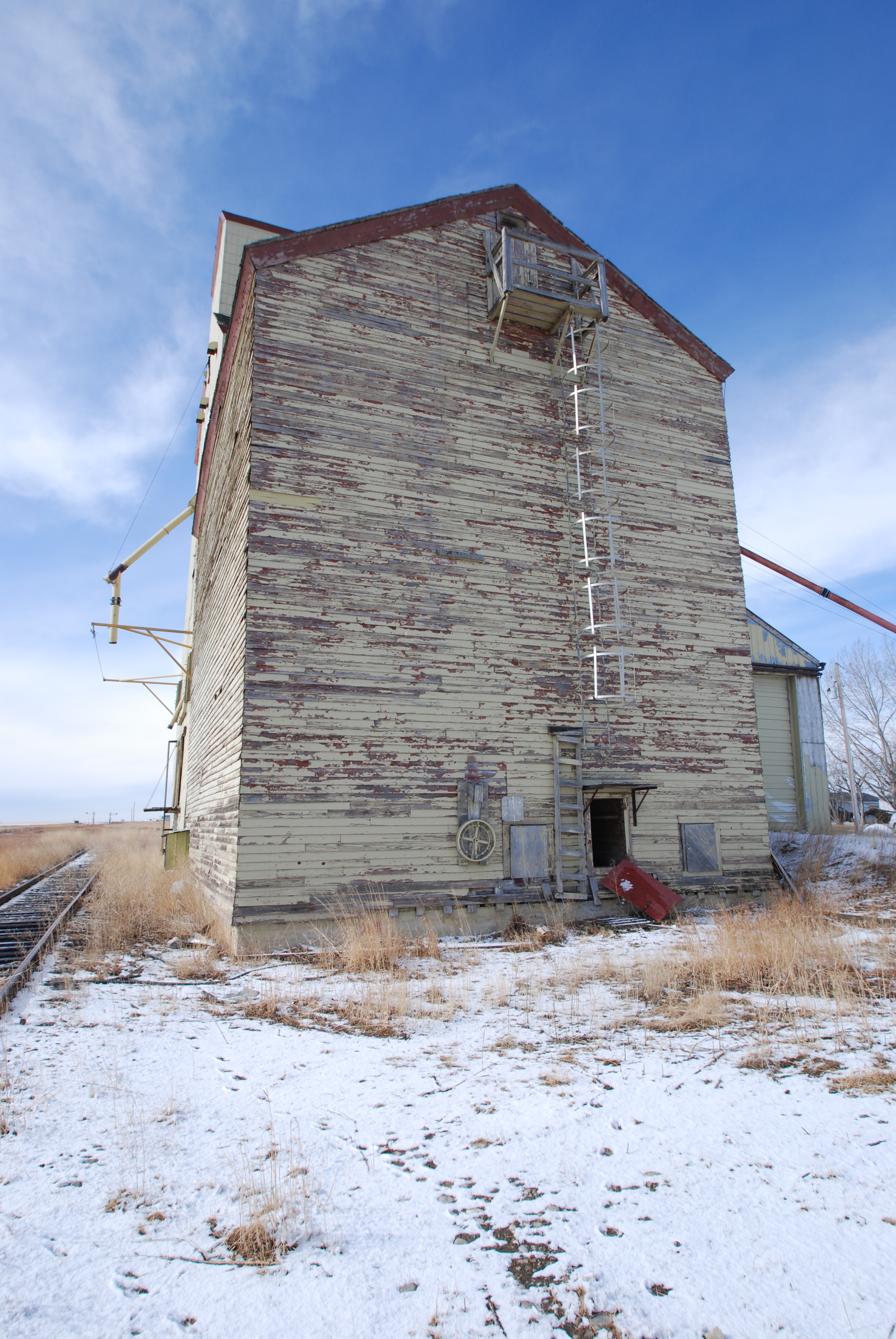
Though not many of my wooden elevator photos have been published here, there is quite a collection of them. It is a passion, and I come by it honestly.

My grandfather, William Osborn, took many photos when I was a little girl. I remember the bellows on his camera, the camera body he carefully set up on a tripod, and his advice to sit still. He would pull the Polaroid photo out of the back of the camera while he started his buzzing timer. The hand on the timer would move interminably, and I would stand on tip-toe, eagerly awaiting the magic moment. Then he would peel the negative away and voila, a damp image would emerge, which I would hold gingerly by the edges while it dried.

As a girl, I wondered at the photo of his first elevator in McCook, Nebraska, that he built for Mayer-Osborn. I never knew I would combine his love for photography with his life’s work one day, and share all of it here.

To check out the photography of Bruce Selyem, visit his website at grain elevator photos. Bruce and Barbara Selyem welcome you.

DSC_0674

A concrete beauty. Nyssa, Oregon