The surprise in Canyon, Texas, is how the Tillotson elevator survived a blowout

IMG_8884By Ronald Ahrens

Too many bad things can happen at a grain elevator. For one, construction crews and elevator workers face the risk of falling. For another, grain dust can explode. And it’s even possible for a worker to be trapped in a silo.

Texas-Okla Logo 04Then there’s the problem of blowouts. We have written before on Our Grandfathers’ Grain Elevators about blowouts.

One had occurred on a Tillotson Construction Co. job, probably in 1955, at Blencoe, Iowa.

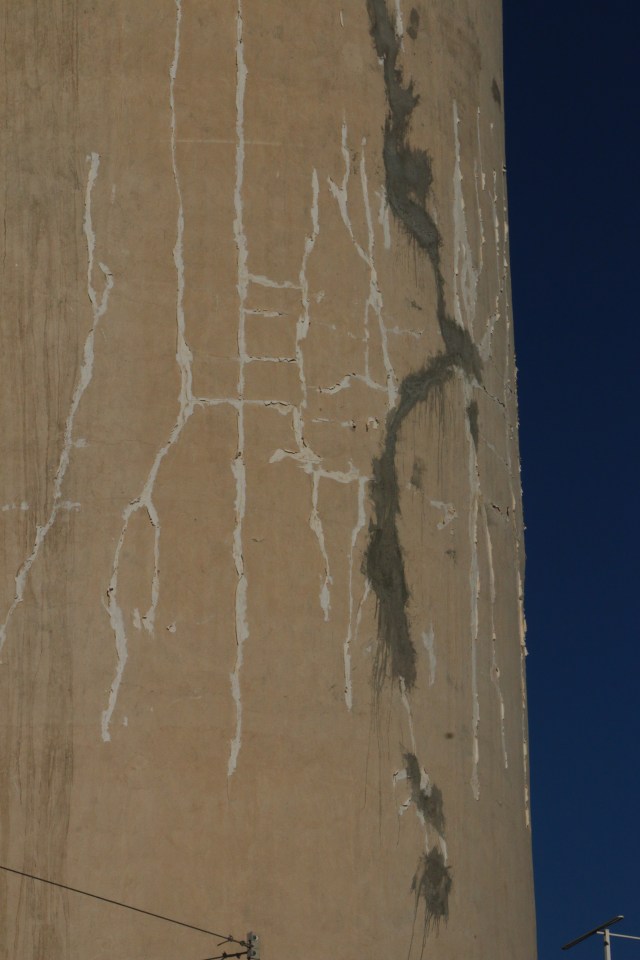
And it turned out, during our visit to the 1950 Tillotson elevator run by Consumer’s Supply Co-op in Canyon, Texas, there was the story to tell of a blowout.

Those weren’t just stretch marks on that corner silo. Well, actually, yes, they were. 

IMG_8859

As Dewayne Powell explained when he showed me around, the blowout in a single silo had occurred sometime before his tenure, which goes back eight years.

Tillotson Construction Co.’s records specify the bearing pressure of the walls at 3.1 tons per square foot. Somehow, the concrete must have deteriorated, leading to the failure.

The elevator’s importance to the Co-op is underscored by the fact that repairs were made. Powell said Gunite was used. I searched for a definition of Gunite and found this passage from the Shotcrete entry on Wikipedia:
IMG_8876

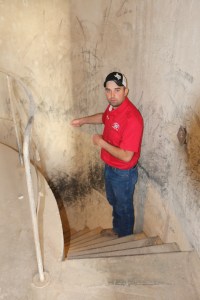
Dewayne Powell leads the way into the elevator’s basement.

“Shotcrete, then known as gunite (/ˈgənīt/), was invented in 1907 by American taxidermist Carl Akeley to repair the crumbling façade of the Field Columbian Museum in Chicago (the old Palace of Fine Arts from the World’s Columbian Exposition).[1]

“He used the method of blowing dry material out of a hose with compressed air, injecting water at the nozzle as it was released.

“In 1911, he was granted a patent for his inventions, the “cement gun”, the equipment used, and ‘gunite,’ the material that was produced.”

Whatever the term, the repair was nicely done. But Powell said he’d heard stories of chaos the blowout caused. Aside from this disaster, the 68-year-old elevator has held up quite well.

Catching the Canyon, Texas, Tillotson elevator at its doggonedest dawn glory

IMG_8858To make it by dawn to the Tillotson elevator in Canyon, Texas, I hit the road at 6.30 a.m. and hightailed out of Hereford, covering the 30 miles across the plain, traveling east-northeast on U.S. 60.

Texas-Okla Logo 04I was happy at last to see the elevator’s distinguished bulk on the faint horizon. And even happier there was no storage annex–just the classic 320,000-bushel job from 1950.

No one was around to chase me away. The elevator looked very well kept, like a 68-year-old with a natty haircut and fine clothes.

I prowled over the grounds to get my photos, as well as going up and down 6th and 7th streets in the neighborhood looking for a street-view. People inside their bungalows might have thought I was some kind of nut. I wondered if they ever pondered much upon their gigantic concrete neighbor.

IMG_8859By the time I finished with photos, the Consumer’s Supply Co-op store on the premises had opened up. I went inside and introduced myself, feeling proud to say, “My grandfather built your elevator.”

I elaborated about Tillotson Construction Co., of Omaha, and my mission to visit the 10 Tillotson elevators in the Texas Panhandle.

Scott Smith, general manager, and Dewayne Powell were interested to hear it. These bright-faced gents explained, among other things, that the Co-op’s charter goes back to 1926.

Two elevators are on the site. “This is our best elevator here,” Smith said of the Tillotson. The other needs repairs to the floor, among other places.

Much of this, the West Elevator, was original. Alas, the truck lift had been removed “before my time,” Smith said. 

I went out to the truck for the construction record. After my explanation of some of the specifications, Smith took it to the copier.

Powell showed me around, explained how things worked, even posed for some pictures.

The basement was clean and tidy, and Powell mentioned that at one point some of it had been used for office space. It was sure bright enough down there.

Something else that had changed: the augur below ground level had been filled in with concrete.

We went back up, and I made one more circuit around the elevator. The driveway door was open, and the Co-op’s yellow Mack truck sat in the driveway.

IMG_8883The quality of the Co-op’s operation was evident. The only things with the elevator that seemed out of order was a broken basement window, and one of the back doors had been splattered with glop.

Otherwise, things were in nice shape.

When I was ready to leave, they presented me with a cap and T-shirt with the Co-op’s emblem–a real honor. Smith recommended KJ’s Coffee and Cafe for breakfast, so I found my way across town to have an omelet.

Then, a-wondering where Palo Duro canyon–the town’s eponym–was, I set out for Bushland.

In our next post, watch for a surprise about the Tillotson elevator in Canyon.


Specs show capacities of the Tillotson elevator in Hereford, Texas

IMG_8833The single-leg elevator built at Hereford, Texas, by Tillotson Construction Company in 1951 had capacity for 300,000 bushels, according to company records. That worked out to 2,640 bushels per foot of height. The drawform walls of the silos, or tanks, rose 125 feet.

Texas-Okla Logo 04Our calculation produces a total of 330,000 bushels at this rate. There were 2,104 cubic yards of reinforced concrete, 28 cubic yards of plain concrete for hoppers, and 121.47 tons of reinforcing steel including jack rods.

The concrete would be mixed on-site, while the reinforcing steel and the lumber used for scaffolding were probably delivered by train.

IMG_8832

The elevator’s main slab covered an area of 76.5 x 56 feet and was 24 inches thick. Below it, the pit depth was 26 feet–unusually deep in comparison to that of other elevators built that year in Greenwood and David City Nebraska and (12 and 17 feet, respectively) and Malta Bend, Missouri (9 feet 3 inches).

The headhouse, or cupola, was 17 feet wide, 36.75 feet long, and 27 feet high. So the structure crested at 152 feet.

That the pulley centers of the leg were 169.5 feet apart reflected the positioning of the lower boot pulley below ground level. That one measured 72 x 14 x 4 15/16 inches. The head pulley was 72 x 14 x 2 3/16. IMG_8823

The head pulley turned at 42 rpm.

The six-ply Calumet belt was 14 inches wide. Cups were 12 x 6 inches and 8.5 inches deep. A 40-hp Howell head-drive turned the leg, and the cups bore a theoretical capacity of 79.2 bushels per hour, although actual capacity–80 percent of theoretical–was 63.4 bushels per hour.

The man-lift operated with a 1.5-hp electric motor.


Horizontal member on Hereford elevator adds civilizing touch for employees

IMG_8824

As we see in these photos from Hereford, Texas, a Tillotson elevator is more than just a collection of tanks and the mechanisms to move grain around inside the structure.

Texas-Okla Logo 04A Tillotson elevator can also come with amenities.

Here we see a lintel above the rear door of the main house. A lintel is a horizontal member that usually bears a load above an opening.

I asked Uncle Chuck Tillotson about it. (He’s also known in these posts as Charles J. Tillotson, son of Reginald Tillotson, of Tillotson Construction Co.)

He responded: “These concrete ‘eyebrows,’ or ‘headers,’ were added above doorways sometimes to provide a bit of shielding from the rainfall sheet flow coming down the vertical face of the wall over the doorway/opening in a rainstorm.”

IMG_8827

So it’s a thoughtful touch. An employee won’t get water down his neck when he opens the door. Think of the increased productivity!

“They were not poured integrally with the concrete bin wall during slipping but were added afterwards,” Uncle Chuck continued.

Not only is there the lintel but also the electric light. I saw the same combination over and over at the Tillotson elevators I visited in the Texas Panhandle and Oklahoma.

“I don’t recall these eyebrows being standard elements,” Uncle C. says. “I think they were added after the fact but whether Tillotson did the work, or the owner, I’m not sure.”

We do think the electric light was a standard item.

In the uppermost photo, the iron or steel hook and dangling cable remain a bit of a mystery, though.

And the rabbit-eared paintwork is beyond guessing.

Handsome in Hereford, Texas, a Tillotson elevator remains in use

IMG_8842On my road trip to visit my grandfather Reginald Tillotson’s elevators, the first stop was Hereford, Texas. It was toward the end of my second day of driving from California, and I arrived in time for late-afternoon light.

Texas-Okla Logo 04I had departed I-40 on the north and came down U.S. 385 for 28 miles through Deaf Smith County.

The desert scrub ends rather suddenly in the Texas Panhandle, and I found myself amid prosperous-looking farmsteads and cropland irrigated by center-pivots. It looked like corn, wheat, and cotton predominated.

IMG_8840

Driveway detail view.

Hereford, which is southwest of Amarillo, is one stinky town. People said it’s because of huge surrounding feedlots. They sounded proud about it.

There were a couple of enormous grain terminals on the horizon as I approached. The Tillotson elevator was evident to their left. It was the smaller one, but the unique curved headhouse gave away its identity.

I drove east on U.S. 60 to what Google Maps identifies as the East End Hereford Grain Corp., which is across the railroad tracks on Dairy Road.

Tillotson Construction Co. built this 300,000-bushel elevator in 1951. Records show it had six tanks, or silos, of 20 feet in diameter. Notes say “Leg-Tunnel-Gallery” and “Top & Bot 30″ belts.”

A semi-truck lift and attached drive were also included.

IMG_8838

The elevator looked to be in pretty good shape. There are some horizontal cracks on the silos, but they had been filled in. On the headhouse, traces of letters appeared to say Freeman Grain Corp. The concrete elevator towered over 10 barrel-like steel silos and an ungainly superstructure, along with bins and hoppers that linked to the concrete elevator’s headhouse by means of a spindly looking line.

This kind of annex was in a way preferable to a series of concrete silos. The Hereford elevator is a nice, free-standing example of Tillotson’s signature style.

The elevator’s tanks are 125 feet high. The headhouse, or cupola, is 17 feet wide, 36.75 feet long, and 27 feet high. So the structure reaches 152 feet up. 

No one was around, so I helped myself to photos. The only distractions came when trains went by. 

I was famished after the long day on the road, so I knocked off when I had my photos and checked in at the Hereford Inn just across East 1st Street. As I wrote in the introduction to this series, it was a pretty crummy place.

But after dining at Dakota’s Steakhouse (smothered fried chicken: $10.83), I went back to the motel and slept well despite the fact that the trains seemed to be crossing through the room.

Texas and Oklahoma road trip takes us to 20 elevators (so get ready)

By Ronald Ahrens

This Ford Ranger violated Tesla parking en route to Texas and Oklahoma.

Get ready for a series of posts on Our Grandfathers’ Grain Elevators.

On April 15, I set out on a road trip to the Texas Panhandle and Oklahoma to see elevators built there between 1939 and the mid-1950s by Tillotson Construction Co.

This was a long-desired destination, as my grandfather, Reginald Tillotson, and his brother Joe Tillotson (until their partnership dissolved), built at least 10 reinforced-concrete elevators in the Panhandle and closer to 20 in Oklahoma. 

Texas-Okla Logo 04The company’s first concrete elevator, dating to 1939, was built in Goltry, Okla., and I was able to visit it.

So as I say, get ready.

I have 410 photos on one memory card and haven’t even counted those on the other card that’s still in the camera.

I saw a nice range of elevators including a surprise Mayer-Osborn one in Follett, Texas–built by my partner Kristen Osborn Cart’s grandfather after he worked for my grandfather.

Our Grandfathers’ Grain Elevators gets inside the main house at Booker, Texas.

I got inside some elevators, met interesting people whom you will also meet, and even have a few trip notes to share.

For example, avoid the Hereford Inn, in Hereford, Texas. Yes, it’s right across the street from the Tillotson elevator. No, you shouldn’t stay there. The owners have done nothing to update the rooms; flimsy mattress, wilted pillow, skimpy towel. And it sounded like the trains were coming through the room. At least there was hot water.

For the same $60 price, I stayed the next night at the Nursanickel Motel in Spearman, Texas. That place was quite nice and cast its shadow on the dump in Hereford.

And here’s a culinary tip: Smrcka’s Dairy Shack, in Medford, Oklahoma, serves a fantastic Czech sausage sandwich with sauerkraut. And the fries are incredible.

The Czech sausage sandwich in question.

With limeade, it came to $8.38.

If you have the same counter-attendant that I had, don’t try to make small talk because she’s super-crabby.

So stay with us for our Texas-Oklahoma series over the next few weeks.

Home-built travel trailers and the demise of a tricked-out ’53 Ford in Iowa

HomemadeThe topic of staying in a travel trailer while working at grain elevator construction sites has prompted Charles J. Tillotson (“Uncle Chuck”) to do some reminiscing and dig through his archive of photos.

He writes:

The first one is a photo of the last trailer Dad built in 1937, which was an upgrade to the one that your mom and I are standing in the doorway of. He had covered the exterior of this trailer with some kind of protective fabric, which doesn’t seem to be attached very well.

The previous trailer had an exposed plywood exterior that was either stained or painted and it evidently didn’t hold up. The focus should be on the small size of the trailers which were probably about 15 feet long, much like the size of the early camper trailers of the 1950s and 1960s. If you allow room for the stove, toilet, closet and even a fold-down tabletop with a little settee, where did we all sleep?

The photo [below] was taken in late summer in Albert City, Iowa, and shows my Dad and me standing along side of my 1953 Ford with another older gentleman who I assume was the Albert City superintendent packing something into the trunk. We had finished up our work on Albert City, and Dad had assigned the three of us to travel across the state to a job he was starting in Clinton, Iowa.

Reg&Chas

Soon after the photo was taken we three boys [Chuck, Tim, and Mike] left Albert City and took along with us a couple of men who wanted to continue working for Tillotson Co. We took off in my beautiful ’53 Ford, which I had modified with a two-tone paint job, a Continental fake-spare-tire kit (remember those?) and lowering blocks among other things. I was driving very fast and in a pattern learned from my Dad, taking short cuts via the old one-mile graveled country roads through the tall cornfields. Zooming along and approaching an intersection ahead I spotted a dust trail from a vehicle approaching the same intersection on my right. With the road being gravel I decided that rather than stop for the oncoming vehicle (that had the right of way) to instead outrun it.

I had almost made it through the intersection when the oncoming vehicle clipped my rear bumper and put me into a sideways spin. I countered the spin by yanking the wheel in the opposite direction which brought me out of the spin, but the action was so fast it put me into another spin in the opposite direction. We zigzagged back and forth for a bit and eventually headed into a huge irrigation ditch, which we entered, rolled over, and flipped upside down. I remember my bro Mike standing up in the back seat hollering at me to ‘straighten out the car’ but to no avail. I think there were five of us in the car including my bros, none of which had seat belts fastened but by some miraculous ending, we were all able to crawl out of the car without a scratch.

The farmer who hit me was a local fellow, and he rounded up a tractor with an operator and the car was pulled back upright and out of the ditch, whereby it was towed off to a local mechanic’s shop.

I don’t remember who came to rescue us, but somehow we continued on to the Clinton job where we put in some closing days of the summer, laboring there. 

Ford&trailer

When it came time to go home, my bro Tim and I went and picked up the Ford which still was operable (a testimonial to Ford), but the vehicle had multiple dents and bruises including missing a windshield which had been knocked out in the crash.

Tim and I bought a pair of goggles and proceeded to hit the trail (in a light drizzle) to Omaha with the wind and rain in our hair and elsewhere. My Dad knew of the accident but he had never seen the car until we got home whereby he came out of the house and I’m sure almost had a heart attack when he viewed the pile of junk that once was my beautiful ’53 Ford. As I recall, he had the car towed away to the junk yard.

It’s funny how viewing old photos can bring back memories of both the exciting and dull days gone by. It’s too bad the photographs taken today are no longer hard-copied by most people and their memories no longer documented to tell the stories of days gone by for both their own revisitation as well as their offspring.

A postcard reveals Tillotson elevator activity before the big changes of 1938

Post Card 01

We have found what may be a rare record of the Tillotson construction enterprise as it existed before 1938. Back then, Charles H. Tillotson led the company, which specialized in wooden elevators. After he died in ’38, his sons Reginald and Joe partnered in Tillotson Construction Co., and started to experiment, and then build, with reinforced concrete.

This card from July 2, 1936 is penned by Sister Mary Concepta, the older sister of Margaret Irene McDunn Tillotson (my grandmother) and sister-in-law to Reginald.

Sr. M. Concepta, born on Sep. 27, 1901, in Emerson, Nebraska, and christened Catherine McDunn, was the second of nine children. (Margaret, born Feb. 9, 1903, was third.) Sr. M. Concepta belonged to the Sisters of the Presentation of the Blessed Virgin Mary, with a motherhouse at Mount Loretto in Dubuque, Iowa.

The parents were William McDunn (b. Feb. 4, 1871, Des Moines, Iowa) and Bridget Loretta Dorcey McDunn (b. March 27, 1872, Luken or Lucan, Ontario). Records show William as a laborer in Omaha in 1891. He became a conductor on the Nebraska Division of the Chicago, St. Paul, Minneapolis & Omaha Railway, and the family became established in Emerson, the town named for Ralph Waldo Emerson, which had come into being in 1881 at a junction on the CSPM&O (known as the Omaha Road). 

The family history comes from These U.S. McDunns: Family Tree of Patrick McDunn and Mary O’Donnell, compiled by John McDunn, of Lodi Wisc., in April 1989. The McDunns homesteaded in Pennsylvania in 1835. 

My Uncle, Charles J. Tillotson, whose name appears in many of this blog’s posts, had kept his grandfather William’s railroad watch–a Hamilton, of course–until a burglar struck in the late-1980s.

Post Card 02Uncle Charles notes that in the mid-1930s Reginald and Margaret lived with the elder Tillotsons at 624 N. 41st Street. They towed a travel trailer to job sites. In early July of 1936 they would also have towed along Uncle Charles, then 18 months old, and my mother Mary Catherine, who was nearly five months old.

On this postcard Sr. M. Concepta addresses her sister Margaret (Mrs. Reginald Oscar Tillotson) at Carlyle, Neb.

Carlisle–note the difference in spelling–is an unincorporated town in Fillmore County.

“I know the name because Mom used to talk about it,” Uncle Charles says.

We presume there was a wooden elevator. Carlisle is an unincorporated community in Fillmore County, about 135 miles southwest of Omaha. It doesn’t appear on our Rand McNally page nor does Google Maps seem to know anything about it. 

MapThe USGS gives coordinates for Carlisle on its Davenport Quadrangle map (named for a town in neighboring Thayer County), and we see a speck on Road X, west of Little Sandy Creek, that could be Carlisle. We called the Fillmore County sheriff’s office, in Geneva, and asked. “Nope,” a very nice woman said. “We don’t have a Carlisle.” 

Whatever.

“Dear Margaret + Reginald + babes,” Sr. M. Concepta begins.

Post Card 03“This card tells you where we are. Saw your Mother and Mary, Reginald. Mary is truly a nice girl and your mother surely is not strong. Won’t be leaving here now until Sat. morning. Just thought you might be coming in for the 4th. Don’t try it just for me though. Love, Sr. M. Concepta.”
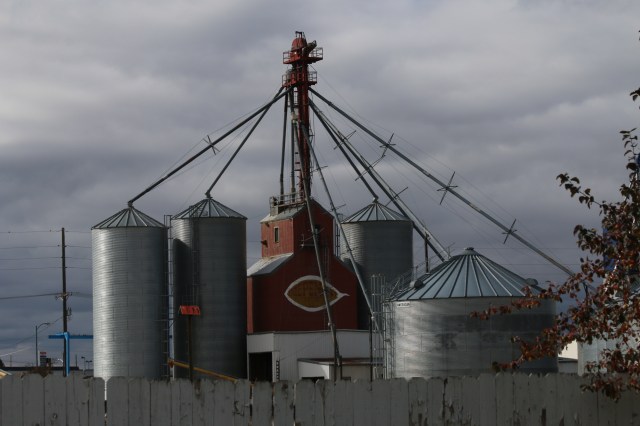
Mary Tillotson was Reginald’s sister who became important to the family business and also is named in many posts here.

It’s hard enough to find a trace of Carlisle, but we would love to know if any remnant of a wooden elevator exists there.


Three elevators near Bozeman, Montana, provide a little variety

IMG_8354

Flying into the Bozeman Yellowstone International Airport the other day delivered a pleasant surprise in the form of three handsome elevators soon after we drove away from the passenger terminal.

One elevator was right there in Belgrade, Montana, where the airport is. It was an old house adapted to operate with metal silos.

Another had concrete silos, and a third looked like a simple wooden house.

These photos are all we can offer. The elevators weren’t Tillotson or Mayer-Osborn jobs, but we were excited to see them and now share with eagerness. Perhaps at a future time we can learn more details.


Travel notes from a Wyoming hunting trip

DSC_0346

Cozad, Nebraska

Story and photos by Kristen Cart

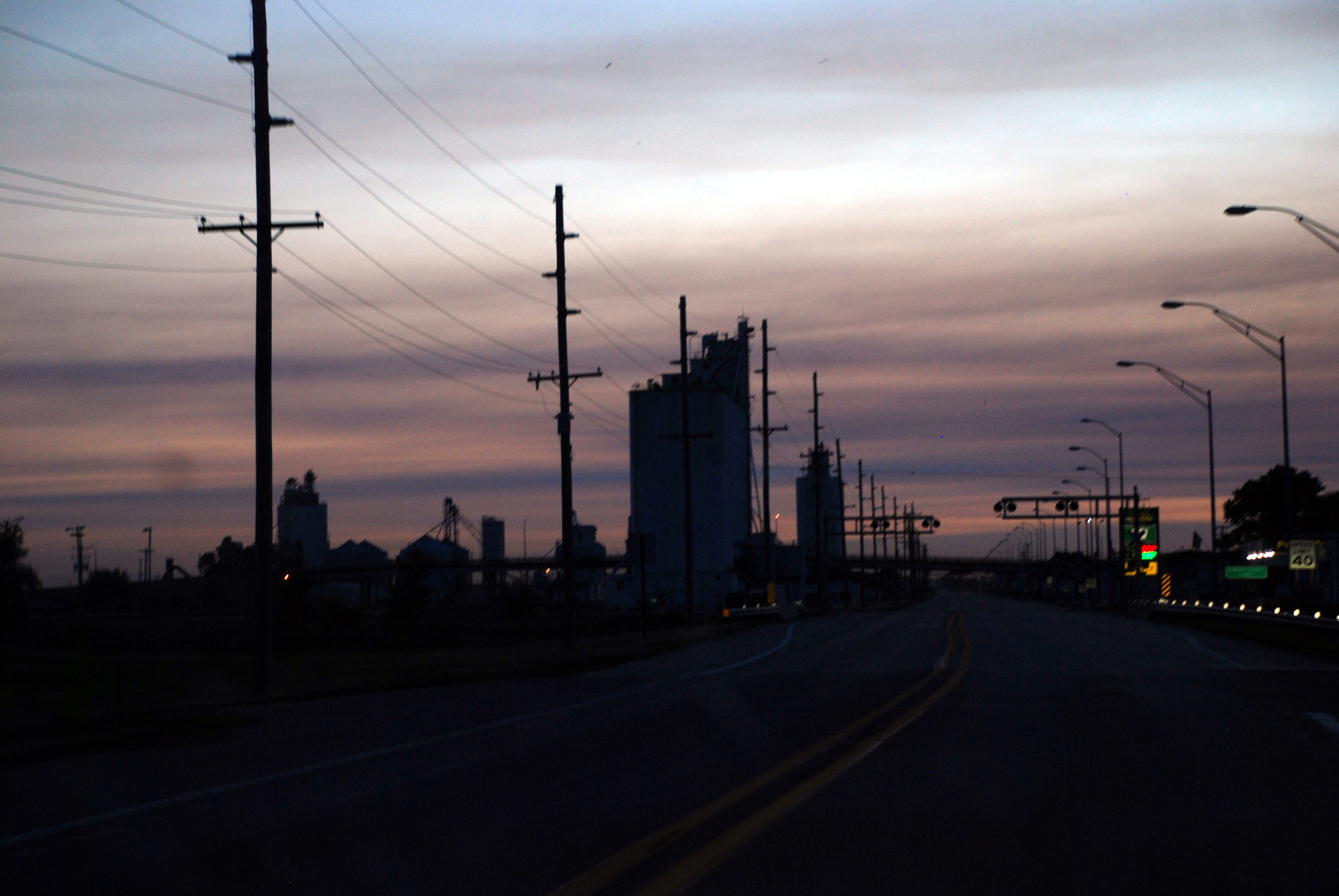
How do you start an essay about the places you miss while traveling? Rolling along a two-lane highway as it becomes dark is a good way.

As you slip beyond the scenes of daylight, your awareness imperceptibly closes in on you until the oval of light from your headlights is your entire world. The highway center-line stripes brighten as they slide by your left knee, keeping a hypnotic rhythm as you fight to stay alert. You see the occasional shadow of a grayish body slipping across, almost out of sight on the edge of your pavement pool save for a momentary flash of eyes, cautiously regarding your progress, shimmering like a pair of reflectors in the ditch.

The rhythm lulls you and you reach for the chewing gum and start looking for a friendly gas station with a tolerable cup of coffee.

Then you know you are missing things.

If it were not for a fortuitous change in our schedule on the way out, when of course we had no time to stop, I would not have known that this inconvenient sunset would obscure two elevator sites. Usually on this trip, this highway is where we stretch the mileage after dark until we can go no further. It is true whether we are starting from camp and stretching the return trip past Ogallala, or rolling from Ashland and hoping to make it as far as Torrington, on the way our hunting spot beyond Lysite.

DSC_0981

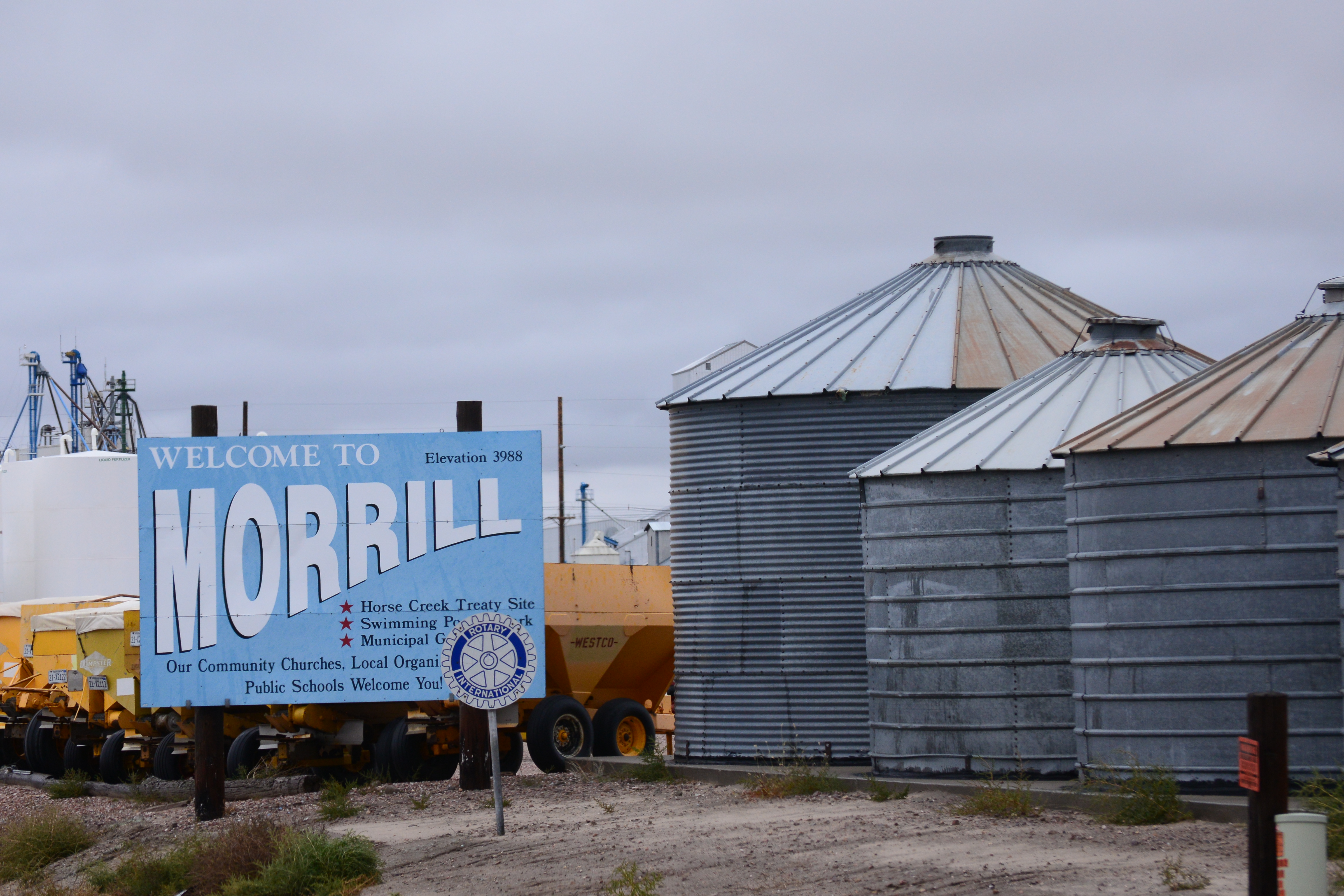
Morrill, Nebraska

Somehow, the view on this road is only as wide as the pavement, every time.

On other trips the stopping spot has been Sidney, where we stay the night, then in the morning we drop into the Cabelas on the way toward Casper for last minute items like socks and bb’s. On our return trip, we overnight in Sidney again to visit Cabelas to get the stuff we forgot so we have it for next year (of course by that time, the new stuff has been misplaced and we go through the whole routine again).

On those occasions we bypass this road altogether.

DSC_1031

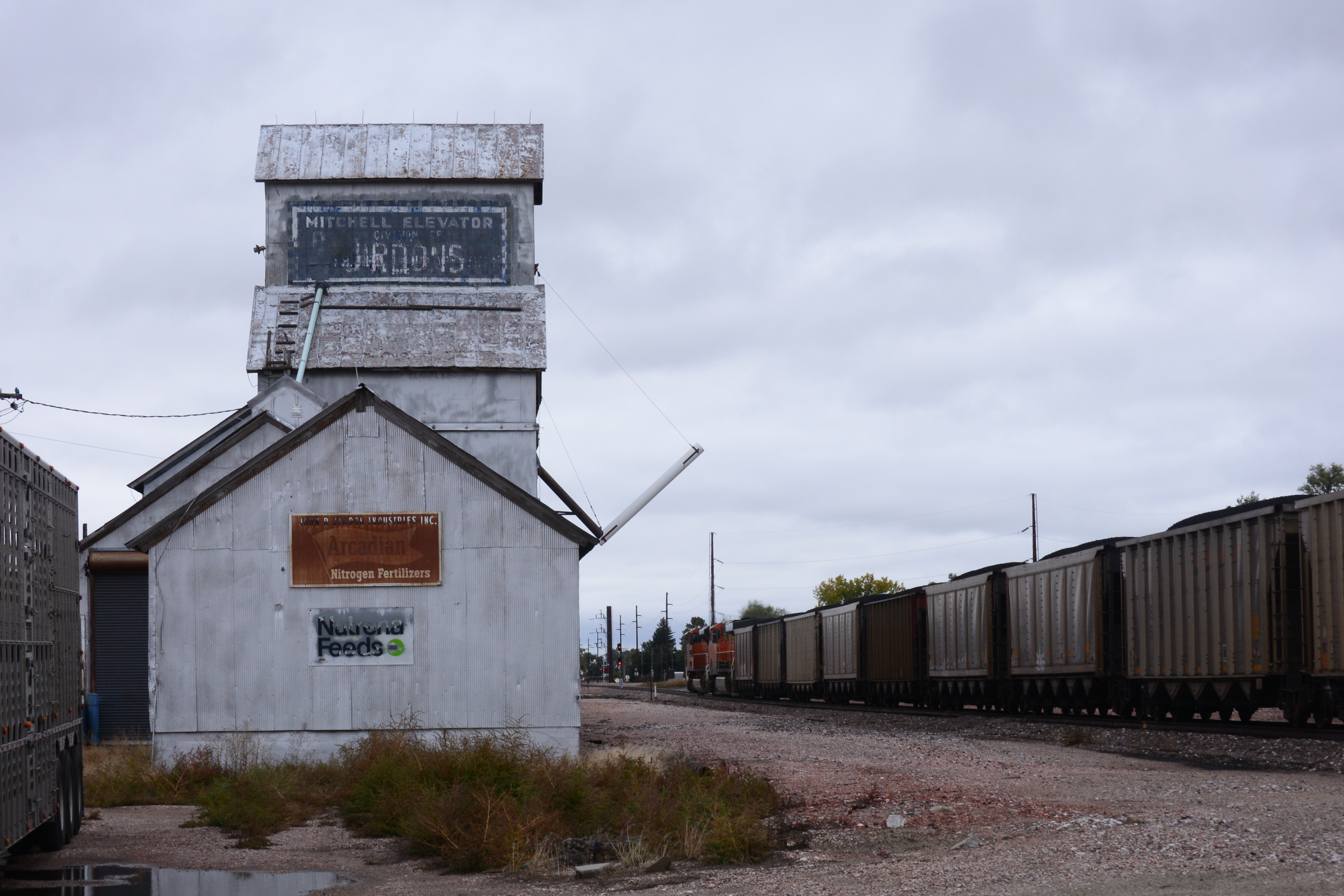
Mitchell, Nebraska

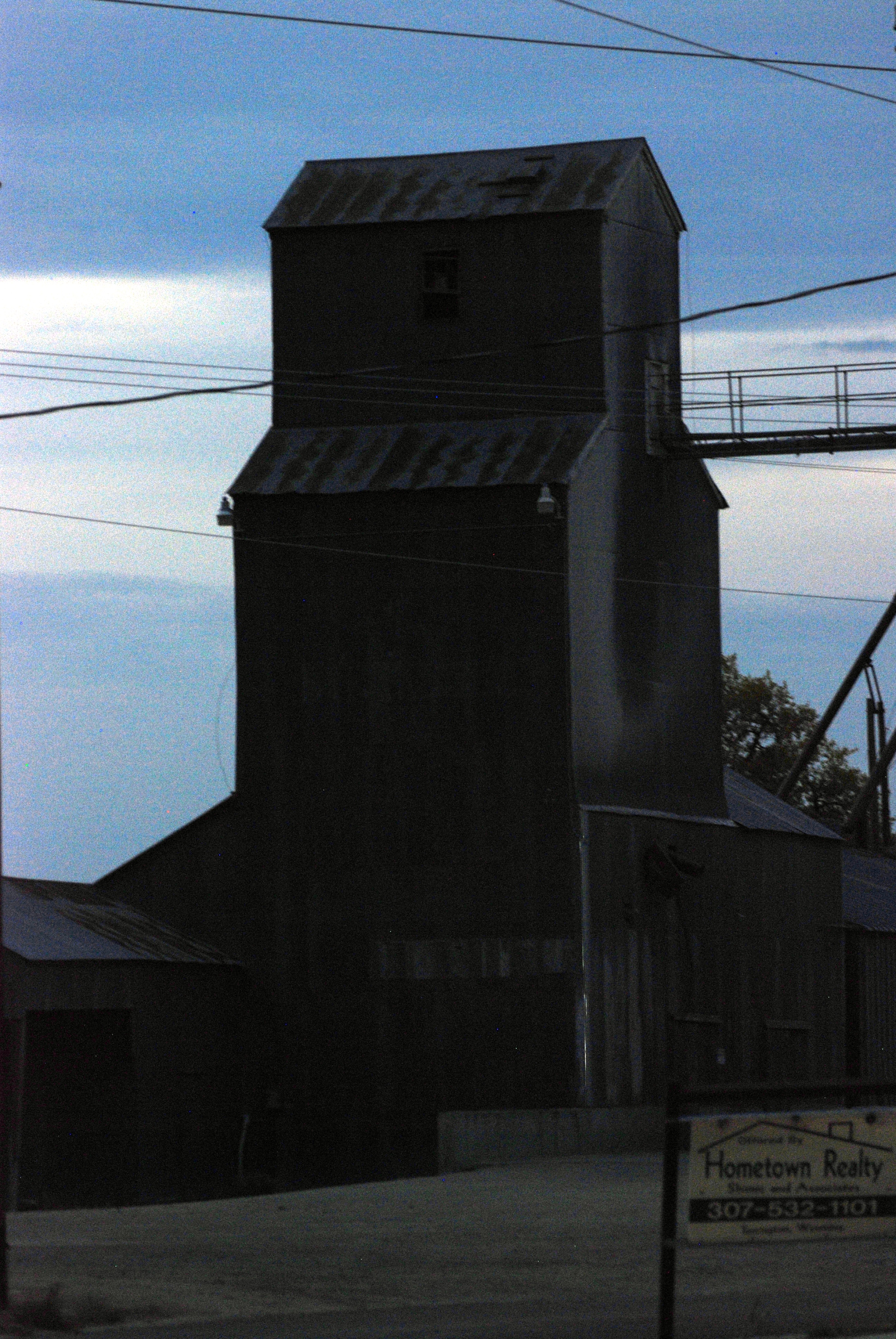
On our way back through–this time, after dark, Llewellyn is the first newly discovered elevator site we see. The old wooden house stands hard by the road with bins lined up on either side. A Purina checkerboard shows faintly in the darkness, but a photograph is out of the question. We are pushing the miles, and the setup for this dark building would be time consuming and the results would be marginal, so we pass it by. I note the town for future reference, for that imaginary trip when we will be rolling through in full sun with all the time in the world.

The second elevator location comes into view when we are just about at the end of our rope in Ogallala. I have gone through a pack of gum, and I have made reservations for a motel somewhere nearby for the night. We are stumbling in past midnight. One old wooden elevator displays a Nutrena sign from it’s spot at the end of a short lane, where it nestles among round bins and bathes in dimly yellowish artificial light. As we roll across the viaduct in town, which takes us over the tracks, we see another silvery old-timer on our left which looks intriguing. I will have to check these elevators later.

Of course.

DSC_0968

Morrill, Nebraska

In the morning, all is forgotten as we get on our way toward Ashland.

This is how you leave a patch of geography perpetually obscured in darkness, and scarcely notice its absence. The absence doesn’t breach your consciousness until you notice what is missing, and that can take a long time.

I spend my professional life flying across the continent in the dark, with things like the Grand Canyon and the Rocky Mountains passing below unremarked. A scattering of lights strewn across the land are all the clues to life below—like droplets of water on black velvet, illuminated by an unseen light, they twinkle and tease.

DSC_0164

Lingle, Wyoming

The familiar cockpit lights are my entire world with little else to distract—the gum to keep me alert, or coffee sometimes, and a cozy hotel to look forward to.