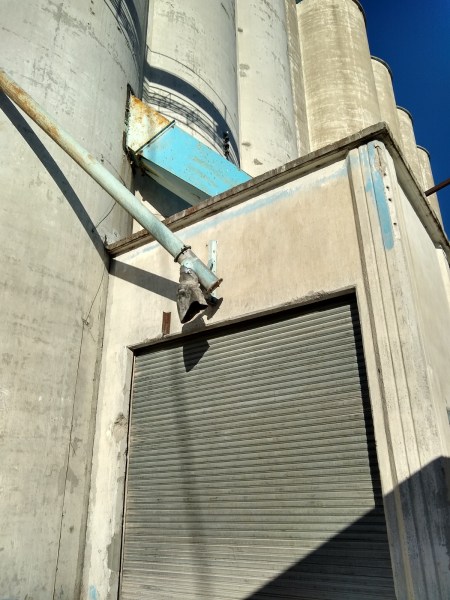
Around 1900, electricity and concrete were advances for Buffalo’s elevators

Buffalo 03

Buffalo and Erie County Historical Society

By Ronald Ahrens

Yesterday we looked at the rise of Buffalo, N.Y., as a grain storage and processing center, one that developed after the the Erie Canal opened in 1825. Buffalo was the port where grain was unloaded from lake boats to canal boats. A bevy of steam-powered bucket elevators sprang up.

Today we consider the advances made in Buffalo after the introduction of electricity and electric motors to replace coal and steam engines. We also look at the rise of slipformed concrete to replace wooden elevator houses.

In his essay on the history of Buffalo’s elevators, Henry H. Baxter notes that inexpensive electric power permitted the electrification of elevators. It also encouraged grain processing: the milling of cereal, flour, and animal feed.

Buffalo 05The first electric elevator–a retrofitting, we assume–was soon after a large-capacity generating station started up in 1895. Two years later, the Electric and  Great Northern elevators were built solely around compact electric motors.

“In this way they eliminated steam boilers, engines, chimneys, numerous workers, and the necessity of bringing fuel to the elevator or mill site,” Baxter explains.

Nevertheless, grain scoopers were still needed, and the Irish from South Buffalo dominated the International Longshoremen’s Association Grain Shovelers Union Local 109 as late as 1940. During Buffalo’s heyday as many as 3,000 men were employed scooping grain from the holds of lake carriers. By 1996, the Buffalo News reported only 80 scoopers remained, the last of their kind in the United States.

A Facebook page offers revealing photos of scoopers at work.

The corresponding advance was the use of reinforced concrete. Baxter explains: “At first, bins were built of wood and usually lined with iron. After 1890 steel bins were built in a number of different arrangements. Since that time reinforced concrete has been used.

Buffalo 04

Buffalo and Erie County Historical Society

To get up to the headhouse, workers used a man lift. “This is an endless moving belt stretching from basement to the top with 12-inch square platforms attached every 25 feet or so. To go up or down a worker has only to step on a wooden platform going in his direction and hold on.”

Baxter does not specify what a worker might hold for security. Of course, a worker could  fall–that’s why enclosed cages replaced the more primitive method.

A reinforced-concrete elevator was built at Buffalo in 1907. Baxter’s understated description of the method is worth quoting at length:

At the beginning, a form usually four feet high was built on the foundation slab. Screw jacks placed at intervals of about seven feet were used to raise the form. Workers operated the jacks at a rate calculated to raise the form about six inches an hour. This rate gave concrete time to set at the bottom before being exposed by the slowly rising form.

Using this method it took about ten days for the Standard Elevator to reach the height of 125 feet. This was the average height of the bins. After completion of the bins, the workhouse was slipformed up until the structure reached a height of about 200 feet.

The top or deck of a grain elevator under construction was an extremely busy place. Placement of steel rods, pouring of concrete, and jacking of the form were continuous processes. Generally, each jack man had twelve jacks to tend to. A whistle sounded as a signal for each man to make one turn on each jack. Raising the form six inches required 24 whistle signals each hour. During that time a jack man would make 288 turns–almost five a minute–on his jack. Understandably a jack man occasionally got tired enough to miss a few turns. This caused his section of the form to be lower than the rest, resulting in a considerable stress on the form. Such an imbalance brought distress to the job superintendent.


Looking to Greenwood from I-80, we see it, twice as tall as the trees

Co-op from Greenwood from I80 overpass IIII

In this photo, our friend Kim David Cooper shows the same refined sense of composition as in his oil paintings. “A different view of your Greenwood elevator,” he says.

The photo’s slug line notes the shot was taken from an overpass on Interstate 80.

Standing at least twice the height of the tallest tree, doesn’t the elevator make a handsome addition to the landscape?

Book report, Part One: Cargill’s first elevators and the blind-horse phenomenon

By Ronald Ahrens

Good fortune has led to my acquiring a copy of Cargill: Trading the World’s Grain, by Wayne G. Broehl, Jr., published in 1992. I got a like-new copy on Amazon for (he goes to the closet to consult credit card records) $7.99—a screamin’ deal.

The massive, 1,007-page book is just part one of Prof. Broehl’s ambitious and masterful history of Cargill—the company let him look at everything, and the reader is left with a detailed account that’s also based on public sources as specific as records on local water wells.

Reading this behemoth will be like skinning a whale with a pocket knife, but as I progress you can look for periodic posts showing what I’ve learned.

Cargill 01In this volume Prof. Broehl starts with Will Cargill’s reaching his majority after the Civil War. As a young man, Cargill showed a disposition for trading grain. It led to a few elevators but also many “flathouses.” These single-story warehouses proliferated along the railroad tracks in northeastern Iowa and southern Minnesota, where Cargill got his start; they could hold a lot of grain but of course they were subject to fire.

Not only could a flathouse burn down in an instant, but other misfortunes could strike.

“This particular spring of 1874 produced a string of bad luck for Will Cargill; in May, his Albert Lea [Minn.] warehouse collapsed, spilling some 2000 bushels of grain,” the professor tells us.

If that had been the season’s lone calamity, Cargill would have gotten off easy. “It had hardly been cleaned up when reports reached Will that another warehouse, at Ridgeway, Iowa, had burned to the ground, ‘the only piece of property which he had neglected to insure…”

Near Austin, Minn., Cargill lost another flathouse “after a couple of years by overloading.” He built an 18,000-bushel elevator with an eight-horsepower steam engine providing the power.

Screen shot 2018-08-06 at 10.49.59 AM

Screen shot from the Northwestern Miller. Wikimedia Commons say, “The Northwestern Miller (1880–1973) was a periodical founded by the Miller Publishing Company of Minneapolis, Minnesota. A trade publication for the grain and flour industry, it also published short fiction.”

Yes, besides flathouses, we learn of “elevator[s] with power machinery for elevating grain, like the large Cresco [Iowa] operation of Beadle & Slee. “By this time, however, elevating mechanisms were more widespread, sometimes simple ‘cup and belt’ devices run by a horse led in a circle, a ‘blind horse’ elevator, so-called. An old-timer recounted how one elevator ‘had a whip attached above the horse, and there was a hole in the wall where the men … could holler down and the horse … and a string attached to the whip so they could pull and hit the horse.”

Seeking more information about blind-horse elevators I went online and found this passage from the Northwestern Miller as reported in Volume 47, published May 24, 1899:

“By some happy, or otherwise, chance, it was discovered that a blind horse will keep on in his circular path, never seeming to know that he isn’t going anywhere, nor can he tell when the man in charge is out of sight. The poor brute will follow his halter around his little circle from noon till night, thinking all the time that he is getting along in the world.

“This set the elevator men thinking with the result that the blind-horse market immediately began to pick up. Poor old blind nags in the Dakotas, Minnesota, and Iowa were surprised to find themselves in demand. Instead of being allowed to die peacefully in pastures and their bones to be forgotten, they were sought after with an eagerness that made them feel there was really some distinction in being blind. It was not unusual, a few years ago, for an elevator company to buy up a carload of blind horses in Iowa and ship them into Minnesota or the Dakotas. But that time has passed and the day of the blind horse is nearly over. Even now, in the odor of gasoline he can smell, if he can’t see, his finish.”

Blind horses happily acceded this odious role to power machinery. Steam engines producing up to 10 horsepower were used to drive the machinery, and they allowed for construction of larger elevators. In 1873—the year of a financial panic as well as a grasshopper plague—Cargill “decided to increase his operations along the McGregor Western tracks and contracted for a large elevator at Cresco. Its total cost eventually came to over $12,000.”

Anyone who wants to read along will find passages of the book online, thanks to Google Books.

A glimpse of Firth makes us go forth with speculations and an investigation

Firth, NE Cemetery 2012 II

By Ronald Ahrens

As with yesterday’s post, we’re working from a photo sent by Kim Cooper, a friend of this blog who happens to have grain elevators in his heritage, too. He likes to incorporate them into his superb, plein air landscape paintings.

Sometimes Cooper sends pictures.

“Here’s one from Firth, Nebraska,” he said. “Looks like a rounded top.”

Indeed, the rounded headhouse was the signature on Tillotson Construction Co.’s elevators after about 1950.

But other builders could have used this style. We see no mention of Firth in Tillotson’s records. We see Minatare (1941), Rushville (1947), Polk and Richland (1948), Hordville (1949), Bellwood (1950), Cedar Bluffs (1950), Aurora and Omaha and Wahoo (1950), Greenwood and David City and York (1951), Fairfield (1952), Bellwood (340,000 bushels of storage in 1954), and Waverly (1955).

That’s 15 locations. Tillotson built far more elevators in Iowa and Oklahoma than in the company’s home state of Nebraska. But 15 isn’t bad. Based on anecdotal information we also suspect a couple of other locations. 

But after calling up Dennis Kenning, we’ve ruled out Firth as an unrecorded job by Tillotson. Kenning is sales and marketing manager for Farmers Cooperative, which has headquarters in Dorchester, Neb. and dozens of elevators throughout southeastern Nebraska.

Kenning expressed curiosity, looked into the matter, and emailed his findings:

“Here’s what we found out,” he wrote.

  • Constructed sometime in the ’60s
  • Roberts Const Co.
  • Hutchinson Foundry & Steel
  • Sabetha, Kansas

We found Roberts Construction Co. located in Axtell but were unable to reach them. The question arises about Roberts’ design source–were there any Tillotson connections?

An elevator in Minden, Neb., offers few clues and one gangling oddity

MIndenNeb

By Ronald Ahrens

Our friend Kim Cooper sent this photo of an elevator in Minden, Neb. We see no mention of Minden in the records of Tillotson Construction Co., of Omaha. One dependable characteristic is that Tillotson built a with center driveway. This elevator has a side driveway.

Although we don’t know how many elevators were constructed by Mayer-Osborn Co., of Denver, or where they were built, an educated guess says this isn’t one of their jobs either. Mayer-Osborn had developed a stepped-headhouse design with rounded corners. Here, there is a step, but nothing like the proportions we have seen at an Mayer-Osborn elevator–the one in Follett, Texas, for example.

So we called up Minden and spoke to Brent, who runs the location. He confirmed that the freestanding tall structure on the elevator’s left in this photo is an outdoor leg and is used to load trains.

And Brent said the elevator was built by Sampson Construction. “I want to say 1960s for the original house,” he said.


Even more views of Buffalo’s terminals and more grain-trade history, Part 3

By Ronald Ahrens

As seen in two previous posts, Kristen was in Buffalo the other day and took photos of the terminal elevators. Here’s the third in the series of three we’re doing with our own commentary as well as some lines from Cargill: Trading the World’s Grain, by Wayne G. Broehl, Jr. These lines show how central Buffalo was to the grain trade.

IMG_7105

“This place has an ADM sign on it but it was deserted over the weekend except for a flock of geese and one of pigeons,” Kristen reported. “It looks pretty worn down too.”

“Quite a headhouse,” I said. “Originally a Cargill elevator?”

* * *

June 7, 1932: “May people connected with Montreal shipping felt quite threatened by the new Albany deep-water port. So too did other communities along the water route to the St. Lawrence, particularly Buffalo.” — p. 536

IMG_7130

“The other side taken from the drawbridge,” Kristen said.

“I do not normally associate kayakers with grain elevators,” I said.

* * *

“Another frequently used routing for Canadian grain was through a Lake Erie port, typically Buffalo, where it might be milled into flour. If the flour was for United States consumption, a duty of 42 cents per bushel of wheat had to be paid. If it was for international sale it could be reloaded under ‘milling-in-transit’ privileges and escape duty.” — p. 541

IMG_7135

“Its neighbor across the water is just as big,” Kristen said. “It also looks quite old.”

“It could use some sprucing up, but that’s not our department,” I said. “Oh, and try this historical view

* * *

1941: “So Cargill too moved once more to increase its own storage capacity … The capacities at Buffalo had been vastly expanded–an addition to the Electric Elevator there increased this one terminal from 1.75 million to over 5.2 million bushels; with the Great Eastern and the Superior, the Company now had over 12.4 million bushels just at that one location.” — p. 582

More views of Buffalo’s terminals and some related grain-trade history, Part 2

 By Ronald Ahrens

As mentioned in the previous post, Kristen was in Buffalo the other day and took photos of the terminal elevators. Today’s post is the second in a series of three we’re doing with our own commentary as well as some lines from Cargill: Trading the World’s Grain, by Wayne G. Broehl, Jr. These lines show how central Buffalo was to the grain trade.

55449882966__9DAFF0D4-3DA9-40F5-BF49-9BB5C9F789F3

“It’s the face of Gold Medal flour,” Kristen said.

“It’s a winking face,” I said.

* * *

“The Farm Board created further consternation by its avowed aim to hold its March wheat contracts until the contract terminated, then take actual grain. Thus, physical grain had to be delivered to Chicago by the shorts to fulfill these contracts. Most of these short contracts were held by private-sector grain traders, but a substantial amount of their physical stock of grain already had been moved forward in the pipeline to eastern terminals. Cargill, its Midwest storage already glutted, had shipped large amounts of grain through the Lakes to the Buffalo and Ogdensburg, New York terminals, paying transportation costs to get it there. If this eastern grain had to be used to fulfill the short contracts, either by physical movement back to Chicago or some compensating trade, the grain traders wanted to recover the transportation costs they had already expended on it. The Farm Board refused to allow this … John [MacMillan] Sr., outraged, fired off missives to everyone in Washington about the Farm Board ‘squeeze.'” — p. 349

IMG_7034

“You can smell the cereal from across the canal,” Kristen said.

“If only it were a scratch-and-sniff photo,” I said.

* * *

“In June 1930, Cecil C. Boden from the Omaha office was assigned to a newly opened Cargill branch in Rotterdam, Holland. John [MacMillan] Jr. told him: ‘While ultimately we expect to have you doing a very large business for us … we wish caution to be the keynote.’ He also reiterated the long-standing company credo relating to ethical conduct: ‘We wish particularly to stress the fact that our future success abroad will depend entirely on our standing in the trade. The motto of our Buffalo office ‘We deliver what we sell’ is an excellent one to remember.'”


In Waverly, Neb., a Ford is older than the Tillotson elevator of 1955

IMG_0264

Once again, our friend Kim Cooper provides a photo, this time from Waverly, Neb.

Six miles farther southwest on U.S. 6 than Greenwood, featured yesterday, Waverly is very close to Lincoln.

The Tillotson elevator seen on the left in the photo was built here in 1955, a few years after the Ford you see on the lower right.

Waverly is one of the last elevators in the company records, which cover the period from 1939 to 1955.

The elevator followed the plan established at Drummond, Okla., in 1950. This meant a single-leg, center-drive house of 199,400-bushel capacity.

To have so much integrated storage, the plan provided for eight tanks of 15.5 feet in diameter rising to 120 feet in height. The cupola, or headhouse, added another 35 feet.

We can only guess at the meaning of four notes in the record:

  1. Main slab including 3″ pile cap 33 c.y.
  2. 8 bin aerat’n tubes
  3. Dryer bin
  4. Piling

The pit was 15 feet 3 inches deep. Perhaps a high water table or unconsolidated subsurface material at Waverly made the pilings necessary.

The photo shows the elevator in remarkable condition.

We welcome our readers’ interpretation of the notes.

Atmospheric view of a classic Tillotson elevator in Greenwood, Neb.

IMG_0148

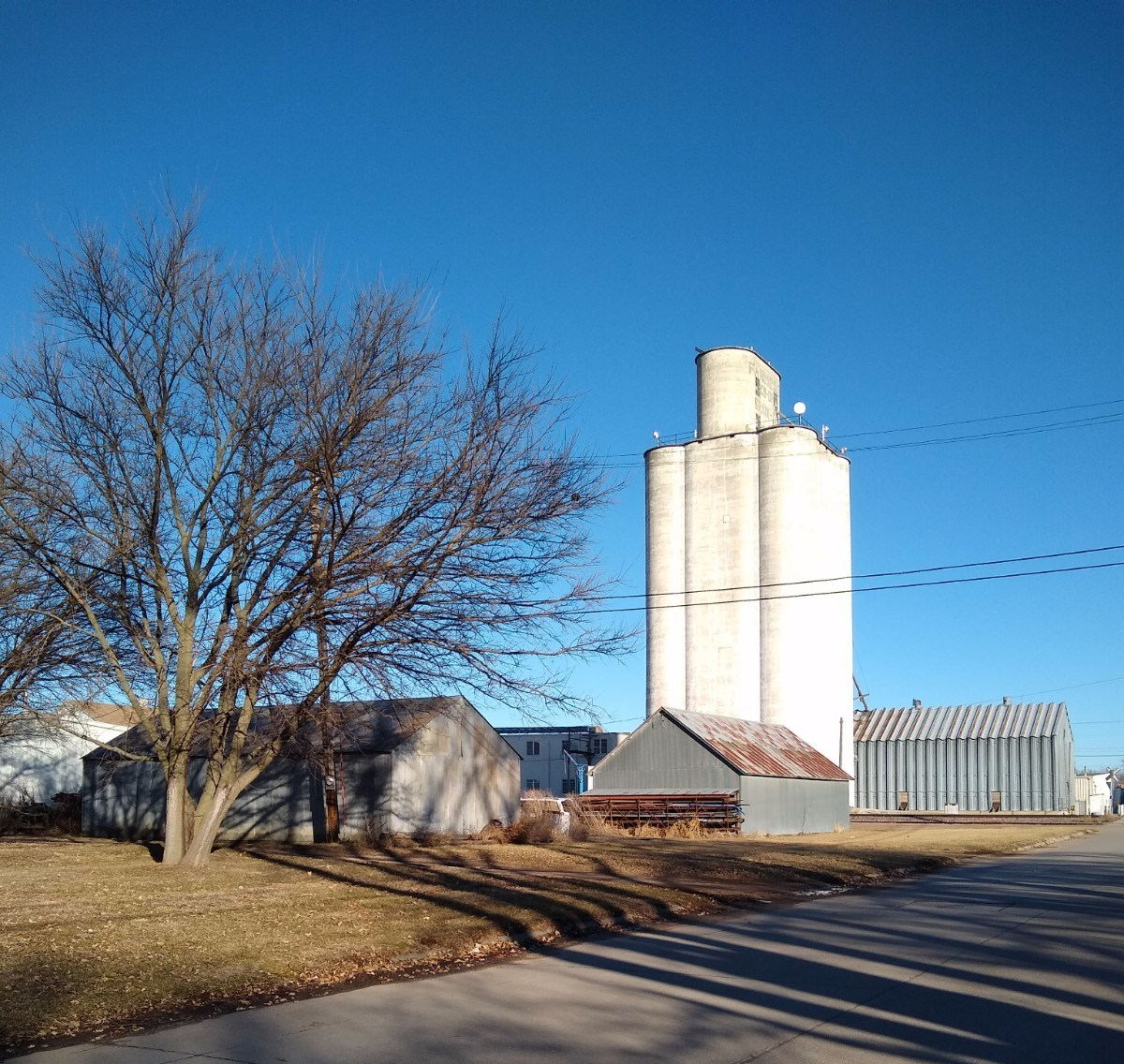
Our friend Kim Cooper sent this atmospheric photo from Greenwood, Neb. We see a classic Tillotson grain elevator: single leg, center driveway, rounded headhouse.

It was built in 1951 on the plan established at Churdan, Iowa, some two years earlier. While Churdan was 102,000 bushels, Greenwood–which sits on U.S. 6 between Omaha and Lincoln–had 129,000-bushel capacity.

Each of the four tanks was of 14.5 feet in diameter and rose 120 feet. The cupola, or headhouse, went up another 22 feet.

A note in the records says, “Rainy @ start.” We can imagine the difficulty of excavating the 12-foot-deep pit, setting forms in the mud, and getting the project off the ground.

An additional note is more cryptic: “30-inch slab proj.” I don’t know how to explain it, especially because the main slab was 18 inches thick, as at Churdan.

Yet another note says, “Inside steps. Dryer prov. (split bin).” That one the reader can interpret for himself.

Calling at Kingfisher, Okla., raises suspicions but leads to answers

By Ronald Ahrens

This past spring we dispatched our indefatigable correspondent, Rose Ann Fennessy, to Kingfisher, Okla., where Tillotson Construction Co., of Omaha, built a 240,000-bushel elevator in 1946.

Kingfisher is a large, multi-faceted complex. Naturally enough, Rose Ann found herself overwhelmed.

Meanwhile, her prowling aroused suspicion.

Without a definitive result–but with Rose Ann managing to avoid a lengthy sentence–we turn to a history of the Kingfisher Cooperative Elevator Association, which fell into our hands a few years ago.

This document was published in 1984 on the Association’s 50th anniversary.

Here we quote from it:

“The association ‘reincorporated’ for $130,000. The previous incorporation was for only $25,000. Also in 1946 the association wrecked the old 34,000 bu. elevator and built a new concrete elevator with a 250,000 bu. capacity. They also wrecked all the other old buildings except the office and scale house which they had built in 1942. It was remodeled into a concrete cleaning and grinding mill and warehouse.” 

There is a discrepancy of 10,000 bushels between Tillotson’s records and the capacity mentioned in the report.

It continues:

“A new skyline was developing on Kingfisher’s horizon. Burrus Mill and Elevator of Kingfisher, perhaps the cooperative’s most unrelenting competition, had built a 1,200,000 bu. facility in the 1930s and it had always loomed large in the farmers’ minds. Now, the farmers had a modern facility and it gave them confidence to know they could compete on a more equitable basis.” 

“For Kingfisher County farmers, who were accustomed to prairie landscapes, concrete elevators looked like skyscrapers, and it made them proud to have erected such a monument to their united efforts.” 

From the photo included in the report we see the Tillotson house in Rose Ann’s photo. As the construction record notes, it was built on an expanded Medford plan from 1941 and has “2 driveways thru center” and a single leg.

We are blessed with the cover photo, which shows the Tillotson elevator in the lower left along with the cleaning-and-grinding mill extending out of frame. The elevator’s rectangular headhouse bears the Kingfisher Coop stamp.

Is it any wonder the farmers felt proud to have a monument to their united efforts?