An elevator in Minden, Neb., offers few clues and one gangling oddity

MIndenNeb

By Ronald Ahrens

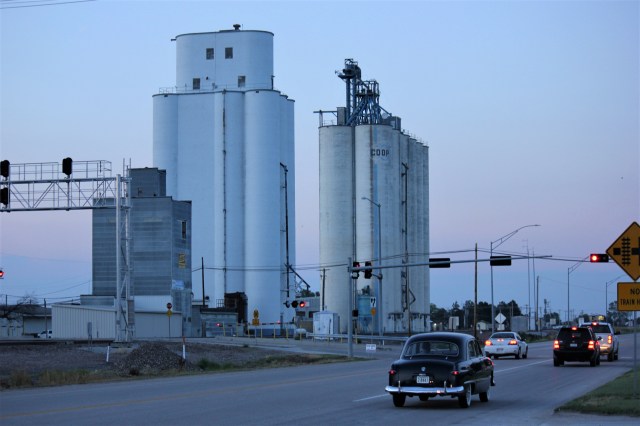
Our friend Kim Cooper sent this photo of an elevator in Minden, Neb. We see no mention of Minden in the records of Tillotson Construction Co., of Omaha. One dependable characteristic is that Tillotson built a with center driveway. This elevator has a side driveway.

Although we don’t know how many elevators were constructed by Mayer-Osborn Co., of Denver, or where they were built, an educated guess says this isn’t one of their jobs either. Mayer-Osborn had developed a stepped-headhouse design with rounded corners. Here, there is a step, but nothing like the proportions we have seen at an Mayer-Osborn elevator–the one in Follett, Texas, for example.

So we called up Minden and spoke to Brent, who runs the location. He confirmed that the freestanding tall structure on the elevator’s left in this photo is an outdoor leg and is used to load trains.

And Brent said the elevator was built by Sampson Construction. “I want to say 1960s for the original house,” he said.


Even more views of Buffalo’s terminals and more grain-trade history, Part 3

By Ronald Ahrens

As seen in two previous posts, Kristen was in Buffalo the other day and took photos of the terminal elevators. Here’s the third in the series of three we’re doing with our own commentary as well as some lines from Cargill: Trading the World’s Grain, by Wayne G. Broehl, Jr. These lines show how central Buffalo was to the grain trade.

IMG_7105

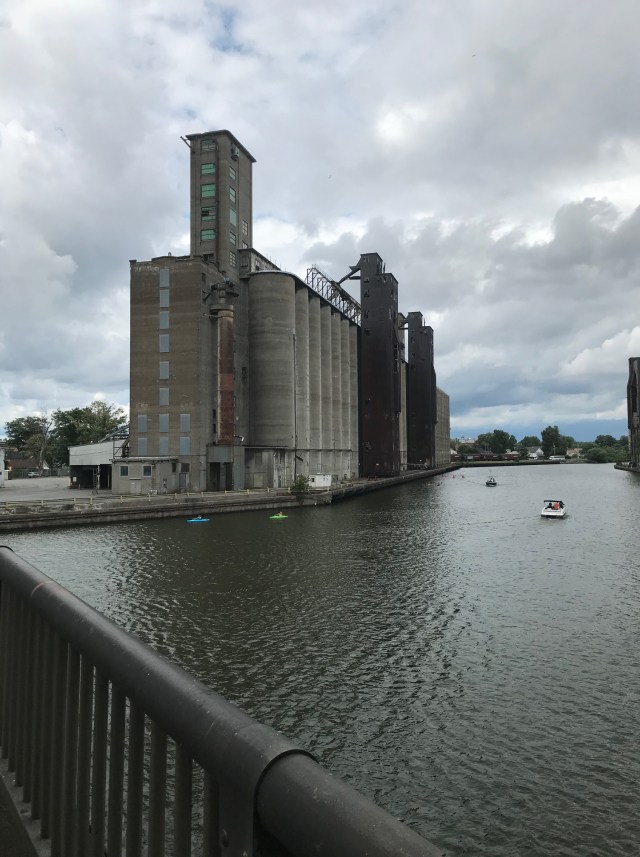
“This place has an ADM sign on it but it was deserted over the weekend except for a flock of geese and one of pigeons,” Kristen reported. “It looks pretty worn down too.”

“Quite a headhouse,” I said. “Originally a Cargill elevator?”

* * *

June 7, 1932: “May people connected with Montreal shipping felt quite threatened by the new Albany deep-water port. So too did other communities along the water route to the St. Lawrence, particularly Buffalo.” — p. 536

IMG_7130

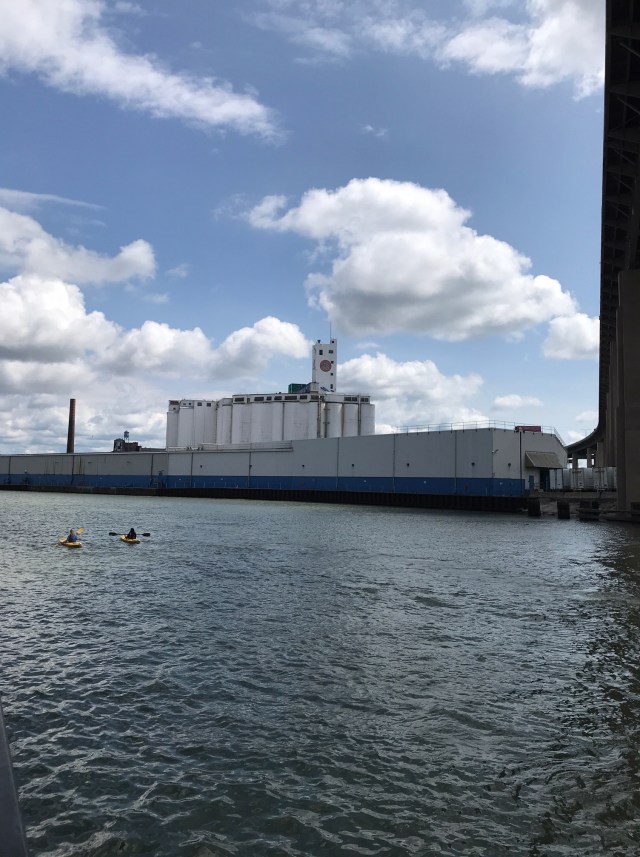
“The other side taken from the drawbridge,” Kristen said.

“I do not normally associate kayakers with grain elevators,” I said.

* * *

“Another frequently used routing for Canadian grain was through a Lake Erie port, typically Buffalo, where it might be milled into flour. If the flour was for United States consumption, a duty of 42 cents per bushel of wheat had to be paid. If it was for international sale it could be reloaded under ‘milling-in-transit’ privileges and escape duty.” — p. 541

IMG_7135

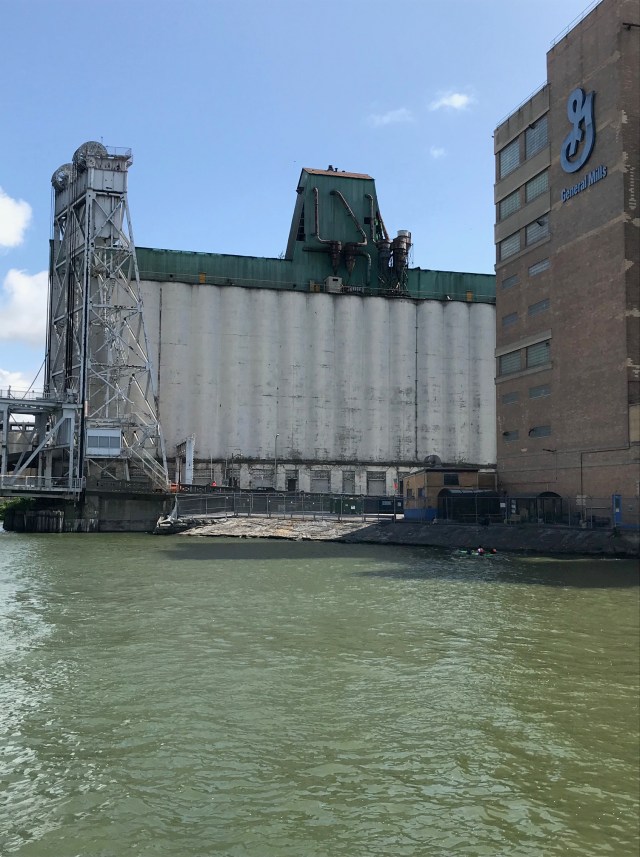
“Its neighbor across the water is just as big,” Kristen said. “It also looks quite old.”

“It could use some sprucing up, but that’s not our department,” I said. “Oh, and try this historical view

* * *

1941: “So Cargill too moved once more to increase its own storage capacity … The capacities at Buffalo had been vastly expanded–an addition to the Electric Elevator there increased this one terminal from 1.75 million to over 5.2 million bushels; with the Great Eastern and the Superior, the Company now had over 12.4 million bushels just at that one location.” — p. 582

More views of Buffalo’s terminals and some related grain-trade history, Part 2

 By Ronald Ahrens

As mentioned in the previous post, Kristen was in Buffalo the other day and took photos of the terminal elevators. Today’s post is the second in a series of three we’re doing with our own commentary as well as some lines from Cargill: Trading the World’s Grain, by Wayne G. Broehl, Jr. These lines show how central Buffalo was to the grain trade.

55449882966__9DAFF0D4-3DA9-40F5-BF49-9BB5C9F789F3

“It’s the face of Gold Medal flour,” Kristen said.

“It’s a winking face,” I said.

* * *

“The Farm Board created further consternation by its avowed aim to hold its March wheat contracts until the contract terminated, then take actual grain. Thus, physical grain had to be delivered to Chicago by the shorts to fulfill these contracts. Most of these short contracts were held by private-sector grain traders, but a substantial amount of their physical stock of grain already had been moved forward in the pipeline to eastern terminals. Cargill, its Midwest storage already glutted, had shipped large amounts of grain through the Lakes to the Buffalo and Ogdensburg, New York terminals, paying transportation costs to get it there. If this eastern grain had to be used to fulfill the short contracts, either by physical movement back to Chicago or some compensating trade, the grain traders wanted to recover the transportation costs they had already expended on it. The Farm Board refused to allow this … John [MacMillan] Sr., outraged, fired off missives to everyone in Washington about the Farm Board ‘squeeze.'” — p. 349

IMG_7034

“You can smell the cereal from across the canal,” Kristen said.

“If only it were a scratch-and-sniff photo,” I said.

* * *

“In June 1930, Cecil C. Boden from the Omaha office was assigned to a newly opened Cargill branch in Rotterdam, Holland. John [MacMillan] Jr. told him: ‘While ultimately we expect to have you doing a very large business for us … we wish caution to be the keynote.’ He also reiterated the long-standing company credo relating to ethical conduct: ‘We wish particularly to stress the fact that our future success abroad will depend entirely on our standing in the trade. The motto of our Buffalo office ‘We deliver what we sell’ is an excellent one to remember.'”


Views of Buffalo’s terminals and some related grain-trade history, Part 1

By Ronald Ahrens

Kristen was in Buffalo the other day and sent photos of the terminal elevators there. In a short series over the next three days we’re going to post them with our own commentary as well as some lines from Cargill: Trading the World’s Grain, by Wayne G. Broehl, Jr. These lines show how central Buffalo was to the grain trade.

IMG_6978

“Terminal elevators, Buffalo, New York,” Kristen said.

“The white elevator has a funny face,” I said.

“It’s the face of Gold Medal flour.

* * *

“Cargill’s most common route for export wheat was by lake-shipping to Buffalo (from either Milwaukee or Green Bay), then by rail through to New York City, where the New York Central & Hudson River Railroad maintained two huge waterside terminals, one holding 2 million bushels, the other 1 1/2 million.” — p. 47

IMG_6993

“Floating tiki bar!” Kristen said.

“Floating tiki in Buffalo–who knew?” I said.

* * *

“[Arthur M.] Prime [“self-styled barley king of Duluth”] and J.B. Cooper, Cargill’s Minneapolis barley trader, continued to dovetail barley purchases from the two locations as well as with the office at Green Bay, and all three offices dealt with an agent from Buffalo, Dudley Irwin.” — p. 110

IMG_7051

“They had a zip line set up between the Labatt’s elevator and the big one. A destroyed elevator foundation is under the zip line. You can see it on Google Earth,” Kristen said.

* * *

“John Sr. and Lindahl began to consider the purchase of a terminal elevator in Buffalo, which would have led to a trading office in that important city. In early 1909 a terminal building came available, but MacMillan turned it down because it was not fireproof…” — p. 144

“As Cargill’s barley went forward to the Buffalo markets, Irwin said he had difficulty in selling it, writing Prime, “We are losing our trade every day just as I told you we would, and for the simple reason that we are shipping dirty barley … It is all right to say you will ship your barley in the dirt and sell it for feed … that is your own business, but if you are going to sell to maltsters you have got to ship them barley as clean as our competitors will furnish them, or fall down.” — p 144


In Waverly, Neb., a Ford is older than the Tillotson elevator of 1955

IMG_0264

Once again, our friend Kim Cooper provides a photo, this time from Waverly, Neb.

Six miles farther southwest on U.S. 6 than Greenwood, featured yesterday, Waverly is very close to Lincoln.

The Tillotson elevator seen on the left in the photo was built here in 1955, a few years after the Ford you see on the lower right.

Waverly is one of the last elevators in the company records, which cover the period from 1939 to 1955.

The elevator followed the plan established at Drummond, Okla., in 1950. This meant a single-leg, center-drive house of 199,400-bushel capacity.

To have so much integrated storage, the plan provided for eight tanks of 15.5 feet in diameter rising to 120 feet in height. The cupola, or headhouse, added another 35 feet.

We can only guess at the meaning of four notes in the record:

  1. Main slab including 3″ pile cap 33 c.y.
  2. 8 bin aerat’n tubes
  3. Dryer bin
  4. Piling

The pit was 15 feet 3 inches deep. Perhaps a high water table or unconsolidated subsurface material at Waverly made the pilings necessary.

The photo shows the elevator in remarkable condition.

We welcome our readers’ interpretation of the notes.

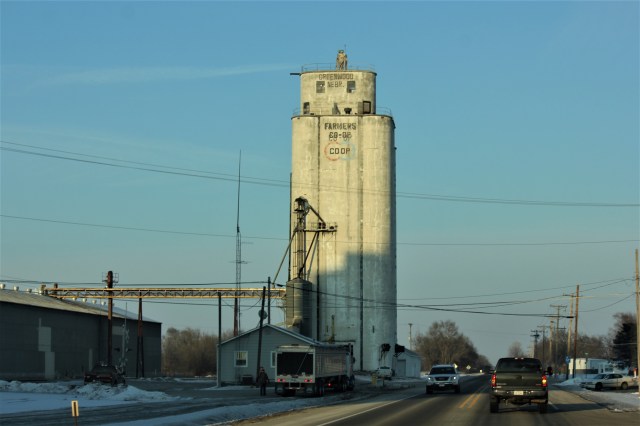
Atmospheric view of a classic Tillotson elevator in Greenwood, Neb.

IMG_0148

Our friend Kim Cooper sent this atmospheric photo from Greenwood, Neb. We see a classic Tillotson grain elevator: single leg, center driveway, rounded headhouse.

It was built in 1951 on the plan established at Churdan, Iowa, some two years earlier. While Churdan was 102,000 bushels, Greenwood–which sits on U.S. 6 between Omaha and Lincoln–had 129,000-bushel capacity.

Each of the four tanks was of 14.5 feet in diameter and rose 120 feet. The cupola, or headhouse, went up another 22 feet.

A note in the records says, “Rainy @ start.” We can imagine the difficulty of excavating the 12-foot-deep pit, setting forms in the mud, and getting the project off the ground.

An additional note is more cryptic: “30-inch slab proj.” I don’t know how to explain it, especially because the main slab was 18 inches thick, as at Churdan.

Yet another note says, “Inside steps. Dryer prov. (split bin).” That one the reader can interpret for himself.

Kingfisher Co-op history, Part 3: Further expansion and maturity

Here are the final pages of the 11-page history published in 1984 by Kingfisher Cooperative Elevator Association.

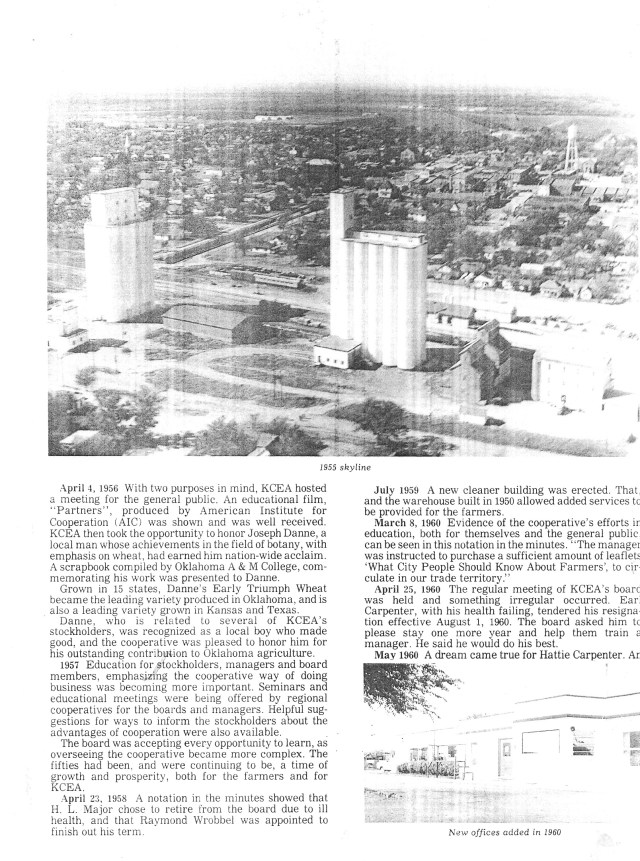
In 1955, after notifying contractors to send in bids, the co-op added a 320,000-bushel elevator. This supplemented the 240,000-bushel elevator built by Tillotson Construction Co., of Omaha, in 1946.

“A new skyscraper had been added to the landscape, and the farmers took pride in the contribution they had made to their community’s appearance and prosperity,” the history says.

You will find the Tillotson elevator on the left in the aerial view of the 1955 skyline (p. 8).

Co-op Way 08

Co-op Way 09

Co-op Way 10

Co-op Way 11


Kingfisher Co-op history, Part 2: Incorporation and steady growth

This is second of our three postings to give you the 11 pages of history published by the Kingfisher Cooperative Elevator Association on its 50th anniversary.

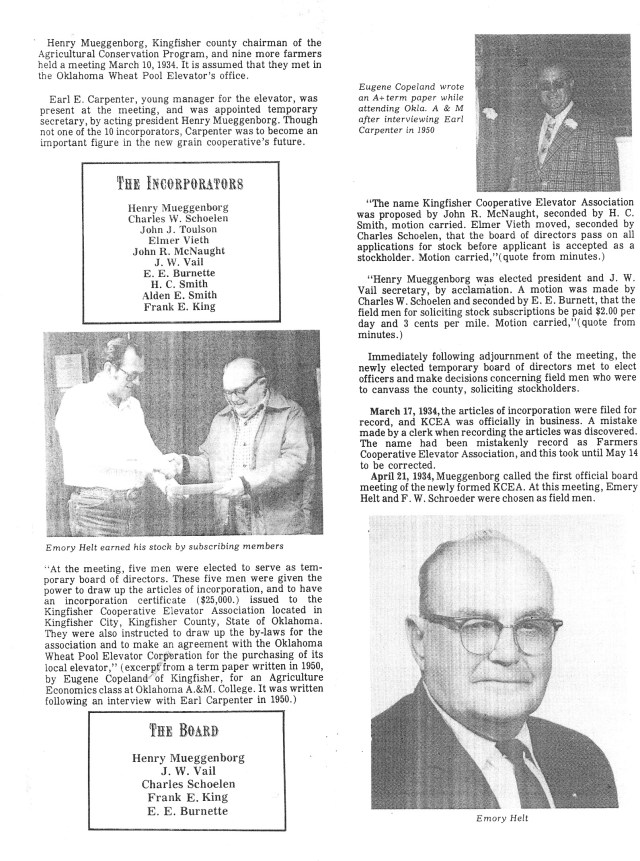
In these pages you’ll learn that one surviving founder of the co-op recalled “with pleasure how the grain cooperative changed farmers’ lives” in the area. On March 10, 1934, a group of 10 men met and arranged for articles of incorporation. Later, they hired a manager for $125 per month.

On the third page here, you will see the 240,000-bushel elevator built by Tillotson Construction Co., of Omaha, in 1946.

Co-op Way 04

Co-op Way 05

Kingfisher Coop

Co-op Way 07 1


Kingfisher Co-op history, Part 1: The ‘disheartening’ year of 1929

Over the next three days, we will post all 11 pages of “The Co-op Way,” published in 1984 in observance of the Kingfisher Cooperative Elevator Association’s 50th anniversary. Our stake in this is the 240,000-bushelTillotson elevator of 1946.

We don’t recall when or how this document miraculously came into our hands, but now is the time to share it. We hope you will enjoy it and benefit from the beautifully written, ever-so-erudite account and stay with us to the conclusion.

Co-op Way 01

Co-op Way 02

Co-op Way 03


Calling at Kingfisher, Okla., raises suspicions but leads to answers

By Ronald Ahrens

This past spring we dispatched our indefatigable correspondent, Rose Ann Fennessy, to Kingfisher, Okla., where Tillotson Construction Co., of Omaha, built a 240,000-bushel elevator in 1946.

Kingfisher is a large, multi-faceted complex. Naturally enough, Rose Ann found herself overwhelmed.

Meanwhile, her prowling aroused suspicion.

Without a definitive result–but with Rose Ann managing to avoid a lengthy sentence–we turn to a history of the Kingfisher Cooperative Elevator Association, which fell into our hands a few years ago.

This document was published in 1984 on the Association’s 50th anniversary.

Here we quote from it:

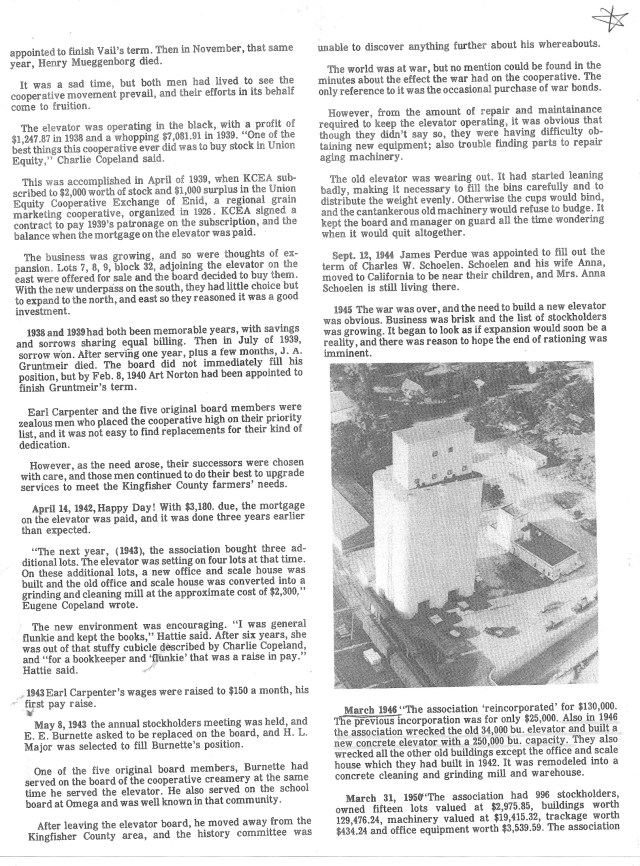
“The association ‘reincorporated’ for $130,000. The previous incorporation was for only $25,000. Also in 1946 the association wrecked the old 34,000 bu. elevator and built a new concrete elevator with a 250,000 bu. capacity. They also wrecked all the other old buildings except the office and scale house which they had built in 1942. It was remodeled into a concrete cleaning and grinding mill and warehouse.” 

There is a discrepancy of 10,000 bushels between Tillotson’s records and the capacity mentioned in the report.

It continues:

“A new skyline was developing on Kingfisher’s horizon. Burrus Mill and Elevator of Kingfisher, perhaps the cooperative’s most unrelenting competition, had built a 1,200,000 bu. facility in the 1930s and it had always loomed large in the farmers’ minds. Now, the farmers had a modern facility and it gave them confidence to know they could compete on a more equitable basis.” 

“For Kingfisher County farmers, who were accustomed to prairie landscapes, concrete elevators looked like skyscrapers, and it made them proud to have erected such a monument to their united efforts.” 

From the photo included in the report we see the Tillotson house in Rose Ann’s photo. As the construction record notes, it was built on an expanded Medford plan from 1941 and has “2 driveways thru center” and a single leg.

We are blessed with the cover photo, which shows the Tillotson elevator in the lower left along with the cleaning-and-grinding mill extending out of frame. The elevator’s rectangular headhouse bears the Kingfisher Coop stamp.

Is it any wonder the farmers felt proud to have a monument to their united efforts?