The Tillotson elevator in Boxholm, Iowa, afforded unique photographic possibilities

DSC_0535Story and photos by Kristen Cart

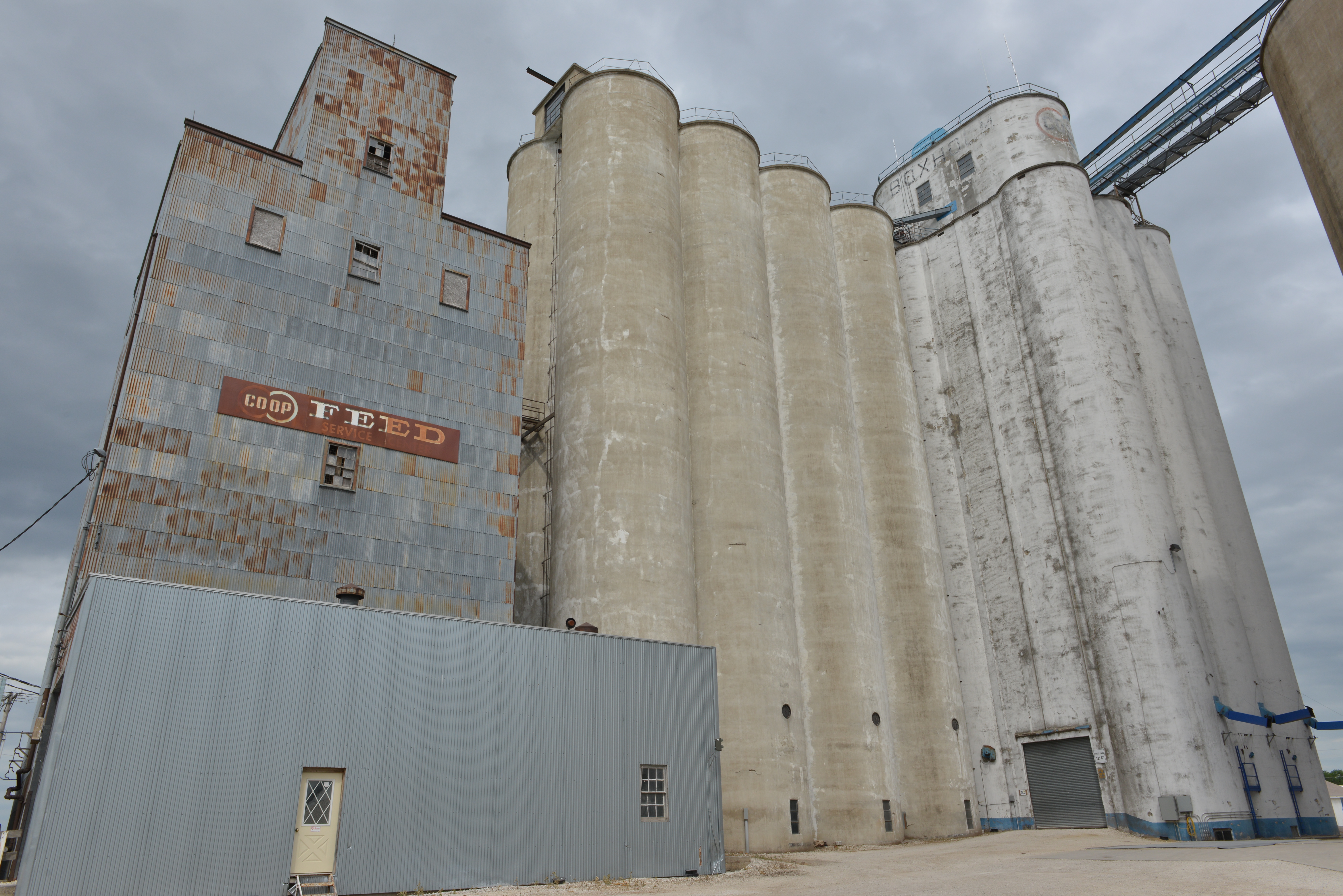
The Boxholm elevator located in central Iowa was an intriguing destination, particularly since I had knowingly passed it by, missing it by a few miles on more than one trip. It became imperative to make the detour to see it. I was glad I did, since the elevator made beautiful pictures on that early summer day. I used a wide-angle lens that added pronounced distortion to the scene, causing the buildings on the edges to lean in dramatically. But the leaning lines pointed to the beautifully clouded sky.

You can use a wide-angle lens to include more of the scene from close quarters than would be possible with another lens, but you forfeit realism. This is not a problem for certain artistic photos, but it is not ideal for documentary shots. When photographing buildings where you want to preserve parallel lines, you must stand farther away and use a longer focal-length lens. At Boxholm, I did not have that option.

DSC_0547

Wide-angle lens distortion is maximized in this view.

At extremely close quarters, the wide-angle lens exaggerates height and adds drama. But the distortion becomes more pronounced.

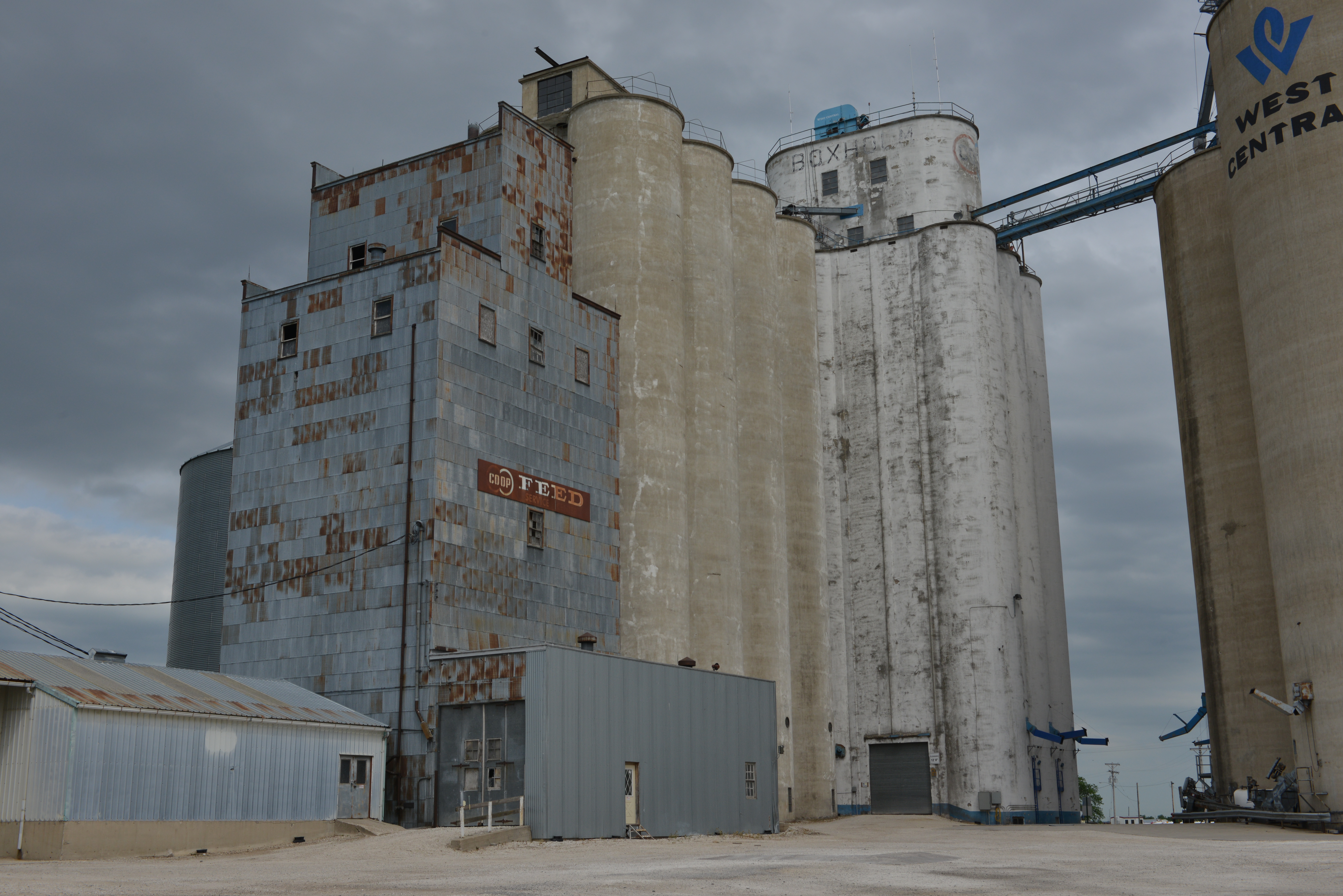
The Tillotson Construction Company of Omaha, Neb., built the elevator in 1955. An annex stands beside it, and an old wooden feed mill is beside that. A much newer elevator with the West Central logo was built later, after it became customary to leave the concrete plain, without the white finish.

DSC_0563

A more conventional view of the elevator complex.

The specifications for the Boxholm elevator are among the Tillotson Company construction records. We learned some details about the elevator from a few stray sources before my visit; for instance, the elevator has exactly 96 light bulbs installed. Its construction followed the Drummond plan. Other projects using the same architectural plan were the elevators at Waverly, Neb., and Lahoma and Drummond, Okla.

Specifications

Capacity per plans (with Dock): 199,400 bushels

Capacity per foot of height: 2,002 bushels

Reinforced concrete per plans (total): 1,797 cubic yards

Plain concrete (3″ hoppers): 33 cubic yards

Reinforcing steel per plans (includes jack rods): 85.71 tons

Average steel per cubic yard reinforced concrete: 95.4 pounds

Steel and reinforced concrete itemized per plans:

Below main slab: 6,861 pounds steel, 59.2 cubic yards concrete

Main slab: 25,603 pounds steel, 202 cubic yards concrete

Drawform walls: 103,192 pounds steel, 1,295 cubic yards concrete

Driveway and Work floor : 3,820 pounds steel, 23.8 cubic yards concrete

Deep bin bottoms (including columns): 7,271 pounds steel, 39.3 cubic yards concrete

Overhead Bin bottoms: 6,040 pounds steel, 27.6 cubic yards concrete

Bin roof and Extension Roofs: 7,210 pounds steel, 41.7 cubic yards concrete

Scale floor (or garner complete): 160 pounds steel, 2.5 cubic yards concrete

Cupola walls (including leg & head): 7,257 pounds steel, 76 cubic yards concrete

Distributor floor: 1,560 pound steel, 9.4 cubic yards concrete

Cupola roof: 2,147 pounds steel, 15.6 cubic yards concrete

Misc. (track sink, steps, etc.): 173 pounds steel, 3.5 cubic yards concrete

Attached driveway: none

Bridge and/or Tunnel: none

Pit Liner–plain: 16 cubic yards concrete

Drier Bin Bottom: 134 pounds steel, 1.3 cubic yards concrete

Coffer Dam, Cleaner Floor: Wood

Remarks: 10 Bin Hot spot; 8 Bin Aeration tubes; Dryer bin

DSC_0541

The rounded headhouse is a reliable indicator of a Tillotson elevator

Construction details

Like Waverly: construction details were identical to Waverly and not listed separately in the records.

Main slab dimensions (drive length first dimension): 56 1/2′ x 70′

Main slab area (actual outside on ground): 3,850 square feet

Weight reinforced (total) concrete (4000 pounds per cubic yard plus steel): 3,747 tons

Weight plain concrete (hoppers; 4000 pounds per cubic yard): 98 tons

Weight hopper fill sand (3000 pounds per cubic yard): 732 tons

Weight of grain (at 60 pounds per bushel): 5,982 tons

Weight of structural steel and machinery: 20 tons

Gross weight loaded: 10,579 tons

Bearing pressure: 2.75 tons per square foot

Main slab thickness: 24″ with 3″ pile cap

Main slab steel: straight #9 at 7″ spacing

Tank steel and bottom (round tanks): #4 at 12″ spacing

Lineal feet of drawform walls & extension: 606′

Height of drawform walls: 120′

Pit depth below main slab: 15’3″

Cupola dimensions (outside width x length x height): 22 1/4′ x 48 1/2′ x 35′

Pulley centers: 160.75′

Number of legs: 1

Distributor floor: yes

Track sink: yes

Full basement: yes

Electrical room: yes

Driveway width clear: 13′

Dump grate size: 2 at 9′ x 5′ and 9′ x 15′

Column under tanks size: 16″ square

Boot legs and head: concrete

DSC_0531Machinery details

Boot pulley: 72″ x 14″ x 4 15/16″

Head pulley: 72″ x 14″ x 2 7/16″

R.P.M. Head pulley: 42

Belt: 335′, 14″ 6 ply Calumet

Cups: 12″ x 6″ at 8″ spacing

Head drive: Howell 40 horsepower [4 circled here]

Theoretical leg capacity (cup manufacturers rating): 8,440 bushels per hour

Actual leg capacity (80% of theoretical rating): 6,750 bushels per hour

Horsepower required for leg (based on actual capacity): 32 horsepower

Man lift: 1 1/2 horsepower Ehr.

Load out scale: 25 Bushel

Load out spout: 10″ diameter

Truck lift: 7 1/2 horsepower Ehr.

Dust collector system: Fan to bin

Cupola spouting: 10″ diameter

Driveway doors: 2 overhead rolling

Conveyor: provision

Remarks

see page 10 (above)

A Tillotson skyscraper dominates corn country in Randall, Iowa

DSC_0638

Story and photos by Kristen Cart

During every elevator scouting trip, there comes a fork in the road where we choose which elevator to see, and which to save for another time. On the way home from Nebraska this summer we came to such a place at the junction of Iowa Route 175 and US 69 in central Iowa. To the north I could see the silhouette of an elevator at Jewell, and just east from Jewell, across the South Skunk River, the town of Ellsworth beckoned. But as I checked my map, to the south I saw Randall, which was a familiar name. I elected to turn south onto US 69.

The name should have been familiar, because it is found in several places in the Tillotson Construction Company records. The elevator in the central Iowa town of Randall was built in 1949 using the “Dike Plan.”

DSC_0662

The elevator commands the Randall skyline

In the company records for subsequent projects at West Bend and Pocahontas, Iowa, both built using the Dike plan, the quantities of concrete and steel and the machinery details were summarized with the shorthand, “Like Randall,” for each project. The Dike plan was widely used for Tillotson’s quarter-million-bushel elevators.

The Randall elevator and its annexes overlooked a silent street of empty storefronts on that quiet Sunday. The co-op office looked new and efficient. The town was a perfect snapshot of the principle of economy-of-scale: the small business, like the small farm operation, must grow, combine forces, or die.

We have the construction records for Randall’s elevator and its siblings in West Bend and Pocahontas, which vary in minor details. Randall’s specifications follow.

DSC_0644

The Randall Lumber Co. appears to be a survivor of the economic slump.


Specifications

Capacity per plans (with Dock): 252,000 bushels

Capacity per foot of height: 2,520 bushels

Reinforced concrete per plans (total): 2,066 cubic yards

Plain concrete (hoppers): 40 cubic yards

Reinforcing steel per plans (including jack rods): 109.37 tons

Average steel per cubic yard reinforced concrete: 106 pounds

Steel and reinforced concrete itemized per plans:

Below main slab: 4,637 pounds steel, 40 cubic yards concrete

Main slab: 39,291 pounds steel, 266 cubic yards concrete

Drawform walls: 129,000 pounds steel, 1,430 cubic yards concrete

Work and Driveway floor (including columns): 3,700 pounds steel, 24 cubic yards concrete

Deep bin bottoms: 11,832 pounds steel, 58 cubic yards concrete

Overhead Bin bottoms: 4,876 pounds concrete, 30 cubic yards concrete

Bin roof (or garner): 8,791 pounds steel, 56 cubic yards concrete

Scale floor (complete): none

Cupola walls: 8,404 pounds steel, 92 cubic yards concrete

Distributor floor: 1,848 pound steel, 11 cubic yards concrete

Cupola roof: 2,360 pounds steel, 18 cubic yards concrete

Misc. (boot, leg, head, track sink, steps, etc.): 3,000 pounds steel, 30 cubic yards concrete

Attached driveway: 1000 pounds steel, 11 cubic yards concrete (driveway extension, walls and roof)

DSC_0664Construction details

Main slab dimensions (drive length first dimension): 60′ x 72 1/2′

Main slab area (actual outside on ground): 4,200 square feet

Weight reinforced (total) concrete (4000 pounds per cubic yard plus steel): 4,241 tons

Weight plain concrete (hoppers 4000 pounds per cubic yard): 74 tons

Weight hopper fill sand (3000 pounds per cubic yard): 985 tons

Weight of grain (at 60 pounds per bushel): 7,560 tons

Weight of structural steel and machinery: 20 tons

Gross weight loaded: 12,880 tons

Bearing pressure: 3.06 tons per square foot

Main slab thickness: 21″

Main slab steel: bent 1″ square at 7″ o. c. spacing

Tank steel and bottom (round tanks): 1/2″ diameter at 9″ o. c. spacing

Lineal feet of drawform walls: 655 excluding extension

Height of drawform walls: 120′

Pit depth below main slab: 14’9″

Cupola dimensions (outside width x length x height): 24 1/2′ x 50 1/4′ x 40′

Pulley centers: 165.25′

Number of legs: 1

Distributor floor: yes

Track sink: yes

Full basement: yes

Electrical room: yes

Driveway width clear: 12′

Dump grate size: 2 at 9′ x 6′ and 9′ x 14′

Column under tanks size: 20″ square

Boot legs and head: concrete

DSC_0635Machinery details

Boot pulley: 72″ x 14″ x 2 3/16″

Head pulley: 72″ x 14″ x 3 15/16″

R.P.M. Head pulley: 42

Belt: 355′, 14″ 6 ply Calumet

Cups: 12″ x 6″ at 8 1/2″ o. c. spacing

Head drive: Howell 40 horsepower [3 circled here]

Theoretical leg capacity (cup manufacturers rating): 7,920 bushels per hour

Actual leg capacity (80% of theoretical rating): 6,340 bushels per hour

Horsepower required for leg (based on above actual capacity plus 15% for motor): 32 horsepower

Man lift: 2 horsepower Ehr.

Load out scale: 10 Bu. Rich.

Load out spout: 10″ w.c.

Cupola spouting: 10″ diameter 14 gauge

Truck lift: 7 1/2 horsepower Ehr.

Dust collector system: Fan to bin

Driveway doors: 2 overhead rolling

Conveyor: provision

Remarks

3 bin distributor under scale

Provision for hopper scale


The twin of the vanished Glidden, Iowa, elevator still stands at Churdan, Iowa

DSC_0476Story and photos by Kristen Cart

Tucked into a nest of grain bins in the west-central Iowa town of Churdan is an old original elevator built by Tillotson Construction Company of Omaha, Neb. The annex hard by its side also boasts the Tillotson name.

DSC_0454

It is immediately obvious that the old Tillotson structure has been updated at some time in the past with a leg that extends above the headhouse, thereby keeping the machinery most prone to overheating far from accumulations of grain dust.

DSC_0497DSC_0490The annex beside it shows signs of cracking. Stress cracks are an old enemy of elevators, a problem which eventually spelled the demise of the Churdan elevator’s twin at Glidden, Iowa, and also the Mayer-Osborn elevator at Maywood, Kan.

Manhole covers along the side declare that the annex was built by Tillotson Construction in 1955.

DSC_0486An elevator built by Quad States was added to the Farmers Cooperative complex some years later. (Its trademark stepped headhouse is curved only at the outside margins, a usually reliable indicator of a Quad States design. A manhole cover dated 1969 boasts its provenance.)
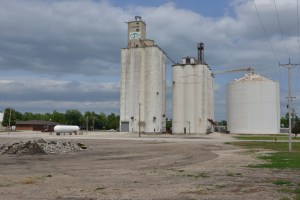
A white-painted metal bin, served by the Tillotson elevator headhouse, was also added to the site to increase storage capacity.

DSC_0463

Click the photo to witness the demolition

After demolition of two faulty bins in 2013, the concrete remnants were bulldozed into the center of an empty lot across from the co-op office.

A large-capacity shiny metal bin across the street completes the scene.

We are fortunate to have the specifications for the Churdan elevator, which is an early example built in 1949, and for its 198,960-bushel annex. The elevator specifications are detailed below.

The “Churdan Plan” was used for a number of Tillotson elevators, including Glidden, Sanborn, Gilmore City, and Thompson, Iowa; Greenwood and Fairfield, Neb.; and Montevideo, Minn. The construction of elevators using this plan spanned from 1949 to 1952. Specifications varied according to an individual customer’s  requirements.

The “Churdan Plan” consisted of four 14 1/2-foot-diameter bins, 100 feet tall, with a 13-by-17-foot driveway and eight bins over the driveway. It had a 13-foot spread. Notations in the company record said “bin split for drier” and “16 bins and dust bin.”

Specifications

Capacity per plans (with Dock): 102,000 bushels

Capacity per foot of height: 1,318 bushels

Reinforced concrete per plans (total): 1,083 cubic yards

Plain concrete (hoppers): 25 cubic yards

Reinforcing steel per plans (including jack rods): 57.72 tons

Average steel per cubic yard reinforced concrete: 106.5 pounds

Steel and reinforced concrete itemized per plans:

Below main slab: 3,133 pounds steel, 29 cubic yards concrete

Main slab: 15,937 pounds steel, 113 cubic yards concrete

Drawform walls: 73,405 pounds steel, 760 cubic yards concrete

Work and Driveway floor (including columns): 3,370 pounds steel, 26 cubic yards concrete

Deep bin bottoms: 3,480 pounds steel, 19 cubic yards concrete

Overhead Bin bottoms: 3,752 pounds concrete, 23 cubic yards concrete

Bin roof (or garner): 3,060 pounds steel, 30 cubic yards concrete

Scale floor (complete): 186 pounds steel, 3 cubic yards concrete

Cupola walls: 3,481 pounds steel, 35 cubic yards concrete

Distributor floor: 886 pound steel, 7 cubic yards concrete

Cupola roof: 1,129 pounds steel, 9 cubic yards concrete

Misc. (boot, leg, head, track sink, steps, etc.): 1,036 pounds steel, 20 cubic yards concrete

Attached driveway: 600 pounds steel, 9 cubic yards concrete (driveway extension)

DSC_0494Construction details

Main slab dimensions (drive length first dimension): 48′ x 48′

Main slab area (actual outside on ground): 2,270 square feet

Weight reinforced (total) concrete (4000 pounds per cubic yard plus steel): 2,224 tons

Weight plain concrete (hoppers 4000 pounds per cubic yard): 50 tons

Weight hopper fill sand (3000 pounds per cubic yard): 360 tons

Weight of grain (at 60 pounds per bushel): 3,060 tons

Weight of structural steel and machinery: 15 tons

Gross weight loaded: 5,709 tons

Bearing pressure: 2.52 tons per square foot

Main slab thickness: 18″

Main slab steel: straight 1 1/4″ square at 10″ o. c. spacing

Tank steel and bottom (round tanks): 3/8″ at 8″ o. c. spacing

Lineal feet of drawform walls: 440 excluding extension

Height of drawform walls: 90′

Pit depth below main slab: 12’0″

Cupola dimensions (outside width x length x height): 15′ x 32 1/3′ x 22′

Pulley centers: 115.67′

Number of legs: 1

Distributor floor: yes

Track sink: yes

Full basement: yes

Electrical room: yes

Driveway width clear: 13′

Dump grate size: 2 at 9′ x 5 1/2′ and 9′ x 15′

Column under tanks size: 16″ square

Boot legs and head: concrete

Machinery details

Boot pulley: 60″ x 14″ x 2 3/16″

Head pulley: 60″ x 14″ x 3 15/16″

R.P.M. Head pulley: 44

Belt: 272′, 14″ 6 ply Calumet

Cups: 12″ x 6″ at 9″ o. c. spacing

Head drive: Howell 30 horsepower [3 circled here]

Theoretical leg capacity (cup manufacturers rating): 6,540 bushels per hour

Actual leg capacity (80% of theoretical rating): 5,230 bushels per hour

Horsepower required for leg (based on above actual capacity plus 15% for motor): 19.9 horsepower

Man lift: 2 horsepower Ehr.

Load out scale: 10 Bu. Rich.

Load out spout: 8 1/4″ w.c.

Cupola spouting: 10″ diameter 14 ga.

Truck lift: 7 1/2 horsepower Ehr.

Dust collector system: Fan to bin

Driveway doors: 2 overhead rolling

Conveyor: None

Remarks

Split bin for dryer