How does a grain elevator work?

By Gary Rich

First of all, let me explain how an elevator actually works. The grain is dumped from a truck through the grates. The area below the grate is called the pit. The leg runs from the pit to the head house. On the leg is a thick rubber belt with buckets or cups. When the leg is started, the belt will move through the pit. The cups will fill up the grain and take it to the head house. As the leg reaches the top, it will arch, the cups will be up side down. When the cups turn to go back down towards the pit, they empty the grain on a conveyor belt. The cups will be facing downward, until the cups reach the pit and the will right themselves, filling up with more grain.

The run is the conveyor belt between the elevator and a storage annex. The run will have walls on the side of conveyor. They could be completely covered, too. Workers will set up the run, to a certain bin. There are openings at each bin. There is generally a door that they can open, so the grain will fall into the bin. They will put another piece of metal on the run, which acts like a chute. Thus, when the grain gets to the proper bin, and the grain hits the chute, the grain will move toward the opening of the run, and the grain will empty into the bin.

Sometimes, there will be a short conveyor belt that can be put under the main conveyor belt from the elevator. It is the same method. The grain will hit the chute, then through the opening, onto the second conveyor belt, which has a rise to it, and it will dump the grain into the bin.

Kristen mentioned that the bins are sloped. Most bins are built this way. You can think of it as self cleaning, as all the grain will come out the bottom of the bin. Now, if they built the bin flat, most of the grain can be removed. However there will still be about three feet of grain that is away from the bottom opening. Then some one has to climb through the manhole into the bin and they must shove the grain through the opening at the bottom. This is the only way that you can empty a flat bin.

The storage annex always has a basement. There is a conveyor belt that runs from a bin, back to the elevator, then up into a hopper. Most elevators have two separate hoppers. One will load a rail car and the other one can load a truck. If you did not have this conveyor belt, you could not unload a bin.

The area where the run is located is enclosed. If you look at a photo of a grain elevator with a storage annex, you will see an enclosed area above the storage annex. Outside this area, the bins are covered with concrete. Inside the run, either part of each bin will be open, or they could have metal slabs that cover the bins.

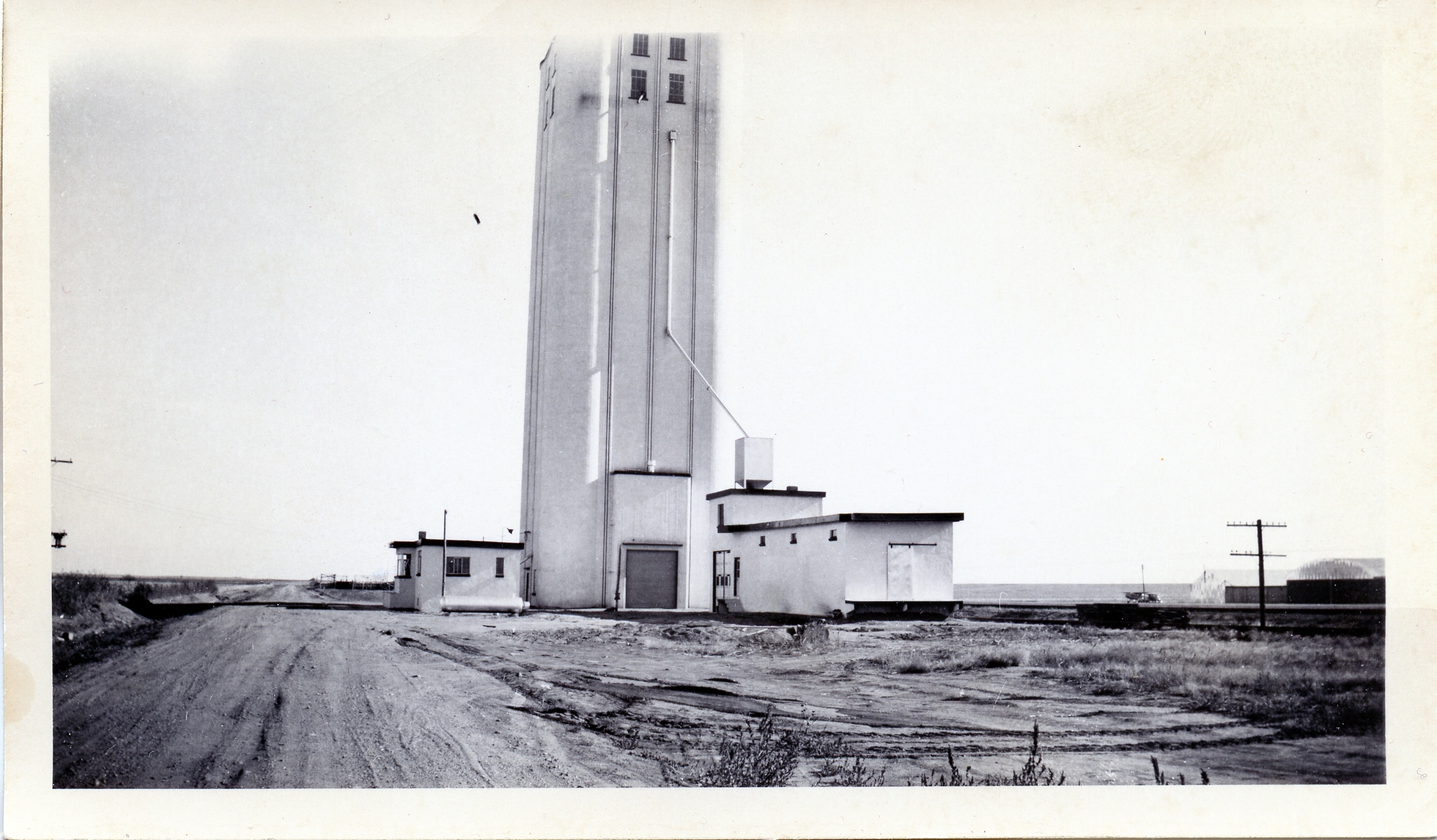
William Osborn’s photo of the Kanorado, Kansas, elevator

By Kristen Osborn Cart

This is an image that was in my grandfather’s papers when he died. It was his photo, since he was the only photographer in the family. This was the only elevator image he identified on the back. The caption was “Kanorado, KA, 125,000 bu.” I know Grandpa worked on it because he photographed it. We know it was built before March of 1947, which was the month Joe Tillotson died.

Grandpa was working for Tillotson Construction of Omaha as late as the fall of 1944 through the spring of 1945, when Giddings, Texas, was built. Dad visited Grandpa on the Giddings job, so he was able to date it–they visited in early 1945, the spring, when Dad turned eleven years old. That means the Kanorado elevator was built circa 1945 to 1947.

It may be hard to find information on Joe Tillotson’s business because he was independent for such a short time–even though there were quite a few elevators to his name.

¶ Ronald’s note: While posting this, I gave Kan-o-RAY-do a call and was told that original records pertaining to the elevator’s construction burned in an office fire.


Details of the Kanorado, Kansas, elevator by J.H. Tillotson, Contractor

Story and Photos by Gary Rich

Kanorado, Kansas–J.H. Tillotson, Contractor, of Denver, built this elevator. Here’s a view of the south side. Note the windows near the top. J.H. Tillotson and Mayer-Osborn built the no-headhouse elevators with different window arrangements.


This view shows the elevator, the office building and feed mill. I do not have a date for when it was built.


The office and feed mill were built at the same time.


This is a manhole cover inside the elevator.


Events leading to Mary V. Tillotson’s death recounted by her niece

In 1989, Ronald Ahrens, partner in this blog, asked his mother, Mary Catherine Tillotson Ahrens, to write an account of the death of her aunt, Mary V. Tillotson, who was Reginald’s partner in Tillotson Construction Company. Mary Catherine’s account follows:

Mary V. Tillotson holds five-month-old Ronald Ahrens early in 1956.

She attempted suicide once by swallowing Lysol & lived & about lost her larnix. She was in the hospital a long time & we were all so discusted with her. That was before we [Ronald’s parents] bought her house [3212 Paxton Boulevard, Omaha] on land contract, $500 down. Then she moved to a home. When the black started moving in we put up the sell sign & she was sooo mad at us—she wouldn’t hardly speak to us after that. Julie was due born in June ’63 & I think Mary died in Ap or May. She was found behind bath door dead—I never did hear why (or was never told I should say) I asked Gram—she didn’t know. She left $67,000 to Catholic church. We all got $2000. That’s what we bought the house on Grant with plus $2000—we made off her house. I’ve never forgiven her for the $67,000—HA. She missed Dad a lot when he died. He was all she really had. I think Dad left us 2000 to. She (Mary) had taken life ins policies out for you & Katie. Katie put herself through school with hers. What did you do with yours? The other kids got left out!

After delay, Tillotson completes 101,000-bushel elevator at Wapello, Iowa

Wapello, Ia—The Wapello Elevator and Exchange has let contract for an all-concrete storage addition to its main building to the Tillotson Construction Co., Omaha. Work will begin this week and is to be finished in 60 days.

The Democrat and Leader, Davenport, Iowa, July 31, 1949

The Wapello elevator, by Sam Willson. The flag and ribbon were added during the Persian Gulf War.

New Grain Storage Structure at Wapello—

Here is the new $80,000 grain storage structure of the Farmers elevator at Wapello, which will be completed next week by the Tillotson Construction Co., Omaha, Neb. The structure is 135 feet in height with ground measurement of 24 by 40 feet, and has seven bins with total storage capacity of 101,000 bushels. The four corner bins are of 20,000 bushels capacity each and three inside or overhead bins each have 7,000 bushel capacity. Inlet and outlet pipes extend to the structure from the main elevator building shown in the photo, and the mechanism was operated for the first time Monday in a test run. Construction was started Sept. 1, but delays have extended the time of completion until some time next week. The new structure gives the elevator company a total storage capacity of 135,000 bushels of grain.

The Democrat and Leader, Davenport, Iowa, Dec. 8, 1949

♦ ♦ ♦

Editor’s note: We found an image of the Wapello elevator on a site called Tankwagon Express.

January 7, 2012

Hiya Tankwagon,

A partner and I are doing a blog about the grain elevators that our grandfathers built, and I believe that my own granddad’s Tillotson Construction Company, of Omaha, built the elevator at Wapello. We have a newspaper article that says it was being completed in 1949.

Can you supply any info? Also, could we use the photo that’s on your site?

Many thanks,

Ronald Ahrens

♦ ♦ ♦

January 8, 2012

Ronald,

Feel free to go ahead and use the picture. I can’t verify if that is a Tillotson elevator, but the date of 1949 is probably correct. Is there a place where they may have left a mark or identifier on the structure? Prior to that date, a large wooden square elevator stood in the approximate vicinity. It like most wooden elevators caught fire and burned sometime in the 1940s. Replacing it was a smaller wood structure tied to the feed mill, and the slip form. The wooden mill in the picture burned to the ground in the fall of 1994. While the concrete structure is still standing, it has not been in use since maybe 2001-2002. At that time, I worked there and we had some issues with the headhouse and confined spaces with the insurance company. It still stands unused. The entire facility has capacity for about 3 million bushels of grain more or less.  Since I left the company in 2005 my access to information on the building is not as readily available. But I will see what I can find for you.

Sam Willson

130-foot fall claims Larry Ryan’s life in Pochahontas, Iowa

Worker Is Killed in Fall From Elevator

Pochahontas, Iowa –(AP)–A 130-foot fall from the top of the Farmers Co-operative Elevator, under construction here, claimed the life Wednesday of Larry Ryan, 20, of Cassville, Mo.

Ryan, an employe of Tillotson Construction Co., Omaha, was operating a hoist used to raise supplies to the top of the elevator. Cause of the accident was not immediately learned.

Muscatine (Iowa) Journal

Thursday, July 29, 1954

Edward Koppes injured in fall at Bonner Springs, Kansas

Injured in Fall (The Sun’s Own Service)

Hanover, Kans., Jan. 28—Edward Koppes, son of Mr. and Mrs. Chris Koppes of Hanover, received a fractured right hip and right arm when he fell 20 feet from the roof to a concrete floor of a grain elevator which he was helping to build at Bonner Springs, Kans., on Jan. 19. He was taken to a Kansas City hospital. He is an employee of the Tillotson Construction company.

Beatrice (Neb.) Daily Sun

Wednesday, Jan. 28, 1948

Tillotson Construction wins contract to rebuild in Hawarden, Iowa

Elevator Contract Awarded

New Structure to Replace Building Which Burned Last Fall

The Tillotson Construction Company of Omaha was awarded the contract Monday evening by the E.R. Lambertson estate for the erection of a new grain elevator on the North Western railway right-of-way to replace the structure which was destroyed by fire last September.

The new elevator is to be approximately the same size as the old structure. It will be 26×28 feet in size with a 14-foot driveway and will have a capacity for approximately 20,000 bushels of grain. The sides of the building will be covered with corrugated iron and it will have a metal roof. The old office, which escaped the flames in the fire last fall, will be utilized in conjunction with the new building. The new elevator is to cost in the neighborhood of $6,000.

The contractors hope to begin work on the project in about two weeks and they will utilize as much local labor as possible in its construction. The contract calls for completion of the building by May 1st.

Hawarden (Sioux County, Iowa) Independent

Thursday, February 1, 1940

* Yet another fire struck the Hawarden elevator in 2006.

The Tillotson Construction Story, by Charles J. Tillotson

Speaking to my Uncle Tim about the airplanes used for business travel in the years after World War Two by my grandfather, Reginald Oscar Tillotson, led me to make a cartoon of one of them, called a Stinson Station Wagon. Then my Uncle Chuck wrote the following narrative in response to some questions I had about the airplanes operated by the business and the nature of the company itself. With his response comes the proviso that his recollections may or may not be entirely accurate!

Looking back, Dad was really an adventurous contractor. Way ahead of his time but I guess he was driven to flight because he was worn out from driving. During the early years of his business, driving 100,000 miles a year was the norm.

Reginald O. Tillotson in his mid-20s

Although Dad took a few flying lessons and probably took the controls while in the air sometimes, he never actually piloted the plane. He had a couple of engineers/salesmen working in the office that got him into flying—both were ex-Air Force pilots. They flew for Dad from time to time but eventually one of them, Marvin Melia, became his full-time pilot. When he wasn’t flying, he was a general overall maintenance/handyman for the business. Dad had double hernias, which I think also prevented him from getting a license. And of course we were glad he couldn’t because of his drinking.

My Grandpa Charles was in the business of constructing wooden grain elevators back in ’20’s thru the late ’30’s. He passed away in 1938 and left the business to his two sons and daughter Mary. The boys, Joe and Mike, (nickname for R.O.) were already working in the business, and shortly before Grandpa Charles died the company started experimenting with constructing grain elevators using reinforced concrete via a method called slip-forming. This method allowed a contractor to build a concrete storage building very fast, which not only provided a more substantial structure but also far more grain storage capacity than the smaller wooden elevators.

After the war, the increase in production of corn, wheat, sorghum, rice, etc., caused the NEED for huge amounts of grain storage, which was virtually non-existent save the old wooden ones. So Dad, Joe, and Mary took off building concrete grain storage, and their business exploded. Many of the grain elevators that you see as you travel the grain belt—from Calgary, Alberta, to Brownsville, Texas, and from Colorado to Illinois, and even some southern states as far east as South Carolina (rice storage)—were built by Tillotson Construction & Development.

Ashland, Neb.

Shortly after the war, my Dad and Joe decided they couldn’t see eye to eye, so they split. Joe moved to Denver to form his own company and Mary remained with Dad in Omaha. As the business grew, the company took on a few employees, including the pilot types, and developed a cadre of field superintendents to handle the construction work. Dad was the initiator of the contracts. His job was to sell, sell, sell. Hence, the 100,000 miles per year of road travel. During the war years, synthetic tires were all you could obtain and of course they weren’t as good as rubber, so Dad went through many tires in those days. He used to come home with a trunk full of casings for retreading and at least one dog, which kept him company during the long hours of driving. He also came home with turtles, tarantulas, cats, shrimp on dry ice, and other sundry items that we got to consume or take care of!

Anyway, between 1940 and 1957, Dad built out hundreds, maybe thousands of elevators. I have no way of knowing how many nor exactly their locations other than to point you to the Midwestern Plains and look for the tall concrete storage tanks. Acquiring a plane was an obvious step. It provided him with faster travel, exacted less wear and tear on his body, and enabled him to spend more time at home.

stinsonstationwagon01When I went back for my 55th high school class reunion, we were invited out to some friends’ home in Gretna, and we drove from Omaha out the old highway, U.S. Route 6, to get there. On the way, I stopped and paid homage to Dad and my aunt in three little towns (spots in the road) where they had built. They didn’t build much in Nebraska, but in Iowa, Kansas, Oklahoma, and Texas they built one in every little farm town where a grain crop was produced. Of course, as the years passed, they had competition, some of which came from men who spun off from Dad—so he wasn’t the only company out there building these units.

By the late ’50s, the need to build more capacity began to diminish and his business started to decline, and it was the end of an era for Tillotson Construction & Development. Dad passed away in 1960 at the early age of 51. He had literally worked and drank and smoked himself to death. I didn’t appreciate all that he did for us kids until much later in life, but to do today what Dad did would be next to impossible with all the government/environmental/safety controls and taxation that now exist.

Tillotson Construction, Omaha, Nebraska, remains legible after 60 years or so. Photo by Charles Tillotson.

About Margaret Tillotson: http://baggyparagraphs.wordpress.com/2009/05/04/things-beyond-control/

“Prairie Cathedrals” article about photographers Bruce and Barbara Selyem, who document grain elevators:  http://www.americanprofile.com/article/31661.html

History of concrete:

http://en.wikipedia.org/wiki/Concrete#History

Recommended book:

http://www.amazon.com/dp/0307351785/?tag=yahhyd-20&hvadid=42537719511&ref=pd_sl_8yzx0tx6xo_e