Will the 1949 Tillotson elevator in Paullina, Iowa, please stand up?

DSC_0508

Story and photos by Kristen Cart

We know that the Tillotson Construction Company of Omaha built an elevator in Paullina, Iowa, but we are not certain which one. We have only newspaper accounts to guide us. The company records list all of their concrete construction projects until 1956 (albeit missing one page), but omit Paullina. A visit to the location provided no clue.

Perhaps the elevator they built was not concrete? There is a precedent in Hawarden, Iowa, where the company built a wooden elevator in the tradition of Charles Tillotson, the patriarch of the family elevator business. But that elevator went up in 1940. Paulina was built in 1949, well after the company had changed its construction method to slip-formed concrete. On review, indeed, we found that the newspaper account said the Tillotson elevator was to be concrete.

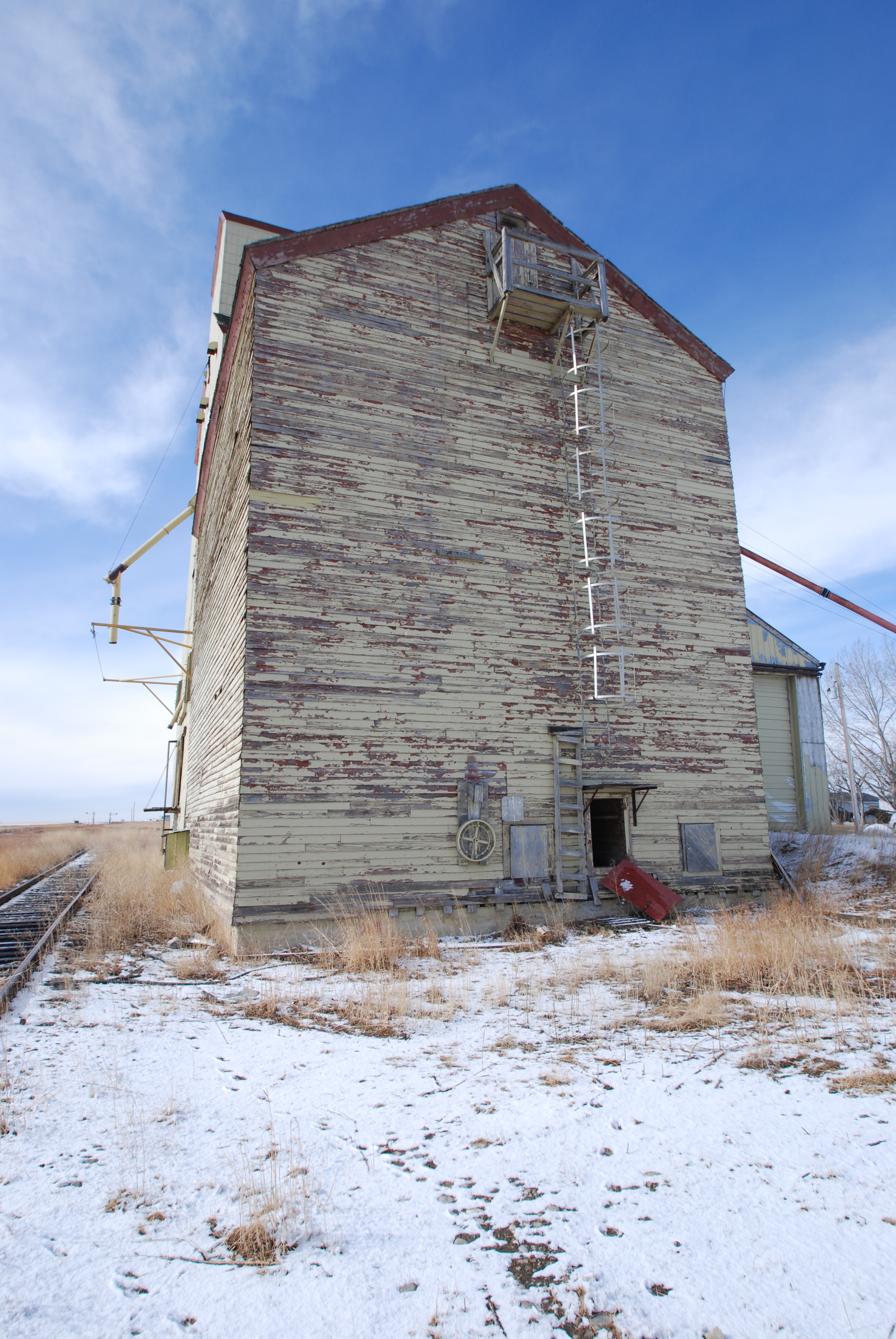
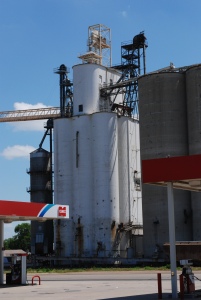
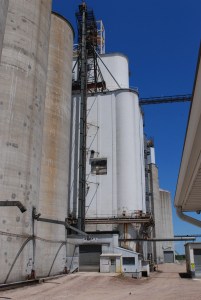
My family rolled through Paullina on a Sunday when the co-op was closed. Grain trucks were parked, and the facility was quiet except for the drone of circulation fans. We found no identifying manhole covers, so I had to content myself with photos. I took at least one image of each elevator on the site. None of the elevators followed the familiar Tillotson style, which may not have been fully developed by 1949 in any case.

Let the reader be the judge from the photos presented here.

These appear to be more modern construction than seen in 1949.

These appear to be more modern than elevators built in 1949.

The two older elevators at Paullina are concrete, but they do not seem to follow the protocol of a continuous pour. The newer-looking elevators deserve a closer look, in spite of their unfamiliar lines–particularly the smaller one on the left. Tillotson Construction set a precedent in 1947, when they built a rectilinear-styled elevator at Minneapolis, Kan.

Perhaps the old Tillotson elevator outlived its usefulness and no longer stands? We don’t know.

Reader input is welcome!


This elevator resembles some of Tillotson's early efforts, and seems to be a good candidate

This elevator resembles some of Tillotson’s early efforts and seems to be a good candidate

Abraham Tillotson, who fought in the Revolution, was too wealthy for a pension


The Tillotson family was adept at seizing opportunities such as the demand for grain storage in the 1940s.

The Tillotsons were adept at seizing opportunities, such as the demand for grain storage in the 1940s.

Story by Kristen Cart

Abraham Tillotson, the direct ancestor of Charles H. Tillotson, the builder of wooden grain elevators, joined the Continental Army in 1775 and served for more than a year, earning the grateful thanks of our new nation. After the war he became a farmer, but in old age he asked for a pension based upon his service.

In 1818, Congress authorized pension payments for veterans who had fallen on hard times. It was not until the 1830s that the pensions were offered to widows and orphans. Veterans had to prove their service (inconveniently, the British burned all of the Revolutionary War service records held in Washington during the War of 1812). To that end, they had to produce witnesses to their service. They also had to prove that they were poor and unable to care for themselves.

Sometimes, veterans navigated the rules adroitly and obtained their pensions without much trouble, and retired in relative comfort. Sometimes it took years for them to prove their service. And sometimes, many letters flew back and forth before a grudging pittance was approved–enough to usher the elderly veteran quietly to his grave.

Abraham’s pension file, digitally preserved at Fold3.com, provides an amusing counterpoint to the usual, sorrowful packet of letters.

Page 4-1

On Oct. 9, 1819, Abraham Tillotson, a resident of Casenovia, aged 63, appeared before the Court of Common Pleas in Madison County, New York to make his statement of service. He said he enlisted on Dec. 18, 1775, serving in Capt. Levi Wells’ company, Col. Samuel Wylie’s Regiment, in the 22nd Connecticut Line of Continental Establishment. He was discharged at Fishkill, New York, on Jan. 1, 1777. He had fought in the Battles of Flatbush and Long Island, and at the taking of General Burgoyne. He produced a witness to his service in the person of Henry Champion.

According to the court, Abraham’s statement averred that “he is in reduced circumstances and stands in need of assistance from his country for support.” Apparently, Abraham had no trouble getting onto the pension rolls. His trouble came later.

Abraham’s consternation was evident in the letter he wrote on July 11, 1822:

“… I am informed of the suspension of my pension until I produce satisfactory evidence doing away [with] information received at the War Department of my being ‘worth more than five to six thousand dollars.’ From whatever source this information may have been received, it is totally false, without a shadow of foundation, and must have been engendered in the brain of some malicious and corrupt villain. The information indirectly charges me with false swearing and if I knew the malicious informant, I would (as I did the enemies of my country) chastise him for his audacity, old and infirm as I am.”

He went on, protesting his honesty: “In obtaining the bounty of my country, for which I fought and bled (when, probably, your informant was in his cradle), I pursued an honest correct course and such as prescribed by the love of my country…”

He was up against a formidable stack of evidence to the contrary.

The Honorable E. Litchfield was the first to alert authorities to Abraham’s wealth, after he learned that Abraham Tillotson was worth between five and six thousand dollars. Abraham’s pension was suspended from that date, Dec. 6, 1821.

Page 42

Further investigation yielded more.

“State of New York,

We, the subscribers, freeholders and inhabitants of the town of Cazenovia in the County of Madison and of the town of Pompey in the County of Onondaga and state aforesaid, do certify–that we have been acquainted with Abraham Tillotson of said Cazenovia for a number of years–that we have lived and do still live [as] neighbors to him–that we have considered him one of our most independent farmers, one who has money to loan, whenever he can obtain extravagant interest, or dispose of some property at a high price and obtain good security–that his property year before last was valued by the assessors at about eighteen hundred dollars–and further we consider him the said Tillotson abundantly able to support himself and family–and under the existing law authorizing the payment of pensions do not think him entitled to a pension–given under our hands this 21st day of August 1822.

Rufus Lyon, Joseph Atwell, Daniel Allen, James McCluen, Joseph Atwell Jr., Elijah Hill.”

Whoops.

Other affidavits contain the same sort of accusations. Needless to say, Abraham never recovered his pension. He died two years later in 1824. His widow tried to reinstate his pension in the 1830s, also to no avail.

Page 33

Abraham offered to pay Rufus Lyon, one of his accusers, to testify in his favor

So began a Tillotson tradition of success and wealth, of sharp business dealings, and of a willingness to partner with the U.S. Government when advantageous–a perfect template for the private/public partnership that became the grain elevator boom of the 1940s and 50s. I would be quite proud of such a clever ancestor, notwithstanding a bit of shading of the truth. His neighbors (debtors?) might not quite agree.
 

The Atlanta, Kan., elevator suggests our grandfathers’ signature designs


AtlantaKansas

Photo by Brad Perry

Editor’s note: Contributor Brad Perry sent this photo of Valley Coop’s elevator in Atlanta, Kan. The rounded, stepped headhouse suggests Tillotson and Mayer-Osborn design influences. A call to the elevator put us in touch with Katherine Grow, who runs it with her husband Darren.

“I think it’s a Johnson house. I remember when they built it. All the men in the community helped when they started pouring. Markle was the head of the crew that did it. I think it was ’58 or ’59 when it was constructed. In fact, it’s better designed than a lot of places. We added an outside leg. We used to load out on the rail but don’t any more. We’ve done maintenance and made safety updates. We’ve had it painted once. We were told it is the kind of concrete that has to be kept painted. It’s easy to work with, the way it’s put together with the inside leg. We’ve been pleased with it. I was a teenager or preteen when they built it. Once started, they kept pouring. With the lights at night, it reminded you of when you see a riverboat all lit up going down the river. It was cool. When we built this other bin and they could do it in sections, it was kind of different. They just pour so much and go round and round with a little cart, and come night, why, they’d quit and go home.”

Bruce Selyem, an old hand in elevator photography, is still in the game

DSC_0065

Ione, Oregon

Story and photos by Kristen Cart

An eagerly awaited package arrived in the mail the other day. I opened it to find Bruce and Barbara Selyem’s 2016 elevator calendar–a vivid sampling of the photography work that Bruce has done over the years. Barbara Selyem called me to see if I would like one this year–I am an old customer, and I get one every year. So of course I asked her to send it.

Thirteen carefully selected images grace the calendar, and it does not disappoint.

DSC_0697

Indus, Alberta, Canada

Selyem Enterprises also produces framed elevator images for home and business, and if I bought everything I liked, I would run out of wall space very quickly. Bruce has documented many beautiful old wooden elevators in the United States and Canada that have gradually disappeared. Over the 20-plus years Bruce has been shooting elevators, most of the structures have only his photos to remember them by.

DSC_0557

Mossleigh, Alberta, Canada

If my kids had anyone to blame for the numerous side trips, excursions, and stops we have made to take pictures of wooden elevators in the wild, Bruce Selyem would top their list. I have studied his website carefully to plan for elevator photography trips in Idaho and Oregon. Many times the kids have admonished me for the odd elevator stop on the way to Nebraska. I can’t help it. They are beautiful.

Though not many of my wooden elevator photos have been published here, there is quite a collection of them. It is a passion, and I come by it honestly.

My grandfather, William Osborn, took many photos when I was a little girl. I remember the bellows on his camera, the camera body he carefully set up on a tripod, and his advice to sit still. He would pull the Polaroid photo out of the back of the camera while he started his buzzing timer. The hand on the timer would move interminably, and I would stand on tip-toe, eagerly awaiting the magic moment. Then he would peel the negative away and voila, a damp image would emerge, which I would hold gingerly by the edges while it dried.

As a girl, I wondered at the photo of his first elevator in McCook, Nebraska, that he built for Mayer-Osborn. I never knew I would combine his love for photography with his life’s work one day, and share all of it here.

To check out the photography of Bruce Selyem, visit his website at grain elevator photos. Bruce and Barbara Selyem welcome you.

DSC_0674

A concrete beauty. Nyssa, Oregon

The demise of Mayer-Osborn Construction remains an enduring puzzle

Audrey, Gerald, William and Alice Osborn, ca. 1950

Audrey, Gerald, William and Alice Osborn, circa 1950.

Story by Kristen Cart

Some mysteries are not meant to be solved. Perhaps it is a natural outgrowth of my grandmother’s tight-lipped discretion where evil tidings were concerned. I can remember the disapproving purse of her lips if I broached the wrong topic–it was wise to move on.

Albert Skoog as a boy

Albert Skoog as a boy

Alice Christoffersen married William Osborn in the 1920s. All anyone in our family could know about those times was conveyed in the pleasant images of a young couple goofing around by the lake and fishing. In later pictures you could see the pained expression of a long-suffering middle-aged woman, but her concerns were private, at least when they brought bad memories to mind.

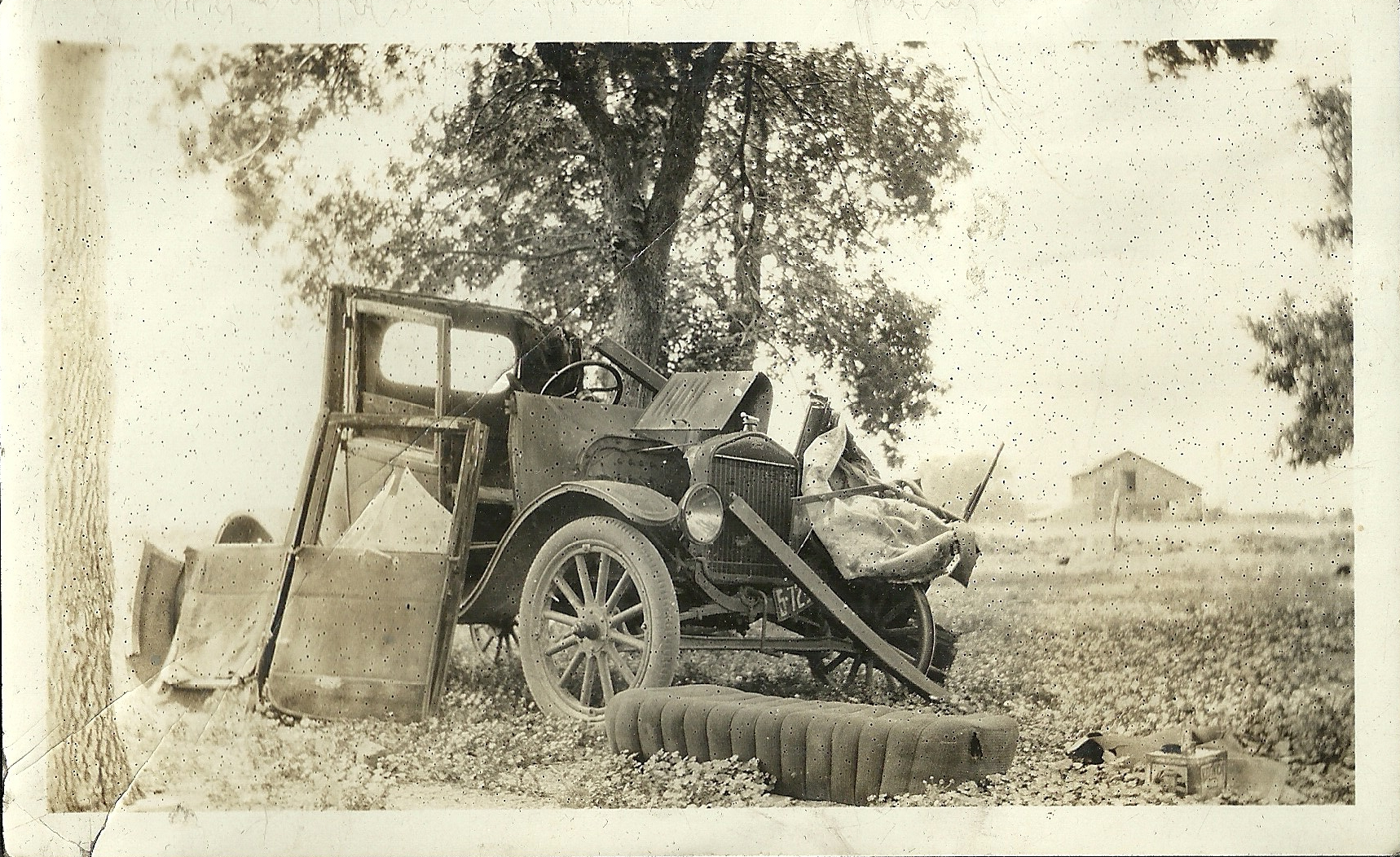
My dad, Jerry Osborn, was quite amazed to find he had a deceased great-uncle, whose name had never been spoken in front of him. Alice Christoffersen’s maternal uncle, Albert Skoog, died young from injuries sustained in a horrific automobile crash when she was a young woman. The story was relegated to the darkest recesses, never to be mentioned again.

“Albert Skoog Dies from Effects of an Auto Accident

Had Lived Nearly Ten Months with a Broken Back

After living nearly ten months with a broken back, during which time he suffered untold agony, Albert Skoog, 42, formerly and employee of the Fremont Stock Yards, died at the home of his sister, Mrs. James L. Christoffersen, south of Fremont. Death was due to injuries sustained in a automobile accident on the Lincoln Highway about a mile east of Fremont last October….”

The article went on to describe the accident and his medical treatment. He died in the family home of Alice’s parents.

This image was found among Grandma's pictures. It was the car her uncle wrecked in an ultimately fatal accident.

The wreck fatally injured Albert Skoog, who died months later from a broken back. Grandma had this photo of the car in an album that once belonged to her mother.

No stone marks his grave. It took many years to locate pictures of him, preserved by a different branch of the Christoffersen clan. Images of the wrecked car also survived, tucked away in Grandma’s photo album. But such things were not discussed in my grandmother’s world.

Another side of Grandma’s personality was not so discrete–she would tell stories that put others in a bad light when she thought she could gain favor for herself. This habit got worse as she aged, and by the time she passed on at age 98, family members believed awful stories about each other because of things she said.

We have tried, without success, to verify Grandma’s story of why my grandpa, William Osborn, got out of the elevator business. Perhaps she invented it. We have no way to tell.

Mayer-Osborn elevator at McCook, Neb. during a family visit, ca 1950. This elevator was the first of its type, a model for the later Blencoe elevator.

Mayer-Osborn elevator at McCook, Neb. during a family visit, circa 1950. This elevator was a prototype for the Blencoe elevator.

Dad never had an inkling about why his dad quit (except that he heard in whispers not intended for him) until Mom started poking around. Grandma told her the story, apparently in a fit of pique. Details were fuzzy, and by now, not well remembered. There’s hardly more to it than speculation. But that one glimpse was the only information we ever got. Otherwise, it “wasn’t discussed,” as Dad put it.

Mom says an elevator was built, and very shortly thereafter, failed. She variously used the terms “collapse,” “explosion,” and “fire.” But the two things she was pretty consistent about were the facts that the concrete mix was wrong because the crew had shorted the materials (possibly for financial gain), and that the collapse occurred as soon as the elevator was filled with grain for the first time. That is all she remembers from what Grandma told her.

Dad says his father was out of the business by 1955. Dad remembers that his dad had come home to Fremont, Neb., from Denver, Colo., the home base of his business, that summer when he should have been on the job. He thinks that his dad was blamed for the failure–Bill’s partner, Gene Mayer, apparently went on without him. But that is all we have.

We don’t know where it happened and haven’t found a newspaper story. We know a large terminal elevator collapsed that year in Fargo, N.D., but we discovered the identity of that builder and it wasn’t Mayer-Osborn. There were whispers about an elevator that had a bad headhouse around Linn, Kan., or Bradshaw, Neb., which might have been his, but that story hasn’t been verified or dated.

The Blencoe, Iowa elevator built by Mayer-Osborn

The Blencoe, Iowa elevator built by Mayer-Osborn

The only story I can verify is the tear-down and restart of the Mayer-Osborn elevator in Blencoe, Iowa. The concrete mix was wrong there, and it cost a few days and quite a lot of money to correct. Could that relatively mundane event in 1954 have created a rift between the partners, Bill Osborn and Gene Mayer? Was the tale of a more dramatic accident simply angry gossip from my grandmother?

Until we know more, it is a skeleton yet to be found, buried in a very deep closet.


A mystery unfolds at the Tillotson elevator of Blencoe, Iowa

This elevator is attributed to the Tillotson Construction Company of Omaha, but evidence points elsewhere

This elevator is attributed to the Tillotson Construction Company, but evidence points elsewhere.

Story and photos by Kristen Cart

In an earlier post, we showed that the elevator built by the Tillostson Construction Company in the northwest Iowa town of Blencoe had a structural failure prior to completion. A photo provided by Tim Tillotson showed that the concrete slumped over the driveway after the slip-form pour had progressed considerably past the point of failure. Construction would have halted there. The question of how the elevator was completed was never answered.

In the company records we have, the specifications log ended by 1956, while the company continued to build elevators beyond that date. So later records are lost to us. Tim Tillotson estimated that this mishap occurred in about 1955. I discovered, on review, that Blencoe was not in the specifications at all. Why?

A photo of the manhole cover on the rail side of the elevator could provide the answer. It is not typical for Tillotson elevators to have exterior manhole covers on elevators of this type, so the existence of these was a little surprising. More shocking was the identity of the company that placed them.

"Grain Storage Const. Co, 1959, Council Bluffs, Iowa" is embossed on the manhole cover

“Grain Storage Const. Co, 1959, Council Bluffs, Iowa” is embossed on the manhole cover.

The Grain Storage Construction Company of Council Bluffs, Iowa, is not familiar to us. It may be the company called in to repair the damage when the failure occurred.

We don’t know if Tillotson Construction was fired on the spot. But it is also possible that Tillotson was given a second chance–the design of the elevator clearly follows the trademark Tillotson design, whether copied by some one or built by the original contractor.

I wonder if the original repair destroyed the structural integrity of the elevator, and Grain Storage Construction was brought in to replace two of the bins. We know it was a later job because of the 1959 date on the manhole covers. Unfortunately, I made my visit on a Saturday, and the co-op was closed, so there was no one there to ask.

It is a beautiful, functional elevator today. It stands beside the older Mayer-Osborn elevator, which is also clearly in use sixty years after it was built. Both elevators had problems during construction, but the capacity was urgently needed, so both projects were finished. How the Tillotson elevator ultimately became a Grain Construction Company branded elevator is a mystery we will try to solve in a future post.

DSC_0427

A low-wing airplane sped up business for Tillotson Construction Company

Navion

Commentary by Tim Tillotson

Note: What follows is from a phone interview on May 14. Here, Uncle Tim recalls flying with Tillotson Construction Company’s pilot Ted Morris.

I remember taking a few trips in that Navion with him. It was one of the last planes Dad bought, the only one with a low wing. That Navion was fast, too, a faster plane. I remember being with him somewhere–where the hell were we?–trying to find a spot to land and picked a spot that looked absolutely wonderful from up there. We didn’t realize till we were almost on the ground that the spot had three-foot-tall grass. We went plowing through that grass and also an electric fence that was in the middle. We had to plow our way out.  

Dad [Reginald “Mike” Tillotson] could never get a license because he had double hernia and all that. Ted was our pilot and we also had Marvin Melia, he flew dad, too. Marvin was giving me flyin’ instructions. We’d go out there to the airport, North Omaha. Marvin’s the one that flew Dad around. They didn’t fly every day, or every week necessarily. He’d been flying Dad two years before. 

Ted came back from KS one time in that Navion, and he said something about, “Let’s go home fast.”

So he’s flying like 200 feet off the ground, really a lot of fun. He radioed in to get clearance for landing, and the communication that came back said, “Where the hell are you? We cant pick you up on the radar!”

Ted said, “I guess we better get up off the deck so they can see it.” 

Neglecting to lag an elevator’s head pulley led to disaster in Bellwood, Neb.

Commentary by Tim Tillotson

Note: What follows is from a phone interview on May 14. He tells of a grain elevator repair job undertaken for Ted Morris, who by 1959 was a former employee of Tillotson Construction Company.

From left, Tim and Chuck Tillotson and La Rose Tillotson Hunt in 2012.

From left, Tim and Chuck Tillotson and La Rose Tillotson Hunt in 2012.

Ted Morris was the pilot. He worked in the office with Wayne doing the drawing and getting the specs together. He flew Dad when Dad would go out to the jobs. Ted used to take me flying out to the job. He was a fun guy, good natured. He tried going into business himself. Matter of fact, when Mart and I got married, we went out to York, Nebraska, to do a repair job that he had a contract on, in the dead of the winter. That was in ’59. It was Bellwood–the one that had the explosion. It blew the damn headhouse apart. Mart and I were married in November ’59 and we went out.

They were dumping grain in the drive pits to feed it up to the tanks. It was cold and also windy, I believe. When they rolled the damn overhead doors down to shut off the wind tunnel through the drive, the dust built up and that was also a job … I don’t know who decided not to lag the head pulley; it’s like putting a tire on a steel wheel. I don’t know what the hell was supposed to be such a big savings. I don’t know we were the only ones that did it, the other grain elevator contractors did, too, they quit lagging the head pulley. That big pulley would slip for a little bit till it got some speed up. Eventually, they found out the hard way, it was taking the facing off the back of the belt and exposing the fiber web in it. The damn web spots would get hot and start on fire.

Conveyor_head_pulley_lagging_for_V_shaped[1]They called it lagging because they’d fasten or wrap a lag of grain elevator belt around real tight like a rubber tire to give it grip.

When I say we would lag the pulley, we didn’t do it. Where we purchased the pulley, they did it before they shipped. There was supposed to be some kind of cost savings. When you’re trying to pull 110, 120 foot of belt, with grain, it takes quite a bit to get thing rolling.

I guess because of the wind, they closed the overhead doors. The dust built up from the trucks just dumpin’ that grain, you can imagine, and it built up, The fire actually started in the boot pit. They were running that grain up, and I think they stopped the belt for a little bit because somebody went down into the pit to grease the bearing, and there was a fire and it exploded. It slammed him into the little steel ladder. The fire went right up the leg well, which was full of dust, and it just blew out in the headhouse.

The distributor floor was quite a height off the roof deck in the headhouse, and of course it was up overhead. You had to have some heights for the spider legs that went out to the tubes. That’s where it did its big explosion. It had enough force to actually bulge the headhouse walls. The distributor floor was concrete but held in place by a key way in the headhouse wall. They call it a key way when you slip the headhouse walls at a certain level. You put tapered two-by-four blocks in the forms that you could peel out later like teeth, so when you poured the floor it went into the keyways and that’s what held the distributor floor walls up. The explosion bulged the headhouse walls out so that they turned loose that distributor floor, which left it standing on the feed pipes that went into the tanks.

I’m trying to remember if Bellwood was the one with the galley out to the annex blowing the windows out of it, and it knocked the tripper–a little feeder that went out across the annex building and would fill whatever tanks you wanted–off its tracks.

The Bellwood Gazette reported the Holland Brothers' elevator fire in 1902.

The Bellwood Gazette reported the Holland Brothers elevator fire in 1902. It was the third elevator that had burned “inside of a year,” and as the town was gaining such notoriety, the Gazette was considering becoming a daily paper.

They were doing the repair on it. I think we pulled off because the temperature was so damn low you couldn’t put your bare hand on a piece of metal; it would stick. I remember we come back into Omaha and wasn’t out there that long. Mart and I came back to Omaha, stayed at my Uncle Ralph (Hassman’s) house, Johnny’s dad, before we got that apartment on the second floor of an old house that was turned into an apartment on Izard Street. That’s when I went to work for Leo A. Daly, the architects, in Omaha, for $300 a month. I went to work for them on the drawing table.

We were actually in York. It might have been a different repair job. Now that I think about it, I’m not even sure it was one of Dad’s elevators. We were married on Armistice Day of ’59. We had to be out there in December. I was working for Daly maybe a week when Dad passed on January 5, 1960.

The York job was a repair, and it was a repair from an explosion but nothing compared to Bellwood. I remember we were up in the headhouse when were there. The one asshole I didn’t know, and either did the other guy. He loaded, like, a shoebox on the floor with acetylene ’cause it’s a heavy gas, and it laid down in that box, and he turned around and threw a match over there and that that box blew up. I damn near ran off the frigging roof to get out of that headhouse. He thought that was so damn funny. I was about ready to bust him. I don’t like his sense of humor.  

Ted wasn’t doing well at the business. I remember a time or two he called Mother. He was distraught, he wasn’t making it. I don’t remember what happened to Ted.

Making sense of a chimney near a wooden elevator in Alta, Iowa

scan0018

Commentary by Tim Tillotson, photo from the Neil A. Lieb archive

Note: What follows is from a phone interview on May 14. Uncle Tim is speculating about the reason why some Tillotson Construction Company employees stayed behind for this small job after completing the concrete elevator at Alta, Iowa, in the summer of 1950.

That chimney is probably about 30 inches in diameter. They’ve got a mortar mixer down there for masonry, a hand line going up, and the framework is scaffolding. The building in front is eight-inch block. Every three blocks is two feet. The building is 12 foot to the eaves.

There’s a reason for that damn stack, and it’s got to have something to do with fire down below. [Brother] Charles [Tillotson] said it could’ve been an iron-working shop.

Why does that car have chock blocks front and rear? Is it some kind of an anchor? It’s a 1935 or 1936, possibly DeSoto.

If you were burning coal, you wouldn’t get sparks. Maybe they were baking bread, cornbread. They’re carrying that stack high enough to get above the wooden elevator. What the hell it could be made of to be that thin and not be braced?

I don’t understand what’s with the masonry mixer down there. If that stack, for example, was a heavy metal tube, I don’t know that you could plaster it.

Virginia Slusher remembers her years as Tillotson Contruction’s office girl

Virginia Slusher 05

Story by Virginia Slusher, photos from her collection

Editor’s note: Virginia Slusher, who lives near Kansas City, contacted us to share these recollections and photos. We have previously written about The Office, part of the old Anheuser-Bush brewery on Jones Street, which served as Tillotson Construction’s headquarters in the 1950s. 

Beginning in the fall of 1951, I worked for Mike (Reginald) and Mary Tillotson for seven years. I was the “office girl”–some bookkeeping, receptionist, et cetera.

I went to Commercial Extension School of Commerce, and Johnny Hassman was my date for our graduation party. He was in the office quite often. I think Johnny helped with sales. IMG_1390

One morning I arrived first, and the safe was hanging open. Because of the burglary, I immediately ran down to the gas station on the corner. The thief took the petty cash they kept in the safe. I don’t think he bothered anything else. The police came to investigate.

I loved working there; they were so good to me.

The three guys and I would sit up on the balcony and play cards sometimes when Mary was gone. It was a raised area where Wayne and Ted, the two engineers, sat. Bob the bookkeeper sat just below.

I loved the guys. They took me out for my first legal drink when I turned 21 years old. They teased me unmercifully but were so good to me.

I remember typing about 2000 W-4s at the end of the year. Men would work for one or two days and quit. I also sent all the “give us your business” cards to the small towns in multiple states. Virginia Slusher 01

The other woman–I can’t remember her name–was working there when I started.

They had a huge NCR bookkeeping machine that she taught me how to operate. Shortly after I started there, the company sold it to, I think, China.

Mary was different to say the least. She had an ugly Boxer that came to work with her sometimes. He would slobber on me; therefore, I did not like him!

She used to tape a St. Christopher medal on her desk. We joked that we wondered if the desk would take her somewhere.

Johnny Hassman and Virginia Slusher celebrate her business school graduation. Photo from the Virginia Slusher archive.

Johnny Hassman and Virginia Slusher celebrate her business school graduation.

She was very good to me, gave me nice bonuses at the end of the year, not quite as big as the three guys. But very good for the ’50s. I received $1000 to $15oo. The men usually around $10,000. Very large amount for the times.

Mike (Reginald) was funny, not in the office much. I had to write the checks to pay the family bills.

I was still Virginia Engel but married William Slusher while working there, 60 years now, and they were very nice to us.

When the company closed, Mary found a new job for me at Power District credit union.