A low-wing airplane sped up business for Tillotson Construction Company

Navion

Commentary by Tim Tillotson

Note: What follows is from a phone interview on May 14. Here, Uncle Tim recalls flying with Tillotson Construction Company’s pilot Ted Morris.

I remember taking a few trips in that Navion with him. It was one of the last planes Dad bought, the only one with a low wing. That Navion was fast, too, a faster plane. I remember being with him somewhere–where the hell were we?–trying to find a spot to land and picked a spot that looked absolutely wonderful from up there. We didn’t realize till we were almost on the ground that the spot had three-foot-tall grass. We went plowing through that grass and also an electric fence that was in the middle. We had to plow our way out.  

Dad [Reginald “Mike” Tillotson] could never get a license because he had double hernia and all that. Ted was our pilot and we also had Marvin Melia, he flew dad, too. Marvin was giving me flyin’ instructions. We’d go out there to the airport, North Omaha. Marvin’s the one that flew Dad around. They didn’t fly every day, or every week necessarily. He’d been flying Dad two years before. 

Ted came back from KS one time in that Navion, and he said something about, “Let’s go home fast.”

So he’s flying like 200 feet off the ground, really a lot of fun. He radioed in to get clearance for landing, and the communication that came back said, “Where the hell are you? We cant pick you up on the radar!”

Ted said, “I guess we better get up off the deck so they can see it.” 

Neglecting to lag an elevator’s head pulley led to disaster in Bellwood, Neb.

Commentary by Tim Tillotson

Note: What follows is from a phone interview on May 14. He tells of a grain elevator repair job undertaken for Ted Morris, who by 1959 was a former employee of Tillotson Construction Company.

From left, Tim and Chuck Tillotson and La Rose Tillotson Hunt in 2012.

From left, Tim and Chuck Tillotson and La Rose Tillotson Hunt in 2012.

Ted Morris was the pilot. He worked in the office with Wayne doing the drawing and getting the specs together. He flew Dad when Dad would go out to the jobs. Ted used to take me flying out to the job. He was a fun guy, good natured. He tried going into business himself. Matter of fact, when Mart and I got married, we went out to York, Nebraska, to do a repair job that he had a contract on, in the dead of the winter. That was in ’59. It was Bellwood–the one that had the explosion. It blew the damn headhouse apart. Mart and I were married in November ’59 and we went out.

They were dumping grain in the drive pits to feed it up to the tanks. It was cold and also windy, I believe. When they rolled the damn overhead doors down to shut off the wind tunnel through the drive, the dust built up and that was also a job … I don’t know who decided not to lag the head pulley; it’s like putting a tire on a steel wheel. I don’t know what the hell was supposed to be such a big savings. I don’t know we were the only ones that did it, the other grain elevator contractors did, too, they quit lagging the head pulley. That big pulley would slip for a little bit till it got some speed up. Eventually, they found out the hard way, it was taking the facing off the back of the belt and exposing the fiber web in it. The damn web spots would get hot and start on fire.

Conveyor_head_pulley_lagging_for_V_shaped[1]They called it lagging because they’d fasten or wrap a lag of grain elevator belt around real tight like a rubber tire to give it grip.

When I say we would lag the pulley, we didn’t do it. Where we purchased the pulley, they did it before they shipped. There was supposed to be some kind of cost savings. When you’re trying to pull 110, 120 foot of belt, with grain, it takes quite a bit to get thing rolling.

I guess because of the wind, they closed the overhead doors. The dust built up from the trucks just dumpin’ that grain, you can imagine, and it built up, The fire actually started in the boot pit. They were running that grain up, and I think they stopped the belt for a little bit because somebody went down into the pit to grease the bearing, and there was a fire and it exploded. It slammed him into the little steel ladder. The fire went right up the leg well, which was full of dust, and it just blew out in the headhouse.

The distributor floor was quite a height off the roof deck in the headhouse, and of course it was up overhead. You had to have some heights for the spider legs that went out to the tubes. That’s where it did its big explosion. It had enough force to actually bulge the headhouse walls. The distributor floor was concrete but held in place by a key way in the headhouse wall. They call it a key way when you slip the headhouse walls at a certain level. You put tapered two-by-four blocks in the forms that you could peel out later like teeth, so when you poured the floor it went into the keyways and that’s what held the distributor floor walls up. The explosion bulged the headhouse walls out so that they turned loose that distributor floor, which left it standing on the feed pipes that went into the tanks.

I’m trying to remember if Bellwood was the one with the galley out to the annex blowing the windows out of it, and it knocked the tripper–a little feeder that went out across the annex building and would fill whatever tanks you wanted–off its tracks.

The Bellwood Gazette reported the Holland Brothers' elevator fire in 1902.

The Bellwood Gazette reported the Holland Brothers elevator fire in 1902. It was the third elevator that had burned “inside of a year,” and as the town was gaining such notoriety, the Gazette was considering becoming a daily paper.

They were doing the repair on it. I think we pulled off because the temperature was so damn low you couldn’t put your bare hand on a piece of metal; it would stick. I remember we come back into Omaha and wasn’t out there that long. Mart and I came back to Omaha, stayed at my Uncle Ralph (Hassman’s) house, Johnny’s dad, before we got that apartment on the second floor of an old house that was turned into an apartment on Izard Street. That’s when I went to work for Leo A. Daly, the architects, in Omaha, for $300 a month. I went to work for them on the drawing table.

We were actually in York. It might have been a different repair job. Now that I think about it, I’m not even sure it was one of Dad’s elevators. We were married on Armistice Day of ’59. We had to be out there in December. I was working for Daly maybe a week when Dad passed on January 5, 1960.

The York job was a repair, and it was a repair from an explosion but nothing compared to Bellwood. I remember we were up in the headhouse when were there. The one asshole I didn’t know, and either did the other guy. He loaded, like, a shoebox on the floor with acetylene ’cause it’s a heavy gas, and it laid down in that box, and he turned around and threw a match over there and that that box blew up. I damn near ran off the frigging roof to get out of that headhouse. He thought that was so damn funny. I was about ready to bust him. I don’t like his sense of humor.  

Ted wasn’t doing well at the business. I remember a time or two he called Mother. He was distraught, he wasn’t making it. I don’t remember what happened to Ted.

Making sense of a chimney near a wooden elevator in Alta, Iowa

scan0018

Commentary by Tim Tillotson, photo from the Neil A. Lieb archive

Note: What follows is from a phone interview on May 14. Uncle Tim is speculating about the reason why some Tillotson Construction Company employees stayed behind for this small job after completing the concrete elevator at Alta, Iowa, in the summer of 1950.

That chimney is probably about 30 inches in diameter. They’ve got a mortar mixer down there for masonry, a hand line going up, and the framework is scaffolding. The building in front is eight-inch block. Every three blocks is two feet. The building is 12 foot to the eaves.

There’s a reason for that damn stack, and it’s got to have something to do with fire down below. [Brother] Charles [Tillotson] said it could’ve been an iron-working shop.

Why does that car have chock blocks front and rear? Is it some kind of an anchor? It’s a 1935 or 1936, possibly DeSoto.

If you were burning coal, you wouldn’t get sparks. Maybe they were baking bread, cornbread. They’re carrying that stack high enough to get above the wooden elevator. What the hell it could be made of to be that thin and not be braced?

I don’t understand what’s with the masonry mixer down there. If that stack, for example, was a heavy metal tube, I don’t know that you could plaster it.

Virginia Slusher remembers her years as Tillotson Contruction’s office girl

Virginia Slusher 05

Story by Virginia Slusher, photos from her collection

Editor’s note: Virginia Slusher, who lives near Kansas City, contacted us to share these recollections and photos. We have previously written about The Office, part of the old Anheuser-Bush brewery on Jones Street, which served as Tillotson Construction’s headquarters in the 1950s. 

Beginning in the fall of 1951, I worked for Mike (Reginald) and Mary Tillotson for seven years. I was the “office girl”–some bookkeeping, receptionist, et cetera.

I went to Commercial Extension School of Commerce, and Johnny Hassman was my date for our graduation party. He was in the office quite often. I think Johnny helped with sales. IMG_1390

One morning I arrived first, and the safe was hanging open. Because of the burglary, I immediately ran down to the gas station on the corner. The thief took the petty cash they kept in the safe. I don’t think he bothered anything else. The police came to investigate.

I loved working there; they were so good to me.

The three guys and I would sit up on the balcony and play cards sometimes when Mary was gone. It was a raised area where Wayne and Ted, the two engineers, sat. Bob the bookkeeper sat just below.

I loved the guys. They took me out for my first legal drink when I turned 21 years old. They teased me unmercifully but were so good to me.

I remember typing about 2000 W-4s at the end of the year. Men would work for one or two days and quit. I also sent all the “give us your business” cards to the small towns in multiple states. Virginia Slusher 01

The other woman–I can’t remember her name–was working there when I started.

They had a huge NCR bookkeeping machine that she taught me how to operate. Shortly after I started there, the company sold it to, I think, China.

Mary was different to say the least. She had an ugly Boxer that came to work with her sometimes. He would slobber on me; therefore, I did not like him!

She used to tape a St. Christopher medal on her desk. We joked that we wondered if the desk would take her somewhere.

Johnny Hassman and Virginia Slusher celebrate her business school graduation. Photo from the Virginia Slusher archive.

Johnny Hassman and Virginia Slusher celebrate her business school graduation.

She was very good to me, gave me nice bonuses at the end of the year, not quite as big as the three guys. But very good for the ’50s. I received $1000 to $15oo. The men usually around $10,000. Very large amount for the times.

Mike (Reginald) was funny, not in the office much. I had to write the checks to pay the family bills.

I was still Virginia Engel but married William Slusher while working there, 60 years now, and they were very nice to us.

When the company closed, Mary found a new job for me at Power District credit union.

Elevator operators once implicated labor activists in mysterious explosions

Evevator test003

A 1920 Department of Agriculture experiment showing that accumulations of grain dust would ignite under the right conditions

Story by Kristen Cart

Elevator fires have been a great concern since the days when Charles H. Tillotson first built wooden elevators with his army of carpenters at the beginning of what would become the family business.

When elevators started to randomly ignite and explode in the early twentieth century, suspicions ran rampant.

Shortly after 1900, labor violence was on the rise, and businesses had reason to be worried.

In the Midwest, elevator owners suspected the labor unionist Industrial Workers of the World (IWW), or Wobblies, had committed acts of sabotage, torching the structures to make their anarchistic point.

Evevator test004

Then, cooler heads prevailed as engineers found a scientific explanation.

Using a scale model in the manner of a college lab experiment, the United States Department of Agriculture demonstrated that grain dust would ignite and explode under the right conditions, leaving destruction and injury in its wake.

The Wobblies were off the hook.

Old clipping leads to discovery of Mayer-Osborn’s elevator in Hoover, Texas

Hoover Populated Place Profile / Gray County, Texas DataStory by Kristen Cart

The Mayer-Osborn Construction Company’s history has been a little difficult to put together because many of the people involved are long gone. My father Jerry Osborn remembers many of the elevators his dad William Osborn built, so I have relied upon these memories quite heavily, filling in the details with newspaper accounts, old photographs, and site visits.

But as Dad’s interests turned to high school girlfriends and football, he paid little attention to his father’s business, and some Mayer-Osborn projects slipped through without his notice. Dad knew nothing about a Mayer-Osborn elevator in the central Texas location of Hoover, eight miles east of Pampa.

Pampa_Daily_News_Sun__Jan_10__1954_Fortunately, the Jan. 10, 1954, Pampa Daily News article announcing its construction survives.

A satellite view shows the stepped headhouse, a Mayer-Osborn trademark, atop the Hoover elevator. The structure appears to be built much like the Mayer-Osborn elevator in McCook, Neb.

The Hoover edifice still stands, and is used for grain storage along a rail line that passes through Pampa to the west.

A history of the town of Hoover may be found here.


Minneapolis, Kansas sports a completely unique Tillotson elevator, circa 1947

dsc_0142

Story and photos by Kristen Cart

I knew there was a small Tillotson elevator in Minneapolis, Kan., when I stopped there last weekend on a quick trip to Nebraska from Wichita.

I had a weekend layover and a rental car, and was headed up to see my folks. The town is right where I-135 gives out when driving north from Wichita. I had to get off anyway to continue north, so when I spotted the elevator down by the railroad bridge, I went to check it out.

The Minneapolis elevator was recorded in the concrete elevator specifications of the Tillostson Construction Company. It was one of the handful of Tillotson projects built in Kansas.

dsc_0275

The manhole cover at the base identifies Tillotson Construction of Omaha as builder.

I did not expect what I found. The manhole cover identified the builder, so there was no doubt, but this 1947 creation was unlike any Tillotson elevator I had ever seen.

The elevator was starkly beautiful, balanced, and gracefully situated in its surroundings. Though it was small, its perfect proportions and simplicity made it monumental. A wide-angle, close-quarters view made it look even grander in the photo.

dsc_0211

I have a passion for window panes—the more, the better. They look good in photos, and the Tillotson Company must have agreed—the several windows that let light into the headhouse to illuminate the workspace had a multitude of them.

It may be a nostalgic thing for me—I remember as a little kid seeing painted panes left over from the blackout days of the last great war. It took lots of paint and many, many hours to cover the hundreds of panes in an aircraft hangar or gymnasium, but it was the only way to hide every scrap of light from an anticipated airborne menace. Many years later, after the paint was peeled and broken panes were replaced with unpainted ones, an interesting patchwork remained. That image held fast in my childish memory.

dsc_0218

Though the cooperative was closed for the weekend, blower noise testified to the elevator’s present utility, along with that of its towering neighbors. After the 1947 elevator was built, more capacity was added—a second elevator and a large annex stood beside the Tillotson structure, and judging by their style, they probably came along not too much later. The whole complex was perfectly neat and tidy.

I took advantage of the quiet and did a thorough job photographing the exterior of the elevator and its companions. Further investigation will have to wait for a time when someone is home at the co-op.

dsc_0273


Specifications

The specifications describe a small, early elevator, of only 100,000 bushels capacity. It was intended to serve a mill operation. The elevator was built using the “Pond Creek plan,” which specified 4 tanks with a 15 1/2 ft diameter, 125 ft drawform walls through the cupola, an attached driveway, no distributor floor, 6 spreads and 9 bins.

Capacity per Plans (with Pack): 100,000 bushels

Capacity per foot of height: 1,020 bushels

Reinforced concrete/plans (Total): 906 cubic yards

Plain concrete (hoppers): 10 cubic yards

Reinforced steel/Plans (includes jack rods): 40.67 tons

Average steel per cubic yard of reinforced concrete: 90.3 pounds

Steel & reinforced concrete itemized per plans

Below main slab: 3,720 lb/34.4 cu yd

Main slab: 12,775 lb/84.7 cu yd

Drawform walls: 56,190 lb/694 cu yd

Work & driveway floor (including columns): 112 lb/1.3 cu yd

Deep bin bottoms: None

Overhead bin bottoms: 910 lb/6.5 cu yd

Bin roof (garner): 730 lb/7.7 cu yd

Scale floor (complete): None

Cupola walls: Drawform walls

Distributor floor: None

Cupola roof: 3,053 lb/21.4 cu yd

Miscellaneous (boot, leg, head, track sink, steps): Included

Attached driveway: 4,250 lb/56.0 cu yd

dsc_0156


Construction details

Main slab dimensions (Drive length first dimen.): 41 x 41 ft

Main slab area (actual outside on ground): 1,626 sq ft

Weight of reinforced (total) concrete (4,000 lb/cu yd + steel): Excluding driveway,  1,752 tons

Weight of plain concrete (hoppers 4,000 lb/cu yd): 20 tons

Weight hopper fill sand (3,000 lb/cu yd): 218 tons

Weight of grain (at 60 lb per bushel): 3,000 tons

Weight of structural steel & machinery: 10 tons

Gross weight loaded: 5,000 tons

Bearing pressure: 3.08 tons per sq ft

Main slab thickness: 18 in

Main slab steel: (straight): 1 in diameter at 9 in o. c. spacing

Tank steel at bottom (round tanks): 1/2 in diameter at 12 in o. c. spacing

Lineal feet of drawform walls: 310 ft with no extensions

Height of drawform walls: 125 ft

Pit depth below main slab 13 ft 3 in

Cupola dimensions (W x L x Ht.): 17 ft 7 in high within drawform walls

Pulley centers: 128.25 ft

Number of legs: 1

Distributor floor: No

Track sink: No

Full basement: No

Electrical room: No

Driveway width–clear 13 ft

Dump grate size: 1 at 5 ft x 9 ft

Columns under tanks-size: None

Boot — leg & head: Concrete

dsc_0255

The grain operation is a close neighbor to residents of the town. This old house is under renovation.


Machinery Details

Head pulley size: 72 x 14 x 2 3/16 in

Boot pulley size: 72 x 14 x 3 7/16 in

Head pulley rpm: 36

Belt: 280 ft, 14 in 6 ply calumet

Cups: 12 x 6 in at 10 in o. c. spacing

Head drive: Howell 20 horsepower

Theoretical leg capacity (cup manufacturer rating): 5,780 bushels per hour

Actual leg capacity (80 percent of theoretical): 4,600 bushels per hour

Horsepower required for leg (based on above actual capacity plus 15 percent for motor) 17.9 hp

Man lift: Hand operated

Load out scale: None

Load out spout: None

Cupola Spouting: None

Truck lift: 7.5 horsepower Ehr

Dust collector system: Fan → Air

Driveway doors: One sliding

Conveyor: None

Remarks

Cupola in drawform walls


Also Built

Transfer spout to mill

A look at the Johnson-Sampson elevator in Grand Island, Nebraska

dsc_1517

Kristen Cart

Sometimes it is instructive to visit an elevator built by one of the competitors of the Tillotson Construction Company of Omaha, Neb., and its offshoots, J. H. Tillotson, Contractor, of Denver, Colo., and Mayer-Osborn Construction, also based in Denver. The elevator built by Johnson-Sampson in Grand Island, Neb. is a good example, for comparison, of a project built by the competition while our grandfathers were active in the business.

One of our readers, Teresa Toland, mentioned the elevator and hoped that we knew something about it, since her father, Darrell Greenlee, had supervised its construction. A couple of years passed before I could follow up on her query. While traveling this fall, I took a detour to see the elevator and take photos. The old grain elevator stands now as a prominent Grand Island landmark, still serving its original purpose. It’s location, just off I-80 in central Neb., made it easy to visit.

The elevator hummed with activity at the height of harvest. On this trip, my dad, Jerry Osborn, was along, so I did not take time to interview the employees–we were all tired after our hunting trip, and were ready to get home. But the elevator was a lovely sight and I was glad for the chance to see it.

dsc_1526The original elevator, flanked by two annexes, was obscured behind a large modern concrete bin, so I got closer for a better look. The headhouse was unlike any I had ever seen. The elevator’s design formed a harmonious whole, much like the attractive Tillotson elevators its builder emulated, but it had taken a different direction and had its own look. It must have been a handsome sight when it stood alone, brand new, and gleaming white–the tallest thing around.

The bin arrangement for the old elevator seemed conventional for storage in the 250,000-bushel class. Adjacent to the main house stood a large capacity metal grain dryer. Including the annexes, the elevator complex was the size of a moderate terminal–the type of storage that would serve as a transit point for a rail or trucking hub.

When Virgil Johnson, an early employee of Tillotson Construction, went out on his own, he built elevators in partnership with his Sampson in-laws for a few years. Darrell Greenlee, who supervised the construction at Grand Island, was one of his superintendents.


A last farewell to a wooden elevator at Ryegate, Montana

DSC_5220

Story and photos by Kristen Cart

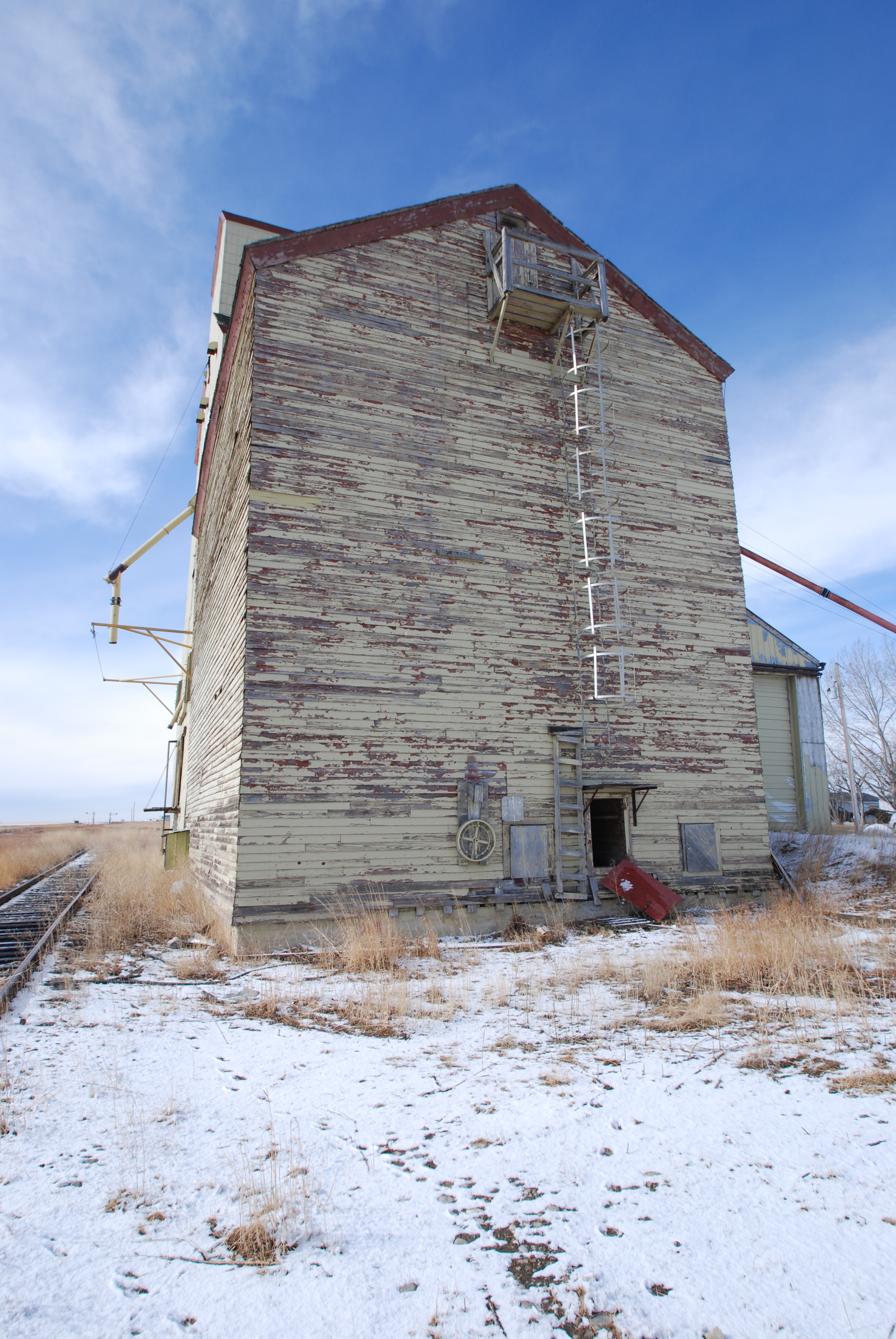
The search for our grandfathers’ elevators has led us to many small towns and many grain operations. Among our discoveries have been ancient wooden elevators, now quaint relics among their larger concrete cousins. In some towns, wooden elevators still have jobs to do, but their time is short.

Charles H. Tillotson built wooden elevators long before his children took up the slip-formed concrete building technique, and at one time, every Midwestern town with a rail line had a row of them serving the local farmers. Now it is increasingly rare to find a town with more than one wooden elevator in service, or for that matter, still standing.

DSC_5225

The Ryegate, Mont., elevator is flanked by its replacement fertilizer plant.

In the last year or two, in several towns, locals have told me that their wooden elevators were no longer used and would shortly be destroyed. I made an extra effort to document those elevators. This week, I almost missed one. In Ryegate, Mont., a new fertilizer plant was put into operation last year, and the elevator that had served the purpose was now slated for destruction.

When I stopped to photograph the pair of wooden elevators at Ryegate, a town on U.S. 12 in east-central Montana, I went into the local cafe for a burger. A fellow at the bar introduced himself as Ken. He wondered where my hometown was, and the purpose of my visit. When I told him I was a bit of an elevator tourist, he told me about the Ryegate elevators. DSC_5156

Ken worked at the Ryegate facility. He said that over the years, he had been employed as a grain hauler and in almost every other aspect of elevator work.

The smaller elevator was built in 1917. Ken said grain dropped 70 feet from the top of the grain spout to a truck below while loading. The elevator had been in use as recently as two years ago, then the new fertilizer plant was built nearby to replace it.

The larger elevator, built in 1914, was still used for storage—it had fresh siding and looked neat and clean on an immaculate lot. But the smaller elevator, equally handsome, would be razed next week. He hoped I would get out and take more pictures before it was gone.

Our discussion ranged from elevators to the military. Ken served in the U.S. Army, had great admiration for the old C-130 aircraft, and expounded with enthusiasm about the M-1 Abrams tank and the Tow missile. He got a kick out of talking with another veteran who shared his interest. He also spoke with reverence about serving under President Ronald Reagan.

DSC_5253

The interior of the shed addition.

Our conversation was interrupted as a young lady burst into the cafe, exclaiming,

“I just got a deer!”

As two men moved to follow her out the door to see her trophy, she said,

“Come see. I got my mulie.”

Her announcement passed without any comment at the bar. Apparently, during deer season, such declarations are expected.

Before I departed to take a closer look at the doomed elevator, Ken introduced himself more formally as Sgt. Ken Davis, and shook my hand. It was an honor to meet this veteran who served back when we had a 600-ship Navy (in the good old days, about three wars ago).

As I took another circuit around the old elevator to shoot a few last pictures, the sun played on the high clouds, projecting light like a halo radiating about the old structure. I thought it a fitting farewell.

In honor of Veterans Day, I salute Sgt. Davis and his life’s work. I hope he enjoys the pictures. DSC_5231

The gun fired, and continuous action of many processes began in Alta, Iowa

scan0007

In this post, Charles J. Tillotson elaborates on Neil A. Lieb’s previous comments, describing the above photo from his archive. The jack rods referred to in the text are the tall, slender steel poles seen throughout the photo.  

They often say, a picture is worth a thousand words and this one fits the bill perfectly. The photo is truly an aid to describing the method of slipform construction that was used in grain elevator construction. Neil mentions the one-handed placement of the jack rod, so I’ll start with that.
 
Slipform construction is made up of many complex disciplines which have to all work together in order to provide the final poured-in-place concrete product.

As mentioned prior to this, the slipping of the formwork used in this type of construction was provided by a series of screw jacks placed apart by an engineered calculation sufficient to lift each jack’s portion of the formwork assembly.

Each screw jack was supported by a wooden, U-shaped yoke, the legs of which were attached to the vertical concrete formwork. Inserted in the top (or horizontal) portion of each yoke was a screw jack (similar to that used in jacking building foundations). A smooth one-inch jack rod was then inserted into the top head of the jack and threaded down through it until stopping at the foundation slab. 

The formwork is clearly seen at the Alta elevator rises. The catwalk around the bottom was for the concrete finisher, who smoothed and patched the freshly formed surface. Photo from the Neil A. Lieb Archive.

The wooden formwork is clearly seen at the Alta elevator rises. The scaffolding around the bottom was for the cement finishers, who smoothed and patched the freshly formed surface. Photo from the Neil A. Lieb Archive. 

A series of horizontal wooden rails at about waist height (looks like a railroad track) were then built directly above the open formwork, the “ties” of which were placed at prescribed intervals and used as a template spacer for inserting the actual vertical reinforcing steel. (See the small, half-inch rebar rods extending vertically out of the open bin forms at each cross tie). The vertical rebar was staggered slightly in an alternating fashion so as to allow the half-inch horizontal rebar to be threaded through the vertical rebar. On the vertical 2x4s that are attached to the exterior side of the formwork and rise above the entire deck assembly, so-called targets placed on their tops were used in leveling the deck in order to provide a final elevator that rose plumb and straight above the foundation.

As the screw jacks were turned (each jack was turned the same amount), the foreman on deck used a leveling instrument and sighted on each target to insure that the formwork was rising true plumb and level. If any of the targets did not align with true level, the portion of the deck out of plumb was corrected by extra turns of the screw jack or jacks as necessary to bring that portion of the deck up level with the rest of the formwork. 

Not shown in the photo is the horizontal rebar that was required to form a steel reinforced grid integrally cast in the concrete to form a reinforced concrete structure. Initially, the horizontal steel was wire-tied in place to the vertical rebar prior to one side of the forms being installed.  This placement occurred only to the height of the wood bin forms. Once the form-lifting began, the horizontal steel was placed by hand by pushing and threading the rebar horizontally through the vertical rebar. Because of the vertical movement of the formwork, close attention was required as to the spacing between horizontal rebar. 

Now, try to imagine: the start gun is fired and the continuous action of the many processes begins, never to stop until the wooden forms and finished structure reaches the prescribed vertical height (some 120 feet) eight days later. Manual labor is involved in each discipline. Personnel changes occur, but each position is filled by a replacement. The gun is fired, cement is mixed and lifted to the deck of the formwork via a Georgia buggy, and the content is dumped into the open form. The pouring of the cement into the formwork is continued in a circular fashion around the entire deck until it reaches a prescribed height in the form. 

The finished elevator. Photo from the Neil A. Lieb Archive.

The finished elevator. Photo from the Neil A. Lieb Archive.

Once the cement is allowed to solidify in the forms on the foundation slab, the jacking operation begins and the formwork starts its vertical lifting and slipping process. The jacks are turned, the cement is poured, the vertical rebar and jackrods are placed and spliced, and all the while the horizontal rebar is positioned at the proper height and spacing. Pour cement, turn jacks, place rebar, check deck level, and on and on through night and day until the construction reaches final height. The most problematic aspect of this system is the placing of the horizontal steel at the correct spacing, the placement of formed openings in the bins, keeping the hoist in operation, mixing the cement, and obtaining enough set time of the cement mixture so that as the finished concrete walls do not fall apart or slough off.     

Also, hanging beneath the formwork structure is the scaffolding for the cement finishers who dutifully serve to patch and smoothly finish the concrete surfaces appearing at the bottom of the vertically slipping formwork.