Some initials on a bronze plaque in Limon, Colo., help to solve a mystery

Story and photos by Kristen Cart

My father, Jerry Osborn, and I had a rare opportunity this October to take a road trip. Our goals were to see family, check out our hunting camp, and see some of the sights in the west. Dad is in his eighties now, so we don’t put off any chances to do neat stuff. This trip exceeded our expectations. Happily, we also were able to take in some elevators.
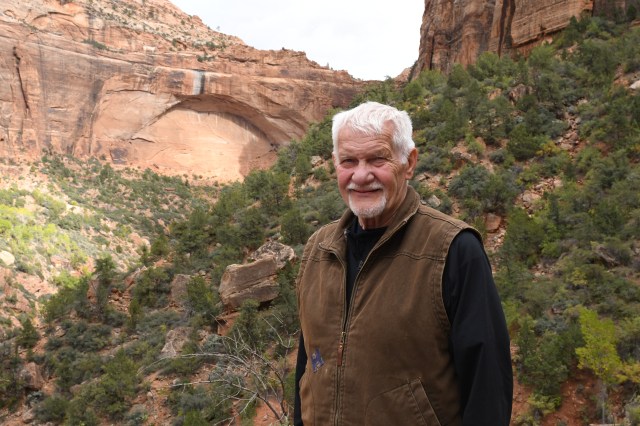
Jerry Osborn at Zion National Park, Utah

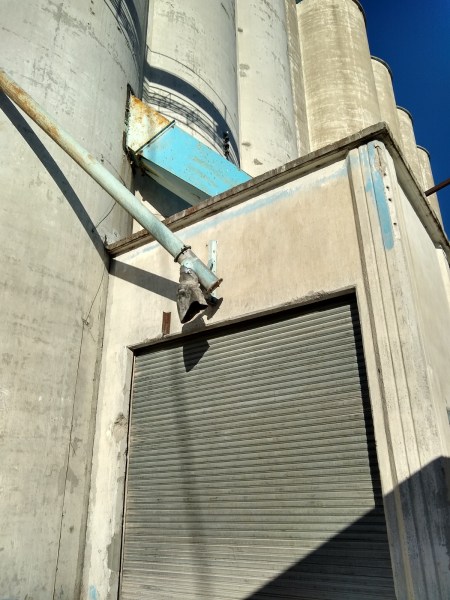
Our stop at the elevator in Limon, Colo., proved to be a wonderful surprise. There was a truck at the co-op when we arrived, but the office door was locked, so I approached the elevator itself and called out to see if it was deserted. When I turned around, a man was approaching from the office. I went to meet him.

Ed Owens was finishing up paperwork before going home for the night. I asked him about the history of the elevator, and he brought me into the office. Ed said his grandfather, S. L. Sitton, helped build the Limon elevator as well as the earlier, neighboring one in Genoa, Colo. He said his grandfather came into the area in 1939. He went away during the war, then came back and looked for whatever work he could find. Elevator construction provided a part-time laborer job that kept food on the table.
The builder put up the elevator like a layer cake, letting each concrete layer cure for a period before adding another, rather than by the continuous-pour method pioneered by early elevator construction companies. The Limon elevator was built in stages by farmers who built by day and farmed by night. I was impressed by Mr. Sitton’s fortitude, and I would have asked the old gentleman about it, but Ed said he was 97 years old and living in a nursing home in Flagler. He likely wouldn’t remember, and even if he did, he might not appreciate a visit.
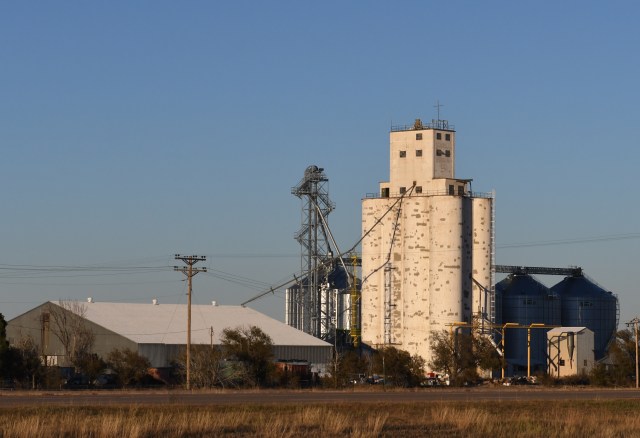
The Genoa, Colo., elevator is in a neighboring town.

The best discovery was yet to come. When Ed ushered me into the office, he showed me the bronze plaque which originally adorned the driveway of the Limon elevator. Ed said all of the directors listed on the plaque were dead by now. The elevator was built in 1958, so all the community leaders of the time were long gone. But the key bit of information on the plaque was the name of the builder and designer, M. and A. Enterprises, Inc., of Denver.

I was very excited to see this name. The company was based in Denver, and the designer claimed to be the builder. Based on the design of the elevator, I had a strong suspicion of who that designer might have been. We now had a key piece of information.

Followers of this blog know that we have puzzled over a few mysteries while tracking our grandfathers’ elevators. The most difficult story to reconstruct, thus far, was how the Mayer-Osborn Construction Company met its demise.

The Denver-based enterprise lasted from 1949 until at least 1954, when my grandfather, William Osborn, apparently left the business. In the summer of 1954 he built the Blencoe, Iowa, elevator with the help of my dad, Jerry Osborn; by the summer of 1955, William was home from his Denver office and never worked elevator construction again. Meanwhile, his partner, Eugene Mayer, probably revived the company under various guises, but we know little of what became of him.

With our visit to Limon, Colo., we may have cracked the case.

Usually, the simplest explanation is the true one. The quickest way to explain why a thriving company would go away is to look for a disaster. Family lore says there was one. But I suspect the rumor of a collapsed elevator, lost to a crew that “shorted materials” and made bad concrete, might have been a tall tale that sprung from a much more pedestrian event. No such disasters can be found in 1954 or 1955 newspaper accounts.

The only related problem I could find occurred at the the Mayer-Osborn elevator in Blencoe, Iowa. During construction, when the elevator had reached about twelve feet high, the forms were slipped for the first time. As soon as concrete appeared below the slipped form, it began to slump and crumble. Bad concrete was indeed the culprit, and it necessitated a tear-down. To get back to a twelve foot height, the company had to add a day or two of expensive labor, which directly cut into profit. Could this event explain why William Osborn left the company? It’s the simplest explanation, so perhaps.

Several subsequent elevators bore the Mayer-Osborn manhole covers, but Dad didn’t know about these elevators, and he was certain that by 1955, his dad, William, was home for good.

The Mayer-Osborn elevator at McCook, Nebr. built in 1949

With its signature stepped headhouse, the elevator in Limon bears an uncanny resemblance to the first elevator Mayer-Osborn built in McCook, Neb. In fact, it is the same design, updated somewhat, and dated 1958. So it certainly went up after Grandpa left the business. But what about Eugene Mayer? Dad said that he was the designer, whereas Bill Osborn started as a carpenter and learned his construction skills on the job. Mayer still retained ownership of his elevator designs, which could explain why McCook clones continued to pop up all over the plains in the mid-1950s.

That brings us back to the builder of the Limon elevator, as inscribed on the plaque, “M. and A. Enterprises, Inc.” It seems inescapable that the “M.” was Mr. Eugene Mayer.

The Limon elevator had newer innovations but was built haltingly. Plainly, all was not the same as it had been when Bill Osborn was on the job. Perhaps fewer workers were available. Fewer contracts were awarded as subsidies waned. So the big, ambitious, day-and-night event of an elevator project was toned down somewhat. I expect we will find that Eugene Mayer’s design was eventually sold and others built it, then it passed into history, along with the great concrete elevator boom.

Happily, Limon’s elevator still thrives, and it gives us a peek at the amazing history of elevators on the American plains.
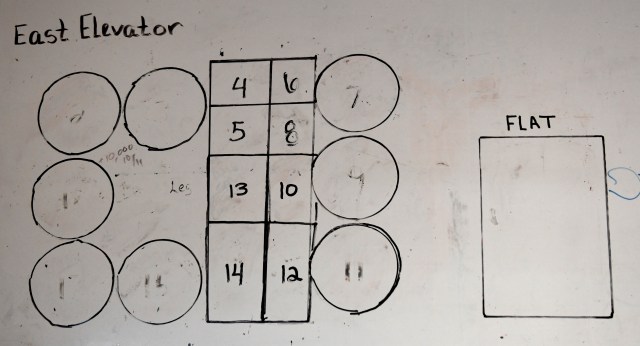
The layout of the elevator is used to record the content of each bin. Flat storage is adjacent to the concrete elevator.


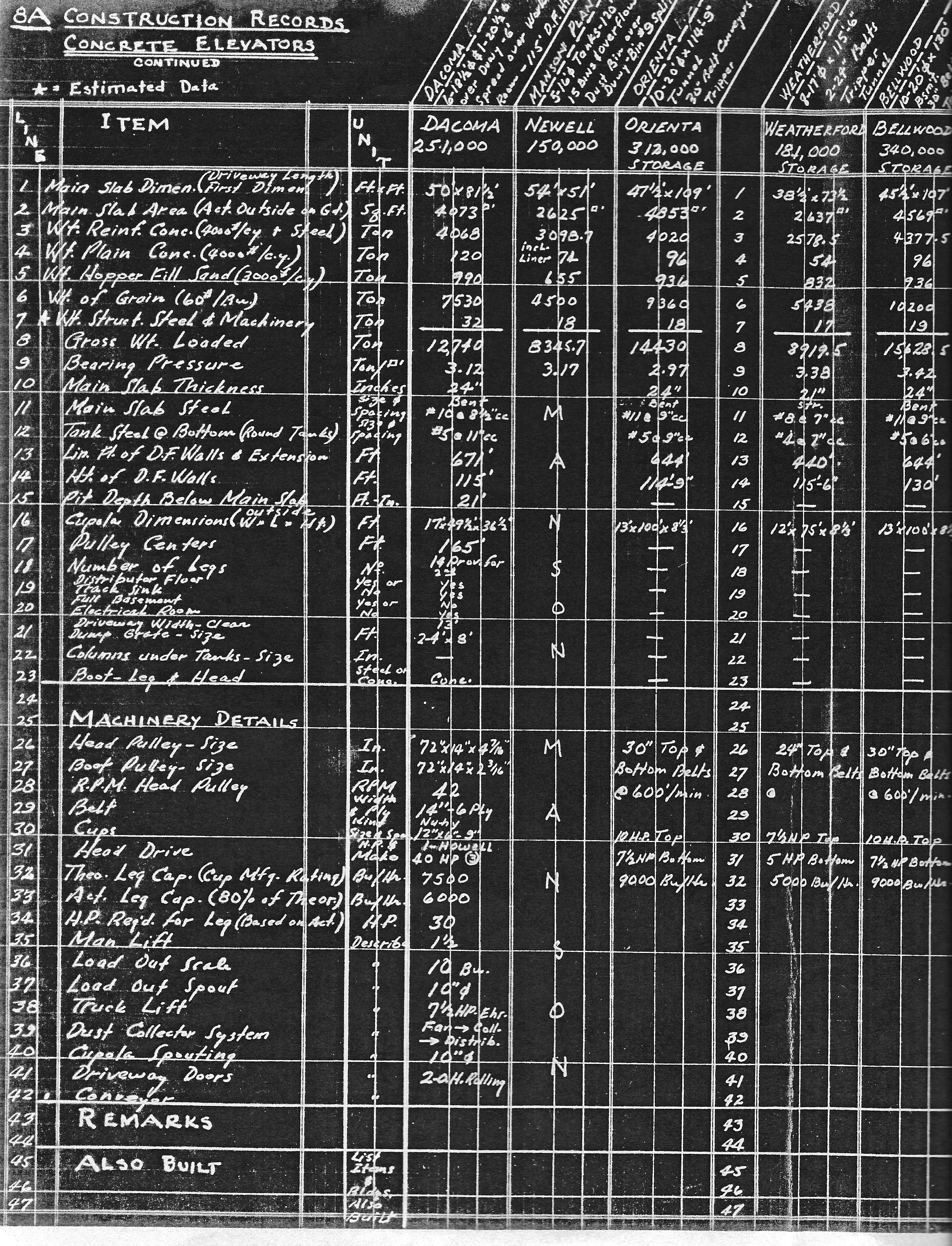
Tillotson built a 181,000-bushel annex at Weatherford, Okla., in 1954

Reader Terry Christensen found himself wondering about something, so he wrote this comment, which is lightly edited for style:

Hello and thanks millions for these awesome stories!

My dad, George T. Christensen, worked for Tillotson Construction in the early ’50s, and he died in an unrelated accident while building the elevator in Boxholm, Iowa, in 1955. My mom told us that he worked on several elevators in Oklahoma, and I would love to see the construction notes for all the elevators they built in Oklahoma. I think they built the one in Weatherford, Okla., in 1952 or 1953 and maybe the one at Hydro Okla.?

Thanks again,

Terry Christensen

Well, in fact,  we don’t know anything about Hydro, but Tillotson Construction Co. sure did build at Weatherford–a 181,000-bushel storage annex in 1954.

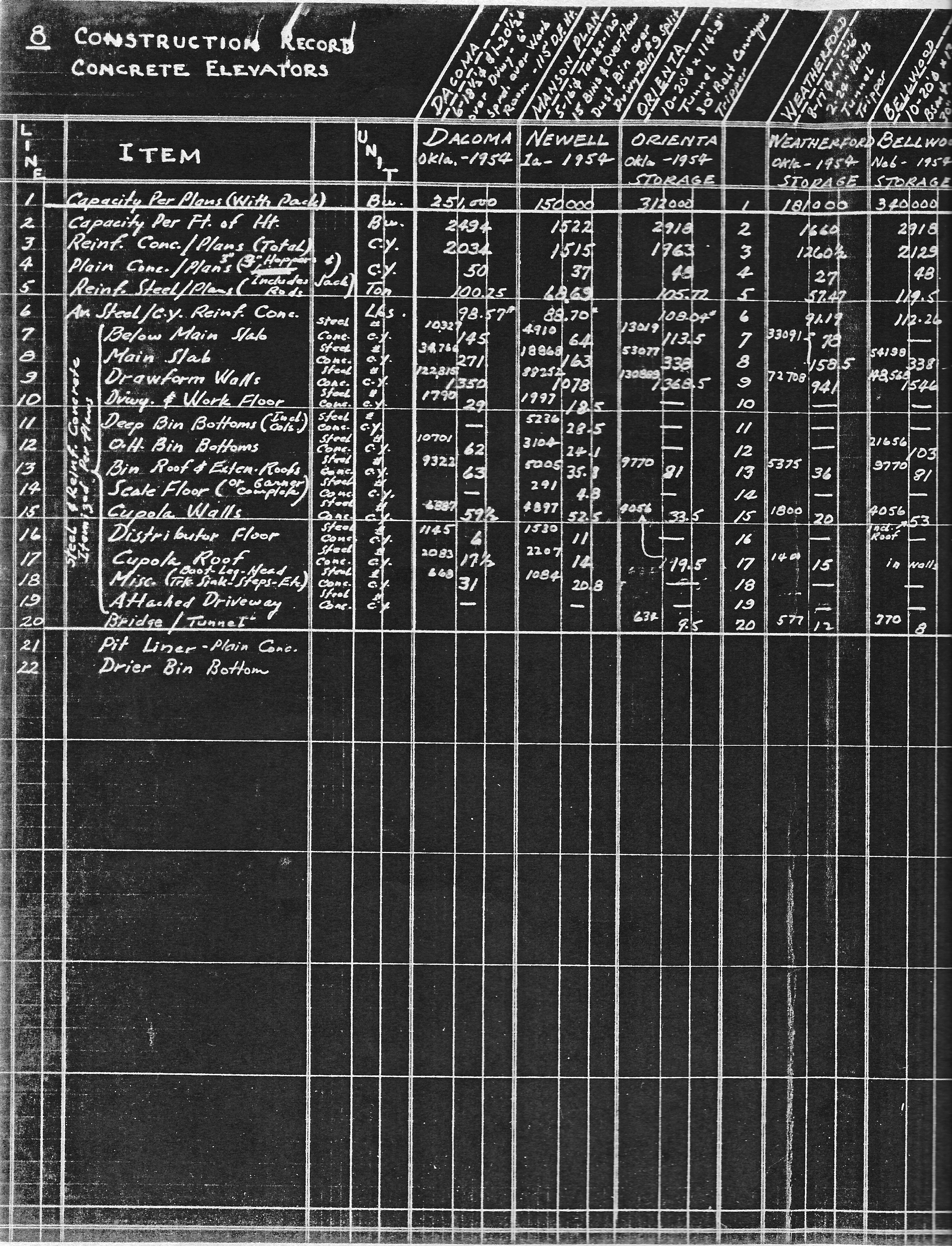
We find specifications in the construction record. At the top of the entry, the coded notes tell us there were eight tanks of 17 feet in diameter by 115 feet in height. Two 24-inch conveyor belts moved grain through the run atop the tanks. There was a tunnel, probably from the main house to the annex. And a tripper would sweep grain off the belt into a storage tank.

“The key feature of the steam-powered conveyor belt that ran alongside the tops of the grain bins was the ‘trimmer’ or ‘tripper,’ a device that deflected the flow of grain off the belt, and down and into a particular grain bin,” writes William J. Brown in American Colossus: The Grain Elevator 1843 to 1943.

Here are the notes for Weatherford (as well as Dacoma and Orienta, Okla.); Newell, Iowa; and Bellwood, Neb.:

Weatherford 01

Weatherford 02


Trying to trace the sweep of Tillotson’s hand in Dalhart, Tex.

By Ronald Ahrens

IMG_9022Tillotson Construction Co. had yet to perfect its signature style of the curved headhouse when it first built in Dalhart in 1947.

Before the late 1940s the headhouses were rectangular with a sort of molding, of concrete, extending up the full height at each corner. 

In ’47, Tillotson built a 150,000-bushel, single-leg elevator along the busy railroad tracks of this market center, the seat of Dallam County.

In specifications it adhered to a unique plan with four tanks, or silos, each measuring 20 feet in diameter and reaching 120 feet in height. There were eight bins. The attached driveway was 13 x 16 feet.

The surprise is that Tillotson built a 98,000-storage annex in the very same year. Notes in the company records show two tanks of 25 feet in diameter reaching a height of 120 feet.

A further note says “Direct spouts from elev.–Gravity flow to Elev. Pit. Ring footing 3 bins.”

When I visited last month, I hadn’t realized there were two elevators. Maybe I missed something. I think I paid a call to the 1949 job.

Here’s what Uncle Chuck contributes: “I remember Dad having to make a number of trips to Dalhart, but if the annex was finished in ’47, like you say, then he must have been there to close out and inspect the finished project.

“My recollection was that the job was either finished or in the final punch-list stage. But like you on your trip, we had visited a bunch of jobs or prospective jobs before we got to Dalhart.

“Also, my young mind in those days wasn’t necessarily concentrated on the job status in each stop but probably more interested in the secretarial staff!”

At last he reveals the truth!
IMG_9016

Except for a railroad employee familiar from down the road in Hartley, no staff–and especially no secretaries–could be located.

Looking through the scale-house window, I saw a plate of uneaten food and an open bag of chips on the counter. Yes, another mystery.

I would leave Dalhart with more questions than before my arrival. 

Onward to Dalhart, Tex., and memories of a wild ride through New Mexico in 1948

IMG_8992After departing Hartley, my next stop, just 15 miles northwest on U.S. 87/385, was Dalhart, a market town with brick streets in the business district and, along the railroad tracks, a whole lot of buildings by Tillotson Construction Co. Dalhart is so remote in the Texas Panhandle that six other state capitals are closer than the Texas capital of Austin. For example, it’s 28 miles shorter distance to Lincoln, Neb., than to Austin.

Texas-Okla Logo 04Mention of Dalhart got my uncle, Charles J. Tillotson, reminiscing about his experience with my grandfather, Reginald O. Tillotson. Perhaps from the following anecdotes we understand why Reginald started using light aircraft for his business travels.

Uncle Chuck writes:

Remembering Dalhart brings back memories of one of Dad’s business trips where I had been brought along to help drive (12 years old). I believe this one was during the winter of ’47 or ’48, and Dad was making a big business loop (similar to yours only in reverse) out of Omaha, down through Kansas, Oklahoma, and Texas and then back up through New Mexico, Colorado, and western Nebraska.

IMG_9009Anyway, on that trip, it was getting close to sunset as we approached Dalhart, so Dad had me stop in Amarillo where he secured a hotel room.

I will never forget the night in that godforsaken place. The hotel was not insulated nor fully sealed from the winter wind, and I practically froze to death in that cold room with the wind whistling through the cracks in the wall.

I was still frozen the next morning when we headed out to Dalhart, glad the car had a good heater.

Another memorable thing about that trip was what happened after we left Dalhart. We went north up through New Mexico to our 640-acre ranch in Cebolla. Dad had recently purchased this section at the encouragement of one of his best superintendents, Francis Dawson, who lived on a big parcel not too far west from our place.

Ours didn’t have running water, heat, or utilities. After we got there Dad decided to go out to Francis’s where we could stay overnight. The problem was that most of the road to his home was very poorly graveled. It was more like a pathway. IMG_9019

I was driving the car, but when we got to an area that was somewhat of a bog, Dad took over the wheel to show me how to drive through the mud. Well, it wasn’t very long after that when he got the car high-centered, tore a hole in the oil pan, and lost all the oil. Yet he kept his foot on the gas until we were stuck dead still; then the engine got so hot, it threw a rod.

We had to slog on foot through the mud to Dawson’s house. We arrived by nightfall. The next morning one of Francis’s hired hands got the tractor, fetched the car, and dragged it into the tiny little town of Cebolla (35 miles south of the Colorado border).

As you can imagine, there was no mechanic nor any repair facility. The closest one was well to the south in Espanola. So Dad called around to the various mechanical shops there until he found someone (lucky) that could repair the engine of the fairly new ’48 Chrysler four-door sedan.

Two days later we got under way again, and amazingly the car ran like it had never been through a torture chamber.

All of that trip transpired during my high school winter break and as I recall I only lost a couple of days of the next semester.

A trip I’ll never forget, in the spring of ’49 with me again subbing as a driver, Dad again high-centered a brand-new ’49 Ford and burned up the engine.

He had a thing about willing the car to go forward even though it was hung up with no wheels touching earth.

Home-built travel trailers and the demise of a tricked-out ’53 Ford in Iowa

HomemadeThe topic of staying in a travel trailer while working at grain elevator construction sites has prompted Charles J. Tillotson (“Uncle Chuck”) to do some reminiscing and dig through his archive of photos.

He writes:

The first one is a photo of the last trailer Dad built in 1937, which was an upgrade to the one that your mom and I are standing in the doorway of. He had covered the exterior of this trailer with some kind of protective fabric, which doesn’t seem to be attached very well.

The previous trailer had an exposed plywood exterior that was either stained or painted and it evidently didn’t hold up. The focus should be on the small size of the trailers which were probably about 15 feet long, much like the size of the early camper trailers of the 1950s and 1960s. If you allow room for the stove, toilet, closet and even a fold-down tabletop with a little settee, where did we all sleep?

The photo [below] was taken in late summer in Albert City, Iowa, and shows my Dad and me standing along side of my 1953 Ford with another older gentleman who I assume was the Albert City superintendent packing something into the trunk. We had finished up our work on Albert City, and Dad had assigned the three of us to travel across the state to a job he was starting in Clinton, Iowa.

Reg&Chas

Soon after the photo was taken we three boys [Chuck, Tim, and Mike] left Albert City and took along with us a couple of men who wanted to continue working for Tillotson Co. We took off in my beautiful ’53 Ford, which I had modified with a two-tone paint job, a Continental fake-spare-tire kit (remember those?) and lowering blocks among other things. I was driving very fast and in a pattern learned from my Dad, taking short cuts via the old one-mile graveled country roads through the tall cornfields. Zooming along and approaching an intersection ahead I spotted a dust trail from a vehicle approaching the same intersection on my right. With the road being gravel I decided that rather than stop for the oncoming vehicle (that had the right of way) to instead outrun it.

I had almost made it through the intersection when the oncoming vehicle clipped my rear bumper and put me into a sideways spin. I countered the spin by yanking the wheel in the opposite direction which brought me out of the spin, but the action was so fast it put me into another spin in the opposite direction. We zigzagged back and forth for a bit and eventually headed into a huge irrigation ditch, which we entered, rolled over, and flipped upside down. I remember my bro Mike standing up in the back seat hollering at me to ‘straighten out the car’ but to no avail. I think there were five of us in the car including my bros, none of which had seat belts fastened but by some miraculous ending, we were all able to crawl out of the car without a scratch.

The farmer who hit me was a local fellow, and he rounded up a tractor with an operator and the car was pulled back upright and out of the ditch, whereby it was towed off to a local mechanic’s shop.

I don’t remember who came to rescue us, but somehow we continued on to the Clinton job where we put in some closing days of the summer, laboring there. 

Ford&trailer

When it came time to go home, my bro Tim and I went and picked up the Ford which still was operable (a testimonial to Ford), but the vehicle had multiple dents and bruises including missing a windshield which had been knocked out in the crash.

Tim and I bought a pair of goggles and proceeded to hit the trail (in a light drizzle) to Omaha with the wind and rain in our hair and elsewhere. My Dad knew of the accident but he had never seen the car until we got home whereby he came out of the house and I’m sure almost had a heart attack when he viewed the pile of junk that once was my beautiful ’53 Ford. As I recall, he had the car towed away to the junk yard.

It’s funny how viewing old photos can bring back memories of both the exciting and dull days gone by. It’s too bad the photographs taken today are no longer hard-copied by most people and their memories no longer documented to tell the stories of days gone by for both their own revisitation as well as their offspring.

A postcard reveals Tillotson elevator activity before the big changes of 1938

Post Card 01

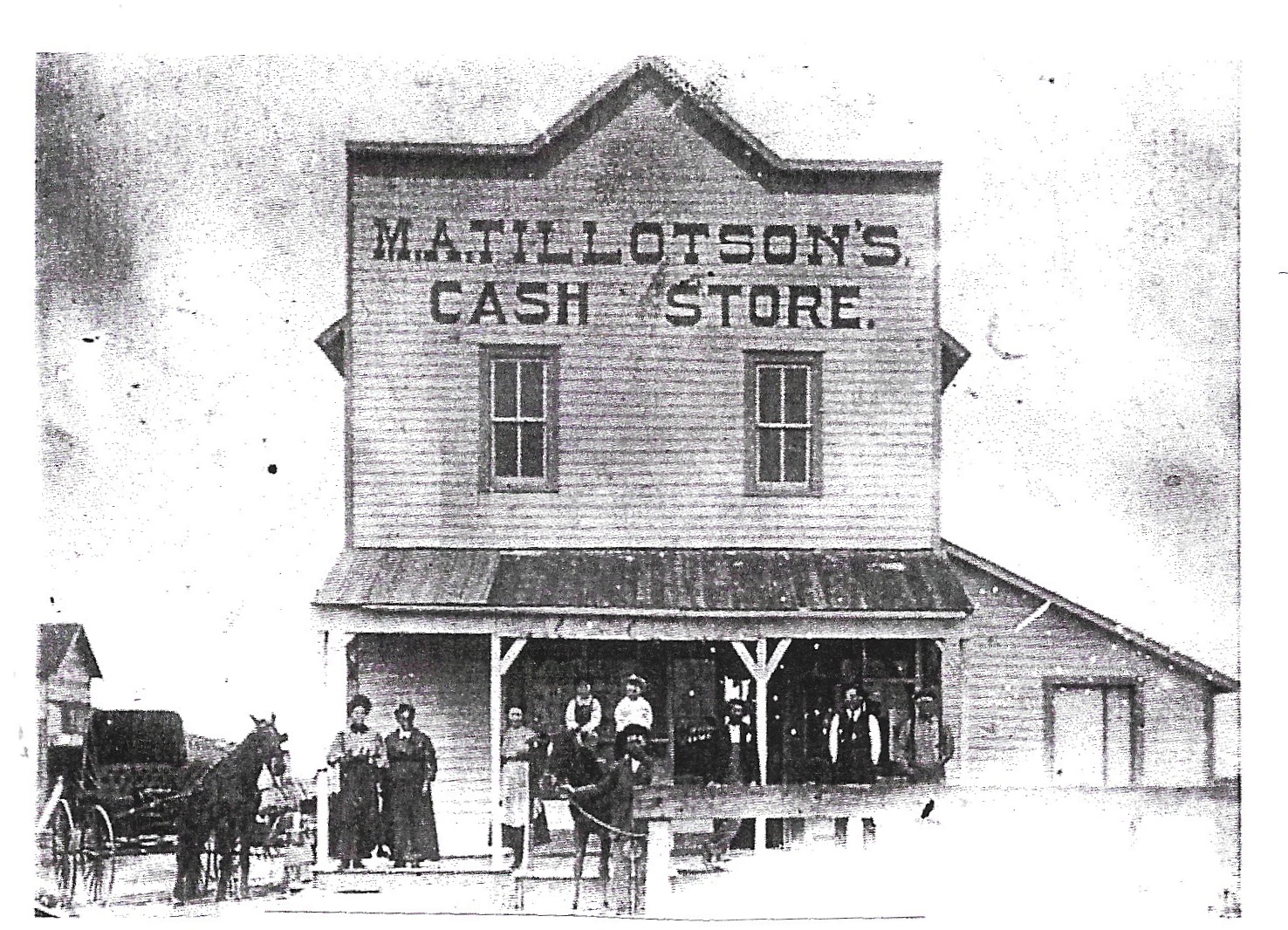
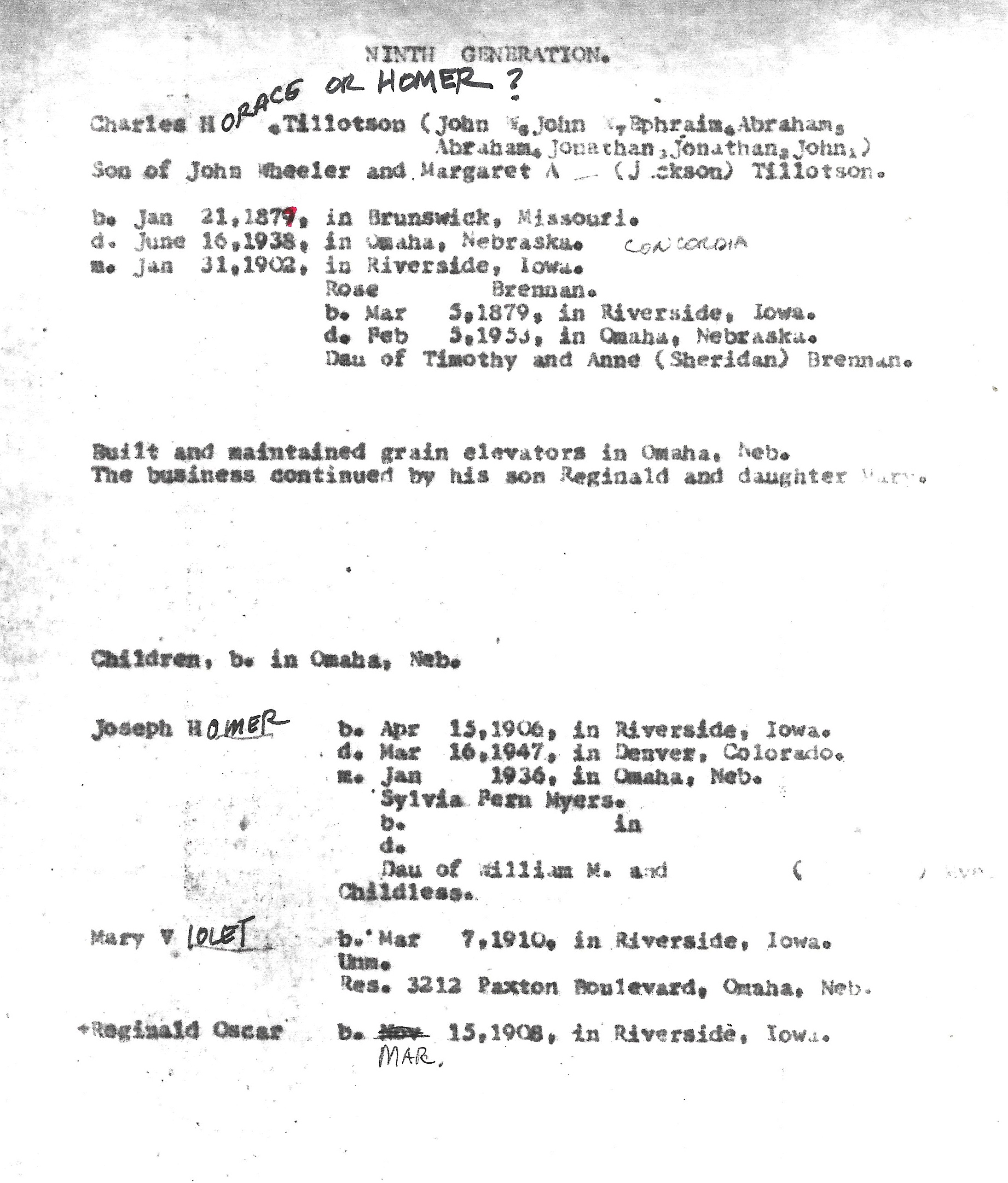
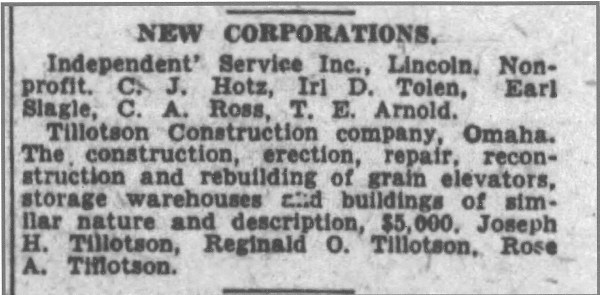
We have found what may be a rare record of the Tillotson construction enterprise as it existed before 1938. Back then, Charles H. Tillotson led the company, which specialized in wooden elevators. After he died in ’38, his sons Reginald and Joe partnered in Tillotson Construction Co., and started to experiment, and then build, with reinforced concrete.

This card from July 2, 1936 is penned by Sister Mary Concepta, the older sister of Margaret Irene McDunn Tillotson (my grandmother) and sister-in-law to Reginald.

Sr. M. Concepta, born on Sep. 27, 1901, in Emerson, Nebraska, and christened Catherine McDunn, was the second of nine children. (Margaret, born Feb. 9, 1903, was third.) Sr. M. Concepta belonged to the Sisters of the Presentation of the Blessed Virgin Mary, with a motherhouse at Mount Loretto in Dubuque, Iowa.

The parents were William McDunn (b. Feb. 4, 1871, Des Moines, Iowa) and Bridget Loretta Dorcey McDunn (b. March 27, 1872, Luken or Lucan, Ontario). Records show William as a laborer in Omaha in 1891. He became a conductor on the Nebraska Division of the Chicago, St. Paul, Minneapolis & Omaha Railway, and the family became established in Emerson, the town named for Ralph Waldo Emerson, which had come into being in 1881 at a junction on the CSPM&O (known as the Omaha Road). 

The family history comes from These U.S. McDunns: Family Tree of Patrick McDunn and Mary O’Donnell, compiled by John McDunn, of Lodi Wisc., in April 1989. The McDunns homesteaded in Pennsylvania in 1835. 

My Uncle, Charles J. Tillotson, whose name appears in many of this blog’s posts, had kept his grandfather William’s railroad watch–a Hamilton, of course–until a burglar struck in the late-1980s.

Post Card 02Uncle Charles notes that in the mid-1930s Reginald and Margaret lived with the elder Tillotsons at 624 N. 41st Street. They towed a travel trailer to job sites. In early July of 1936 they would also have towed along Uncle Charles, then 18 months old, and my mother Mary Catherine, who was nearly five months old.

On this postcard Sr. M. Concepta addresses her sister Margaret (Mrs. Reginald Oscar Tillotson) at Carlyle, Neb.

Carlisle–note the difference in spelling–is an unincorporated town in Fillmore County.

“I know the name because Mom used to talk about it,” Uncle Charles says.

We presume there was a wooden elevator. Carlisle is an unincorporated community in Fillmore County, about 135 miles southwest of Omaha. It doesn’t appear on our Rand McNally page nor does Google Maps seem to know anything about it. 

MapThe USGS gives coordinates for Carlisle on its Davenport Quadrangle map (named for a town in neighboring Thayer County), and we see a speck on Road X, west of Little Sandy Creek, that could be Carlisle. We called the Fillmore County sheriff’s office, in Geneva, and asked. “Nope,” a very nice woman said. “We don’t have a Carlisle.” 

Whatever.

“Dear Margaret + Reginald + babes,” Sr. M. Concepta begins.

Post Card 03“This card tells you where we are. Saw your Mother and Mary, Reginald. Mary is truly a nice girl and your mother surely is not strong. Won’t be leaving here now until Sat. morning. Just thought you might be coming in for the 4th. Don’t try it just for me though. Love, Sr. M. Concepta.”

Mary Tillotson was Reginald’s sister who became important to the family business and also is named in many posts here.

It’s hard enough to find a trace of Carlisle, but we would love to know if any remnant of a wooden elevator exists there.


Conversation with Sherman Johnson, scion of Johnson Construction, of Salina, Kansas

We were happy to be able to give Sherman Johnson a call the other day. Sherman, a flooring contractor in Shawnee, Kansas, is one of Virgil Johnson’s six sons. Johnson Construction, Virgil’s contracting firm, operated out of Salina, Kansas, and built a whole lot of elevators. We have speculated about the existence of a strong link, perhaps a common architectural designer, between Johnson Construction and Mayer-Osborn Construction. Johnson Construction sometimes acted in partnership with Rex Bratcher, and we know something about Johnson & Sampson. The design themes spread through those channels.

AtlantaKansas

Brad Perry took this photo in Atlanta, Kansas. “I think it’s a Johnson house,” he said. The rounded and stepped headhouse suggests Mayer-Osborn and Tillotson design influences.

Sherman was born in 1945 and went to elevator construction sites as a kid. “I remember going to Texas and Oklahoma. We lived in Salina, but most of the jobs were in Oklahoma and Texas, in the Panhandle of Nebraska, and in Iowa.” 

We had many other questions for Sherman, and he tried to help as much as possible. One thing he seemed pretty certain of was that Virgil talked about Tillotson Construction Company, of Omaha. “I heard my dad talking about them!” he said. “My father, he worked for Tillotson, I think. I don’t know for sure. I heard the name Tillotson, Chalmers and Borton, people like that.” 

Kristen Cart: Do you remember being on any job sites when you were a kid?

Sherman Johnson: Oh, yeah.

KC: Are there any memories you’d like to share?

SJ: Oh, like I said, I was just a kid. I remember going to Texas and Oklahoma–Newkirk (Okla.) and Blackwell and Conlon, Texas.

Ronald Ahrens: How long was Johnson Construction active?

SJ: As near as I can tell, at first it was my father and my uncles. And then Rex Bratcher was his partner for a while.

KC: The Sampsons were your uncles?

SJ: My dad’s wife’s brothers, Darwin and Sherman. I’m named after one.

RA: Do you remember the name Darrell Greenlee?

SJ: Darrell and Rosina. They were very, very nice people, great people. They had six girls.

RA: He was a foreman for your dad’s construction company, right? 

SJ: Superintendent.

RA: Can you characterize him?

SJ: In the summertime I had to work for him, and he worked me pretty hard. He was a good guy: a hard worker, a smart guy. We’d go out in the summertime, I don’t remember what the jobs were, they had me doing all the grunt work. I guess that’s why I’m not a contractor. 

KC: My dad described installing rebar.

SJ: Laying it and tying it. And it seemed like you always had a shovel in your hand doing something. 

KC: We had comments from Emily Frank, whose grandparents were Darrell and Rosina.

SJ: He built an elevator in Rushville, Illinois, and he retired there. If she’s still alive, she’s there. I don’t know if she’s still alive or not. 

Editors’ note: Here is the link to Rosina’s obituary.

KC: A couple of jobs, I’m going to ask if they’re familiar. Grand Island?

SJ: I don’t know.

KC: Atlanta, Kansas?

SJ: That rings a bell but I wouldn’t tell you that we did.

KC: One of the things we do is visit the elevators, and right on the manhole covers is the name of the company.

SJ: Oh, yeah. They used to make those at Wyatt Manufacturing in Salina. There was a foundry for a long time.

The Minatare, Nebraska, concrete elevator mystery solved

The Minatare elevator was an intriguing photography subject.

Story and photos by Kristen Cart

My dad, Jerry Osborn, and I were traveling in western Nebraska on a three-day road trip to visit old friends and family when we happened upon the Minatare elevator built by Tillotson Construction. I immediately suspected that it was a special find. I asked my dad to be prepared for an afternoon of investigation, so after our visit with his cousins in Scotts Bluff, we began our inquiry in earnest.

Our first view of the elevator.

The name Minatare rang a bell, and I thought it might be home to an early elevator, catalogued in the Tillotson Construction Company records. But I didn’t have any way to check, being well out of cellphone range, and began to doubt my memory. Perhaps Minatare’s elevator was featured in an early postcard, one of hundreds I had examined on Ebay, while looking through old elevator images. I couldn’t remember where I had seen the name before.

Only the old-fashioned gumshoe method was going to work. Dad went along on our mission in good humor. For a good part of it, he spent his time comfortably hanging out in the air-conditioned car, while I called upon local people and shot every possible camera view.

So how do you check out a mystery elevator? After copious photos, you check out the town office. If the town clerk smiles, shrugs, and sends you down the hall to the library, which is closed, then you go (on her advice) to the local tavern. If you are lucky, the owner is intrigued and makes some calls. Pop into the library when it opens. Jump into and out of the car, drive a few blocks, get Dad a coke from the tavern, where the owner sends you to the next place. Touch base at the new place on the way out of town–then leave, still scratching your head.

It was a fairly typical visit.

No one I talked to in town remembered when the elevator had been in operation. The secretary at the town hall was standing in for someone else, and was relatively new in town. The local policeman laughed and shook his head when I asked him about it. He was a recent resident, too. One young person offered a tidbit–she said that the interior of the elevator might have been seen by teenagers at one time or another. It wasn’t a mystery to everyone in town, apparently. Too bad it was shut up tight, with no one around, so we couldn’t see the inside for ourselves.

A 1940s parade photo shows the elevator in its early years.

The librarian was very helpful. She kept the library open for a very short time because of her poor health, but she pointed us in the right direction. The town of Minatare was featured in a newly published local history, “Minatare Memories,” published by the Minatare Historical Committee. It had a short mention of a concrete elevator built in 1924. That information didn’t fit with any elevator that was of interest to us–it was way too early for a Tillotson job. We thought perhaps the 1924 date pertained to an earlier wooden elevator, the first one erected in the town, but at that moment we weren’t sure.

However, she offered a bookshelf filled with boxes of photographs, among them unattributed parade photos, taken a long time ago. In the parade photos were vintage cars, motorcycles, and best of all, the Minatare movie house marquee with the movie playing at the time, “California,” starring Barbara Stanwyck. In the background, behind the parade, stood the gleaming white Minatare elevator. The photos were thereby dated to about 1947, the latest date the elevator could have been completed.

The movie marquee dates the parade more precisely. The movie, “California,” came out in 1947.

The tavern owner, Dennis Wecker, offered more information on our second visit. He had made some calls, and he now knew the name of the company that owned the elevator–Kelley Bean. He gave us a contact and a location. On our stop at the bean facility, two workers in the office said the general manager at the Minatare location, Chris Hassel, had gone on vacation.

Dad and I left, still scratching our heads, and thinking about dinner. We had a drive ahead of us.

Kelley Bean is the current owner of the property.

It wasn’t until later when I conferred with my blogging partner, Ronald Ahrens, that we had an answer to the elevator’s provenance. He looked up the Minatare elevator in the Tillotson construction records and delightedly reported that it was not only the work of his grandfather, Reginald Tillotson, but it was an early one, built in 1941 very soon after the company was founded.

Eureka! It was a great find, and worthy of another visit. We will stop again and thank everyone who helped us tell its story.

Jerry Osborn, my dad and great traveling companion.


A slip-formed lesson in character-building at Blencoe, Iowa

Mayer-Osborn pay stubs from August, 1954

Mayer-Osborn pay stubs from August, 1954.

Story by Kristen Cart

Just when you think you know all there is to know about your parent, you find a document that tells you something more. In this case, I found the pay stubs for when my dad, Jerry Osborn, worked for Mayer-Osborn Construction Company in 1954. He wedged a few weeks of hard labor between school in the spring and football in the fall.

The project was a large elevator similar to the first elevator Bill Osborn built with his partner, Gene Mayer, in McCook, Nebraska, in 1949. This example of the type went up in Blencoe, Iowa–and not without incident, as we have related in this blog.

It struck me that his pay rate was just that of a laborer. No cushy job for the son of the boss was offered–he laid steel rebar down during the uninterrupted concrete pour, working his way around the bin top as workers jacked the forms and scaffolding ever higher. Dad mentioned that when he worked for his father, he was paid the same as everyone else–a dollar an hour for back-breaking labor. Not a few times, laborers walked off the job after the first paycheck. It wasn’t easy.

Dad managed to find something to do on the job that was worth even less–he put in a fair amount of time at fifty cents an hour. I can only imagine what that job entailed.

kimberly-osborn188

Jerry Osborn had interests other than building elevators for his dad. He was a champion golfer at Midland College. It seems odd that a good golfer, while cultivating the skill and concentration such sport required, would take time out to heave rebar for a summer job.

I’m not sure which year they won the championship, but I like the juxtaposition between the brutality of the labor and the finesse of golf.

kimberly-osborn186

The summer job added up to a tidy sum for the time. Perseverance paid off.

These days, many of our college-educated young people seem too delicate for such work, especially in exchange for such a meager reward. It would make no sense to them.

But my grandfather, William Osborn, might say that this kind of work built character. Especially if you showed up for that second and third week.

Monuments go up, memories surround them, but all ultimately subside and vanish

McCook Elevator

Story by Kristen Cart

Workers were taking down an old silver maple today on the greenway beside the Boise River. It was a living tree, and I wondered why they chose to remove it. All along the park stood younger trees–sugar maples and walnuts and spruce trees–and under some of them, memorial plaques were placed, probably at the time the trees were planted.

I noticed one plaque had partially sunk in soft ground, and a puddle of water covered most of it, but the birth year of 1911 could still be seen. This person had come into the world 105 years ago. His children, if living, would be in their 70s or 80s perhaps. No one tended the memorial. The Boise State students who strolled by might not know why he was remembered.

These memorial trees were intended to grow in beauty while families and colleagues remembered the dead. When the names are eventually forgotten, the trees will provide shade and nesting places until they become unsightly or weak or damaged. Then they will go.

DSC_0378

Concrete rubble from the Maywood, Neb., elevator. Mayer-Osborn Construction built it during the heyday of elevator building in the 1950s.

I remember a book about the ubiquitous stone walls in Kentucky horse country. The author explained how they came to be, how they disappeared into hillocks of rock, and how they sank back into the soil. Frost heaved stones out of the ground every winter, and farmers endlessly piled them onto the edges of their fields every summer. The stones were stacked and filled into walls, but after many years, weather and erosion consigned the stones back into the earth in a sinking process which all heavy stones must endure.

Today, even the locations of some old walls can only be estimated, in spite of the labor invested into them over many years.

Cemetery monuments–in fact, whole cemeteries–disappear in this manner, taking their inscriptions with them. The identities and locations of the dead are not resurrected unless a caring relative intervenes.

My grandfather’s generation was slighted in the monument department. He lived too late to be conscripted into the Great War, and by the time the next conflagration arrived, he was considered too old to serve. My father slipped through a similar gap between the Korean and Vietnam wars. Whole families lived their lives between one glut of glorious war dead and the next–to their good fortune, but at the cost of corporate memory.

William A. Osborn in 1965

William A. Osborn in 1965.

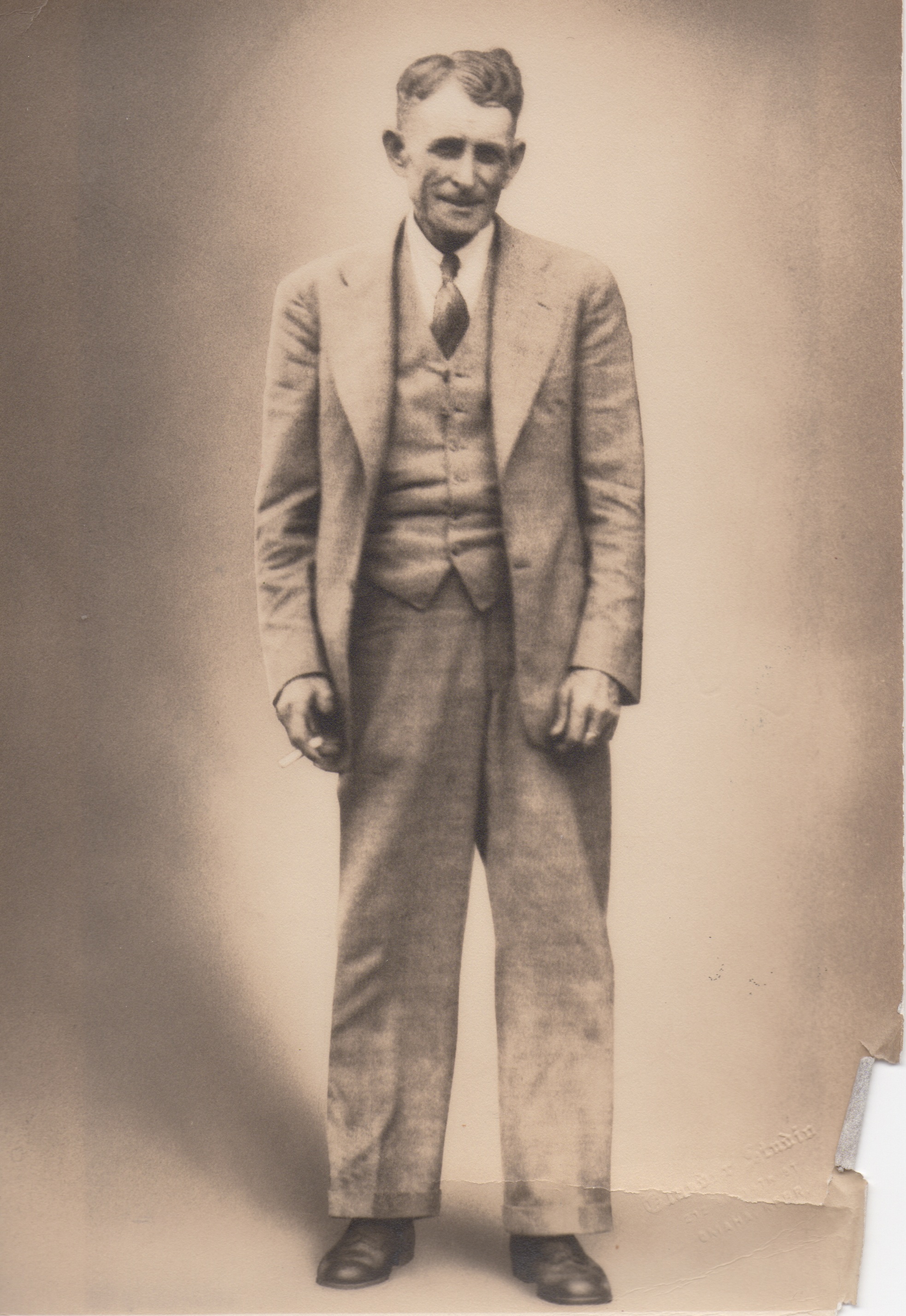
Grandpa was fortunate, however, to have left the elevators he built. With his name forged into the manhole covers and plaques set into concrete walls, his legacy seems more certain. Grain elevators are a durable memorial–but much like the trees in the park, they only represent him until no one remembers. Eventually, his great and useful contribution to the world will pass into utility, then into obsolescence.

Like the silver maple tree, the elevators will come down when they no longer serve. The plaques and covers will be recycled, and even his name will disappear. And those who loved William Arthur Osborn, beloved father and grandfather, will be past knowing when they go.