Tillotson Construction’s signature, the curved headhouse, was a practical matter

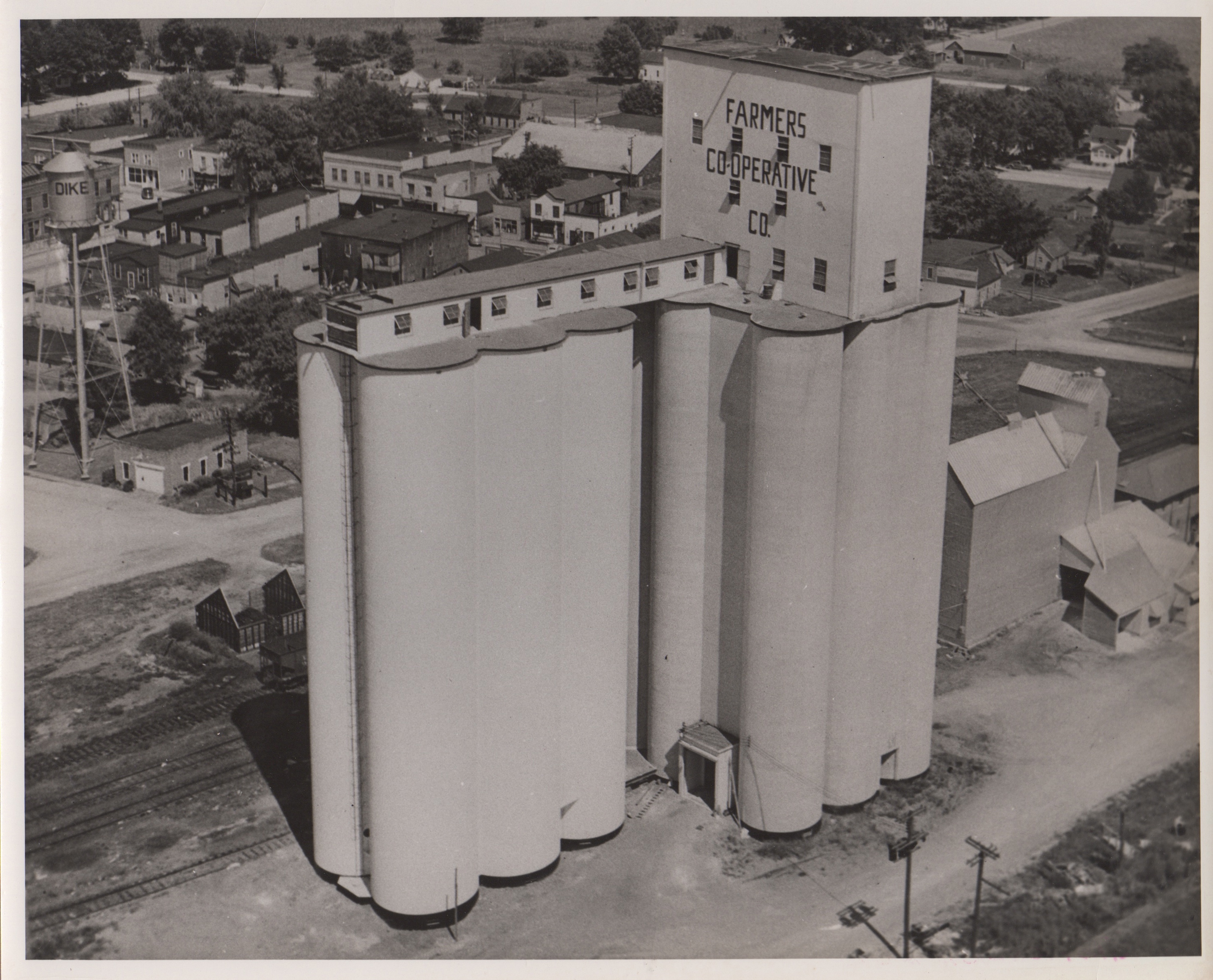
The main house of Tillotson Construction's elevator at Dike, Iowa, built in 1946 (annex, left, 1949), is crowned by a rectilinear headhouse.

The main house of Tillotson Construction’s elevator at Dike, Iowa, built in 1946 (annex, left, 1949), is crowned by a rectilinear headhouse. 

In this post, Charles J. Tillotson explains how his father, Reginald Tillotson, president of Tillotson Construction Company, developed the curved headhouse design.

It would be nice to say that the curved walls were created by Dad for aesthetic reasons and leave it at that.

However, a number of factors actually influenced the design, those being:

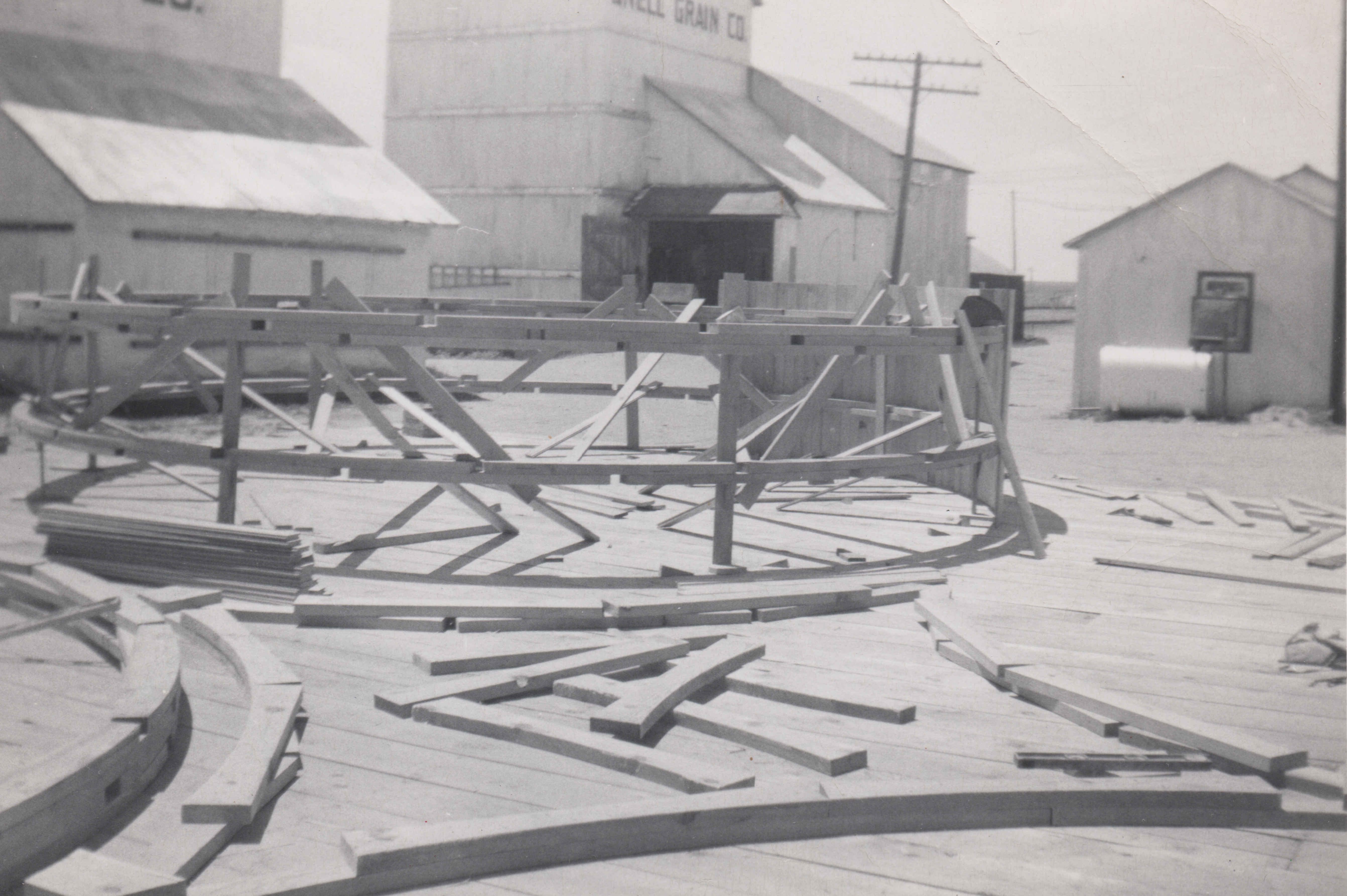
  1. Re-use of the curved yokes (the horizontal framework supporting the vertical forms used during slip-form construction of the storage bins).
  2. Building square corners into concrete slip-form construction proved to be more difficult than curved corners.
  3. Placing horizontal reinforcing steel for square corners entailed bending it at a ninety-degree angle and then manhandling it into position, whereas with the curved forms, the horizontal reinforcing steel could be inserted much easier by sliding it into position.
Tillotson's Aurora, Neb., elevator, built in 1950, has a curved headhouse.

Tillotson’s Aurora, Neb., elevator, built in 1950, has a curved headhouse.

For numbers two and three above, keep in mind that all horizontal reinforcing steel, or rebar, was placed by hand (anywhere from twelve to sixteen inches) during the slip-form process, all while the forms were being slipped vertically by screw jacks.

The horizontal steel had to be placed rather quickly throughout the entire structure, so that the steel bars were approximately in alignment from the beginning of placement throughout the structure and back to the beginning point.

On large projects, steel placement was divided into segments with a team captain in charge of each, and all captains would then synchronize their start times for installing the rebar.

Slip-form construction involves a great deal of detailed labor to carry out specific functions while the forms are being jacked vertically in constant motion. It used to be about five to six inches per hour.

History is preserved in pictures at St. Francis, Kansas

Story by Kristen Cart

Farmers line up their grain trucks at St. Francis, Kan.

Farmers line up their grain trucks at St. Francis, Kan.

One of the most pleasant surprises at the St. Francis Mercantile Equity Exchange was their historical record preserved in pictures. In its hundred-year history, the exchange has maintained a continuous presence on the site of the present elevator, and has seen many changes in technology. Fortunately, photos exist that document the old way of doing things, and  Shirley Zweygardt, the site grain manager, was kind enough to provide copies.

In this photo dated 1951, an old wooden elevator stands immediately behind the concrete house. It was demolished to make room for the second bank of concrete bins, built in 2000.

In this photo dated 1951, an old wooden elevator stands immediately behind the concrete house. It was demolished to make room for the second bank of concrete bins, built in 2000.

It is always a fantastic find when you locate a pictorial history of an elevator.

A picture album, filled with historical treasures, which Shirley Zweygardt was pleased to share

A picture album, filled with historical treasures, which Shirley Zweygardt was pleased to share

I had already acquired a 1947 dated postcard depicting the elevator, so we knew its age. These additional photos, dated on the reverse “1951,” show its stately beauty. They depict two additional wooden elevators, which have long since disappeared. The vintage automobile in the foreground of the first image substantiates the date of the caption. Without the car, this photo would appear timeless, even though it was taken shortly before the addition of the first annex built by Chalmers and Borton.

Another view, dated 1951

Another view, dated 1951

It was quite a lovely thing; by 1951, the largest known elevator built by J. H. Tillotson, Contractor, was celebrating its fifth year, and was still white and stark against the sky. The elevator at McCook, Neb., was only two years old when this photo was taken, and my grandfather, builder William Osborn, had gone on to other projects with the Mayer-Osborn Construction Company.

Shirley Zweygardt told me an elderly resident of the town had preserved these photos in an album, which she brought to the elevator office, where they became part of the records of the equity exchange. The prints, reproduced here, were duplicate copies, now part of my growing library of historical images.

The visit to St. Francis was a happy one, capping an October 2012 elevator tour. This elevator marked the pinnacle of J. H. Tillotson’s construction career. Impressive still, it is a fitting monument to the skill, ambition, and industry of its builders.

Kingfisher Co-op documented the sequence of its elevators in a 1984 history

Scan

By Ronald Ahrens

Thanks to Linda at Plains Partners, in Kingfisher, Okla., we have pages from the special 50-year-history edition of The Co-op Way, published by the Kingfisher Cooperative Elevator Association in 1984.

The history reports what happened only twelve years after the co-op was incorporated. Because of postwar expansion “the need to build a new elevator was obvious,” the history says.

Scan 2The co-op chose Tillotson Construction, of Omaha, for the job.

First, however, the co-op reincorporated early in 1946 to increase its capital.

Work soon got under way when “the association wrecked the old 34,000 bu. elevator and built a new concrete elevator with a 250,000 bu. capacity,” the history says.

“They also wrecked all the other old buildings except the office and scale house which they had built in 1942. It was remodeled into a concrete cleaning and grinding mill and warehouse.”

The year of 1955 “saw the skyline of Kingfisher change once more. A new skyscraper had been added to the landscape, and the farmers took pride in the contribution they had made to their community’s appearance and prosperity.”

Tillotson company records don’t address the question of who built the second elevator, seen at right in the photo below. Neither does the co-op’s history mention the builder.

Scan 3


Discovering the J. H. Tillotson elevator at St. Francis, Kansas, as a centennial looms

DSC_0248(2)

The J. H. Tillotson elevator in St. Francis, Kan. is nestled between two annexes.

Story and photos by Kristen Cart

St. Francis, Kan., stayed on my mind for months after I failed to find any sign of the work of my grandfather, William Osborn, on our first visit.

Out on the western end of Kansas, the town was well clear of any route our family would take on the way to somewhere else. It was a very intentional stop on our itinerary. On our first visit, we took a wide loop, arriving just after sundown, and we lost the opportunity to investigate further than one cursory look at the wrong elevator. The visit to St. Francis was shelved for several months, and I almost didn’t go, but when I did, I made sure to be there before nightfall.

The weather caught up, however.

DSC_0224(1)

St. Francis Mercantile Equity Exchange grain merchandiser, Shirley Zweygardt.

This time, I headed toward the highest structure in town. By the time I pulled up to the elevator office, fat flakes of snow wafted down and splotched the truck’s windshield, melting on contact with the ground. It was October, and the trees, which still held their leaves, were a golden brown backdrop for the early snow. I shook off the cold and entered the co-op.

A surprise awaited. A long-time employee of St. Francis Mercantile Equity Exchange, Shirley Zweygardt, greeted me at the door. Raised on a farm just down the road, she was intimately familiar with the elevator’s history and purpose, so in 1979, when a job opportunity arose, she was glad to fill in where needed.

It has been a happy arrangement. Shirley started as a bookkeeper, then worked in grain accounting and is presently in charge of grain merchandising. She has seen the St. Francis Mercantile Equity Exchange through many changes over the years.

She asked me to sit down and have some coffee, and she shared her experiences of working around the old St. Francis elevator.

The manhole cover on the interior of the driveway identifies the builder

The manhole covers on the interior of the driveway identify the builder.

St. Francis Mercantile Equity Exchange was incorporated in 1913. As slip-formed concrete construction methods advanced, the equity exchange looked for a company to build their first concrete elevator. Once it was completed in 1946, their quarter-million-bushel elevator was the biggest and most modern in western Kansas. It more than doubled the storage capacity of its lesser neighbors. And lo and behold, it was built by J. H. Tillotson, Contractor, of Denver, with the construction supervised by my grandfather, William Osborn.

It was not the only grain storage on the site for long. Soon, the capacity proved to be too little for the 1940s and 1950s boom years, so Chalmers and Borton came along and built the first annex.

Later, the site incorporated a flat storage facility which only holds wheat, since its air system does not ventilate adequately for moist corn. A second three-bin annex was built in 2000, using the same old technique of lifting concrete up to a dump cart that ran on a track around the perimeter of the rising elevator. It was completed just before the onset of a seven-year drought, and it took a few good harvest years to recoup the investment, since the annual wheat yield was too low at first to fill the bins.

Wall Street would not be the only beneficiary of perfect prognostication. The present snowfall was gladly welcomed in St. Francis.

The St. Francis Mercantile Equity Exchange will be celebrating its 100th anniversary this year. It has been and is the cornerstone of the town, and the center of business and economic life. Stay tuned for a little more of the history, and wonderful images, of this fine elevator, which Shirley kindly shared.

The Chalmers and Borton annex is in the foreground, and the new annexes are behind the main house.

The Chalmers and Borton annex is in the foreground, and the new annex bins are behind the main house. The flat storage shed is on the left.

‘Walking the plank’ on the new Pocahontas, Iowa, elevator in 1954

pocahontasgrainelevator

By Charles J. Tillotson

Safety and the preservation of life have become much more important in today’s world of construction. However, during the 1940s and 1950s, the urgent need to build grain storage coupled with the fact that most elevators were built in very rural areas meant that safety was secondary to getting the job done.

A case in point was a personal experience I had while working in Pocahontas, Iowa.

As with most small towns, the labor pool was rather limited to itinerant farmhands and workmen passing through town. Scaffolding and access walkways were pieced together in a very haphazard way–the means to an end.

One day I was working “up top” of the newly built grain tanks and needed to cross over from the new tanks to the deck of the existing elevator. The distance between the two structures was probably eight feet. To span the gap, two 2×12 planks were placed down between the two structures.

As I began my “walk the planks,” I stubbed my toe on the butt end of one of them. Accordingly, I stumbled forward–but was fortunate enough to regain my footing and continued on across to the other structure.

I realized then how easy it would be to make a misstep and end up at the bottom of the chasm.

Map of Iowa highlighting Pocahontas County

Map of Iowa highlighting Pocahontas County (Photo credit: Wikipedia)

While working in Pocahontas I met a young man, a few years older than I, who had been passing through town on his way back to his home in Hinton, Iowa. His name was Marv, and he had signed on as a carpenter. It was refreshing to me when I met Marv, as he seemed to be a person who was not only a good worker but an intelligent one as well.

When the summer came to an end I had to return to school, and so I said my good-byes to Marv and all the crew on the job. Later that year I learned that Marvin Richards had fallen to his death on the Hinton job (Tillotson-built) while attempting to cross over between two structures.

Hearing the news of his death, I assumed he was the same person I had encountered.

That same summer, Larry Ryan, the hoist operator working for Tillotson Construction Company on the Pocahontas job, had a similar mishap. During Larry’s break from the hoist, he decided to go up through the existing elevator terminal and cross over to the new construction to deliver a piece of angle iron needed by someone up top.

Again, somehow he lost his balance on the planking, and he, too, fell to his death.

It was eerie to think about how, more than once, I had come so close to doing the same thing and just how dangerous an act this was. On the other hand, the concept was fairly simple and straightforward: two 2×12 planks, side by side, laid down between two structures and spanning a distance of only six or eight feet. Not much to it – but only if you don’t slip, stumble, or in some way lose your balance!

At minimum, there should have been a safety railing on one or both sides of the planking.

But, back then, there just wasn’t enough attention given to safety and the value of human life.

Of course, I learned a valuable lesson in precaution and safety from these incidents, which I carried with me throughout my construction career.

Hunting for a J. H. Tillotson elevator in St. Francis, Kansas

Elevator photos012

Postcard of early concrete elevator in St. Francis, Kan.

Story by Kristen Cart

Grandpa was pretty good at naming his elevators when he talked to the press. While building the McCook, Neb., elevator, William Osborn spoke about a number of his previous projects that were built while he worked for J.H. Tillotson, Contractor.

He named six elevators he built in Maywood, Wauneta, Daykin, Fairbury, and Lodgepole, Neb., and Traer, Kan.

McCook’s elevator, then under construction, was much larger than the rest, but he named one other elevator in the area that was of similar size, that one in St. Francis, Kan. He said he built that one, too.

The newspaper clipping and my dad’s recollections were all we had to go on when our family made the first trip to western Nebraska and Kansas to see grandpa’s elevators.

All of the elevators–save one–were easy to find (even Maywood, whose present incarnation is a rubble pile not far from the surviving elevators).

When we visited St. Francis, we stopped at one likely elevator complex, where my hopes were dashed when I saw the “Jarvis” name on the manhole covers. The other complex in town seemed far too big and looked very much like every other Chalmers and Borton project I had ever seen. Besides, it was getting dark and we had to put more miles behind us, since this elevator nonsense was just one of “Mom’s diversions” from the primary mission of going kayaking on the Niobrara River. So our first opportunity passed without finding grandpa’s elevator.

Dated 1947, the postcard highlights a major local landmark

Dated 1947, the postcard highlights a major local landmark

I scoured eBay for a while looking for images of Grandpa’s elevators, and I even bought an early postcard from St. Francis, and regarded it doubtfully when it arrived. What was it doing with a rectangular headhouse, if it was grandpa’s elevator? It was set aside on a growing pile of assorted elevator images.

The answer would have to wait for another visit and a close-up look at the elevator I had tossed off as a probable Chalmers and Borton edifice.

The second visit would reveal some surprises and challenge what I thought I knew about Grandpa’s elevators.

Stay tuned.

J. H. Tillotson’s project at Lodgepole, Neb., was the end of the line for Supt. Bill Morris

DSC_0380

The Lodgepole, Neb. elevator viewed through a rainy windshield on a blustery day.

Story and photo by Kristen Cart

It was the heyday of elevator construction, and J. H. Tillotson, Contractor, of Denver, was riding the crest of the building wave, when a new elevator was begun along Highway 30 (the Lincoln Highway), in the sand hill country of western Nebraska. Lodgepole was a sleepy town along the rail line that connected Sidney to the west, with Chappell and Big Springs to the east.

My grandfather, William Osborn, had been building for several years, and he accompanied Joe Tillotson to Denver when Joe made his break with the family business, Tillotson Construction of Omaha, and set out on his own. The new company had several projects under its belt, and several others ongoing in 1947, when Lodgepole’s elevator was started.

Bill Morris, an employee poached from the parent company, was superintendent for the job.

The dangers of the business were well known. But for the J. H. Tillotson company, fate was especially cruel, though the disasters that befell the builders were of a more mundane sort. In about March of 1947, Bill Morris was changing a tire on the side of Highway 30 near Lodgepole when a car struck him, and he was killed.

Of course the construction project went forth, and my grandfather played a role, since he had the experience to step in where Bill Morris left off.

It was not long afterward that Joe Tillotson met his maker in a car accident–only a matter of a few weeks. In those days safety in vehicles was an afterthought, and the Grim Reaper was guaranteed a regular harvest.

Joe’s death opened doors for my grandfather, since there were elevators to build and contracts to fulfill. By September of 1948, Bill Osborn had joined with Eugene Mayer, Joe’s brother-in-law, and together they formed the partnership of Mayer-Osborn Construction Company. My dad said Grandpa had to put up some money to opt into the business, and then he continued as before, building elevators as fast as they would go up.

The McCook, Neb., elevator marked their first joint effort.

Elevator work included a quick and painful education in the use of a chain fall

Image

Story by Charles J. Tillotson

Grain elevator construction brought with it the need for hoists that placed and set mechanical equipment for the grain-moving distribution systems. Most of headhouse mechanicals had to be placed via the use of manual chain hoists, in those days called chain falls.

ScanThese hoists consisted of a series of pulley wheels and chains that used leverage for moving heavy equipment up and down in precise increments. The hoist system was often used in conjunction with an overhead track so equipment could be adjusted horizontally as well.

The headhouse mechanicals were first lifted more than 100 feet to the top of the grain tanks using the main construction hoist. Once the equipment reached the top deck, a dolly cart moved each piece to the place of use. Most big pieces were mounted on preset anchor bolts. In order to hoist the equipment over the bolts and into horizontal position, the chain fall was rigged.

My lesson in using the manual chain hoist came one day in 1947 when I was working with an experienced workman named Fred on the Vinton Street job in Omaha. As a twelve- or thirteen-year old carpenter’s apprentice and hod carrier, I had never even been near a chain fall system, but this day I was assigned to help set a grain dryer.

After the rigging was finished, Fred had me guiding the dryer for alignment with the anchor bolts while he yanked the leverage end of the chain fall.

Scan 4While he operated the vertical location, I nudged the dryer ever so slightly back and forth as it swung above the anchor bolts. To accomplish this feat, I pushed on the chains with my hands placed right above the pulley wheel. When the dryer reached its spot, I hollered to Fred to lower it over the bolts.

Concentrating so much on the dryer’s placement, I neglected to release at the key moment. Consequently, my hand followed the chain into the sheave as Fred lowered the dryer, and my fingers slipped between the chain and wheel.

I yanked my hand back–but not before the tips of my index and middle fingers were crushed, skin and fingernails pulled off, leaving me with bloody stumps. As I was about to collapse from shock, Fred grabbed me, guided me to the man lift, and lowered me to the ground. My destination was the Super’s office, which was previously built for the grain company.

The Super, a rough dude from the old school, took one look at my bleeding fingers and told me to sit down on a chair next to his reference table, which was covered with plans and paperwork. He asked for a minute to get some first aid treatment and then told me to turn my head and look out the office window. I heard him pouring something into a little bowl on the table. He took my hand, saying he would dip my fingers and it might hurt a little.

Scan 2Well, after he scraped me off of the ceiling, controlled my sobbing, and began resuscitation, I was hurting more than ever. My fingertips felt like they had been burned off! As an antiseptic he had used Merthiolate, administered in those days to treat abrasions and cuts.

Next he wrapped my fingers in gauze and tape. “Keep the bandages on for a few days, and you’ll be as good as new,” he said. It turned out more like six months before my skin and nails miraculously healed to their original appearance.

Of course, through this experience, I gained a valuable lesson in the use of chain falls. Even though such systems today have better safety shields and braking devices, I still shudder when I see a chain fall system being used.

I have related this experience to many people over the years and learned I was fortunate to survive the ordeal–not only the accident, but also the first aid.

Merthiolate, the marketing name coined by Eli Lilly and Company for the antiseptic Thimerosal, is compounded of fifty percent mercury and the caustic chemicals alcohol and benzalkonium chloride.

Because of Thimerosal’s toxicity, Merthiolate was essentially banned from general usage as a topical treatment by the 1990s.

Looking back to those days of such primitive medicine, I often reflect on why we lived through such treatments. I guess one of the main reasons is, we didn’t have crowded doctor’s offices and hospitals, which today bring along their own set of detrimental toxic bacteria and contamination to contend with.

Timeline for Tillotson Const., J.H. Tillotson, and Mayer-Osborn companies and jobs

Ronald Ahrens and Kristen Cart cofounded this blog. Gary Rich is a primary contributor. We have visited elevators around the United States and Canada.

Ronald’s maternal grandfather was Reginald Oscar “Mike” Tillotson.

Kristen’s paternal grandfather was William Arthur Osborn.

Reginald O. Tillotson

R. O. Tillotson

Reginald’s company was Tillotson Construction Co., of Omaha. The company had been building and repairing wooden elevators since the 1920s, when it was led by Reginald’s father Charles H. Tillotson. Before his death, experiments were made with slip-form concrete construction techniques.

1938: Charles dies, and the company passes to his sons Reginald and Joseph H. Tillotson and daughter Mary V. Tillotson. They begin to perfect slip-forming and refine their design strategy, which includes a rounded headhouse.

1945: Tillotson Construction builds a concrete elevator in Giddings, Tex. William Osborn works on this project. He is probably employed by the company by late in ’44. Tillotson Construction wins the contract to build in Elkhart, Kan., and starts construction.

1946: The 225,000-bushel elevator in Elkhart is completed. “Shortly after the war, my Dad and Joe decided they couldn’t see eye to eye, so they split,” writes Charles J. Tillotson in “The Tillotson Construction Story” on this blog. Joe forms J.H. Tillotson, Contractor in Denver. William Osborn works for Joe Tillotson.

William A. Osborn in 1965

William A. Osborn in 1965

1947: Tillotson Construction builds  the Vinton Street elevator in Omaha. Joe Tillotson dies in a car accident in March. J.H. Tillotson, Contractor builds at Daykin and Fairbury, Neb., and Hanover and Linn, Kan., with William Osborn supervising the projects. Maxine Carter leaves Tillotson Construction on Oct. 7 to wed Russell L. Bentley.

1948: Formed in September from the residue of J.H. Tillotson, Contractor, the Mayer-Osborn Company builds its first elevator at McCook, Neb. Joe Tillotson’s wife Sylvia was a Mayer, and her brother Eugene Mayer is one of the partners. William Osborn is the other. Meanwhile, Reginald begins to use a light airplane for business travel in the postwar years. Reginald’s nephew John Hassman joins Tillotson Construction in September; among many other duties, he pilots the company plane to jobs in Nebraska, Kansas, and Oklahoma. Tillotson’s projects that year are in Paullina, Iowa, and Montevideo, Minn.

1949: John Hassman’s father Ralph, Reginald’s cousin, joins Tillotson Construction in sales and stays through 1952.

1950: Construction begins in November on the Tillotson house, which is built of concrete. It still stands north of Omaha. Tillotson employee Jess Weiser weds Lavonne Wiemers on Dec. 22.

1951: Drafted into the Air Force, John Hassman leaves Tillotson Construction in January.

Related articles

Hanging by a thread on the ‘wrecking-out’ scaffold, a young workman faces mortality

By Charles J. Tillotson

Editor’s note: Uncle Chuck here recalls one of the more harrowing experiences of his young life, when he was building grain elevators for Tillotson Construction Company. It occurred on what is called a wrecking scaffold–or to be more precise, during the scramble off one heading into the void.

From left, Tim Tillotson, Chuck Tillotson, and La Rose Tillotson Hunt, posing in June 2012 in Victorville, California.

From left, Tim Tillotson, Chuck Tillotson, and La Rose Tillotson Hunt, posing in June 2012 in Victorville, California.

When the slip-form process reached the intended height of construction, all wood form-work and other equipment and devices were removed from the structure via an external hoist.

The final portion of the demolition process, the removal of the wood forms, involved the most difficult and dangerous part of the operation, that being the “wrecking out” of the wood forms and decking material that is, by design, trapped inside each of the grain tanks.

All of this wooden material must be removed, and it must be done from the inside.

This is accomplished by utilizing a temporary platform, or wrecking-out scaffold, suspended within each tank.

Elevator design preconceived the need for a ‘wrecking-out’ platform

In preparation for the building of a temporary platform, cutout sleeves and manhole forms are strategically placed to allow cable and scaffold planking to be inserted into the tanks after the concrete roof deck has been poured. The cutouts, usually four round holes per tank, are each large enough in diameter for insertion of a cable with a preconstructed loop end.

Via the manhole, planks are slid through to a workman who is suspended on a rope with a bosun’s chair, allowing him to have a hands-free position.

He takes the planking being passed down to him and extends the two major beam planks through the hanging cable loops.

After the beam planks are in place, scaffold planking is installed perpendicular to the beams in such a way as to create a solid plank platform.

The final scaffold then becomes a square platform suspended in a round tank.

The void on each side of the scaffold is used for lowering or throwing the wood material into the tank’s dark abyss. After all the overhead wrecking has been accomplished, another team gains access to the tank’s bottom via a manhole in the side of the tank at or near ground level.

The noon whistle as harbinger of doom

This description of building the wrecking-out scaffold sets the stage on another personal experience with the perils of constructing grain elevators.

It took place when I was assigned duty on the wrecking-out scaffold. The morning of labor with two other workmen had passed without incident, and when the town’s noon whistle blew, we three stopped for lunch.

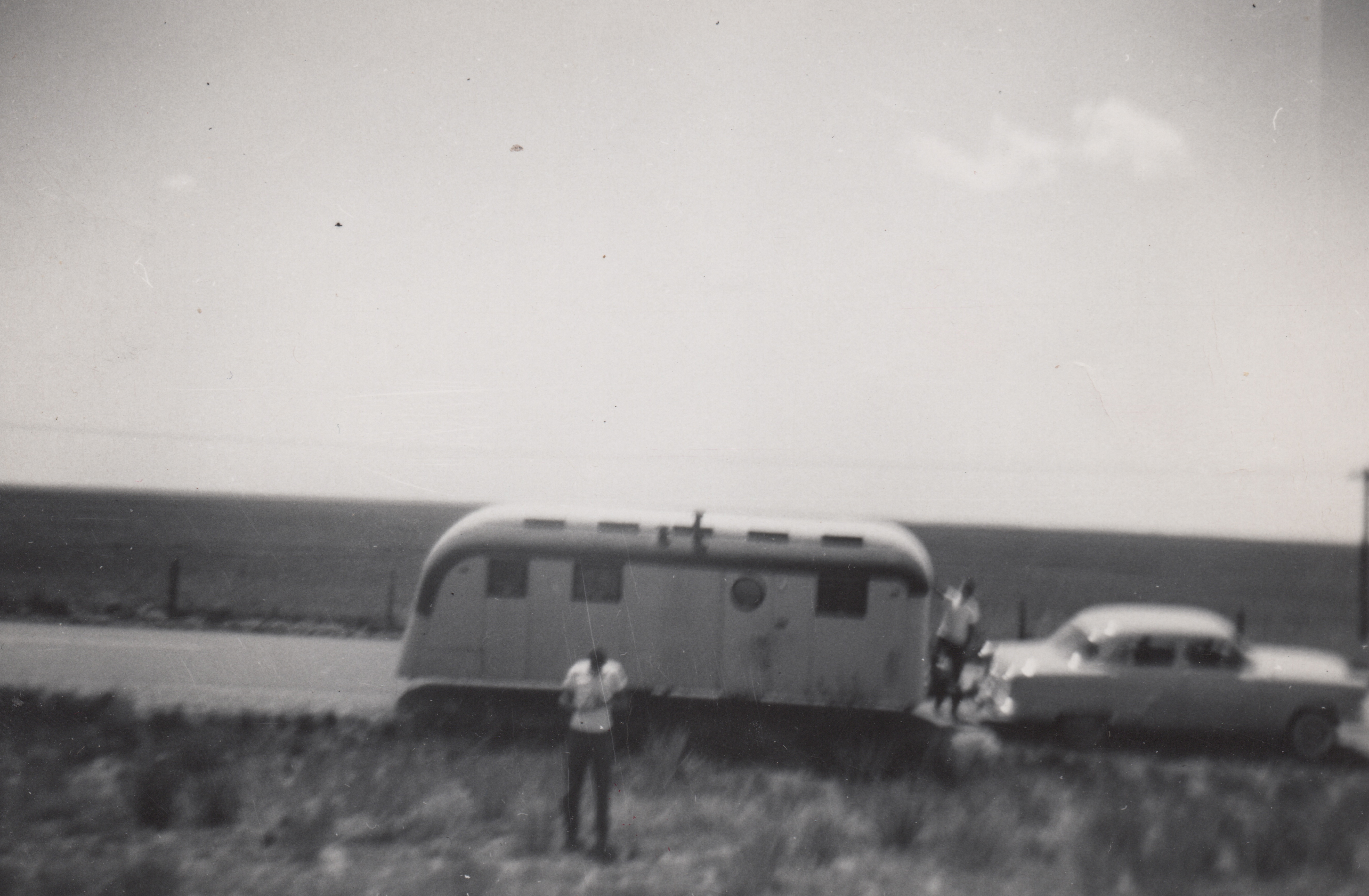
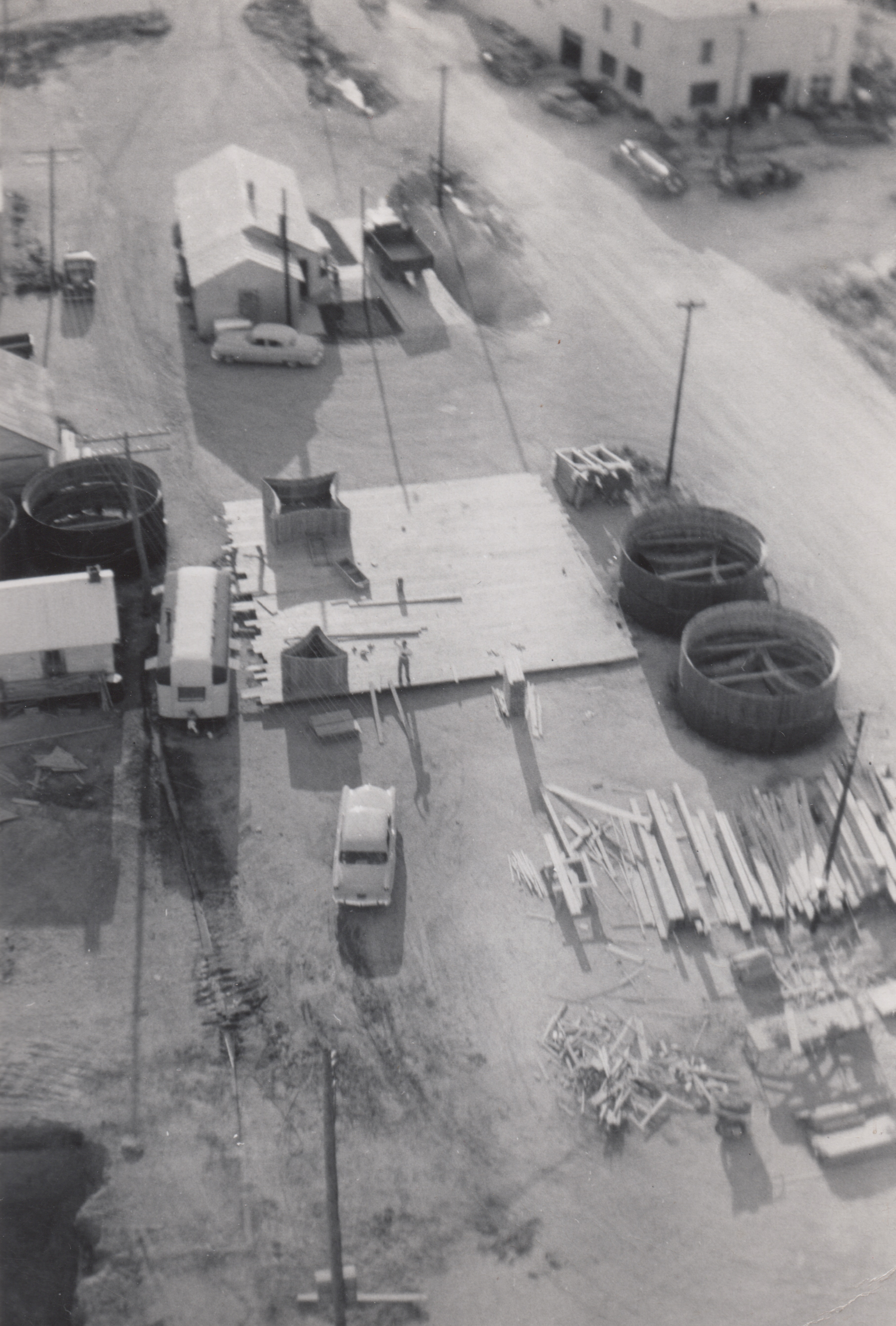
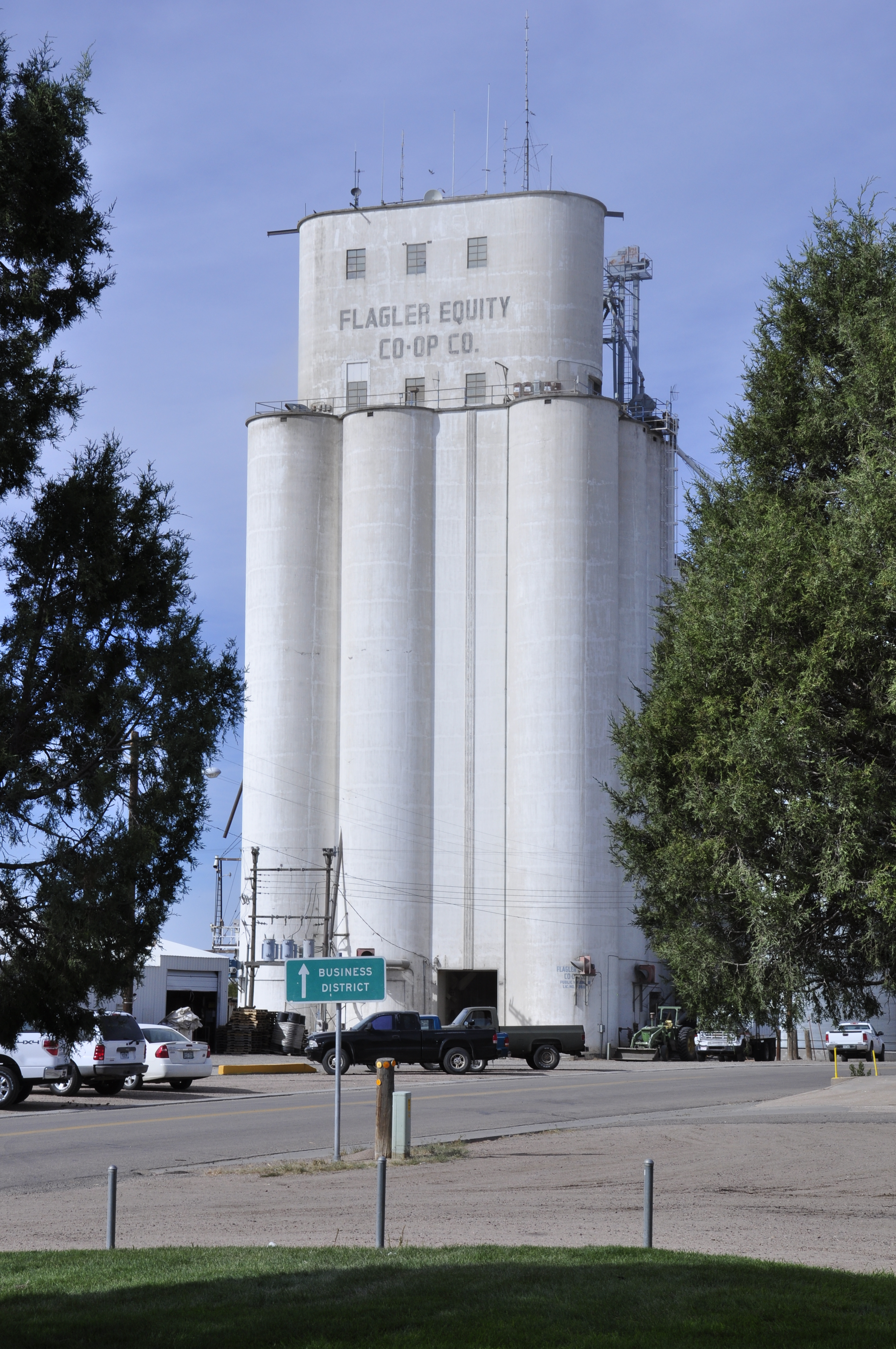
The beginning of Tillotson Construction's job in Flagler, Colo.

The beginning of Tillotson Construction’s job in Flagler, Colo.

Typically, rather than have the wrecking crew go through the process of crawling or being lifted back up through the manholes and then go in reverse to gain access to the platform again, the workmen just brought their lunches down to the platform and ate them there.

As we sat on the planking in this semi-dark and dank grain tank, eating our lunches and telling war stories, I heard a plunking noise that sounded like someone had dropped a rock onto the scaffold. It seemed to come from the corner behind me. I didn’t pay much attention and soon rejoined the important conversation taking place.

About five minutes later, I noticed another similar sound and asked the other two workmen if they had heard it, too. Neither of them had. They went back to talking. But within minutes another “rock” hit the scaffold and simultaneously one corner tilted down.

A precarious situation soon becomes a mortal threat

We suddenly realized the nut fasteners of the cable clamps–which were U-shaped and bolted around the main cable drop and the end of the cable loop–had somehow unwound. (Two cable clamps were used per loop, each clamp having two fastener nuts turned sufficiently tight to form a bond on the loop.)

So only one nut remained on the cable clamp to hold the loop and that corner of the scaffold.

To save ourselves from this sinking ship, we quickly helped one another by doing a foot-up maneuver, with the first man out through the manhole above. Once he crawled to safety on the deck, he reached down for the next one and yanked him through.

I had been sitting the furthest away from the manhole, so I was the last man out.

Again, as with my previously described narrow escape (see the link below), God was watching after me.

Just as I punched through to safety on the roof, I heard the cable loop fail and the scaffolding crash into the tank’s deep dark recesses.

Why worker safety was a secondary consideration

In those days, there were many similar incidents that occurred during the construction process.

Contributing to the lack of safety precautions was the use of unskilled labor. Most of it came from the surrounding farm community, and these men had no background in construction.

Lives were lost, and assumptions were made that this would occur, as the ultimate goal was building grain storage as quickly as possible. Safeguarding life and limb took a secondary position to that effort.