Van Ness completes a 30,000-bushel elevator in Cedar Bluffs, Nebr. and the party is on

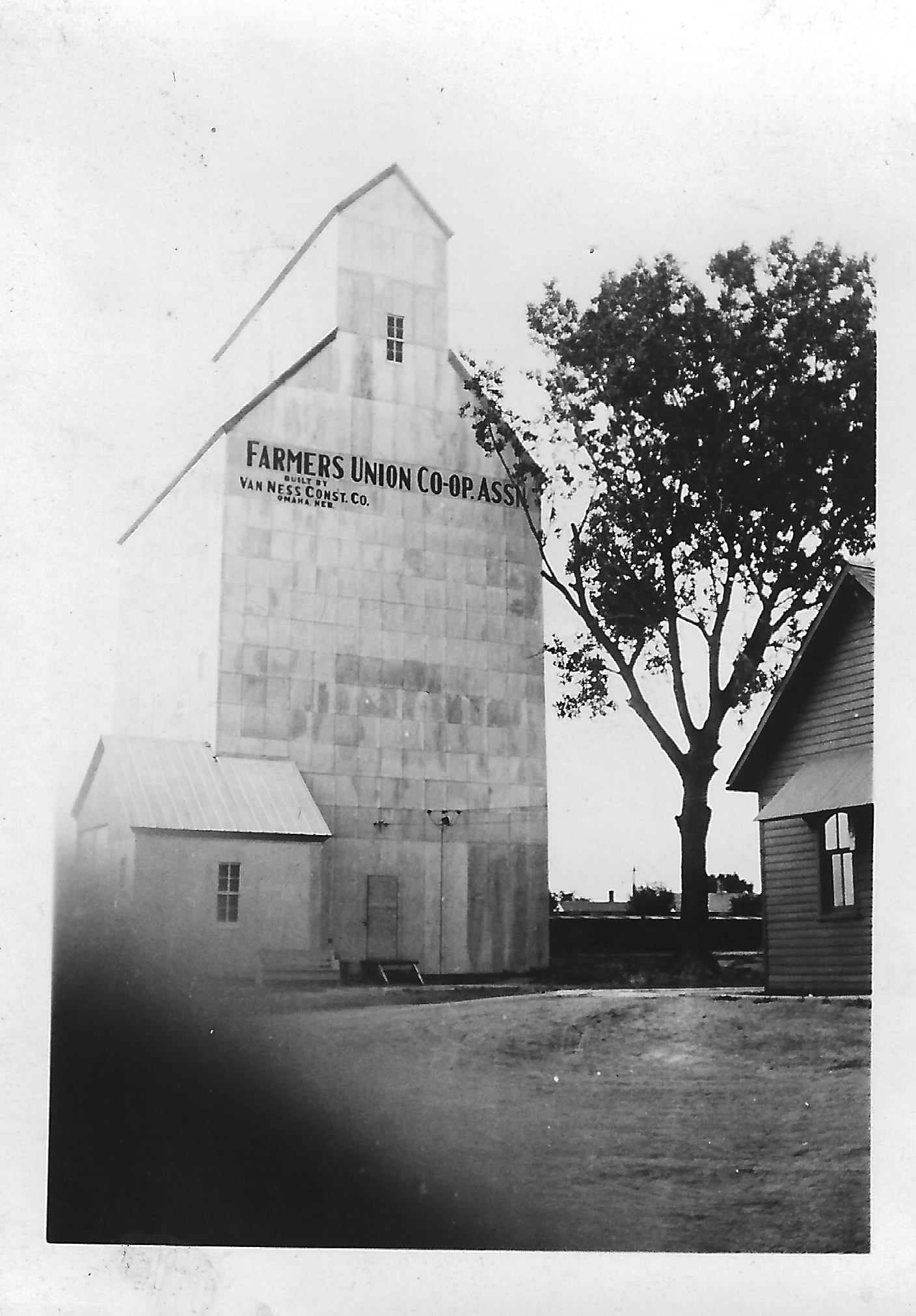
A lovely Monday in early May of 1934 proved perfect for festivities that attended dedication of the new Farmers Union elevator in Cedar Bend, Nebr. 

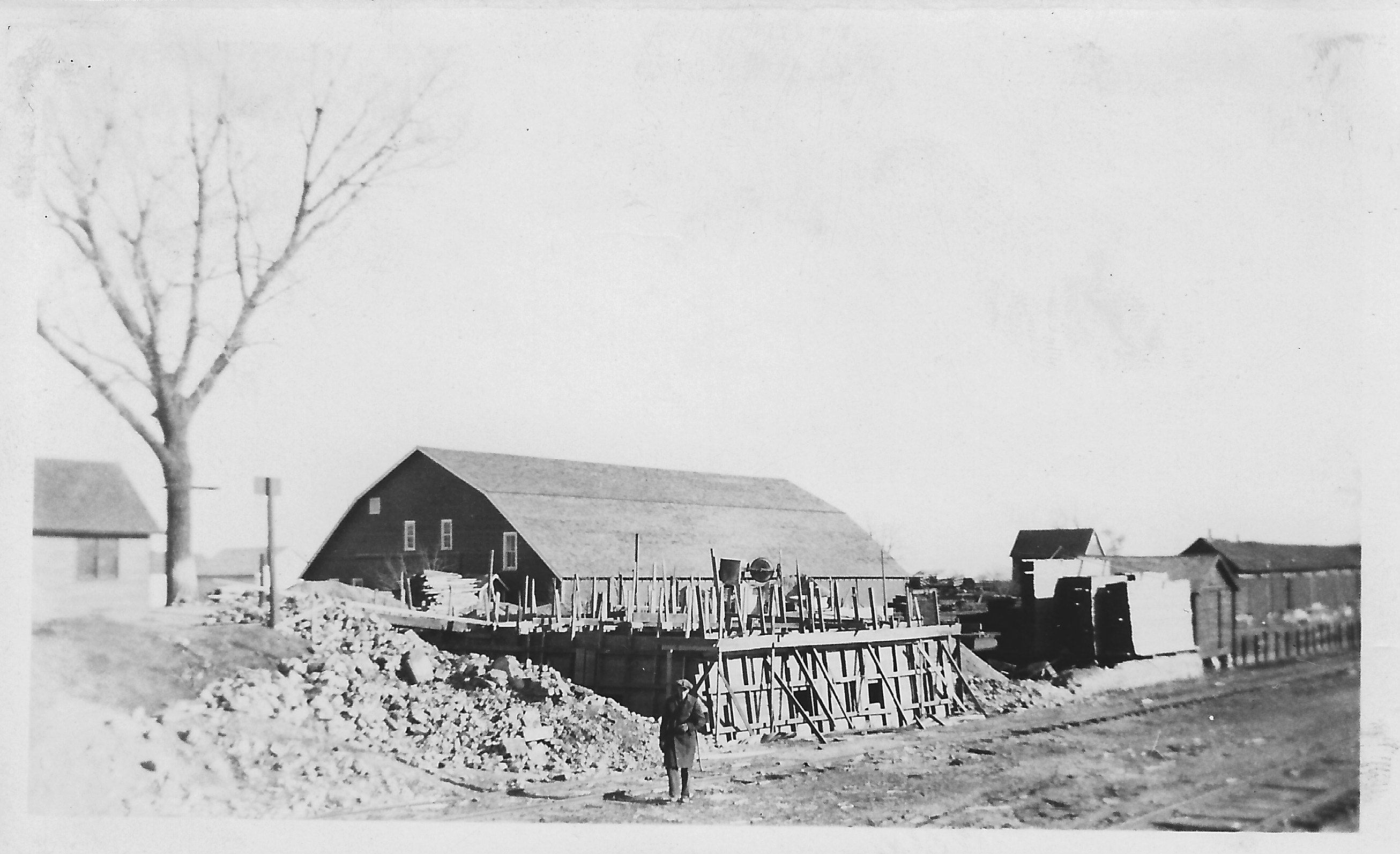
After deciding in January to tear down its 48-year-old elevator and rebuild, the Farmers Union Co-Operative Association awarded the job to Van Ness Construction Co., of Omaha. A new 30,000-bushel elevator soon rose on the same site as the demolished elevator in Cedar Bluffs, a progressive Saunders County village. Photos by Reginald Tillotson, who worked for Van Ness along with his father Charles H. Tillotson, show the job starting in early spring before the trees budded out.

A news report explains how the dedication attracted an “immense” crowd and sparked a festival-like atmosphere on that pleasant occasion. Events started at 12.00 noon with free ice cream, cake, and coffee for more than 600 registrants. 

“There was plenty to eat for everybody,” the New Cedar Bluffs Standard reported. 
After dinner, races and contests were held for boys and girls, providing entertainment for the crowd and fun for the youngsters. Cash prizes were given out. The Midland College band traveled from nearby Fremont to play for everybody.

Mayor J. P. Jessen took the platform, welcomed folks, and introduced lots of dignitaries. H.D. Black received special recognition as manager of the elevator, and Alex McAuley—a 17-year veteran of the company—was assistant manager. 

Next came the parade. A line of automobiles carried the officers and directors of the elevator association. A former employee of Farmers Union weighed in with the ceremonial first load of wheat to be received and stored away in the new house.
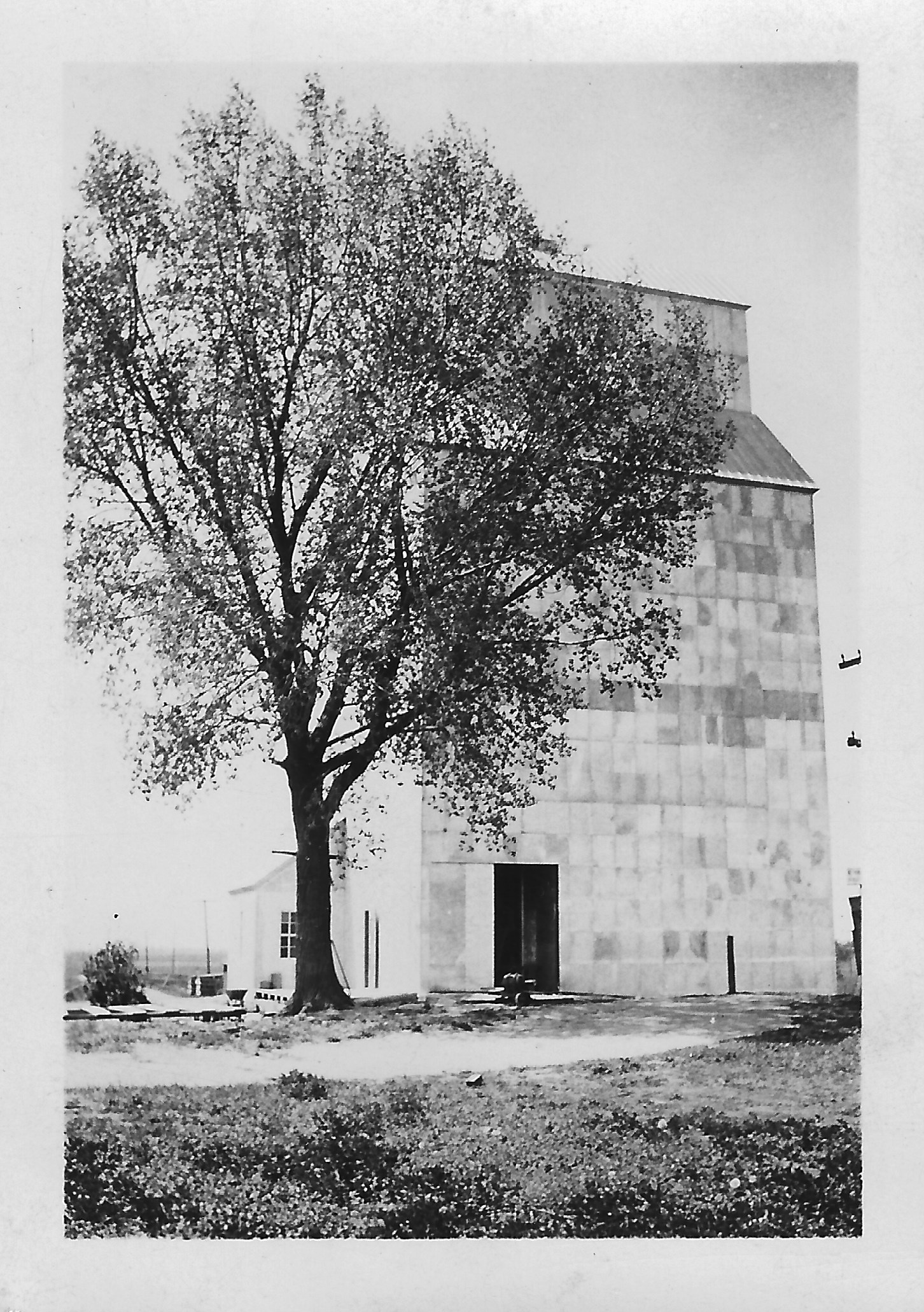
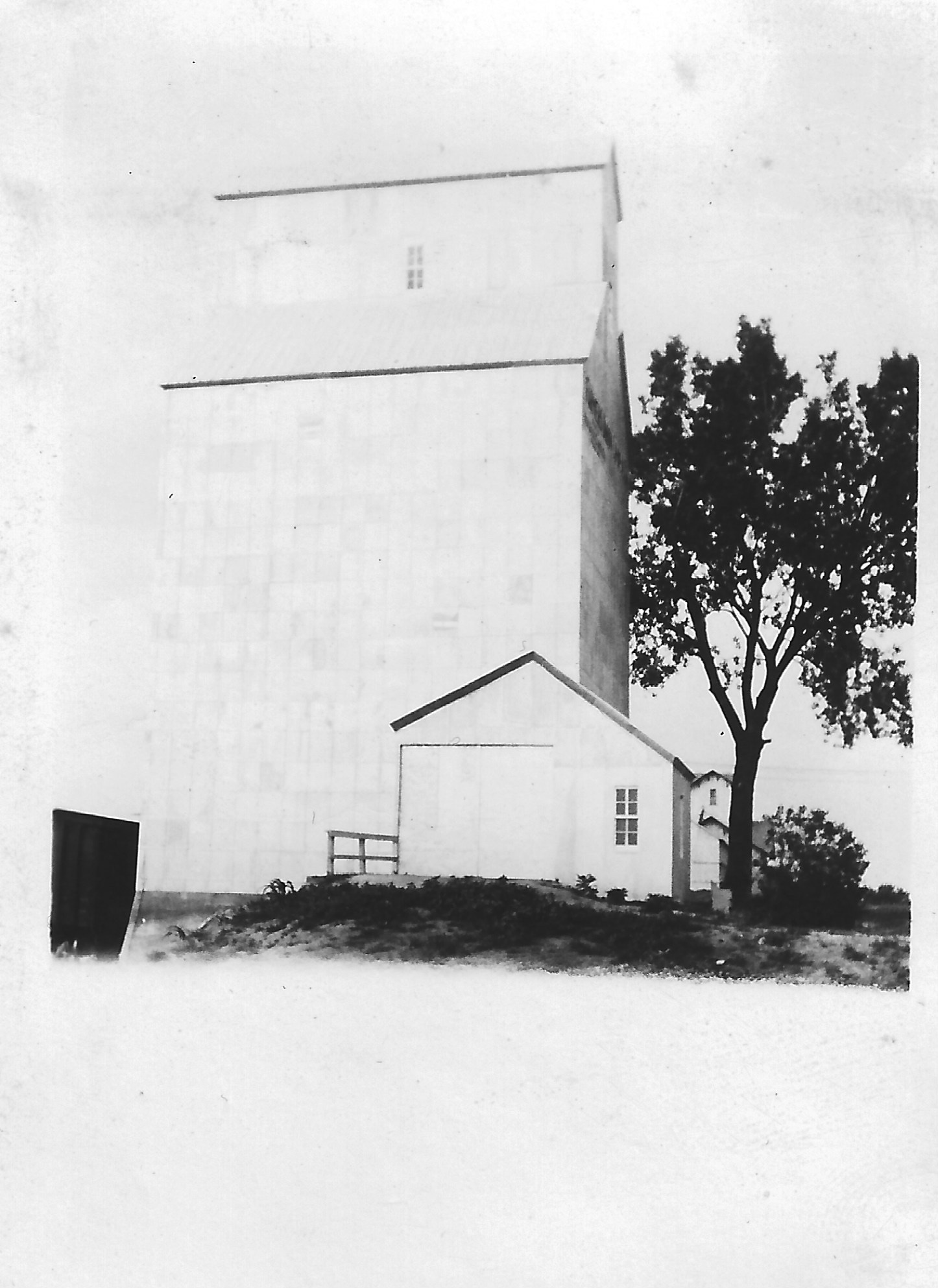
The entertainment continued as a quartet took the stage and sang old favorites. Following their numbers, a solo vocalist performed with piano accompaniment.

Other cash prizes were awarded, this time to L.A. Freeman, the association stockholder who had the largest family present. The jackpot for longest distance traveled went to Jim Broz, who made the journey from Prague, a town 16.5 miles away by road. 
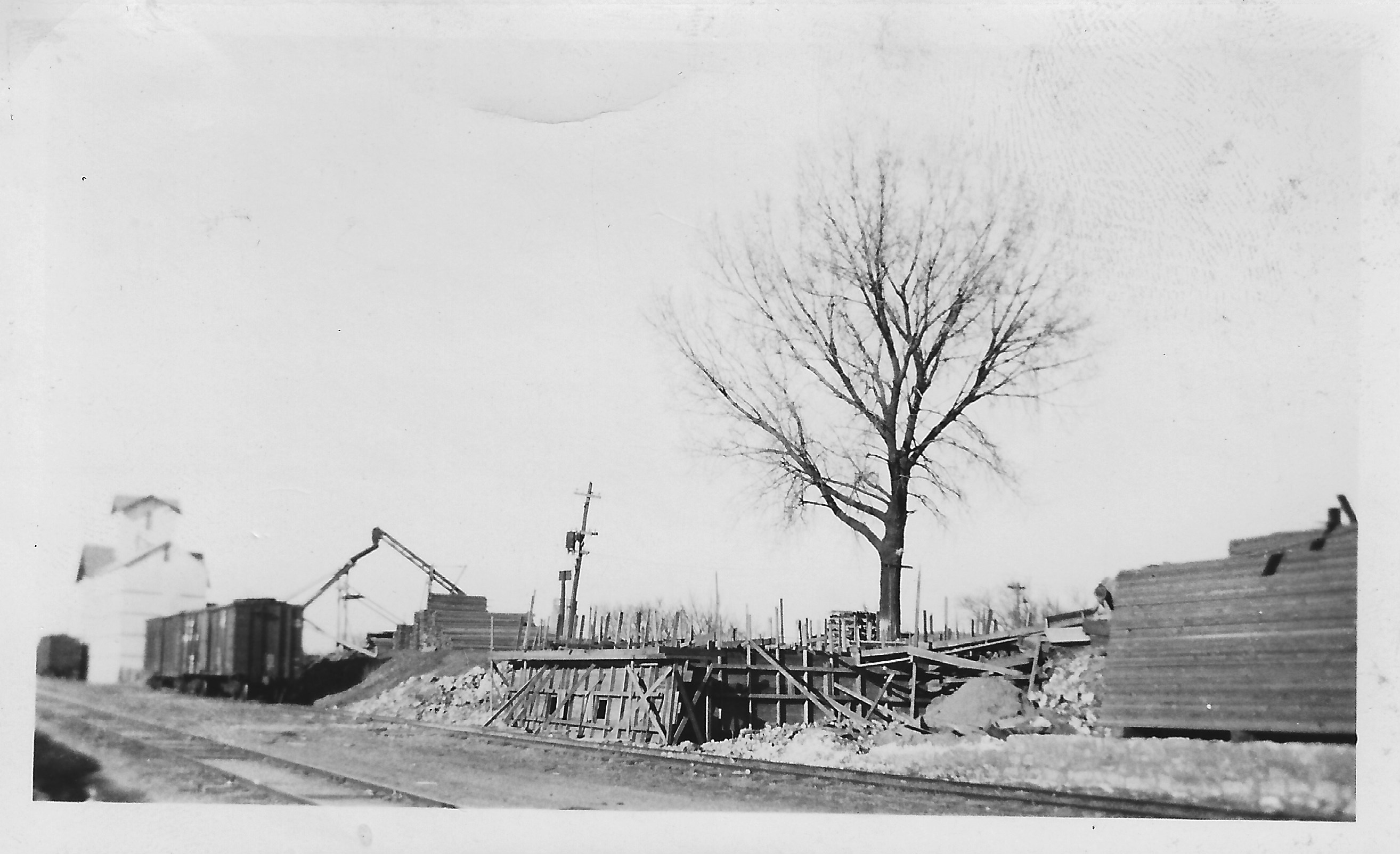
Speechifying was courtesy of Newton Gaines, of the University of Nebraska Extension service, who “as usual did a mighty fine job of it. He is an interesting and entertaining speaker.” Gaines himself was Midland College graduate devoted to the gospel of better farming and spread it with humor and philosophy in thousands of speeches.

The Cedar Bluffs day of parties ended with a free, well-attended dance at the opera house, and the next day was back to normal with the new elevator in service. The dedication day was long-remembered by the people. Even now we take away the message of an elevator’s importance within its community. Sometimes in daily life, the people came and went without even noticing it, but in fact it was the thing that held the community together.
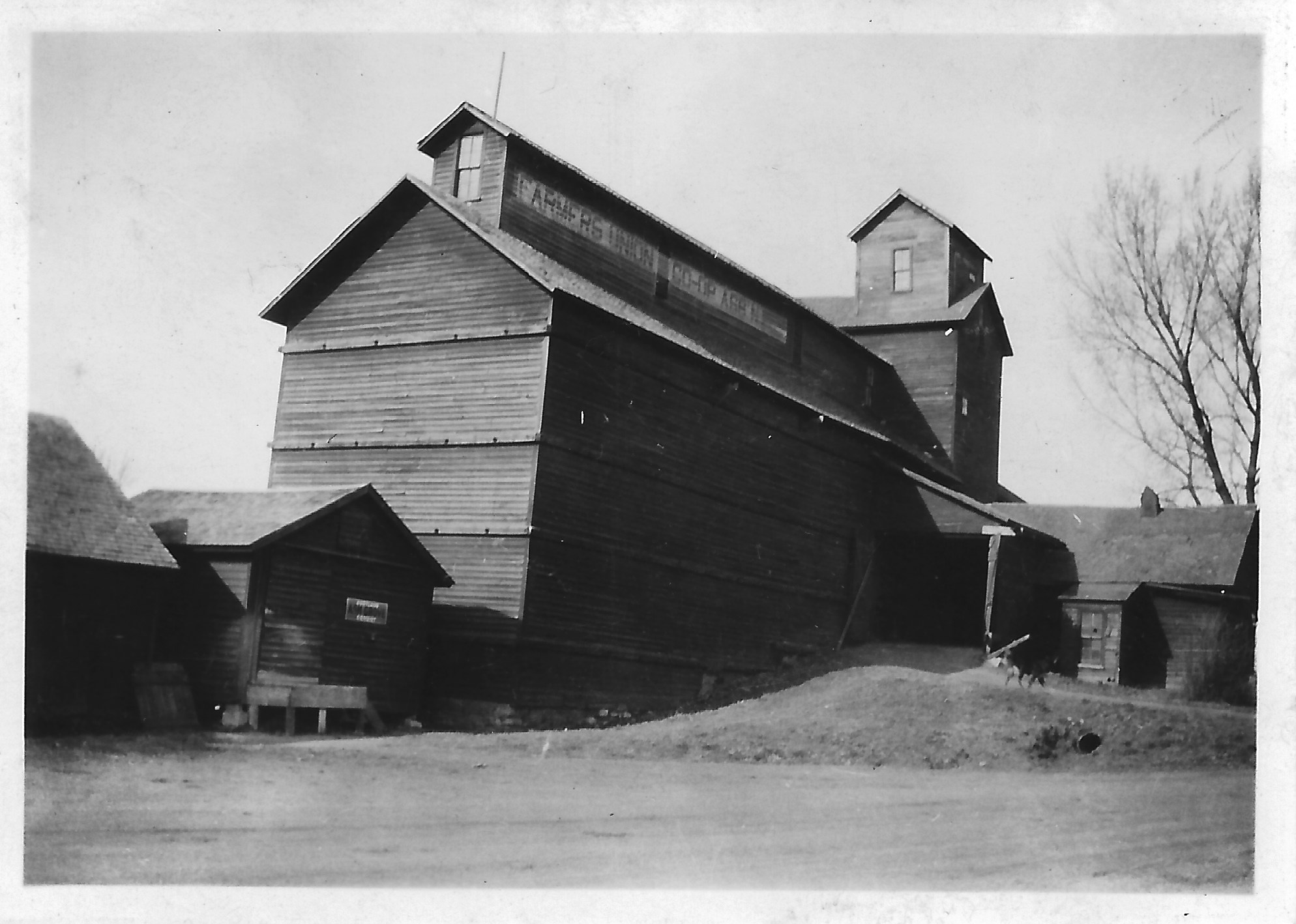
Farmers Union decides to demolish and rebuild in 1934 at Cedar Bluffs, Nebr.

It was January of 1934, still the depths of the Great Depression, but optimism led the stockholders of Farmers Union Co-Operative Association, of Cedar Bluffs, Nebr., to decide the time had come to tear down and replace their old elevator. 

Organized in 1888, Farmers Union claimed to be “the oldest cooperative elevator in the United States,” according to the New Cedar Bluffs Standard weekly newspaper. There were 200 stockholders with capital stock in the total of $50,000. 

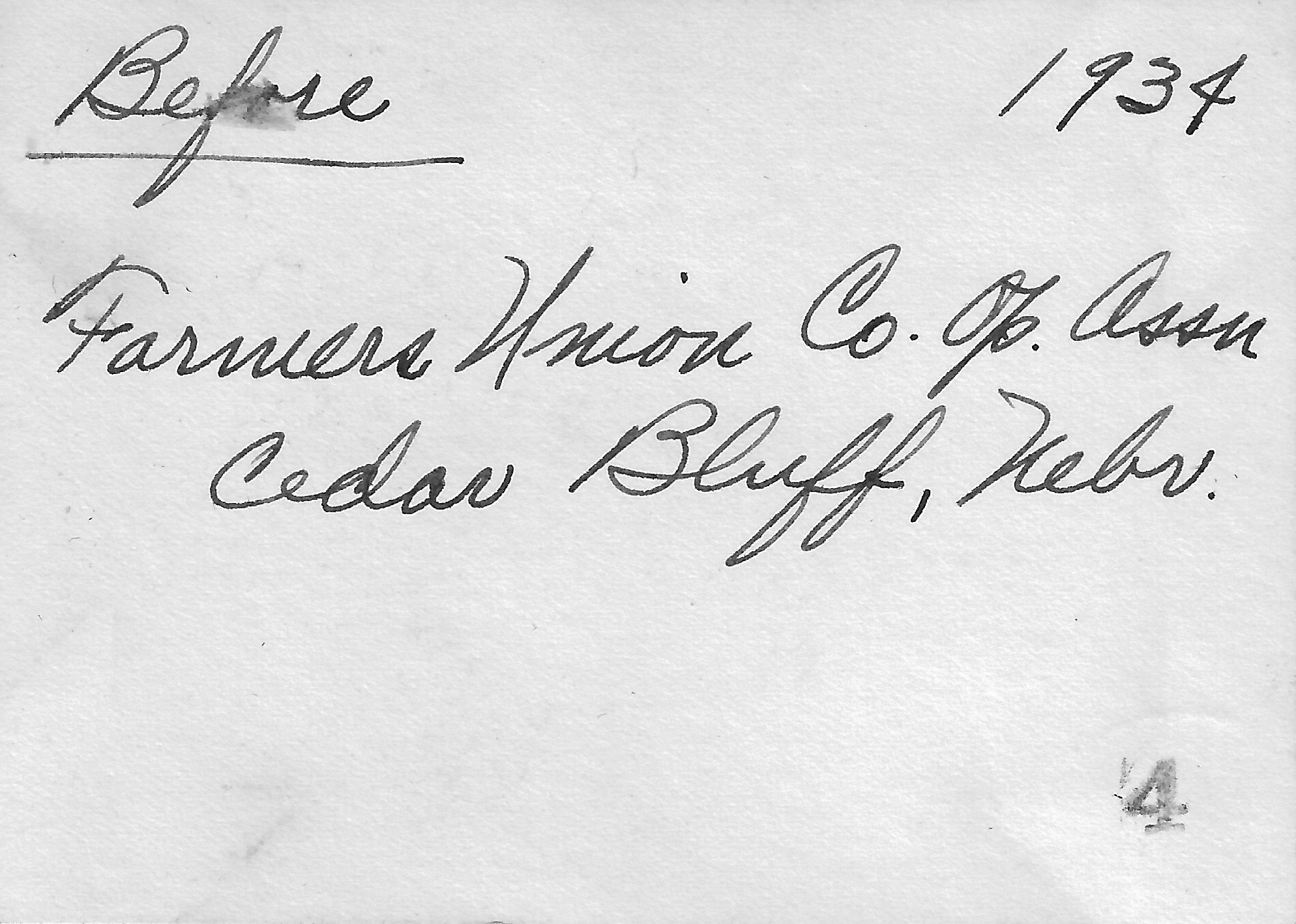
Reginald Tillotson’s neat script on the back of his photo.

At the same annual meeting, the Association announced payout of stock dividends at eight percent and patronage dividends of one percent. The newspaper remarked that “considering the times [it’s] a mighty fine showing.” 

The old elevator was to be dismantled, with as much material as possible being salvaged for re-use. The new elevator would be steel-covered. The initial report stated capacity at 80,000 bushels, which is a lot for a cribbed wooden elevator. A subsequent report put it at 30,000 bushels—a more realistic figure. 

The photo above shows the weathered main house with its peaked headhouse, and a storage annex with the upper structure enclosing the run being labeled Farmers Union Co-Op Assn. The shed on the left bears a sign saying Ash Grove Portland Cement.

A selling point on the rebuild was the prospect of local help getting employment in the construction. 

Van Ness Construction won the job, as will be seen in a follow-up post. Tillotson Construction, which evolved from Van Ness, returned to Cedar Bluffs in 1950 to build a 130,000-bushel reinforced-concrete elevator, which we visited in 2020.

First look at archive of 1930s photos shows back-to-business after wooden elevator repair in North Dakota

The Tillotson homestead north of Omaha was sold in 2025, and as a consequence Our Grandfathers’ Grain Elevators has received a few leaves from a photo album with snapshots of 1930s jobs. Together, these pictures comprise the earliest documentation we’ve ever seen of Van Ness Construction and Tillotson activities. 

After the sudden passing of Charles H. Tillotson in 1938, his sons Reginald and Joseph built Tillotson Construction Company’s first concrete elevator, located in Goltry, Oklahoma. Prior to that, they worked for Ralston Van Ness out of Omaha. The photos we received appear to show jobs done for that company earlier in the 1930s. 

Most of the photos are inscribed on the back with a name, location, and date. 

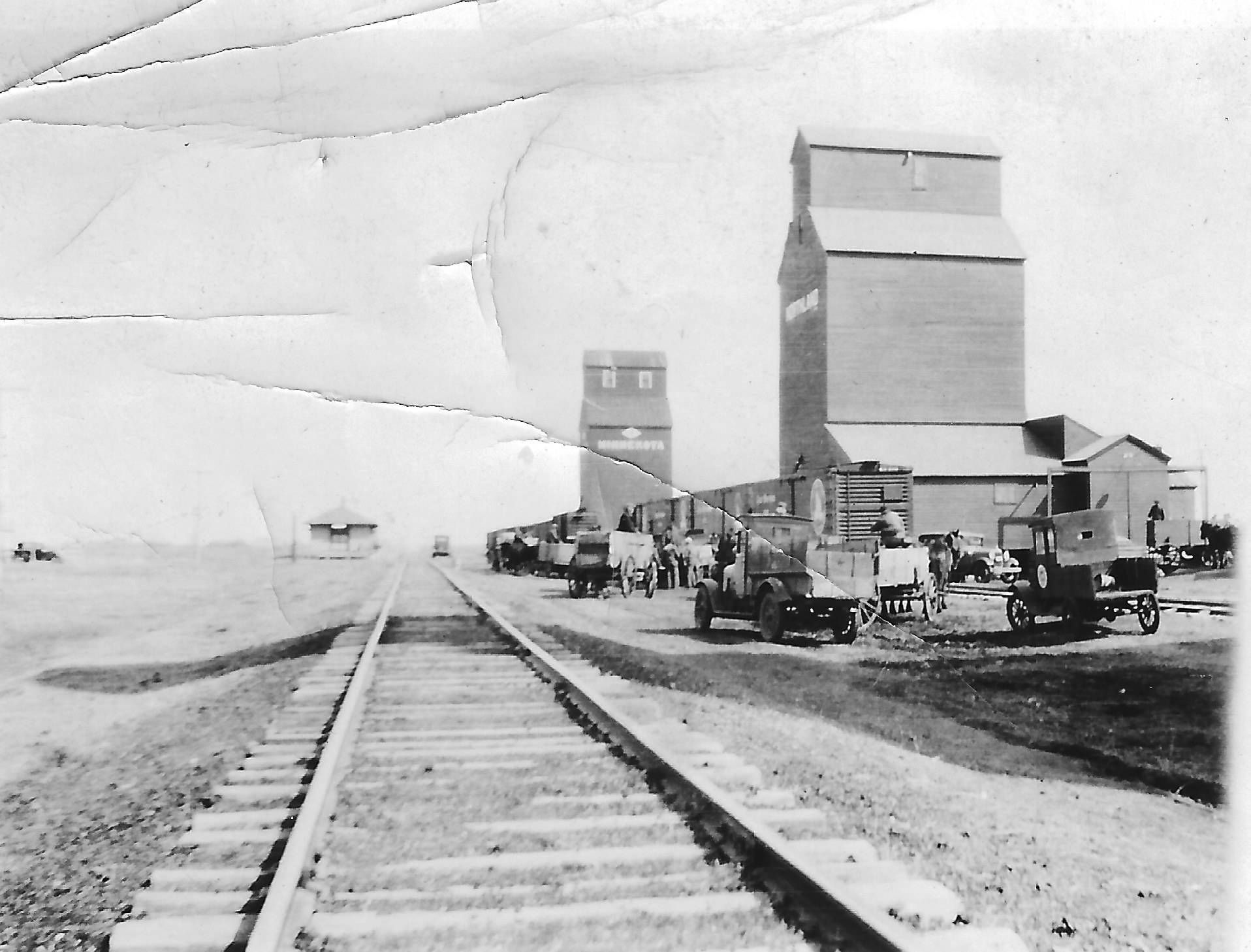
The above photo depicts a 1933 scene at a twin-elevator complex in Norma, North Dakota. Norma is a dot on the map in Renville County northwest of Minot and twenty or so miles south of the Canadian province of Saskatchewan. A note on the album page says “Rebuilt Fire Loss 1933.” 

Searching through a newspaper archive turns up no more details, so we can only look at the image and suppose the relief felt by local farmers who had limited options for grain disposition. Especially at a country location like this, a damaged elevator was an unhappy circumstance that would have required hauling grain over an extended distance. 

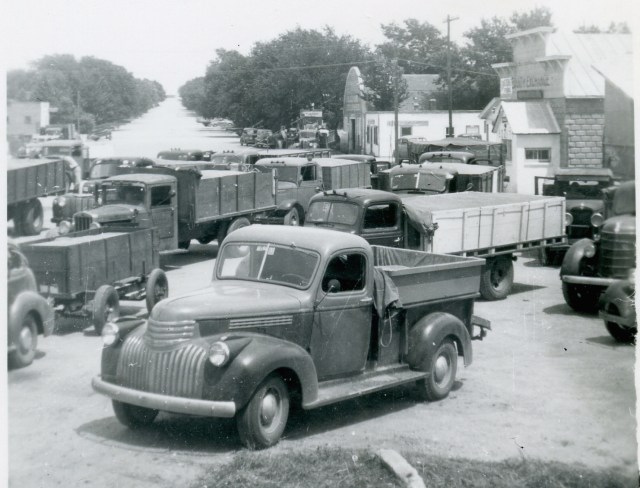
On a sunny day at Norma, a few motor vehicles converge at the complex with at least four horse-drawn farm wagons. It’s illuminating to see wagons still in use at that time. Their limitations surely gave farmers a sense of urgency about acquiring a motor truck.

An old pickup with wooden artillery-style wheels in the right foreground was likely a Ford. It has an emblem on the driver’s door, but we can’t determine anything more about it. 

Under close examination of the photo, the elevator tower in the distance appears to be labeled “Minnekota.” The sign on the near tower can’t be read at all. 

A number of men are going about their business, whether they’re still seated on wagon perches, standing inside a wagon, or on the ground. In the mix of trucks and cars, note the silhouette of an automobile way down the sidetrack.

Several boxcars await service. Norma is on a secondary road leading south from North Dakota Route 5, and it seems likely the rail line was a spur. This could have been part of Soo Line operations. 

We lack additional information about the event that led to the reconstruction. Newspaper pages often had stories of grain elevator fires in 1932 and 1933, with casualties in Chicago at a 200,000-bushel elevator on the river there, and with lesser tolls at smaller elevators in prairie locations. 

The Bismark Tribume reported on Aug. 24, 1933 that a 20,000-bushel Minnekota Grain Co. elevator had burned at Butte, North Dakota, to the southeast of Minot. It also claimed a 14,000-bushel carload of wheat. Butte was left with three elevators after the disaster.

We invite our readers to stay with us as we post the rest of the thirty photos in the newly obtained archive.

Tillotson family’s 1930s Omaha home at 624 N. 41 St is revealed

By Charles J. Tillotson

“My oh my! The old house is still standing after all these years, which is at least 89 years.

“This is my Grandpa and Grandma’s (Charles H. and Rose A. Brennan Tillotson’s) home and where Dad and Mom (Reginald O. and Margaret I. Tillotson) lived intermittently for three years after they got married.

“I was born in 1935 in Creighton [University]’s St. Joseph Hospital and lived here for my first three years when Dad wasn’t on a construction site too far to come home. Dad built a small house-trailer so that he could take Mom and his kids along with him when going away. 

“When Dad finally decided to settle down three years later [after the death of Charles J. and formation of Tillotson Construction Co. with brother Joe], he bought a house with a fruit orchard located on the northern outskirts of Omaha. 

“I have a bunch of photos of the house while I was standing in front of it with my winter togs on, and of course it was painted white at that time.” 

Uncle Chuck affixes a generator to his memory, and Van Ness Construction comes alive

001

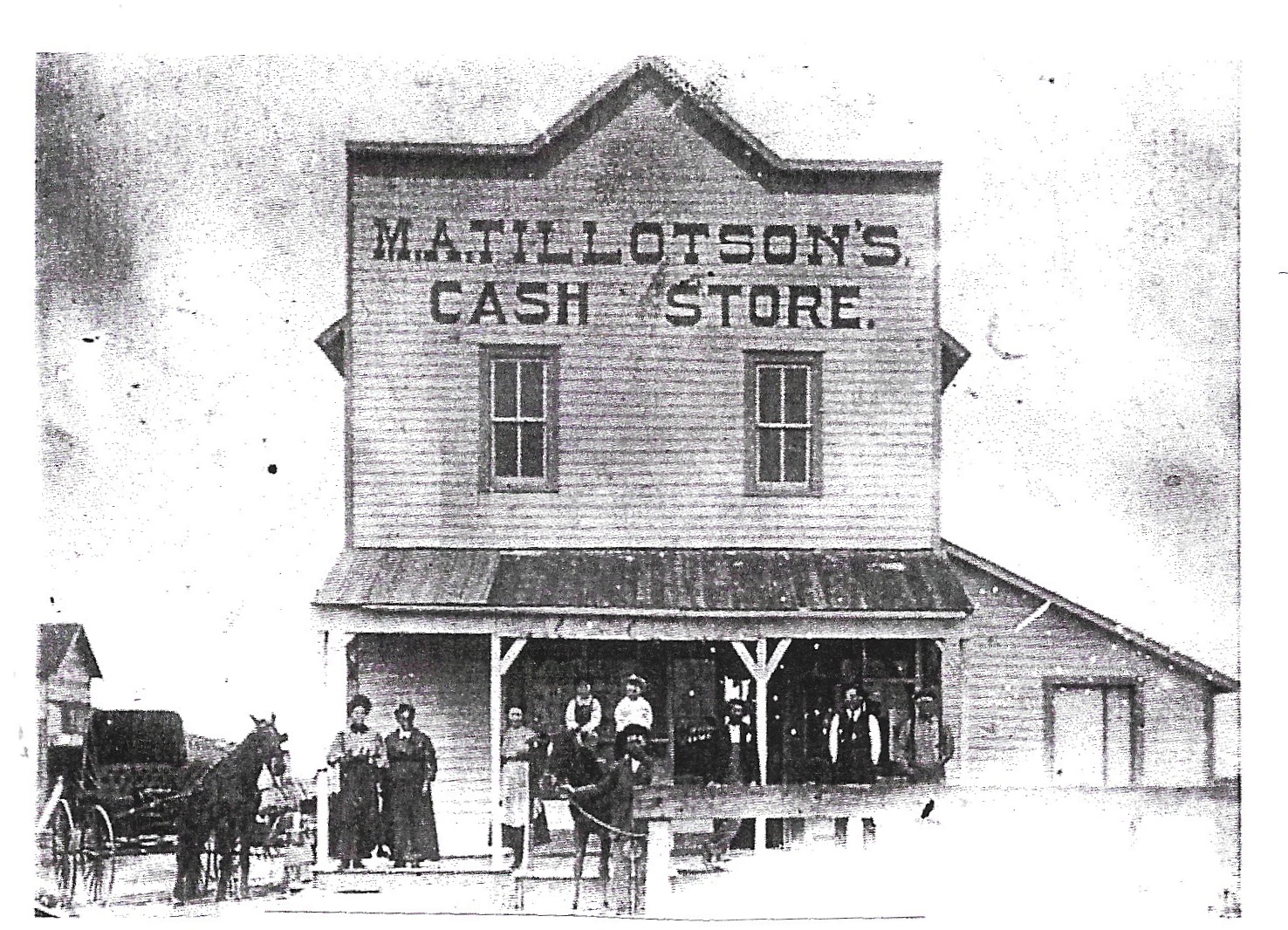
Great-grandma Margaret’s general store, Shields, Kan., 1910. Margaret A. Tillotson was Grandpa Charles’s mother. I don’t know why Mother (Margaret Irene) thought it was my Great Aunt Mary’s store. Maggie was a nickname for Margaret, and my Dad would call Mom “Maggie” every once in a while to tease her because he knew she didn’t like it.

By Charles J. Tillotson

I forgot to add in my comments [on company origins] what little I know about Grandpa Charles’s experience with Van Ness Construction.
I’m really stretching the memory, and I have to start with Grandpa Charles’s father:
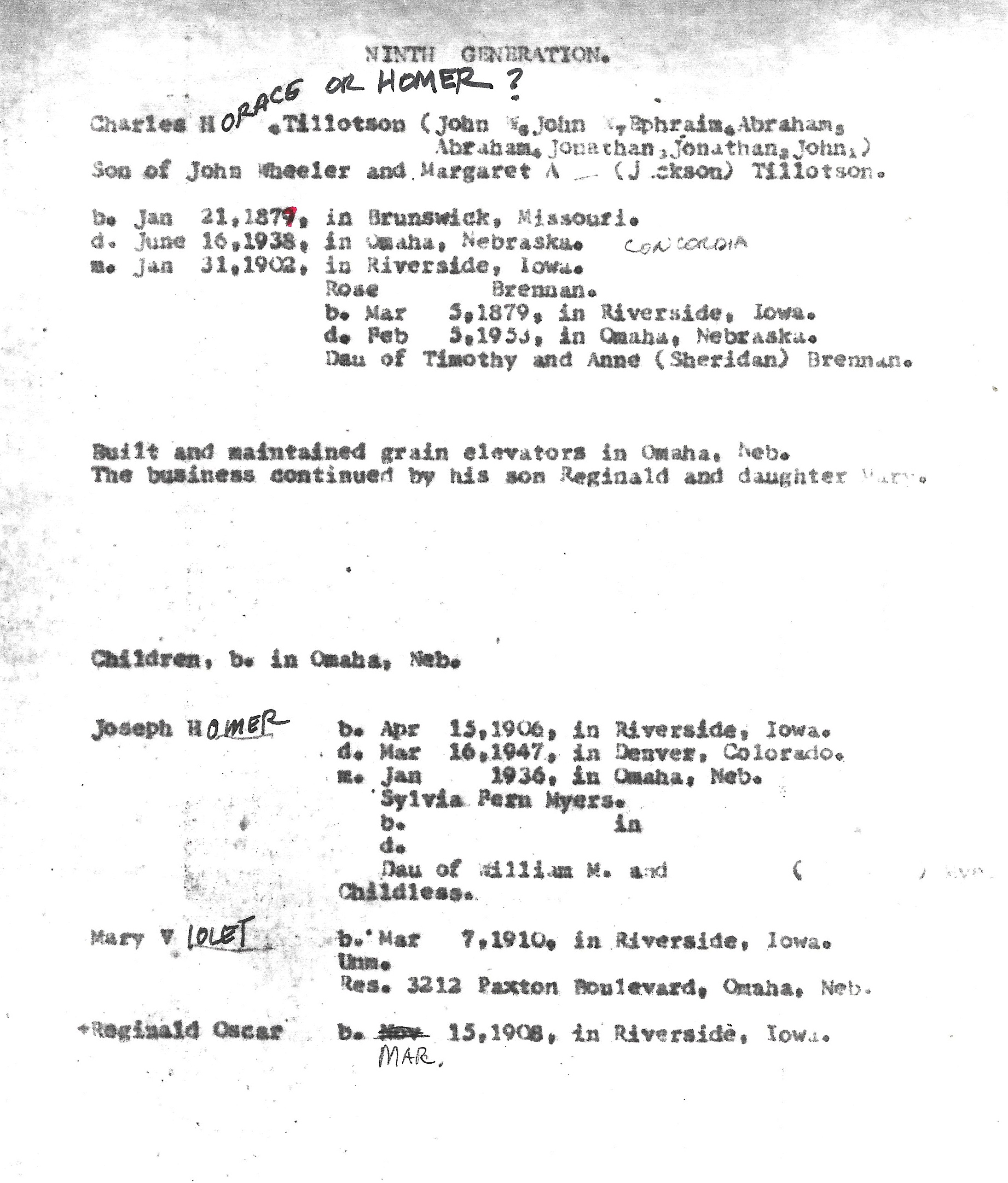
Charles H. Tillotson was the son of John Wheeler and Margaret A. (Jackson) Tillotson.
John and Margaret to my knowledge had at least six children: Raymond, Charles (grandpa), Bertha, Mary Alice (known as Lovie), Walter, and May.
  1. Raymond took over the homestead.
  2. Charles worked as a carpenter.
  3. Bertha married a telegraph operator.
  4. Mary Alice (Lovie) married Ralston Van Ness, elevator builder.
  5. Walter worked as a landscaper.
  6. May married Zomer Dryden and lived on a farm in Ohio.
My mother used to call Mary Alice, Aunt Lovie, so that is how I remember her. Aunt Lovie married Ralston Van Ness (he was 26 years old) in 1902 in Shields, Kan., where he operated his wooden grain elevator construction business. However, within a year’s time, they had relocated to Omaha where their daughter Mary was born. The couple also had twin daughters who died at birth in 1906 and a son, Ralston, who also died at birth in 1908.
By 1930, Ralston and Mary had built up quite a reputation for the construction of wooden grain elevators, and it was about then that Grandpa Charles went to work for them. I know for sure that Dad also went to work for Ralston as a laborer. (I don’t know about Uncle Joe). I have no exact date for when Ralston passed away, but I think it was around 1935 when I was born. Around 1935 Ralston died and left Aunt Lovie with the business.
003
Very interesting that, on my birth certificate from 1935, Dad is listed as a laborer employed by Van Ness Construction, and he had been employed in this work for a period of three years. Dad was listed as 26 years of age and Mom at 31. Place of residence for them (and me) is listed as 624 N. 41 St., Omaha, Neb. That is where Grandpa Charles and Grandma Rose lived and where Dad and Mom bunked up when they were not on a construction job using Dad’s trailer as home.
From what I can determine, Aunt Lovie wanted to continue in the building business, but she wanted to build homes for the growing Omaha community. So Grandpa and Dad gradually finished up the Van Ness contracts and in 1938 decided to form their own company.
Aunt Lovie eventually moved out to California where she built homes in Mill Valley and San Rafael. Although Mom and Dad fell out of contact with her, after my discharge from the Army, in 1957, I  managed to track her down and had a nice visit over the phone. She was in her early 70s by then and wanted to retire. Her daughter, Mary, stayed in Omaha, married Guy Stribling, and they had three children, the youngest was born in 1940. I don’t know if the offspring are still living.
Van Ness Construction Co. built wood grain elevators. Their field of influence was centered in Nebraska, Iowa, Kansas, Oklahoma, and a portion of Texas.

Formation of Tillotson Construction Co. pinned down thanks to news clipping

By Ronald Ahrens

We knew Tillotson Construction Co. was formed in 1938 after the death of my great-grandfather, Charles F. Tillotson. Family records show that he died in June of 1938 in New CorpsConcordia, Kan.

Sons Joseph H. Tillotson and Reginald O. Tillotson decided the future lay in reinforced-concrete elevators.

While they may have continued construction and repair of wooden elevators, the company’s construction record shows the first concrete elevator went up at Goltry, Okla., in 1939.

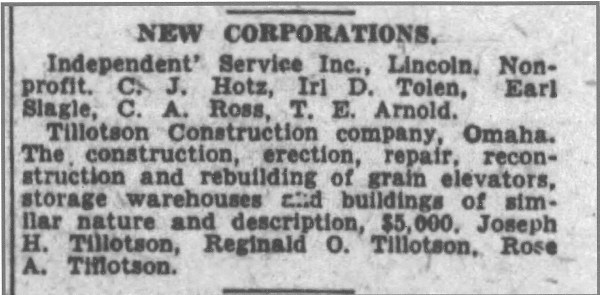
A notice of “New Corporations” in the Sep. 9, 1938 edition of the Lincoln Journal Star announces:

“Tillotson Construction company (sic), Omaha. The construction, erection, repair, reconstruction and rebuilding of grain elevators, storage warehouses and buildings of similar nature and description, $5,000. Joseph H. Tillotson, Reginald O. Tillotson, Rose A. Tillotson.”

Born in the late 1880s as Rose Brennan, Rose A. Tillotson, was the surviving widow of Charles and mother of Reginald and Joe. She died in the 1950s. 

These details help us to construct a timetable while also showing the Tillotson brothers took bold steps to embrace new techniques and processes, moving the family enterprise forward.

Thank you to blog follower Suzassippi for passing along this clipping.

An old letter reveals some details about the Tillotsons’ early days in wooden elevators

Charles H. Tillotson

By Ronald Ahrens

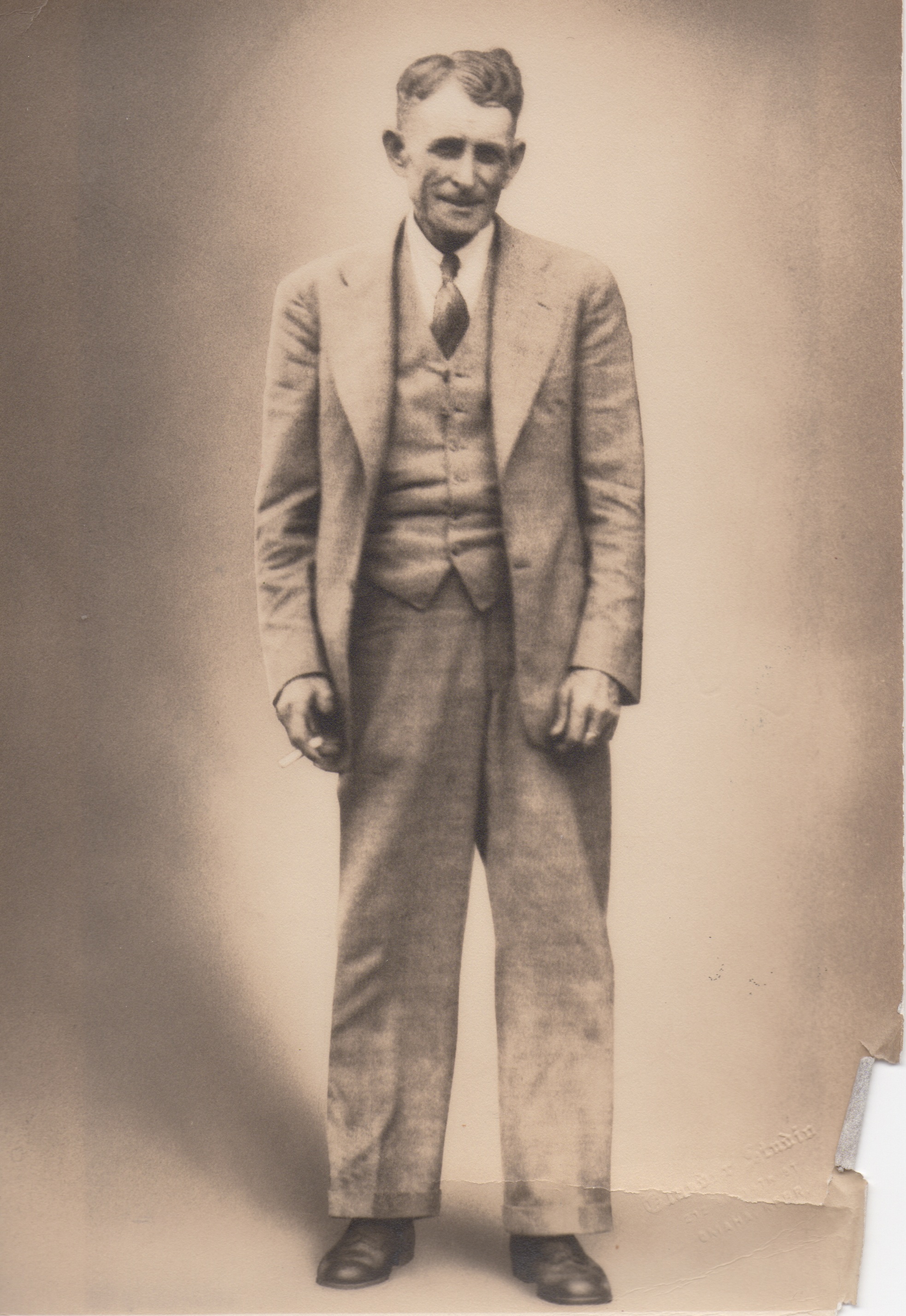
A letter from my grandmother Margaret Irene McDunn Tillotson reveals some details about the early nomadic life of my grandfather Reginald Oscar Tillotson. As we have documented in this blog, Charles H. Tillotson (seen in the photo above), who was Reginald’s father, built wooden elevators.

When Charles H. died in 1938, Reginald and his brother Joe took the helm of the family’s construction company and learned how to build elevators by slip-forming concrete. That positioned Tillotson Construction Company to advance as the new method served to meet demand for greater storage capacity at rural cooperatives.

My grandmother’s missive of Oct. 6, 1978 gives a few details of those early days.

Charles_Tillotson_Obit__The_Nebraska_State_Journal__Lincoln__Nebr___19_June_1938“When they moved from place to place with the construction company they had many funny places for a home. Your grandfather moved ten times one school term. They built cribbed elevators during those days. This was made by placing a two by four on a two by four to build the walls for the outside and to make the bins. The fields of corn and grain were used by the farmers so they had no great need for storage or grain elevators. So many jobs were to add on to bins or repair them. This made small jobs and many changes in places to live.
“One time they lived in a school house. Many times when it was a small job they lived in the elevator office. During the cold weather they got to live in parts of others’ homes and tried not to have to move. Construction those days was almost nil during the cold weather. They wished many times they were farmers when they had big snow storms.

“After his grade school days they settled in Omaha. Reginald worked in stores. His recreation was sports which I mention (tennis, baseball, football).”

A postcard reveals Tillotson elevator activity before the big changes of 1938

Post Card 01

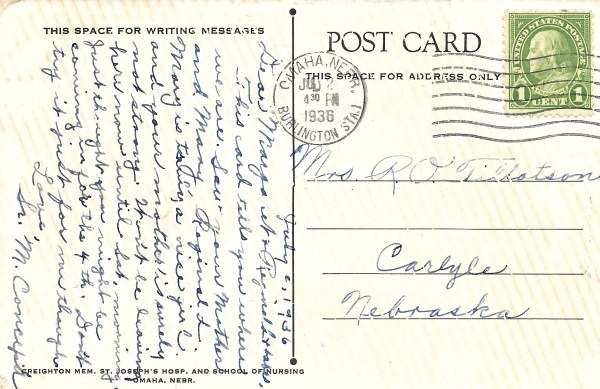
We have found what may be a rare record of the Tillotson construction enterprise as it existed before 1938. Back then, Charles H. Tillotson led the company, which specialized in wooden elevators. After he died in ’38, his sons Reginald and Joe partnered in Tillotson Construction Co., and started to experiment, and then build, with reinforced concrete.

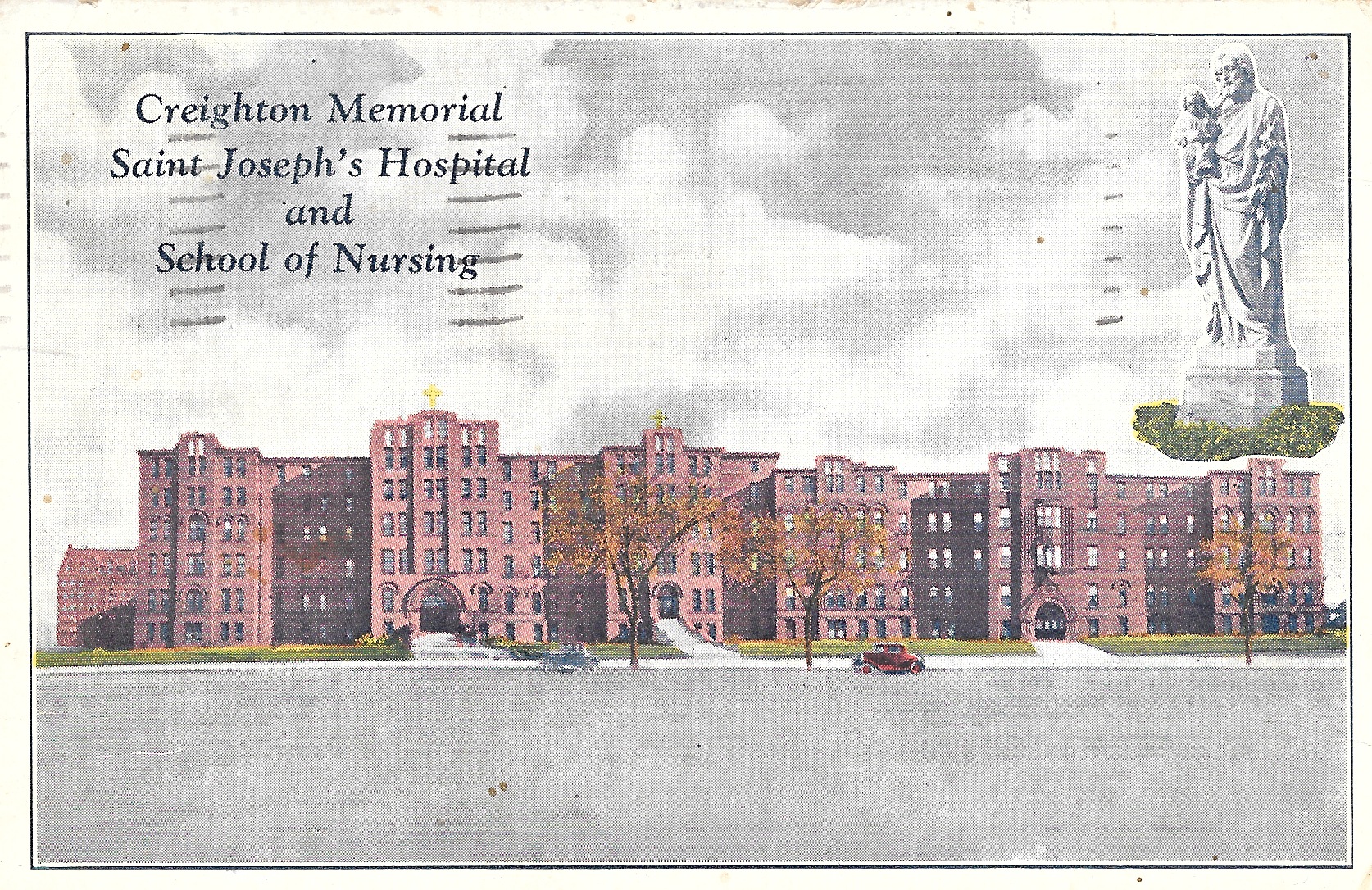
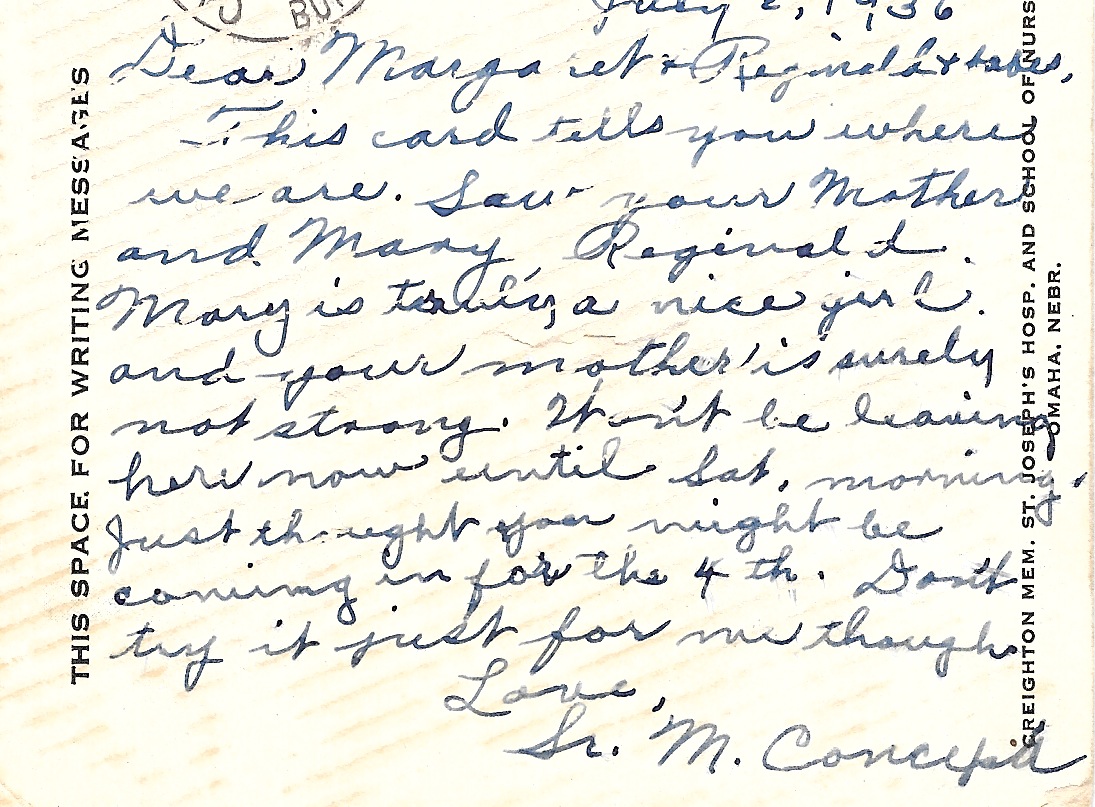
This card from July 2, 1936 is penned by Sister Mary Concepta, the older sister of Margaret Irene McDunn Tillotson (my grandmother) and sister-in-law to Reginald.

Sr. M. Concepta, born on Sep. 27, 1901, in Emerson, Nebraska, and christened Catherine McDunn, was the second of nine children. (Margaret, born Feb. 9, 1903, was third.) Sr. M. Concepta belonged to the Sisters of the Presentation of the Blessed Virgin Mary, with a motherhouse at Mount Loretto in Dubuque, Iowa.

The parents were William McDunn (b. Feb. 4, 1871, Des Moines, Iowa) and Bridget Loretta Dorcey McDunn (b. March 27, 1872, Luken or Lucan, Ontario). Records show William as a laborer in Omaha in 1891. He became a conductor on the Nebraska Division of the Chicago, St. Paul, Minneapolis & Omaha Railway, and the family became established in Emerson, the town named for Ralph Waldo Emerson, which had come into being in 1881 at a junction on the CSPM&O (known as the Omaha Road). 

The family history comes from These U.S. McDunns: Family Tree of Patrick McDunn and Mary O’Donnell, compiled by John McDunn, of Lodi Wisc., in April 1989. The McDunns homesteaded in Pennsylvania in 1835. 

My Uncle, Charles J. Tillotson, whose name appears in many of this blog’s posts, had kept his grandfather William’s railroad watch–a Hamilton, of course–until a burglar struck in the late-1980s.

Post Card 02Uncle Charles notes that in the mid-1930s Reginald and Margaret lived with the elder Tillotsons at 624 N. 41st Street. They towed a travel trailer to job sites. In early July of 1936 they would also have towed along Uncle Charles, then 18 months old, and my mother Mary Catherine, who was nearly five months old.
On this postcard Sr. M. Concepta addresses her sister Margaret (Mrs. Reginald Oscar Tillotson) at Carlyle, Neb.

Carlisle–note the difference in spelling–is an unincorporated town in Fillmore County.

“I know the name because Mom used to talk about it,” Uncle Charles says.

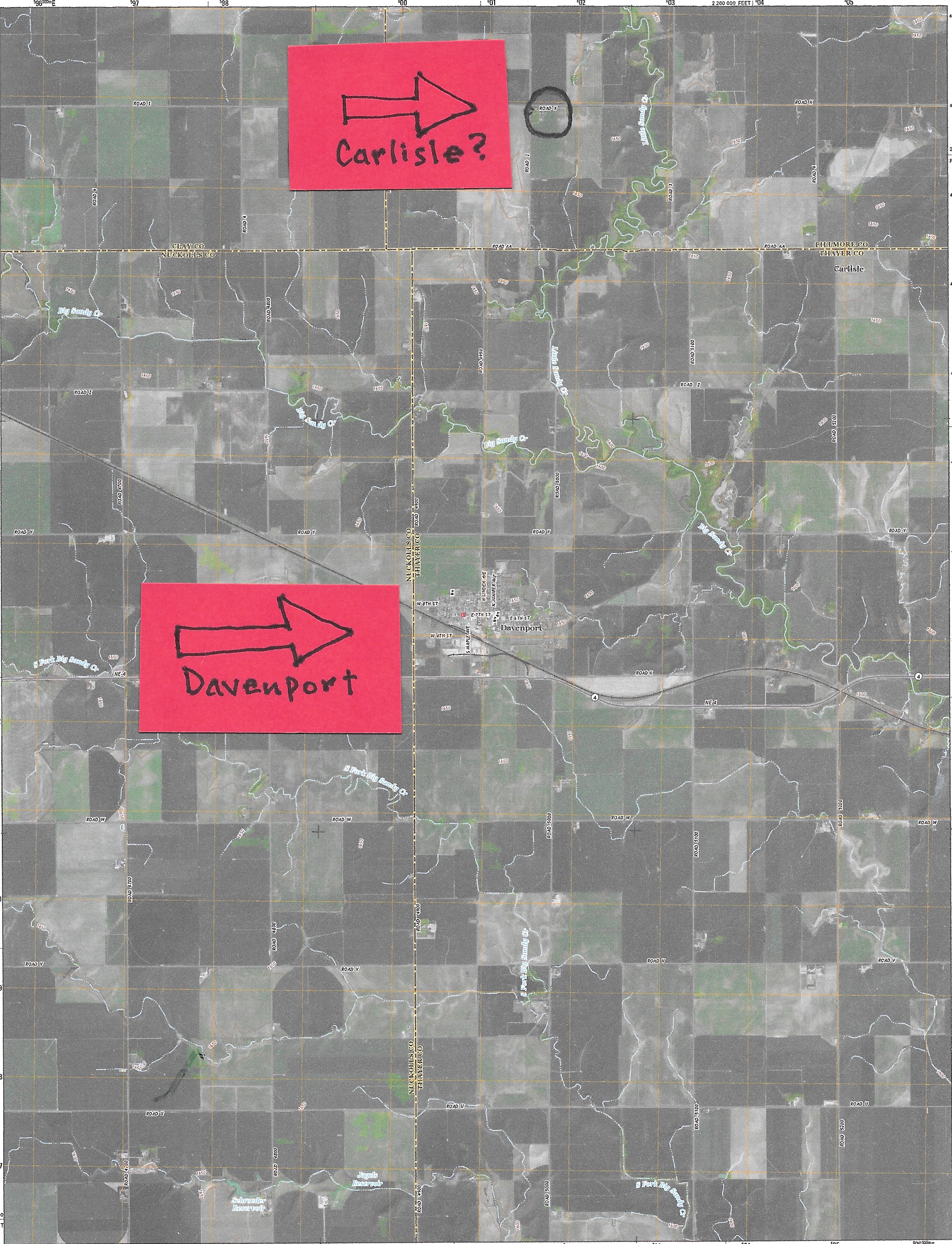
We presume there was a wooden elevator. Carlisle is an unincorporated community in Fillmore County, about 135 miles southwest of Omaha. It doesn’t appear on our Rand McNally page nor does Google Maps seem to know anything about it. 

MapThe USGS gives coordinates for Carlisle on its Davenport Quadrangle map (named for a town in neighboring Thayer County), and we see a speck on Road X, west of Little Sandy Creek, that could be Carlisle. We called the Fillmore County sheriff’s office, in Geneva, and asked. “Nope,” a very nice woman said. “We don’t have a Carlisle.” 
Whatever.

“Dear Margaret + Reginald + babes,” Sr. M. Concepta begins.

Post Card 03“This card tells you where we are. Saw your Mother and Mary, Reginald. Mary is truly a nice girl and your mother surely is not strong. Won’t be leaving here now until Sat. morning. Just thought you might be coming in for the 4th. Don’t try it just for me though. Love, Sr. M. Concepta.”
Mary Tillotson was Reginald’s sister who became important to the family business and also is named in many posts here.

It’s hard enough to find a trace of Carlisle, but we would love to know if any remnant of a wooden elevator exists there.


Will the 1949 Tillotson elevator in Paullina, Iowa, please stand up?

DSC_0508

Story and photos by Kristen Cart

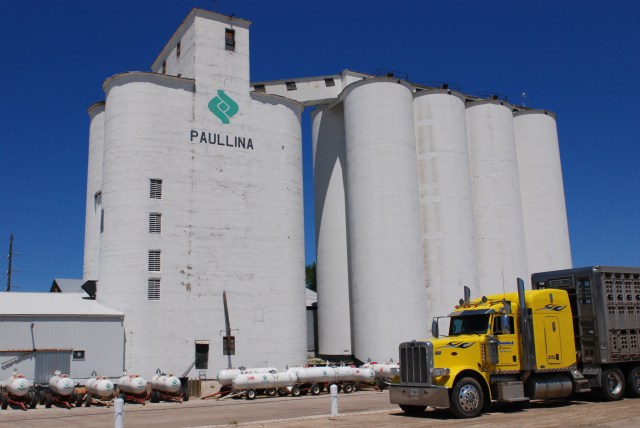
We know that the Tillotson Construction Company of Omaha built an elevator in Paullina, Iowa, but we are not certain which one. We have only newspaper accounts to guide us. The company records list all of their concrete construction projects until 1956 (albeit missing one page), but omit Paullina. A visit to the location provided no clue.

Perhaps the elevator they built was not concrete? There is a precedent in Hawarden, Iowa, where the company built a wooden elevator in the tradition of Charles Tillotson, the patriarch of the family elevator business. But that elevator went up in 1940. Paulina was built in 1949, well after the company had changed its construction method to slip-formed concrete. On review, indeed, we found that the newspaper account said the Tillotson elevator was to be concrete.

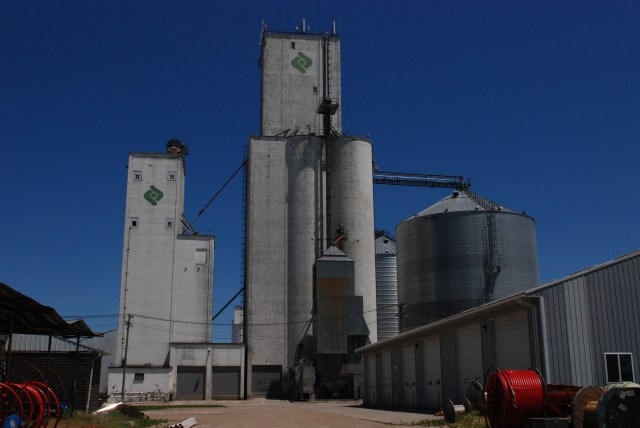
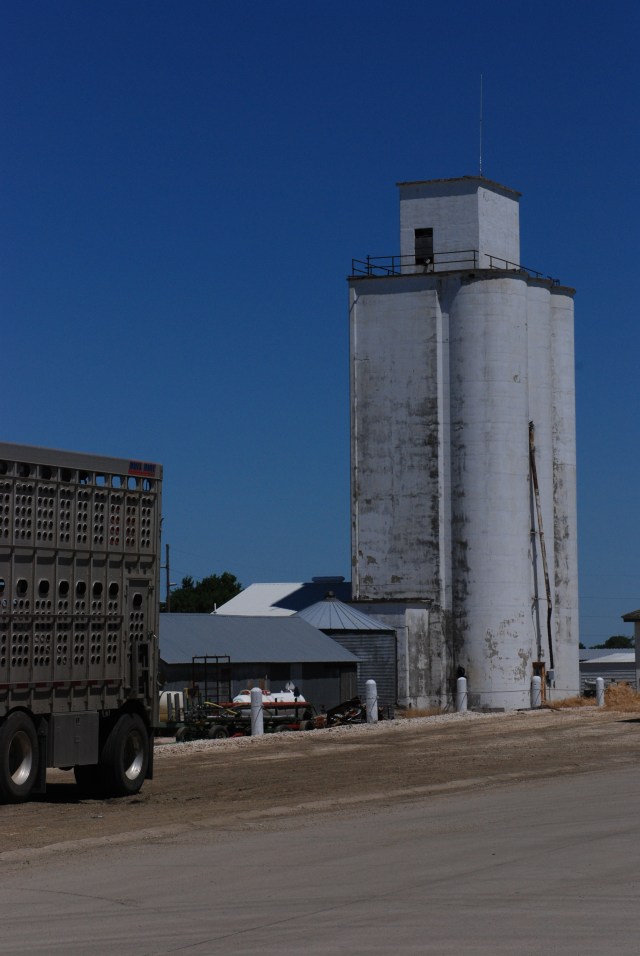
My family rolled through Paullina on a Sunday when the co-op was closed. Grain trucks were parked, and the facility was quiet except for the drone of circulation fans. We found no identifying manhole covers, so I had to content myself with photos. I took at least one image of each elevator on the site. None of the elevators followed the familiar Tillotson style, which may not have been fully developed by 1949 in any case.

Let the reader be the judge from the photos presented here.

These appear to be more modern construction than seen in 1949.

These appear to be more modern than elevators built in 1949.

The two older elevators at Paullina are concrete, but they do not seem to follow the protocol of a continuous pour. The newer-looking elevators deserve a closer look, in spite of their unfamiliar lines–particularly the smaller one on the left. Tillotson Construction set a precedent in 1947, when they built a rectilinear-styled elevator at Minneapolis, Kan.

Perhaps the old Tillotson elevator outlived its usefulness and no longer stands? We don’t know.

Reader input is welcome!


This elevator resembles some of Tillotson's early efforts, and seems to be a good candidate

This elevator resembles some of Tillotson’s early efforts and seems to be a good candidate

Abraham Tillotson, who fought in the Revolution, was too wealthy for a pension


The Tillotson family was adept at seizing opportunities such as the demand for grain storage in the 1940s.

The Tillotsons were adept at seizing opportunities, such as the demand for grain storage in the 1940s.

Story by Kristen Cart

Abraham Tillotson, the direct ancestor of Charles H. Tillotson, the builder of wooden grain elevators, joined the Continental Army in 1775 and served for more than a year, earning the grateful thanks of our new nation. After the war he became a farmer, but in old age he asked for a pension based upon his service.

In 1818, Congress authorized pension payments for veterans who had fallen on hard times. It was not until the 1830s that the pensions were offered to widows and orphans. Veterans had to prove their service (inconveniently, the British burned all of the Revolutionary War service records held in Washington during the War of 1812). To that end, they had to produce witnesses to their service. They also had to prove that they were poor and unable to care for themselves.

Sometimes, veterans navigated the rules adroitly and obtained their pensions without much trouble, and retired in relative comfort. Sometimes it took years for them to prove their service. And sometimes, many letters flew back and forth before a grudging pittance was approved–enough to usher the elderly veteran quietly to his grave.

Abraham’s pension file, digitally preserved at Fold3.com, provides an amusing counterpoint to the usual, sorrowful packet of letters.

Page 4-1

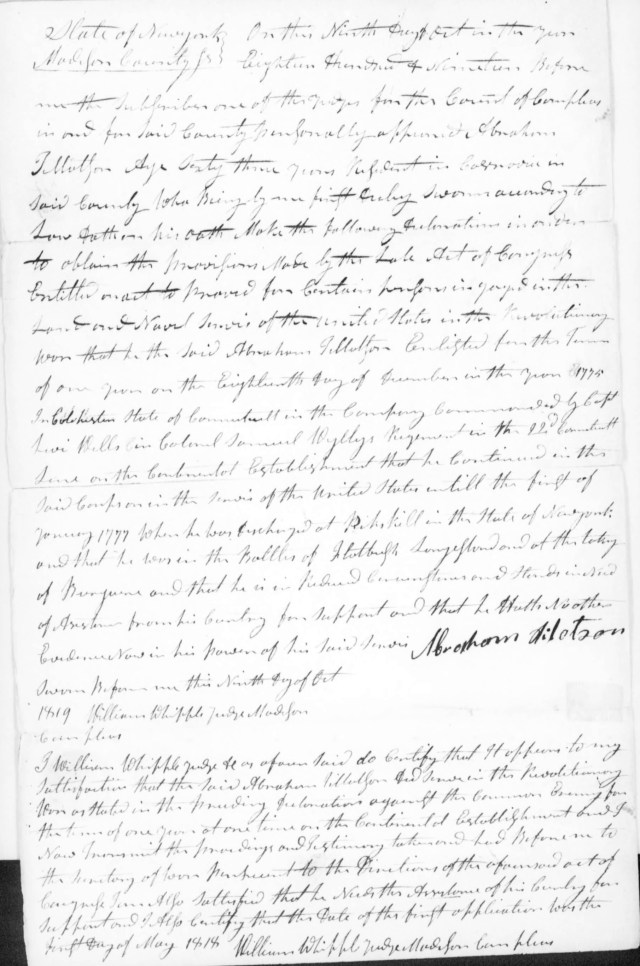
On Oct. 9, 1819, Abraham Tillotson, a resident of Casenovia, aged 63, appeared before the Court of Common Pleas in Madison County, New York to make his statement of service. He said he enlisted on Dec. 18, 1775, serving in Capt. Levi Wells’ company, Col. Samuel Wylie’s Regiment, in the 22nd Connecticut Line of Continental Establishment. He was discharged at Fishkill, New York, on Jan. 1, 1777. He had fought in the Battles of Flatbush and Long Island, and at the taking of General Burgoyne. He produced a witness to his service in the person of Henry Champion.

According to the court, Abraham’s statement averred that “he is in reduced circumstances and stands in need of assistance from his country for support.” Apparently, Abraham had no trouble getting onto the pension rolls. His trouble came later.

Abraham’s consternation was evident in the letter he wrote on July 11, 1822:

“… I am informed of the suspension of my pension until I produce satisfactory evidence doing away [with] information received at the War Department of my being ‘worth more than five to six thousand dollars.’ From whatever source this information may have been received, it is totally false, without a shadow of foundation, and must have been engendered in the brain of some malicious and corrupt villain. The information indirectly charges me with false swearing and if I knew the malicious informant, I would (as I did the enemies of my country) chastise him for his audacity, old and infirm as I am.”

He went on, protesting his honesty: “In obtaining the bounty of my country, for which I fought and bled (when, probably, your informant was in his cradle), I pursued an honest correct course and such as prescribed by the love of my country…”

He was up against a formidable stack of evidence to the contrary.

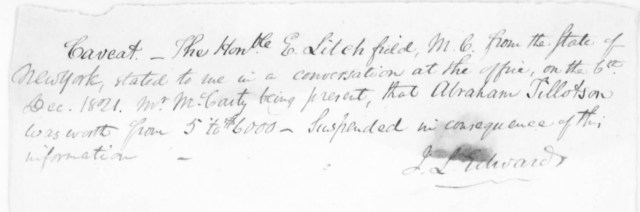
The Honorable E. Litchfield was the first to alert authorities to Abraham’s wealth, after he learned that Abraham Tillotson was worth between five and six thousand dollars. Abraham’s pension was suspended from that date, Dec. 6, 1821.

Page 42

Further investigation yielded more.

“State of New York,

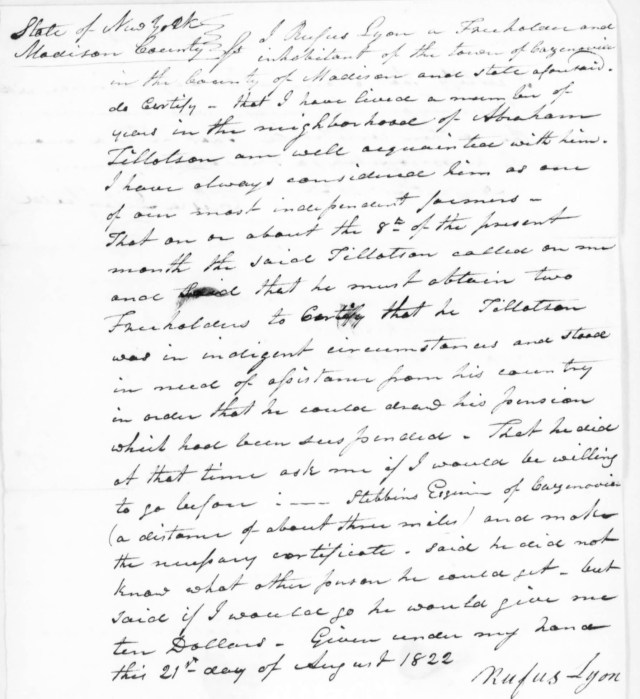
We, the subscribers, freeholders and inhabitants of the town of Cazenovia in the County of Madison and of the town of Pompey in the County of Onondaga and state aforesaid, do certify–that we have been acquainted with Abraham Tillotson of said Cazenovia for a number of years–that we have lived and do still live [as] neighbors to him–that we have considered him one of our most independent farmers, one who has money to loan, whenever he can obtain extravagant interest, or dispose of some property at a high price and obtain good security–that his property year before last was valued by the assessors at about eighteen hundred dollars–and further we consider him the said Tillotson abundantly able to support himself and family–and under the existing law authorizing the payment of pensions do not think him entitled to a pension–given under our hands this 21st day of August 1822.

Rufus Lyon, Joseph Atwell, Daniel Allen, James McCluen, Joseph Atwell Jr., Elijah Hill.”

Whoops.

Other affidavits contain the same sort of accusations. Needless to say, Abraham never recovered his pension. He died two years later in 1824. His widow tried to reinstate his pension in the 1830s, also to no avail.

Page 33

Abraham offered to pay Rufus Lyon, one of his accusers, to testify in his favor

So began a Tillotson tradition of success and wealth, of sharp business dealings, and of a willingness to partner with the U.S. Government when advantageous–a perfect template for the private/public partnership that became the grain elevator boom of the 1940s and 50s. I would be quite proud of such a clever ancestor, notwithstanding a bit of shading of the truth. His neighbors (debtors?) might not quite agree.