Could the previously unidentified Tillotson employee be Mary Melia?

Virginia Slusher 01

Photo from the Virginia Slusher archive

We believe the woman on the far right is Mary Melia. Her husband Marvin also worked for Tillotson Construction Company and served as a pilot. Virginia Slusher is second from right.

Mary Melia died six months ago. Here’s an obitiuary:

Melia, Mary Clare (Burns) Aug 31, 1922 – Dec 29, 2014

Preceded in death by husband, Marvin G. Melia. Survived by children, Marvin G. Melia II of Pleasant Valley, Mo., Mary Lou (Timothy) Brennan, Steven M. (Janet) Melia of Cheyenne, Wyo., and Donald L. Melia; brother, Jack (Carol) Burns of Twenty Nine Palms, Calif.; 10 grandchildren; 10 great grandchildren and many nieces and nephews.

VISITATION Thursday, January 1, 2015 from 4-7 pm with a Rosary at 7 pm at Roeder Mortuary 108th Street Chapel.

FUNERAL SERVICE Friday, January 2, 2015 at 10am at St. Philip Neri Church 8200 N. 30th Street.

Interment Holy Sepulchre Cemetery.

Mechanization and the Russian wheat deal caused elevator construction booms

AuroraBrad Perry

Story and photos by Brad Perry

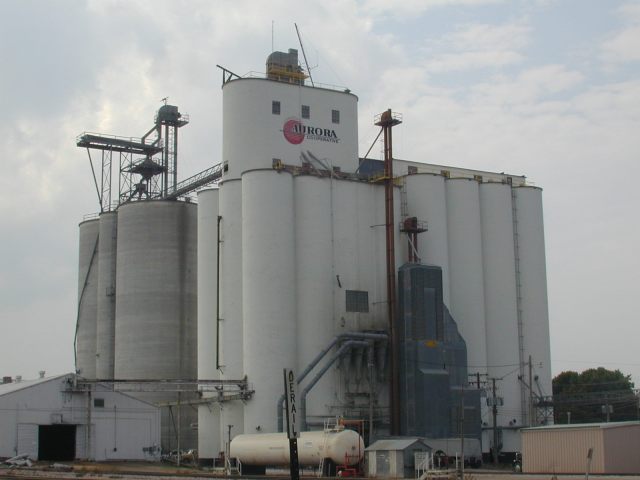
These photos are from my travels across Highway 34: Aurora Cooperative and their branch at Murphy. The workhouses would indicate Tillotson. The new two-tank annex at Aurora was done by Todd & Sargent. I believe the four-tank annex at Murphy was T&S as well.

You’ve gotten me thinking about all the construction I was involved in.  Here comes some more history.

Prior to the past eight to 10 years, there were two boom periods of elevator construction in the Midwest. The first is well documented by your blog— early ’50s thru mid 60’s. That was the mechanization age of United States agriculture.

By the ’60s, however, we were building flat storage buildings for the Commodity Credit Corporation. This and the United States Department were our market–and our only market. I still remember being in St. Edward, Neb., in 1975, and being told that the co-op had just gotten shipping orders on 250,000 bushels of wheat that had been in storage there for 12 years.

That’s what paid for the monster terminals in Hutchinson, Salina, Wichita, and Enid.

MurphyBradPerry

The second boom period followed the Russian wheat deal of 1972 and 1973. After that purchase, the USDA eliminated diverted acres and we went to wall-to-wall production. It created the need for new, and faster capacity.

This boom lasted into the early 1980s. It was assisted in Nebraska by center-pivot irrigation.

Most of the elevators were built by co-ops. Cargill, Continental, and a few local privates built in Nebraska, but not many. Peavey was a purchaser rather than a builder.

Farmland Industries served as the general contractor on virtually all of these elevators and annexes. At the Bank for Cooperatives, we waived the need for a performance bond if Farmland was the general contractor.

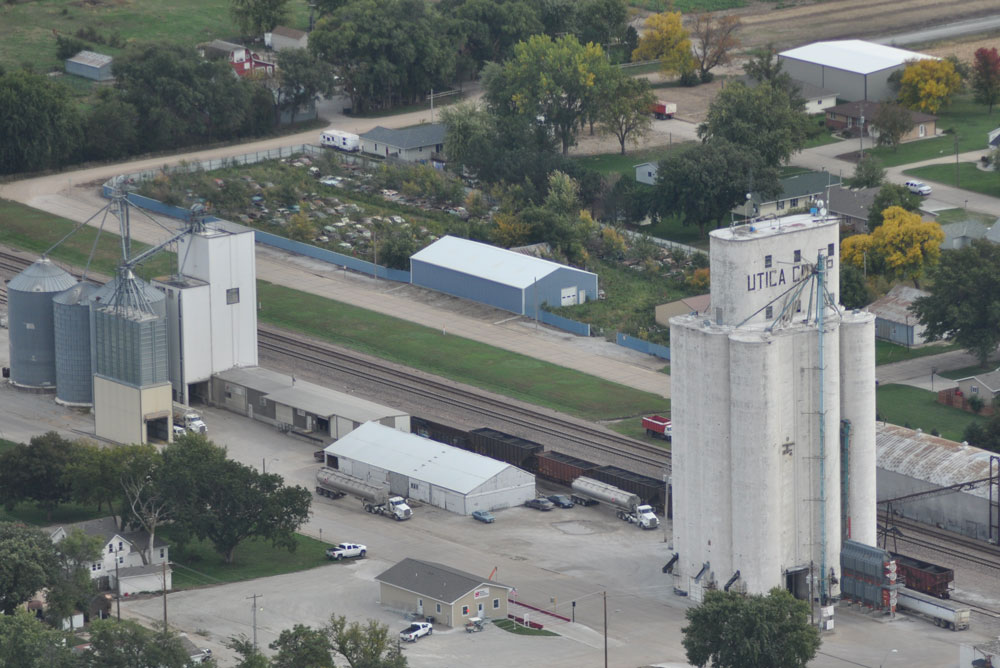
An aerial view of Utica, Neb. With the round headhouse, Brad Perry thinks it looks like it could be a Tillotson elevator.

An aerial view of Utica, Neb. With the round headhouse, Brad Perry thinks it could be a Tillotson elevator. Existing records don’t indicate company activity there. 

That saved a ton of money for the client, and also Farmland paid patronage dividends on the project. Farmland then subbed out the contracts to the major builders that they used.

These were Mid-States, Jarvis, and Borton as the main players. Farmland also brought Wilson, Venturi, and Jordan into Nebraska when demand heated up.

Todd & Sargent did several projects in Nebraska, but mainly stayed in Iowa—lots more grain (and new elevators built) over there.

Quad States built a few facilities (Rising City, Shelby, Benedict, Hooper, and Milford) in Nebraska as well.

The old house at Tamora, which is just off Route 34 between Utica and Seward. Note the stepped, or partial,  headhouse. The feed mill beside it was kind of a standard blueprint as well and would have been 1950s or 1960s construction. Sisters to it are found in Leigh, Minden, Holdrege, and Beatrice, Neb., and Red Oak and Shenandoah, Iowa.

The old house at Tamora, which is just off Route 34 between Utica and Seward. Note the stepped, or partial, headhouse. The feed mill beside it was kind of a standard blueprint as well and would have been 1950s or 1960s construction. Sisters are found in Leigh, Minden, Holdrege, and Beatrice, Neb., and Red Oak and Shenandoah, Iowa.

There are a couple of odd ones that occurred when the general manager had had experience with a contractor from a different state.

For example, the big elevator at Tamora was built by Conger, a Minnesota company, and the newer workhouse at Plymouth by Weigel, also of Minnesota.

During this period, most facilities–elevators and annexes–were built with 24- to 28-foot diameter tubes.

Toward the end of this boom time, we started seeing en masse conveyors used on annexes, replacing Texas headhouses and open belts with trippers.

We also saw the movement away from small tube elevators to 40 ft and larger diameter tubes.

This was due to two factors: the producers’ yields and harvest speed and the movement to outbound unit trains.

In Hampton, Neb., the grain elevator could be from the Tillotson Construction lineage

Brad Perry Hampton Nebr.

Story and photos by Brad Perry

Bradshaw, Neb.

Bradshaw, Neb.

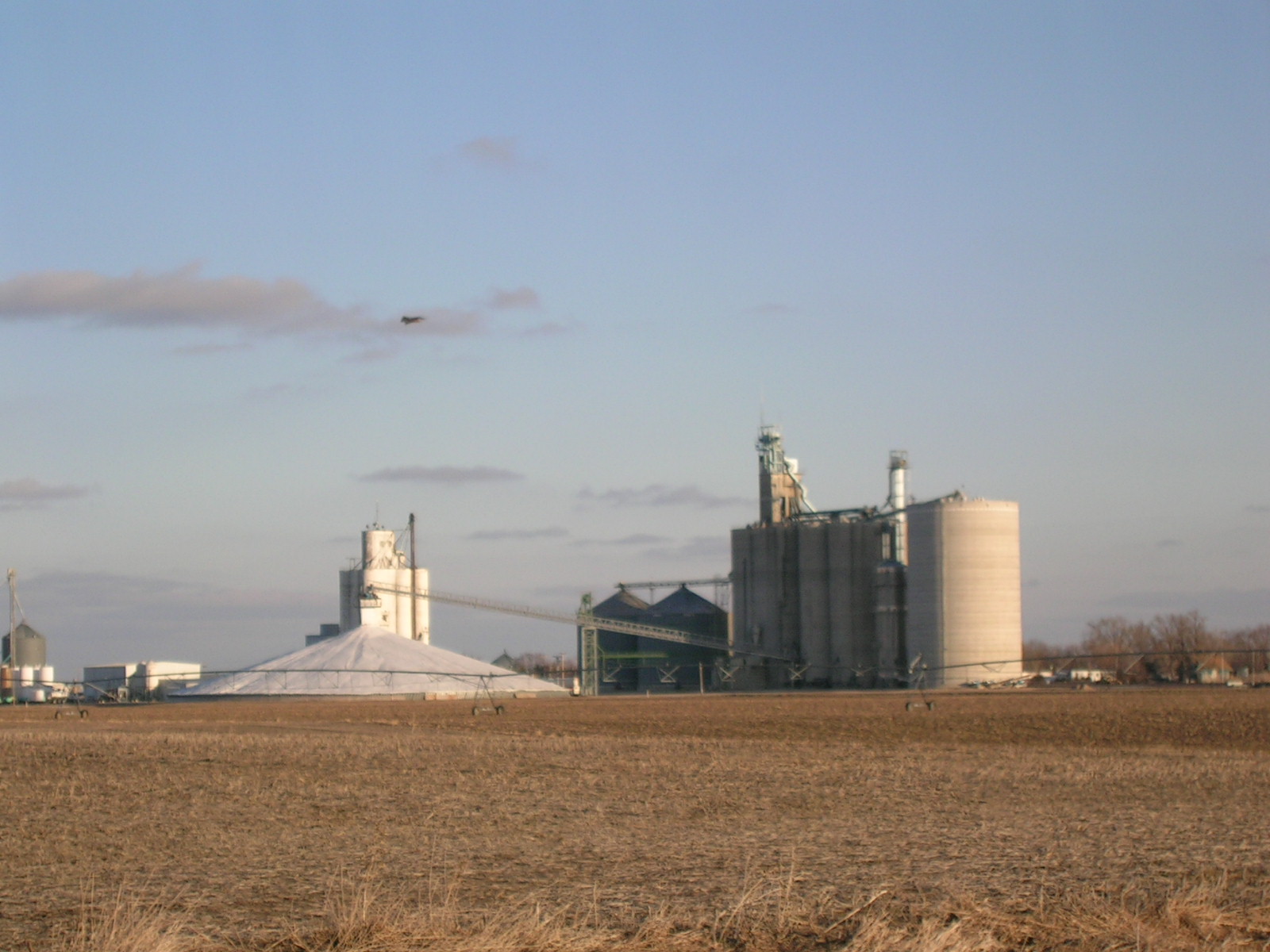
I was a loan officer in Nebraska and financed many of the elevators built from 1975 to 1980. The dominant Nebraska builder was probably Mid-States, out of Omaha, along with Jarvis. Borton wasn’t very active in Nebraska at that time, but Farmland Industries brought more players in. Venturi and Jordan were two of them. Farmland served as the general contractor on the majority of elevators built by co-ops in the 1970s and 1980s. The players in Iowa were Younglove and Todd & Sargent, but the lowest-priced builder was always Quad-States out of Des Moines. It’s easy to tell their elevators—they only had one design! This photo above is from Hampton, Neb. Looks like a Tillotson, but I think it was Sampson. There was a twin to it at Bradshaw, 10 miles east, that was hit by lightning and had to be torn down.

Elevator operators once implicated labor activists in mysterious explosions

Evevator test003

A 1920 Department of Agriculture experiment showing that accumulations of grain dust would ignite under the right conditions

Story by Kristen Cart

Elevator fires have been a great concern since the days when Charles H. Tillotson first built wooden elevators with his army of carpenters at the beginning of what would become the family business.

When elevators started to randomly ignite and explode in the early twentieth century, suspicions ran rampant.

Shortly after 1900, labor violence was on the rise, and businesses had reason to be worried.

In the Midwest, elevator owners suspected the labor unionist Industrial Workers of the World (IWW), or Wobblies, had committed acts of sabotage, torching the structures to make their anarchistic point.

Evevator test004

Then, cooler heads prevailed as engineers found a scientific explanation.

Using a scale model in the manner of a college lab experiment, the United States Department of Agriculture demonstrated that grain dust would ignite and explode under the right conditions, leaving destruction and injury in its wake.

The Wobblies were off the hook.

Welcome to Alta. Please slow-down and see our new grain elevator!

scan0009

Story by Ronald Ahrens, photo from the Neil A. Lieb archive

Why would we not be blamed for thinking the sign in the photo was actually about the new elevator that Tillotson Construction Company had just completed in Alta, Iowa? Or do we read too much into it?

Just think what was required to build the elevator in 1950. Men started in the mud and gloom of early spring. All they had were piles of sand and lumber and steel bars, relatively few, simple tools, and an ingenious way of keeping the formwork level. They were about to perform an amazing feat.

By midsummer, the job was done, the lettering affixed to the headhouse, and farmers could more efficiently store and ship their corn.

The men who built the elevator moved on to another job, maybe in Iowa, maybe in Texas.

What they left behind towered over the countryside of Buena Vista County. Some folks had probably never seen a monument this grand.

Shucks, by scrooching up your eyes, you might even have been able to see it all the way from Storm Lake, three miles down Route 7.

How an Iowa grain business flourished without a concrete elevator and silos

Story and photos by Kristen Cart

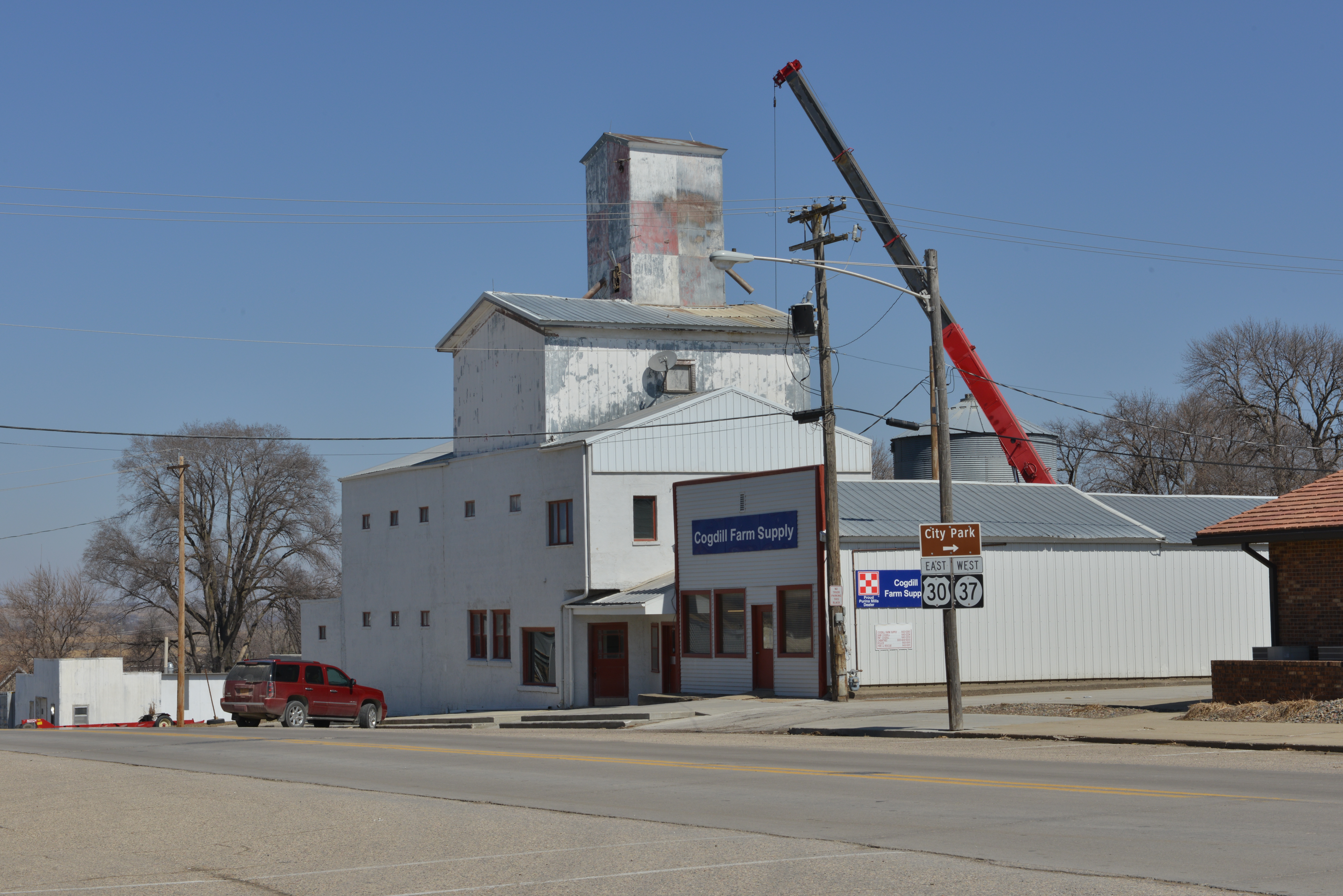
Cogdill Farm Supply Inc. is a family business, founded in 1979. It flourished as the grain business underwent big changes. Gone were the days of government-subsidized concrete grain elevators, but this operation, one step at a time, went from a small feed and grain business, operating a terminal-style wooden elevator, to a full-service farm supply company sprawling across several towns in western Iowa. The business skipped the concrete-elevator stage as it grew without price supports, relying instead on good business practices and a growing economy.
DSC_5821

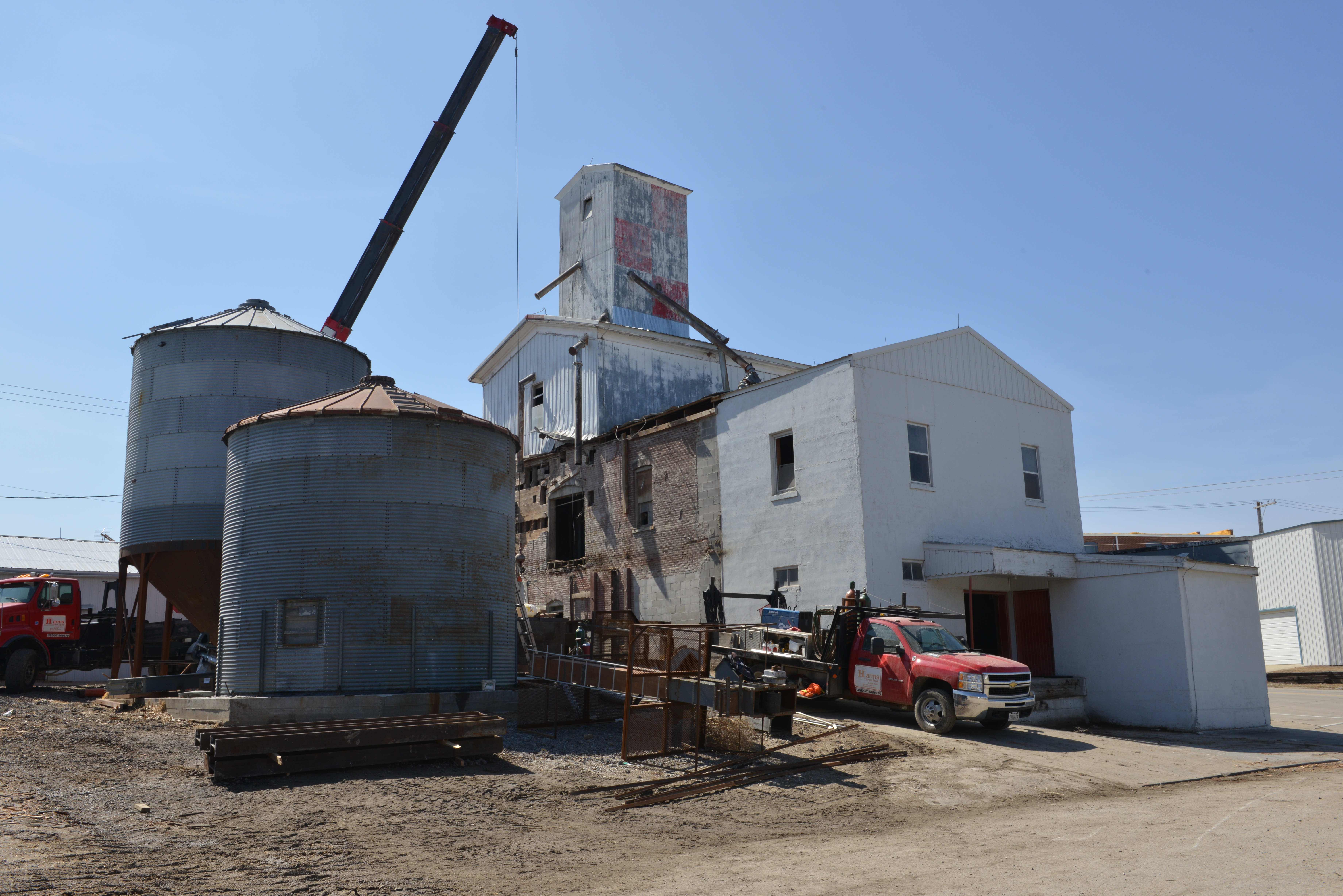
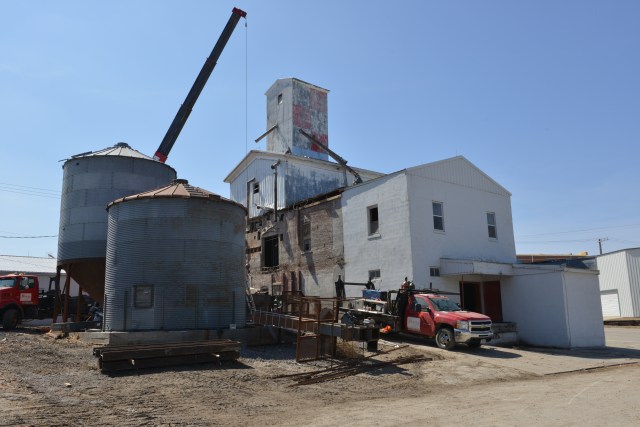
Brand new shiny bins (not shown) stood by to replace the old wooden ones at the mill in Dunlap. The shed roof was gone, exposing the wall for the first time in generations.

The company showed no signs of slowing down as it modernized. When I visited over a year ago, new bins were going in at the Dunlap feed mill.

As I photographed the mill, Rob Cogdill came down and greeted me. He said that temporary feed facilities were set up as the old shed roof came down (animals don’t quit eating for a day while the mill is down for repairs). Steel bins stood by across the street, waiting for installation. He told me that the side of the mill, now bared, had not seen daylight for a hundred years.

DSC_5736

Cogdill feed mill in Logan, Iowa.

The Cogdill feed mill facility in Logan, Iowa, another town along U.S. 30, was idle and slated to come down, according to Rob Cogdill. It was another step to be taken to streamline and modernize the business.
DSC_5811

Old Cogdill elevator in Dunlap, Iowa.

Rob also told me about his plans to replace the older wooden elevators as they became obsolete. He pointed out the elevator in Dunlap and said he hated to operate the thing any more—it had become difficult to keep in working condition. He had spent his youth in that elevator, and he said it was close to time for it to go.

It is easy to appreciate the aesthetic beauty of these old buildings, but when their service life ends, they cannot be saved and must be replaced. However, it is not only the beauty that makes them hard to destroy—sometimes, their history keeps them in service well beyond their heyday. “The crookedest elevator in Iowa,” in Dow City was one such case. That elevator represented the beginnings of Cogdill Farm Supply Inc. I went on down the road to see it, and while there, I met the founder of the company.
DSC_5830

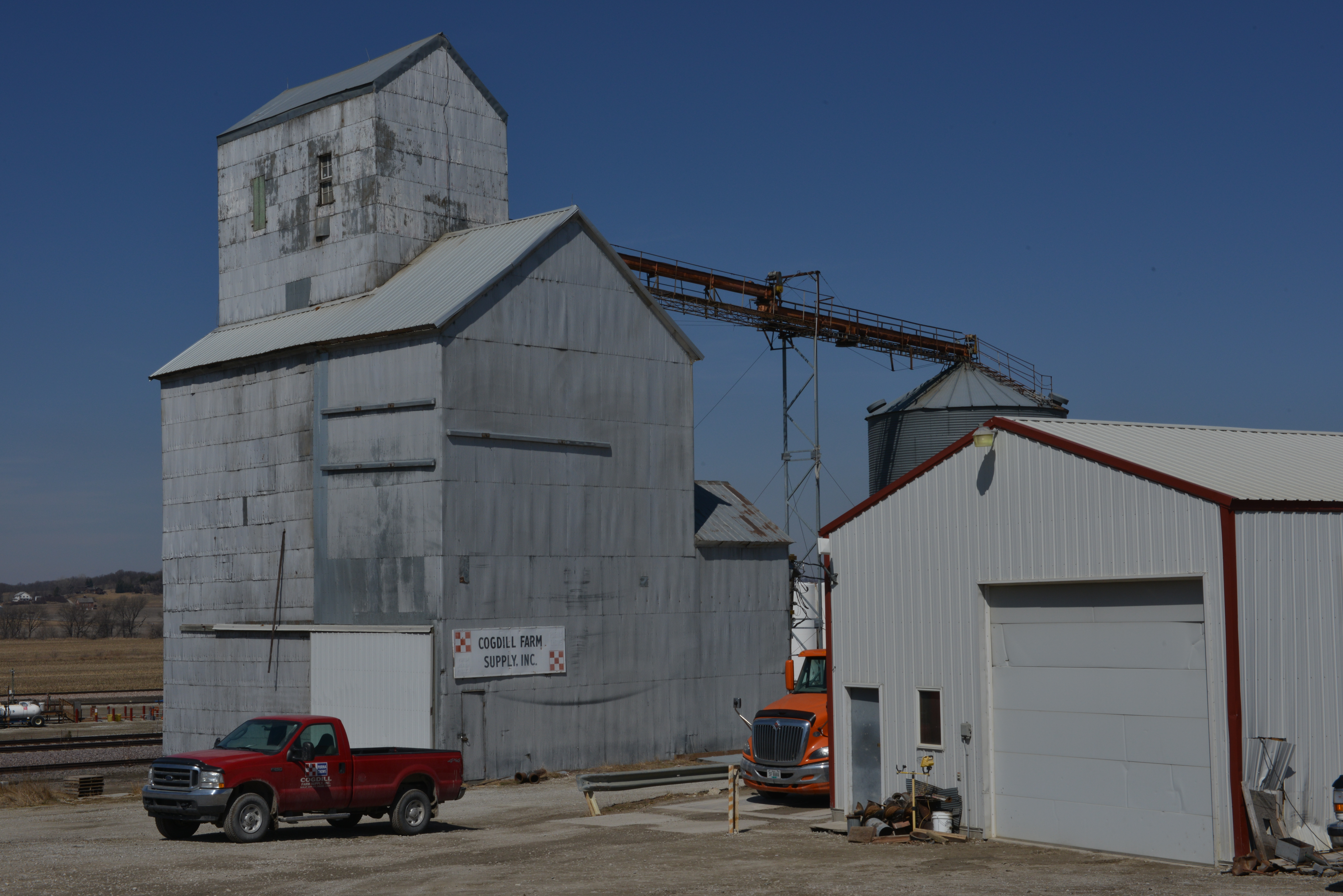
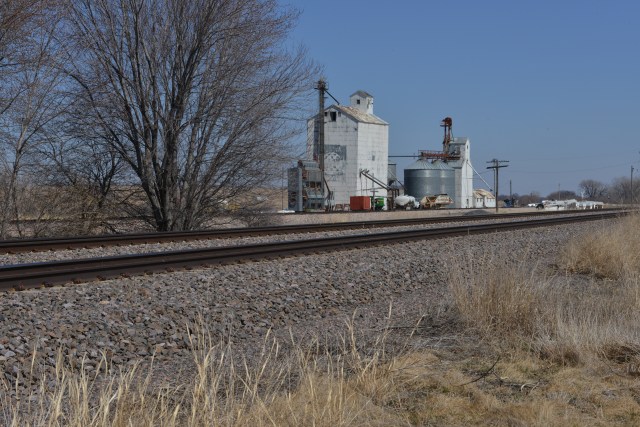
“The crookedest elevator in Iowa” still had its Purina logo, visible from the rail line, in Dow City, Iowa.

Pat Cogdill, Rob’s father, gave me the run of the site to take pictures. Afterward, he gave each of my kids a soda and told me about the old elevator. Clearly, there was a sentimental attachment.

The Cogdill operation took over the old wooden elevators in Dow City, which were built in 1946 and 1953. The larger one had two rows of bins. Conveyors were installed above and below—an arrangement which allowed a custom mix of grain for each individual customer. Pat said it was a “terminal elevator. It can mix anything.”

He said, “It’s the crookedest elevator in Iowa,” describing how the marshy soil allowed one corner to sink during construction.

When I asked if it would be replaced any time soon, Pat said, “This elevator paid for all of this,” indicating the whole operation with a wave of his arm. “It will provide the boards for my coffin.”
dsc_5949

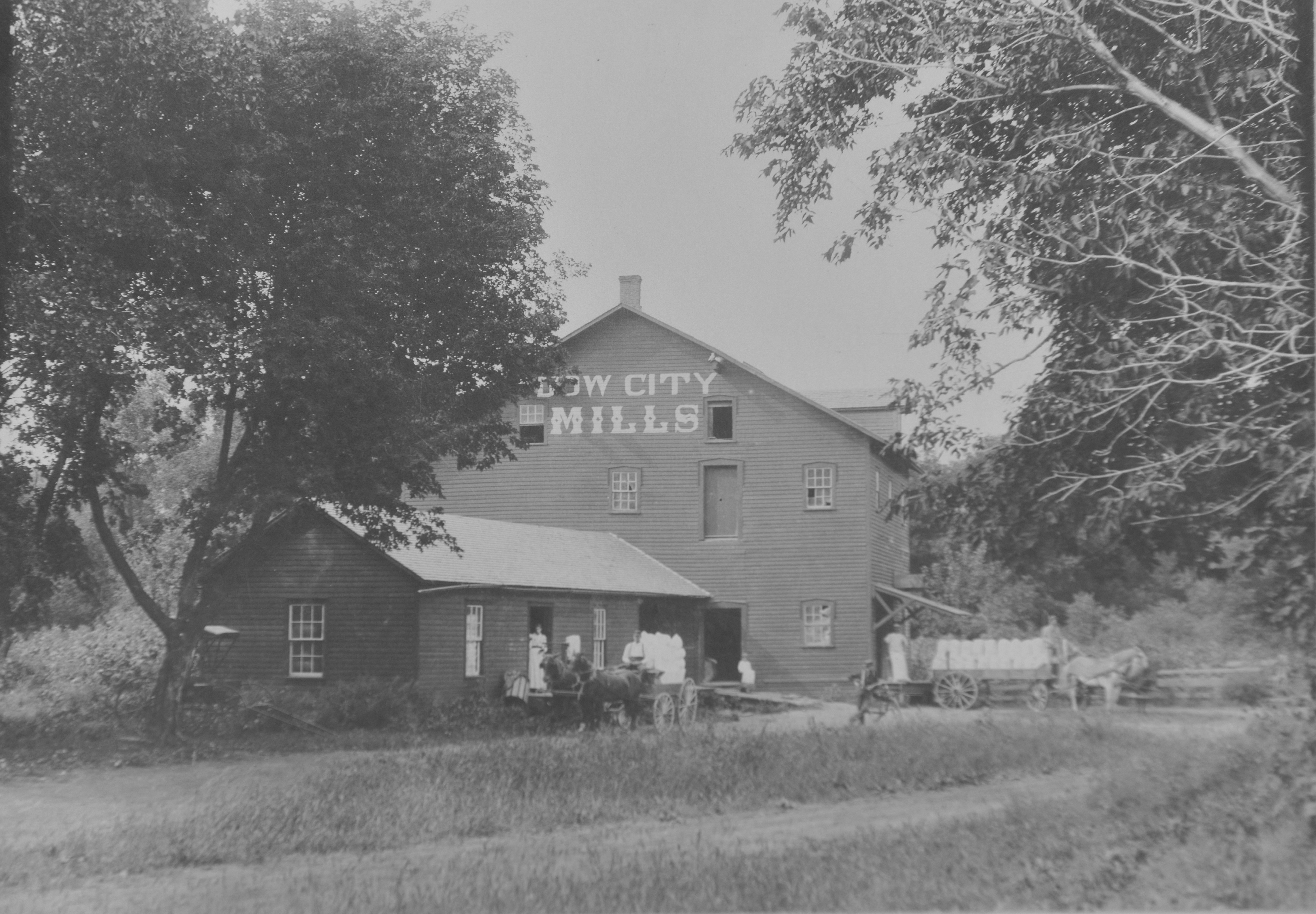
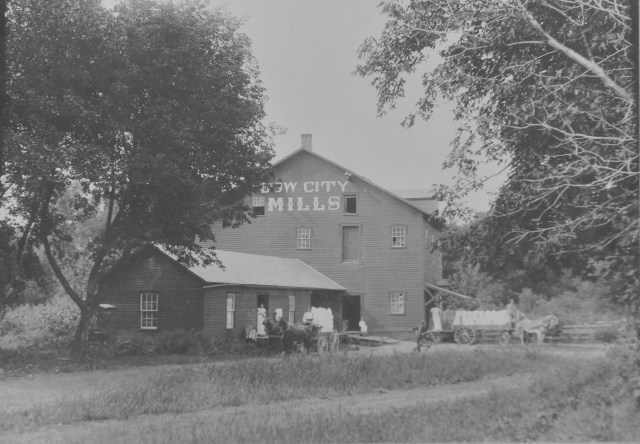
Dow City Mills from an early day, courtesy Pat Cogdill.


How ‘the crookedest elevator in Iowa’ was built

DSC_0416Story and photos by Kristen Cart

It was a terminal elevator, a family operation, capable of supplying a custom mix of feed fine-tuned to the individual farmer’s requirements. It sat along a rail line that ran through Dow City, Iowa, along U.S. 30 in the western part of the state. And it had been crooked as long as it existed.

There were two different explanations offered for its seemingly casual slouch. The first was intended for credulous tourists, and the last was a more scientific tale. But I liked the first story better.

You see, when the wooden elevator was built, the crew employed for nailing the boards was instructed to rotate around the structure as they built it. That way, the fellows who hammered harder would work their way around the elevator, keeping it even. That precaution had been neglected. The slackers on one side of the elevator, by not pounding as hard, left the rising wall noticeably taller on their side than did the guys who could swing a hammer. Thus, the finished elevator gained a noticeable tilt.

dsc_5941I bought every word of it. I imagined the men smacking the boards tightly on one side, and their chagrin when they discovered what they had done. But alas, the truth was far less romantic.

According to the owner, the builders set the foundation in soggy ground left from years of servicing steam locomotives, and the elevator sagged into the bog as soon as it was built.

Humbug.

dsc_5929In the next post, I will explain how this pay-as-you-go family operation skipped the concrete elevator stage of business. The present effort to modernize must do so without the subsidies that characterized the concrete elevator boom.


Visitors from 113 countries checked in on grain elevators in 2014

The WordPress.com stats helper monkeys prepared a 2014 annual report for this blog.

Here’s an excerpt:

The concert hall at the Sydney Opera House holds 2,700 people. This blog was viewed about 16,000 times in 2014. If it were a concert at Sydney Opera House, it would take about 6 sold-out performances for that many people to see it.

Click here to see the complete report.

Collin Quiring delivers a load of corn to Tillotson’s Aurora South elevator

IMG_5453

Collin Quiring, a 26-year-old reader of this blog who farms with his brother in Henderson, Nebr., made contact and offered to send some photos when he took a load of grain to the Aurora South elevator, which was built by Tillotson Construction Company in 1959.

Collin had first commented on one of Kristen’s posts.

A view of Tillotson Construction Company's Aurora South elevator, as seen Nov. 2, 2014, by Collin Quiring.

A portrait of Tillotson Construction Company’s Aurora South elevator, as seen Nov. 2, 2014, by Collin Quiring.

“It’s funny that you drove through Hampton,” he wrote. 

“I’ve been following this blog for a while now and started looking at all the manhole covers on elevators that I haul to, and sure enough there were a lot of Chalmers-Borton, Tillotson, and Mayer-Osborn elevators around.

Hampton has the manhole covers on the outside of the silos and they’re 10 feet or so off the ground, so I’ve been wondering who made it for a while now!

It looks like you just saw the one downtown elevator in Aurora though?

The other elevator is called Aurora South and is on the southwest edge of town. It used to be a Cargill elevator, but Aurora Coop purchased it.

I’m pretty sure that’s a Tillotson elevator, too.”

So Collin did some more reconnoitering and took pictures on his next run.

IMG_5454

Collin’s view from the scale house.

“We’ve been alternating where we were taking corn, and I was planning to get back there for a few more pics.

But harvest will be over in an hour.

So I won’t be getting back there anytime soon.

Here’s what I did get while trying not to hold up the line.

End of this week or beginning of next I will be hauling to Hampton and will send you some from over there.”

Two days later, he made the run to Hampton but found it was not a Tillotson elevator; instead, it was built in 1959 by Grain Storage Construction Company, of Council Bluffs, Iowa.