
By Ronald Ahrens
In 1971 a monstrous tornado just missed Gruver, Tex., veering away from the town at the last minute.
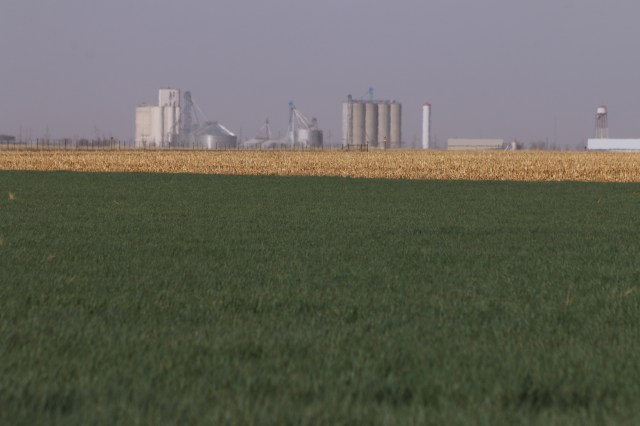
 The funnel cloud was as great as two miles wide, and we can’t help wondering what would have happened if a direct strike had engulfed the town of 1,100 souls and its fine Tillotson elevator.
Besides breaking windows, ripping out doors, twisting spouts and ladders and sending them flying, the tornado might have played hell with some of the elevatotr’s internals as they became exposed.
The reinforced-concrete structure would have looked tattered, but it might well have withstood the fierce storm. Anyone sheltering in the basement would have been rattled but OK.
 Records kept by Tillotson Construction Co. reveal this single-leg elevator was built in 1947 and was, as a note says, “Similar to Satanta (but 125′ D.F. walls).”
That’s the Kansas town where Tillotson built earlier the same year. To decode that sentence: Satanta is a town 100 miles away in southwestern Kansas; D.F. stands for drawform, and Satanta’s silos were 120 feet high.
Both elevators succeeded from the Dike, Iowa, plan of 1946.
The basics are that this 265,000-bushel elevator had eight tanks, or silos, of 18 feet in diameter–two feet less than Tillotson would later offer as the standard dimension.
Gruver had an extra attached driveway, a hopper scale in the cupola, and double distribution floors.
The entry for Satanta notes some 2,072 cubic yards of reinforced concrete were used, and 25 cubic yards of plain concrete went for the hoppers.


Steel used for reinforcing the concrete amounted to 107.50 (including the amount used for jack rods).
The 21-inch-thick main slab sprawled over an area measuring 57 x 69.5 feet. The records say that amounted to 3,754 square feet “outside on ground.” Again, as with other Texas elevators, we get 3,961.5 square feet and can’t account for the difference.
If the tornado bumped against the elevator, it would have realized this structure had 4,251 tons of reinforced concrete and weighed 12,351 tons when fully loaded. The confrontation would have been interesting.
The cupola, or headhouse, measured 21.5 feet wide, 48.5 feet long, and 40.25 feet high.

With a pit reaching 16 feet in depth, the pulley centers of the leg were 166.75 feet apart. Pulleys were standard size: the boot was 72 x 14 x 3 3/16 inches while the head pulley was .75-inch deeper. The head turned at 42 rpm.
The 14-inch, six-ply Calumet belt stretched over a distance of 360 feet and carried 12 x 6-inch cups. Two 40-hp Howell motors were installed to turn the leg. Theoretical capacity was 8,450 bushels per hour, but actual capacity was 80 percent of theoretical, coming to 6,750 bushels per hour.
The man lift rose and dropped with a 2-hp Ehrsam motor. The truck lift had a 7.5-hp Ehrsam motor.
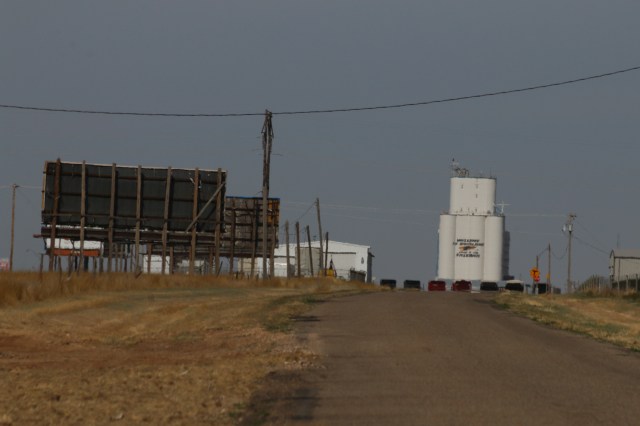
After 71 years, this Tillotson elevator appeared to be in good working condition and maybe even ready to take on the next monster storm that approached Gruver.
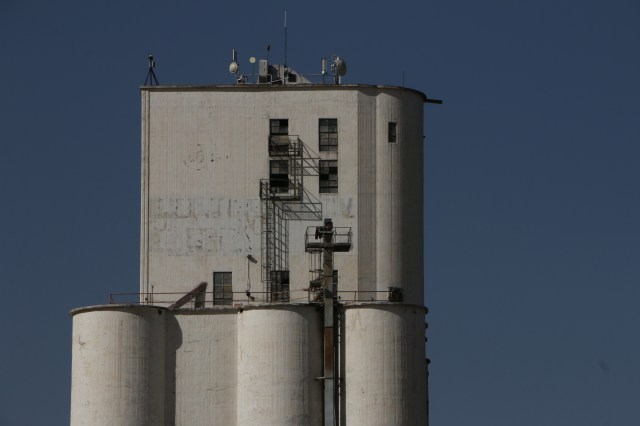 The cupola, or headhouse, was rectilinear on one side, with sharp corners and splendid moldings to cover the raggedness. But the other end of this 48.5-foot-long headhouse had an articulated curve.


 Up in the run, a conveyor belt turned on two pulleys, one being 16 x 32 inches and the other being 18 x 32 inches. The pulley turned at 127 rpm, so the 30-inch, four-ply belt moved at the rate of 600 feet per minute.
 Tillotson Construction Co. had yet to perfect its signature style of


 After departing Hartley, my next stop, just 15 miles northwest on U.S. 87/385, was Dalhart, a market town with brick streets in the business district and, along the railroad tracks, a whole lot of buildings by Tillotson Construction Co. Dalhart is so remote in the Texas Panhandle that six other state capitals are closer than the Texas capital of Austin. For example, it’s 28 miles shorter distance to Lincoln, Neb., than to Austin.
 Anyway, on that trip, it was getting close to sunset as we approached Dalhart, so Dad had me stop in Amarillo where he secured a hotel room.




 By Ronald Ahrens
 Weight of the reinforced concrete came to 5,004 tons. Plain concrete for the hoppers totaled 40.3 tons. Grain filling the tanks, or silos, weighed as much as 9,000 tons.
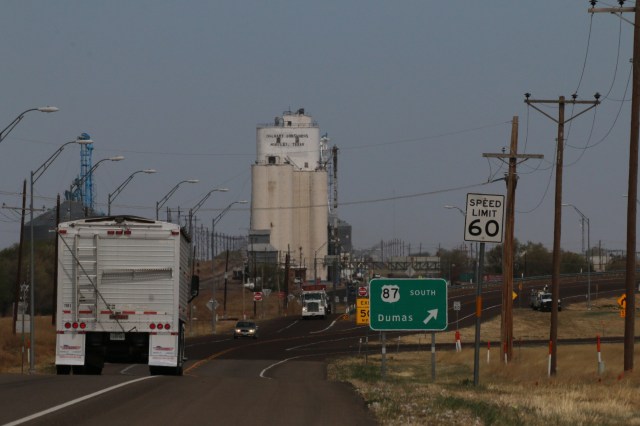
 Schoolchildren were at recess as I drove through side streets looking for a good view of the elevator.


 By Ronald Ahrens
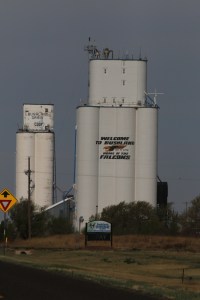 The job 68 years ago required the careful mixing of 2,066 cubic yards of concrete from the sand pile on the site. It would be reinforced with 109.37 tons of steel. At least I think that’s the number in the company records. That line got pinched in the copying process. But 109 tons is consistent with the amount used in other elevators of similar size. The 252,000-bushel elevator built the same year in Pond Creek, Okla.–another on the Dike plan and one of two dozen Tillotson jobs in that bounteous year–used 112.91 tons of steel.


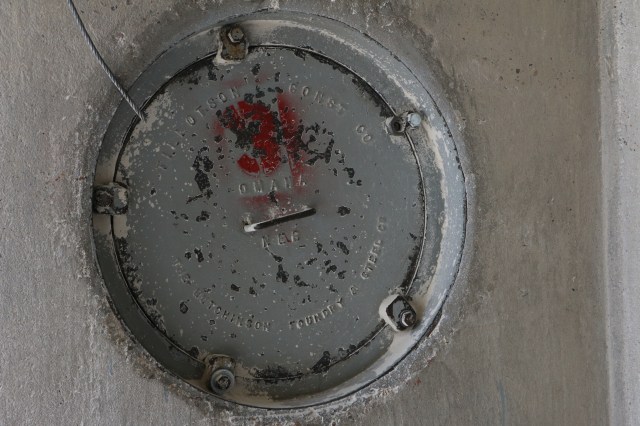 It turned at 42 rpm, cranking the 14-inch, six-ply belt and it’s cups that measured 12 x 6 inches at 8.5 inches o.c. The head drive had a 40-horsepower Howell motor.
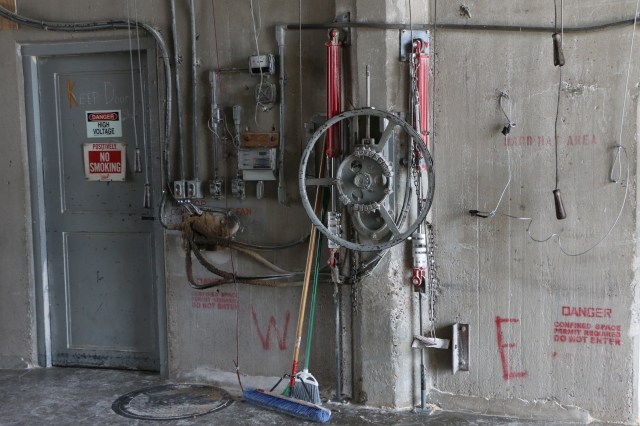 After prowling in and out, up and down, and finding the Ag Producers Co-op elevator at Bushland, Texas, to be spotless and more than serviceable after 68 years, I struggled in the ambitious crosswind and went over the the co-op’s office just to the installation’s north. It’s just north of I-40.
 I remarked on the elevator’s excellent condition and the glistening paint job.


 Our Grandfathers' Grain Elevators