 After departing Hartley, my next stop, just 15 miles northwest on U.S. 87/385, was Dalhart, a market town with brick streets in the business district and, along the railroad tracks, a whole lot of buildings by Tillotson Construction Co. Dalhart is so remote in the Texas Panhandle that six other state capitals are closer than the Texas capital of Austin. For example, it’s 28 miles shorter distance to Lincoln, Neb., than to Austin.
 Mention of Dalhart got my uncle, Charles J. Tillotson, reminiscing about his experience with my grandfather, Reginald O. Tillotson. Perhaps from the following anecdotes we understand why Reginald started using light aircraft for his business travels.
Uncle Chuck writes:
Remembering Dalhart brings back memories of one of Dad’s business trips where I had been brought along to help drive (12 years old). I believe this one was during the winter of ’47 or ’48, and Dad was making a big business loop (similar to yours only in reverse) out of Omaha, down through Kansas, Oklahoma, and Texas and then back up through New Mexico, Colorado, and western Nebraska.
 Anyway, on that trip, it was getting close to sunset as we approached Dalhart, so Dad had me stop in Amarillo where he secured a hotel room.
I will never forget the night in that godforsaken place. The hotel was not insulated nor fully sealed from the winter wind, and I practically froze to death in that cold room with the wind whistling through the cracks in the wall.
I was still frozen the next morning when we headed out to Dalhart, glad the car had a good heater.
Another memorable thing about that trip was what happened after we left Dalhart. We went north up through New Mexico to our 640-acre ranch in Cebolla. Dad had recently purchased this section at the encouragement of one of his best superintendents, Francis Dawson, who lived on a big parcel not too far west from our place.
Ours didn’t have running water, heat, or utilities. After we got there Dad decided to go out to Francis’s where we could stay overnight. The problem was that most of the road to his home was very poorly graveled. It was more like a pathway. 
I was driving the car, but when we got to an area that was somewhat of a bog, Dad took over the wheel to show me how to drive through the mud. Well, it wasn’t very long after that when he got the car high-centered, tore a hole in the oil pan, and lost all the oil. Yet he kept his foot on the gas until we were stuck dead still; then the engine got so hot, it threw a rod.
We had to slog on foot through the mud to Dawson’s house. We arrived by nightfall. The next morning one of Francis’s hired hands got the tractor, fetched the car, and dragged it into the tiny little town of Cebolla (35 miles south of the Colorado border).
As you can imagine, there was no mechanic nor any repair facility. The closest one was well to the south in Espanola. So Dad called around to the various mechanical shops there until he found someone (lucky) that could repair the engine of the fairly new ’48 Chrysler four-door sedan.
Two days later we got under way again, and amazingly the car ran like it had never been through a torture chamber.
All of that trip transpired during my high school winter break and as I recall I only lost a couple of days of the next semester.
A trip I’ll never forget, in the spring of ’49 with me again subbing as a driver, Dad again high-centered a brand-new ’49 Ford and burned up the engine.
He had a thing about willing the car to go forward even though it was hung up with no wheels touching earth.




 By Ronald Ahrens
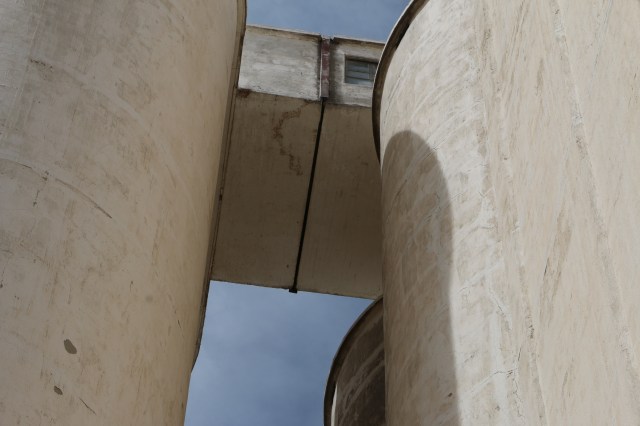
 Weight of the reinforced concrete came to 5,004 tons. Plain concrete for the hoppers totaled 40.3 tons. Grain filling the tanks, or silos, weighed as much as 9,000 tons.
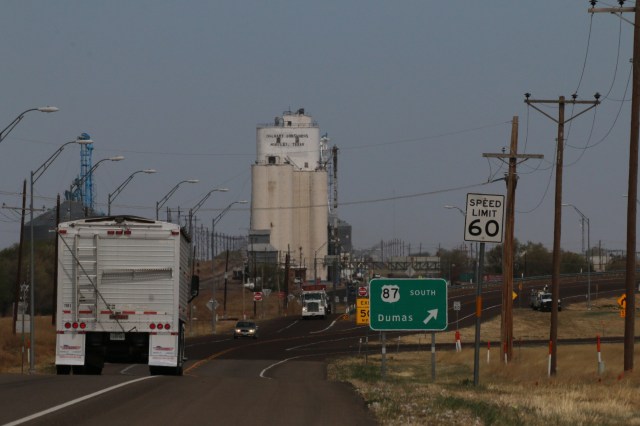
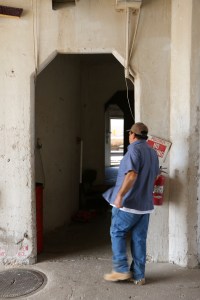
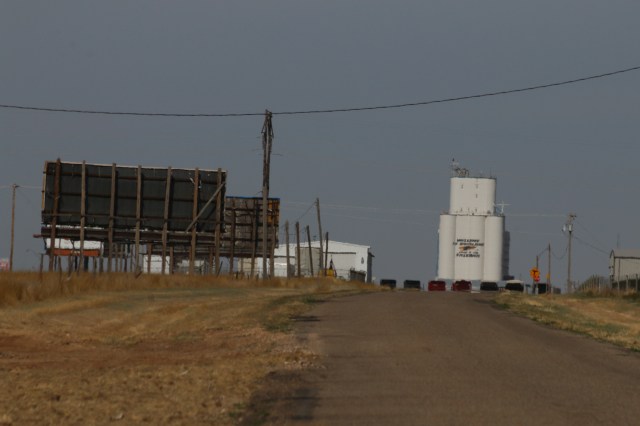
 Schoolchildren were at recess as I drove through side streets looking for a good view of the elevator.




 By Ronald Ahrens
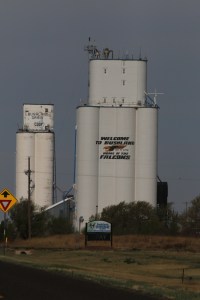 The job 68 years ago required the careful mixing of 2,066 cubic yards of concrete from the sand pile on the site. It would be reinforced with 109.37 tons of steel. At least I think that’s the number in the company records. That line got pinched in the copying process. But 109 tons is consistent with the amount used in other elevators of similar size. The 252,000-bushel elevator built the same year in Pond Creek, Okla.–another on the Dike plan and one of two dozen Tillotson jobs in that bounteous year–used 112.91 tons of steel.


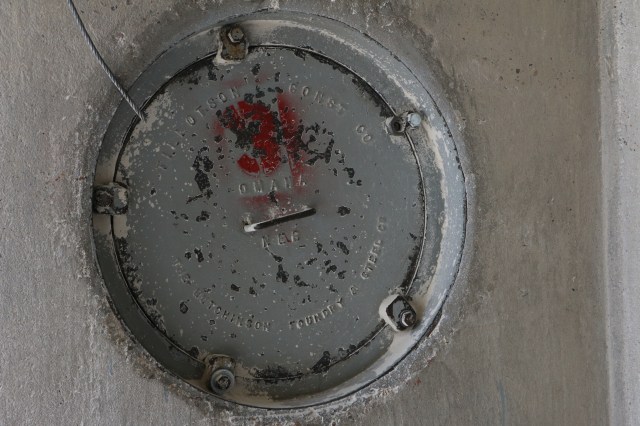 It turned at 42 rpm, cranking the 14-inch, six-ply belt and it’s cups that measured 12 x 6 inches at 8.5 inches o.c. The head drive had a 40-horsepower Howell motor.
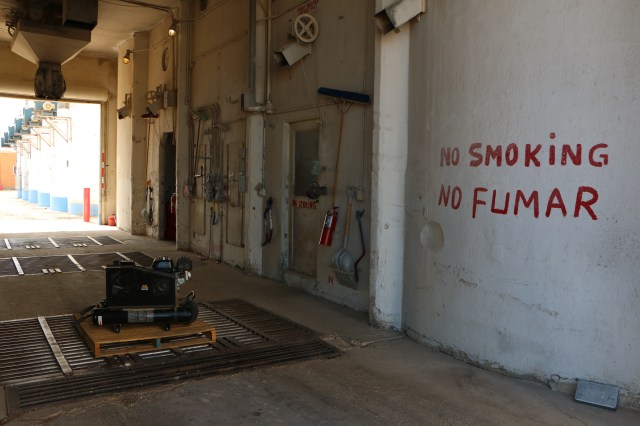
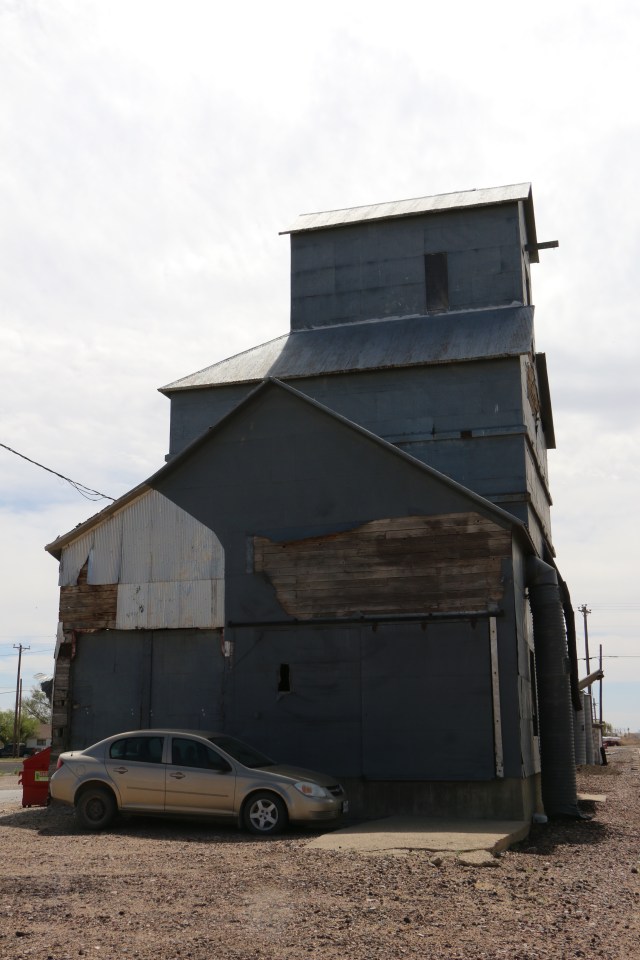
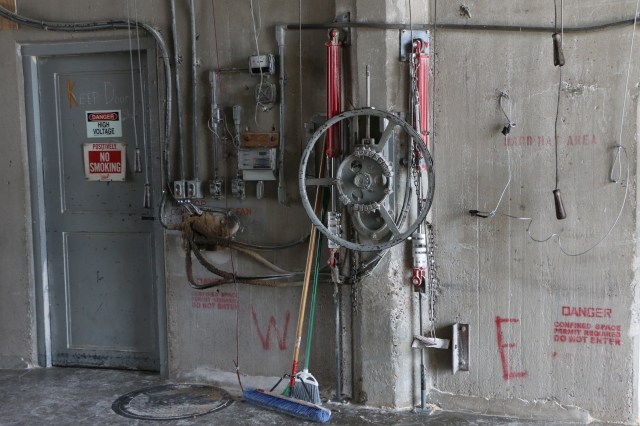 After prowling in and out, up and down, and finding the Ag Producers Co-op elevator at Bushland, Texas, to be spotless and more than serviceable after 68 years, I struggled in the ambitious crosswind and went over the the co-op’s office just to the installation’s north. It’s just north of I-40.
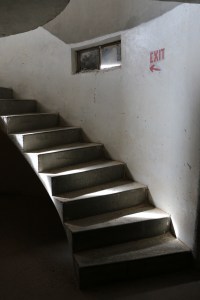 I remarked on the elevator’s excellent condition and the glistening paint job.


 But the drama of the elevator’s construction might have eluded the Class of 2010.
 Indeed, we can hardly count the human cost to building an elevator, or any tall structure, in the early and middle decades of the 20th century.


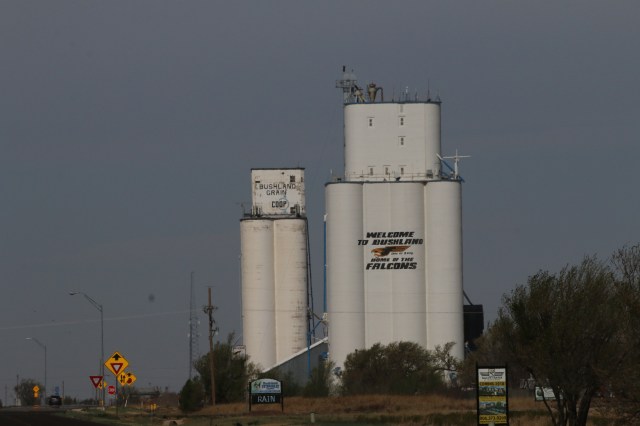


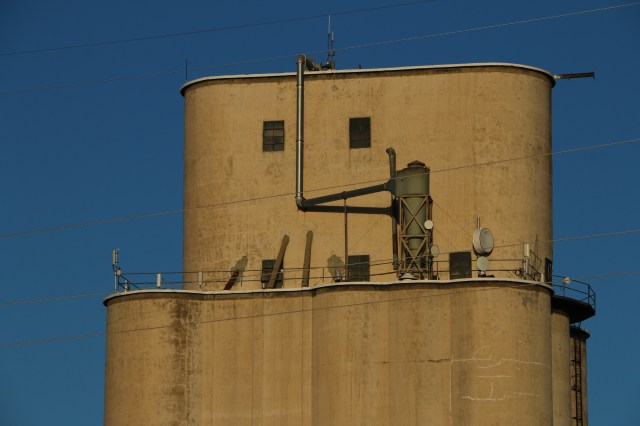 The year 1950 was a busy one for Tillotson Construction Co. The Omaha outfit (my grandfather Reginald Tillotson’s company) built 25 grain elevators–an amazing number. They were in Oklahoma, Texas, Colorado, Kansas, Nebraska, and Iowa. The next year they would build one in Missouri.
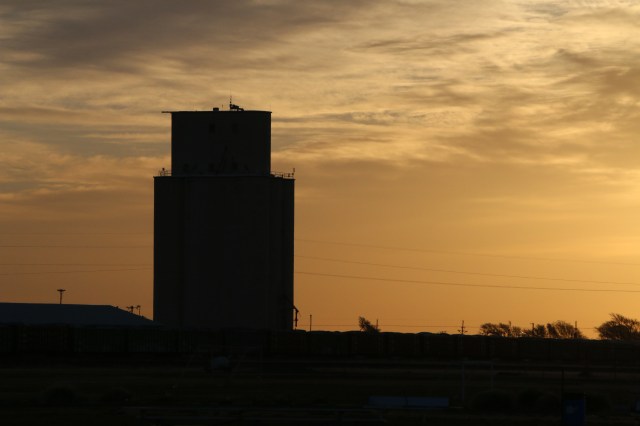 While the Bellwood plan was used for five elevators, it’s interesting to note the slight differences in materials used. For example, Canyon took 2,463 cubic yards of reinforced concrete while Burlington, Colorado, also on the Bellwood plan, took 2,436 cubic yards (the exact same amount as the mother elevator in Bellwood and the one in Hartley, Texas, which is coming soon in this series). Rock Valley, Iowa, though, took 2,394 cubic yards.


 Altogether, 34 hp was required to operate the leg; the record says two 40-hp Howell motors were installed. Theoretical capacity of the leg, based on the cup manufacturer’s rating, was 7,920 bushels per hour. But the leg operated at an actual capacity of 80 percent the theoretical capacity, or 6,350 bushels per hour.
 Our Grandfathers' Grain Elevators