Building a mighty elevator required specialized carpentry and subtle touches

Scan


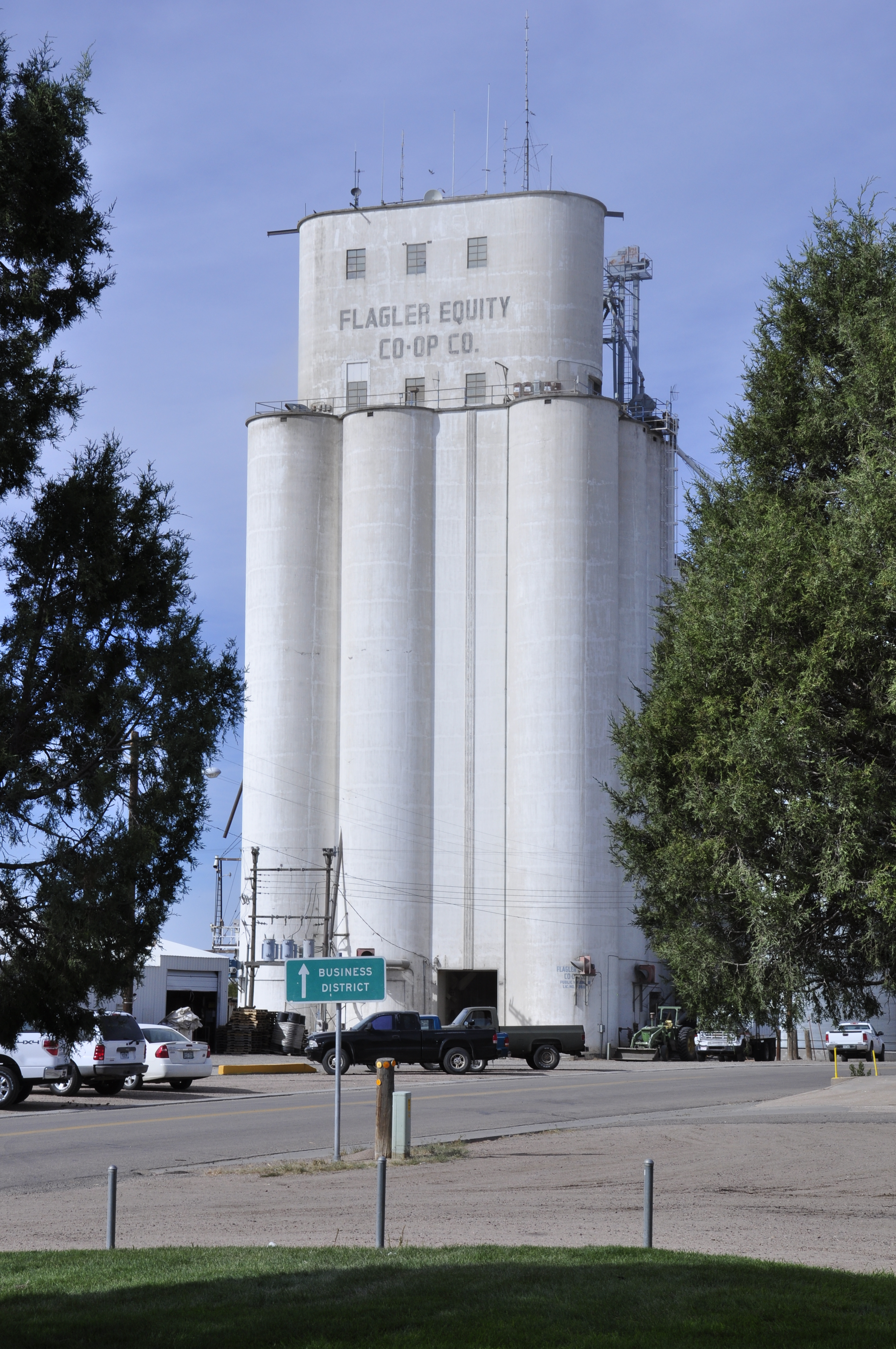
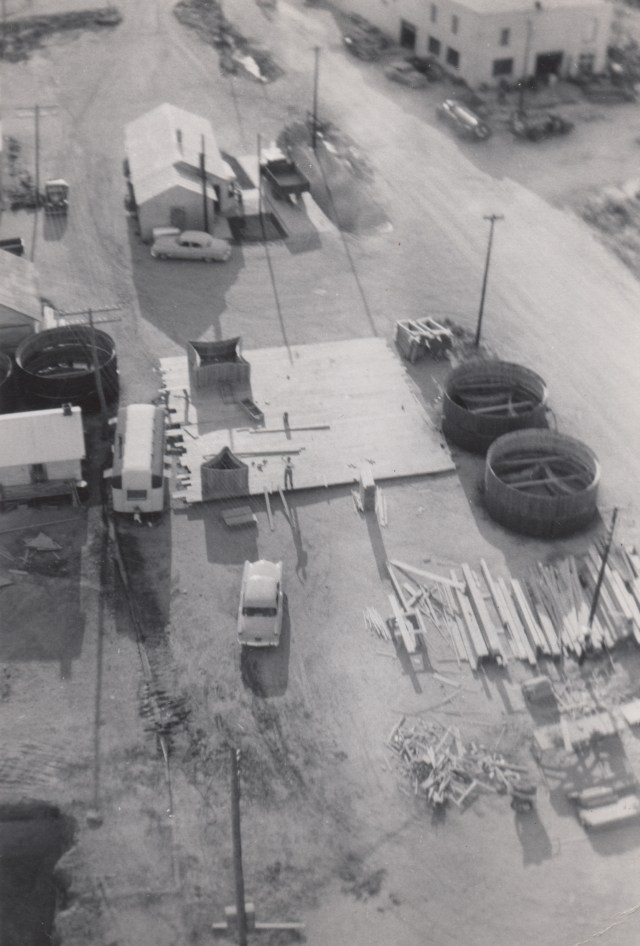
Editor’s note: Here, Charles J. Tillotson offers additional explanation about the formwork at the start of the Flagler, Colo., annex, seen in this 1953 photo from Tillotson Construction Company archives. 

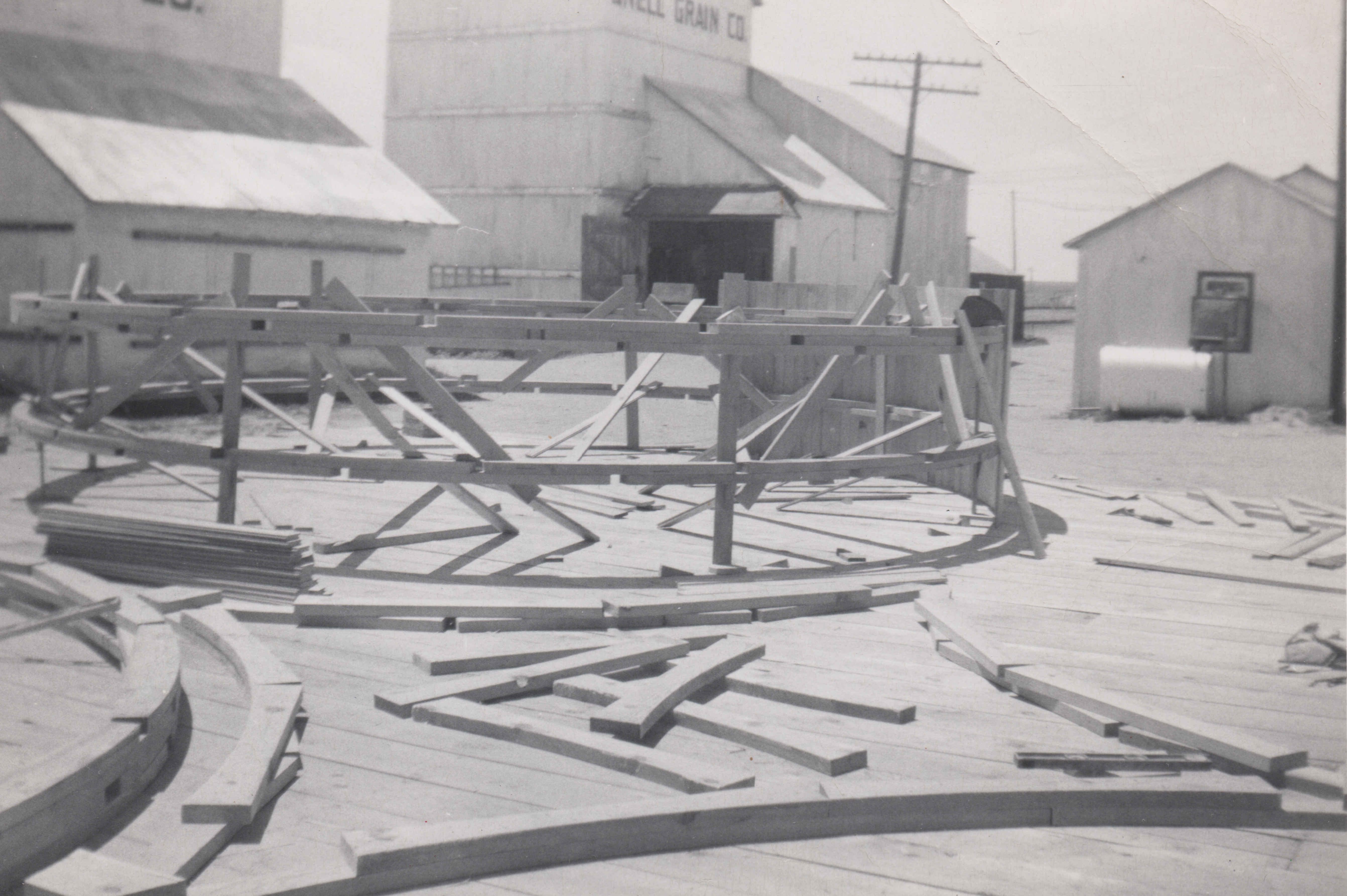
All new lumber was used, the amount of which I couldn’t give any idea but it was a few truckloads at minimum.

The curved lumber was done by hand, either with a table saw or a Skilsaw or both. The notches, of course–for example at the jack yoke locations–were again cut in the field.

Mucho carpentry work, the length of which depended on the number of carpenters that could be scrounged up.

Also, the superintendent of the job was usually out of the carpentry world and could pitch in as needed during form construction.

And there remains one more point to make about the photo from a previous post, “Taking it from the top at Tillotson Construction’s annex in Flagler, Colo.” (use the link that’s included below or click on the photo to see an enlarged version). 

ScanThe dark shadow around the circular bin forms is the residue from “washing down the side.” (This is the side where the cement will be poured.)

The formwork was coated with used motor oil or some other type of lubrication.

Doing so made the formboards moisture resistant and let them more easily slip upward with less friction.


Related articles


Taking it from the top at Tillotson Construction’s annex in Flagler, Colorado

Scan

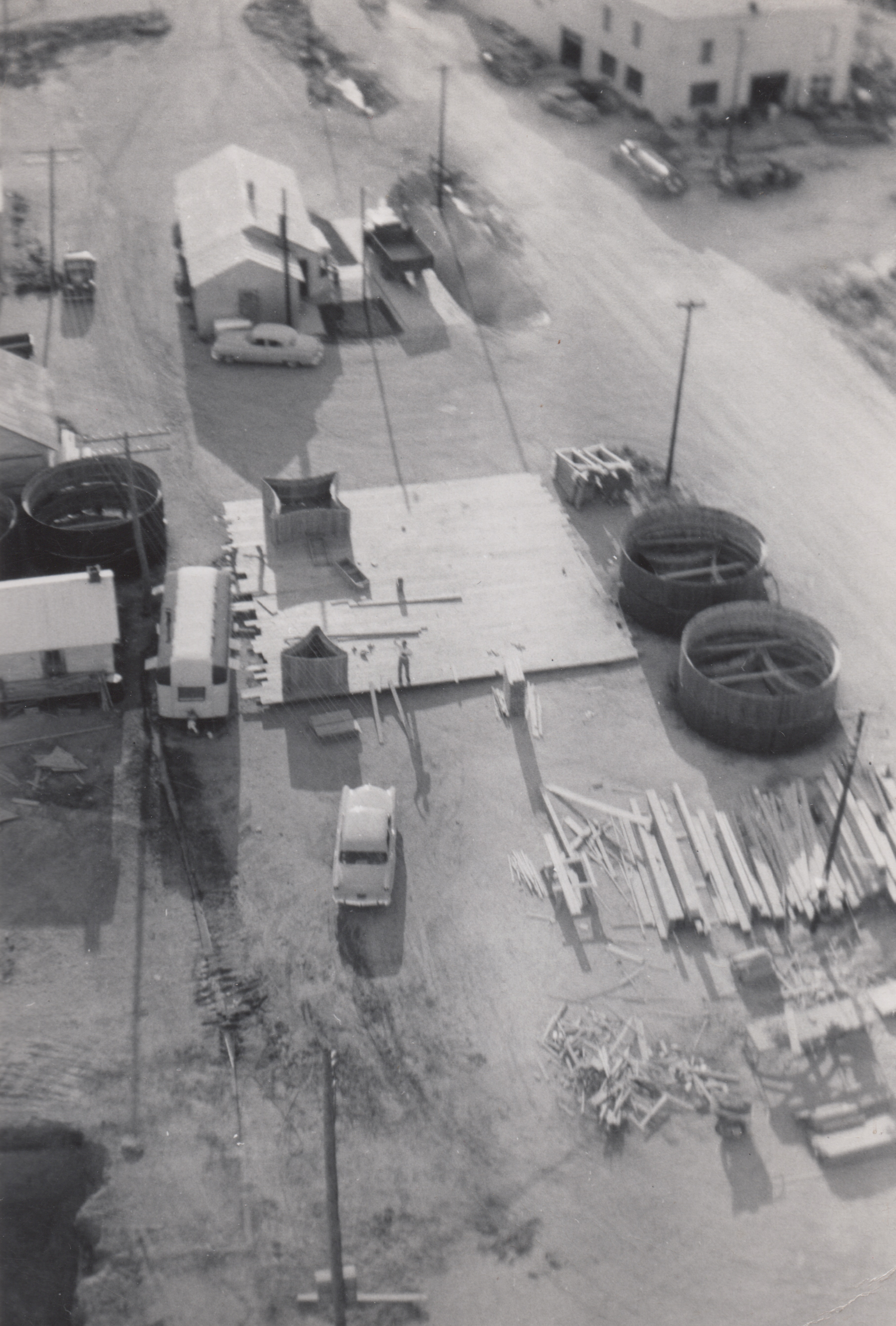
This photo from the Tillotson Construction Company archives shows the staging deck, on which all formwork was built to ensure it was dead level. The square section was probably the form for a conveyor or bucket shaft, or for a man lift. The triangular section, called a groin form, was made for the void where two rows of bin forms were placed together. The excavation hole for the new annex is seen, lower left, at the foot of the 252,000-bushel elevator the company built in 1950, modeling it after their one in Pond Creek, Okla. 

By Ronald Ahrens

In 1953, my grandfather Reginald Tillotson decided to send his three sons, Charles, 18, Tim, 16, and Mike, 13, to work on an annex to the Flagler, Colo., elevator Tillotson Construction Company had built three years earlier.

My grandmother Margaret didn’t like the idea.”You can’t send those kids out there,” she protested.

“It’s about time they grew up,” Reginald said.

Indeed, my uncles were sent, leaving Omaha in a new Ford and pulling the travel trailer that would be their home for the next few weeks.

“I don’t remember that he even came out,” Uncle Tim said recently of Reginald.

From left, Tim and Chuck Tillotson and La Rose Tillotson Hunt in 2012.

From left, Tim and Chuck Tillotson and La Rose Tillotson Hunt in 2012.

While Charles and Tim labored on the formwork that rose toward the sky, Mike stayed in the trailer, which doubled as their bunkhouse and the job office. His task was that of timekeeper.

“I don’t recall him bein’ out there when we was jackin’ and pourin’,  jackin’ and pourin,'” Tim said, although he did recall him reading hot rod magazines.

Once the pouring started, it couldn’t stop. A cold joint between concrete that had already set and a new pour wasn’t at all desirable, for it would leak.

“You had to treat that damn good when you started over,” Tim said.

Work went on in twelve-hour shifts. As the concrete was dumped out of a Georgia buggy–a V-shaped tub riding on large wheels behind a U-shaped handle–someone with a spud hoe would follow the pour and work the concrete, releasing the air from around the rebar. “The only way you shut down was an emergency,” Tim said. Lightning, for example, was an emergency because it was attracted to the rebar being used to bolster the concrete.
_DSC0033_9425The crew was made up of some trusted old hands and an assortment of locals. “You never knew who you were workin’ next to,” Tim said.

He remembers the local sheriff asking himself why he should put up anyone in the jail when they could work and earn their keep. One of the convicts toiling alongside Tim had a funny thought. “You think you can hang onto that hoist handle hard enough if I push you off?” he said.

Any number of mishaps could occur. “You ought to see one of them Georgia buggies go off the top,” Tim said. “Or the cotter pin come off the wheel and the wheel go off.”

At ground level the pour was made in six-inch increments, but the speed increased as the elevator rose.

To keep the screw jacks on the same plane and maintain plumb, the crew used a water-level system on the deck. A clear hose was fed by water from a 55-gallon drum. Tim said the hose had a level “that you marked before you ever pulled off the ground. And believe it or not, you’d get one hundred and some feet up, and you’d be plumb!”
Gordon, Nebraska’s elevator was built in a classic Mayer-Osborn style

The Mayer-Osborn elevator, identified by manhole covers inside the driveway, stands in front of Chalmers and Borton additions

The Mayer-Osborn elevator, identified by manhole covers inside the driveway, stands in front of Chalmers and Borton additions.

Story and photos by Gary Rich

Farmers Co-op operates these elevators. The co-op is based in Gordon, Hay Springs, and Hemingford, Neb.

The elevator in the foreground was built by Mayer-Osborn Construction Company, based in Denver. The completion date is not known.

The elevator in the background was built by Chalmers and Borton Construction, based in Hutchinson, Kan., in 1958. The company built a second elevator, west of these elevators, as well as a couple of annexes.

A side view of the Mayer Osborn elevator

A side view of the Mayer Osborn elevator.

By Kristen Cart

This stepped up headhouse design was first rolled out with the elevator in McCook, Neb., built in 1949 by Mayer-Osborn Construction Company. The style was featured in the Mayer-Osborn ad that ran in the early 1950s in the Farmers Elevator Guide.

The Gordon elevator showcased the rounded headhouse construction method adopted by Tillotson Construction for their later projects, but it is not known which company pioneered the cost saving technique.

From his home in Colorado, Gary Rich investigated this elevator on a trip east to photograph a number of Midwestern elevators. Gary has been instrumental in identifying a large number of Mayer-Osborn, Tillotson Construction, and J. H. Tillotson projects, pursuing the history of the elevators with as much passion as he puts into his excellent photography.

We are indebted to him for his relentless pursuit of good information, now contained in this blog.

Tillotson Construction’s signature, the curved headhouse, was a practical matter

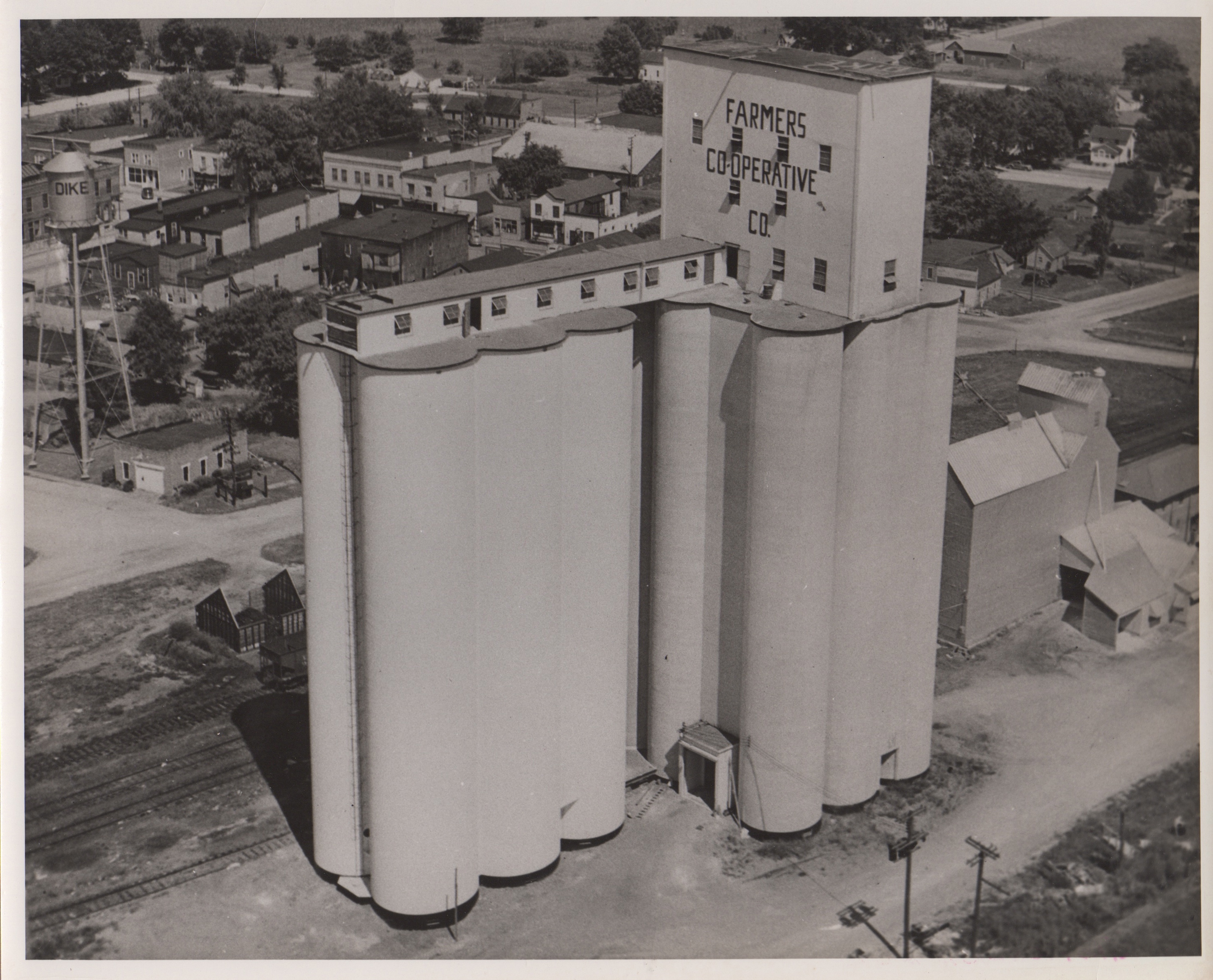
The main house of Tillotson Construction's elevator at Dike, Iowa, built in 1946 (annex, left, 1949), is crowned by a rectilinear headhouse.

The main house of Tillotson Construction’s elevator at Dike, Iowa, built in 1946 (annex, left, 1949), is crowned by a rectilinear headhouse. 

In this post, Charles J. Tillotson explains how his father, Reginald Tillotson, president of Tillotson Construction Company, developed the curved headhouse design.

It would be nice to say that the curved walls were created by Dad for aesthetic reasons and leave it at that.

However, a number of factors actually influenced the design, those being:

  1. Re-use of the curved yokes (the horizontal framework supporting the vertical forms used during slip-form construction of the storage bins).
  2. Building square corners into concrete slip-form construction proved to be more difficult than curved corners.
  3. Placing horizontal reinforcing steel for square corners entailed bending it at a ninety-degree angle and then manhandling it into position, whereas with the curved forms, the horizontal reinforcing steel could be inserted much easier by sliding it into position.
Tillotson's Aurora, Neb., elevator, built in 1950, has a curved headhouse.

Tillotson’s Aurora, Neb., elevator, built in 1950, has a curved headhouse.

For numbers two and three above, keep in mind that all horizontal reinforcing steel, or rebar, was placed by hand (anywhere from twelve to sixteen inches) during the slip-form process, all while the forms were being slipped vertically by screw jacks.

The horizontal steel had to be placed rather quickly throughout the entire structure, so that the steel bars were approximately in alignment from the beginning of placement throughout the structure and back to the beginning point.

On large projects, steel placement was divided into segments with a team captain in charge of each, and all captains would then synchronize their start times for installing the rebar.

Slip-form construction involves a great deal of detailed labor to carry out specific functions while the forms are being jacked vertically in constant motion. It used to be about five to six inches per hour.

Iowan Frank Nine recalls working for Tillotson Construction in the mid-1950s

This photo showing the aftermath of a grain dryer explosion at the Boxholm elevator was uploaded to KCCI by u local contributor hmuench.

This 2009 photo showing the aftermath of a grain dryer explosion at Tillotson’s Boxholm elevator was uploaded to KCCI by u local contributor hmuench.

The following two-part memoir was recently written by Frank Nine, who worked for Tillotson Construction Company in 1954 and 1955 and now lives near Sedalia, Missouri:

I first worked for Tillotson in Dayton, Iowa. Jay Wiser was superviser. We finished there and moved to Bancroft, Iowa, and finished late-fall 1954.

Frank Nine is seen in this recent photo.

Frank Nine, in a recent photo.

Early 1955 we started the Boxholm elevator, where I was from. G.T. Christensen, Jay Wiser, and I became friends and often hung out together when not working. I attended George’s funeral. I was 19 at the time. We went to Dallas Center, Iowa. George’s wife and family [lived] for some time in Boxholm. I later helped her with some minor repair, etc, on their trailerhouse. The children were very young then.

I am now 77 years old.

♦ ♦ ♦

I started out on the tractor-loader filling the hopper for the cement mixer. Some as carpenter helper, on-deck pouring cement, and most of time wherever needed. This was in Dayton, Iowa.

Jay Wiser’s brother–Bud is what they called him, I think Harold was his name–was foreman or boss.

Then we moved to Bancroft, Iowa, where Jay was supervisor, his brother Jesse was a foreman, and George T. Christensen was also.

I worked with Bobby Wheeler and his brother Billy. (I think that was his name.) Also with Jerry Gustafson and his dad and a man they called Cowboy. I think Carlson was his last name.

Bobby and I were friends and hung out often. Jerry and I did the same.

We finished job October-November 1954. Early 1955 we started the job in Boxholm, Iowa, where I met Jim Sheets, and we became friends. I worked the master jacks and run jack crew. Later on, finished cement with Jim–among other jobs as needed. This is where George, Jay, and an old welder, Jesse, became friends.

Bobby, Jerry, Jim, George, Jay, Jesse, and others hung out often. We lost George this year.

Kingfisher Co-op documented the sequence of its elevators in a 1984 history

Scan

By Ronald Ahrens

Thanks to Linda at Plains Partners, in Kingfisher, Okla., we have pages from the special 50-year-history edition of The Co-op Way, published by the Kingfisher Cooperative Elevator Association in 1984.

The history reports what happened only twelve years after the co-op was incorporated. Because of postwar expansion “the need to build a new elevator was obvious,” the history says.

Scan 2The co-op chose Tillotson Construction, of Omaha, for the job.

First, however, the co-op reincorporated early in 1946 to increase its capital.

Work soon got under way when “the association wrecked the old 34,000 bu. elevator and built a new concrete elevator with a 250,000 bu. capacity,” the history says.

“They also wrecked all the other old buildings except the office and scale house which they had built in 1942. It was remodeled into a concrete cleaning and grinding mill and warehouse.”

The year of 1955 “saw the skyline of Kingfisher change once more. A new skyscraper had been added to the landscape, and the farmers took pride in the contribution they had made to their community’s appearance and prosperity.”

Tillotson company records don’t address the question of who built the second elevator, seen at right in the photo below. Neither does the co-op’s history mention the builder.

Scan 3


In 1946, Tillotson Construction built a mighty elevator in Kingfisher, Oklahoma

Scan

By Ronald Ahrens

In 1946, Tillotson Construction Company, of Omaha, built a grain elevator in Kingfisher, Oklahoma.

Kingfisher, a town of 4500 people, lies about forty-five miles northwest of Oklahoma City.

Company plans list the reinforced concrete elevator’s capacity at 240,000 bushels.

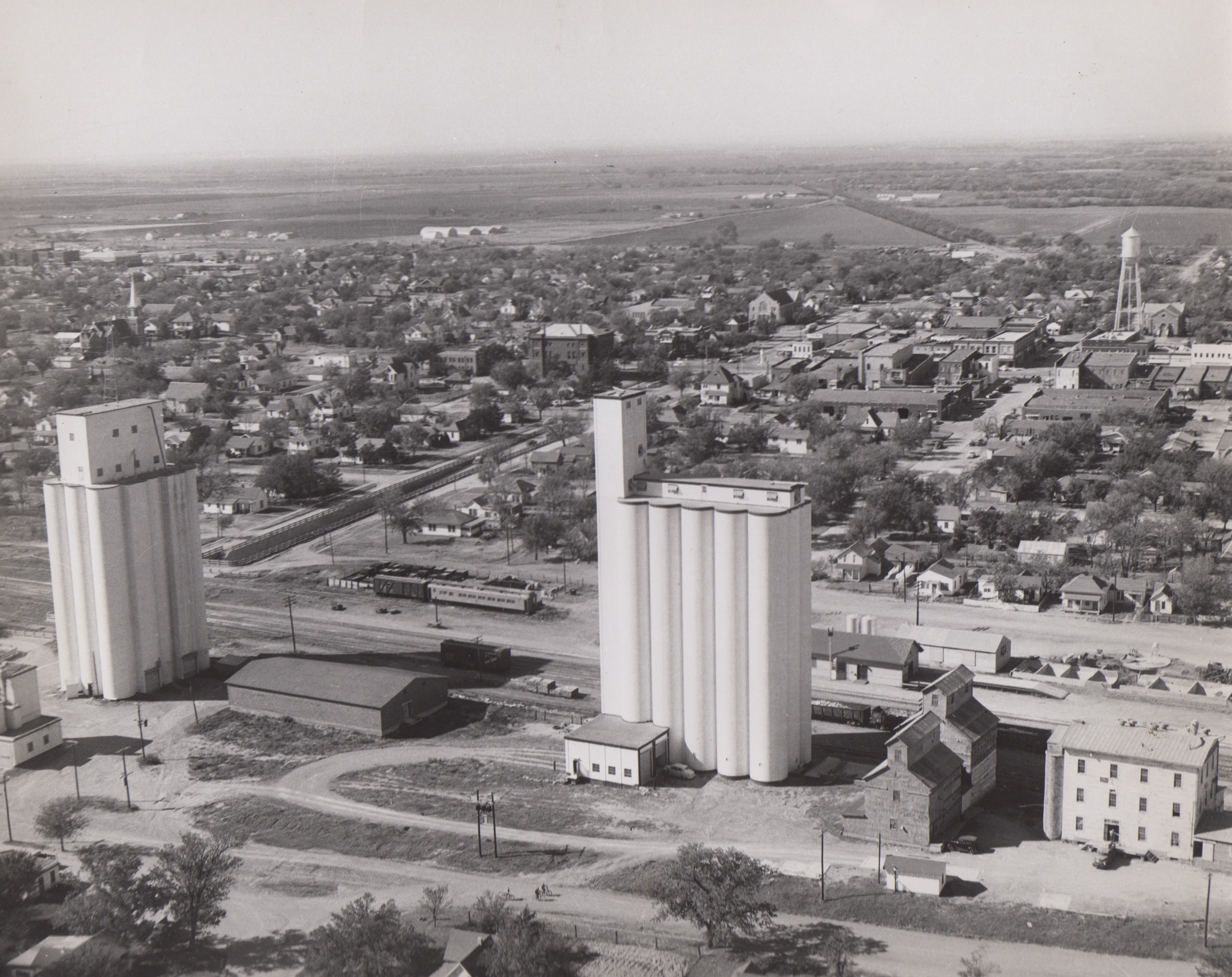
The elevator, seen on the left in the photo in a view from the northeast, was built on an expanded version of Tillotson’s standard Medford plan, with one leg. Two driveways pass through the center of the house.

Storage was calculated at 2400 bushels of grain for each foot of height.

Adapted from Wikipedia's OK county maps by Set...

A call to the elevator was answered by Linda in the office. She dug out a 50-year history of the co-op, published in 1984.

It says that in 1946 the co-op “wrecked” its old 34,000-bushel elevator, preserving the office and sale house, and erected a new 250,000-bushel elevator. (No telling how to account for the 10,000-bushel difference between the company’s records and the co-op’s history.)

The published history includes a 1955 “skyline view” photo that may be the same picture as above. Note the stained, north-facing, outer walls of the Tillotson elevator, indicating it had been in use for some time, while the elevator to the right is obviously brand new.

The Tillotson elevator is presently known as the south elevator. The wooden buildings no longer exist at the site. In recent times, the Kingfisher Co-op Elevator first merged into a regional organization and is now part of a conglomerate.

‘Walking the plank’ on the new Pocahontas, Iowa, elevator in 1954

pocahontasgrainelevator

By Charles J. Tillotson

Safety and the preservation of life have become much more important in today’s world of construction. However, during the 1940s and 1950s, the urgent need to build grain storage coupled with the fact that most elevators were built in very rural areas meant that safety was secondary to getting the job done.

A case in point was a personal experience I had while working in Pocahontas, Iowa.

As with most small towns, the labor pool was rather limited to itinerant farmhands and workmen passing through town. Scaffolding and access walkways were pieced together in a very haphazard way–the means to an end.

One day I was working “up top” of the newly built grain tanks and needed to cross over from the new tanks to the deck of the existing elevator. The distance between the two structures was probably eight feet. To span the gap, two 2×12 planks were placed down between the two structures.

As I began my “walk the planks,” I stubbed my toe on the butt end of one of them. Accordingly, I stumbled forward–but was fortunate enough to regain my footing and continued on across to the other structure.

I realized then how easy it would be to make a misstep and end up at the bottom of the chasm.

Map of Iowa highlighting Pocahontas County

Map of Iowa highlighting Pocahontas County (Photo credit: Wikipedia)

While working in Pocahontas I met a young man, a few years older than I, who had been passing through town on his way back to his home in Hinton, Iowa. His name was Marv, and he had signed on as a carpenter. It was refreshing to me when I met Marv, as he seemed to be a person who was not only a good worker but an intelligent one as well.

When the summer came to an end I had to return to school, and so I said my good-byes to Marv and all the crew on the job. Later that year I learned that Marvin Richards had fallen to his death on the Hinton job (Tillotson-built) while attempting to cross over between two structures.

Hearing the news of his death, I assumed he was the same person I had encountered.

That same summer, Larry Ryan, the hoist operator working for Tillotson Construction Company on the Pocahontas job, had a similar mishap. During Larry’s break from the hoist, he decided to go up through the existing elevator terminal and cross over to the new construction to deliver a piece of angle iron needed by someone up top.

Again, somehow he lost his balance on the planking, and he, too, fell to his death.

It was eerie to think about how, more than once, I had come so close to doing the same thing and just how dangerous an act this was. On the other hand, the concept was fairly simple and straightforward: two 2×12 planks, side by side, laid down between two structures and spanning a distance of only six or eight feet. Not much to it – but only if you don’t slip, stumble, or in some way lose your balance!

At minimum, there should have been a safety railing on one or both sides of the planking.

But, back then, there just wasn’t enough attention given to safety and the value of human life.

Of course, I learned a valuable lesson in precaution and safety from these incidents, which I carried with me throughout my construction career.

J. H. Tillotson’s project at Lodgepole, Neb., was the end of the line for Supt. Bill Morris

DSC_0380

The Lodgepole, Neb. elevator viewed through a rainy windshield on a blustery day.

Story and photo by Kristen Cart

It was the heyday of elevator construction, and J. H. Tillotson, Contractor, of Denver, was riding the crest of the building wave, when a new elevator was begun along Highway 30 (the Lincoln Highway), in the sand hill country of western Nebraska. Lodgepole was a sleepy town along the rail line that connected Sidney to the west, with Chappell and Big Springs to the east.

My grandfather, William Osborn, had been building for several years, and he accompanied Joe Tillotson to Denver when Joe made his break with the family business, Tillotson Construction of Omaha, and set out on his own. The new company had several projects under its belt, and several others ongoing in 1947, when Lodgepole’s elevator was started.

Bill Morris, an employee poached from the parent company, was superintendent for the job.

The dangers of the business were well known. But for the J. H. Tillotson company, fate was especially cruel, though the disasters that befell the builders were of a more mundane sort. In about March of 1947, Bill Morris was changing a tire on the side of Highway 30 near Lodgepole when a car struck him, and he was killed.

Of course the construction project went forth, and my grandfather played a role, since he had the experience to step in where Bill Morris left off.

It was not long afterward that Joe Tillotson met his maker in a car accident–only a matter of a few weeks. In those days safety in vehicles was an afterthought, and the Grim Reaper was guaranteed a regular harvest.

Joe’s death opened doors for my grandfather, since there were elevators to build and contracts to fulfill. By September of 1948, Bill Osborn had joined with Eugene Mayer, Joe’s brother-in-law, and together they formed the partnership of Mayer-Osborn Construction Company. My dad said Grandpa had to put up some money to opt into the business, and then he continued as before, building elevators as fast as they would go up.

The McCook, Neb., elevator marked their first joint effort.

Is it a Tillotson elevator in the Idaho Potato Commission’s TV ad?

IMG_1560

Story by Ronald Ahrens

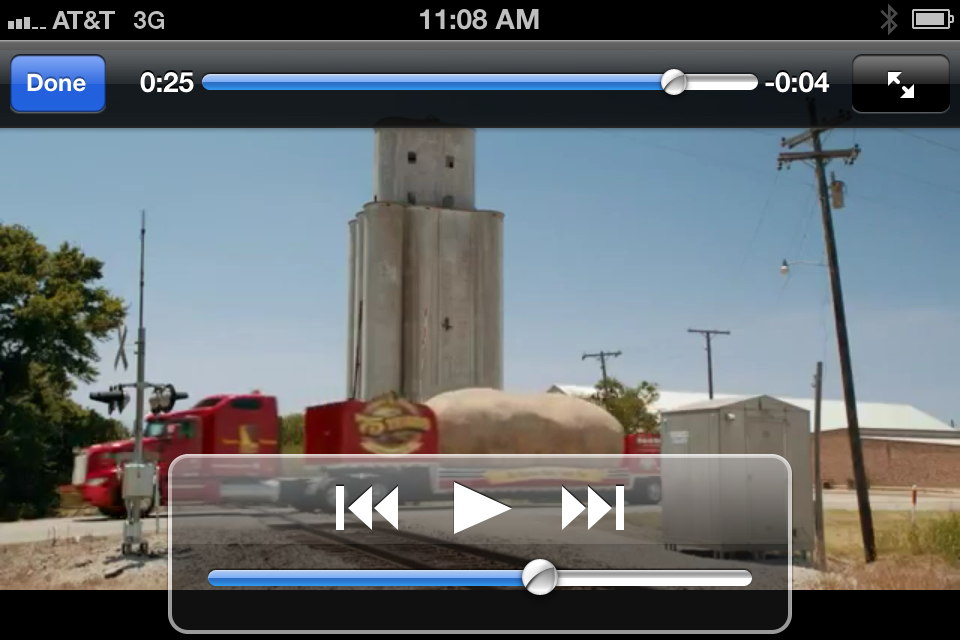
In a television ad for the Idaho Potato Commission, which last year observed its diamond jubilee, a flatbed truck goes missing while on tour with a giant potato. Among the many American landmarks visited in the twenty-five-second spot is a railroad crossing with a concrete grain elevator in the background.

The spot, called “Missing Truck,” was created by Evans, Hardy & Young. Its debut came Aug. 31, 2012, during the Boise State-Michigan State football game on ESPN. The storyline and airing schedule were detailed in a press release on the Idaho Potato Commission’s website.

Although we find nothing in the scene to indicate the exact location, the elevator sure looks to us like a Tillotson Construction job. The rounded headhouse and symmetrically placed windows tell as much. The slot for the driveway also is indicative.

So we phoned the Santa Barbara, Calif., office of EH&Y and left a voice message with Max Martens, vice president for public relations. Replying by email, Mr. Martens wrote, “As close as the art director can pinpoint, the location with the grain elevator was a rural area about a half hour west of Dallas, Texas.”

That’s more than we had to go on.

Meanwhile, we hope the truck and potato made it back to Idaho.