1939 Omaha directory locates Tillotson Construction in Grain Exchange Building

The Omaha city directory for 1939, found by Kristen on Ancestry.com, verifies the status of the Tillotsons. From these pages it emerges that Tillotson Contruction Company kept offices at 720 Grain Exchange Building. Joseph H. Tillotson was president, Reginald O. Tillotson was vice-president, and their mother Rose A. (Brennan) Tillotson was secretary-treasurer in this  year.“Grain elev,” as seen in the listing, would refer to the company’s specialty.

Company president Joe Tillotson appears to have lived at 345 N. 41 St. with his wife Sylvia.

For the other Tillotsons, what could be a residential address of 1804 Dodge St. is given, although the directory’s abbreviations aren’t clear. Included here are Mrs. C.H. (Rose) Tillotson, who was by then the widow of Charles H. Tillotson, and Mary Tillotson, Reginald’s sister.

It seems unlikely that Reginald lived with his mother and sister at 1804 Dodge St. because by 1939 he and his wife Margaret already had at least four children of their own.

All this is in keeping with the announcement the previous autumn of Tillotson Construction Company’s establishment.

‘Stored Potential’ will expand art themes at Tillotson’s Vinton Street elevator

Illustration from Emerging Terrain, a Nonprofit Research & Design Collaborative

The Vinton Street elevator represents a bellwether for Tillotson Construction Co. Not only was it high and mighty but also close at hand for the company with headquarters in Omaha. Family and friends who never went to the small grain-belt towns where Tillotson put up elevators could see this one for themselves. In fact, they couldn’t miss it. And this was particularly true after Interstate 80 was completed: the superhighway went right past the complex that had risen and then expanded and finally fallen into abandonment.When I worked for a time at Omaha’s very first Federal Express office, a part-time job during my freshman year of college, I reguarly drove past the complex while on my way to the airport, having no idea my grandfather’s company had built the key elevator. And in the many times I’ve gone by since then on my return visits to Omaha, I still had no idea.The other day, speaking with my Uncle Tim Tillotson, he mentioned Vinton Street and said that Uncle Charles, the oldest son of Reginald and Margaret Tillotson, worked the night shift during the construction phase.

He also told me about the public art project.

Photo from Emerging Terrain

The abandoned elevator and silos are “bombproof,” as he put it, not readily lending themselves to any scheme for demolition. Even though my own grandfather and uncle had a hand in putting up this structure, I will admit it became rather tedious.

But I object to the invective of the blogger who used the term “visual pollution” and casually denigrated the elevators. Tillotson Construction took pains to erect symmetrical buildings with graceful cupolas.

In language more suitable for a grant proposal than a black eye, Anne Trumble, a thoughtful woman, describes the Vinton Street elevators as a blank canvas for “a large-scale installation re-purposing a prominent grain elevator no longer used for its original purpose.”

In September of 2010, her nonprofit, Emerging Terrain, weighed in with “Stored Potential: Re-Purposing the Mid-Century Grain Elevator” exercise, which allowed artists to work on a large canvas, draping thirteen banners, each of twenty-by-eighty-feet, on the silos.

The theme was land use, and the result was stunning.

Good news: next month, thirteen new banners will be added, this time addressing transport–the physical kind, not the ecstasy some will experience when seeing the finished result.

Related articles

Omaha World-Herald went high above the Vinton Street elevator in ’47

Omaha World-Herald photo in 1947 by John S. Savage, from http://www.historicomaha.org

From www.historicomaha.org

During the summer of 1947, the Omaha World-Herald published a series of 45 aerial photographs depicting the city of Omaha. The pictures were later published in a book entitled “Omaha From the Air.” The photographs were taken by World-Herald staff photographer John S. Savage. The plane was piloted by Marion Nelson of the Omaha Aircraft Company.

Omaha is known around the world for many things. Not the least is its giant grain and milling industry.

This view from the Magic Carpet shows just a segment of the industry which employs thousands here, puts bread and cereals on tables over the world.

From the Magic Carpet you are looking south. The large structure in the foreground is the 1,750,000-bushel elevator of the Westcentral Co-operative Grain Company. Seemingly rising out of the elevator at the rear are the buildings of the Maney Milling Company. South of the elevator is the plant of the Famous Molasses Feed Company.

At far left in the background is the Omar, Inc., mill. Nearby, but not shown, is the Allied Mill. The Butler-Welsh Grain Company elevator is behind the span shown in the background. Also not shown is the Kellogg plant. It is off to the right in the foreground.

The span in the foreground is the Bancroft Street viaduct. Behind it is the Vinton Street viaduct. Far in the background is the Dahlman Crossing. The street at far right is Twenty-seventh.

The two sets of tracks shown at left in the foreground are those of the Burlington. The center string belongs to the Union Pacific and the area is known as its Summit yards. At right are yards of the Chicago and Great Western Railroad.

Through the yards shown here come much of the grain that makes Omaha the nation’s fifth largest grain and milling center.

Carload grain shipments so far this year total 46,508.

Most of the grain pours into Omaha through the Omaha Grain Exchange, organized in 1904. Actually, only little pans of samples appear on the floor of the Exchange. The rest stays in box cars until it is bought, or is stored in elevators.

The market’s 18 elevators have a capacity of 28,185,000 bushels. They include one of the largest in the world, the 10 million bushel elevator of Cargill, Inc.

The railroads serve the grain market.

A good share of Omaha grain receipts is turned into food products here. There are three flour mills, with a daily milling capacity of 10,800,000 pounds. Allied Mills, Inc., has a capacity of 1,200 tons daily in its feed and alfalfa meal plant. The Kellogg Company‘s daily corn products capacity is 7,200 bushels.

A major Omaha grain consumer is the Farm Crops Processing Corporation’s alcohol plant. It can gulp up 40 thousand bushels a day.

One more view, approaching driveway, of Tillotson’s Dallas Center elevator


Photo by Kristen Osborn Cart

Approaching Tillotson Construction’s Dallas Center, Iowa, elevator from a different angle yields a view of the driveway used by co-op members when unloading grain.

This original elevator built in 1955 boasted capacity of 250,000 bushels and rose 166 feet in height.

Dallas Center Farmers Cooperative had contracted Tillotson to do the job for $151,000.

Handsome headhouse adds distinction to Tillotson’s Dallas Center elevator

Story by Ronald Ahrens

Photo by Kristen Osborn Cart

In a phone conversation today with my Uncle Tim Tillotson, who lives in Virginia, he initially had no recollection of Tillotson Construction Company’s elevator in Dallas Center, Iowa.

He put this down to his hitch in the Army from 1955 to 1957.

After a while, though, the name Dallas Center started to come back to him a little. Uncle Tim reckoned it was indeed among the dozens and dozens of Tillotson Elevators.

This was the first he had heard about Our Grandfathers’ Grain Elevators. (We played phone tag in January and now finally got in touch.) He said he would look at it at one of his neighbors’. He doesn’t have a computer.

We’re hoping he can come up with some pictures and maybe a few documents, and that his memory is sparked.

One question to me was whether we’re aware of the distinctive architectural styles of individual construction companies. I could answer that indeed we are, thanks in large part to Gary Rich’s expositions through words and pictures.

A Tillotson characteristic is the rounded headhouse, also called a cupola, which Kristen has so graphically captured in this image.

It’s good to see the window panes have been replaced as they’ve broken: I presume that explains the checkerboard pattern.

But then after all, in Dallas Center, as Kristen points out, the Tillotson elevator is at the center of the community, so naturally it’s kept up.

After 57 years, springtime blossoms enhance Tillotson’s Dallas Center elevator

Story and photos by Kristen Osborn Cart

On the way home from spring break in Nebraska, we went through Dallas Center, Iowa, on a perfectly beautiful day.

The kids got ice cream cones while I took out my camera.

A worker at the complex let me wander around and take pictures. He pointed out the older elevator with the rounded headhouse.

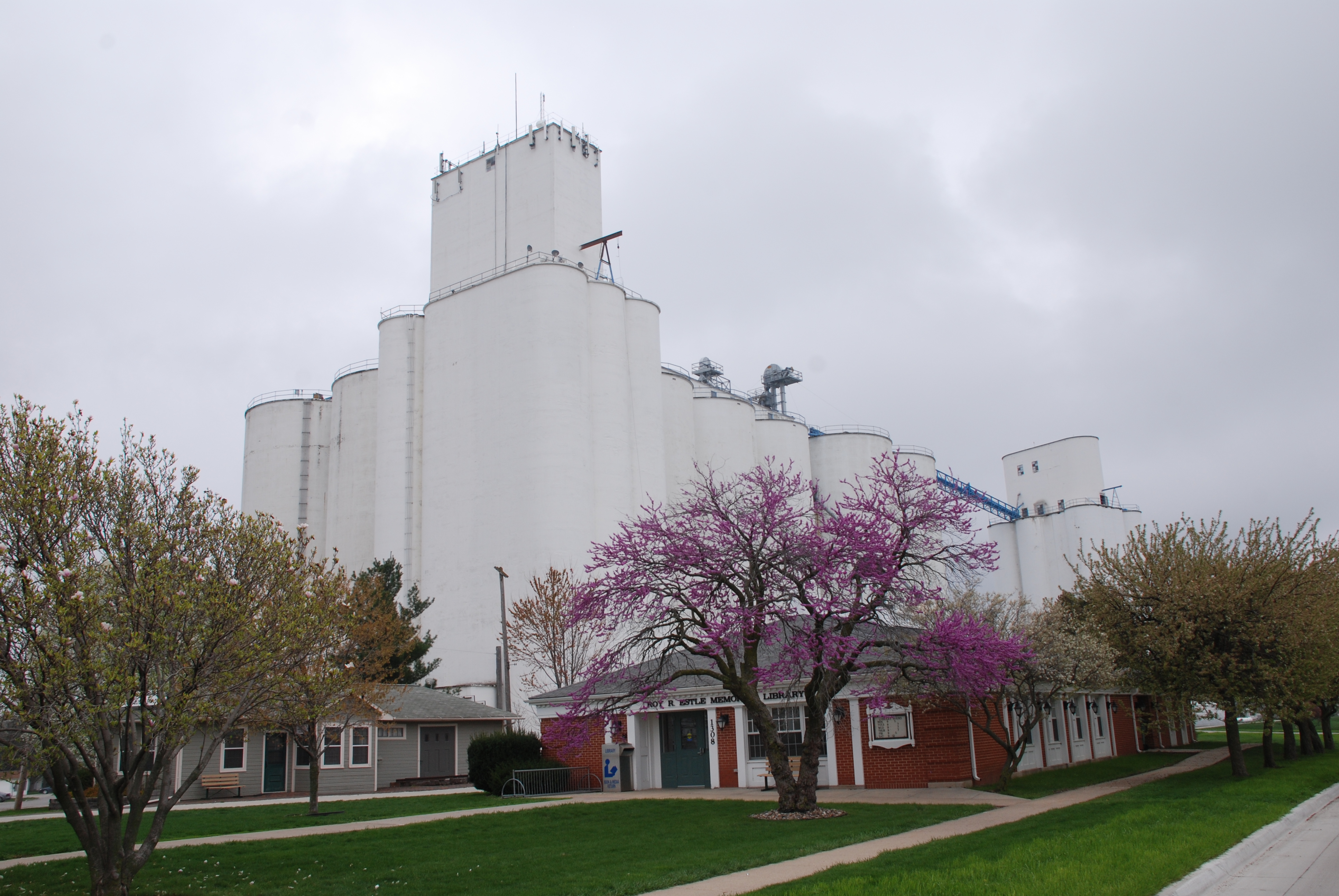
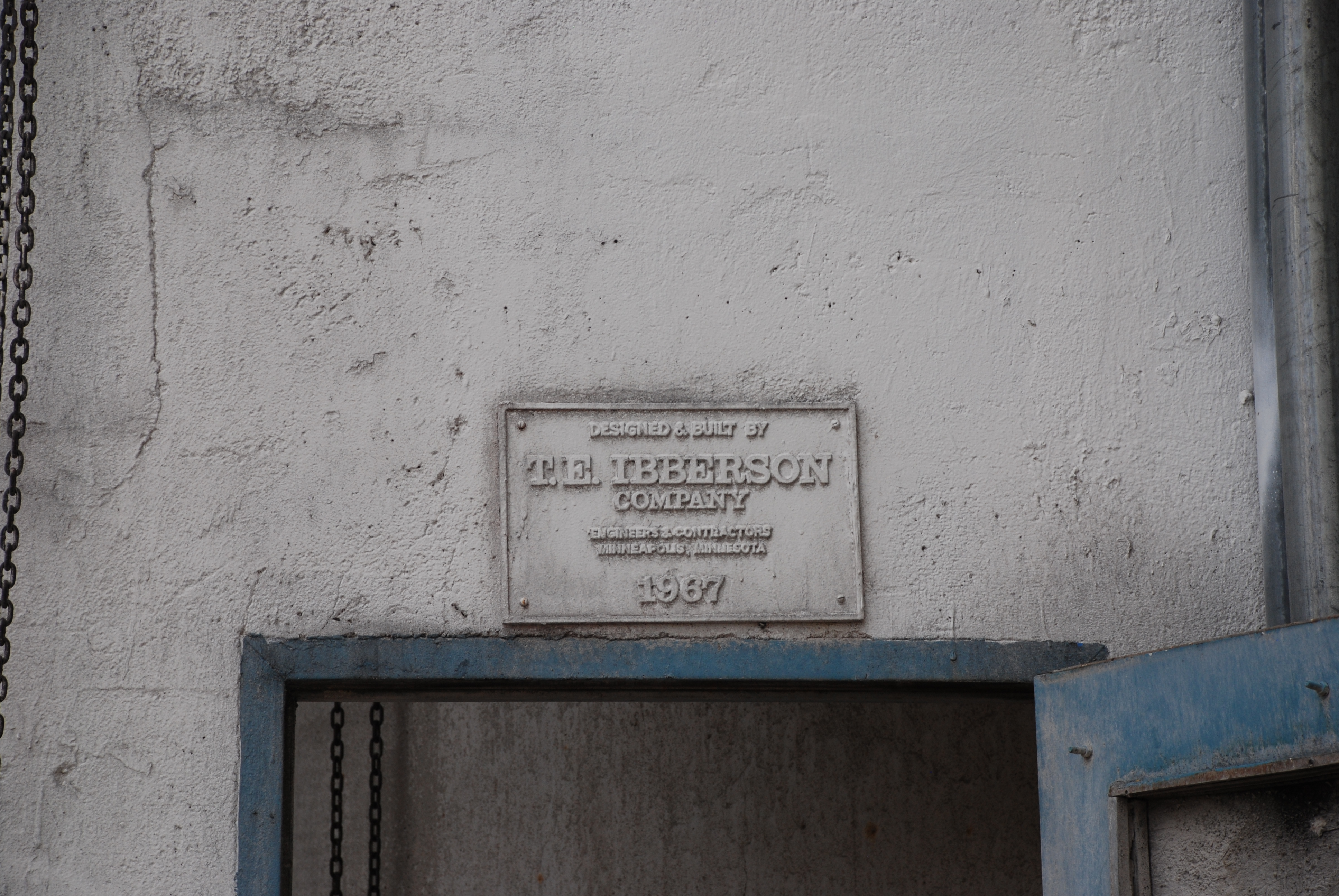
This elevator (seen far right in the photo above), built by Tillotson Construction Company in 1955, is connected by a run to the annex, which adjoins a T. E. Ibberson elevator (far left), built in 1967.

A grain dryer stands between them.

No railway is in evidence, other than the re-purposed station.

Everything appears to be in good working order with a fresh coat of paint.

The elevators dominate Dallas Center as a true prairie landmark, rising at the end of the main street and extending more than a block, with a library and ice cream shop next door.

A blooming redbud tree brightens the scene.

Standing before the annex: a veterans memorial.

The whole property exists in harmony with the town, unlike the many derelict elevators in Midwestern towns where progress has moved past, and only the wrecking ball awaits.

This elevator complex is worth a visit. It’s a beauty.

Greenwood elevator welcomes 250 at open house

Photo by Kristen Osborn Cart

GREENWOOD (Nebr.)–The Farmers Union Cooperative Association held open house at the new concrete elevator which has capacity for 128,000 bushels of grain. Manager Floyd H. Gove and assistant M.L. Griffith conducted 250 through the plant. Doughnuts, cookies and coffee were served in the basement.Farmers’ Elevator Guide, November 1951

Approval and completion of a concrete elevator in Pocahontas, Iowa

POCAHONTAS–The Farmers’ Cooperative Elevator has approved final plans for construction of a 250,000 bushel storage plant. The new elevator will consist of eight tanks, 20 feet in diameter and 120 feet high with a cupola to project more than 20 feet above the tanks. Each of 17 bins will hold about 15,000 bushels. Their present elevator has a capacity of 60,000 bushels while the Havelock branch elevator holds 40,000. The new plant should be finished about Sept. 1.Farmers’ Elevator Guide, June 1949
POCAHONTAS–The New 250,000-bushel concrete elevator which cost the Farmers Cooperative association $125,000 is completely filled with soybeans stored for customers and corn stored for the government. The structure is 120 feet high. The Pocahontas cooperative, one of the leading groups in northwest Iowa, plans to build a new truck scale, a new office and a new (illegible) house next spring.Farmers’ Elevator Guide, December 1949
Note: Tillotson Construction Company worker Larry Ryan fell to his death here in 1954.

This map shows the incorporated and unincorpor...

Tillotson Construction completes Big Springs sorghum plant

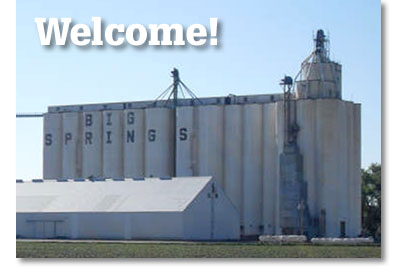
Photo courtesy of Farmers Elevator Coop Association

BIG SPRINGS–The Tillotson Construction Co., Hastings, Neb., has completed a $40,000 building for the Farmers Cooperative Elevator sorghum plant.

Farmers’ Elevator Guide, August 1951

Note: A conversation today with Larry McCroden, long-time manager of the Big Springs Farmers Coop Elevator, reveals additional information about the facilities. Mr. McCroden consulted tax documents that showed “Elevator A” had a value of $184,432 and “Elevator B” had a value of $25,100. He said the twenty original bins of Elevator A stand about 115 feet tall, and the two-tiered headhouse reaches to 170 feet. The documents give January 15, 1951 as the date of service for the two.

Later additions were made to the original structure, increasing storage capacity by hundreds of thousands of bushels.

Mr. MrCroden said the elevator at Roggen, Colorado, bears many similarities to Big Springs.

Additional note: We don’t know why Hastings, Nebraska is given as the location of Tillotson Construction Co., which had its headquarters in Omaha.

Tillotson gets 50,000-bushel Paullina elevator under way

Paullina elevator complex, Dec. 9, 2009, by Jim Hamann

PAULLINA (IOWA)–A new concrete elevator is under construction to replace the Paullina Grain Co. elevator destroyed by fire. The new one will be 103 feet high, containing 18 bins. All new machinery, including a 50-ton scale, will be installed. Capacity will be 50,000 bushels.

Farmers’ Elevator Guide, June 1949