 By Ronald Ahrens
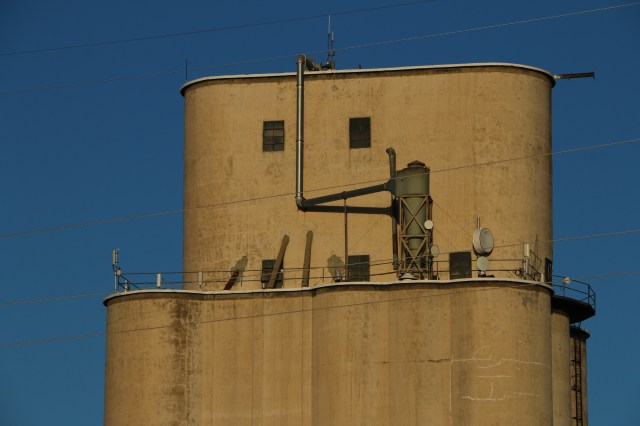
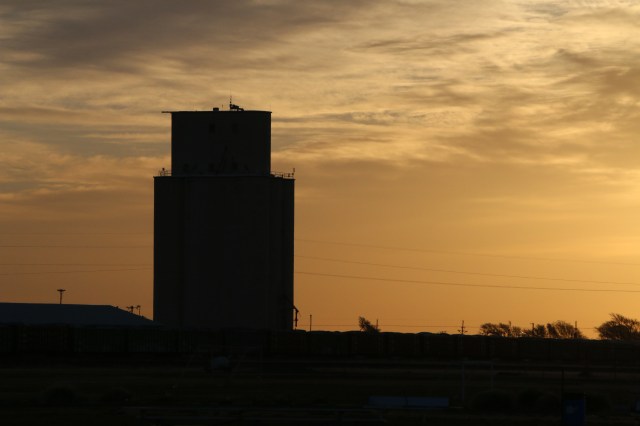
The elevator built by Tillotson Construction Co. in Hartley, Tex., fulfilled a crying need for grain handling and storage there in 1950. More capacity would be added, but for the time being this 300,000-bushel elevator was the answer.
 Although records say it followed the Bellwood, Neb., plan like Burlington, Colo., which was another of Tillotson’s bountiful 1950 crop of elevators, Bellwood was a single-leg elevator. Hartley and Burlington were twin-leg elevators. We wonder how difficult it was to adapt the standardized design to include two legs.
In the early days, Tillotson’s talented engineer, Wayne Skinner, did the calculations.
In its construction, the Hartley elevator used 2,436 cubic yards of reinforced concrete and 20.3 yards of plain concrete for the hoppers.

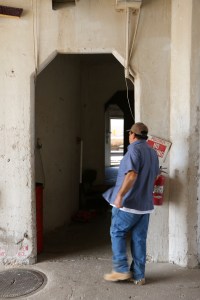
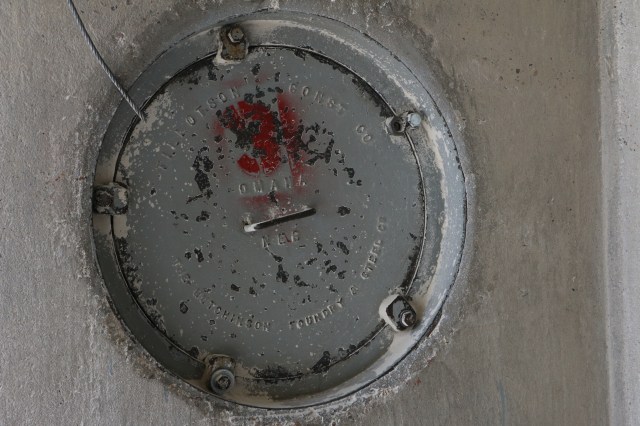
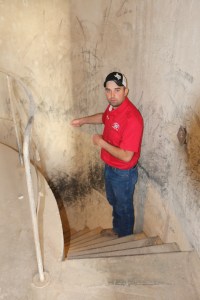
Access points to the two legs inside the Hartley, Tex., elevator.
Some 131.71 tons of steel (including jack rods) were needed for the job. That translated to 108.14 pounds of steel per cubic yard of concrete.
The 24-inch-thick main slab occupied a space of 66 feet by 72.5 feet for an area of 4,806 square feet, according to Tillotson’s records. We get 4,785 feet from our arithmetic and don’t know how to account for the discrepancy unless the note saying “Act. outside on Ground” means something in this regard.
Below the main slab, the pit reached the depth of 19 feet 0 inches.
 Weight of the reinforced concrete came to 5,004 tons. Plain concrete for the hoppers totaled 40.3 tons. Grain filling the tanks, or silos, weighed as much as 9,000 tons.
With another 28 tons of structural steel and machinery, the elevator weighed 14,299 tons. Again, we find a discrepancy, with our calculations showing 14,072 tons.
Bearing pressure on the drawform walls of the silos maxed out at 2.975 tons per square foot.
The Bellwood plan provided for 120-foot-tall silos, but those at Hartley (and Burlington) were 115 feet tall.
The outside of the cupola, or headhouse, was 23 feet wide, 63.75 feet long, and 44 feet tall. Like Canyon, with its five-foot-taller silos but lower headhouse, the Hartley elevator still reached 159 feet in overall height.
The legs’ pulley centers were separated by a distance of 168 feet. The boot pulleys were the standard size Tillotson used in 1950. That was 72 x 14 x 2 3/16 inches. The head pulleys, also conforming to the standard of that year, were 72 x 14 x 3 15/16 inches.
The 40-hp Howell motor could turn the head at 42 rpm.
The multi-ply, 360-foot Calumet belt had cups of 12 x 6 inches to carry grain from the pit. Like Burlington and Canyon, the cup manufacturer’s theoretical capacity was 7,920 bushels per hour. But of course the leg operated at 80 percent of theoretical, so the actual capacity was 6,350 bushels per hour, requiring 32 hp.
The man lift operated with a 1.5-hp motor. The truck lift in the 13-foot-wide driveway used a robust 7.5-hp Ehrsam motor.
No special notes attached to the Bellwood plan. Tillotson had a solid design that enabled construction of a mighty elevator in many locations by small crews working around the clock. The one in Hartley keeps doing its job.
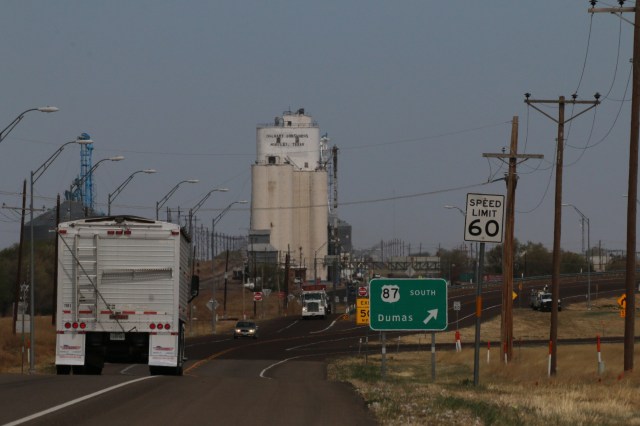
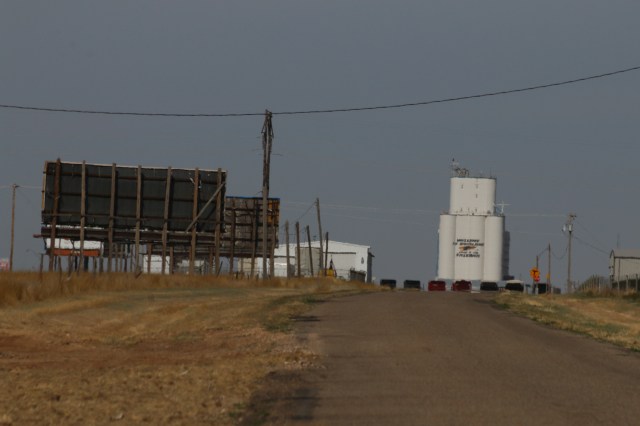
 Schoolchildren were at recess as I drove through side streets looking for a good view of the elevator.




 By Ronald Ahrens
 The job 68 years ago required the careful mixing of 2,066 cubic yards of concrete from the sand pile on the site. It would be reinforced with 109.37 tons of steel. At least I think that’s the number in the company records. That line got pinched in the copying process. But 109 tons is consistent with the amount used in other elevators of similar size. The 252,000-bushel elevator built the same year in Pond Creek, Okla.–another on the Dike plan and one of two dozen Tillotson jobs in that bounteous year–used 112.91 tons of steel.


 It turned at 42 rpm, cranking the 14-inch, six-ply belt and it’s cups that measured 12 x 6 inches at 8.5 inches o.c. The head drive had a 40-horsepower Howell motor.
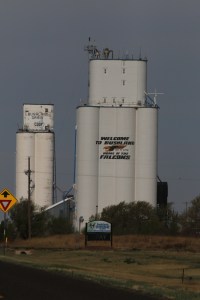
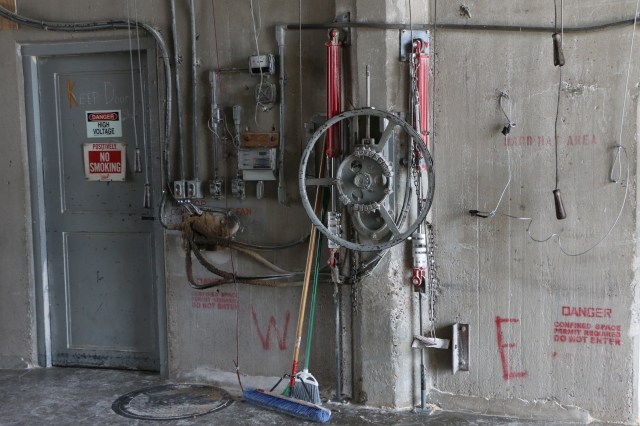 After prowling in and out, up and down, and finding the Ag Producers Co-op elevator at Bushland, Texas, to be spotless and more than serviceable after 68 years, I struggled in the ambitious crosswind and went over the the co-op’s office just to the installation’s north. It’s just north of I-40.
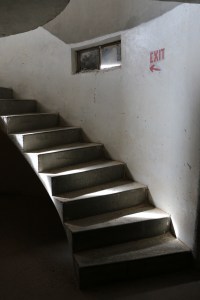 I remarked on the elevator’s excellent condition and the glistening paint job.


 But the drama of the elevator’s construction might have eluded the Class of 2010.
 Indeed, we can hardly count the human cost to building an elevator, or any tall structure, in the early and middle decades of the 20th century.


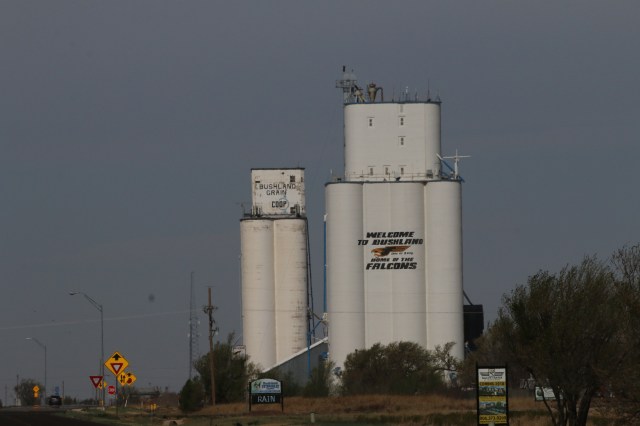


 The year 1950 was a busy one for Tillotson Construction Co. The Omaha outfit (my grandfather Reginald Tillotson’s company) built 25 grain elevators–an amazing number. They were in Oklahoma, Texas, Colorado, Kansas, Nebraska, and Iowa. The next year they would build one in Missouri.
 While the Bellwood plan was used for five elevators, it’s interesting to note the slight differences in materials used. For example, Canyon took 2,463 cubic yards of reinforced concrete while Burlington, Colorado, also on the Bellwood plan, took 2,436 cubic yards (the exact same amount as the mother elevator in Bellwood and the one in Hartley, Texas, which is coming soon in this series). Rock Valley, Iowa, though, took 2,394 cubic yards.


 Altogether, 34 hp was required to operate the leg; the record says two 40-hp Howell motors were installed. Theoretical capacity of the leg, based on the cup manufacturer’s rating, was 7,920 bushels per hour. But the leg operated at an actual capacity of 80 percent the theoretical capacity, or 6,350 bushels per hour.
 By Ronald Ahrens
 Our Grandfathers' Grain Elevators