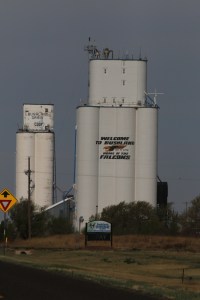
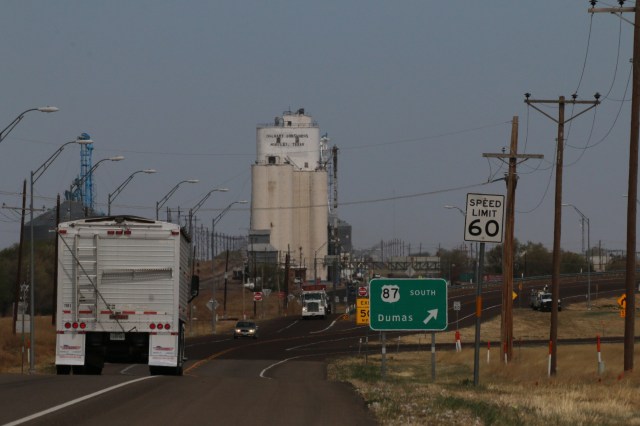
Onward to Dalhart, Tex., and memories of a wild ride through New Mexico in 1948

IMG_8992After departing Hartley, my next stop, just 15 miles northwest on U.S. 87/385, was Dalhart, a market town with brick streets in the business district and, along the railroad tracks, a whole lot of buildings by Tillotson Construction Co. Dalhart is so remote in the Texas Panhandle that six other state capitals are closer than the Texas capital of Austin. For example, it’s 28 miles shorter distance to Lincoln, Neb., than to Austin.

Texas-Okla Logo 04Mention of Dalhart got my uncle, Charles J. Tillotson, reminiscing about his experience with my grandfather, Reginald O. Tillotson. Perhaps from the following anecdotes we understand why Reginald started using light aircraft for his business travels.

Uncle Chuck writes:

Remembering Dalhart brings back memories of one of Dad’s business trips where I had been brought along to help drive (12 years old). I believe this one was during the winter of ’47 or ’48, and Dad was making a big business loop (similar to yours only in reverse) out of Omaha, down through Kansas, Oklahoma, and Texas and then back up through New Mexico, Colorado, and western Nebraska.

IMG_9009Anyway, on that trip, it was getting close to sunset as we approached Dalhart, so Dad had me stop in Amarillo where he secured a hotel room.

I will never forget the night in that godforsaken place. The hotel was not insulated nor fully sealed from the winter wind, and I practically froze to death in that cold room with the wind whistling through the cracks in the wall.

I was still frozen the next morning when we headed out to Dalhart, glad the car had a good heater.

Another memorable thing about that trip was what happened after we left Dalhart. We went north up through New Mexico to our 640-acre ranch in Cebolla. Dad had recently purchased this section at the encouragement of one of his best superintendents, Francis Dawson, who lived on a big parcel not too far west from our place.

Ours didn’t have running water, heat, or utilities. After we got there Dad decided to go out to Francis’s where we could stay overnight. The problem was that most of the road to his home was very poorly graveled. It was more like a pathway. IMG_9019

I was driving the car, but when we got to an area that was somewhat of a bog, Dad took over the wheel to show me how to drive through the mud. Well, it wasn’t very long after that when he got the car high-centered, tore a hole in the oil pan, and lost all the oil. Yet he kept his foot on the gas until we were stuck dead still; then the engine got so hot, it threw a rod.

We had to slog on foot through the mud to Dawson’s house. We arrived by nightfall. The next morning one of Francis’s hired hands got the tractor, fetched the car, and dragged it into the tiny little town of Cebolla (35 miles south of the Colorado border).

As you can imagine, there was no mechanic nor any repair facility. The closest one was well to the south in Espanola. So Dad called around to the various mechanical shops there until he found someone (lucky) that could repair the engine of the fairly new ’48 Chrysler four-door sedan.

Two days later we got under way again, and amazingly the car ran like it had never been through a torture chamber.

All of that trip transpired during my high school winter break and as I recall I only lost a couple of days of the next semester.

A trip I’ll never forget, in the spring of ’49 with me again subbing as a driver, Dad again high-centered a brand-new ’49 Ford and burned up the engine.

He had a thing about willing the car to go forward even though it was hung up with no wheels touching earth.
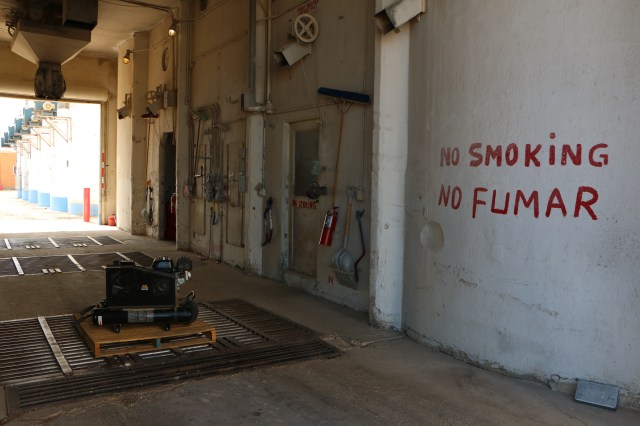
Photo details of Tillotson’s 300,000-bushel elevator in Hartley, Tex.

IMG_8963

However you express it, there’s no smoking at the Hartley elevator.

IMG_8971

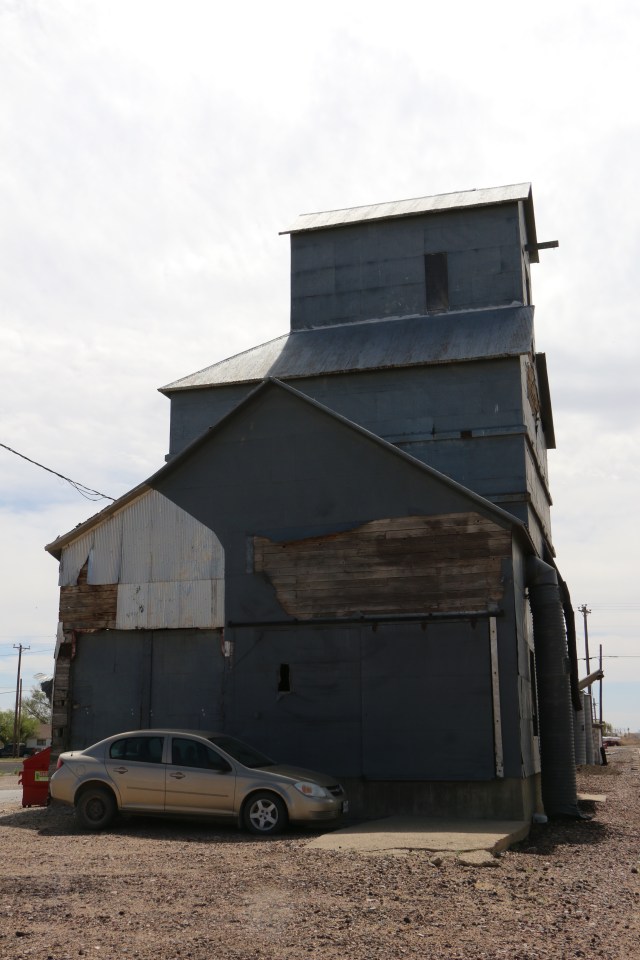
The metal-clad wooden elevator remains intact in Hartley.


IMG_8974

A closer view of the metal-clad wooden elevator at Hartley. Note the modest eaves, which reduced the chance of catching sparks from a passing train.


IMG_8955

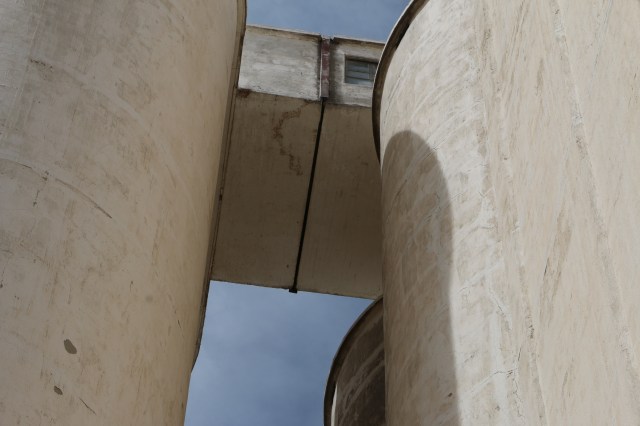
Detail view of the run that surmounts silos, here bridging from the main house to the storage annex at the Tillotson elevator in Hartley, Tex.

Specs show how Tillotson’s Hartley elevator measured up in 1950

IMG_8944By Ronald Ahrens

The elevator built by Tillotson Construction Co. in Hartley, Tex., fulfilled a crying need for grain handling and storage there in 1950. More capacity would be added, but for the time being this 300,000-bushel elevator was the answer.

Texas-Okla Logo 04Although records say it followed the Bellwood, Neb., plan like Burlington, Colo., which was another of Tillotson’s bountiful 1950 crop of elevators, Bellwood was a single-leg elevator. Hartley and Burlington were twin-leg elevators. We wonder how difficult it was to adapt the standardized design to include two legs.

In the early days, Tillotson’s talented engineer, Wayne Skinner, did the calculations.

In its construction, the Hartley elevator used 2,436 cubic yards of reinforced concrete and 20.3 yards of plain concrete for the hoppers.

IMG_8957

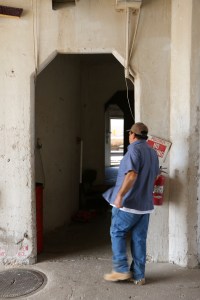
Access points to the two legs inside the Hartley, Tex., elevator.

Some 131.71 tons of steel (including jack rods) were needed for the job. That translated to 108.14 pounds of steel per cubic yard of concrete.

The 24-inch-thick main slab occupied a space of 66 feet by 72.5 feet for an area of 4,806 square feet, according to Tillotson’s records. We get 4,785 feet from our arithmetic and don’t know how to account for the discrepancy unless the note saying “Act. outside on Ground” means something in this regard.

Below the main slab, the pit reached the depth of 19 feet 0 inches.

IMG_8958Weight of the reinforced concrete came to 5,004 tons. Plain concrete for the hoppers totaled 40.3 tons. Grain filling the tanks, or silos, weighed as much as 9,000 tons.
With another 28 tons of structural steel and machinery, the elevator weighed 14,299 tons. Again, we find a discrepancy, with our calculations showing 14,072 tons.

Bearing pressure on the drawform walls of the silos maxed out at 2.975 tons per square foot.

The Bellwood plan provided for 120-foot-tall silos, but those at Hartley (and Burlington) were 115 feet tall.

The outside of the cupola, or headhouse, was 23 feet wide, 63.75 feet long, and 44 feet tall. Like Canyon, with its five-foot-taller silos but lower headhouse, the Hartley elevator still reached 159 feet in overall height.

The legs’ pulley centers were separated by a distance of 168 feet. The boot pulleys were the standard size Tillotson used in 1950. That was 72 x 14 x 2 3/16 inches. The head pulleys, also conforming to the standard of that year, were 72 x 14 x 3 15/16 inches.

The 40-hp Howell motor could turn the head at 42 rpm.IMG_8952

The multi-ply, 360-foot Calumet belt had cups of 12 x 6 inches to carry grain from the pit. Like Burlington and Canyon, the cup manufacturer’s theoretical capacity was 7,920 bushels per hour. But of course the leg operated at 80 percent of theoretical, so the actual capacity was 6,350 bushels per hour, requiring 32 hp.

The man lift operated with a 1.5-hp motor. The truck lift in the 13-foot-wide driveway used a robust 7.5-hp Ehrsam motor.

No special notes attached to the Bellwood plan. Tillotson had a solid design that enabled construction of a mighty elevator in many locations by small crews working around the clock. The one in Hartley keeps doing its job.


In Hartley, Tex., the Tillotson elevator keeps good companions in a big operation

IMG_8935

By Ronald Ahrens

The elevator at Bushland was the third of 10 Tillotson jobs I intended to visit in the Texas Panhandle. It was still midmorning when I hightailed it out of there, heading 58 miles north and a little west through the rolling scrub country of Potter, Oldham, and Hartley Counties.

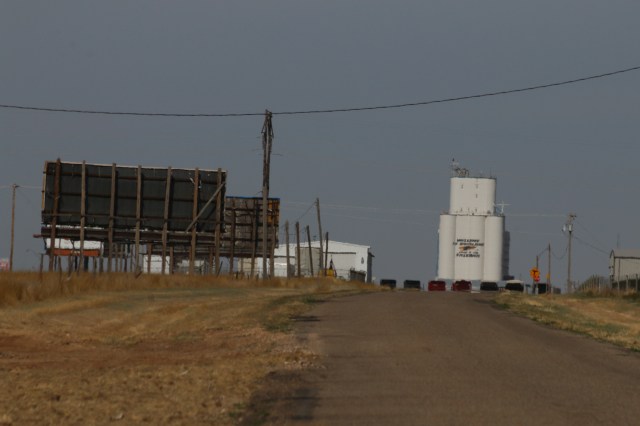
Texas-Okla Logo 04The next destination was Hartley, a town of about 500 people where U.S. 385 meets U.S. 87. Tillotson Construction Co., of Omaha, built a twin-leg, 300,000-bushel elevator here in 1950.

Like several others that year–Rock Valley, Iowa; Burlington, Colo.; and Canyon, Tex., where I had been at sunrise–Hartley was built on the Bellwood, Neb., plan. This entailed eight tanks, or silos, measuring 20 feet in diameter and here reaching to 115 feet in height. (Bellwood itself had 120-foot silos.)

IMG_8972Schoolchildren were at recess as I drove through side streets looking for a good view of the elevator. 

Arriving on the scene, I found a big operation. Of course I had recognized the Tillotson elevator’s curved headhouse. This elevator, as it turned out, has a substantial storage annex that likely more than doubles capacity. And there is a second concrete elevator onsite.

A pleasant surprise was the metal-clad wooden elevator that pre-dated everything else. Wooden elevators often went up in flames because of grain dust explosions, sparks from passing trains or short circuits. Finding one standing in good condition is a rare event. 

IMG_8956

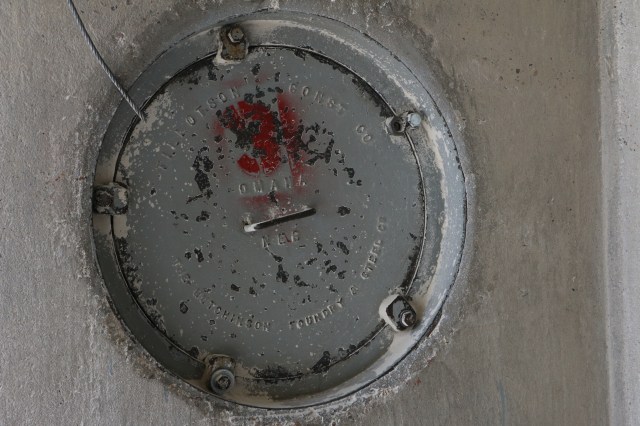
Getting out of the truck with my camera, I chatted a bit with an employee and showed him my grandfather’s name on a manhole cover.

Then I looked around, finding the elevator in pretty nice shape after so many years. A previous logo on the headhouse had been covered up and replaced with simple lettering that said, “Dalhart Consumers, Hartley, Texas.”

My notes show that I also peeked into the office and met an employee named Yvette, who said they store corn, wheat, and milo.

The elevators in Canyon and Bushland, Tex., have more dramatic stories to tell. This one in Hartley merely keeps its head up and goes about its job every day.


Fave photos from elevators in Hereford, Canyon and Bushland, Tex.

IMG_8858

In Canyon, Tex., the 1950 Tillotson elevator operated by Consumers Supply Co-op receives the graces at day’s dawn, April 17, 2018.


IMG_8883

Consumer Supply Co-op’s grain monster. In case you missed it, the name’s MACK.


IMG_8832

The beautiful, classic, curved 1951 Tillotson cupola reaches 152 feet in Hereford.


At 252,000 bushels, Bushland stuck to the ’49 plan perfected at Dike, Iowa

IMG_8889By Ronald Ahrens

The 252,000-bushel Bushland, Tex., elevator that today remains in pristine condition was built by Tillotson Construction Co., of Omaha, in 1950 and followed the plan for single-leg elevators established the year before at Dike, Iowa.

Texas-Okla Logo 04Notes on the plan specify eight tanks, or silos, of 18 feet in diameter rising to 120 feet in height–certainly the tallest thing in Bushland, an unincorporated town that sits between cropland and rangeland.

Even today Bushland has just 130 people or so, and none paid attention to me as I photographed the elevator from every good angle.

IMG_8895The job 68 years ago required the careful mixing of 2,066 cubic yards of concrete from the sand pile on the site. It would be reinforced with 109.37 tons of steel. At least I think that’s the number in the company records. That line got pinched in the copying process. But 109 tons is consistent with the amount used in other elevators of similar size. The 252,000-bushel elevator built the same year in Pond Creek, Okla.–another on the Dike plan and one of two dozen Tillotson jobs in that bounteous year–used 112.91 tons of steel.

The hoppers required another 40 cubic yards in which no reinforcing steel was used.

The 21-inch-thick main slab covered 60 x 72.5 feet. A note on slab’s area saying “Act. outside on ground” records a total of 4,200 square feet. We get 4,350 square feet when we multiply those numbers. How to account for the discrepancy?

When loaded with up to 7,560 tons of grain, the elevator could achieve a gross weight of 12,880 tons. So there was never a danger of jealous farmers sneaking over at night from Wildorado, down the road to the west, and towing it away on a flatbed.

The cupola, or headhouse, was 24.5 feet wide, 50.25 feet long, and 40 feet high.

With a pit depth of 14 feet 9 inches, there was a distance of 165.25 feet between the leg’s pulley centers.

In the construction record’s Machinery Details section we find a note that says: “LIKE POND CREEK.” That means the boot pulley was 72 x 14 x 2 3/16 inches. The head pulley, as we found in our earlier visit to Canyon, Tex., was the same except for being 1.75 inches wider.

IMG_8908It turned at 42 rpm, cranking the 14-inch, six-ply belt and it’s cups that measured 12 x 6 inches at 8.5 inches o.c. The head drive had a 40-horsepower Howell motor.
Theoretical leg capacity according the cup manufacturer’s rating was 7,920 bushels per hour. But actual capacity being 80 percent of that, the leg delivered 6,340 bushels per hour, demanding only 32 hp of the motor.

The man lift had a 1.5-hp electric motor. The truck lift had a 7.5-hp Ehrsam. Some day, after our road trip series ends, we need to write a post about Jürgen Ehrsam, inventor, who sounds like a fascinating subject.

Tillotson’s Bushland, Tex., elevator glistens with paint. Is that a good thing?


IMG_8912After prowling in and out, up and down, and finding the Ag Producers Co-op elevator at Bushland, Texas, to be spotless and more than serviceable after 68 years, I struggled in the ambitious crosswind and went over the the co-op’s office just to the installation’s north. It’s just north of I-40.
Texas-Okla Logo 04As said before, I had encountered no one. Going through the back door, still, no one. But I went through to the front of the building and saw Bret Brown in his office.

Brown stood up to greet me hear my explanation. I had come to see what Tillotson Construction Co. built here in 1950. The company’s principal, Reginald Tillotson, was my grandfather.

Brown, the co-op’s CFO, wore a short-sleeve plaid shirt. He had a couple of minutes to chat with the intruder.

IMG_8920I remarked on the elevator’s excellent condition and the glistening paint job.

He said the paint was applied after the insurance company issued an imperative to seal cracks and coat the silos and main house.

In fact, he said, it was $160,000 paint job.

Yes, the result is spectacular.

For concrete, though, is paint a good thing? As reader Paul Grage wrote in a comment last week about the elevator in Rockwell City, Iowa, “The elevator is rotten in concrete terms.” Happy news to us is that it remains standing.

“But for how long who knows?” Grage writes. “Another victim of paint.”

There was a reason the builders finished the jobs with whitewash instead of paint.

What’s the difference?

A quick search turns up this definition of whitewash: “A solution of lime and water or of whiting, size, and water, used for painting walls white.”

Porous whitewash allows the concrete to breath. It might also be cheaper than paint. You can mix it onsite, maybe by grinding up Hyundais built in the 1990s. I don’t know. But let’s think about it.

Next in the Tex-Okla Road Trip series: Bushland’s specs.

Tillotson’s Bushland, Tex., elevator was the scene of a scary, non-fatal fall in 1950

IMG_8901

Besides yesterday’s story about getting off-level when building the Bushland, Tex., elevator in 1950, the late Niel Lieb supplied another one that illustrates how dangerous elevator construction could be. 

Texas-Okla Logo 04I recalled it during my road trip when approaching the 252,000-bushel Bushland elevator that gleamed in the midmorning Monday sun. A second one on the site looked a little tattered in comparison to the classic Tillotson with its fine curved headhouse.

Lettering on the east side’s upper-middle part proclaimed, “Welcome to Bushland, Home of the Falcons.” The Class of 2010 was responsible.

IMG_8923But the drama of the elevator’s construction might have eluded the Class of 2010.

“Every job had a peculiarity,” Lieb said.

“The guy in Bushland jumped off the top. He started to fall, so he jumped. He jumped out far enough to land on the sand pile. We were probably 40 to 50 feet [above ground on the slipform]. He landed on the side of the sand pile and slid to the bottom.

We said, “How you doing?”

He said, “Oh, I’m fine. I’ll be a little stiff and sore.”

“There were seven guys that I worked with. Baker was one and Bill Russell. All of ’em fell or got killed somewhere along the line.

“When you’re working in the air, you become careless because it’s like walking on the ground, but you’re not walking on the ground.”

IMG_8911Indeed, we can hardly count the human cost to building an elevator, or any tall structure, in the early and middle decades of the 20th century.

Sometime afterward, we figured out more specifics about safety procedures and equipment.

At last I drove onto the grounds. The elevator was open. Chalk up another score for me–the second elevator in a row I could enter and inspect. No one seemed to notice me even though the Ag Producers Co-op office was just to the north.

Admitting myself, I went in and out through open doorways and up and down stairs. Not only was the elevator well painted outside, but it was meticulously clean inside.

Sports arenas and shopping centers go up with much acclaim but sometimes are torn down before 68 years go by. But the Tillotson elevator in Bushland was fit and trim.

As the grandson of builder Reginald Tillotson, I felt pride in his work and gratitude to the owners who have kept it so well.

Tomorrow, a meeting with a co-op executive.


Catching the Canyon, Texas, Tillotson elevator at its doggonedest dawn glory

IMG_8858To make it by dawn to the Tillotson elevator in Canyon, Texas, I hit the road at 6.30 a.m. and hightailed out of Hereford, covering the 30 miles across the plain, traveling east-northeast on U.S. 60.

Texas-Okla Logo 04I was happy at last to see the elevator’s distinguished bulk on the faint horizon. And even happier there was no storage annex–just the classic 320,000-bushel job from 1950.

No one was around to chase me away. The elevator looked very well kept, like a 68-year-old with a natty haircut and fine clothes.

I prowled over the grounds to get my photos, as well as going up and down 6th and 7th streets in the neighborhood looking for a street-view. People inside their bungalows might have thought I was some kind of nut. I wondered if they ever pondered much upon their gigantic concrete neighbor.

IMG_8859By the time I finished with photos, the Consumer’s Supply Co-op store on the premises had opened up. I went inside and introduced myself, feeling proud to say, “My grandfather built your elevator.”

I elaborated about Tillotson Construction Co., of Omaha, and my mission to visit the 10 Tillotson elevators in the Texas Panhandle.

Scott Smith, general manager, and Dewayne Powell were interested to hear it. These bright-faced gents explained, among other things, that the Co-op’s charter goes back to 1926.

Two elevators are on the site. “This is our best elevator here,” Smith said of the Tillotson. The other needs repairs to the floor, among other places.

Much of this, the West Elevator, was original. Alas, the truck lift had been removed “before my time,” Smith said. 

I went out to the truck for the construction record. After my explanation of some of the specifications, Smith took it to the copier.

Powell showed me around, explained how things worked, even posed for some pictures.

The basement was clean and tidy, and Powell mentioned that at one point some of it had been used for office space. It was sure bright enough down there.

Something else that had changed: the augur below ground level had been filled in with concrete.

We went back up, and I made one more circuit around the elevator. The driveway door was open, and the Co-op’s yellow Mack truck sat in the driveway.

IMG_8883The quality of the Co-op’s operation was evident. The only things with the elevator that seemed out of order was a broken basement window, and one of the back doors had been splattered with glop.

Otherwise, things were in nice shape.

When I was ready to leave, they presented me with a cap and T-shirt with the Co-op’s emblem–a real honor. Smith recommended KJ’s Coffee and Cafe for breakfast, so I found my way across town to have an omelet.

Then, a-wondering where Palo Duro canyon–the town’s eponym–was, I set out for Bushland.

In our next post, watch for a surprise about the Tillotson elevator in Canyon.


A postcard reveals Tillotson elevator activity before the big changes of 1938

Post Card 01

We have found what may be a rare record of the Tillotson construction enterprise as it existed before 1938. Back then, Charles H. Tillotson led the company, which specialized in wooden elevators. After he died in ’38, his sons Reginald and Joe partnered in Tillotson Construction Co., and started to experiment, and then build, with reinforced concrete.

This card from July 2, 1936 is penned by Sister Mary Concepta, the older sister of Margaret Irene McDunn Tillotson (my grandmother) and sister-in-law to Reginald.

Sr. M. Concepta, born on Sep. 27, 1901, in Emerson, Nebraska, and christened Catherine McDunn, was the second of nine children. (Margaret, born Feb. 9, 1903, was third.) Sr. M. Concepta belonged to the Sisters of the Presentation of the Blessed Virgin Mary, with a motherhouse at Mount Loretto in Dubuque, Iowa.

The parents were William McDunn (b. Feb. 4, 1871, Des Moines, Iowa) and Bridget Loretta Dorcey McDunn (b. March 27, 1872, Luken or Lucan, Ontario). Records show William as a laborer in Omaha in 1891. He became a conductor on the Nebraska Division of the Chicago, St. Paul, Minneapolis & Omaha Railway, and the family became established in Emerson, the town named for Ralph Waldo Emerson, which had come into being in 1881 at a junction on the CSPM&O (known as the Omaha Road). 

The family history comes from These U.S. McDunns: Family Tree of Patrick McDunn and Mary O’Donnell, compiled by John McDunn, of Lodi Wisc., in April 1989. The McDunns homesteaded in Pennsylvania in 1835. 

My Uncle, Charles J. Tillotson, whose name appears in many of this blog’s posts, had kept his grandfather William’s railroad watch–a Hamilton, of course–until a burglar struck in the late-1980s.

Post Card 02Uncle Charles notes that in the mid-1930s Reginald and Margaret lived with the elder Tillotsons at 624 N. 41st Street. They towed a travel trailer to job sites. In early July of 1936 they would also have towed along Uncle Charles, then 18 months old, and my mother Mary Catherine, who was nearly five months old.

On this postcard Sr. M. Concepta addresses her sister Margaret (Mrs. Reginald Oscar Tillotson) at Carlyle, Neb.

Carlisle–note the difference in spelling–is an unincorporated town in Fillmore County.

“I know the name because Mom used to talk about it,” Uncle Charles says.

We presume there was a wooden elevator. Carlisle is an unincorporated community in Fillmore County, about 135 miles southwest of Omaha. It doesn’t appear on our Rand McNally page nor does Google Maps seem to know anything about it. 

MapThe USGS gives coordinates for Carlisle on its Davenport Quadrangle map (named for a town in neighboring Thayer County), and we see a speck on Road X, west of Little Sandy Creek, that could be Carlisle. We called the Fillmore County sheriff’s office, in Geneva, and asked. “Nope,” a very nice woman said. “We don’t have a Carlisle.” 

Whatever.

“Dear Margaret + Reginald + babes,” Sr. M. Concepta begins.

Post Card 03“This card tells you where we are. Saw your Mother and Mary, Reginald. Mary is truly a nice girl and your mother surely is not strong. Won’t be leaving here now until Sat. morning. Just thought you might be coming in for the 4th. Don’t try it just for me though. Love, Sr. M. Concepta.”

Mary Tillotson was Reginald’s sister who became important to the family business and also is named in many posts here.

It’s hard enough to find a trace of Carlisle, but we would love to know if any remnant of a wooden elevator exists there.