Catching the Canyon, Texas, Tillotson elevator at its doggonedest dawn glory

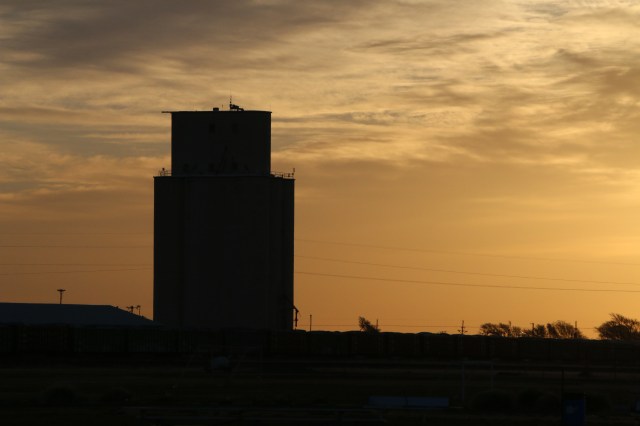
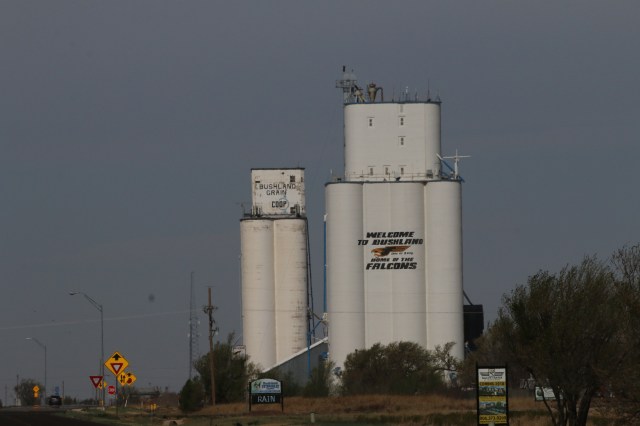
IMG_8858To make it by dawn to the Tillotson elevator in Canyon, Texas, I hit the road at 6.30 a.m. and hightailed out of Hereford, covering the 30 miles across the plain, traveling east-northeast on U.S. 60.

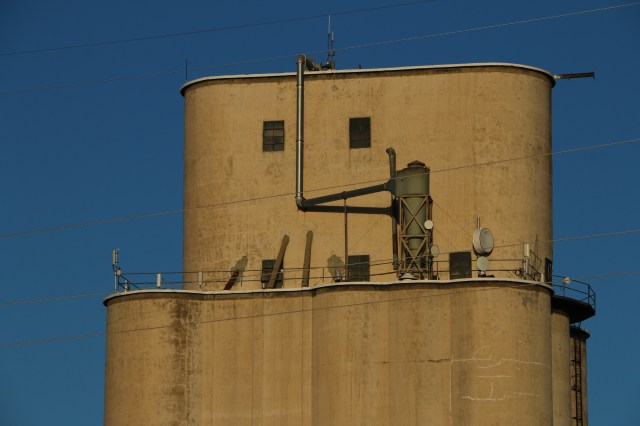
Texas-Okla Logo 04I was happy at last to see the elevator’s distinguished bulk on the faint horizon. And even happier there was no storage annex–just the classic 320,000-bushel job from 1950.

No one was around to chase me away. The elevator looked very well kept, like a 68-year-old with a natty haircut and fine clothes.

I prowled over the grounds to get my photos, as well as going up and down 6th and 7th streets in the neighborhood looking for a street-view. People inside their bungalows might have thought I was some kind of nut. I wondered if they ever pondered much upon their gigantic concrete neighbor.

IMG_8859By the time I finished with photos, the Consumer’s Supply Co-op store on the premises had opened up. I went inside and introduced myself, feeling proud to say, “My grandfather built your elevator.”

I elaborated about Tillotson Construction Co., of Omaha, and my mission to visit the 10 Tillotson elevators in the Texas Panhandle.

Scott Smith, general manager, and Dewayne Powell were interested to hear it. These bright-faced gents explained, among other things, that the Co-op’s charter goes back to 1926.

Two elevators are on the site. “This is our best elevator here,” Smith said of the Tillotson. The other needs repairs to the floor, among other places.

Much of this, the West Elevator, was original. Alas, the truck lift had been removed “before my time,” Smith said. 

I went out to the truck for the construction record. After my explanation of some of the specifications, Smith took it to the copier.

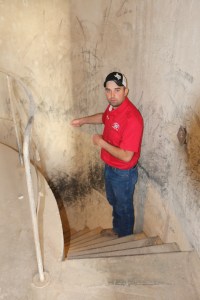
Powell showed me around, explained how things worked, even posed for some pictures.

The basement was clean and tidy, and Powell mentioned that at one point some of it had been used for office space. It was sure bright enough down there.

Something else that had changed: the augur below ground level had been filled in with concrete.

We went back up, and I made one more circuit around the elevator. The driveway door was open, and the Co-op’s yellow Mack truck sat in the driveway.

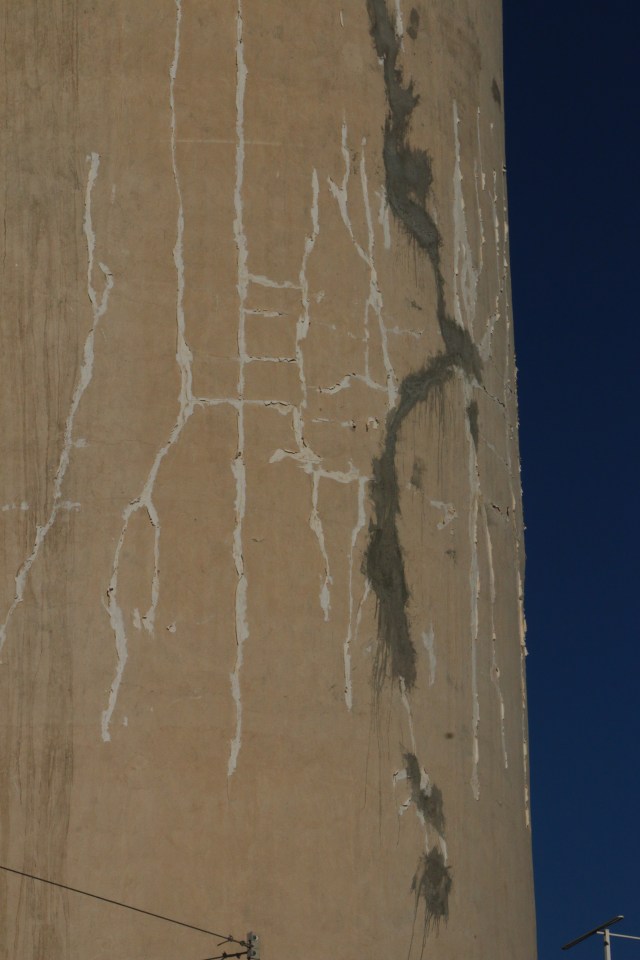
IMG_8883The quality of the Co-op’s operation was evident. The only things with the elevator that seemed out of order was a broken basement window, and one of the back doors had been splattered with glop.

Otherwise, things were in nice shape.

When I was ready to leave, they presented me with a cap and T-shirt with the Co-op’s emblem–a real honor. Smith recommended KJ’s Coffee and Cafe for breakfast, so I found my way across town to have an omelet.

Then, a-wondering where Palo Duro canyon–the town’s eponym–was, I set out for Bushland.

In our next post, watch for a surprise about the Tillotson elevator in Canyon.


Specs show capacities of the Tillotson elevator in Hereford, Texas

IMG_8833The single-leg elevator built at Hereford, Texas, by Tillotson Construction Company in 1951 had capacity for 300,000 bushels, according to company records. That worked out to 2,640 bushels per foot of height. The drawform walls of the silos, or tanks, rose 125 feet.

Texas-Okla Logo 04Our calculation produces a total of 330,000 bushels at this rate. There were 2,104 cubic yards of reinforced concrete, 28 cubic yards of plain concrete for hoppers, and 121.47 tons of reinforcing steel including jack rods.

The concrete would be mixed on-site, while the reinforcing steel and the lumber used for scaffolding were probably delivered by train.

IMG_8832

The elevator’s main slab covered an area of 76.5 x 56 feet and was 24 inches thick. Below it, the pit depth was 26 feet–unusually deep in comparison to that of other elevators built that year in Greenwood and David City Nebraska and (12 and 17 feet, respectively) and Malta Bend, Missouri (9 feet 3 inches).

The headhouse, or cupola, was 17 feet wide, 36.75 feet long, and 27 feet high. So the structure crested at 152 feet.

That the pulley centers of the leg were 169.5 feet apart reflected the positioning of the lower boot pulley below ground level. That one measured 72 x 14 x 4 15/16 inches. The head pulley was 72 x 14 x 2 3/16. IMG_8823

The head pulley turned at 42 rpm.

The six-ply Calumet belt was 14 inches wide. Cups were 12 x 6 inches and 8.5 inches deep. A 40-hp Howell head-drive turned the leg, and the cups bore a theoretical capacity of 79.2 bushels per hour, although actual capacity–80 percent of theoretical–was 63.4 bushels per hour.

The man-lift operated with a 1.5-hp electric motor.


Horizontal member on Hereford elevator adds civilizing touch for employees

IMG_8824

As we see in these photos from Hereford, Texas, a Tillotson elevator is more than just a collection of tanks and the mechanisms to move grain around inside the structure.

Texas-Okla Logo 04A Tillotson elevator can also come with amenities.

Here we see a lintel above the rear door of the main house. A lintel is a horizontal member that usually bears a load above an opening.

I asked Uncle Chuck Tillotson about it. (He’s also known in these posts as Charles J. Tillotson, son of Reginald Tillotson, of Tillotson Construction Co.)

He responded: “These concrete ‘eyebrows,’ or ‘headers,’ were added above doorways sometimes to provide a bit of shielding from the rainfall sheet flow coming down the vertical face of the wall over the doorway/opening in a rainstorm.”

IMG_8827

So it’s a thoughtful touch. An employee won’t get water down his neck when he opens the door. Think of the increased productivity!

“They were not poured integrally with the concrete bin wall during slipping but were added afterwards,” Uncle Chuck continued.

Not only is there the lintel but also the electric light. I saw the same combination over and over at the Tillotson elevators I visited in the Texas Panhandle and Oklahoma.

“I don’t recall these eyebrows being standard elements,” Uncle C. says. “I think they were added after the fact but whether Tillotson did the work, or the owner, I’m not sure.”

We do think the electric light was a standard item.

In the uppermost photo, the iron or steel hook and dangling cable remain a bit of a mystery, though.

And the rabbit-eared paintwork is beyond guessing.

Handsome in Hereford, Texas, a Tillotson elevator remains in use

IMG_8842On my road trip to visit my grandfather Reginald Tillotson’s elevators, the first stop was Hereford, Texas. It was toward the end of my second day of driving from California, and I arrived in time for late-afternoon light.

Texas-Okla Logo 04I had departed I-40 on the north and came down U.S. 385 for 28 miles through Deaf Smith County.

The desert scrub ends rather suddenly in the Texas Panhandle, and I found myself amid prosperous-looking farmsteads and cropland irrigated by center-pivots. It looked like corn, wheat, and cotton predominated.

IMG_8840

Driveway detail view.

Hereford, which is southwest of Amarillo, is one stinky town. People said it’s because of huge surrounding feedlots. They sounded proud about it.

There were a couple of enormous grain terminals on the horizon as I approached. The Tillotson elevator was evident to their left. It was the smaller one, but the unique curved headhouse gave away its identity.

I drove east on U.S. 60 to what Google Maps identifies as the East End Hereford Grain Corp., which is across the railroad tracks on Dairy Road.

Tillotson Construction Co. built this 300,000-bushel elevator in 1951. Records show it had six tanks, or silos, of 20 feet in diameter. Notes say “Leg-Tunnel-Gallery” and “Top & Bot 30″ belts.”

A semi-truck lift and attached drive were also included.

IMG_8838

The elevator looked to be in pretty good shape. There are some horizontal cracks on the silos, but they had been filled in. On the headhouse, traces of letters appeared to say Freeman Grain Corp. The concrete elevator towered over 10 barrel-like steel silos and an ungainly superstructure, along with bins and hoppers that linked to the concrete elevator’s headhouse by means of a spindly looking line.

This kind of annex was in a way preferable to a series of concrete silos. The Hereford elevator is a nice, free-standing example of Tillotson’s signature style.

The elevator’s tanks are 125 feet high. The headhouse, or cupola, is 17 feet wide, 36.75 feet long, and 27 feet high. So the structure reaches 152 feet up. 

No one was around, so I helped myself to photos. The only distractions came when trains went by. 

I was famished after the long day on the road, so I knocked off when I had my photos and checked in at the Hereford Inn just across East 1st Street. As I wrote in the introduction to this series, it was a pretty crummy place.

But after dining at Dakota’s Steakhouse (smothered fried chicken: $10.83), I went back to the motel and slept well despite the fact that the trains seemed to be crossing through the room.

Texas and Oklahoma road trip takes us to 20 elevators (so get ready)

By Ronald Ahrens

This Ford Ranger violated Tesla parking en route to Texas and Oklahoma.

Get ready for a series of posts on Our Grandfathers’ Grain Elevators.

On April 15, I set out on a road trip to the Texas Panhandle and Oklahoma to see elevators built there between 1939 and the mid-1950s by Tillotson Construction Co.

This was a long-desired destination, as my grandfather, Reginald Tillotson, and his brother Joe Tillotson (until their partnership dissolved), built at least 10 reinforced-concrete elevators in the Panhandle and closer to 20 in Oklahoma. 

Texas-Okla Logo 04The company’s first concrete elevator, dating to 1939, was built in Goltry, Okla., and I was able to visit it.

So as I say, get ready.

I have 410 photos on one memory card and haven’t even counted those on the other card that’s still in the camera.

I saw a nice range of elevators including a surprise Mayer-Osborn one in Follett, Texas–built by my partner Kristen Osborn Cart’s grandfather after he worked for my grandfather.

Our Grandfathers’ Grain Elevators gets inside the main house at Booker, Texas.

I got inside some elevators, met interesting people whom you will also meet, and even have a few trip notes to share.

For example, avoid the Hereford Inn, in Hereford, Texas. Yes, it’s right across the street from the Tillotson elevator. No, you shouldn’t stay there. The owners have done nothing to update the rooms; flimsy mattress, wilted pillow, skimpy towel. And it sounded like the trains were coming through the room. At least there was hot water.

For the same $60 price, I stayed the next night at the Nursanickel Motel in Spearman, Texas. That place was quite nice and cast its shadow on the dump in Hereford.

And here’s a culinary tip: Smrcka’s Dairy Shack, in Medford, Oklahoma, serves a fantastic Czech sausage sandwich with sauerkraut. And the fries are incredible.

The Czech sausage sandwich in question.

With limeade, it came to $8.38.

If you have the same counter-attendant that I had, don’t try to make small talk because she’s super-crabby.

So stay with us for our Texas-Oklahoma series over the next few weeks.

A visit to Omaha’s Vinton Street elevator reveals recent activity by muralists

IMG_4613

Our friend Rose Ann Fennessy lives near the Vinton Street elevator in South Omaha. On a recent spring day she took a stroll and recorded these views.

Above we see the elevator and storage annex in a long gaze from the Field Club trail. The Field Club, which bills itself as the oldest private club west of the Mississippi River, is about a mile away from the elevator.

IMG_4614

Rose Ann also discovered the silos of the annex are being used by muralists. She calls it “the current artwork.” Since the Stored Potential banners came down in July of 2014, the silos have become more available to artists.

IMG_4615

“I like this one,” Rose Ann says.

It’s good indeed. In a way, these murals are like stained glass but at the the wrong end of the towers.

We don’t mind the silos of the annex being painted, but we hope the artists leave the elevator’s main house alone.


A through-the-windshield glimpse of Omaha’s Vinton Street elevator

sIMG_4607

Kate Oshima, a granddaughter of Reginald Tillotson, provides this through-the-windshield view of the Vinton Street elevator in Omaha.

We see the unique, tall headhouse and the runs atop the main house and extending to the annexes. We also see that the elevator needs some TLC.

Omahans call I-80 “the Interstate.” Kate says, “It is towering over the Interstate.”

In SoCal, an elevator’s tall headhouse reminds us of Vinton Street in Omaha

unnamed-1

I’ve meant for a long time to stop at the grain elevator along Interstate 10 in Colton, California, and finally I did.

The elevator, which appears to date from the 1960s, has an elongated headhouse and reminds me in a way of our Vinton Street elevator in Omaha.

The Colton operation is one of 40 sites run by Ardent Mills, which is based in Denver. The elevator stands along the Union Pacific tracks between Riverside and Ontario. No one was to be seen late on a Sunday afternoon, but there was probably milling activity going on in another building: machinery hummed away. 

The elevator’s silos are multi-sided, which is different from anything Tillotson Construction Co. built. Could it be that the walls have greater bearing pressure with such a configuration?

IMG_4560

The headhouse is stepped and thrusts toward the sky above the Inland Empire. It would be good to know how long the leg is and why such a rise was necessary.

I tried to look from every angle and even climbed up to the top of a rail car for a picture without hurting myself.

More information about this handsome elevator will be shared as it’s revealed.


Three elevators near Bozeman, Montana, provide a little variety

IMG_8354

Flying into the Bozeman Yellowstone International Airport the other day delivered a pleasant surprise in the form of three handsome elevators soon after we drove away from the passenger terminal.

One elevator was right there in Belgrade, Montana, where the airport is. It was an old house adapted to operate with metal silos.

Another had concrete silos, and a third looked like a simple wooden house.

These photos are all we can offer. The elevators weren’t Tillotson or Mayer-Osborn jobs, but we were excited to see them and now share with eagerness. Perhaps at a future time we can learn more details.


The Minatare, Nebraska, concrete elevator mystery solved

The Minatare elevator was an intriguing photography subject.

Story and photos by Kristen Cart

My dad, Jerry Osborn, and I were traveling in western Nebraska on a three-day road trip to visit old friends and family when we happened upon the Minatare elevator built by Tillotson Construction. I immediately suspected that it was a special find. I asked my dad to be prepared for an afternoon of investigation, so after our visit with his cousins in Scotts Bluff, we began our inquiry in earnest.

Our first view of the elevator.

The name Minatare rang a bell, and I thought it might be home to an early elevator, catalogued in the Tillotson Construction Company records. But I didn’t have any way to check, being well out of cellphone range, and began to doubt my memory. Perhaps Minatare’s elevator was featured in an early postcard, one of hundreds I had examined on Ebay, while looking through old elevator images. I couldn’t remember where I had seen the name before.

Only the old-fashioned gumshoe method was going to work. Dad went along on our mission in good humor. For a good part of it, he spent his time comfortably hanging out in the air-conditioned car, while I called upon local people and shot every possible camera view.

So how do you check out a mystery elevator? After copious photos, you check out the town office. If the town clerk smiles, shrugs, and sends you down the hall to the library, which is closed, then you go (on her advice) to the local tavern. If you are lucky, the owner is intrigued and makes some calls. Pop into the library when it opens. Jump into and out of the car, drive a few blocks, get Dad a coke from the tavern, where the owner sends you to the next place. Touch base at the new place on the way out of town–then leave, still scratching your head.

It was a fairly typical visit.

No one I talked to in town remembered when the elevator had been in operation. The secretary at the town hall was standing in for someone else, and was relatively new in town. The local policeman laughed and shook his head when I asked him about it. He was a recent resident, too. One young person offered a tidbit–she said that the interior of the elevator might have been seen by teenagers at one time or another. It wasn’t a mystery to everyone in town, apparently. Too bad it was shut up tight, with no one around, so we couldn’t see the inside for ourselves.

A 1940s parade photo shows the elevator in its early years.

The librarian was very helpful. She kept the library open for a very short time because of her poor health, but she pointed us in the right direction. The town of Minatare was featured in a newly published local history, “Minatare Memories,” published by the Minatare Historical Committee. It had a short mention of a concrete elevator built in 1924. That information didn’t fit with any elevator that was of interest to us–it was way too early for a Tillotson job. We thought perhaps the 1924 date pertained to an earlier wooden elevator, the first one erected in the town, but at that moment we weren’t sure.

However, she offered a bookshelf filled with boxes of photographs, among them unattributed parade photos, taken a long time ago. In the parade photos were vintage cars, motorcycles, and best of all, the Minatare movie house marquee with the movie playing at the time, “California,” starring Barbara Stanwyck. In the background, behind the parade, stood the gleaming white Minatare elevator. The photos were thereby dated to about 1947, the latest date the elevator could have been completed.

The movie marquee dates the parade more precisely. The movie, “California,” came out in 1947.

The tavern owner, Dennis Wecker, offered more information on our second visit. He had made some calls, and he now knew the name of the company that owned the elevator–Kelley Bean. He gave us a contact and a location. On our stop at the bean facility, two workers in the office said the general manager at the Minatare location, Chris Hassel, had gone on vacation.

Dad and I left, still scratching our heads, and thinking about dinner. We had a drive ahead of us.

Kelley Bean is the current owner of the property.

It wasn’t until later when I conferred with my blogging partner, Ronald Ahrens, that we had an answer to the elevator’s provenance. He looked up the Minatare elevator in the Tillotson construction records and delightedly reported that it was not only the work of his grandfather, Reginald Tillotson, but it was an early one, built in 1941 very soon after the company was founded.

Eureka! It was a great find, and worthy of another visit. We will stop again and thank everyone who helped us tell its story.

Jerry Osborn, my dad and great traveling companion.