An airplane crash ends Gandy Construction, an early elevator player

WAO3

The Mayer Osborn company brochure mentions Gaddy (sic) Construction of Omaha

Story by Kristen Cart

My father remembers the grain elevator construction business from earliest childhood. But his childish memories did not distinguish one job from another, so until recently we did not know about the company where my grandfather William Osborn began his career as a carpenter.

Dad said they still lived on the farm when his father went to Kansas City in pursuit of a better opportunity, which dated the event to before 1944. That job was likely with the Tillotson Construction Company of Omaha. Before then, Grandpa’s Mayer Osborn Construction brochure said he worked for Gaddy (sic) Construction of Omaha. It was difficult to come up with any information about them, until we located a clipping that marked a tragedy.

The newspaper account related:

Plane Crashes at Lexington, Omahan Killed

Lexington, Neb., (AP). Ralph Arden Gandy, 41, head of an Omaha construction firm, died Saturday night after the light plane he was piloting crashed near here.

Tommy Johnson, a Gandy construction company foreman, was injured in the crash.

W. H. Pfiefer, Lexington funeral director, said Gandy’s plane took off from a field on the farm of Dennis O’Connor, a cattle feeder who lives six miles northeast of here.

After the takeoff, the funeral director said, the plane stalled and crashed on a road. Both men were thrown free of the wreckage.

Gandy died a short time after the crash in the Community hospital of Lexington.

Johnson received a broken jaw and chest injuries. He was removed to the Methodist Hospital in Omaha by ambulance Sunday night.

The Gandy firm had built a grain elevator on the O’Connor farm, Pfiefer said, and Gandy and Johnson had been at the farm inspecting it. The plane was taking off to return to Omaha when it crashed.

Gandy is survived by his widow, Clara, and four children.

The Nebraska State Journal, Lincoln, Neb.,  Aug. 1, 1949.

William Osborn worked with Loren Saunders, his brother-in-law, at a job in Omaha before he took the opportunity in Kansas City, according to my dad. It seems likely that the Gandy company was that job.

A reader recalls his youthful days at the grain elevator in Emmetsburg, Iowa

This T.E. Ibberson elevator, foreground, keeps company with a Tillotson elevator, right, in Dallas Center, Iowa. Photo by Kristen Cart

This T.E. Ibberson elevator, foreground, keeps company with a Tillotson elevator, right, in Dallas Center, Iowa. Photo by Kristen Cart

By Paul Grage

Editor’s note: Paul Grage (pronounced “GREGG-ee”) of Rockwell City, Iowa, is a 39-year-old supervisor at North Central Correctional Facility there. In his free time he surfs the Web looking for elevator sites.

I would like to share some memories of Cargill in Emmetsburg, Iowa, during the 1980s.

My fondest memory is of Old Number 2, built by T.E. Ibberson, of Minneapolis. My dad was the manager from 1979 until about 1996, and I would often call after school at harvest to see if I could come hang around. If they were accepting grain at Number 2, that is where I would be.

The alleyway [driveway] was huge. It had one  main grate and two side grates for overflow that all emptied into one  pit. It had a large horn like a fire alarm buzzer. This  sounded for phone calls, when the leg was up to speed, or when a bin ran full. The side entrance inside was flanked by two large aerator fans that roared. As a kid, it was kind of terrifying to exit between these two.

The Ibberson nameplate. Photo by Kristen Cart

The Ibberson nameplate. Photo by Kristen Cart

I remember the rippling of the grates as semis crossed them. I still remember the old portable, homemade, electrically powered, hydraulic pump that raised the old barge box wagons pulled by pickup trucks.

I remember the old gate at the bottom of the pit that accessed the leg. It was moved by a large lever next to the pit, right next to the leg button. You had to hear the buzzer before you opened that gate unless you wanted to plug the leg before it got up to speed. My dad tells horror stories about unplugging the leg. A test of your manhood was to go to the headhouse and hold back the anti-rollback dogs, like a one-way clutch, with a wrench or bar. The whole trunking would shake. The distributor crank was right next to the leg and man lift. It was a lever brake and crank-style bin selector that had belt pulley webbing on it to indicate which bin you had selected.

I remember the first trip to the headhouse with my brother. He was an employee with Cargill before they had nepotism rules. It was a sight to behold: the big open headhouse with all of its huge spouts, the huge gearbox and chain-drive leg and the big distributor. Inside this headhouse was a huge plywood shack. It was explained to me that it was a tripper scale used for loading railroad cars. It was long out of use, as this elevator had no rails and the new elevator did. This tripper scale did have long rods that extended down the man lift shaft to the alley below.

I remember the ride up the man lift with my brother. The dust was so thick on the walls the people had stopped along the way and scratched rather colorful sayings in the dust. (This was long before the days of dust control, so that dust was a good three inches thick in that man lift shaft. Now they have an air chuck so they can blow the dust down.) When I say man lift shaft I mean man lift onlythe leg shafting was built into the concrete.

The T.E. Ibberson name on the manhole cover.

The T.E. Ibberson name on the manhole cover.

The metal trunking only existed between the boot pit up to ceiling of the alleyway and then from the bin deck to the leg-drive pulley in the headhouse. The rest of the leg trunking was made of a cement column inside. The shaft that the rest of the bucket was built into was hopper-bottomed just like all the overhead bins.

If I remember right, this elevator had eighteen overhead bins, one of which was used for rail car/tripper scale.

After learning the elevator inside out, the ironic thing is that I could never go to work in the grain business because I’m allergic to soybean dust. It’s almost lethal to me. When I was a kid, it didn’t faze me a bit. But my last year I hung around there, around 1988, I had to wear a respirator. 

Something else: They don’t paint this elevator any longer because it’s stress-cracked. They quit painting it because it was making the concrete rot. I like the aged look.

In 1954, near the boom’s end, Albert City, Iowa, had a gleaming concrete elevator

Albert City, Iowa

By Ronald Ahrens 

Looking at this photo of Tillotson Construction Company’s 252,000-bushel elevator, completed in 1954, it’s easy to imagine the pride and awe of a small town’s few hundred residents.

Albert City is in northwest Iowa on a spur from Route 3, not far from Storm Lake in Buena Vista County. The Tillotson’s had also built that same year in nearby Pocahontas, where there was tragedy.

The Albert City job went more smoothly as the structure rose far above the tallest elms, although Uncle Charles Tillotson, who recently dug up this photo, has written about his frightening dismount from the formwork during a storm.

Uncle Michael Tillotson has also recollected about working here:

“The following summer (1954) we went to Albert City, Iowa, 75 miles North of Council Bluffs. We rented rooms in a private home. We worked with a 20 something guy that ran the winch pulley bucket to the top of the elevator as it progressed, and brought building materials down. We also rode the bucket up and down to get on deck. The elevator bens were 125 feet to the top with a Head-House of 75 on top of that.”

Company records show the elevator was built according to the same plan used in Pocahontas. This entailed eight outer bins that were eighteen feet in diameter and, contrary to Uncle Mike’s reckoning, 120 feet tall. Altogether, some 2091 cubic yards of concrete were reinforced by 106.57 tons of steel.

The bins rose from a main slab 21 inches thick and 60 x 72.5 square feet in area. It supported a gross loaded weight of 12,974 tons.

The cupola, or headhouse, was 23 feet wide, 58 feet tall, and 40 feet long.

Albert City was a single-leg elevator. Its head pulley was 72 inches in diameter and turned at 42 rpm. A 40-horsepower Howell motor supplied more than enough energy to turn it.

Twelve-inch-wide cups on a six-ply, 14-inch-wide belt carried up the grain that was dumped by incoming trucks. The 12-foot-wide driveway had two dump grates: 9 x 6 feet and 9 x 14 feet.

In 1954, Tillotson also built in Dacoma, Lahoma, Orienta, and Weatherford, Okla.; Booker, Tex.; Ensign and Montezuma, Kan.; Bellwood, Neb.; and Glidden, Goldfield, Newell, Manson, Pocahontas, and Iowa Falls, Iowa.

These were among Tillotson’s last elevators–the records close out with work in 1955–and they represented nearly everything the company knew about building.

A visit to Google Maps shows the elevator is still standing, which is to be expected given the Herculean effort needed to knock down all that reinforced concrete. But it appears idle. Given what we’ve learned about the limitations of midcentury elevators and today’s need for greater storage capacity and quicker unloading, that would make sense.

Nevertheless, it endures as a handmade monument, and a rich human history goes with it.

With their works in Estill, South Carolina, Tillotson built big in cotton country

Freshly harvested cotton field in central South Carolina

Freshly harvested cotton field in central South Carolina.

Story and photos by Kristen Cart

The brightly wrapped cotton bales highlighted an otherwise drab landscape as I traveled the 91 miles south from Columbia to visit the Estill elevator, originally built in 1947. Rain and haze flattened the view. Since it was Sunday when I visited the elevator, few people appeared to be about. It was going to be a photography outing, for better or for worse.

DSC_3487

The Estill elevator, greatly expanded since it was built in 1947, was secured behind barbed wire.

I graduated high school in South Carolina. My impression of the place, after growing up in the western desert, was one of endless dark pine woods, with a brief gaudy display of azaleas and dogwood blooms in springtime.  I didn’t appreciate the raw beauty at the time. Now, on a soggy day, it had a mysterious appeal.

DSC_3431When I learned that the Tillotson Construction Company built an elevator in the state, it came as a surprise. We do not know who built the original house in 1947. Tillotson, according to company records, built the 225,000-bushel annex and a second, larger elevator, in 1952 and 1953, respectively. The trademark rounded headhouse rises above the 350,000 bushel elevator, built to finish the concrete elevator complex.

Michael M. DeWitt, Jr. outlined the history of the Estill elevator in his article for the Hampton County Guardian published on December 14, 2010. The article was written to herald the purchase of Carolina Soya by ADM. During its heyday, the elevator stored soybeans for soybean processing, which was part of the operation. Now it is strictly a storage facility for ADM, focusing on soybeans but also accepting corn.

The company laid off staff upon acquiring the facility in 2010, shrinking from 45 to 14 workers, heralding a loss to the community in a time of slow economic growth. ADM promised to hire from the laid off worker pool as needed.

DSC_3406I noticed that the good times had passed during my drive down. The decline of the area was evidenced by empty store fronts and decrepit gas stations, ancient closed restaurants, and tired houses–all along the highway south from Columbia, it was apparent that development chose another corridor and not this one. I wondered if there was one open gas station anywhere along the route.

The histories neglect one of the Estill elevator’s darker episodes. In the ’40s and ’50s, construction safety was not mandated as it is now. In one of the accidents that was all too common for elevator construction, Wayne Eugene Baker lost his life in a fall while working on the storage addition, or annex, built in 1952. For all of the heartache, Wayne helped build a thing of beauty that sustained its neighborhood for many years and still brings economic benefit to its region.

A mystery is solved with the discovery of elevator builder Van Ness Construction

The wooden elevator at Wymore, Nebraska, is representative of the style of Van Ness Construction

The wooden elevator at Wymore, Neb., is representative of the style of Van Ness Construction.

Story and photo by Kristen Cart

When we began investigating the elevators our grandfathers built, we had no idea how far the project would take us or what surprises would unfold. With the discovery of Van Ness Construction Company of Omaha, we have learned about the beginnings of the Tillotson family enterprise, and have entered a new phase of our search.

Charles_Tillotson_Obit__The_Nebraska_State_Journal__Lincoln__Nebr___19_June_1938

The Nebraska State Journal, June 19, 1938

We knew that Charles H. Tillotson, patriarch of the family and great-grandfather of Ronald Ahrens, built elevators before the days of slip-formed concrete. We found only one Tillotson elevator, made of wood, that predated the elegant concrete structures that sprang up all over the Midwest in the ’40s and ’50s–at least we found its obituary in a news video of its fiery demise. That 1940 vintage elevator, in Hawarden, Iowa, was built two years after Charles died. It burned down in 2006. We didn’t find, at the time, a project that we could attribute to Charles.

Then we had a breakthrough, thanks to Ancestry.com.

Ancestry has a wonderful collection of city directories. I had seen listings for the Tillotson family in Omaha before, but I missed a significant data point. While searching for Sylvia (Mayer) Tillotson, the wife of Joe and sister of Eugene Mayer, I discovered an Omaha directory for 1936 in which Charles H. Tillotson was listed as president of Van Ness Construction Company. Further Internet searches revealed some of the sites where Van Ness built its small steel-cased wooden elevators, but as yet we have found none that have survived.

Now we hope to find an existing elevator from the days before Joe and Reginald Tillotson dreamed up their slip-formed concrete designs. So far the closest we have come is an elevator that perished in a fire in Scribner, Neb., in 1971 , a nightmare that repeated itself in June, 2013.

Also, in a Google satellite image of the town of Diller, Neb., another identified site, a square concrete pad with a grain spout lying alongside it is located near new steel bins, right where an old elevator should have been. In Rydal, Kan., you can see a concrete pad with concrete pits near a horizontal storage building, with the remains of a rail siding alongside. I was a little surprised to find evidence of earlier elevators at these sites, but of course digging up tons of concrete for no special reason would be unnecessarily expensive, so there are remains.

Everywhere we looked for these ancient elevators, we found evidence of obsolescence and ultimate destruction, with little left to identify the sites. Newspapers were the only way to find the locations. Fire certainly destroyed some of them. For those that remained, the adoption of concrete and much larger storage facilities turned these old Van Ness elevators into relics and ultimately spelled their doom.

How a 1950 elevator matches advanced farming practices in Cordell, Oklahoma

DSC_2318Story and Photos by Kristen Cart

Once we discovered that the Cordell, Oklahoma elevator was built by Mayer-Osborn, it became a priority to pay a visit.  Luckily an opportunity presented itself when I went shopping for an Australian Shepherd puppy for my son Jesse. Deadra Buffing breeds lovely pups at Horse Creek Aussies right there in Cordell, and we found the right dog, so off I went on a puppy mission, first flying to Oklahoma City then driving two hours west to Cordell. (I’m sure there were breeders closer to home, but this coincidence was too good to pass up.)

DSC_2335But the first stop was the Mayer-Osborn elevator. After a quick tour around the outside with my camera, I stepped inside the Wheeler Brothers Grain Company office. There, Jim Balzer greeted me. He was more than happy to share his insights and long experience with the Cordell elevator. His stint at the elevator spanned a number of owners, beginning in 1979 with General Mills.

General Mills sold their Oklahoma operations in about 1984, including elevators at Cordell, Bessie, Carrier, Reading, and the terminal at Enid. Logan Farms bought the Cordell elevator from General Mills, then Johnson’s Grain bought it. Goodpasture, out of Texas, owned it for awhile. Wheeler Brothers finally bought it in 1996 or 1997.

After 1984, a truck spout was added on the west side of the elevator, and the train spout on the east side was remodeled using salvaged parts. The old wooden doors were also replaced with metal ones. Jim said the elevator is holding corn for the first time, an atypical crop for the area, but a sign of the times due to ethanol subsidies.

DSC_2333

Jim Balzer has worked at the Cordell elevator since 1979. The small elevator has stood as long as he can remember.

The structure is completely unique, having two driveways. It’s special features are its two legs, each rated at 5,000 bushels per hour, to achieve an unload rate of 10,000 bushels per hour. Most elevators of this size and age have long since retired because of limitations in their loading rates, if not for their lack of capacity. Jim said their newer, larger elevator at Cordell, when running “full out” with its single leg, only surpassed the old elevator by a little bit at 11,500 bushels per hour.

In the past, all manner of vehicles would line up to unload their grain at Cordell. The earliest were horse-drawn wagons, used in the old wooden elevator days (before Jim’s time, he noted), where the farmers would scoop the grain manually into the pit. Jim showed me a bit of concrete foundation by the tracks where the wood elevator used to be. A slow leg was no problem then, because the choke point of the process was the farmer’s shovel.

Years later, after the concrete elevator was built, farmers drove their trucks in and unloaded them much more quickly. They would queue up in the hot sun and wait their turn, while Jim’s young daughter brought them cold pop from a wagon.

Now, nothing much smaller than a semi-tractor trailer will bring grain, and the leg speed is much more crucial. Rail cars are also serviced at the small elevator. The Cordell elevator was far ahead of its time, able to keep up with advances in farming practices. It is a testament to the forethought of the original designers that the Mayer-Osborn elevator still meets the need.

The Mayer -Osborn Construction Company is identified on the manhole cover

The Mayer-Osborn Construction Company is identified on the manhole cover.

Dennis Russell reflects on his brother Jim’s tragic death on the Murphy, Neb., elevator

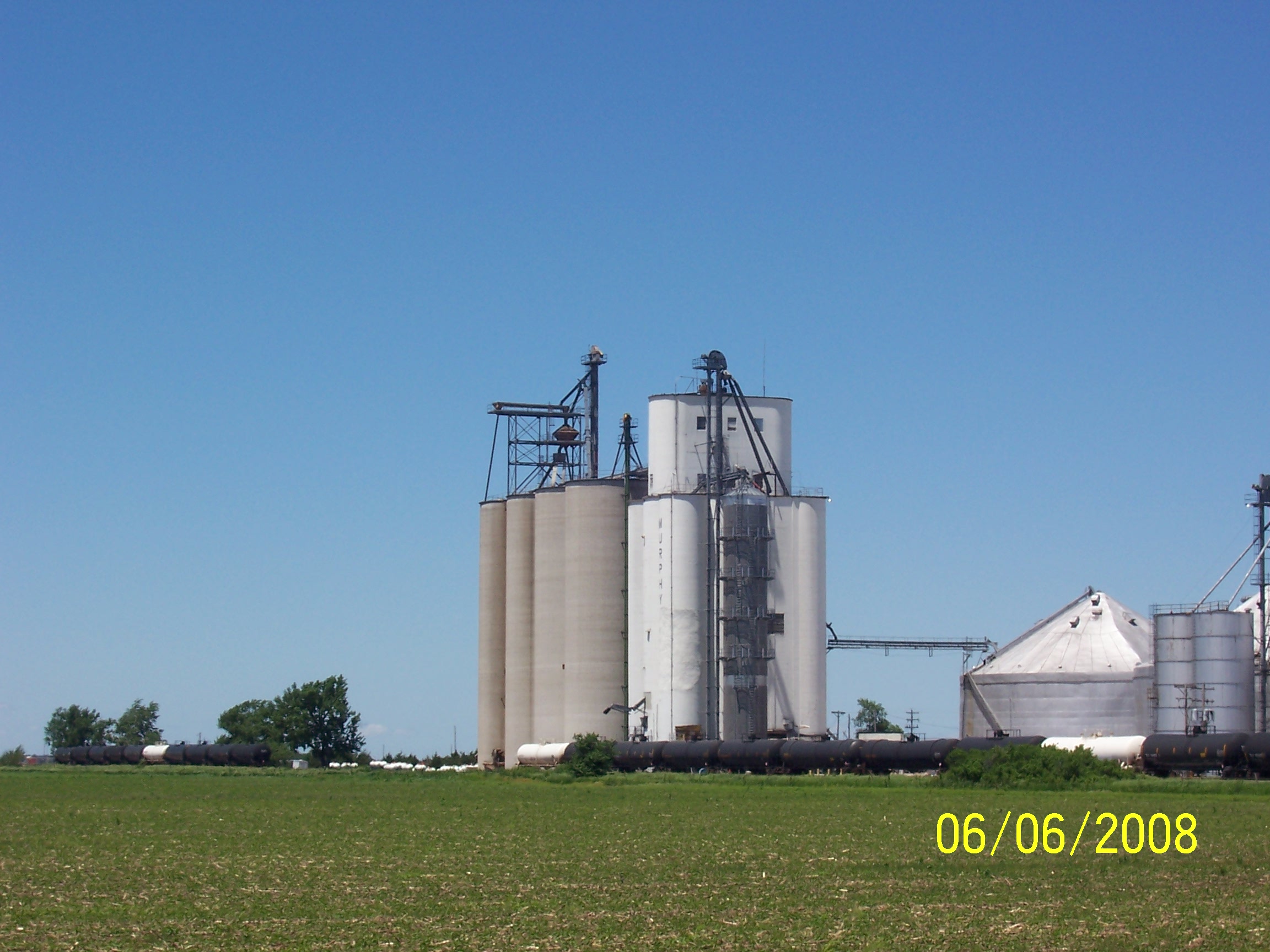
This photo, provided by Kurtis Glinn, shows Tillotson Construction's Murphy elevator in the early 1960s. Note the ground storage of grain sorghum on the right.

This photo, provided by Kurtis Glinn, shows Tillotson Construction’s Murphy, Neb., elevator in the early 1960s. Note the ground storage of grain sorghum on the right, and the old wooden elevator on the left.

By Ronald Ahrens  

A recent telephone conversation with Dennis Russell, who lives in Plano, Tex., revealed more details about the Russell family and his brother Jim, who died in an accident during construction of the Murphy, Neb., elevator. Dennis was the youngest of eight brothers: Bob, Roger, Jim, Jack, Byron, Bill, and Mark.

Their father William, born in 1900, had done construction on ammunition depots during World War Two, Dennis recalled. William, known as Bill, went to work for Tillotson Construction Company at an unknown date after the War.

“He worked for them a long time,” Dennis said. “He left Tillotson’s and started Mid States Construction Company with Gordon Erickson and another individual. I think he was a partner for a brief period and then ran jobs for them as a superintendent until his retirement.”

The name was changed to Mid States Equipment Company. Grain elevators and feed mills were the main specialties. Bill Russell retired in 1972, but he “always had fond memories working for Tillotson, I know that,” Dennis said. “I remember he was awful fond of Mary.”

Jim Russell’s promising future cut short 

Dennis was born in 1949. “My whole life was elevators. We moved every year from ’59 till I graduated high school.”

All the Russell brothers worked on elevators, Dennis recalled. “I worked on those quite a bit myself every summer.”

“Jim, he was third-oldest, he died in, like, ’58 in Murphy, Neb., right outside of Aurora. There was an article about that in the Aurora paper at the time. We lived in Vermillion, South Dakota, but that summer I was in Aurora, we were staying with Dad. I remember Mom taking that phone call.”

At the time of his death in a freak accident (the links below tell the story), Jim was married to Shirley, a nurse, and had one year of law school remaining at the University of South Dakota.

More details on the Nebraska elevator site where Jim Russell died

By Kurt Glinn

I was the manager at the Aurora Cooperative Murphy location in central Nebraska. I was told from the old timers in the area that were around when the elevator was built in the late-’50s [that an] accident happened there, shutting down construction for about a week.

The Aurora Coop's Murphy elevator and annex. Jim Russell died in a fall during the elevator's construction.

The Aurora Coop’s Murphy elevator and annex. Jim Russell died in a fall during construction.

Murphy is no more than an elevator along the railroad now. It is six miles west of Aurora, Neb., or fifteen miles east of Grand Island, Neb.

Thank you for a wonderful site. One of my first bosses was a man by the name of Willis “Bill” Maahs. He was a superintendent for Tillotson into the early ’60s when he stayed in Aurora and  became operations supervisor for Aurora Co-op. He helped build the Murphy elevator and the Aurora elevators. There are two Tillotson houses in town, as well as the feed mill in Aurora.

I have always been intrigued with the workings of the old concrete houses versus the new bigger faster ones, although I know how farming and the grain business view them.

Concrete grain elevators are very highly regarded in the industry as the most permanent. My reference is to the older, smaller, multi-bin elevators of 20,000- to 25,000-bushel bins versus the newer 250,000- to 300,000-bushel bins being built.

The industry has come along way in the last fifty years: the ability to jack the forms with hydraulics, the diameter of the bins, the height and capacity of legs. Putting all the equipment outside of the structures rather than enclosing everything in the house, which has saved many elevators from the disaster of explosions, et cetera.

Farmers are into a newer generation also, thirty-five years and younger. They want fast unload and large unloading pits.
The ag industry as a whole had seen large improvements in the size and capacity of equipment, making some of the smaller, older elevators almost impossible to use.

I find the older ones more interesting because they were what started a new generation from wood houses to concrete. Building work floors and platforms from concrete rather than steel and expanded metal. All is my own opinion as to why I enjoy the first generation of concrete grain elevators in the ag industry.

A freak accident led to the fatal fall of Bill Russell’s son

The Aurora Coop's Murphy elevator and annex. Jim Russell died in a fall during the elevator's construction.

The Aurora Cooperative’s Murphy elevator and annex. Jim Russell died in a fall during the elevator’s construction. Photo by Kurt Glinn.

Story by Ronald Ahrens

My uncle, Tim Tillotson, recalls some details of the death of a son of Bill Russell, a superintendent for Tillotson Construction Company. Russell was the father of eight sons in all. The accident occurred in the 1950s.

Although he can’t remember which job [it was the Aurora Cooperative’s Murphy location in central Nebraska] or when it happened, Uncle Tim, who was not present at the time, recalls from on-the-scene reports that two of Russell’s sons were running the night crew.

The two were working with a storey pole, a measuring device of ancient origin. In this case, the storey pole was a metal tape, and it was used to verify the height of vertical sections. One son was on top, fifty-five feet up, feeding the tape down to the other on the ground.

“It was blowing in the wind, and he was letting it out,” Uncle Tim says. “The wind caught it to some power lines, and it gave him a jolt.”

A fall to the ground ensued.

“One side of him hit the Georgia buggy, which kind of spun him around. He was conscious on the ground, saying he thought he’d broken a leg. But by the time the ambulance got there, he’d died of shock.”

Uncle Tim suggests the likelihood of a brain hemorrhage as well.

Mayer-Osborn elevator contract proposals are preserved at Wauneta, Nebraska

Much of the time on the road was spent marketing. William Osborn at the wheel

William Osborn at the wheel. Much of his time was spent selling elevators to prospective buyers.

Story by Kristen Cart

The Mayer-Osborn Construction Company built their elevators from 1949 until about 1955. To do this, they had to beat out a number of formidable competitors, both large and small, vying for the same jobs. But they did not win the contract every time they tried. One example of their perseverance survives at the Frenchman Valley Co-op at Wauneta, a town in southwestern Nebraska. Mayer-Osborn did not win their bid, but their contract proposals, made over a period of several years, are still kept in the co-op vault among blueprints and records spanning almost 70 years.

The cover letter for the Mayer-Osborn contract proposal at Wauneta, Neb.

The cover letter for the Mayer-Osborn contract proposal at Wauneta, Neb.

When I was first trying to get a handle on the scope of Mayer-Osborn’s business, I asked my dad, Jerry Osborn, which partner did most of the marketing. I was under the mistaken impression that Eugene Mayer was in charge of all that, and I thought that all my grandfather William Osborn had to do was show up and start pouring concrete.

“No,” Dad said, “Gene Mayer took care of the office and accounting, but your grandpa did a lot of the sales.”

This ad for Mayer-Osborn Company ran in Farmers' Elevator Guide over a period of several years in the early 1950s.

This ad for Mayer-Osborn Company ran in Farmers’ Elevator Guide over a period of several years in the early 1950s.

Grandpa put many miles on his cars, visiting prospective clients, when he was not supervising an active construction site. He spent almost all of his time on the road. Dad recalls that he and his mother were home alone during those years, while his brother Dick was in Korea and his sister Audrey was married. We have a few pictures of Dad with both of his parents, but they were taken at a job site. The sales part of Grandpa’s job took much more effort than I had ever imagined.

For a closer look at the Mayer-Osborn plans for Wauneta, Neb., and the final outcome of their efforts, stay tuned.