At Tillotson’s Albert City, Iowa, job, a deckhand’s pendulous moments

This photo, provided by Kristen Cart from Osborn family archives, shows a deckhand standing nonchalantly on elevator formwork. Kristen believes the picture may have been taken in Giddings, Texas, in 1945.

This photo, provided by Kristen Cart from Osborn family archives, shows a deckhand standing nonchalantly on elevator formwork. Kristen believes the picture may have been taken in Giddings, Texas, when Tillotson Construction Co. built there in 1945.

Story by Charles J. Tillotson

Reinforced-concrete grain elevators used the slip-form method of construction, whereby a wooden form system was built on the ground, having the footprint required to configure the grain-storage tanks.

Once the forms were in place and the vertical lifting and jacking system assembled, laborers began installing rebar and pouring cement into these forms.

When the forms were filled to the top–about four feet–the lifting and slipping commenced by turning screw jacks placed strategically throughout the formwork. After this procedure of vertical form lifting and rebar setting and cement pouring began, it never stopped until the structure reached its intended height, usually between 100 and 120 feet.

thThis process was the intended norm but was oftentimes interrupted by a myriad of problems, which caused the form-slipping to come to a halt. One of these instances occurred one night when I was eighteen or nineteen, working as a deckhand in Albert City, Iowa, for the family’s construction company.

The structure had reached about eighty feet in height when the electrical power supplying the lighting system and other machinery was cut off by a huge summer storm distributing lots of rain and wind throughout the area.

All personnel, including myself, were stranded on the stationary deck with little else to do but wait out the storm and the return of power.

A few hours of waiting produced a carload of my friends that had arrived on the surface. They were yelling for me to come down and join them. The only possible way to get off the tower was the vertical “ship’s ladder” that was installed in sections on the side of the rising structure.

Access to this emergency ladder was gained by going over the side of the formwork to the finishing scaffold below. Here, a rope was suspended down to the uppermost section of the ship’s ladder. The length of the rope was normally long enough so that a person could slide down it and gain hold of the ladder’s top rung.

I say normally the rope was long enough, based on the fact that the ladder sections were routinely placed sufficient to keep pace with the ever-vertical movement of the concrete structure.

However, as I soon discovered on this particular stormy night, the norm didn’t prevail. I hopped over the side of the formwork and reached for the rope hanging from the finishing scaffold’s frames. It was pitch black, and the wind was blowing to go along with heavy rain, but I was able to find the rope and swing off the side.

The first thing I discovered was that the wind was so strong, it blew me sideways and shoved me around the bin tank.

When the gusting stopped, I was able to line up vertically above the supposed location of the ship’s ladder.

So, undeterred, I slid down the rope—but not very far before another gust of wind blew. I had to stop sliding down and let it subside.

This process went on for a number of iterations, and as I slowly went down the rope, I began to wonder where the top of the ladder was exactly.

I was running out of rope.

With about three feet left, I really started sweating–I still couldn’t see the top of the ladder.

Because I had become somewhat exhausted while sliding down, swinging back and forth like a teabag, I knew I couldn’t crawl back up to the scaffold.

Now I reached the very end of the rope, and a big blast of wind blew me away and around the tank. When that gust stopped, I flew back around and by sheer luck found purchase with my foot on the top rung of the ladder. Another blast hit me, but with my foot hooked under the top rung, I stabilized myself.

With my strength ebbing, if I was going to survive, I had to make an attempt to release the rope, drop down along the ladder, and catch a rung. (Any rung would do.) So, with trepid emotions, I let go of the rope and dropped.

The testimony of my luck (and strength and skill of course) is that I am able today to relate this harrowing story.

As I released the rope I yelled up to the top of the tower to alert other personnel that they shouldn’t attempt to do what I had done. I’m sure I saved someone else’s life besides my own that night.

But the message of this story is that constructing grain elevators in the early days was filled with these types of unsafe conditions where protection of life was not as important and took a back seat to getting the job done.

There was grain being harvested in the fields, and it needed a place to be stored. The nation was on the upswing, growing by leaps and bounds, and in need of being fed.

Marvin Richards falls 105 feet from Hinton elevator

Iowan Killed in Fall from Grain Elevator

Sioux City (AP) — Marvin Richards, 28, of Hinton died in a hospital here Friday shortly after he had fallen 105 feet from the top of a grain elevator at Hinton.

Richards was employed by the Tillotson Construction Company of Omaha. He was working on a scaffold atop the nearly completed elevator of the Farmers Elevator Company.

He apparently lost his balance and fell 105 feet to the concrete top of a hopper.

Cedar Rapids Gazette, October 1, 1954

♦ ♦ ♦

Special note: The obituary of Mr. Richards’s sister Deloris E. Holtz.

News of recent developments in Hinton are found on Younglove’s site, including a picture of the original elevator.

Seed money: Roggen safecrackers use welding torch, net $34 for the trouble

Roggen Elevator Safe Robbery Investigated

Sheriff’s officers Thursday investigated a safe robbery at the Farmers Grain and Bean Association elevator at Roggen. The safecrackers got $34 in cash.

Photo by Gary Rich

A similar safe job, but unsuccessful, was done in Denver Thursday night, Sheriff William C. Tegtman was informed.

Deputies Harry Mills and Robert Patterson reported that the Roggen building had been entered by breaking a south window. The office window was then broken, and welding equipment moved to the safe to cut it open.

Greeley (Colo.) Tribune, Feb. 18, 1955

In Chase County, we meet Gary State, an elevator construction veteran

By Gary Rich

Editor’s note: Gary is recently returned from a fact-finding foray in Nebraska.

I stopped at the Chase County courthouse in Imperial, Neb., looking for the dates when the elevators were built in Imperial, Enders, and Wauneta. They did not have much information about the build dates. The only info they have in their records is that the old office building for Frenchman Valley Co-op was done in 1946. The FVC built a new office across the street from the old one.

The ladies on the courthouse staff told me to stop in at the FVC office and talk with Gary State, who might have the dates. Mr. State went to work for Mid States building grain elevators and feed plants. I do not know if it was just Mid States or Mid States Construction. He was living in Imperial when he started working for them.

Map of Nebraska highlighting Chase County

I explained about Tillotson Construction Company, of Omaha, J.H. Tillotson, Contractor, of Denver, and Mayer-Osborn Company. He gave me some leads. He told me that Hugh O’Grady is still alive and lives in Omaha. Mid States was started by a man name Erickson. He had seven sons. Six of the sons ended up working for Mid States. One son died at a construction site. He said Jack Russell was a superintendent. He thought that he was living in Seward, Neb.

Mr. State built the second annex, or elevator number two, at Big Springs, and then elevator number three.

He told me that he built the Woolstock, and Goldfield, Iowa, elevators; the feed plant at Fruita, Colo.; and elevators at Garrison and nearby David City, Neb. At the other end of the Cornhusker State, he built the west elevator in Imperial. After the west elevator was finished, he left Mid States and he went to work for the Co-op. This is the reason that he is working for FVC.

♦ ♦ ♦

Okay, here is another thing. I thought that when a construction company built an elevator that they did everything. This is not true. Mr. State told me about a company based at York, Neb. This company did all the belts inside the elevators, all around Nebraska, no matter who the builder was. So we know the belts were installed by a separate company. Now I am wondering if a separate company was onsite to install the leg as they built the elevator up. Or did the general contractor install the leg?

Listing fire perils to wooden elevators highlights pluses of slip-formed concrete

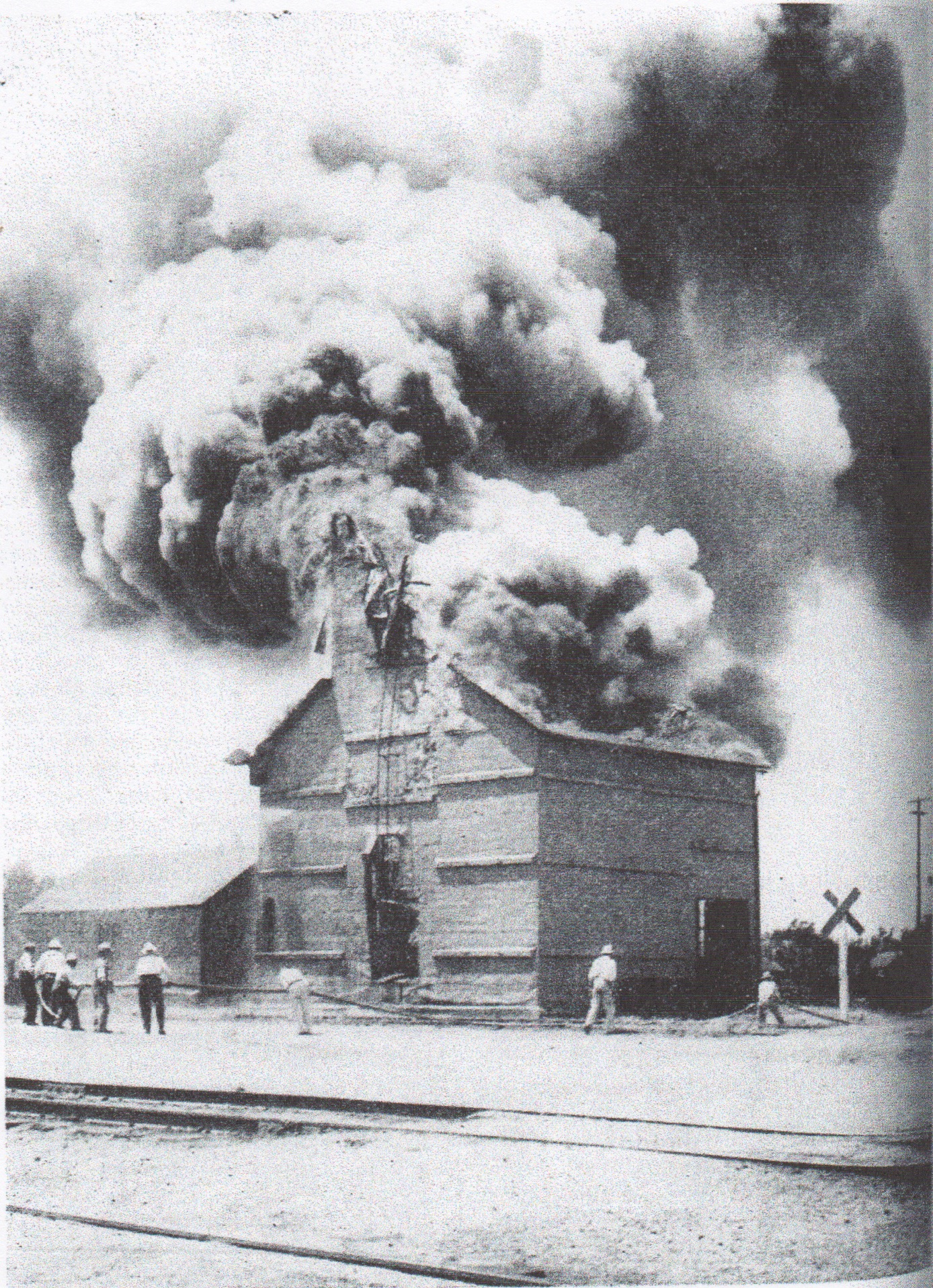
This photo appeared with Mr. Gustafson's cautions in 1939.

By Ronald Ahrens

Concrete grain elevators offered more to the local farmers’ cooperatives than greater storage capacity: the risk of fire was vastly reduced, too. Several of the construction notices on this blog, for instance, one about the new elevator in Wapello, Iowa, point out that the new slip-formed elevator was replacing a wooden one destroyed by fire. A 1957 press photo available on eBay for $15, which is beyond our budget, shows the smoldering ruins of a wooden elevator beside an unscathed concrete one.

An October 5, 1939 article in Farmers’ Elevator Guide listed the gamut of threats to a wooden elevator. The occasion was national Fire Prevention Week. C.W Gustafson, chief engineer of the Mill Mutual insurance company’s Fire Prevention Bureau, wrote that “grain elevators are unfortunately one type of plant in which fire prevention is a year ’round problem rather than one which requires special attention only one week out of the year.”

Mr. Gustafson’s list started with the advice that bearings in the elevator head and conveyor belts should be oiled daily in order not to overheat. “It is not sufficient to simply ‘slop’ oil on the bearing, but the oiler should make certain that the oil actually reaches the interior where it will do some good,” he wrote.

Other important no-no’s:

  • No smoking: “We often see farmers congregated in the elevator driveway or approaches and the tendency to discard cigarette and cigar stubs and matches without regard for their ultimate resting place is evident.”
  • Bad housekeeping: neatness improves safety.
  • Overworked electric motors: they should be cleaned weekly with compressed air, Mr. Gustafson wrote, and if blown fuses are a problem, a “competent electrician” should be called in if available.
  • Elevator legs: check that the head pulley is operating smoothly and the belt isn’t rubbing against the legging.

The following passage deserves to be delivered whole.

When dumping trucks
Request the driver to shut off the motor of his truck. Considerable oil and gasoline is usually spilled in the driveway, particularly from gravity feed truck engines and ignition of this accumulation by sparks from exhaust or backfire would result in a fire difficult to extinguish. Signs calling attention to this rule are available from your Mill Mutual insurance office.

Nowadays, we don’t notice trucks leaking as much fuel as in 1939.

Mr. Gustafson’s practical advice concluded with the suggestion that the elevator operator return in the evening after supper to look in the cupola and basement to see that all is well. “Many fires are detected by observing this rule,” he wrote.

Pulling the switches on lighting and power circuits when leaving was a final recommendation.

Boxholm manager foresees timely completion of Tillotson’s new elevator

Photo uploaded to KCCI in 2009 by the station's u local contributor hmuench

Boxholm, Iowa–Manager Bud Lane reported that the new 200,000-bushel Farmers Cooperative Elevator Company’s concrete elevator will be completed on July 15. Tillotson Construction Co. of Omaha is the builder.

The structure will rise 150 feet with storage tanks standing 120 feet high.

The firm will have 256,000 bushels of space with the new unit.

Farmers’ Elevator Guide, 1954-1955 library volume 

♦ ♦ ♦

Note: The Boxholm Farmer’s elevator was founded in 1900, according to a 2004 article in the Dayton Review. On October 25, 2004, the elevator–now expanded–took in 145,422 bushels of grain, the new single-day record at this location. For the entire 2004 harvest season, more than 2 million bushes were taken in.

On November 16, 2009, two workers were injured when a grain dryer exploded at the Boxholm elevator. See the report from Des Moines station KCCI.

This map shows the incorporated and unincorpor...

Boxholm is in northwestern Boone County, Iowa.

Tillotson Construction wins Rock Valley contract, loses $870 judgment for employee’s injuries

Photo by Rock Valley city administrator Tom Van Maanen

East Elevator To Be Sold At Public Auction Saturday

Directors of the Farmers Elevator company decided last week to sell the red (east) elevator structure to make way for the new concrete storage elevator. Included also will be a feed shed and the driveway office structure.

Various and sundry pieces of equipment are being offered for sale, either before or during the public auction, scheduled to be held this Saturday, starting at 2:00 p.m.

The elevator building to be sold has a 15,000 bushel capacity and Manager Owen Manning has pointed out that the driveway and office would make a good machine shed. The feed shed measures 30 by 48 feet. See the advertisement on another page for the list of machinery and equipment up for sale.

Manager Manning said that the contract for the new concrete storage building had been awarded to the Tillotson Construction company of Omaha and that work on the structure will begin on or about June 1. The building is due to be completed about September 15 and work may be far enough advanced to permit acceptance of grain for storage about September 1.

Rock Valley Bee, Thursday, April 27, 1950 

♦ ♦ ♦

Sioux County Courthouse News 

In the case of Winfield Kenneth Bagley vs Tillotson Construction Company & American Mu. Liability, the court approved the compromise settlement between the parties in which the defendants are to pays $870.00 to plaintiff for injuries he received to his foot, while employed at Rock Valley, Iowa by the Tillotson Construction Co.

Sioux Center News, Thursday, August 16, 1951 


Painting a concrete grain elevator in Lincoln, Nebraska

Merle Ahrens, uncle of Ronald Ahrens, has written an account of his summer of 1955, which was spent on a scaffold with another of Ronald’s uncles, Michael Tillotson, youngest son of Reginald and Margaret Tillotson:

After graduating from Omaha North High School in 1955, I went to work for Tillitoson Construction on a grain elevator in Lincoln, Nebraska, with Michael Tillotson. I was paid $1.25 an hour.

Merle at home

Merle Ahrens in 2011, at home in Titusville, Fla.

I remember the first day on the job we had to go to the top of the grain storage tank—at least 100 feet—on a bucket that was used to haul up concrete. The bucket was connected to the swinging boom at the top by a wire cable. The cable went to a stationary, manually operated, rotating spool, which wound up the cable to lift the bucket. The operator let it free-fall down, seeing how close to the ground the bucket and riders could get before hitting the brake. It was a scary ride with four or five other workers standing on the rim of the bucket, especially the free fall down. Thankfully, it didn’t take long to get used to.

At the top, there were no rails around the edges nor any safety provisions like you see today, just one jack rod sticking out of the surface to hold on to as you got on and off of the bucket. The first day, I spent a lot of time holding onto that rod looking over the side.

When Michael and I started work, all the concrete pouring was complete and we were given the task of painting the outside of the whole elevator. We painted it using a lime-base whitewash. We had to crawl over the edge of the top of the tank onto a flying scaffold. The scaffold was held up by a pair of rope block-and-tackles connected to a pair of wood beams that were extended about two feet over the edge of the tank. The wood beams extended about ten feet inboard and were weighed down with sandbags to keep the scaffold from falling. The scaffold was made up of a pair of two-by-twelve boards with a metal frame at each end and two-by-four railings around it. The rope block and tackles were attached to the scaffold on the ground. We had to pull the scaffold up to the top every time for each ten-foot width we painted. There was an old man on the ground who mixed the paint and pulled it up to us in a five gallon bucket. He had a harder job than we had. All we had to do was brush on the paint and pull the rope to release the half hitch that held up the scaffold and let gravity work to lower it. The “flying” part of flying scaffold was when the wind was blowing. You would fly halfway around the tank.

Every night we would take off our Levi’s and stand them in a corner. There was so much paint on them! Yet one pair lasted all summer.

After a couple of months we finished painting the elevator in Lincoln and went to David City to paint another grain elevator. This time we used a new latex paint. It was very slow-drying and the wind kicked up a lot of dust. The elevator ended up white with grey stripes.

We kept hearing of accidents at other sites. One man was said to have fallen from a plank used to walk between the top of two tanks. He was wearing new boots and slipped. Another was killed when roofers removed the sandbags holding the beam for the flying scaffold so they could hot-tar the roof. A couple more were hurt while riding on a bucket and the clamps holding the cable slipped. The clamps were installed wrong. I do know for a fact that one worker at Lincoln was hit in the face when a five-gallon bucket with concrete in it fell while he was using a rope and pulley to lift it overhead.

At the end of the summer, Michael went back to North High, and I went to work for the Union Pacific Railroad.

Merle Ahrens

January 9, 2012

130-foot fall claims Larry Ryan’s life in Pochahontas, Iowa

Worker Is Killed in Fall From Elevator

Pochahontas, Iowa –(AP)–A 130-foot fall from the top of the Farmers Co-operative Elevator, under construction here, claimed the life Wednesday of Larry Ryan, 20, of Cassville, Mo.

Ryan, an employe of Tillotson Construction Co., Omaha, was operating a hoist used to raise supplies to the top of the elevator. Cause of the accident was not immediately learned.

Muscatine (Iowa) Journal

Thursday, July 29, 1954

Edward Koppes injured in fall at Bonner Springs, Kansas

Injured in Fall (The Sun’s Own Service)

Hanover, Kans., Jan. 28—Edward Koppes, son of Mr. and Mrs. Chris Koppes of Hanover, received a fractured right hip and right arm when he fell 20 feet from the roof to a concrete floor of a grain elevator which he was helping to build at Bonner Springs, Kans., on Jan. 19. He was taken to a Kansas City hospital. He is an employee of the Tillotson Construction company.

Beatrice (Neb.) Daily Sun

Wednesday, Jan. 28, 1948