Lincoln Journal Star, April 8, 1981
BELLWOOD–One man died under tons of grain and concrete and two others were listed in critical condition Wednesday in an explosion that ripped through the Farmers Co-Op grain elevator late Tuesday afternoon, authorities said.
The body of Gary Roh, 20, of Linwood was pulled from the debris Tuesday by rescue teams working under floodlights and using heavy equipment, including a bulldozer.

Hospital and elevator officials said Joe Stastny, 58, a rural Bellwood farmer who was unloading grain when the blast was triggered, and elevator employee Larry Navrkal, 28, of Bellwood were in critical condition Wednesday morning at Lincoln’s St. Elizabeth Community Health Center’s burn center.
“It was a pretty big boom,” the elevator’s grain department manager Bob Bell said in a telephone interview Wednesday. “I was here in the office, which is about 50 yards from the elevator. It looked like night outside and we just dived on the floor until the debris stopped flying. Then we called the emergency number.”
Roh was reported missing after the blast, which destroyed parts of the elevator and hurled huge chunks of concrete into nearby streets and homes. Elevator officials had hoped Roh might be trapped alive, but optimism faded as the hours passed.
His body was found about 9:45 p.m.–more than five hours after the blast–in an alleyway pit inside the elevator where Stastny was unloading grain.
John Navrkal of Bellwood, an elevator supervisor and Larry Navrkal’s father, also was injured, but did not require hospitalization.
“We had a farmer (Stastny) in the elevator in a truck unloading grain,” said co-op office manager Maxine McDonald. “We had three employees there, too. The farmer was covered with grain, and they had to dig him out.”
Rescue workers used the Jaws of Life to remove him from his truck.
Witnesses said the blast apparently was triggered somewhere in the south end near Stastny’s unloading truck.
Mrs. McDonald said the 1.5 million-bushel structure was about half full of a mixture of grains and that there had been no fires. She said damage was extensive.
The blast’s cause had not been determined Wednesday morning, and damage estimates were unavailable.
Bell said insurance investigators, State Patrol officers and State Fire Marshall’s office investigators were at the scene Wednesday to try to determine the blast’s cause and whether the facility is structurally sound enough to remove remaining grain.
State Fire Marshall Wally Barnett said Wednesday the cause never may be determined “because it went from one end to the other, blew out the top and even blew out some of the bins.”
Joe Wilson, who owns a barbershop near the elevator, said there were holes measuring 25-by-50 feet in the elevator’s walls.
“The north headhouse is completely blown off,” he said. “A tank on the northeast side of the elevator was split from top to bottom.”
Wilson said the blast shook the area around the elevator, damaging homes on both sides and sending concrete fragments flying for two blocks.
“The house on the east side was riddled with concrete chunks the size of basketballs, and windows were broken,” he said. “Another house a half a block away has holes the side of footballs in the walls.”
The damage to the elevator was so extensive that at one point, the search for Roh was called off because rescue workers feared moving the grain would cause the damaged structure to collapse. Mrs. McDonald said digging resumed after a structural engineer brought in by the co-op’s insurance company examined the elevator.
There were no reports of other serious injuries.
Bellwood’s elevator is the third Nebraska elevator to explode in 1 1/2 months. In late February, an explosion rocked the Southeast Nebraska Farmers Co-op in Beatrice, injuring three men. Then slightly more than two weeks ago, a series of explosions and fires extensively damaged the McMaster Grain Co. in South Sioux City. No one was injured, but damage was estimated at $1 million.
Bellwood, a community of 361 residents, had another explosion Feb. 19 when an explosion and fire at the Farmer’s Co-op service station injured three employees and flattened the garage. None of the men were injured seriously, and the station was back in business soon after the explosion.
Mrs. McDonald said she had worked at the Bellwood elevator for 24 years, and there was another explosion there in 1959.
“But it wasn’t anywhere like this one,” she said. “We are just all in a state of shock. This is a terrible thing–one that you hope you never have to see again.”
Thank you to Susan Allen for providing this article.





 Nevertheless, we expected to see an elevator with a replacement structure at its crown.


 Concordia, Kan.
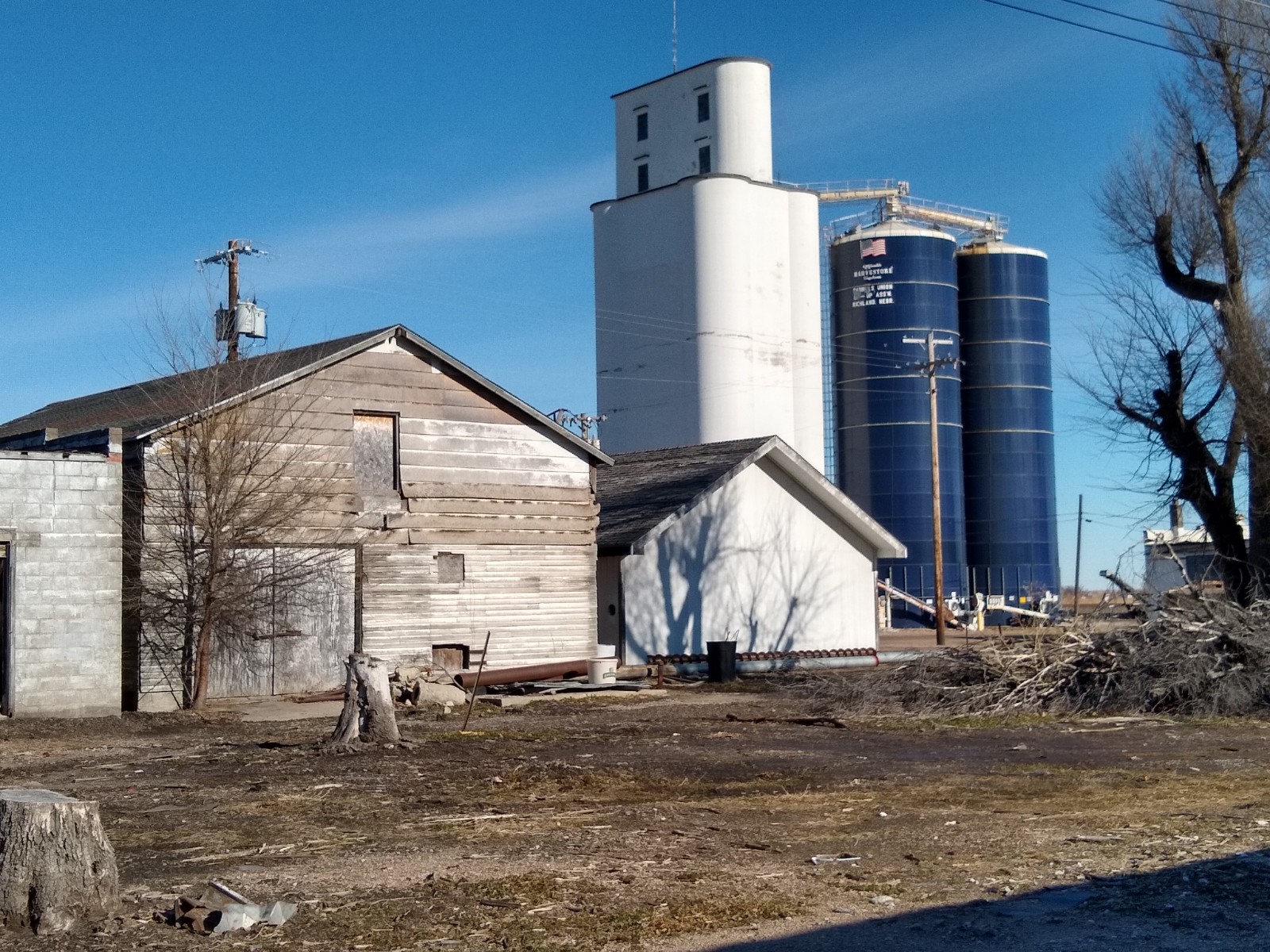


 Our Grandfathers' Grain Elevators