A view of early preparations at the foundation of Alta Cooperative’s elevator

scan0003

Photo from the Neil A. Lieb Collection

In a July 22 telephone conversation, Neil A. Lieb, who worked for Tillotson Construction Company from 1949 to 1951, described for us the elements of this photo, taken in the spring of 1950 during the earliest stage of work on the Alta Cooperative elevator, in Alta, Iowa.

  • The slab and rebar box in middle is the pit, covered with wood to leave a hole in concrete.
  • The horizontal box in the background is for the elevator’s leg, the critical motor-driven pulley-and-belt mechanism with attached scoops that lift the grain from the pit to the headhouse for distribution to bins and silos.
  • Planking is to provide a smooth course for the wheelbarrow in order to transport and dump freshly mixed concrete.
  • The dirt in the background came from the excavation.
  • In the center, the larger black tank on left contains acetylene and the smaller one holds oxygen, for fueling a torch, presumably to cut rebar.
  • The concrete mixer (upper left) had the capacity of one-half or one cubic yard of concrete.

Editor’s note: Although there is some distortion, the upper-right corner appears to show a worker who is bent at the waist and leaning away from the camera.


Excavating with explosives led to trouble on Tillotson’s Alta, Iowa, elevator


scan0001

Story by Neil A. Lieb and photos from the Neil A. Lieb Collection

I do not know exactly when the Alta job started, but I think it was in March or early April of 1950. At that time of the year the ground in Iowa is frozen two to three feet deep. Since the ground was frozen, the bulldozer could not dig the hole needed for the slab. So it was decided they would use dynamite to loosen the soil. I guess Superintendent Bill Russell had this approved by the town fathers and the police and fire chef. 

Neil A. Lieb, left, and Blaine Bell worked on the Alta, Iowa, elevator in 1950.

Neil A. Lieb, left, and Blaine Bell worked on the Alta, Iowa, elevator in 1950.

Now, remember, Alta is a very small town, maybe 900 to 1000 residents then.

It was decided to use one-quarter stick of dynamite at a depth of 18 to 24 inches. The first charge was set off and it loosened about six to seven feet of dirt so they repeated this procedure every six to eight feet.

After setting off several charges, someone decided that if one-quarter stick worked so well, one-half stick would loosen a bigger area. So they used one-half  stick for the next charge. When it was set off, the explosion was so loud that Bill came charging out of his office to find why at about the same time as the woman across the street came out of her house screaming that her china cabinet had fallen over and all her good china had been broken. 

Within a few minutes the mayor, fire and police chiefs, and most of the town council members showed up. I guess Bill was very busy trying explain. Once he’d calmed everyone down, they all left.

That was the end of the dynamiting. The next day everyone was swinging a pick.

scan0007


Newly discovered photos show Tillotson’s big Alta, Iowa, grain elevator in 1950

Neil A. Lieb collection

Photos contributed by Neil A. Lieb

Of the slew of elevators Tillotson Construction Company put up in 1950, the one at Alta, Iowa, could have been considered a typical job, although the photo above shows that a sign company must have gone to work sinking anchors in the headhouse for the raised lettering. Built in the small Buena Vista County town that sits at the highest point on the Chicago-Illinois Railroad in its crossing of the Hawkeye State, the elevator followed Tillotson’s established Palmer Plan, with eight tanks of 18 feet in diameter rising to 115 feet in height. There was a 13-foot-wide driveway passing through the house in an opening 15 feet high under four split bins. An additional note about the Palmer plan says, “Extra dist @ Cupola and on Cleaner Floor,” and we take the abbreviation to mean distribution.

Formwork as the Alta Cooperative's elevator rises in a continuous pour. Note the driveway door.

Formwork as the Alta Cooperative’s elevator rises in a continuous pour. Note the driveway door.

Here is the full list of specifications:

Capacity per Plans (with Pack) 246,070 bushels

Capacity per foot of height 2640 bushels

Reinforced concrete/plans (Total) 2082 cubic yards

Plain concrete (hoppers) 49.6 cubic yards

Reinforcing steel/Plans (includes jack rods) 112.4 tons

Average steel per cubic yard of reinforced concrete 107/96 pounds

Steel & reinforced concrete itemized per plans

Below main slab 9419 lb/91 cu yd

Main slab 32,077 lb/272 cu yd

Drawform walls 142,070 lb/1424 cu yd

Work & driveway floor (including columns) 1485 lb/30 cu yd

Deep bin bottoms 6682 lb/47 cu yd

Overhead bin bottoms 7929 lb/40 cu yd

Bin roof (corner) 10150 lb/51 cu yd

Scale floor (complete) none

Cupola walls 9655 lb/88 cu yd

Distributor floor 1912 lb/10 cu yd

Cupola roof 2753 lb/15 cu yd

Miscellaneous (boot, leg, head, track sink, steps) 2560 lb/13 cu yd (a note here in the plans says “Cleaner floor”)

Elevator construction continued around the clock in a spectacle that must have awed the surrounding community.

Elevator construction continued around the clock in a spectacle that must have awed the community.

Construction details 

Main slab dimensions (Drive length first dimen.) 60 x 73.5 feet

Main slab area (actual outside on ground) 4101 sqare feet

Weight of reinforced (total) concrete (4000#/cu yd + steel) 4276 tons

Weight of plan concrete (hoppers 4000#/cu yd) 99 tons

Weight hopper fill sand (3000#/cu yd) 708 tons

Weight of grain (at 60# per bushel) 7380 tons

Weight of structural steel & machinery 20 tons

Gross weight loaded 12,483 tons

Bearing pressure 3.04 tons per sq ft

Main slab thickness 24 inches

Main slab steel (bent) 1 in diameter at 7 inch o.c.

Tank steel at bottom (round tanks) 5/8 inch diameter at 6 inch o.c.

Lineal feet of drawform walls 762 feet including exterior

Height of drawform walls 115 feet

Pit depth below main slab 15 feet 0 inches

Cupola dimensions (W x L x Ht.) 23 x 61.5 x 39 feet

Pulley centers 161 feet

Number of legs 1

Distributor floor Yes

Track sink Yes

Full basement Yes

Electrical room Yes

Driveway width–clear 13 feet

Dump grate size 3 – 9 x 6 feet

Columns under tanks size 20 inches square

Boot — leg & head Concrete

scan0010

Machinery Details 

Boot pulley 72 x 14 x 2 3/16 inches

Head pulley 72 x 14 x 3 15/16 inches

R.P.M. head pulley 42 rpm

Belt 14 inch 6 ply Calumet

Cups 12 x 6 inch at 8 inch o.c. Howell

Head drive 40 horsepower

Theoretical leg capacity (cup manufacturer rating) 8440 bushels per hour

Actual leg capacity (80 percent of theoretical) 6750 bushels per hour

The finished elevator, before the headhouse windows were installed and whitewashing was done.

The finished elevator, before whitewashing and installation of the headhouse windows.

Horsepower required for leg (based on above actual capacity plus 15 percent for motor) 33 hp

Man lift 1.5 horsepower electric

Load out scale Two 25 bushel Rich.

Load out spout 10.75 inch W.C.

Cupola spouting 10-inch diameter 14 gauge

Truck lift 7.5 horsepower Ehr

Dust collector system Fan → Dust bin

Driveway doors Two overhead rolling

Conveyor 14-inch R.H. 3 hp.

With their works in Estill, South Carolina, Tillotson built big in cotton country

Freshly harvested cotton field in central South Carolina

Freshly harvested cotton field in central South Carolina.

Story and photos by Kristen Cart

The brightly wrapped cotton bales highlighted an otherwise drab landscape as I traveled the 91 miles south from Columbia to visit the Estill elevator, originally built in 1947. Rain and haze flattened the view. Since it was Sunday when I visited the elevator, few people appeared to be about. It was going to be a photography outing, for better or for worse.

DSC_3487

The Estill elevator, greatly expanded since it was built in 1947, was secured behind barbed wire.

I graduated high school in South Carolina. My impression of the place, after growing up in the western desert, was one of endless dark pine woods, with a brief gaudy display of azaleas and dogwood blooms in springtime.  I didn’t appreciate the raw beauty at the time. Now, on a soggy day, it had a mysterious appeal.

DSC_3431When I learned that the Tillotson Construction Company built an elevator in the state, it came as a surprise. We do not know who built the original house in 1947. Tillotson, according to company records, built the 225,000-bushel annex and a second, larger elevator, in 1952 and 1953, respectively. The trademark rounded headhouse rises above the 350,000 bushel elevator, built to finish the concrete elevator complex.

Michael M. DeWitt, Jr. outlined the history of the Estill elevator in his article for the Hampton County Guardian published on December 14, 2010. The article was written to herald the purchase of Carolina Soya by ADM. During its heyday, the elevator stored soybeans for soybean processing, which was part of the operation. Now it is strictly a storage facility for ADM, focusing on soybeans but also accepting corn.

The company laid off staff upon acquiring the facility in 2010, shrinking from 45 to 14 workers, heralding a loss to the community in a time of slow economic growth. ADM promised to hire from the laid off worker pool as needed.

DSC_3406I noticed that the good times had passed during my drive down. The decline of the area was evidenced by empty store fronts and decrepit gas stations, ancient closed restaurants, and tired houses–all along the highway south from Columbia, it was apparent that development chose another corridor and not this one. I wondered if there was one open gas station anywhere along the route.

The histories neglect one of the Estill elevator’s darker episodes. In the ’40s and ’50s, construction safety was not mandated as it is now. In one of the accidents that was all too common for elevator construction, Wayne Eugene Baker lost his life in a fall while working on the storage addition, or annex, built in 1952. For all of the heartache, Wayne helped build a thing of beauty that sustained its neighborhood for many years and still brings economic benefit to its region.

Dennis Russell reflects on his brother Jim’s tragic death on the Murphy, Neb., elevator

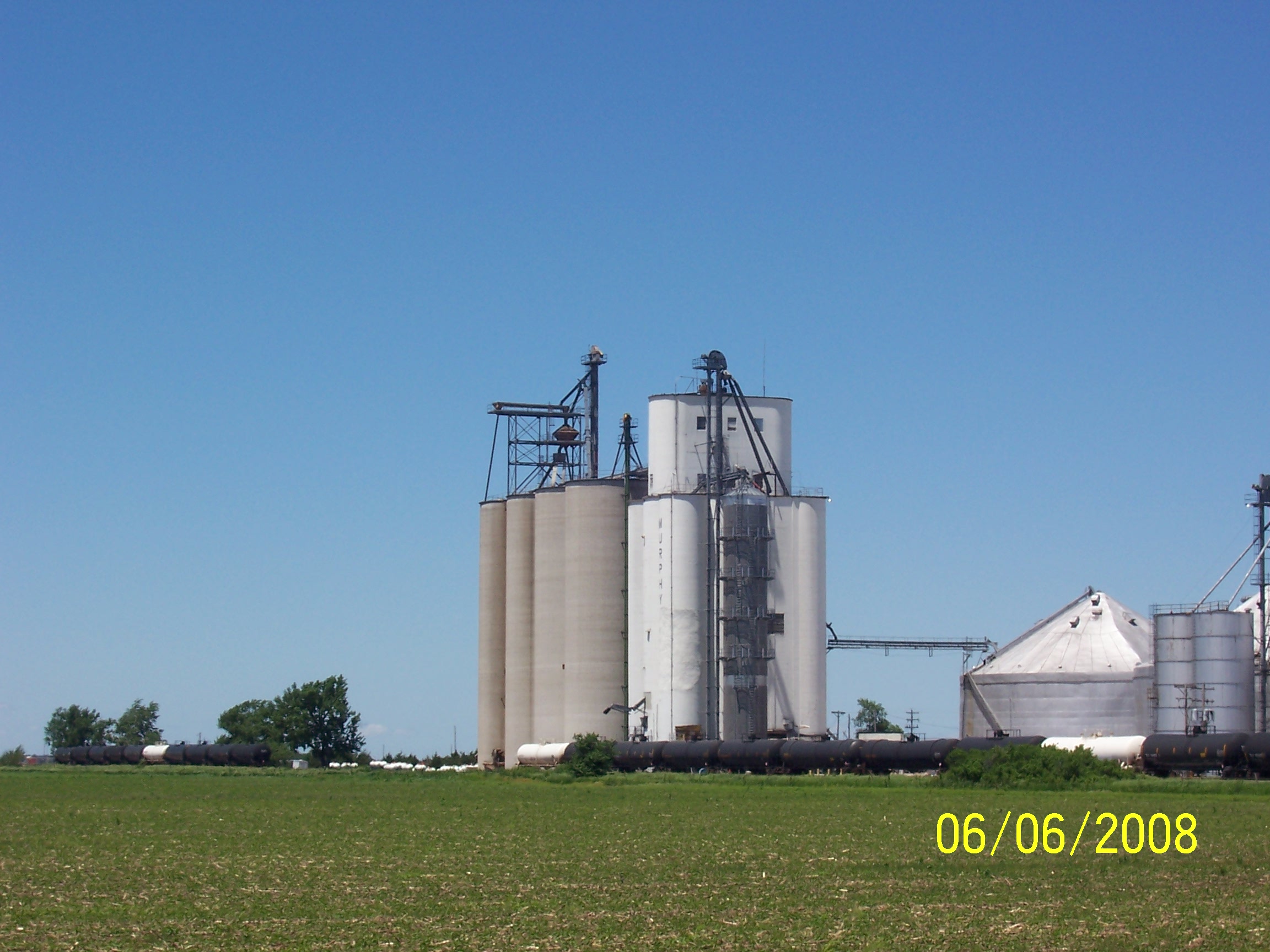
This photo, provided by Kurtis Glinn, shows Tillotson Construction's Murphy elevator in the early 1960s. Note the ground storage of grain sorghum on the right.

This photo, provided by Kurtis Glinn, shows Tillotson Construction’s Murphy, Neb., elevator in the early 1960s. Note the ground storage of grain sorghum on the right, and the old wooden elevator on the left.

By Ronald Ahrens  

A recent telephone conversation with Dennis Russell, who lives in Plano, Tex., revealed more details about the Russell family and his brother Jim, who died in an accident during construction of the Murphy, Neb., elevator. Dennis was the youngest of eight brothers: Bob, Roger, Jim, Jack, Byron, Bill, and Mark.

Their father William, born in 1900, had done construction on ammunition depots during World War Two, Dennis recalled. William, known as Bill, went to work for Tillotson Construction Company at an unknown date after the War.

“He worked for them a long time,” Dennis said. “He left Tillotson’s and started Mid States Construction Company with Gordon Erickson and another individual. I think he was a partner for a brief period and then ran jobs for them as a superintendent until his retirement.”

The name was changed to Mid States Equipment Company. Grain elevators and feed mills were the main specialties. Bill Russell retired in 1972, but he “always had fond memories working for Tillotson, I know that,” Dennis said. “I remember he was awful fond of Mary.”

Jim Russell’s promising future cut short 

Dennis was born in 1949. “My whole life was elevators. We moved every year from ’59 till I graduated high school.”

All the Russell brothers worked on elevators, Dennis recalled. “I worked on those quite a bit myself every summer.”

“Jim, he was third-oldest, he died in, like, ’58 in Murphy, Neb., right outside of Aurora. There was an article about that in the Aurora paper at the time. We lived in Vermillion, South Dakota, but that summer I was in Aurora, we were staying with Dad. I remember Mom taking that phone call.”

At the time of his death in a freak accident (the links below tell the story), Jim was married to Shirley, a nurse, and had one year of law school remaining at the University of South Dakota.

More details on the Nebraska elevator site where Jim Russell died

By Kurt Glinn

I was the manager at the Aurora Cooperative Murphy location in central Nebraska. I was told from the old timers in the area that were around when the elevator was built in the late-’50s [that an] accident happened there, shutting down construction for about a week.

The Aurora Coop's Murphy elevator and annex. Jim Russell died in a fall during the elevator's construction.

The Aurora Coop’s Murphy elevator and annex. Jim Russell died in a fall during construction.

Murphy is no more than an elevator along the railroad now. It is six miles west of Aurora, Neb., or fifteen miles east of Grand Island, Neb.

Thank you for a wonderful site. One of my first bosses was a man by the name of Willis “Bill” Maahs. He was a superintendent for Tillotson into the early ’60s when he stayed in Aurora and  became operations supervisor for Aurora Co-op. He helped build the Murphy elevator and the Aurora elevators. There are two Tillotson houses in town, as well as the feed mill in Aurora.

I have always been intrigued with the workings of the old concrete houses versus the new bigger faster ones, although I know how farming and the grain business view them.

Concrete grain elevators are very highly regarded in the industry as the most permanent. My reference is to the older, smaller, multi-bin elevators of 20,000- to 25,000-bushel bins versus the newer 250,000- to 300,000-bushel bins being built.

The industry has come along way in the last fifty years: the ability to jack the forms with hydraulics, the diameter of the bins, the height and capacity of legs. Putting all the equipment outside of the structures rather than enclosing everything in the house, which has saved many elevators from the disaster of explosions, et cetera.

Farmers are into a newer generation also, thirty-five years and younger. They want fast unload and large unloading pits.
The ag industry as a whole had seen large improvements in the size and capacity of equipment, making some of the smaller, older elevators almost impossible to use.

I find the older ones more interesting because they were what started a new generation from wood houses to concrete. Building work floors and platforms from concrete rather than steel and expanded metal. All is my own opinion as to why I enjoy the first generation of concrete grain elevators in the ag industry.

A freak accident led to the fatal fall of Bill Russell’s son

The Aurora Coop's Murphy elevator and annex. Jim Russell died in a fall during the elevator's construction.

The Aurora Cooperative’s Murphy elevator and annex. Jim Russell died in a fall during the elevator’s construction. Photo by Kurt Glinn.

Story by Ronald Ahrens

My uncle, Tim Tillotson, recalls some details of the death of a son of Bill Russell, a superintendent for Tillotson Construction Company. Russell was the father of eight sons in all. The accident occurred in the 1950s.

Although he can’t remember which job [it was the Aurora Cooperative’s Murphy location in central Nebraska] or when it happened, Uncle Tim, who was not present at the time, recalls from on-the-scene reports that two of Russell’s sons were running the night crew.

The two were working with a storey pole, a measuring device of ancient origin. In this case, the storey pole was a metal tape, and it was used to verify the height of vertical sections. One son was on top, fifty-five feet up, feeding the tape down to the other on the ground.

“It was blowing in the wind, and he was letting it out,” Uncle Tim says. “The wind caught it to some power lines, and it gave him a jolt.”

A fall to the ground ensued.

“One side of him hit the Georgia buggy, which kind of spun him around. He was conscious on the ground, saying he thought he’d broken a leg. But by the time the ambulance got there, he’d died of shock.”

Uncle Tim suggests the likelihood of a brain hemorrhage as well.

Mayer-Osborn elevator contract proposals are preserved at Wauneta, Nebraska

Much of the time on the road was spent marketing. William Osborn at the wheel

William Osborn at the wheel. Much of his time was spent selling elevators to prospective buyers.

Story by Kristen Cart

The Mayer-Osborn Construction Company built their elevators from 1949 until about 1955. To do this, they had to beat out a number of formidable competitors, both large and small, vying for the same jobs. But they did not win the contract every time they tried. One example of their perseverance survives at the Frenchman Valley Co-op at Wauneta, a town in southwestern Nebraska. Mayer-Osborn did not win their bid, but their contract proposals, made over a period of several years, are still kept in the co-op vault among blueprints and records spanning almost 70 years.

The cover letter for the Mayer-Osborn contract proposal at Wauneta, Neb.

The cover letter for the Mayer-Osborn contract proposal at Wauneta, Neb.

When I was first trying to get a handle on the scope of Mayer-Osborn’s business, I asked my dad, Jerry Osborn, which partner did most of the marketing. I was under the mistaken impression that Eugene Mayer was in charge of all that, and I thought that all my grandfather William Osborn had to do was show up and start pouring concrete.

“No,” Dad said, “Gene Mayer took care of the office and accounting, but your grandpa did a lot of the sales.”

This ad for Mayer-Osborn Company ran in Farmers' Elevator Guide over a period of several years in the early 1950s.

This ad for Mayer-Osborn Company ran in Farmers’ Elevator Guide over a period of several years in the early 1950s.

Grandpa put many miles on his cars, visiting prospective clients, when he was not supervising an active construction site. He spent almost all of his time on the road. Dad recalls that he and his mother were home alone during those years, while his brother Dick was in Korea and his sister Audrey was married. We have a few pictures of Dad with both of his parents, but they were taken at a job site. The sales part of Grandpa’s job took much more effort than I had ever imagined.

For a closer look at the Mayer-Osborn plans for Wauneta, Neb., and the final outcome of their efforts, stay tuned.

List of Tillotson Construction supervisors includes 2 unfortunate incidents

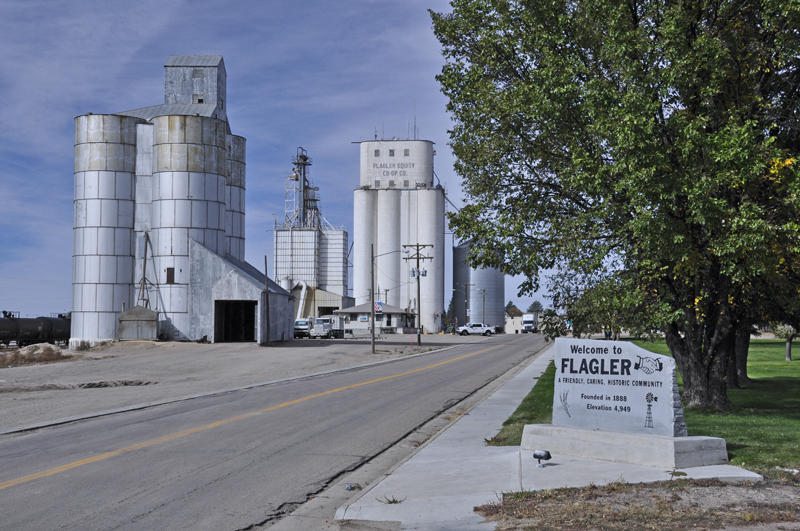
Flagler by Gary Rich

Flagler, Colo. in 2011. Photo by Gary Rich

By Ronald Ahrens

My uncles Tim and Charles Tillotson have put their heads together and come up with a list of supervisors who directed operations on Tillotson Construction Company jobs. What follows are Uncle Tim’s notes, and we’ve done the best that we can in regard to spelling.

Glen Morrison

Francis Dawson (ranch in New Mexico connected to ours)

Doyle Elliott

Glen Casey

Jerry Grimes

Wallly Farmer (also did the house, Kelby Road)

Bill Russell (had seven [surviving] sons; some ran jobs for us; one [the eighth] was electrocuted dropping a steel measuring tape down one morning to verify height on a deck “story pole”; wind blew tape, which touched bare spot on high-tension power lines)

Jim Sheets (’bout half Native American)

Everett Glen (Chas & I concur Everett was the super on Flagler, Colo., in 1953; I had told you before that Mother found him dead in his car in the parking at the house where he was working on finish trim, cabinet work, et cetera; this unfortunate incident had to be fall or winter of ’53 after the job in the summer.)

The Vinton Street elevator’s driveway took special planning before construction


Vinton Street Drive way

By Ronald Ahrens

The Vinton Street elevator‘s driveway required the building of plenty of formwork before concrete could be poured. Here we see two men making final preparations. One is sweeping the deck, while the worker at the lower right is perhaps using a tool. The unknown photographer’s shadow intrudes into the lower left part of the frame.

Records show that 17 cubic yards of concrete were allotted for the driveway and the elevator’s work floor. The amount of reinforcing steel was not recorded.

A truck shed was then built. Although we lack a photo of it after completion, the record does show that Johnson Overhead Doors were to be installed, one at each end of the shed. And of course a scale was part of the package.