Kingfisher Co-op documented the sequence of its elevators in a 1984 history

Scan

By Ronald Ahrens

Thanks to Linda at Plains Partners, in Kingfisher, Okla., we have pages from the special 50-year-history edition of The Co-op Way, published by the Kingfisher Cooperative Elevator Association in 1984.

The history reports what happened only twelve years after the co-op was incorporated. Because of postwar expansion “the need to build a new elevator was obvious,” the history says.

Scan 2The co-op chose Tillotson Construction, of Omaha, for the job.

First, however, the co-op reincorporated early in 1946 to increase its capital.

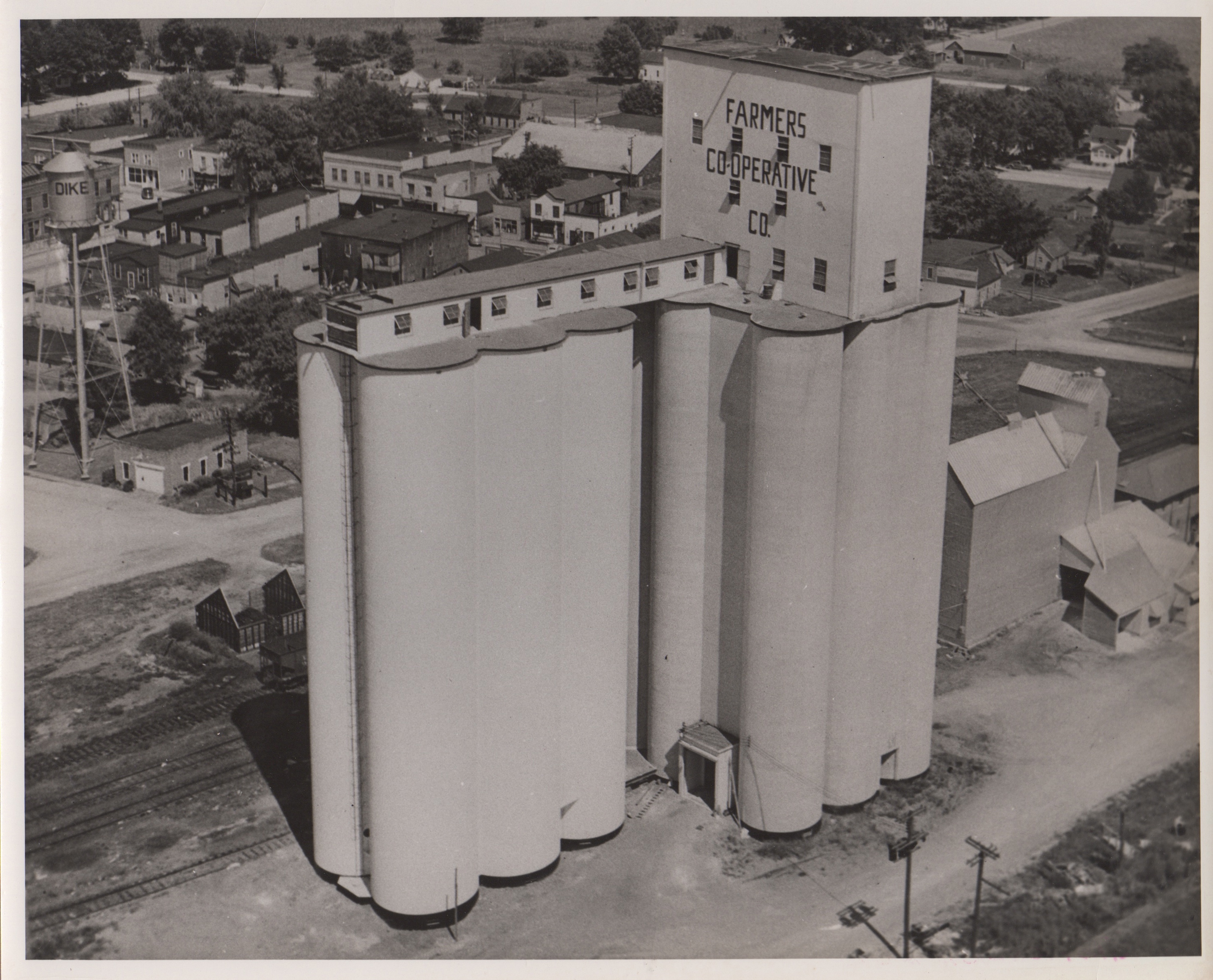
Work soon got under way when “the association wrecked the old 34,000 bu. elevator and built a new concrete elevator with a 250,000 bu. capacity,” the history says.

“They also wrecked all the other old buildings except the office and scale house which they had built in 1942. It was remodeled into a concrete cleaning and grinding mill and warehouse.”

The year of 1955 “saw the skyline of Kingfisher change once more. A new skyscraper had been added to the landscape, and the farmers took pride in the contribution they had made to their community’s appearance and prosperity.”

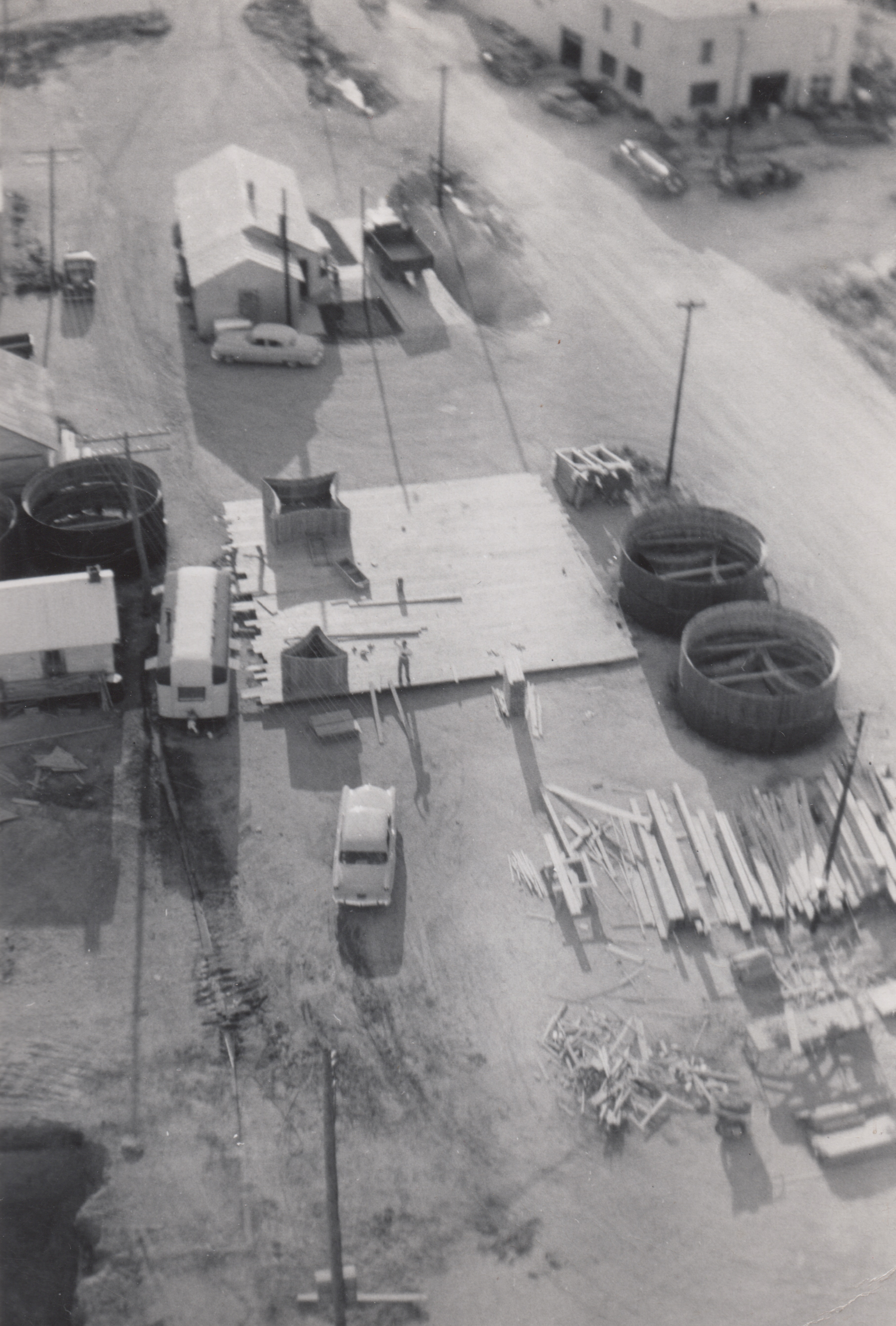
Tillotson company records don’t address the question of who built the second elevator, seen at right in the photo below. Neither does the co-op’s history mention the builder.

Scan 3


Timeline for Tillotson Const., J.H. Tillotson, and Mayer-Osborn companies and jobs

Ronald Ahrens and Kristen Cart cofounded this blog. Gary Rich is a primary contributor. We have visited elevators around the United States and Canada.

Ronald’s maternal grandfather was Reginald Oscar “Mike” Tillotson.

Kristen’s paternal grandfather was William Arthur Osborn.

Reginald O. Tillotson

R. O. Tillotson

Reginald’s company was Tillotson Construction Co., of Omaha. The company had been building and repairing wooden elevators since the 1920s, when it was led by Reginald’s father Charles H. Tillotson. Before his death, experiments were made with slip-form concrete construction techniques.

1938: Charles dies, and the company passes to his sons Reginald and Joseph H. Tillotson and daughter Mary V. Tillotson. They begin to perfect slip-forming and refine their design strategy, which includes a rounded headhouse.

1945: Tillotson Construction builds a concrete elevator in Giddings, Tex. William Osborn works on this project. He is probably employed by the company by late in ’44. Tillotson Construction wins the contract to build in Elkhart, Kan., and starts construction.

1946: The 225,000-bushel elevator in Elkhart is completed. “Shortly after the war, my Dad and Joe decided they couldn’t see eye to eye, so they split,” writes Charles J. Tillotson in “The Tillotson Construction Story” on this blog. Joe forms J.H. Tillotson, Contractor in Denver. William Osborn works for Joe Tillotson.

William A. Osborn in 1965

William A. Osborn in 1965

1947: Tillotson Construction builds  the Vinton Street elevator in Omaha. Joe Tillotson dies in a car accident in March. J.H. Tillotson, Contractor builds at Daykin and Fairbury, Neb., and Hanover and Linn, Kan., with William Osborn supervising the projects. Maxine Carter leaves Tillotson Construction on Oct. 7 to wed Russell L. Bentley.

1948: Formed in September from the residue of J.H. Tillotson, Contractor, the Mayer-Osborn Company builds its first elevator at McCook, Neb. Joe Tillotson’s wife Sylvia was a Mayer, and her brother Eugene Mayer is one of the partners. William Osborn is the other. Meanwhile, Reginald begins to use a light airplane for business travel in the postwar years. Reginald’s nephew John Hassman joins Tillotson Construction in September; among many other duties, he pilots the company plane to jobs in Nebraska, Kansas, and Oklahoma. Tillotson’s projects that year are in Paullina, Iowa, and Montevideo, Minn.

1949: John Hassman’s father Ralph, Reginald’s cousin, joins Tillotson Construction in sales and stays through 1952.

1950: Construction begins in November on the Tillotson house, which is built of concrete. It still stands north of Omaha. Tillotson employee Jess Weiser weds Lavonne Wiemers on Dec. 22.

1951: Drafted into the Air Force, John Hassman leaves Tillotson Construction in January.

Related articles

A house of slip-formed concrete was Reginald Tillotson’s pet project in 1950

Tillotson Home

By Ronald Ahrens

An early post on this blog included John Hassman’s recollection of design and construction of the house Reginald Tillotson built on a hilltop north of Omaha’s Florence neighborhood:

“While in the office I [was] trained by the office engineer to design buildings and was the major designer with R.O. to build his new home in Florence, Neb. Many mornings he would arrive with new ideas of what he wanted changed in the house, and we would start all over. Starting in Nov. 1950 we began construction on the new house. The foremen were kept busy in the winter doing that work. All using a concrete house with the ideas we used in Elevator Const. That was the coldest, windiest place to work in December. I left to go the the Air Force because I was about to be drafted in the middle of the Korean War.” 

The house, of course, still stands, and is the home of Michael Tillotson, youngest son of Reginald and Margaret.

It did not incorporate Tillotson Construction’s signature rounded headhouse!

As a grandchild who spent a lot of time there, I always though it was remarkable because of the use of glass blocks as a design feature. The entire second floor was reserved as a music and game area. And despite the single garage door, there was a second “lane” to the right when you drove in.

But Uncle Mike always had it blocked with his relics.

Tillotson Construction’s postwar business card, in full color, is a story in itself

Scan0005

By Ronald Ahrens

Reginald Tillotson’s business card from the years after World War Two demands some interpretation.

The splashy color side—perhaps a bit of an extravagance, although surely effective when handed to a co-op manager in a remote district—presents the image of what we’re sure is the Vinton Street elevator. Completed in 1947, this South Omaha elevator with its unusual, towering headhouse, would be a showcase for any builder.

On the back, above the rule, the range of Tillotson Construction’s services is spelled out. We don’t yet know much about the mills and warehouses but hope some information will turn up.

Below the rule, we find the six-character telephone number from the alphanumeric dialing days. Local exchanges were assigned prefix names from Bell Telephone’s mostly generic list. Besides Atlantic, Omaha exchanges were named Jackson, Prospect, Regent, and so on.

Seven-digit numbers replaced Omaha’s alphanumeric plan in 1960. The Atlantic exchange received the numerical prefix of 341.

Numerical postal zones, introduced during World War Two, were replaced when the national zip code system was introduced in 1963.

Reginald Oscar Tillotson was widely known as Mike. It could have been that Reginald was too exotic for the time and place, so he picked the nickname for himself.

Tillotson Construction’s classic elevator makes a good neighbor in Clifton, Kansas

Story and photos by Kristen Cart

The north-central Kansas town of Clifton is dominated at each end by a massive elevator. At one end of the main drag is a huge metal-sided wood elevator rising prominently above the street, and at the other is a gleaming white concrete elevator with its annex. The two elevators, defining the town skyline, are the center of the town’s agricultural business. Clifton’s concrete elevator was very busy during a visit there in October.

DSC_0889(2)

The Clifton elevator, built by Tillotson Construction Company, of Omaha, Neb., defines the town skyline.

The characteristic rounded headhouse epitomized the classic Tillotson Construction Company style. After sixty-odd years of continuous use, the durable elevator was still going full steam ahead during the harvest. Several trucks pulled through the driveway while I watched, and it looked like more were waiting.

DSC_0890

Its neighboring landmark, the wooden elevator, was deserted and may have been retired, but anyone entering the town would be immediately impressed by its size. The two elevators together represented a continuum of agricultural cooperation and success, beginning in the first half of the twentieth century and still going strong in the twenty-first.

The concrete elevator had a manhole cover on the exterior that identified the builder as Tillotson Construction Company of Omaha, Neb., but you could see that fact from a mile away by looking at the headhouse. The elevator was very representative of its type.

John B. Tillinghast, the location supervisor for United Farmers Co-op, cheerfully stood for a picture in front of his charge. He said the elevator was built in 1953.

DSC_0931

The familiar rounded headhouse atop a straight-up elevator was Tillotson Construction’s signature design.

DSC_0938

John B. Tillinghast, location supervisor for United Farmers Co-op.

DSC_0924

Clifton elevator with annex.

DSC_0928

Manhole cover names builder.

Gary Rich’s analysis reveals subtle aspects of Mitchellville, Iowa, elevator operation

Story by Gary Rich
Photos by Kristen Cart

There are several possibilities as to why Heartland Co-op’s Mitchellville, Iowa, elevator would only use rail service for shipping out its grain. The most obvious one is that this might be a shuttle operation. Whether corn or soybeans, the company that receives the grain might have a contract with the elevator specifying shipment of a certain number of carloads per week. It is probably a larger-name company, and they could be paying for the shipping charges. This would keep their operation from having to shut down for lack of grain.

The photos appear to show nine or ten covered hopper cars at the elevator’s far right. In the view at top, we see yellow markings on the rail on the elevator track. This is known as the “clearance point.” You can’t have cars sitting beyond these markings without “fouling” the main line. The following links to lexicons of railroad terminology will explain both terms:

http://www.icrr.net/terms.htm
http://cfr.vlex.com/vid/214-7-definitions-19944901

Here’s an illustration why it’s cheaper to move grain by rail. The amount of grain in one covered hopper car leaving the elevator equals three semi-trailer loads. If you load ten hopper cars, you’re probably looking at an equivalent of around thirty-three or thirty-four semi-trailers. If the plant that receives the grain is over 200 miles from Mitchellville, it would take more than a week to move all that grain over the highway.

Indeed, if the plant is 200 miles away, you also have to consider the amount of time a trucker can work. He wouldn’t be able to cover two round-trips per day. And besides, the trucker’s charge of something over $4.00 per mile might erode all profit for the grain operation.

Tillotson Construction’s Mitchellville elevator is a key part of Heartland’s grain operation

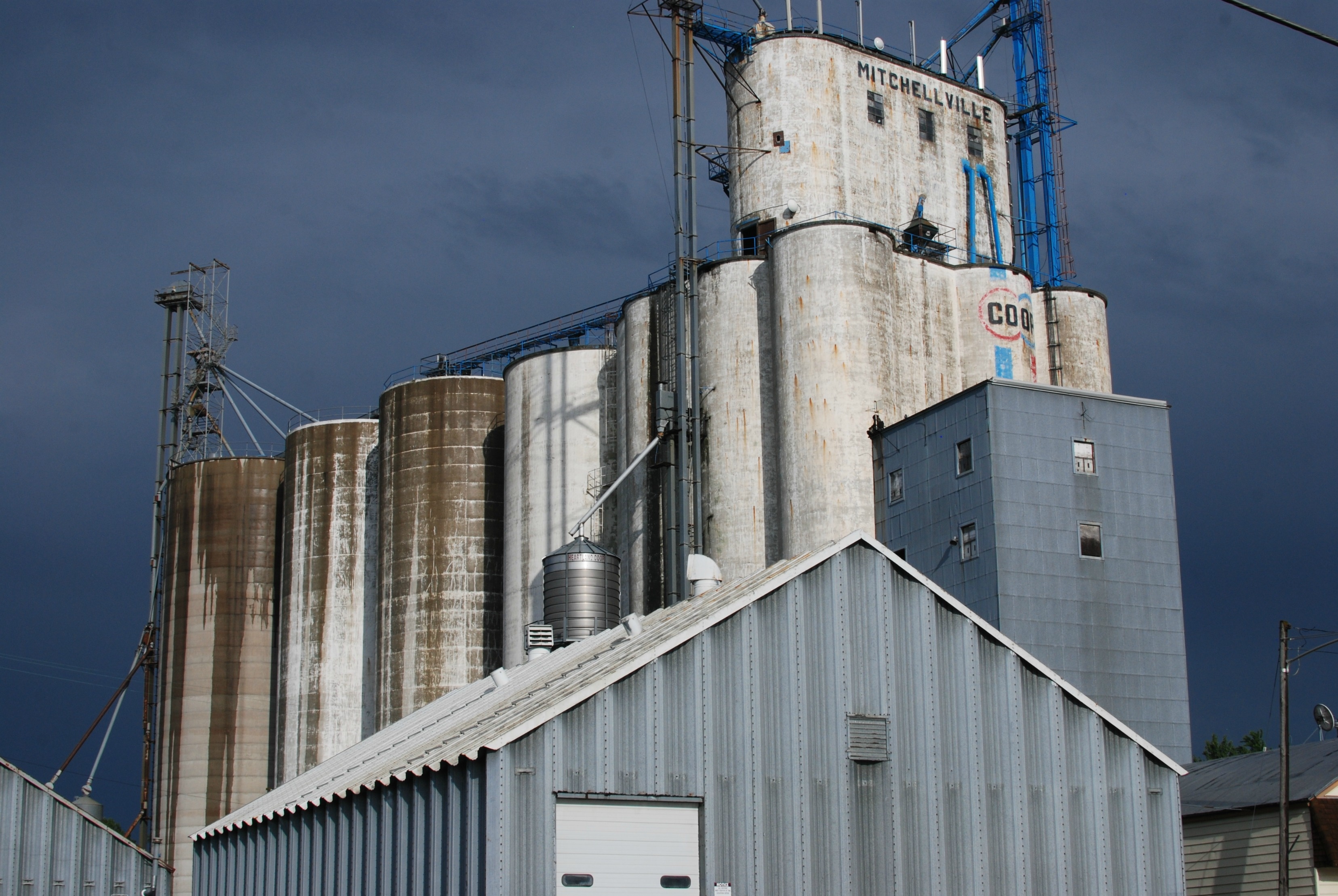
The Heartland Cooperative elevator complex at Mitchellville, Iowa.

Story and photos by Kristen Cart

The Mitchellville elevator is visible from Interstate 80, and the rounded head house drew my attention as we headed through Iowa on our way home from our recent trip out West. “Just one more stop, OK, kids?” I said, and they answered with groans. I think I promised ice cream to quell the protest.

The main elevator built by Tillotson Contruction Company of Omaha, with grain drier.

I parked the van, air conditioner running, in a shady spot and hopped out with my camera. Thunderheads threatened nearby, but the storm seemed to be moving off, and the sun peeked out and illuminated the scene. I took advantage of the beautiful light to photograph the elevator.  As I finished up, I saw a truck rounding the corner from an alley into the gravel lot beside the elevator, so I flagged the driver down to ask if he knew anything about it. We were in luck.

The driver introduced himself as Ed Baldwin, a grain truck driver for Webb Farms. He was more than happy to talk about the elevator, having trucked “at least two million bushels” in and out of Michellville. Bill and Stan Webb own the farm, and Ed purchased his truck from their father who used to truck his own grain. Ed gave me a quick outside tour of the elevator property.

The Younglove annex viewed from the driveway.

Ed explained the Heartland Cooperative operation at Mitchellville. He did not know the builder of the “head house,” as he termed the main elevator, but he knew the adjacent annex was built by Younglove in 1972.  The bins had numbers and he pointed out the function of each one. All the way to the left was a new bin with its own leg that was built in the 1980s and used for damaged corn. Immediately to the right of it, on one end of the Younglove annex, was a bin dedicated to soybeans. The rest of the annex held corn, with the main house taking all the wet corn since it gave access to the grain drier.

The Younglove annex is placarded with the date of construction.

During harvest, the employees kept a grueling schedule filling the bins, especially during a wet year. Jim Dietrich, grain manager for Heartland Co-op at Mitchellville, would pull a twenty-four hour shift to accept the grain into the main elevator and dry it. The drier had a capacity of seven thousand bushels per hour, which would limit the amount of grain that could be taken in. Ed said the main house would take seven semi loads per hour of grain that needed to be dried. Shipments from the elevator were by rail, unless capacity was reached and grain needed to be trucked.  Trucking would be the exception for Mitchellville’s operation.

We visit the former Omaha office of Tillotson Construction Company

By Ronald Ahrens

On May 10, I was in Omaha with my camera. One objective was to visit the former office of Tillotson Construction Company. Uncle Tim Tillotson had recently tipped me off to this, saying he helped move out the company’s papers after Reginald’s death.

“Twelfth and Jones–the Office, the OFFICE!” he said.

I parked at 13th and Jones in the southern part of the Old Market area and walked across the intersection. In just a few more steps to the east I knew exactly what he was talking about.

It turns out, the Office was part of an Anheuser-Busch plant of four buildings erected in 1887. Besides the Office, designed in Romanesque style, there was a bottling facility, a beer storage warehouse, and a stable. The other three buildings were torn down, but the Office survives.

One hundred and one years after the Office went up, a finial above the doorway blew down during a windstorm. It was stolen and has never been recovered.

By 1930, the Tillotsons are prospering — with a radio set!

By Ronald Ahrens

On April 4, 1930, the census-taker knocked at the Tillotsons’ door at 624 N. 41 St., in Omaha, and found them prospering.

Charles H. Tillotson, 51, was head of household and gave his occupation as superintendent in construction. Census code 73X1 supports this. It appears he was an employee.

Rose Tillotson, 52, was home. The age given here corroborates my belief that Rose’s age, given as 38 in 1920, was incorrect.

Charles was 23 and Rose 24 when they were wed.

Son Joseph, 23, was employed as a salesman in the wholesale grocery business, as census code 4590 supports. Son Reginald, 21, as well as daughter Mary, 19, also lived in the home.

The Tillotsons owned their home, which was valued at $3500. And they cooperated in supplying an extra bit of data: they had a radio set.

By 1935, Reginald would be the father of Charles J. Tillotson, the first of six children with Margaret Irene McDunn Tillotson. The grandson would barely know his grandfather: Charles H. would die in June 1938 at Concordia, Kansas.

1920 census finds the Tillotsons settled in Omaha

By Ronald Ahrens

After their sojourn on Alda Street in Elba, Nebraska, where they were living at the time of the 1910 census, the family of Charles H. and Rose A. Tillotson found their way to Omaha.

When the census-taker came to the door in 1920, my great-grandfather gave his occupation as a “mechanic” in construction. This tells me several things. One is that just fifteen years earlier, the term “mechanician” was frequently used in the press. So it might be said that the language was in a sense settling.

Another thing is that mechanic was rather loosely defined. During the 1930s, Bill Knudsen, who became president of General Motors in 1937, gave speeches and interviews in which he insisted that every boy should learn the mechanic’s trade. This didn’t necessarily mean auto mechanics. It was more a case of learning the manual arts: sheet-metal work, electrical, maybe even plumbing or pipefitting.

But in the case of “Chas. H,” as he’s here listed (he was Charlie in 1910), I suspect it has something to do with assembling the legs and other internals of grain elevators.

Note that, whereas he was evidently an employer in 1910, he’s now a worker. The family was living at 624 N. 41 St, where they would be found again in 1930.

My grandfather’s name is entered incorrectly as “Oscar R.” instead of Reginald Oscar.

Joseph H. was 13, Reginald was 11, and Mary V. was 9. (Although that numeral may at first glance look like a 7, inspection by magnifying glass of a printed copy shows that it’s in fact a 9 with the loop nearly closed.)

Meanwhile, it’s certainly unusual that my great-grandmother Rose was thirty-five years old in 1910 but here is thirty-eight. Hers had to be the most effective anti-aging strategy ever!