Van Ness completes a 30,000-bushel elevator in Cedar Bluffs, Nebr. and the party is on

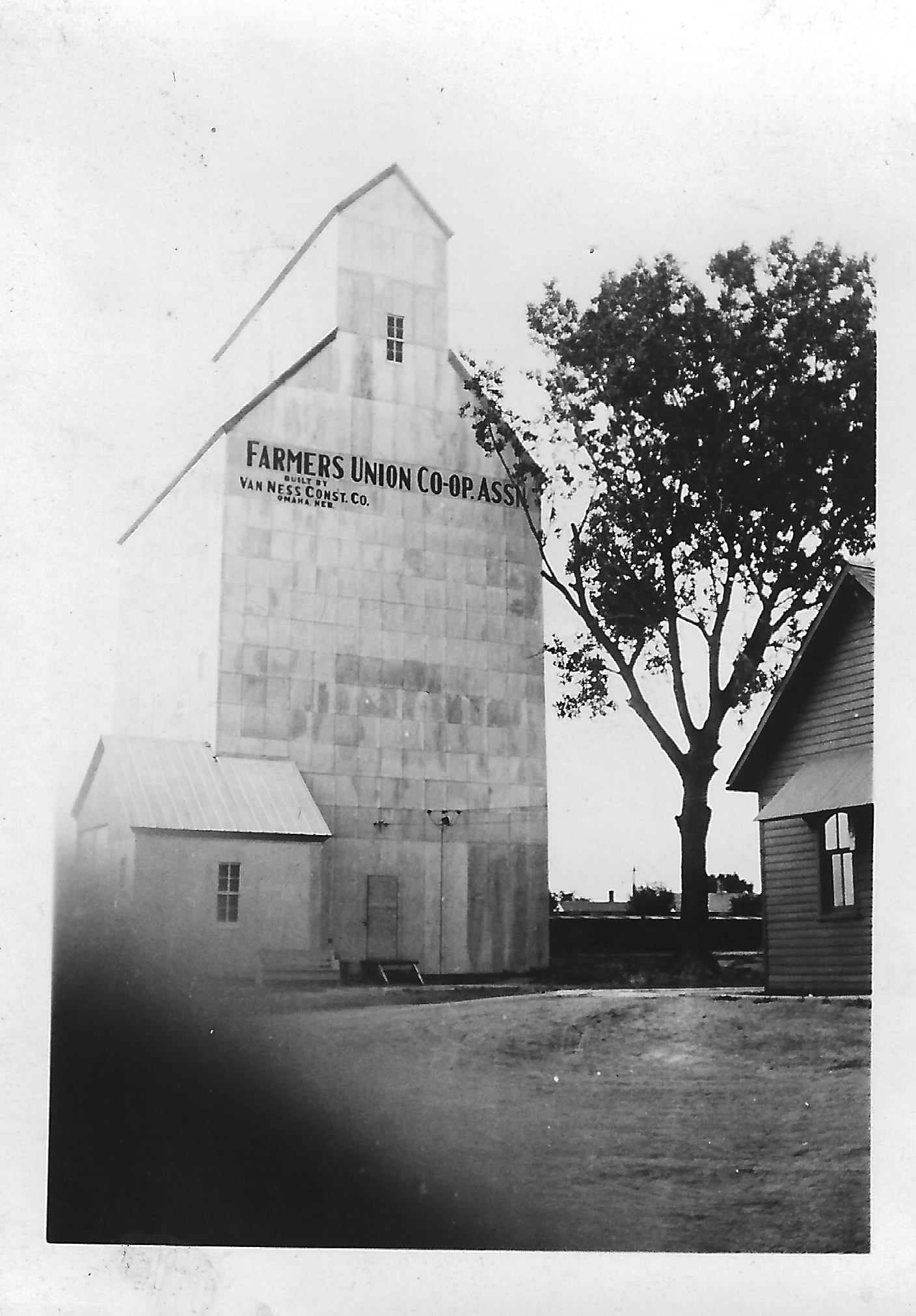
A lovely Monday in early May of 1934 proved perfect for festivities that attended dedication of the new Farmers Union elevator in Cedar Bend, Nebr. 

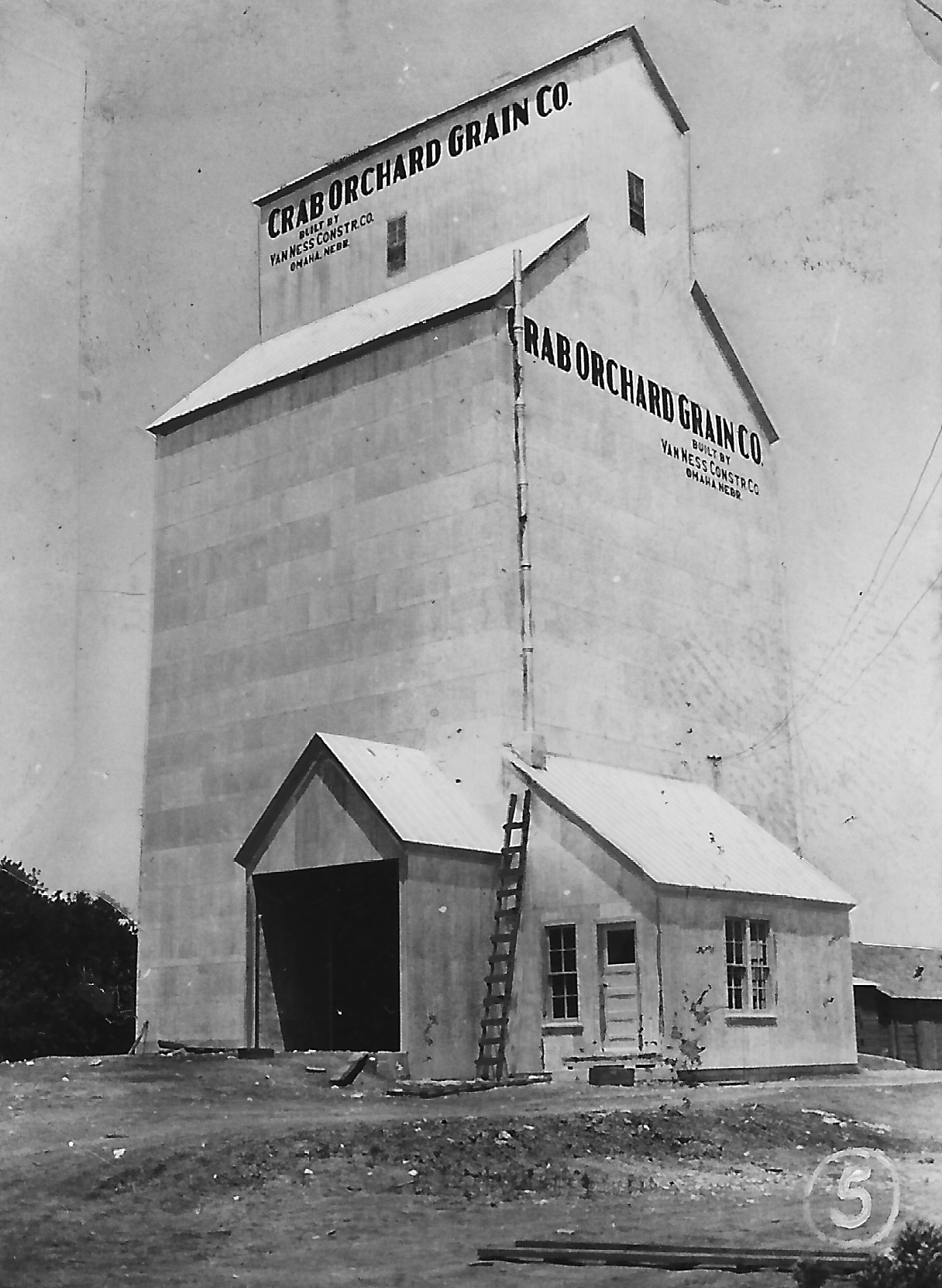
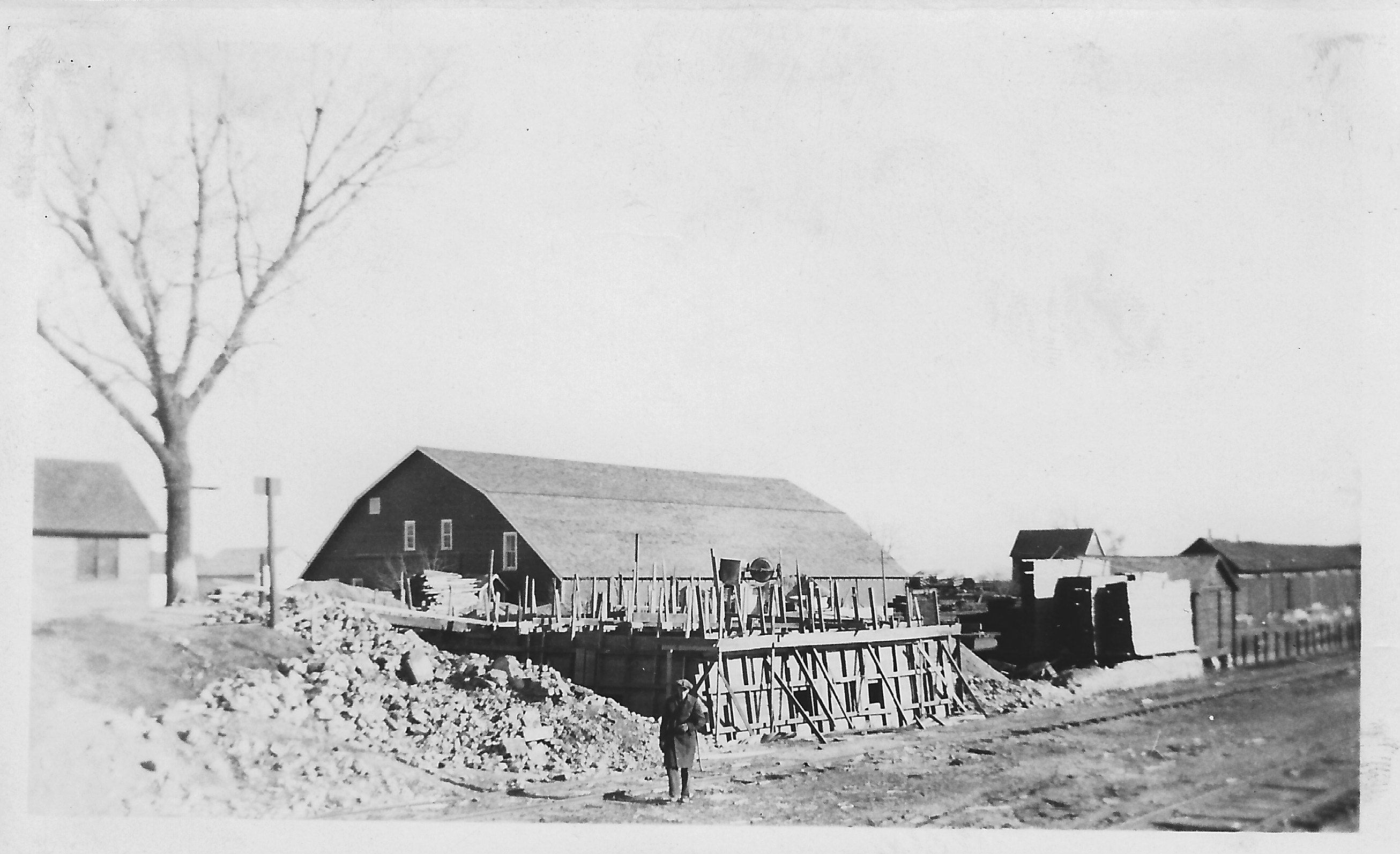
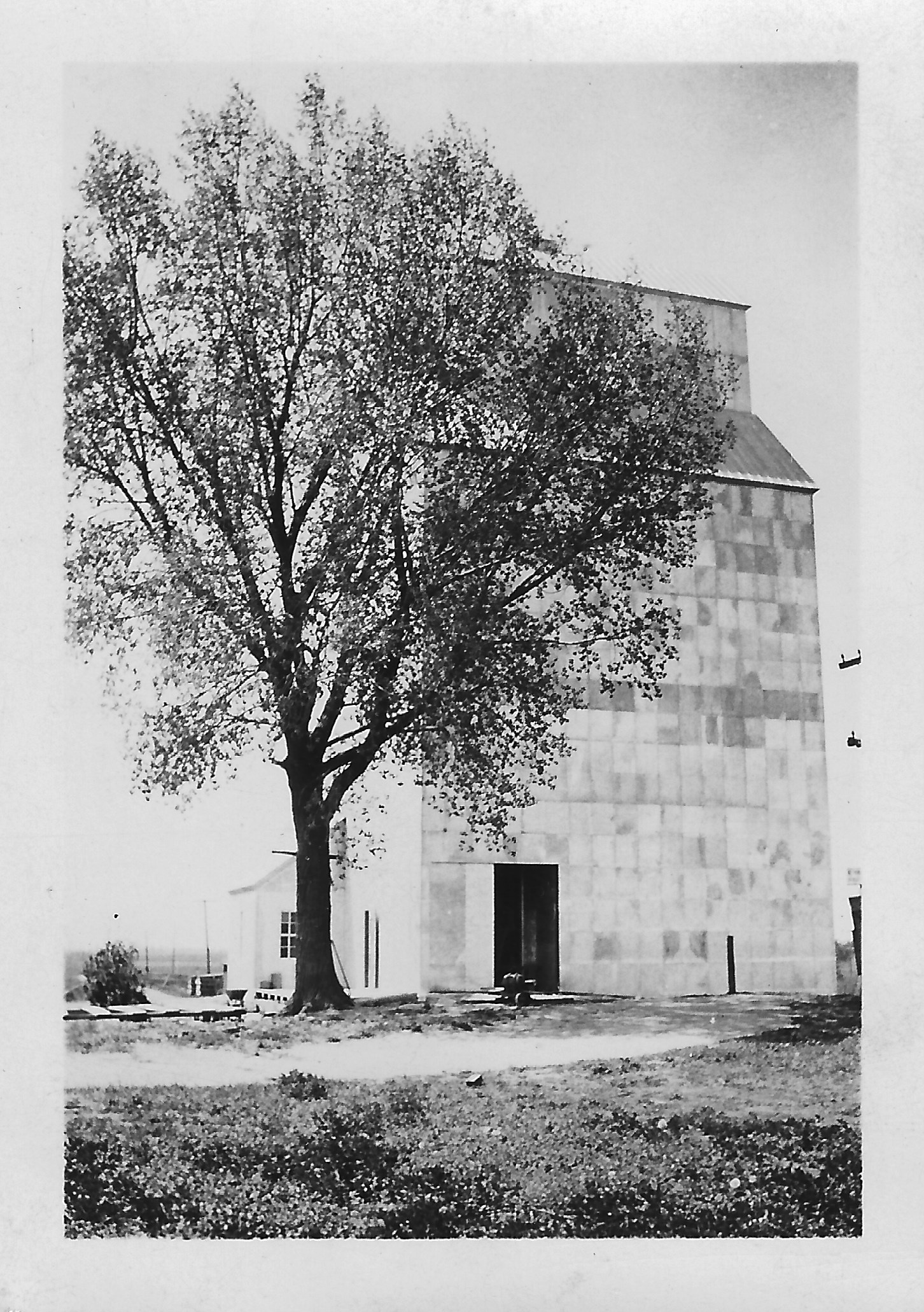
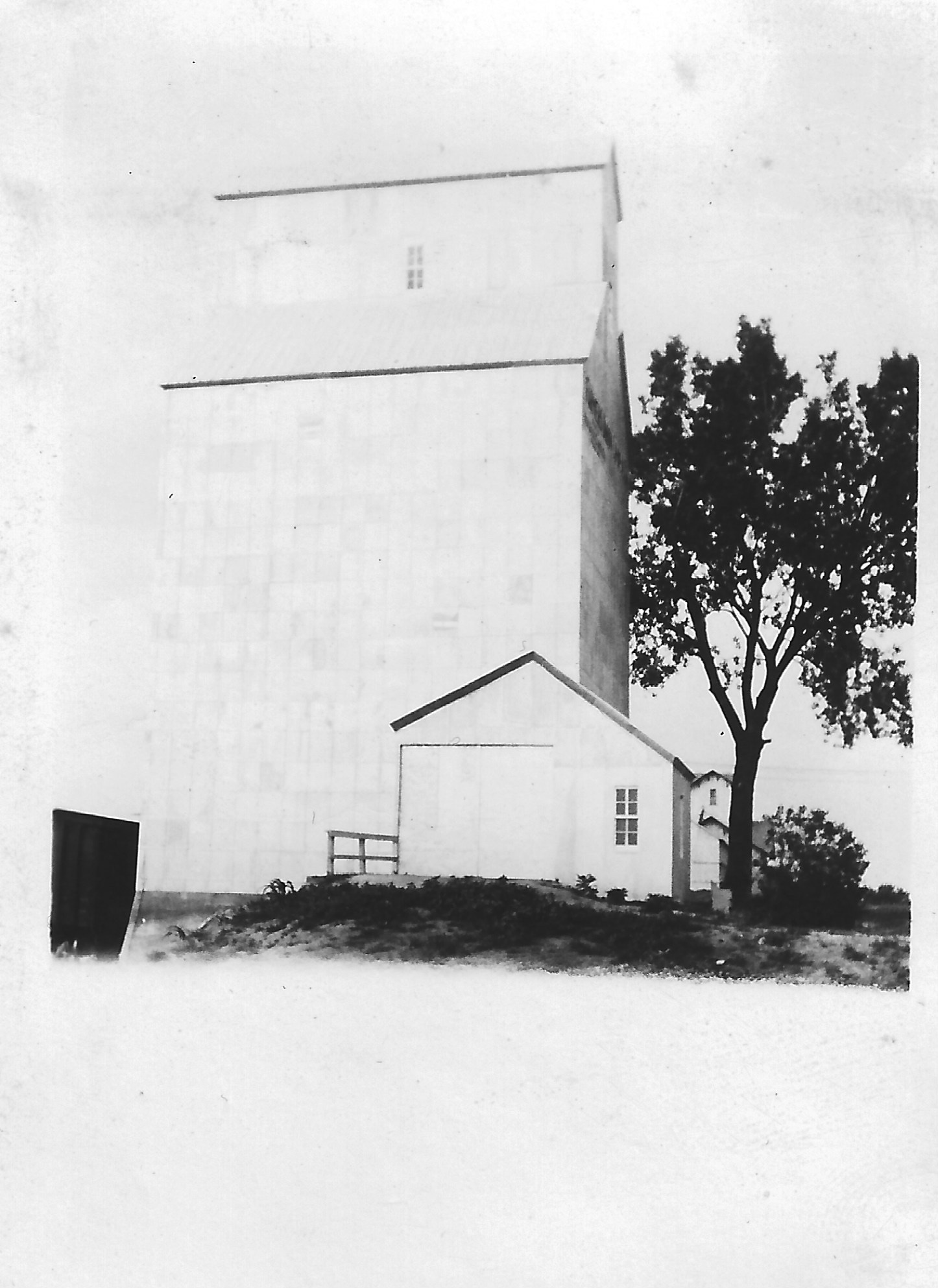
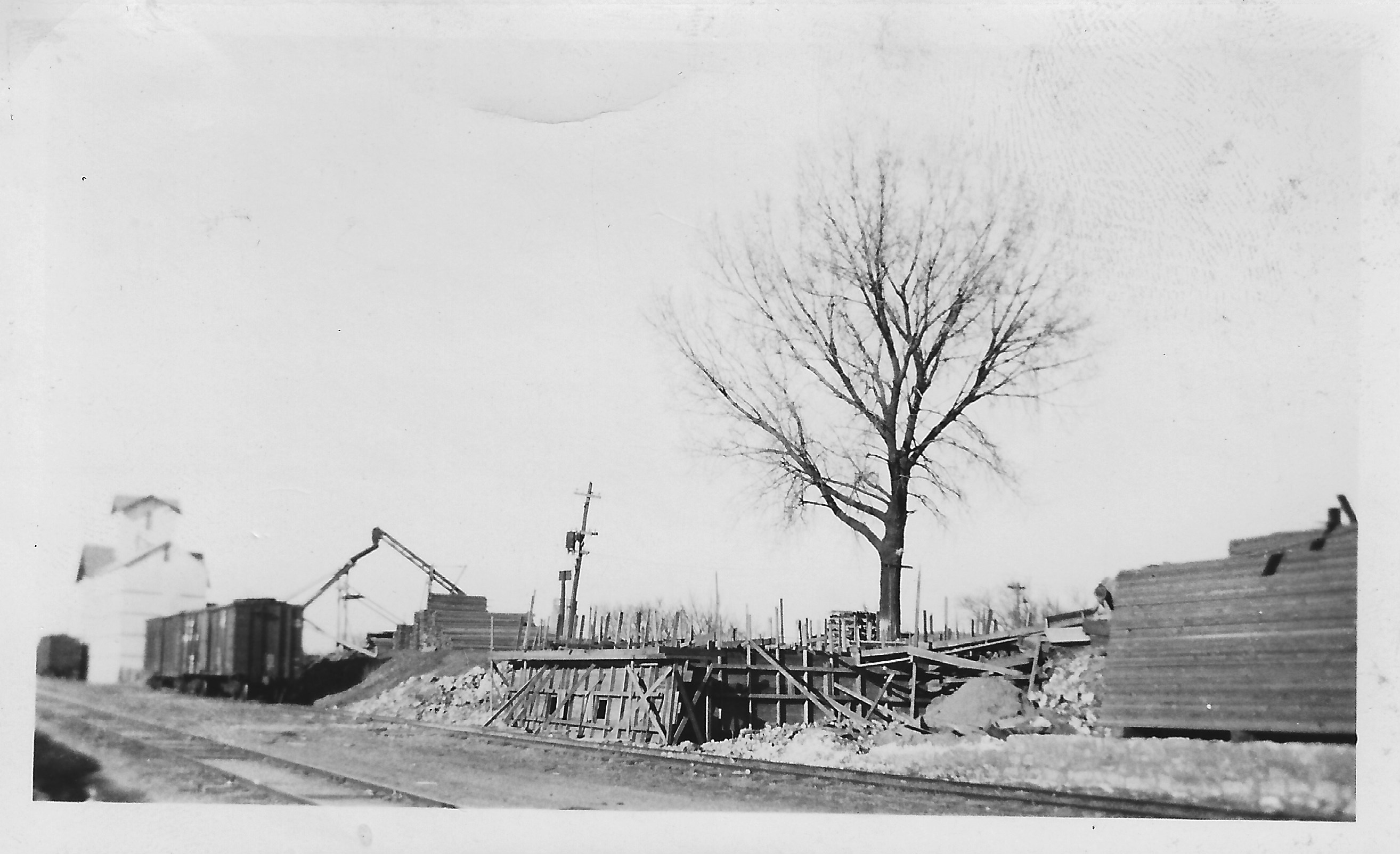
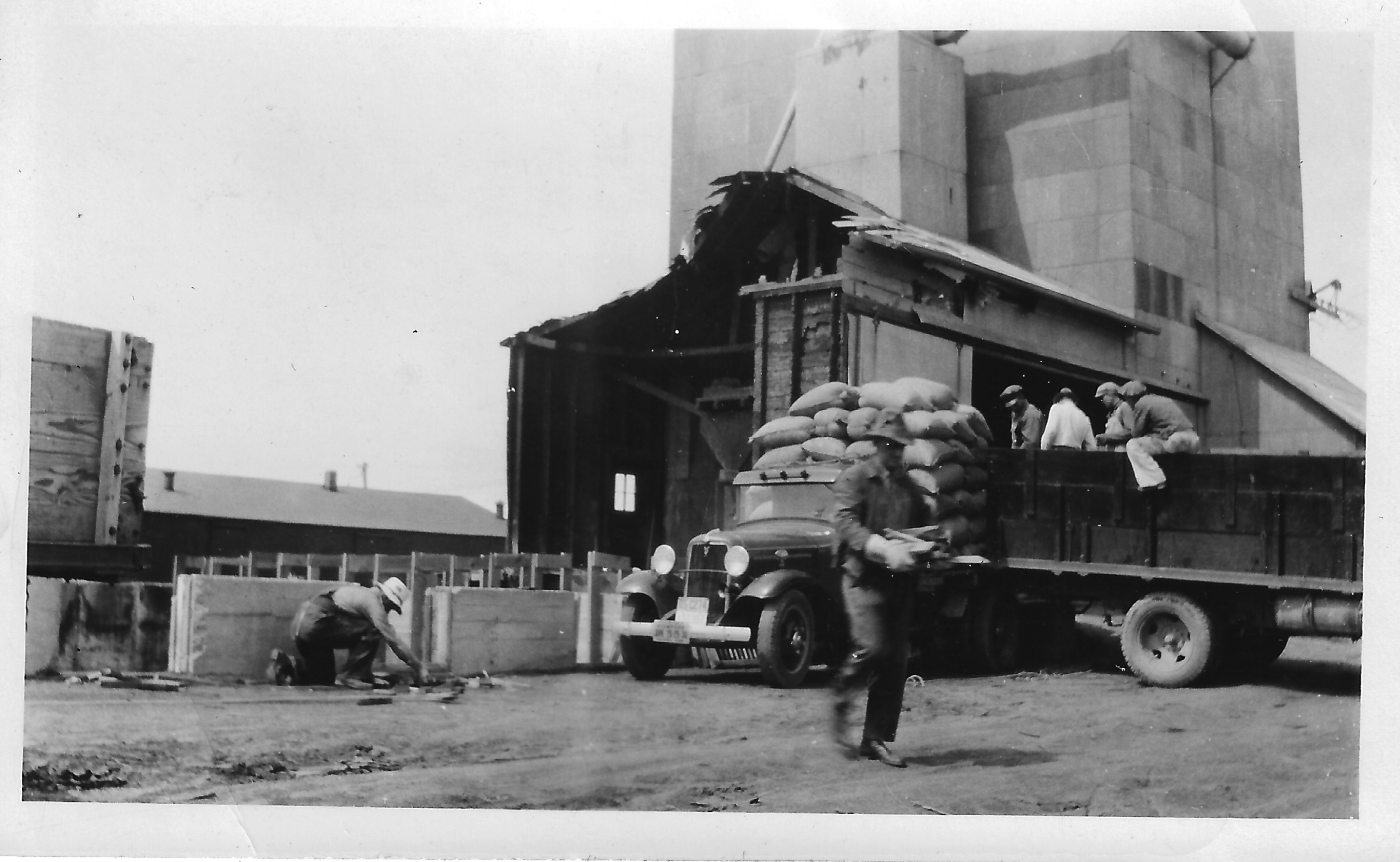
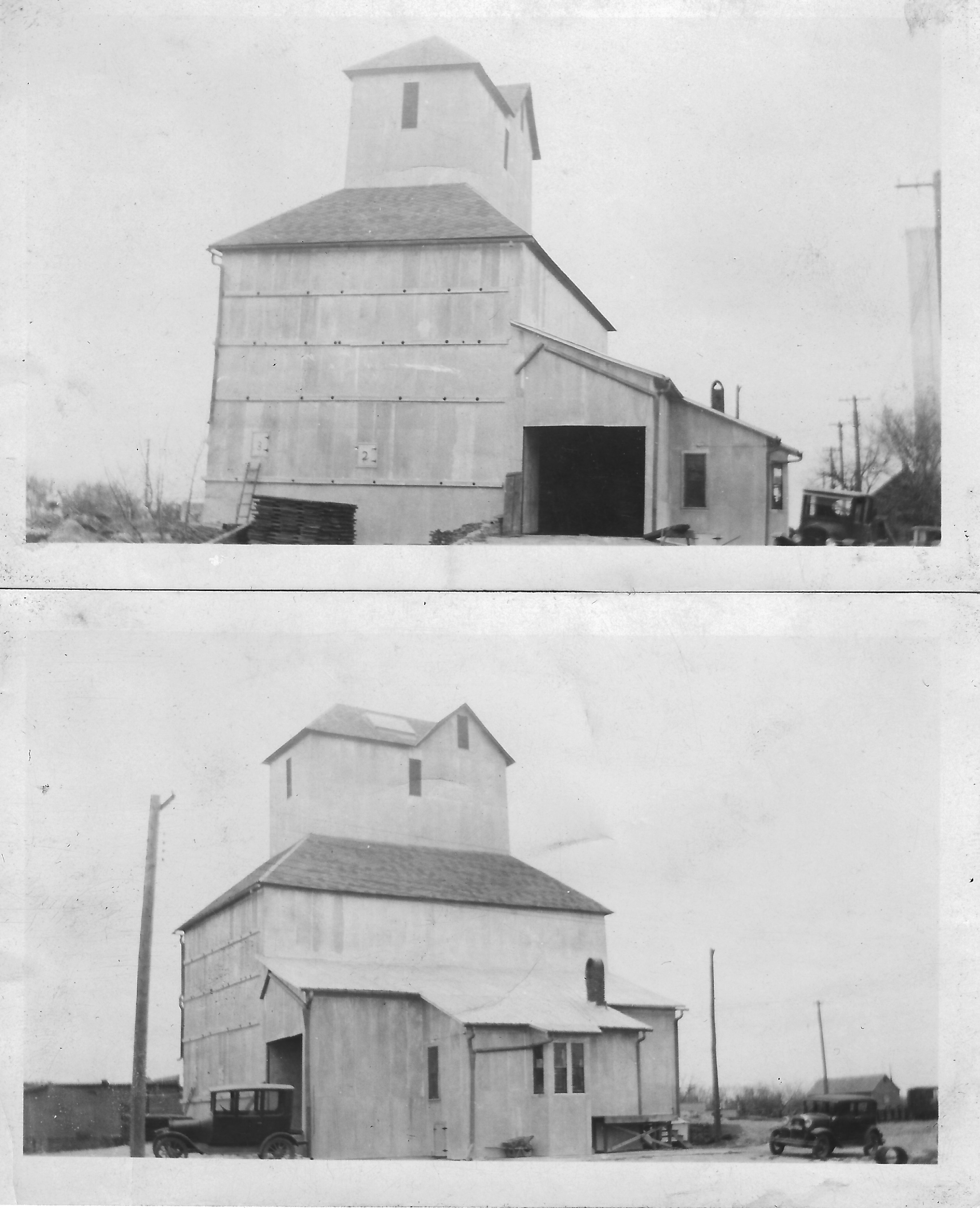
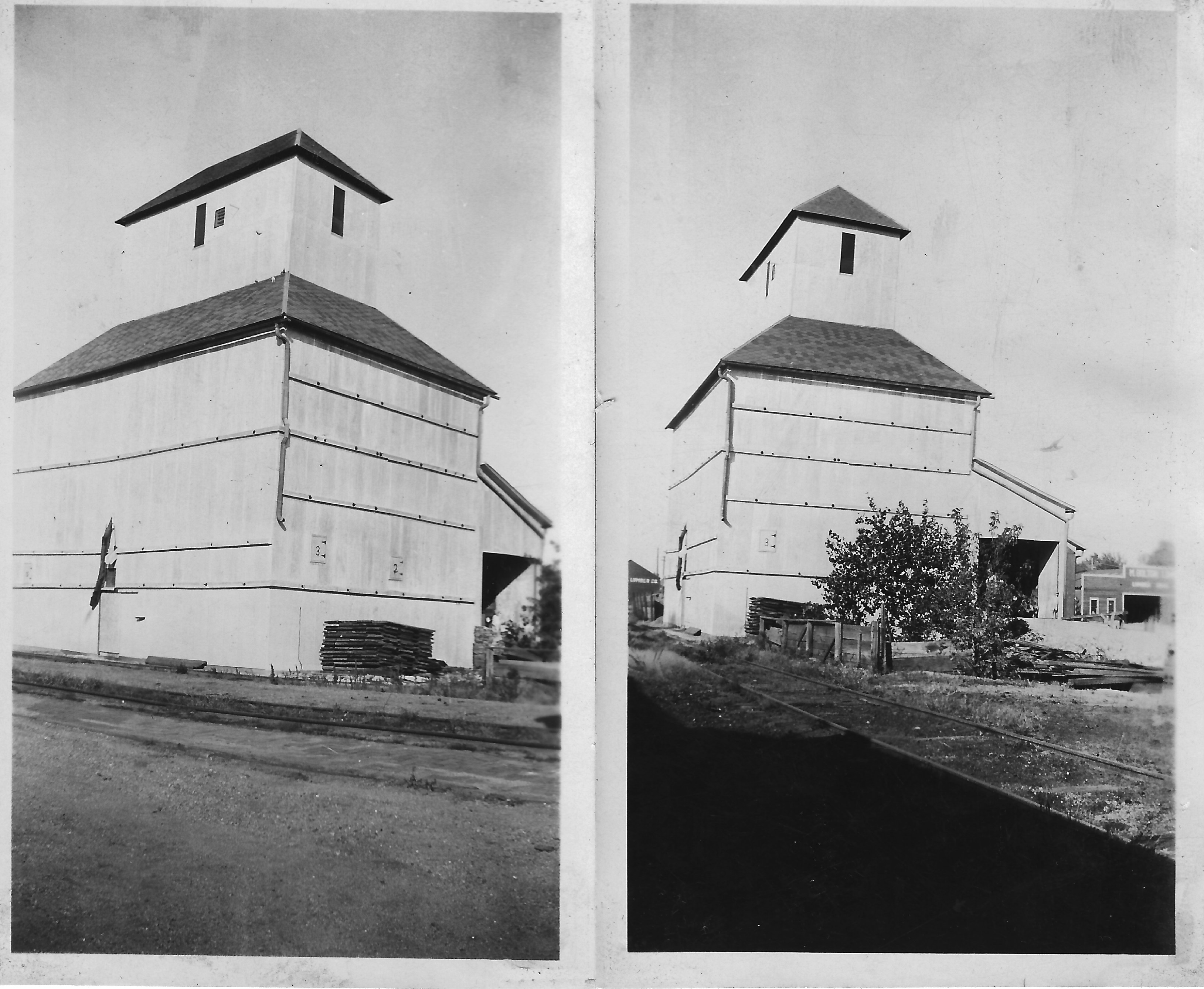
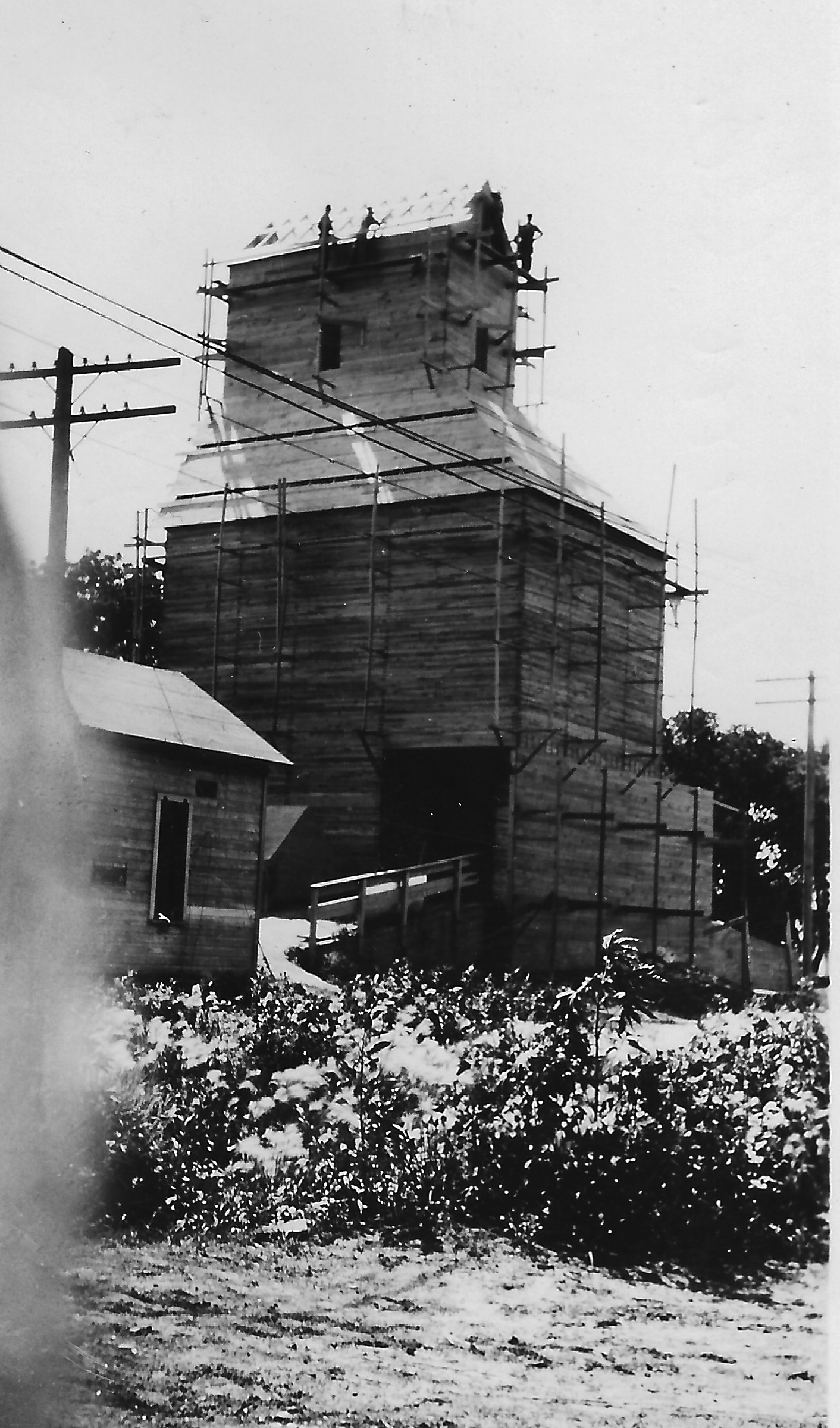
After deciding in January to tear down its 48-year-old elevator and rebuild, the Farmers Union Co-Operative Association awarded the job to Van Ness Construction Co., of Omaha. A new 30,000-bushel elevator soon rose on the same site as the demolished elevator in Cedar Bluffs, a progressive Saunders County village. Photos by Reginald Tillotson, who worked for Van Ness along with his father Charles H. Tillotson, show the job starting in early spring before the trees budded out.

A news report explains how the dedication attracted an “immense” crowd and sparked a festival-like atmosphere on that pleasant occasion. Events started at 12.00 noon with free ice cream, cake, and coffee for more than 600 registrants. 

“There was plenty to eat for everybody,” the New Cedar Bluffs Standard reported. 

After dinner, races and contests were held for boys and girls, providing entertainment for the crowd and fun for the youngsters. Cash prizes were given out. The Midland College band traveled from nearby Fremont to play for everybody.

Mayor J. P. Jessen took the platform, welcomed folks, and introduced lots of dignitaries. H.D. Black received special recognition as manager of the elevator, and Alex McAuley—a 17-year veteran of the company—was assistant manager. 

Next came the parade. A line of automobiles carried the officers and directors of the elevator association. A former employee of Farmers Union weighed in with the ceremonial first load of wheat to be received and stored away in the new house.

The entertainment continued as a quartet took the stage and sang old favorites. Following their numbers, a solo vocalist performed with piano accompaniment.

Other cash prizes were awarded, this time to L.A. Freeman, the association stockholder who had the largest family present. The jackpot for longest distance traveled went to Jim Broz, who made the journey from Prague, a town 16.5 miles away by road. 

Speechifying was courtesy of Newton Gaines, of the University of Nebraska Extension service, who “as usual did a mighty fine job of it. He is an interesting and entertaining speaker.” Gaines himself was Midland College graduate devoted to the gospel of better farming and spread it with humor and philosophy in thousands of speeches.

The Cedar Bluffs day of parties ended with a free, well-attended dance at the opera house, and the next day was back to normal with the new elevator in service. The dedication day was long-remembered by the people. Even now we take away the message of an elevator’s importance within its community. Sometimes in daily life, the people came and went without even noticing it, but in fact it was the thing that held the community together.

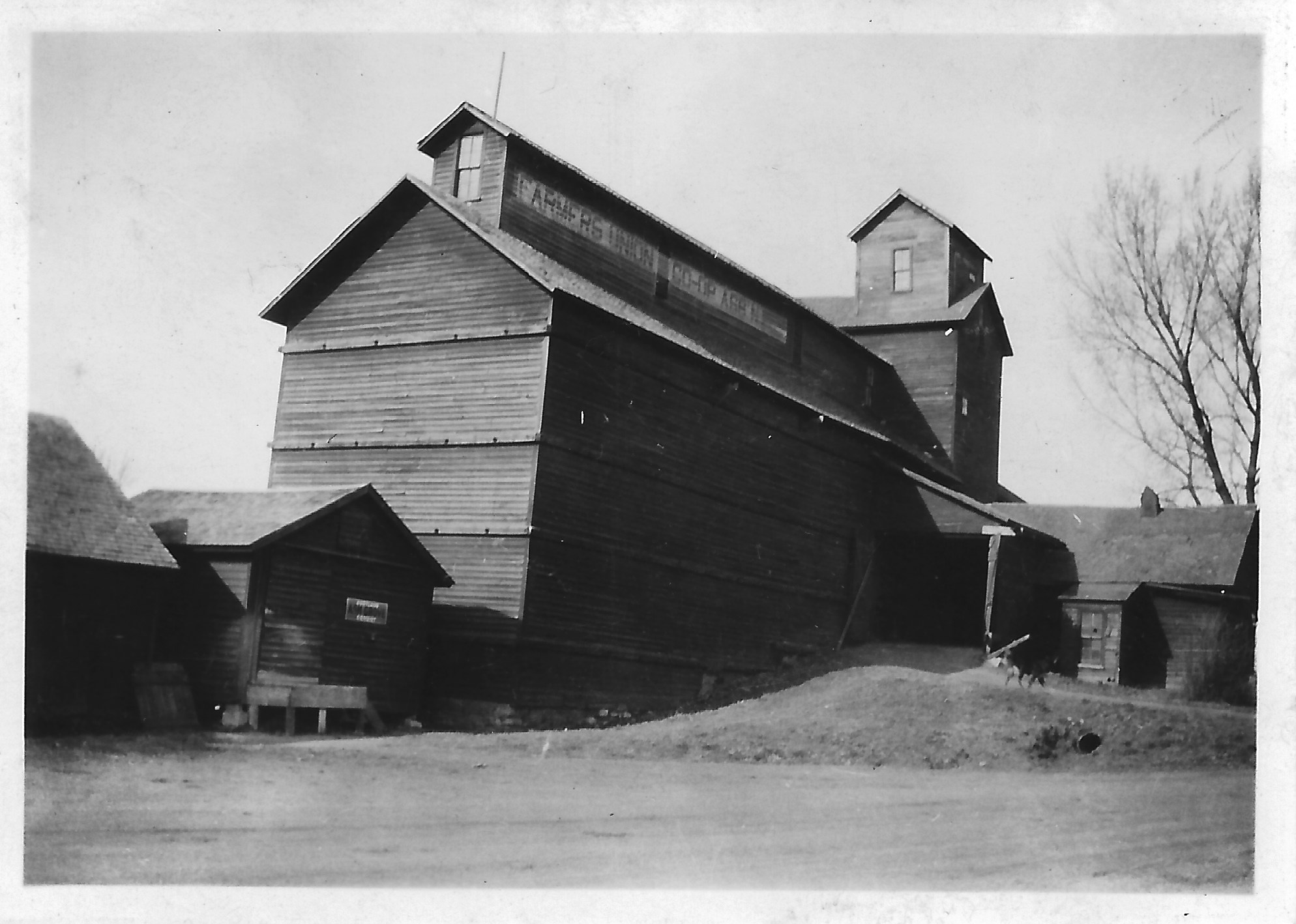
Farmers Union decides to demolish and rebuild in 1934 at Cedar Bluffs, Nebr.

It was January of 1934, still the depths of the Great Depression, but optimism led the stockholders of Farmers Union Co-Operative Association, of Cedar Bluffs, Nebr., to decide the time had come to tear down and replace their old elevator. 

Organized in 1888, Farmers Union claimed to be “the oldest cooperative elevator in the United States,” according to the New Cedar Bluffs Standard weekly newspaper. There were 200 stockholders with capital stock in the total of $50,000. 

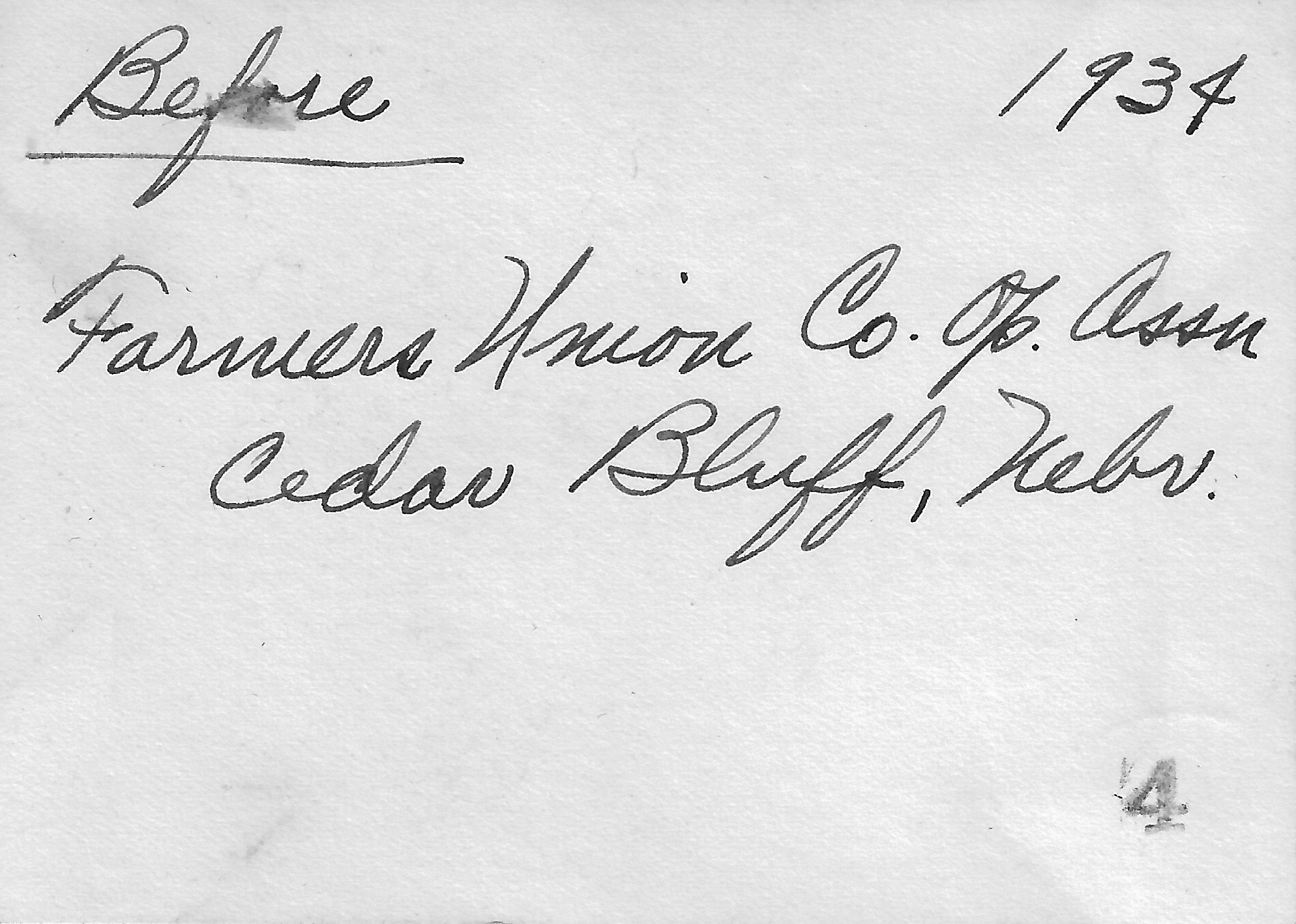
Reginald Tillotson’s neat script on the back of his photo.

At the same annual meeting, the Association announced payout of stock dividends at eight percent and patronage dividends of one percent. The newspaper remarked that “considering the times [it’s] a mighty fine showing.” 

The old elevator was to be dismantled, with as much material as possible being salvaged for re-use. The new elevator would be steel-covered. The initial report stated capacity at 80,000 bushels, which is a lot for a cribbed wooden elevator. A subsequent report put it at 30,000 bushels—a more realistic figure. 

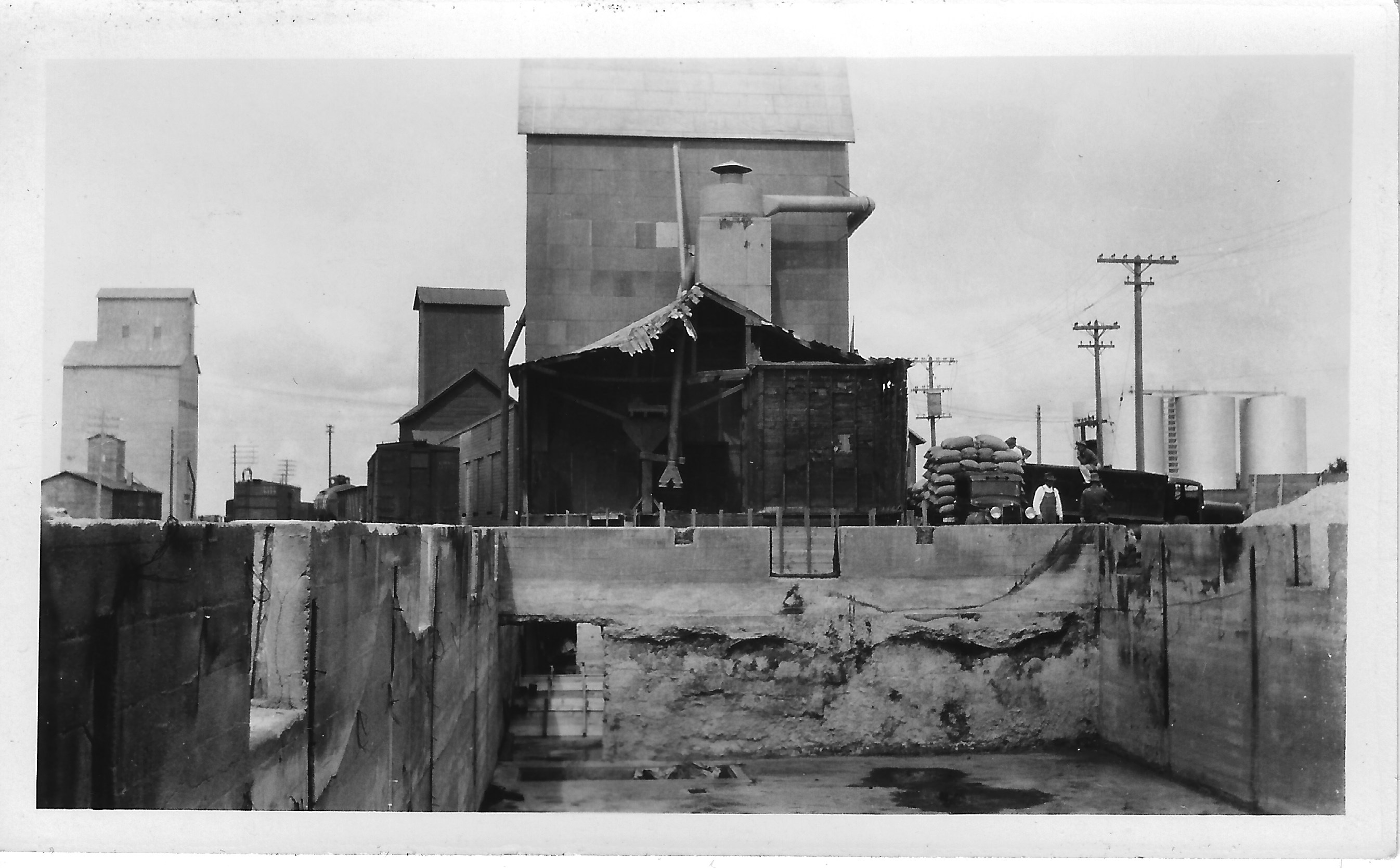
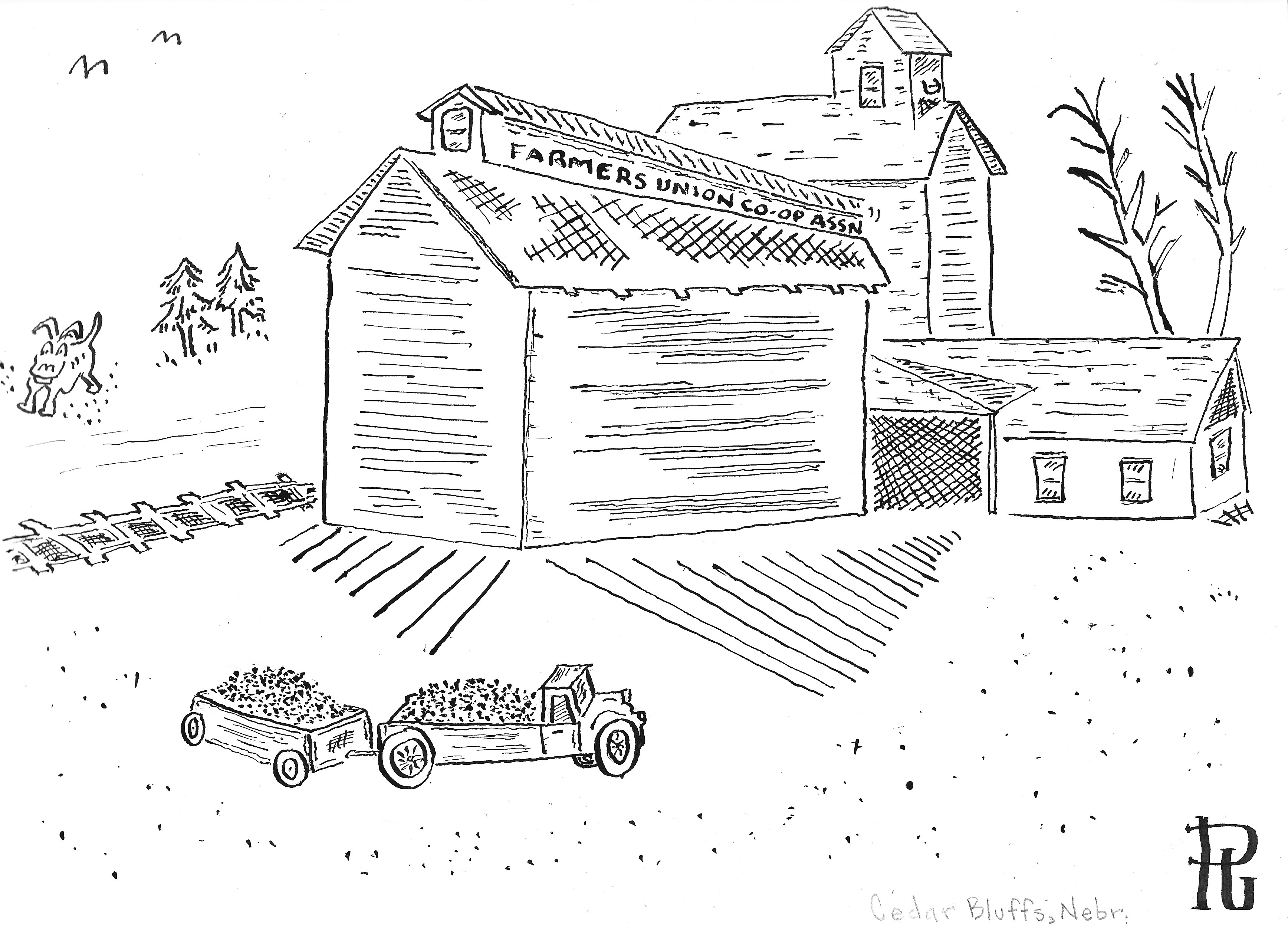
The photo above shows the weathered main house with its peaked headhouse, and a storage annex with the upper structure enclosing the run being labeled Farmers Union Co-Op Assn. The shed on the left bears a sign saying Ash Grove Portland Cement.

A selling point on the rebuild was the prospect of local help getting employment in the construction. 

Van Ness Construction won the job, as will be seen in a follow-up post. Tillotson Construction, which evolved from Van Ness, returned to Cedar Bluffs in 1950 to build a 130,000-bushel reinforced-concrete elevator, which we visited in 2020.

Tillotson returns in 1941 to Alliance, Nebr. as independent contractor with a familiar client

Four years after their 1937 call to remedy fire loss at George Neuswanger’s elevator in Alliance, Nebr., the Tillotsons returned to that Panhandle town with the commission to build more storage and a feed mill.

The Alliance Times-Herald reported as follows:

Construction work has begun on a large warehouse and feed processing plant here by the J.H. Tillotson contracting company of Omaha for George Neuswanger of Alliance. 

We are unsure how “J.H. Tillotson contracting company” got the credit. The brothers Reginald and Joseph Tillotson formed Tillotson Construction Co. in 1938. We believe a rupture between then led to the founding of Joseph H. Tillotson, Contractor in 1948. Joe Tillotson died not long afterward in a car accident. There could be more to learn on this question, but until then we rely on existing records and previous verbal accounts.

The newspaper continued:

The building will be located just north of the Neuswanger elevator. The warehouse will be 148 feet long and 50 feet wide, and the feed processing mill will be 32 feet square. Total cost of the project has been listed at $12,000. 

According to Neuswanger, some difficulty is being experienced in the obtaining of material, and he has no idea when the building which will be of reinforced concrete construction, will be completed. At this time much of the excavation work has been completed by a dragline which has been in operation this week. 

The newspaper added these details:

Concrete mixing machinery is already in place at the site, a tool and supply shed has been erected, and some of the forms are being built. Much of the gravel which will be needed has been hauled to the site also. 

When the feed processing plant is put into operation, mixing and grinding of many types of livestock feed will be carried on here, Neuswanger said.

In part because of the large barley crop, grain storage facilities were at a premium in those months just before the United States entered World War Two. Nebraska farmers were expected to harvest 33 million bushels of grain.

While there was sufficient capacity for 55 million bushels in total, space was available for only 13.5 million.

The federal government allowed farmers seven cents per bushel towards putting up new storage silos on their farms.

Otherwise, a state official had this suggestion: “Another way to store the coming harvest is to bind and stack it. Stacking is becoming a lost art, but it is still an excellent method.” 

After fire loss, Tillotson contributed to an annex and mill in Alliance, Nebr.

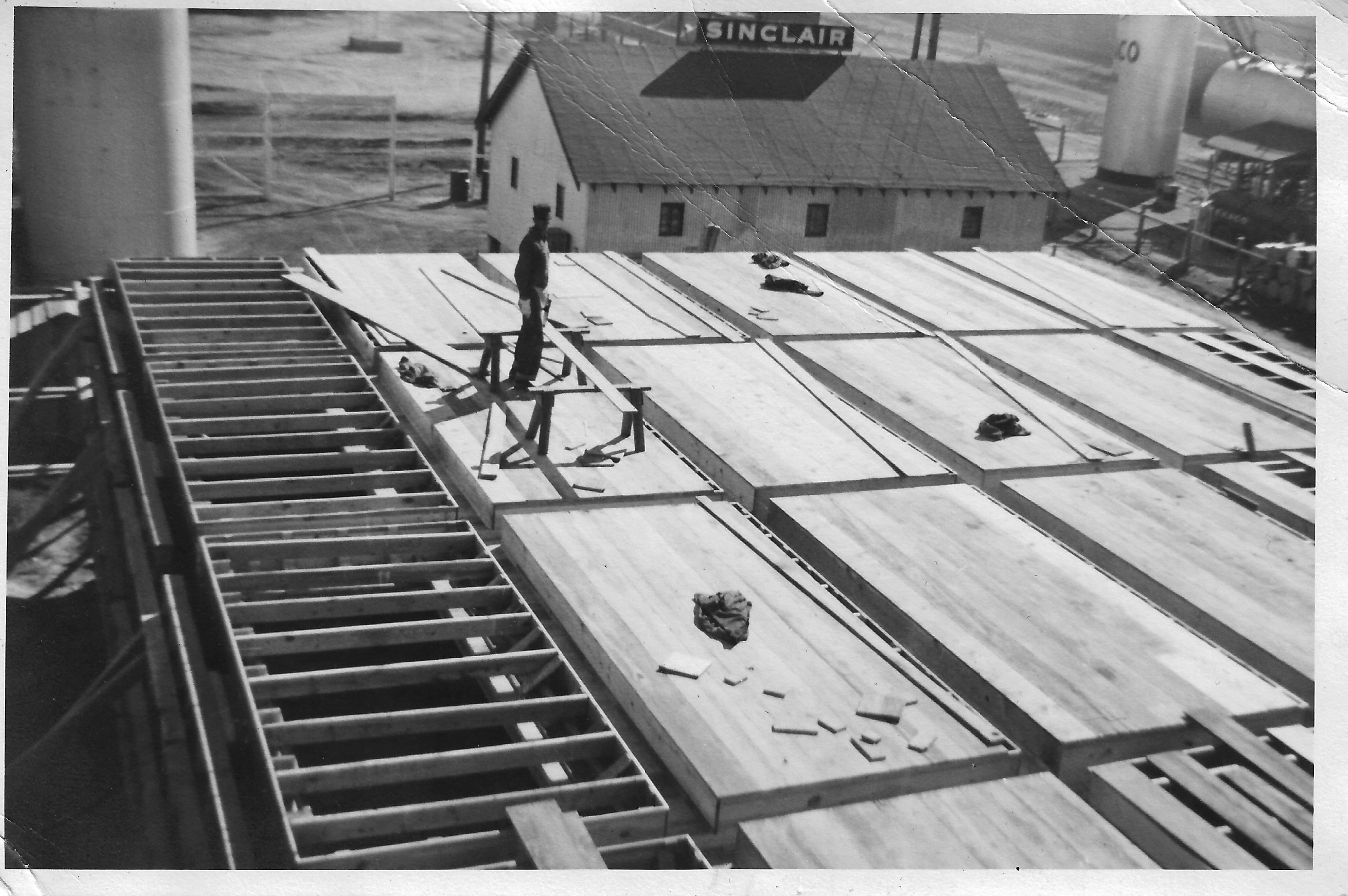
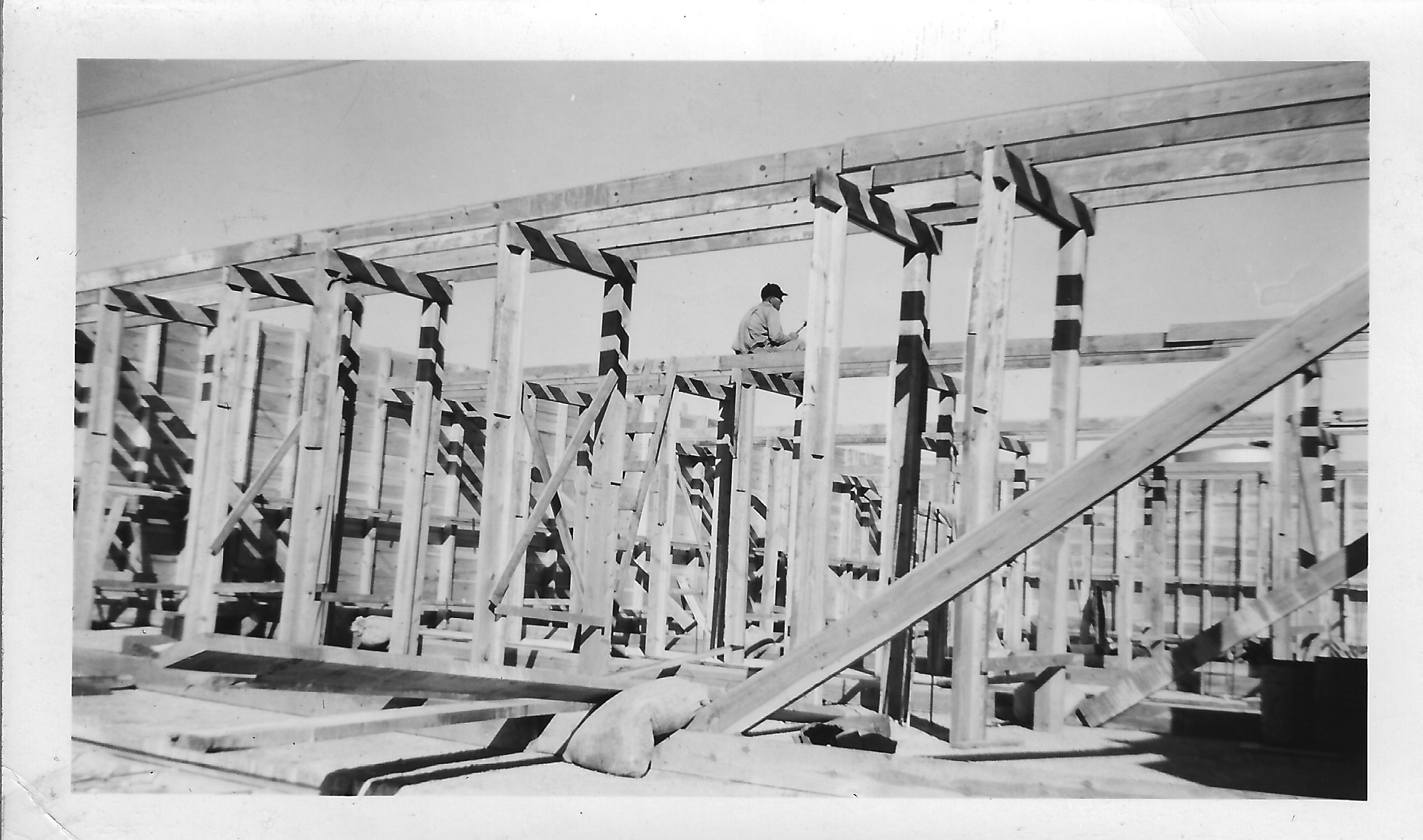
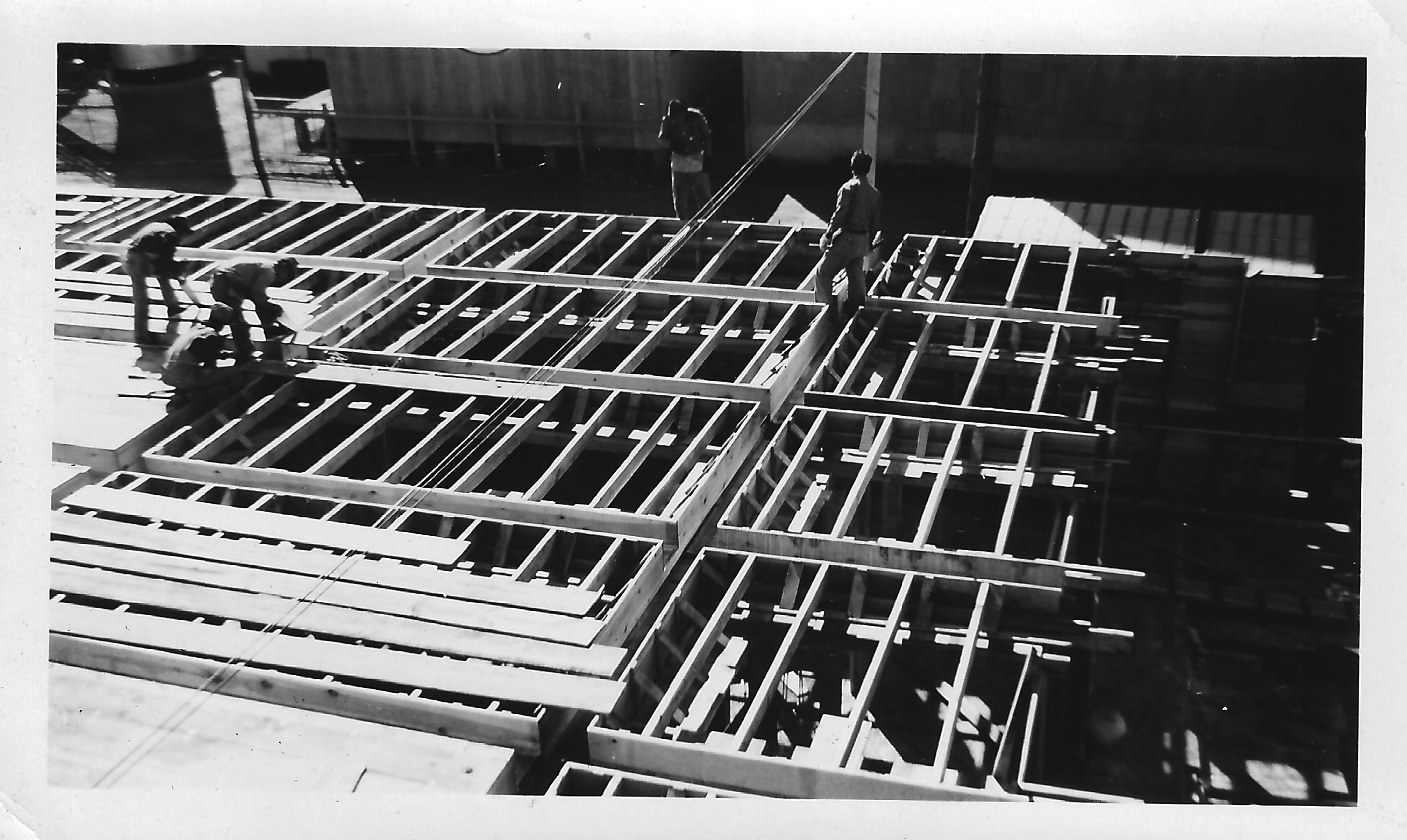
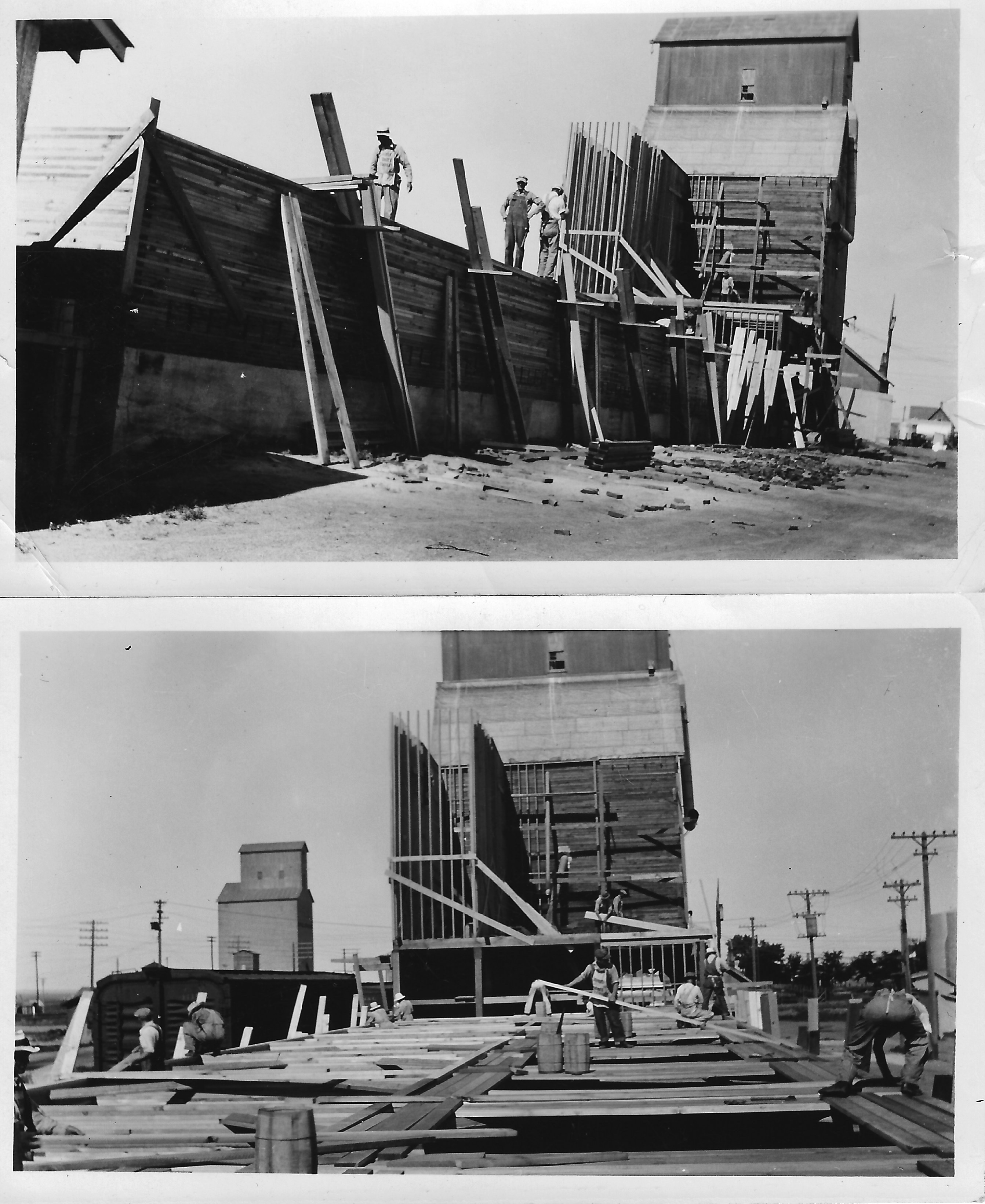
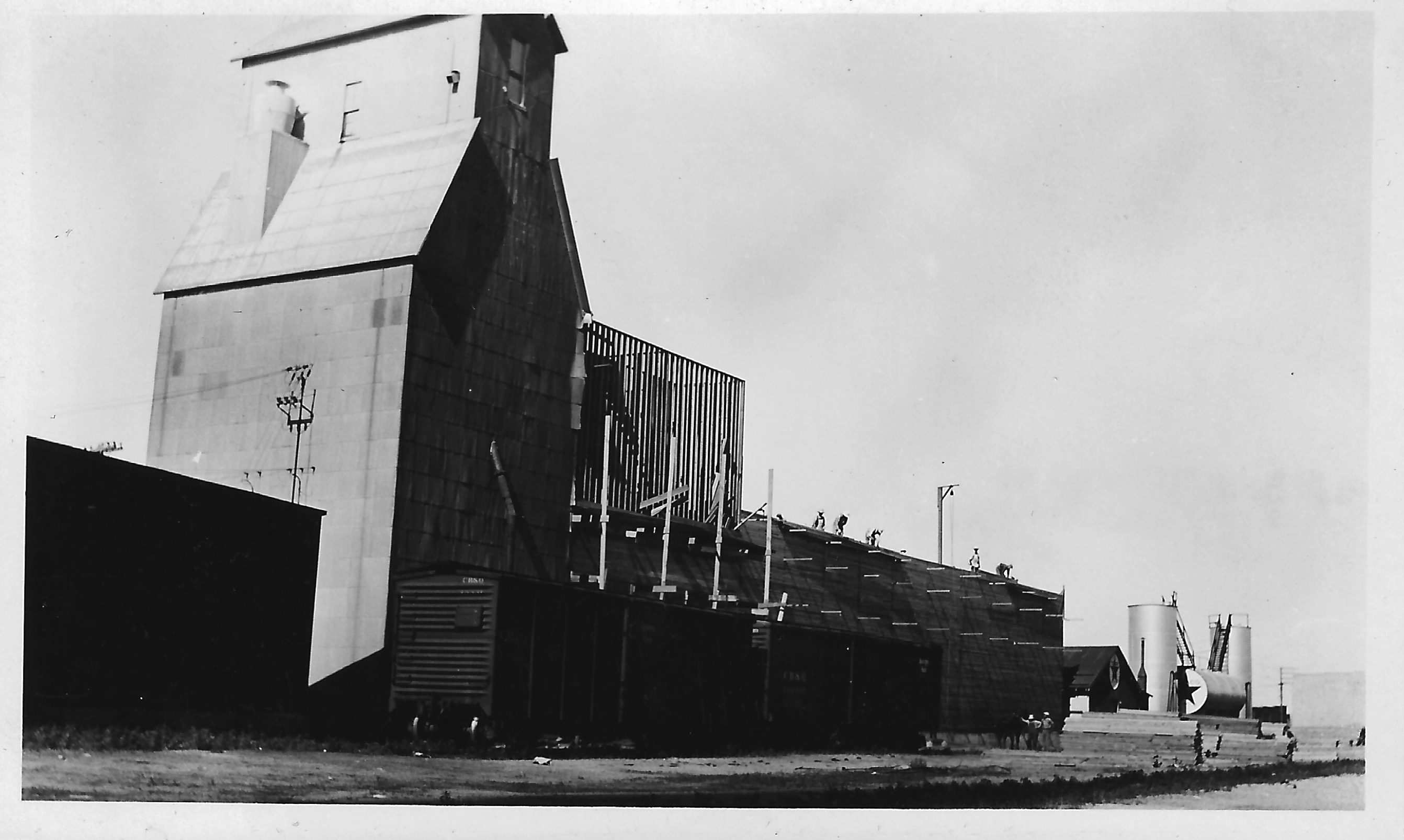
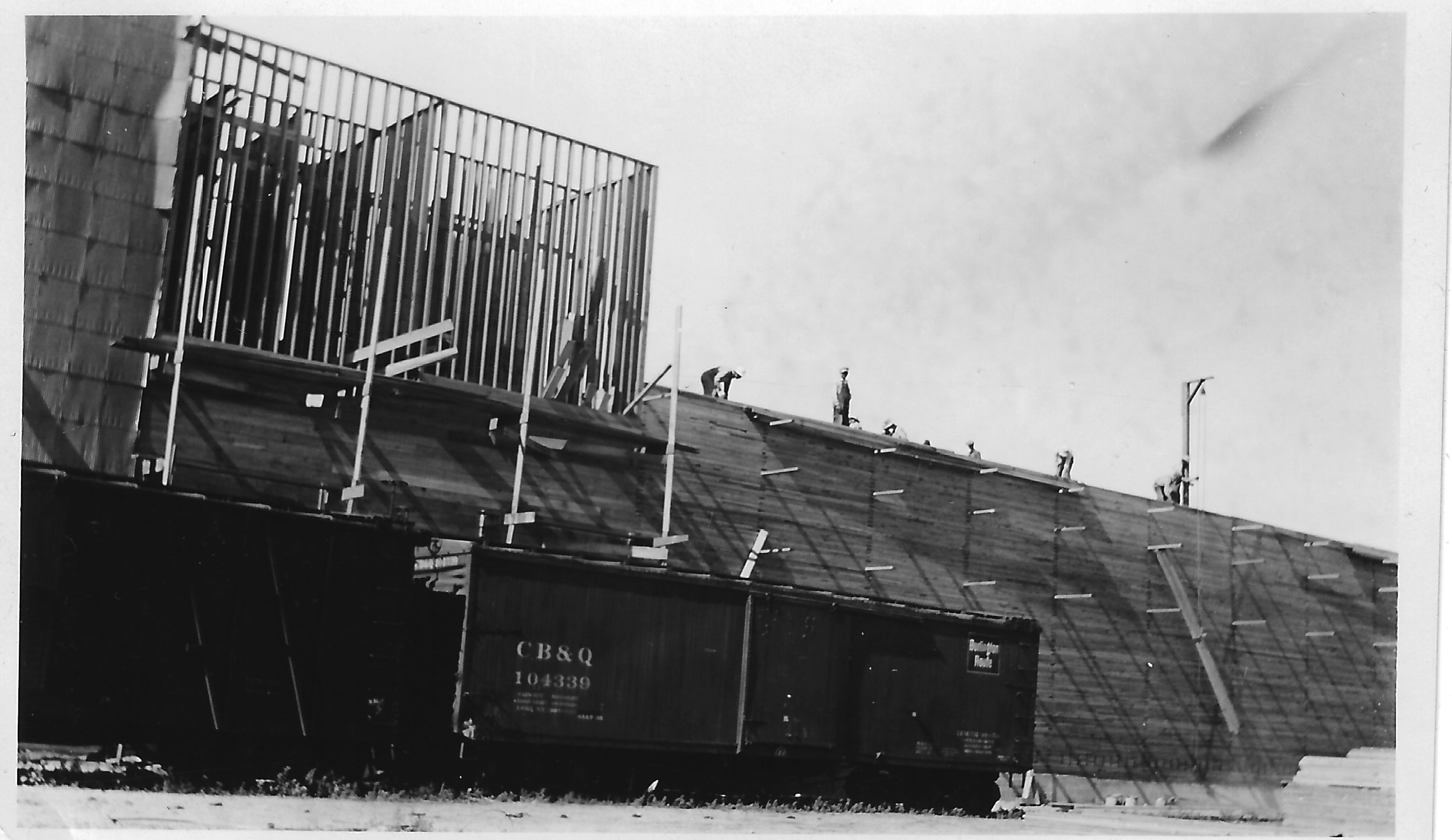
A series of vivid photos shows work underway in 1935 as a crew undertakes the construction of a new storage annex and feed mill after fire loss at an elevator site in Alliance, Nebr. In this case, we assume the job was in the hands of Van Ness Construction Co., of Omaha, and Reginald Tillotson, employed by Van Ness along with his father Charles H. Tillotson, took the photos while working on the project. It wasn’t until 1938 that Charles H. Tillotson passed away, and Reginald and his brother Joseph formed Tillotson Construction Co.

Alliance is an important market town in Box Butte County, located in the Nebraska Panhandle. The client on this project was George Neuswanger, an oil and grain merchant.

“He first came to Alliance, after graduation from the University of Nebraska, in 1916 when he served as Box Butte County agent,” the Alliance Times-Herald would explain in a 1966 obituary.

The Times-Herald explains the construction activity in an article of July 16, 1935:

Work on a new small-grain elevator being built for George Neuswanger is in progress at the location where the Neuswanger building burned last spring at the southwest corner of the city and plans call for the new structure to be completed within a month’s time, ready to house a bumper harvest. 

About 30 men are receiving employment, erecting a cribbed elevator of wood which will be covered with galvanized metal. The project was begun three weeks ago. 

The elevator will be 150 by 30 feet and will be 60 feet high. Its capacity is to be 100,000 bushels.

Mr. Neuswanger intends to store only small grain in the building. He sees ahead a need for more space, with harvest conditions ideal and chances good for a splendid yield in this territory. 

Neuswanger’s bad luck continued in August of 1937 when a tornado missed Alliance by a mile but struck four of his hog barns on a feed lot north of town. There was no mention of what happened to the hogs.

Jobs at Geneva and Exeter, Nebr., shed light on elevator activities and a crime spree

Our collection of Reginald Tillotson’s early 1930s photos includes two “before” and two “after” snapshots with notes that say “Farmers Terminal Elevator, Geneva, Nebr., Repair and Ironing Job 1932.” Without photographic support, an additional note records that in the following year Van Ness Construction Co., of Omaha—which employed Reginald and his father Joseph—“Tore down two old, rebuilt one new” in the nearby Fillmore County town of Exeter. 

A search of articles in the Nebraska Signal newspaper, of Geneva, turns up little additional information about either job. One item suggests the elevator had been closed during the spring. Further elaboration is awaited. 

We did learn that by January of 1932, a pair of burglars, Louis Shallenberg and Clifford Crowder, had been arrested in Grand Island and “confessed to robbing the farmers’ elevator at Exeter and taking a radio and other articles valued at $50. They are also implicated in numerous other robberies in this and nearby counties. Shallenberg was released from the pen last summer after completing a term for robbery and Crowder recently served a jail sentence at Wilber.”

Farmers Elevator, Geneva, Nebr., 1932 “After” photos. The “Before” photos are seen at top.

In lieu of information about elevator “repair and ironing,” we present the following items from the Nebraska Signal that describe 1932 activities in Geneva. 

The annual business meeting of the Farmers elevator was held Tuesday afternoon at the I.O.O.F. temple. The meeting was called to order by the president, Henry Jensen. At the election of officers Fred Underwood was re-elected secretary and Henry Kolar and William Morgan were re-elected directors. The report showed that the company had a good business year and a ten per cent dividend was declared on shares, eight percent on gas and one-half cent on grain. About $90 of undivided profit was given to the American Legion fund. Due to the blocked condition of the roads only about forty were present. Nebraska Signal, Jan 14, 1932 

The Farmers Elevator of Geneva will open Saturday, April 30, and thereafter on Friday and Saturday each week until further notice. We will have a full line of farm seeds. Will exchange some for some good seed corn. Come and see our new machinery at used machinery prices. Sheridan Grain & Machinery Co. Nebraska Signal, Apr. 28, 1932 

Orange cane, Honeydrip and black, 50 cents per bushel. Fridays and Saturdays every week at Farmers elevator, Geneva, Neb. We buy grain Fridays and Saturdays only. Wm. Sheridan. Nebraska Signal, May 26, 1932

The Farmers Elevator will be open every day after July 1. Phone 98. Nebraska Signal, June 30, 1932

We will pay a premium for mixed wheat and oats. Also have Grim alfalfa seed at $6.50 per bushel. Farmers Elevator. Nebraska Signal Aug. 11, 1932 

The Farmers Elevator Co. at Geneva will have No. 66 Turkey Red seed wheat free from rye will exchange for other wheat reasonable. 48-1. Nebraska Signal, Aug. 24, 1932 

Van Ness and the Tillotsons step in and rebuild after fire takes out a country elevator

By Ronald Ahrens

It was an uneventful run through the night until the track led Burlington No. 22 to the flyspeck town of Corning in northwest Missouri. Corning wasn’t even normally a whistlestop but now, at 2.30 a.m., the locomotive’s crew released a blast to alert the sleeping Holt County community that their Farmers Grain Co. elevator was burning. 

A hell of a blaze was going by the time the fire crew arrived on scene, and they couldn’t stop the destruction. The coup de grâce occurred when the roof fell in, and by dawn on that Saturday, April 29, 1933, the elevator had collapsed and was a smoldering ruin. Authorities indicated the fire had started under the cob bin. The elevator and its contents were insured for $8,000. 

It would become a case of Van Ness Construction, from 95 miles away in Omaha, to the rescue. 

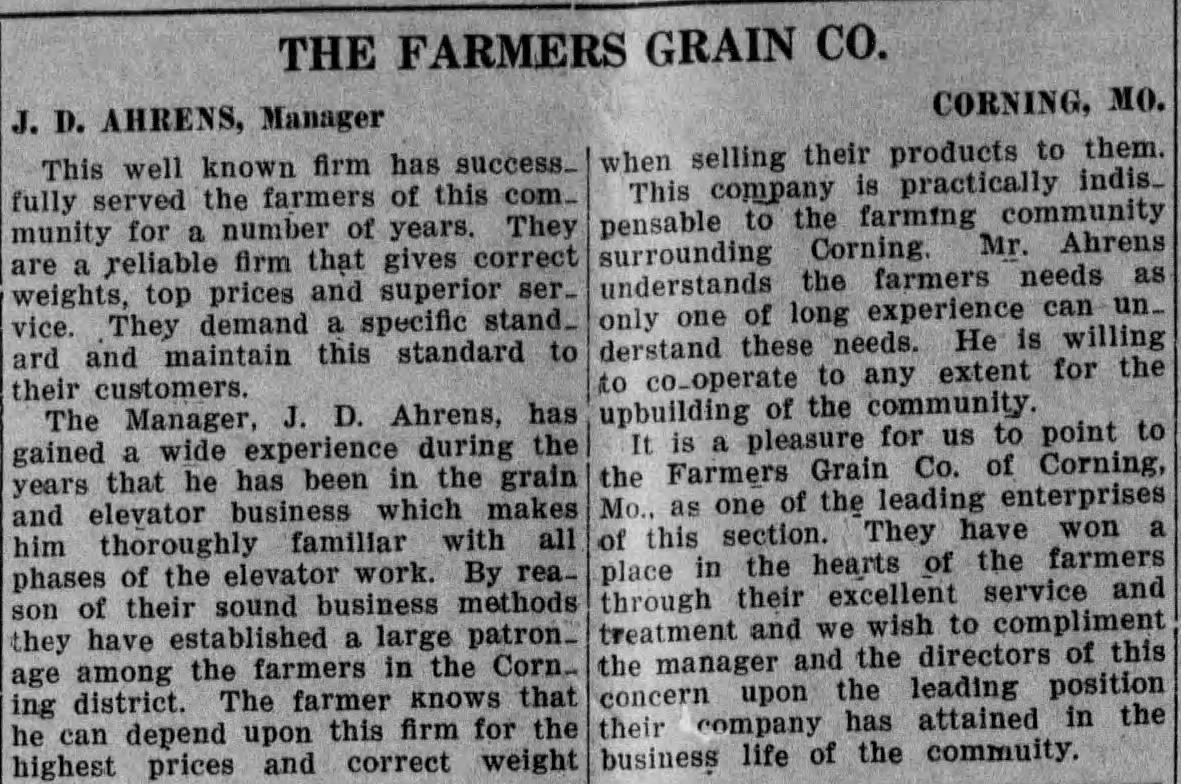
Oddly enough, on the very day before, a newspaper called The Holt County Democrat and The Craig Leader had run a substantial profile of the Farmers Grain Co. as part of a feature titled “Who’s Who in Neighboring Towns.” 

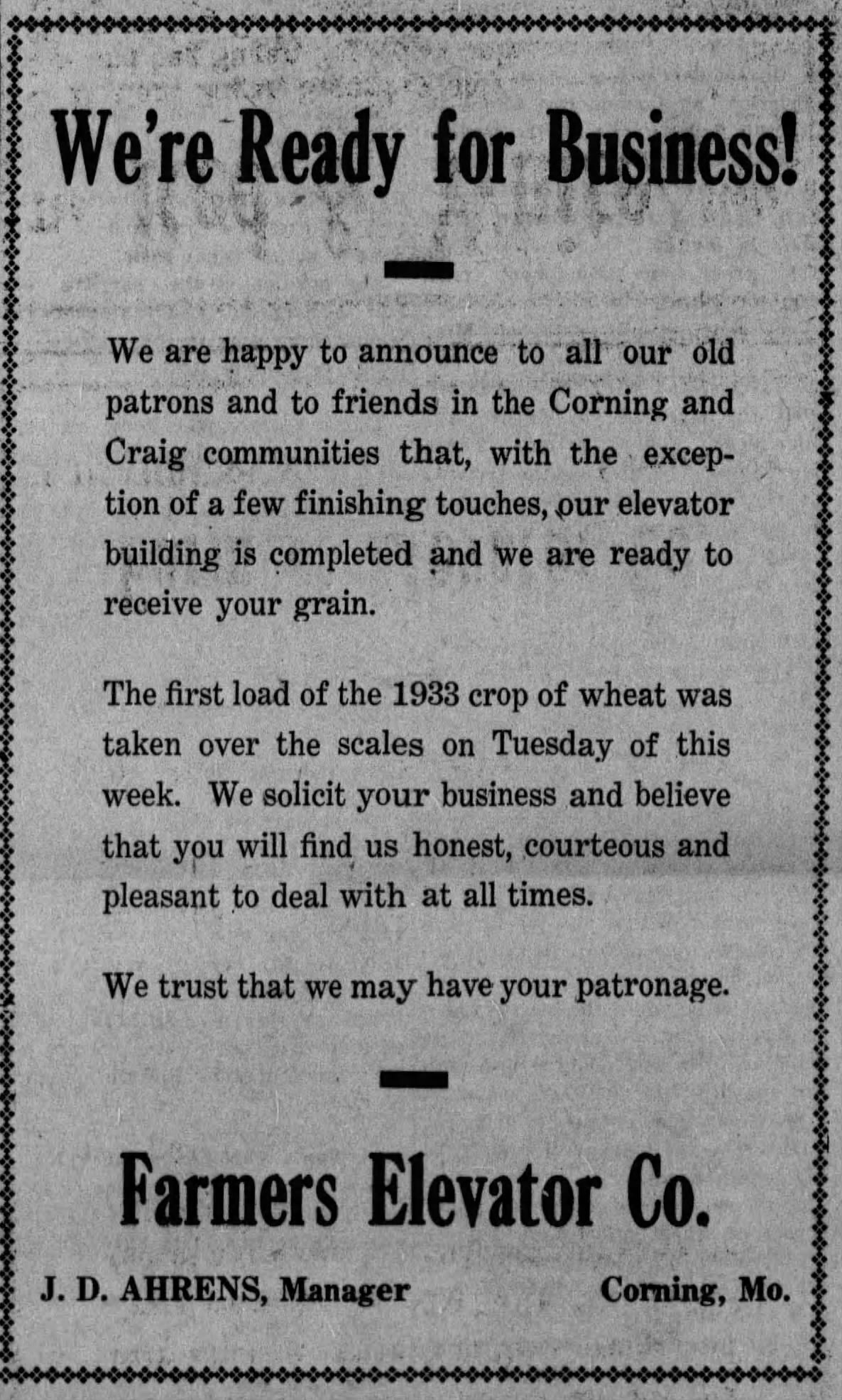
Under the management of J.D. Ahrens (no relation to the present blogger), the “well known firm” was successful for years. 

“They are a reliable firm that gives correct weights, top prices and superior service,” the profile declared. “They demand a specific standard and maintain this standard to their customers.” 

The elevator was “practically indispensable to the farming community surrounding Corning” and had even “won a place in the hearts of the farmers through their excellent service and treatment.” 

Obviously, quick replacement of the elevator would be a priority. Van Ness, which employed my great-grandfather Charles H. Tillotson and grandfather Reginald O. Tillotson, who was in his mid-twenties, came onto the scene.  

So sure of a good outcome were the principals of Farmers Grain that, on June 23, The Holt County Democrat reported one V.A. Solleder had bought a Chevrolet truck for use at the elevator. 

“Heretofore the elevator has been handicapped because of the inability to make delivery of coal, cobs and grain, also in hauling from the Farmers, their grain,” the news item said.

“The truck will be an important asset to the business.” 

Meanwhile, the Omaha crew toiled on with help from some local men who joined in. 

Only a few finishing touches remained to be completed when Farmers Elevator placed a July 14 ad in the Leader informing “all our old patrons and … friends in the Corning and Craig communities … we are ready to receive your grain.”  

Van Ness performed its part with unprecedented skill and speed. 

“It was exactly forty-eight days from the time the contractor began the work on the new building until it was ready for use,” a July 23 article reported. Farmer James Mavity arrived with the first load of wheat. 

The new elevator that was bigger than the old by some 5,000 bushels, giving a total capacity of 18,000 bushels, and work was completed at the tidy price of $7,000, which ensured the cooperative’s solvency. 

Near the end of that job, Reginald snapped the photo we see with this post, providing enduring evidence of the Tillotsons’ handiwork.  

First look at archive of 1930s photos shows back-to-business after wooden elevator repair in North Dakota

The Tillotson homestead north of Omaha was sold in 2025, and as a consequence Our Grandfathers’ Grain Elevators has received a few leaves from a photo album with snapshots of 1930s jobs. Together, these pictures comprise the earliest documentation we’ve ever seen of Van Ness Construction and Tillotson activities. 

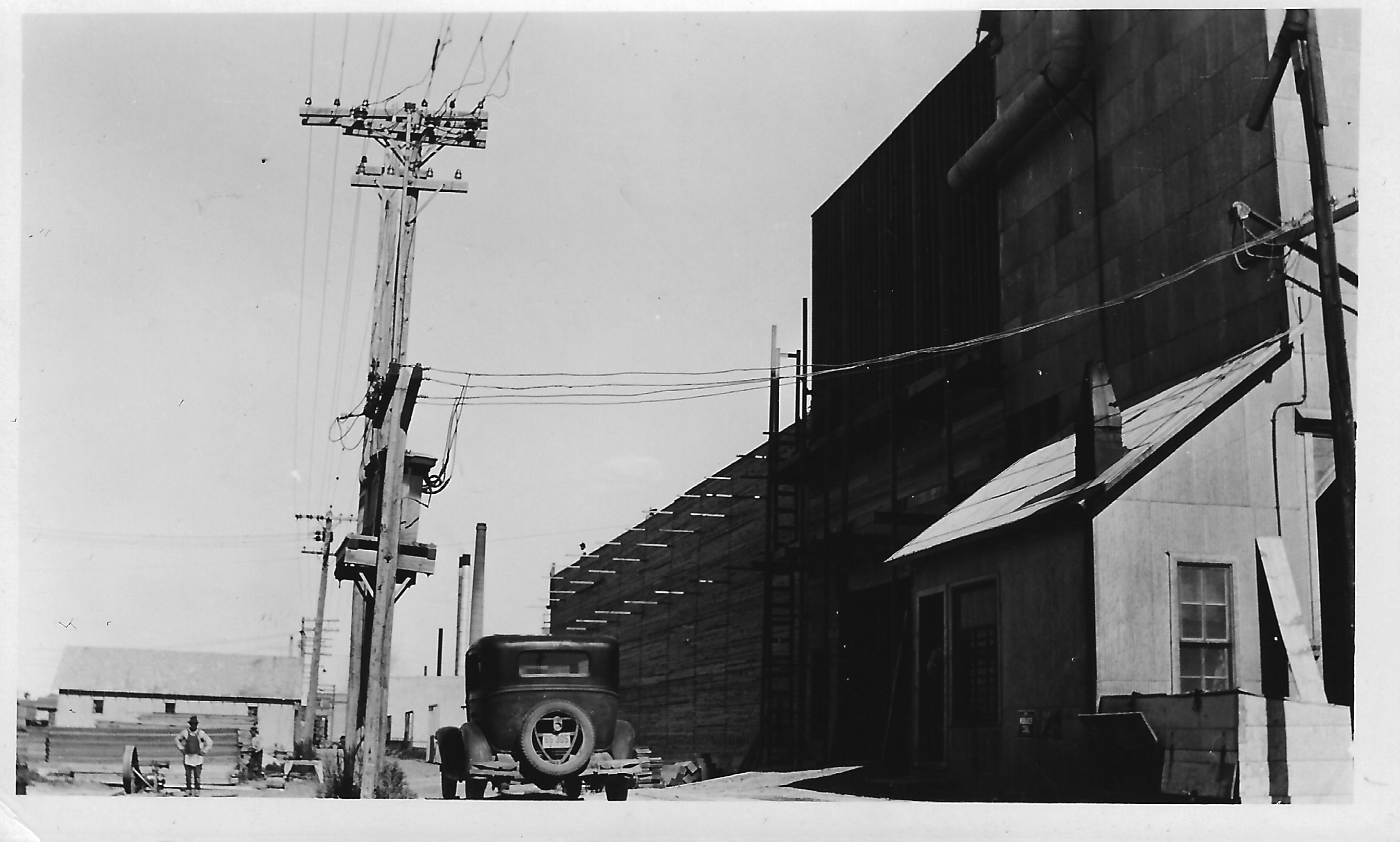
After the sudden passing of Charles H. Tillotson in 1938, his sons Reginald and Joseph built Tillotson Construction Company’s first concrete elevator, located in Goltry, Oklahoma. Prior to that, they worked for Ralston Van Ness out of Omaha. The photos we received appear to show jobs done for that company earlier in the 1930s. 

Most of the photos are inscribed on the back with a name, location, and date. 

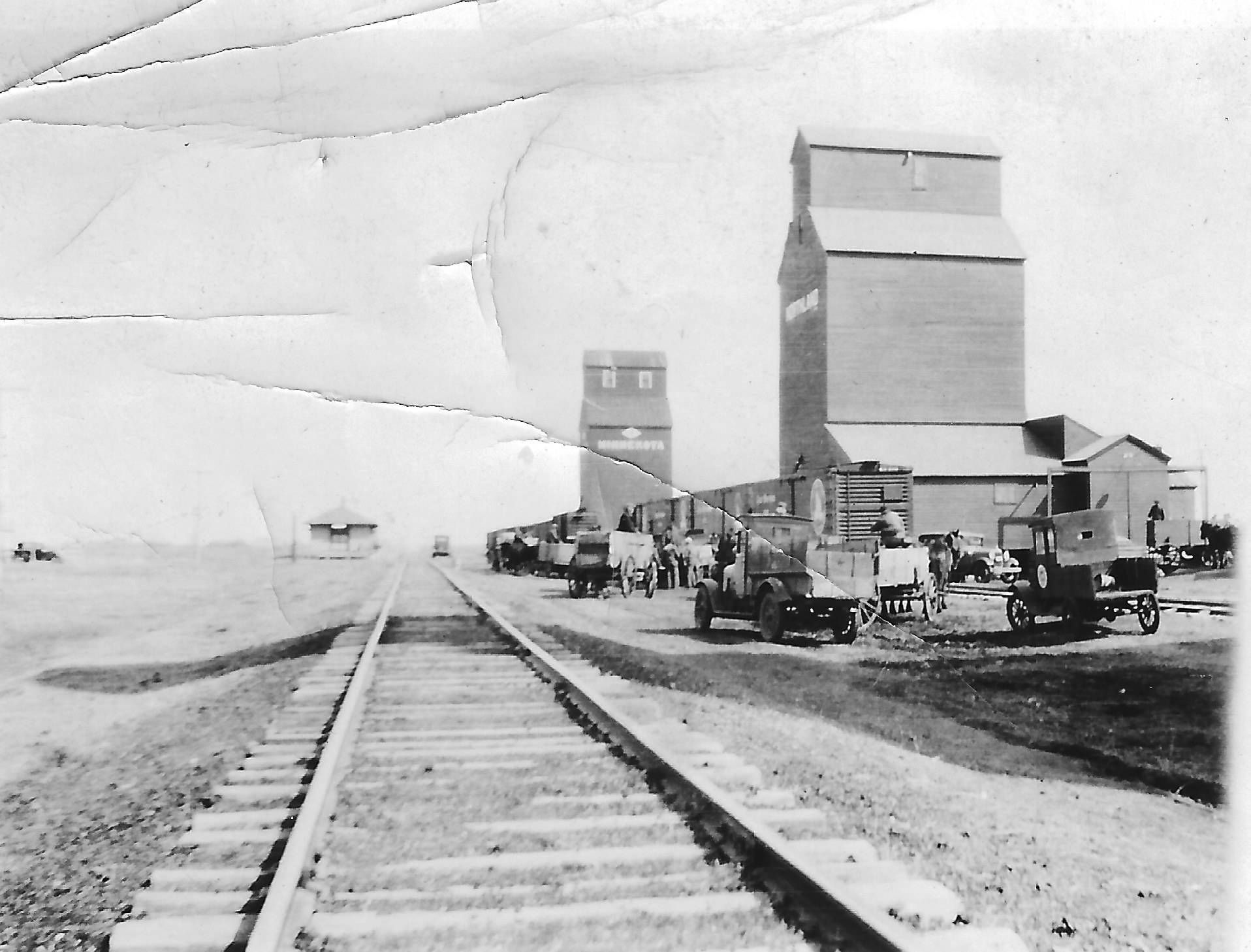
The above photo depicts a 1933 scene at a twin-elevator complex in Norma, North Dakota. Norma is a dot on the map in Renville County northwest of Minot and twenty or so miles south of the Canadian province of Saskatchewan. A note on the album page says “Rebuilt Fire Loss 1933.” 

Searching through a newspaper archive turns up no more details, so we can only look at the image and suppose the relief felt by local farmers who had limited options for grain disposition. Especially at a country location like this, a damaged elevator was an unhappy circumstance that would have required hauling grain over an extended distance. 

On a sunny day at Norma, a few motor vehicles converge at the complex with at least four horse-drawn farm wagons. It’s illuminating to see wagons still in use at that time. Their limitations surely gave farmers a sense of urgency about acquiring a motor truck.

An old pickup with wooden artillery-style wheels in the right foreground was likely a Ford. It has an emblem on the driver’s door, but we can’t determine anything more about it. 

Under close examination of the photo, the elevator tower in the distance appears to be labeled “Minnekota.” The sign on the near tower can’t be read at all. 

A number of men are going about their business, whether they’re still seated on wagon perches, standing inside a wagon, or on the ground. In the mix of trucks and cars, note the silhouette of an automobile way down the sidetrack.

Several boxcars await service. Norma is on a secondary road leading south from North Dakota Route 5, and it seems likely the rail line was a spur. This could have been part of Soo Line operations. 

We lack additional information about the event that led to the reconstruction. Newspaper pages often had stories of grain elevator fires in 1932 and 1933, with casualties in Chicago at a 200,000-bushel elevator on the river there, and with lesser tolls at smaller elevators in prairie locations. 

The Bismark Tribume reported on Aug. 24, 1933 that a 20,000-bushel Minnekota Grain Co. elevator had burned at Butte, North Dakota, to the southeast of Minot. It also claimed a 14,000-bushel carload of wheat. Butte was left with three elevators after the disaster.

We invite our readers to stay with us as we post the rest of the thirty photos in the newly obtained archive.

Goltry hails the new grain elevator in July 6, 1939 issue of the Leader newspaper

Grain Building Is the Work Of Omaha Firm

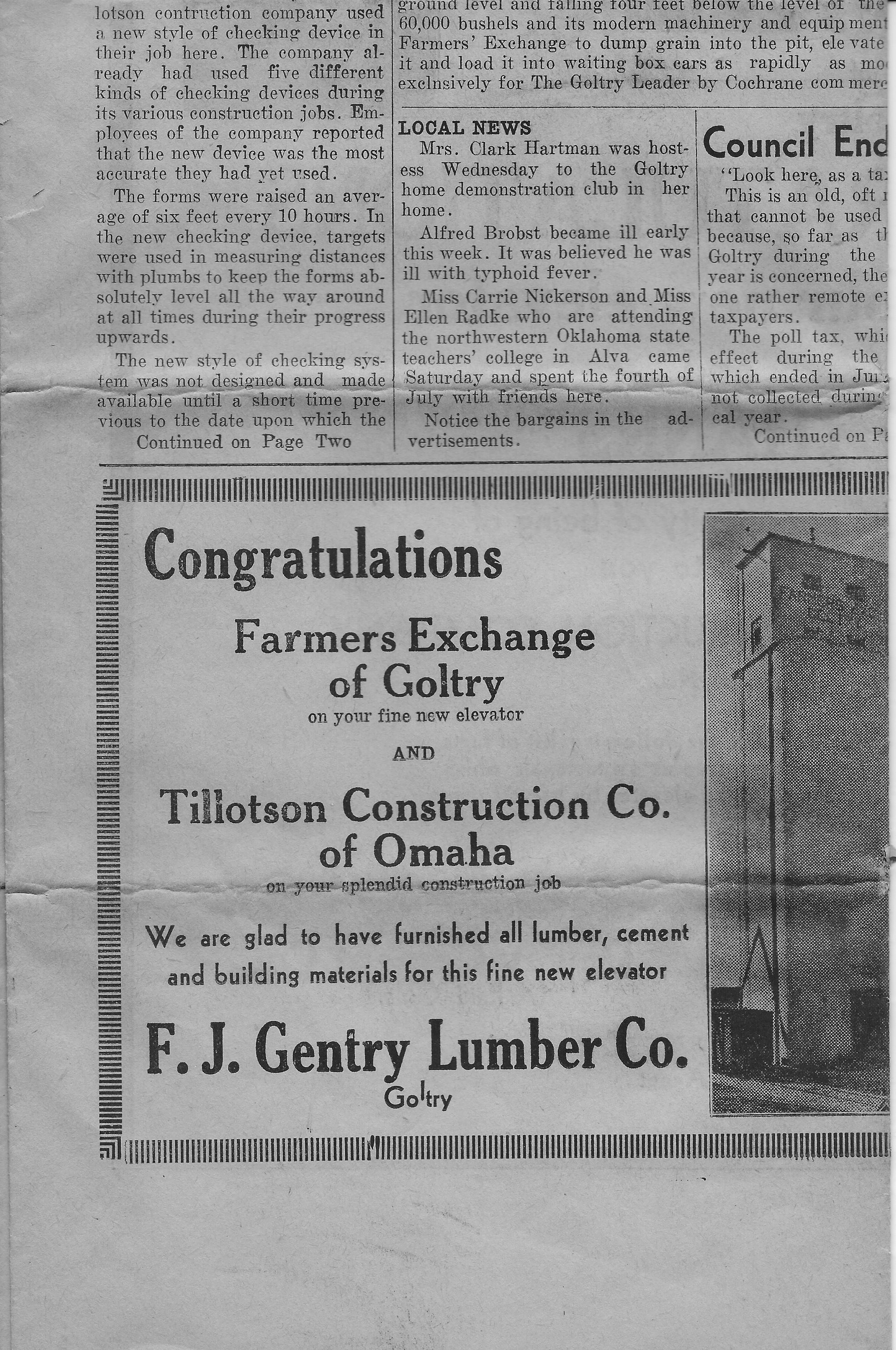
One of the largest wheat crops ever yielded by this section of the northwestern Oklahoma wheat belt was dumped into Goltry’s new 60,000 bushel elevator built for the Farmers’ Exchange of Goltry by the Tillotson construction company of Omaha, Nebraska,

The construction company operated by R.O and J.H. Tillotson, brothers, designers of modern concrete buildings, both of whom were in Goltry at various times during the progress of the building, was awarded the contract March 15. Shortly afterwards a crew of local workers began digging the pit, the first step in the actual construction of the new building.

Wheat was being dumped into the elevator at a time when the harvesting of wheat in this section was only beginning while electricians and skilled workers for the construction company were giving the building its finishing touches.

After the pit had been dug, a crew of 45 men–part of them local persons–was put to work by the company. Carpenters were building slip forms into which concrete was poured. The forms were four feet in height. As concrete was poured, the forms were moved upwards.

The forms were raised with jacks of which there were 48. All 48 jacks were turned by four men. Two turns of the jack screw raised the forms an inch and the jacks were turned in almost continuous operation.

The level of the forms was checked every hour in an effort to insure absolute accuracy. The Tillotson construction company used a new style of checking device in their job here. The company already had used five different kinds of checking devices during its various construction jobs. Employees of the company reported that the new device was the most accurate they had yet used.

The forms were raised an average of six feet every 10 hours. In the new checking device, targets were used in measuring distances with plumbs to keep the forms absolutely level all the way around at all times during their progress upwards.

The new style of checking system was not designed and made available until a short time previous to the date upon which the company began the Goltry job.

Before superintendent W.B. Morris, whose home is in Kansas City, left the job, 150,000 bushels of wheat had been put through the elevator. More than 85 carloads had been loaded from the elevator before Morris left. Each carload amounts to an average of 1,800 bushels. The machinery and equipment in the elevator were operating perfectly before the last of the company’s workers and the superintendent left the job.

“Everything ran smoothly with never a touch of trouble,” Morris, superintendent of the Goltry job for the Tillotson construction company, said.

A large amount of the responsibility for seeing that the day by day progress of the building was not interrupted at any time was delegated to Morris. However, Morris gave a great deal of the credit to the entire group of workers which included a number of local men. Morris said his company had “the best cooperation among the men working for us. We appreciate the interest shown by the people of the community and the efforts the men put forth endeavoring to keep the job going at the proper speed at all times,” Morris said.

The new elevator is 120 feet from the bottom of the basement to the top. The basement is four feet below the ground level and seven and a half feet below the floor. The capacity is 60,000 bushels.

A truck lift on the first floor of the elevator picks up trucks with ease in the process of dumping grain from the trucks into the pits. The new style of truck lift will not catch the radiator or damage the truck in any way.

Two pits into which grain is dumped hold 1,200 bushels. The first pit holds 850, the second 450.

Legs motivate the belt and cups and such a speed that the grain is elevated upwards into the bins at a rate of 60 bushels per minute.

At the top of the building, an automatic scale dumps 60 bushels per minute. The scale hold 10 bushels and automatically drops six times per minute.

A blowing system cleans wheat and sends the dust and chaff and foreign particles down a chute and into a compartment just above the first floor. At intervals this compartment is dumped into a truck and hauled away.

A fast cage type man lift–one of the fastest man lifts to be found in an elevator of the size of the new Goltry building–hoists the workers upward to the top of the building at a time saving rate of speed.

Among the various types of men working on the job–of which there were as many as 45 at the time the crew was running slip forms–were electricians, concrete workers, steel men, jack men, hoisting engineer, concrete mixer operator, finishers who smoothed the walls and the floors, painters, buggy men and wheel barrow men.

Front page caption:

Goltry’s new modern elevator building (above), built for the Farmers’ Exchange of Goltry by the Tillotson construction company of Omaha, Nebraska, is 120 feet in height, rising 116 feet above the ground level and falling four feet below the level of the ground. The capacity of the new building is 60,000 bushels and its modern machinery and equipment, all brand new, enable the operators of the Farmers’ Exchange to dump grain into the pit, elevate it, clean it with a modern blowing system, weigh it and load it into waiting box cars as rapidly as modern high speed trucks can bring it in. Photo exclusively for The Goltry Leader by Cochrane commercial photographers.

Inside page caption:

Approaching Goltry from the west a person would be afforded this view of the new Farmers’ Exchange elevator building (above) towering 116 feet toward the sky, its smooth, white walls reflecting with added brilliance the dazzling rays of the midsummer, afternoon sun. (Photo exclusively for The Goltry Leader by Cochrane commercial photographers).

Tillotson family’s 1930s Omaha home at 624 N. 41 St is revealed

By Charles J. Tillotson

“My oh my! The old house is still standing after all these years, which is at least 89 years.

“This is my Grandpa and Grandma’s (Charles H. and Rose A. Brennan Tillotson’s) home and where Dad and Mom (Reginald O. and Margaret I. Tillotson) lived intermittently for three years after they got married.

“I was born in 1935 in Creighton [University]’s St. Joseph Hospital and lived here for my first three years when Dad wasn’t on a construction site too far to come home. Dad built a small house-trailer so that he could take Mom and his kids along with him when going away. 

“When Dad finally decided to settle down three years later [after the death of Charles J. and formation of Tillotson Construction Co. with brother Joe], he bought a house with a fruit orchard located on the northern outskirts of Omaha. 

“I have a bunch of photos of the house while I was standing in front of it with my winter togs on, and of course it was painted white at that time.” 

Uncle Chuck affixes a generator to his memory, and Van Ness Construction comes alive

001

Great-grandma Margaret’s general store, Shields, Kan., 1910. Margaret A. Tillotson was Grandpa Charles’s mother. I don’t know why Mother (Margaret Irene) thought it was my Great Aunt Mary’s store. Maggie was a nickname for Margaret, and my Dad would call Mom “Maggie” every once in a while to tease her because he knew she didn’t like it.

By Charles J. Tillotson

I forgot to add in my comments [on company origins] what little I know about Grandpa Charles’s experience with Van Ness Construction.
I’m really stretching the memory, and I have to start with Grandpa Charles’s father:
Charles H. Tillotson was the son of John Wheeler and Margaret A. (Jackson) Tillotson.
John and Margaret to my knowledge had at least six children: Raymond, Charles (grandpa), Bertha, Mary Alice (known as Lovie), Walter, and May.
  1. Raymond took over the homestead.
  2. Charles worked as a carpenter.
  3. Bertha married a telegraph operator.
  4. Mary Alice (Lovie) married Ralston Van Ness, elevator builder.
  5. Walter worked as a landscaper.
  6. May married Zomer Dryden and lived on a farm in Ohio.
My mother used to call Mary Alice, Aunt Lovie, so that is how I remember her. Aunt Lovie married Ralston Van Ness (he was 26 years old) in 1902 in Shields, Kan., where he operated his wooden grain elevator construction business. However, within a year’s time, they had relocated to Omaha where their daughter Mary was born. The couple also had twin daughters who died at birth in 1906 and a son, Ralston, who also died at birth in 1908.
By 1930, Ralston and Mary had built up quite a reputation for the construction of wooden grain elevators, and it was about then that Grandpa Charles went to work for them. I know for sure that Dad also went to work for Ralston as a laborer. (I don’t know about Uncle Joe). I have no exact date for when Ralston passed away, but I think it was around 1935 when I was born. Around 1935 Ralston died and left Aunt Lovie with the business.
003
Very interesting that, on my birth certificate from 1935, Dad is listed as a laborer employed by Van Ness Construction, and he had been employed in this work for a period of three years. Dad was listed as 26 years of age and Mom at 31. Place of residence for them (and me) is listed as 624 N. 41 St., Omaha, Neb. That is where Grandpa Charles and Grandma Rose lived and where Dad and Mom bunked up when they were not on a construction job using Dad’s trailer as home.
From what I can determine, Aunt Lovie wanted to continue in the building business, but she wanted to build homes for the growing Omaha community. So Grandpa and Dad gradually finished up the Van Ness contracts and in 1938 decided to form their own company.
Aunt Lovie eventually moved out to California where she built homes in Mill Valley and San Rafael. Although Mom and Dad fell out of contact with her, after my discharge from the Army, in 1957, I  managed to track her down and had a nice visit over the phone. She was in her early 70s by then and wanted to retire. Her daughter, Mary, stayed in Omaha, married Guy Stribling, and they had three children, the youngest was born in 1940. I don’t know if the offspring are still living.
Van Ness Construction Co. built wood grain elevators. Their field of influence was centered in Nebraska, Iowa, Kansas, Oklahoma, and a portion of Texas.