The Cordell, Oklahoma elevator project fused engineering prowess with family ties

Story by Kristen Cart

christofferson041

Edwin Christoffersen was the superintendent on the Mayer-Osborn Construction project in Cordell, Okla. in 1950. His son and namesake kindly provided a notebook that gave a glimpse of the concrete engineering that went into the elevator. By trial and error, the company learned best practices, creating an enduring structure which would still operate more than sixty years later.

Edwin Louis Christofferson was the son of Jens “James” Lauritz Christoffersen, a first generation American who farmed and operated a farm stand in Fremont, Neb. Edwin was one of nine children. Ed’s sister Alice married William Osborn in 1923.

When the Mayer-Osborn enterprise was in full swing, Bill Osborn tapped relatives to manage projects or to provide manual labor. He followed a common practice.

Sons Dick and Jerry Osborn worked at various times building elevators. Bill Osborn entered partnership with Eugene Mayer, the brother of Joseph H. Tillotson’s wife Sylvia. At the Tillotson Construction Company of Omaha, Bill Osborn worked with Iver Salroth, husband of Emma, a Christoffersen cousin.

Naturally, when the opportunity arose, Ed Christoffersen found employment with his brother-in-law’s company an attractive proposition.
christofferson019(1)

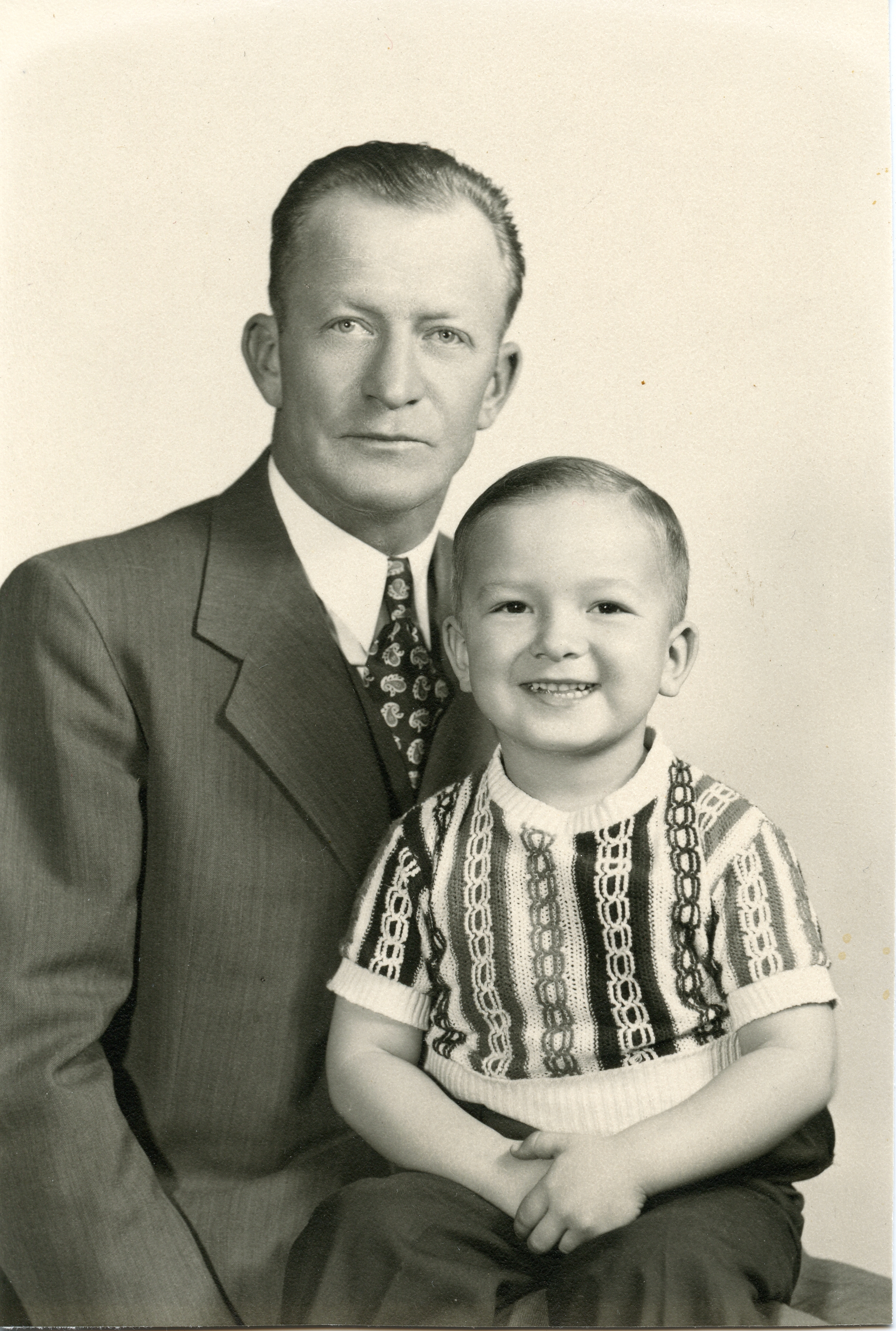
Edwin Louis Christoffersen with his only child.

Ed’s son has kept a number of Mayer-Osborn keepsakes, in memory of his dad, who died when he was still quite young. One intriguing item was the logbook that Ed kept for the Cordell, Okla. elevator, recording concrete tests.

Various sand, gravel, and concrete mixtures were tested to a failure point to determine the ideal formula for a given project. The date and time of day was recorded for each test. In this journal, we discovered the year of construction for the Cordell elevator.

The elevator business brought families together to accomplish a common goal, and now, many years later, writing about the elevators brings the builders and their sons and daughters together again. The memories are kept in small personal repositories of clippings, photos and documents, and in tales of the job, and are captured fleetingly before the witnesses leave us.

Looking up at these great landmarks, we also look up to the patriarchs who built them, with respect, and awe.
Go West, young men, to Flagler, Colorado, and build a grain elevator!

Scan 1

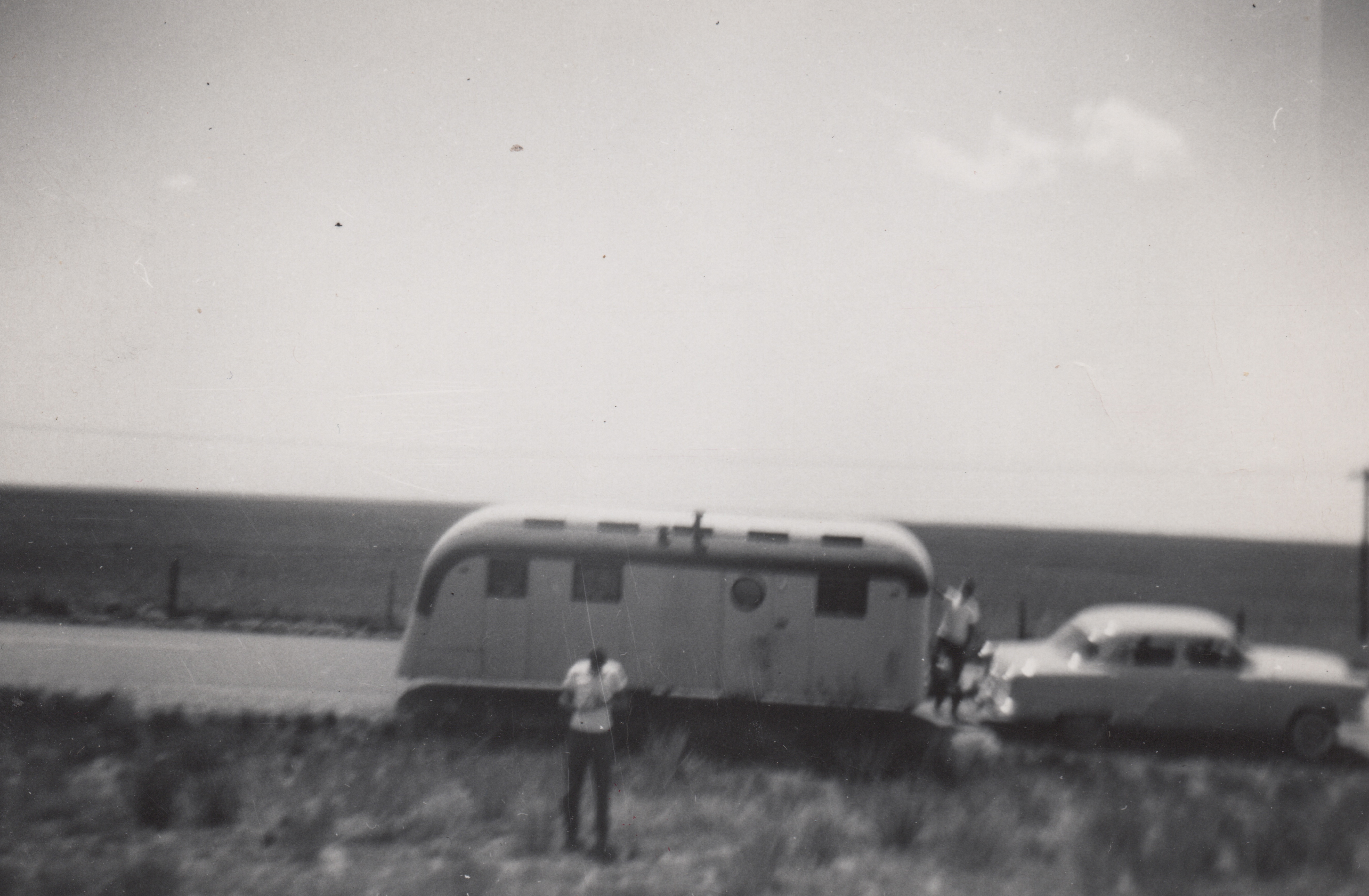
What could help the three teenaged sons of Reginald and Margaret Tillotson sons to grow up? Nothing better than going from Omaha, Neb., where Tillotson Construction Company was located, to Flagler, Colo., to build the annex to a grain elevator in 1953.

Charles, 18, Tim, 16, and Mike, 13, drove across the Great Plains in a new Ford, towing the trailer that would serve as their home and the job office.

Having started for the company as an assistant carpenter when he was 12, Charles was already quite skilled in elevator construction techniques.

But how did they fare for themselves? For instance, what did they eat during their weeks on the job?

“Regarding what we ate, I really don’t remember but it was probably beans and wieners,” Charles recalls. “We also ate at the local cafe in Flagler. That was when Tim and I weren’t screaming over to Elitches Park Outdoor pavilion in Denver (some 120 miles to the west) to squeeze in a night of dancing and return at daybreak to assume our work shift–no sleep of course. I think we left Mike alone in Flagler to fend for himself.

Mike spent many hours in the trailer, serving as timekeeper and reading hot rod magazines when he could.

Building a mighty elevator required specialized carpentry and subtle touches

Scan


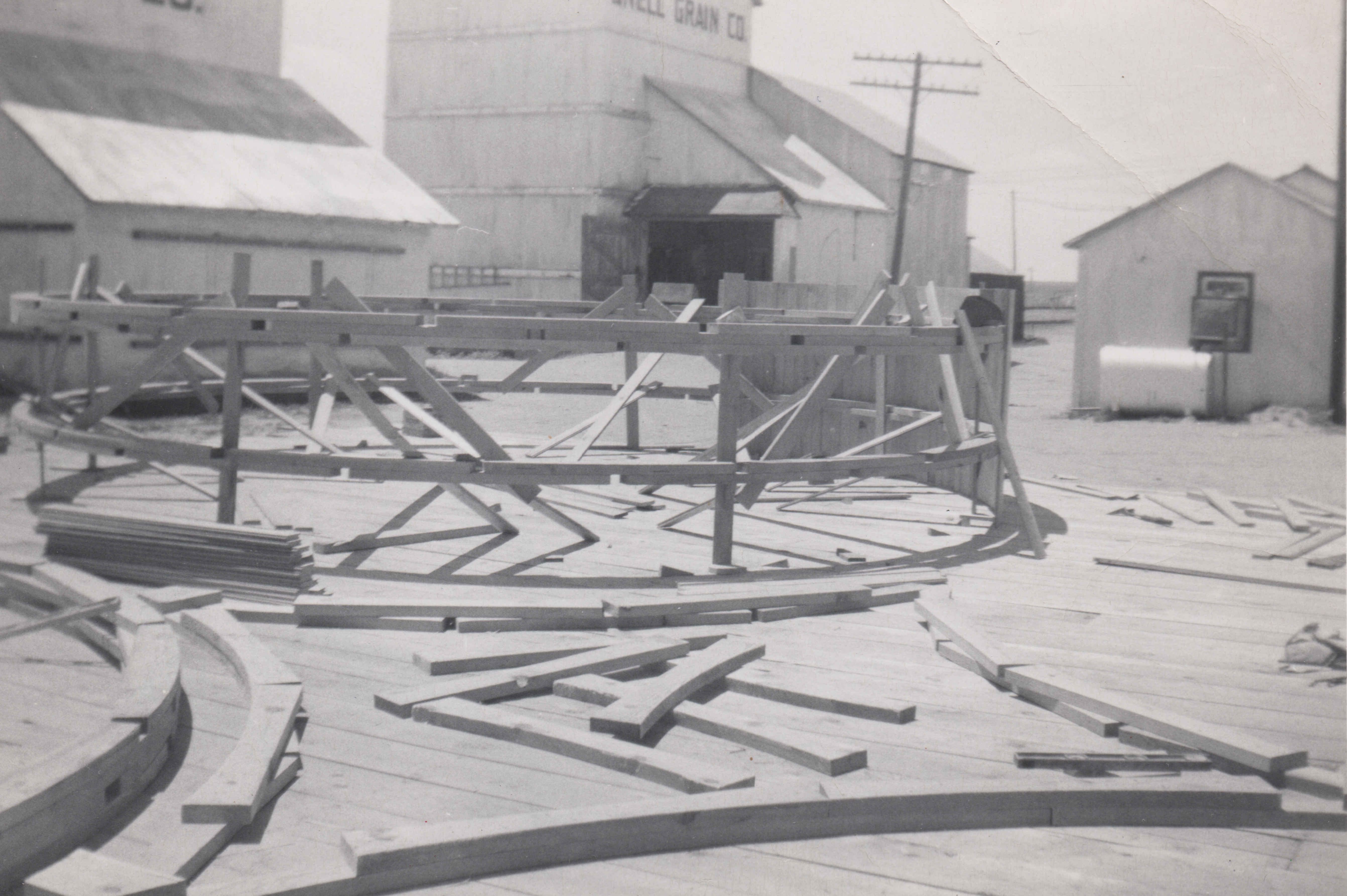
Editor’s note: Here, Charles J. Tillotson offers additional explanation about the formwork at the start of the Flagler, Colo., annex, seen in this 1953 photo from Tillotson Construction Company archives. 

All new lumber was used, the amount of which I couldn’t give any idea but it was a few truckloads at minimum.

The curved lumber was done by hand, either with a table saw or a Skilsaw or both. The notches, of course–for example at the jack yoke locations–were again cut in the field.

Mucho carpentry work, the length of which depended on the number of carpenters that could be scrounged up.

Also, the superintendent of the job was usually out of the carpentry world and could pitch in as needed during form construction.

And there remains one more point to make about the photo from a previous post, “Taking it from the top at Tillotson Construction’s annex in Flagler, Colo.” (use the link that’s included below or click on the photo to see an enlarged version). 

ScanThe dark shadow around the circular bin forms is the residue from “washing down the side.” (This is the side where the cement will be poured.)

The formwork was coated with used motor oil or some other type of lubrication.

Doing so made the formboards moisture resistant and let them more easily slip upward with less friction.


Related articles


Mystery elevator identified as Mayer-Osborn’s Cordell, Oklahoma project

William Osborn photo provided by his granddaughter Diane Osborn Bell

William Osborn photo provided by his granddaughter Diane Osborn Bell.

By Kristen Cart

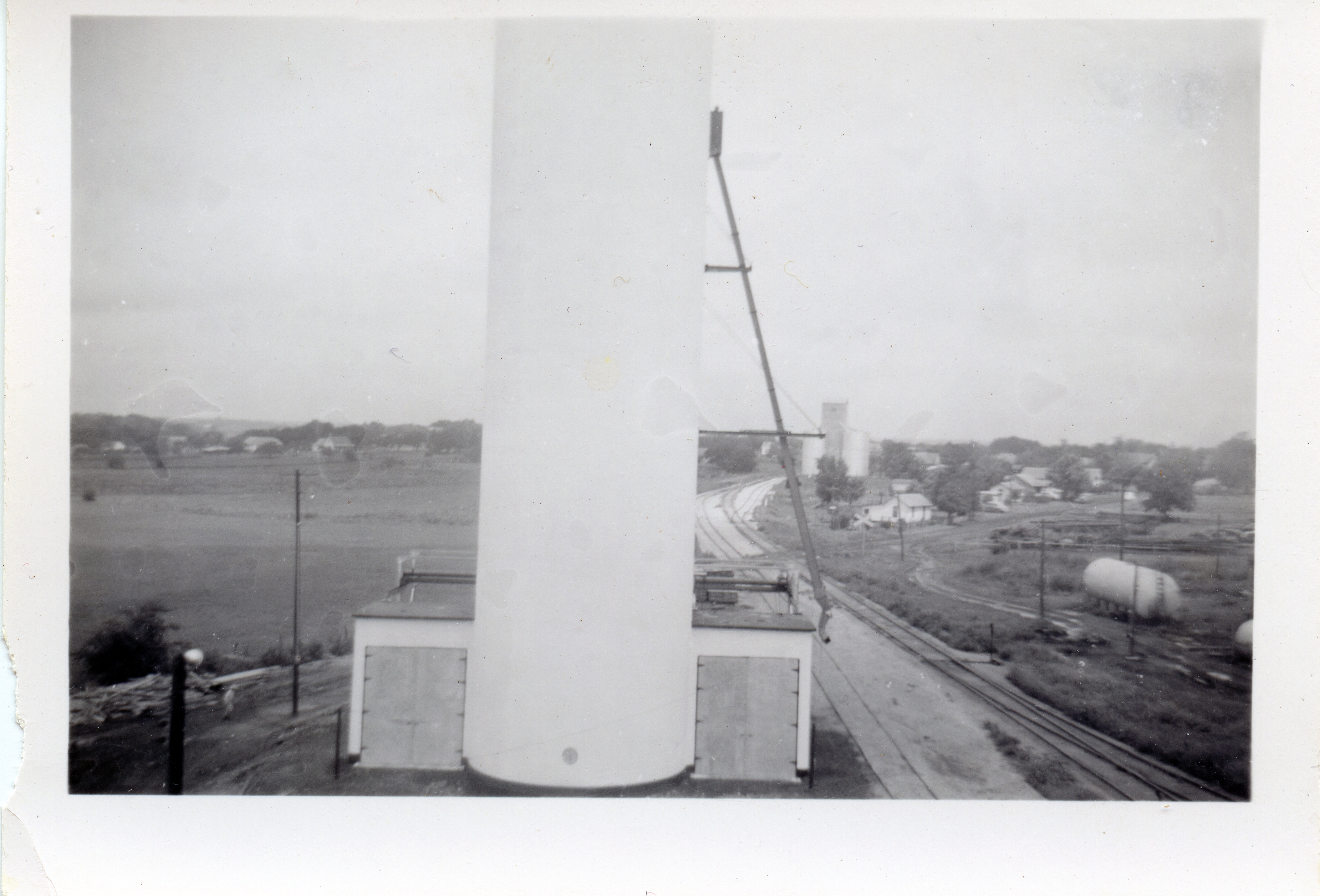
christofferson040This photograph has left us scratching our heads for over a year. Gary Rich knew of no such elevator from all of his travels, so he rummaged through his photographs for any hint of it. He looked for an elevator with a single bin-width and two driveways, with a curve of track and a second elevator around the bend, all to no avail. The photo sat in my files waiting for serendipity to step in. Sometimes, it is best to bide your time, and if you are lucky you get more than a location and a name. We hit the jackpot in this case.

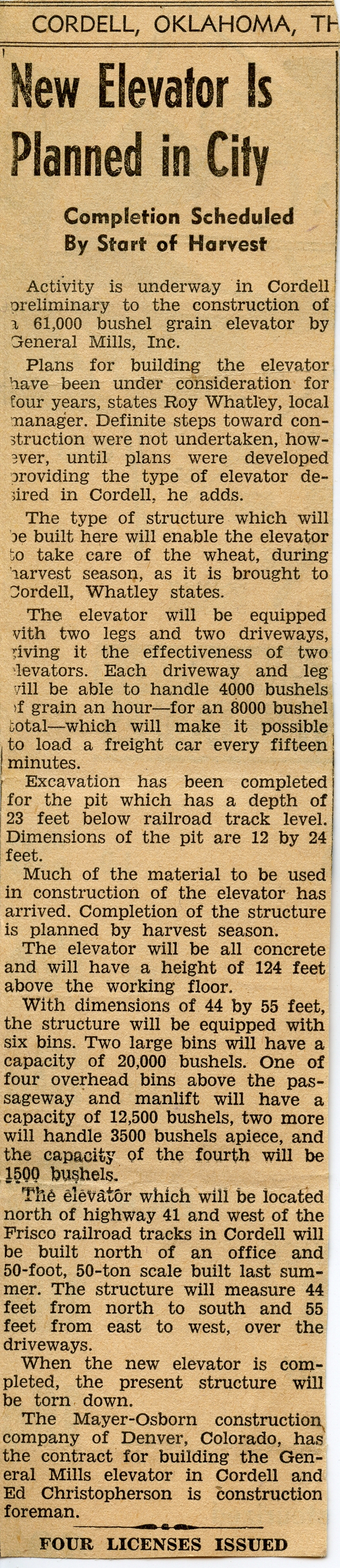
When Dad and I visited his first cousin, we sorted through boxes of hundred-year-old family pictures. Midway through the second box, we found a newspaper clipping about an elevator, with a photo I instantly recognized. There it was, plain as day.

This unique elevator was built in Cordell, Okla., a town almost directly south of Wichita, Kan., well within the territory served by Mayer-Osborn Construction. The superintendent on the job was Ed Christoffersen, brother-in-law to my grandfather William Osborn.

Cordell Oklahoma Elevator

In this photo by Joy Franklin, you can see two driveways, built for faster grain loading during harvest. The curve of train track is evident here.

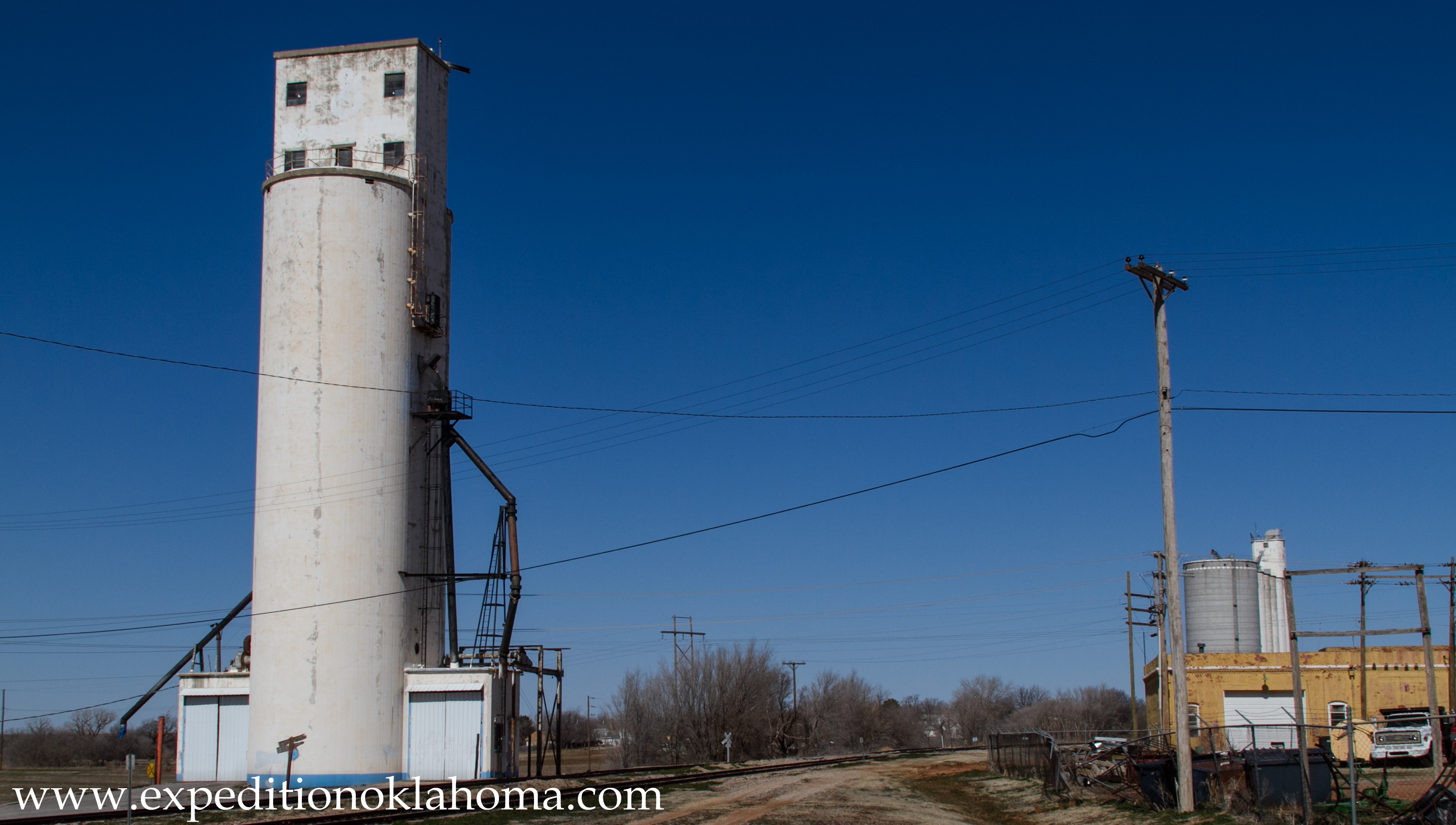
After making the identification, I looked online and found Expedition Oklahoma, where Joy Franklin posted a beautiful current photo of the elevator. With her kind permission, it is posted below. She said the elevator is owned by the Wheeler Brothers Grain Company, founded in 1917, which presently owns eighteen grain elevators. It is a happy surprise to see that one of Mayer-Osborn’s most innovative elevators not only survives, but is still in use today.


Linking together preassembled formwork came after pouring an elevator’s slab

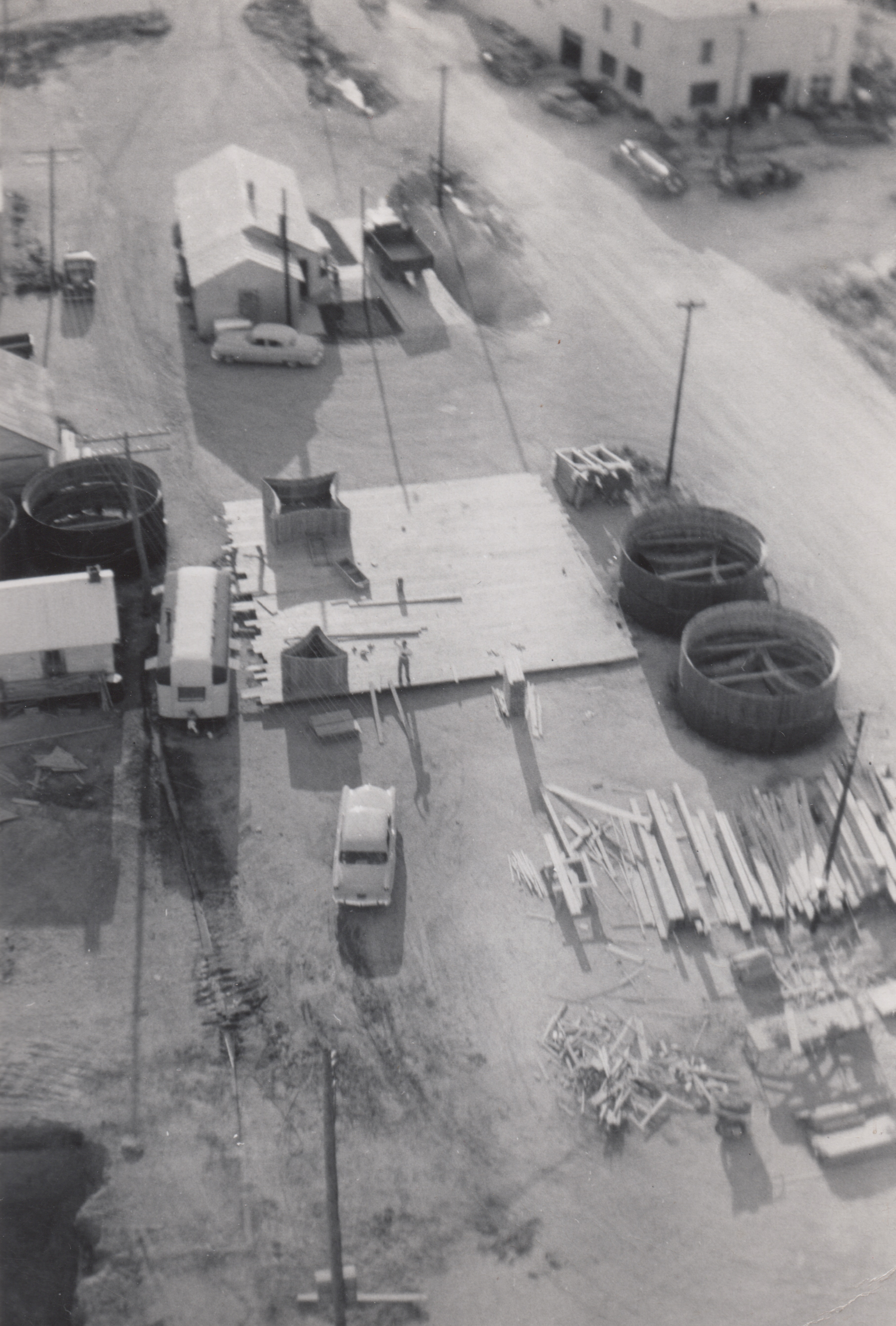
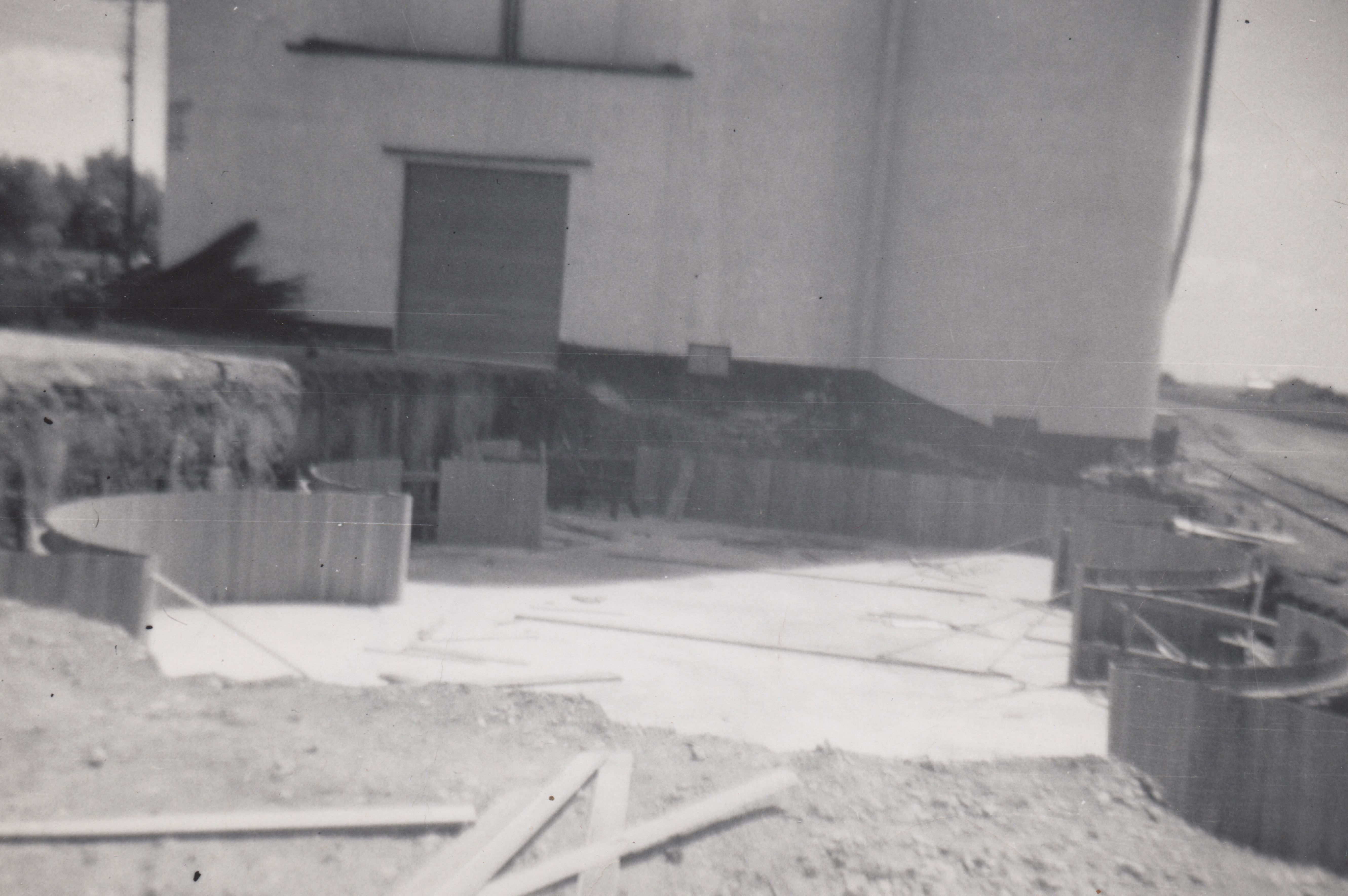
Initial formwork for new grain bins at Flagler in 1953.

Initial formwork for Tillotson Construction’s new annex of grain bins at Flagler, Colo., in 1953.

Editor’s note: The following explanation by Charles J. Tillotson helps to answer the question of how a grain elevator is built.

The excavation you see in the picture was dug for the foundation and floor slab of the annex at Flagler. Once the slab is poured, the forms that have been built are moved onto the slab where further carpentry is used to connect all the formwork together and construct the supplemental formwork such as horizontal ribs, jack yokes, et cetera, to make an integral form, all assembled into a uniform unit and capped entirely with a walking deck, also of wood.

Oftentimes the job site did not lend itself to building the major portion of the formwork simultaneously with the excavating and placement of the foundation (lack of space, topography, et cetera). So all of the formwork had to be built in place after the new floor was poured, which slowed the construction time of the overall build-out of the elevator.

Taking it from the top at Tillotson Construction’s annex in Flagler, Colorado

Scan

This photo from the Tillotson Construction Company archives shows the staging deck, on which all formwork was built to ensure it was dead level. The square section was probably the form for a conveyor or bucket shaft, or for a man lift. The triangular section, called a groin form, was made for the void where two rows of bin forms were placed together. The excavation hole for the new annex is seen, lower left, at the foot of the 252,000-bushel elevator the company built in 1950, modeling it after their one in Pond Creek, Okla. 

By Ronald Ahrens

In 1953, my grandfather Reginald Tillotson decided to send his three sons, Charles, 18, Tim, 16, and Mike, 13, to work on an annex to the Flagler, Colo., elevator Tillotson Construction Company had built three years earlier.

My grandmother Margaret didn’t like the idea.”You can’t send those kids out there,” she protested.

“It’s about time they grew up,” Reginald said.

Indeed, my uncles were sent, leaving Omaha in a new Ford and pulling the travel trailer that would be their home for the next few weeks.

“I don’t remember that he even came out,” Uncle Tim said recently of Reginald.

From left, Tim and Chuck Tillotson and La Rose Tillotson Hunt in 2012.

From left, Tim and Chuck Tillotson and La Rose Tillotson Hunt in 2012.

While Charles and Tim labored on the formwork that rose toward the sky, Mike stayed in the trailer, which doubled as their bunkhouse and the job office. His task was that of timekeeper.

“I don’t recall him bein’ out there when we was jackin’ and pourin’,  jackin’ and pourin,'” Tim said, although he did recall him reading hot rod magazines.

Once the pouring started, it couldn’t stop. A cold joint between concrete that had already set and a new pour wasn’t at all desirable, for it would leak.

“You had to treat that damn good when you started over,” Tim said.

Work went on in twelve-hour shifts. As the concrete was dumped out of a Georgia buggy–a V-shaped tub riding on large wheels behind a U-shaped handle–someone with a spud hoe would follow the pour and work the concrete, releasing the air from around the rebar. “The only way you shut down was an emergency,” Tim said. Lightning, for example, was an emergency because it was attracted to the rebar being used to bolster the concrete.

_DSC0033_9425The crew was made up of some trusted old hands and an assortment of locals. “You never knew who you were workin’ next to,” Tim said.

He remembers the local sheriff asking himself why he should put up anyone in the jail when they could work and earn their keep. One of the convicts toiling alongside Tim had a funny thought. “You think you can hang onto that hoist handle hard enough if I push you off?” he said.

Any number of mishaps could occur. “You ought to see one of them Georgia buggies go off the top,” Tim said. “Or the cotter pin come off the wheel and the wheel go off.”

At ground level the pour was made in six-inch increments, but the speed increased as the elevator rose.

To keep the screw jacks on the same plane and maintain plumb, the crew used a water-level system on the deck. A clear hose was fed by water from a 55-gallon drum. Tim said the hose had a level “that you marked before you ever pulled off the ground. And believe it or not, you’d get one hundred and some feet up, and you’d be plumb!”

Gordon, Nebraska’s elevator was built in a classic Mayer-Osborn style

The Mayer-Osborn elevator, identified by manhole covers inside the driveway, stands in front of Chalmers and Borton additions

The Mayer-Osborn elevator, identified by manhole covers inside the driveway, stands in front of Chalmers and Borton additions.

Story and photos by Gary Rich

Farmers Co-op operates these elevators. The co-op is based in Gordon, Hay Springs, and Hemingford, Neb.

The elevator in the foreground was built by Mayer-Osborn Construction Company, based in Denver. The completion date is not known.

The elevator in the background was built by Chalmers and Borton Construction, based in Hutchinson, Kan., in 1958. The company built a second elevator, west of these elevators, as well as a couple of annexes.

A side view of the Mayer Osborn elevator

A side view of the Mayer Osborn elevator.

By Kristen Cart

This stepped up headhouse design was first rolled out with the elevator in McCook, Neb., built in 1949 by Mayer-Osborn Construction Company. The style was featured in the Mayer-Osborn ad that ran in the early 1950s in the Farmers Elevator Guide.

The Gordon elevator showcased the rounded headhouse construction method adopted by Tillotson Construction for their later projects, but it is not known which company pioneered the cost saving technique.

From his home in Colorado, Gary Rich investigated this elevator on a trip east to photograph a number of Midwestern elevators. Gary has been instrumental in identifying a large number of Mayer-Osborn, Tillotson Construction, and J. H. Tillotson projects, pursuing the history of the elevators with as much passion as he puts into his excellent photography.

We are indebted to him for his relentless pursuit of good information, now contained in this blog.

Tillotson Construction’s signature, the curved headhouse, was a practical matter

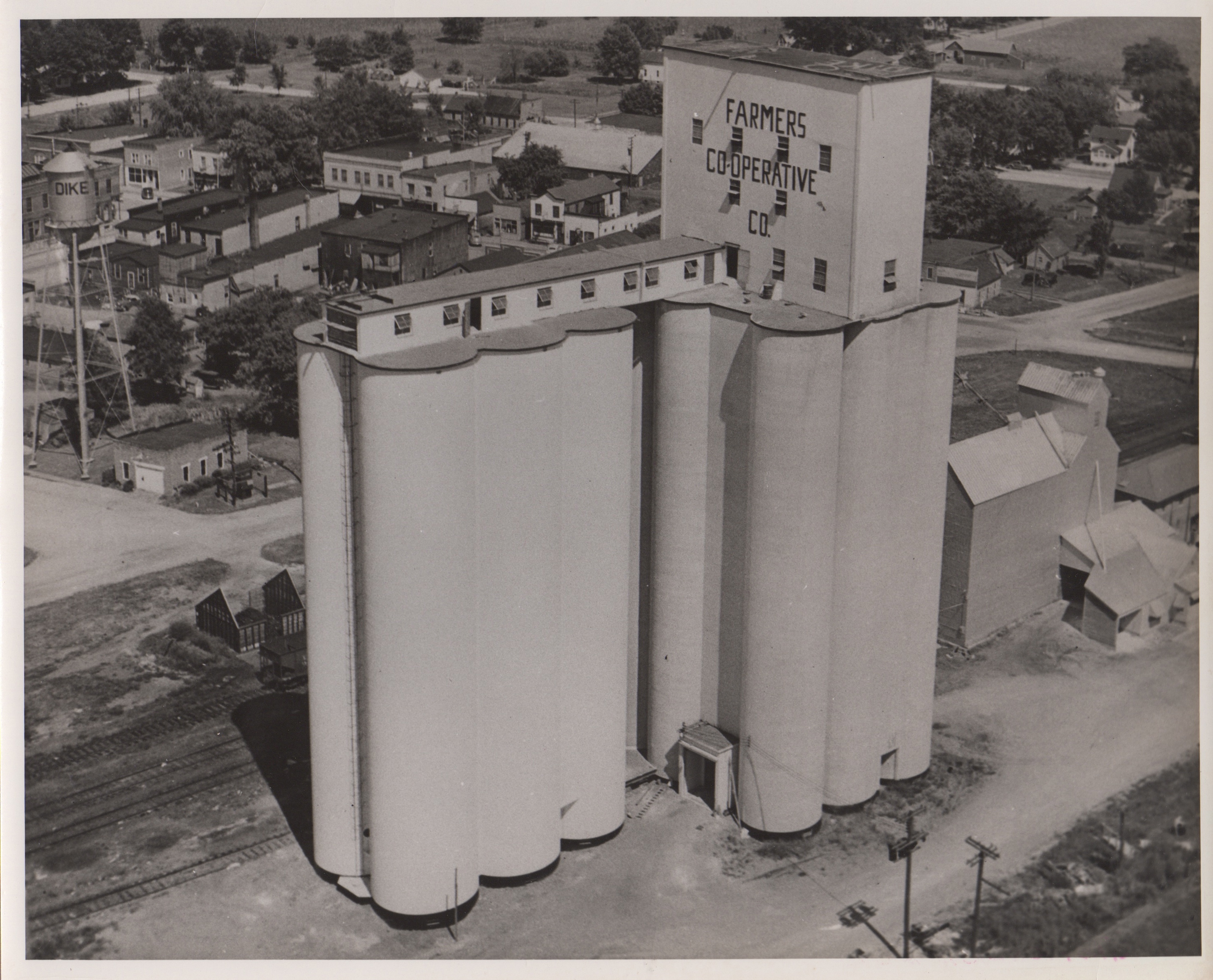
The main house of Tillotson Construction's elevator at Dike, Iowa, built in 1946 (annex, left, 1949), is crowned by a rectilinear headhouse.

The main house of Tillotson Construction’s elevator at Dike, Iowa, built in 1946 (annex, left, 1949), is crowned by a rectilinear headhouse. 

In this post, Charles J. Tillotson explains how his father, Reginald Tillotson, president of Tillotson Construction Company, developed the curved headhouse design.

It would be nice to say that the curved walls were created by Dad for aesthetic reasons and leave it at that.

However, a number of factors actually influenced the design, those being:

  1. Re-use of the curved yokes (the horizontal framework supporting the vertical forms used during slip-form construction of the storage bins).
  2. Building square corners into concrete slip-form construction proved to be more difficult than curved corners.
  3. Placing horizontal reinforcing steel for square corners entailed bending it at a ninety-degree angle and then manhandling it into position, whereas with the curved forms, the horizontal reinforcing steel could be inserted much easier by sliding it into position.
Tillotson's Aurora, Neb., elevator, built in 1950, has a curved headhouse.

Tillotson’s Aurora, Neb., elevator, built in 1950, has a curved headhouse.

For numbers two and three above, keep in mind that all horizontal reinforcing steel, or rebar, was placed by hand (anywhere from twelve to sixteen inches) during the slip-form process, all while the forms were being slipped vertically by screw jacks.

The horizontal steel had to be placed rather quickly throughout the entire structure, so that the steel bars were approximately in alignment from the beginning of placement throughout the structure and back to the beginning point.

On large projects, steel placement was divided into segments with a team captain in charge of each, and all captains would then synchronize their start times for installing the rebar.

Slip-form construction involves a great deal of detailed labor to carry out specific functions while the forms are being jacked vertically in constant motion. It used to be about five to six inches per hour.

History is preserved in pictures at St. Francis, Kansas

Story by Kristen Cart

Farmers line up their grain trucks at St. Francis, Kan.

Farmers line up their grain trucks at St. Francis, Kan.

One of the most pleasant surprises at the St. Francis Mercantile Equity Exchange was their historical record preserved in pictures. In its hundred-year history, the exchange has maintained a continuous presence on the site of the present elevator, and has seen many changes in technology. Fortunately, photos exist that document the old way of doing things, and  Shirley Zweygardt, the site grain manager, was kind enough to provide copies.

In this photo dated 1951, an old wooden elevator stands immediately behind the concrete house. It was demolished to make room for the second bank of concrete bins, built in 2000.

In this photo dated 1951, an old wooden elevator stands immediately behind the concrete house. It was demolished to make room for the second bank of concrete bins, built in 2000.

It is always a fantastic find when you locate a pictorial history of an elevator.

A picture album, filled with historical treasures, which Shirley Zweygardt was pleased to share

A picture album, filled with historical treasures, which Shirley Zweygardt was pleased to share

I had already acquired a 1947 dated postcard depicting the elevator, so we knew its age. These additional photos, dated on the reverse “1951,” show its stately beauty. They depict two additional wooden elevators, which have long since disappeared. The vintage automobile in the foreground of the first image substantiates the date of the caption. Without the car, this photo would appear timeless, even though it was taken shortly before the addition of the first annex built by Chalmers and Borton.

Another view, dated 1951

Another view, dated 1951

It was quite a lovely thing; by 1951, the largest known elevator built by J. H. Tillotson, Contractor, was celebrating its fifth year, and was still white and stark against the sky. The elevator at McCook, Neb., was only two years old when this photo was taken, and my grandfather, builder William Osborn, had gone on to other projects with the Mayer-Osborn Construction Company.

Shirley Zweygardt told me an elderly resident of the town had preserved these photos in an album, which she brought to the elevator office, where they became part of the records of the equity exchange. The prints, reproduced here, were duplicate copies, now part of my growing library of historical images.

The visit to St. Francis was a happy one, capping an October 2012 elevator tour. This elevator marked the pinnacle of J. H. Tillotson’s construction career. Impressive still, it is a fitting monument to the skill, ambition, and industry of its builders.

Kingfisher Co-op documented the sequence of its elevators in a 1984 history

Scan

By Ronald Ahrens

Thanks to Linda at Plains Partners, in Kingfisher, Okla., we have pages from the special 50-year-history edition of The Co-op Way, published by the Kingfisher Cooperative Elevator Association in 1984.

The history reports what happened only twelve years after the co-op was incorporated. Because of postwar expansion “the need to build a new elevator was obvious,” the history says.

Scan 2The co-op chose Tillotson Construction, of Omaha, for the job.

First, however, the co-op reincorporated early in 1946 to increase its capital.

Work soon got under way when “the association wrecked the old 34,000 bu. elevator and built a new concrete elevator with a 250,000 bu. capacity,” the history says.

“They also wrecked all the other old buildings except the office and scale house which they had built in 1942. It was remodeled into a concrete cleaning and grinding mill and warehouse.”

The year of 1955 “saw the skyline of Kingfisher change once more. A new skyscraper had been added to the landscape, and the farmers took pride in the contribution they had made to their community’s appearance and prosperity.”

Tillotson company records don’t address the question of who built the second elevator, seen at right in the photo below. Neither does the co-op’s history mention the builder.

Scan 3