Big Springs adds 320,000-bushel storage elevator

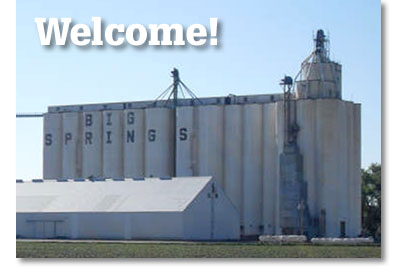
Photo by Kristen Osborn Cart

BIG SPRINGS–Work on the 320,000-bushel storage elevator is about completed here, giving the Farmers Cooperative Elevator Association of Denver, Colo., a plant with 20 bins, 130-feet high. The elevator with headhouse is 165 feet high. The building is concrete.

Farmers’ Elevator Guide, September 1951

Note:  It isn’t known at the time of this posting which construction company did the project.

Tillotson Construction completes Big Springs sorghum plant

Photo courtesy of Farmers Elevator Coop Association

BIG SPRINGS–The Tillotson Construction Co., Hastings, Neb., has completed a $40,000 building for the Farmers Cooperative Elevator sorghum plant.

Farmers’ Elevator Guide, August 1951

Note: A conversation today with Larry McCroden, long-time manager of the Big Springs Farmers Coop Elevator, reveals additional information about the facilities. Mr. McCroden consulted tax documents that showed “Elevator A” had a value of $184,432 and “Elevator B” had a value of $25,100. He said the twenty original bins of Elevator A stand about 115 feet tall, and the two-tiered headhouse reaches to 170 feet. The documents give January 15, 1951 as the date of service for the two.

Later additions were made to the original structure, increasing storage capacity by hundreds of thousands of bushels.

Mr. MrCroden said the elevator at Roggen, Colorado, bears many similarities to Big Springs.

Additional note: We don’t know why Hastings, Nebraska is given as the location of Tillotson Construction Co., which had its headquarters in Omaha.

Tillotson gets 50,000-bushel Paullina elevator under way

Paullina elevator complex, Dec. 9, 2009, by Jim Hamann

PAULLINA (IOWA)–A new concrete elevator is under construction to replace the Paullina Grain Co. elevator destroyed by fire. The new one will be 103 feet high, containing 18 bins. All new machinery, including a 50-ton scale, will be installed. Capacity will be 50,000 bushels.

Farmers’ Elevator Guide, June 1949

Government price supports, loan guarantees led to proliferating grain elevators

By Ronald Ahrens

I see why grain elevators proliferated like mad–like mice, actually–starting in 1949.

This happened before Ezra Taft Benson, the crusader against Socialism, became Secretary of Agriculture in 1953, so the trend can’t be attributed to Mormon food-hoarding instincts in the face of Doomsday.

Here’s the story: Section 417 of the Agricultural Act of 1949 made an extra $8 million in cheap loans available to farmers’ cooperatives through the Commodity Credit Corporation.

150

Ezra Taft Benson, Ag Chief

The United States Department of Agriculture figured the private sector wasn’t keeping pace in grain storage as farmers realized increasingly bountiful crop yields. The USDA stepped in to provide the incentive to build storage capacity. The government price supports had resulted in hundreds of millions of bushels going nowhere.

Washington’s policy of building “warehouse” capacity was of enormous benefit to established outfits like Tillotson Construction Company and J.H. Tillotson, Contractor. For the principals, like my grandfather, Reginald O. Tillotson, it became a matter of  dashing between farflung towns in order to make his sales pitch. And the CCC also breathed life into new organizations like Mayer-Osborn Company.

Given certain conditions, the loans–which were extended through the government’s Banks for Cooperatives–were  intended to cover up to eighty percent of construction costs, with the rest funded by local sources. The eighty percent would cover $100,000 of what looks like an  average cost of $125,000 around then, so we’re talking about eighty new elevators in a year’s time.

And that’s in addition to what supposedly would’ve been ordered in normal periods, although who would turn down a government subsidy and pay retail?

Indeed, I’ve already heard one story of a group forming, with maybe five businessmen kicking in $5000 each, to take up the government’s kind offer, not caring about the disposition of the grain after the three-year guarantee (on new storage) ended.

The CCC pledged it would use seventy-five percentof the additional capacity. And farmers were lining up to sell to the CCC. Indeed, build it and they will come. The more of the subsidized canisters that the government provided, the more that was needed.

United States Department of Agriculture buildi...

United States Department of Agriculture

“The possibility that 1950 will present another storage crisis is evidenced by the latest report of the Department of Agriculture, which shows that as of Nov. 1, farmers had put approximately 353,746,480 bushels of 1949-crop[s] … under CCC price support,” reported the Farmers’ Elevator Guide in December of 1949. “This was nearly 100,000,000 bushels more than with 1948-crop produce.”

Meanwhile, the government had frozen construction of commercial buildings other than hospitals, churches, and schools. So while the traditional construction companies were fighting over those slim pickins, the Tillotsons and Mayer-Osborn, with their specialized knowledge in shaping, reinforcing, and pouring concrete, dashed back and forth like bees, covering the land from Alberta to South Carolina.

They knocked together slip-forms and jacked their way up beyond 100 feet, grinning the whole way.

One of Tillotson’s biggest elevators under way in Dallas Center

Photo by Don McLaughlin on April 11, 2010. Click on the photo to visit his photostream.

DALLAS CENTER–Work has started on a 250,000-bushel concrete elevator for Dallas Center Farmers Cooperative Company. It will be 166 feet tall and is being built by Tillotson Construction Company at a cost of $151,000.

Located west of the firm’s south elevator, it is 56×70 in base dimensions.

Aeration equipment will be included in each of the ten 23,000-bushel bins, Manager Don Brown reports.

Farmers’ Elevator Guide, circa September 1955

Dallas Center

Photo by Pete Zarria, April 1, 2011. Click the image to visit his photostream.

See another recent images from Dallas Center: 

January 7, 2012

This map shows the incorporated and unincorpor...

Boxholm manager foresees timely completion of Tillotson’s new elevator

Photo uploaded to KCCI in 2009 by the station's u local contributor hmuench

Boxholm, Iowa–Manager Bud Lane reported that the new 200,000-bushel Farmers Cooperative Elevator Company’s concrete elevator will be completed on July 15. Tillotson Construction Co. of Omaha is the builder.

The structure will rise 150 feet with storage tanks standing 120 feet high.

The firm will have 256,000 bushels of space with the new unit.

Farmers’ Elevator Guide, 1954-1955 library volume 

♦ ♦ ♦

Note: The Boxholm Farmer’s elevator was founded in 1900, according to a 2004 article in the Dayton Review. On October 25, 2004, the elevator–now expanded–took in 145,422 bushels of grain, the new single-day record at this location. For the entire 2004 harvest season, more than 2 million bushes were taken in.

On November 16, 2009, two workers were injured when a grain dryer exploded at the Boxholm elevator. See the report from Des Moines station KCCI.

This map shows the incorporated and unincorpor...

Boxholm is in northwestern Boone County, Iowa.

Tillotson Construction hurries to meet deadline in Aurora, Nebraska

Photo by David Wilson

Contracts for new elevators at Aurora and Murphy were let by the Aurora Cooperative Elevator Co. The Aurora 250,000-bushel concrete elevator will be built by Tillotson Construction Co. of Omaha. The 33,000-bushel plant at Murphy will be erected by Black, Sivalls & Bryson, Kansas City, Mo., bolted steel tank construction company. The cooperative has a government contract to store grains for three years and the elevators must be completed by September 15 to meet terms of the contracts. The Murphy elevator will be in use by mid-July.

Farmers’ Elevator Guide, July 1950 

By January of 1955, it was reported that the co-op was operating a new, 271,000-bushel addition built by Tillotson, bringing overall capacity to 551,000 bushels.

Related articles

Farmers’ Elevator Guide reports Tillotson Construction’s record Montevideo project

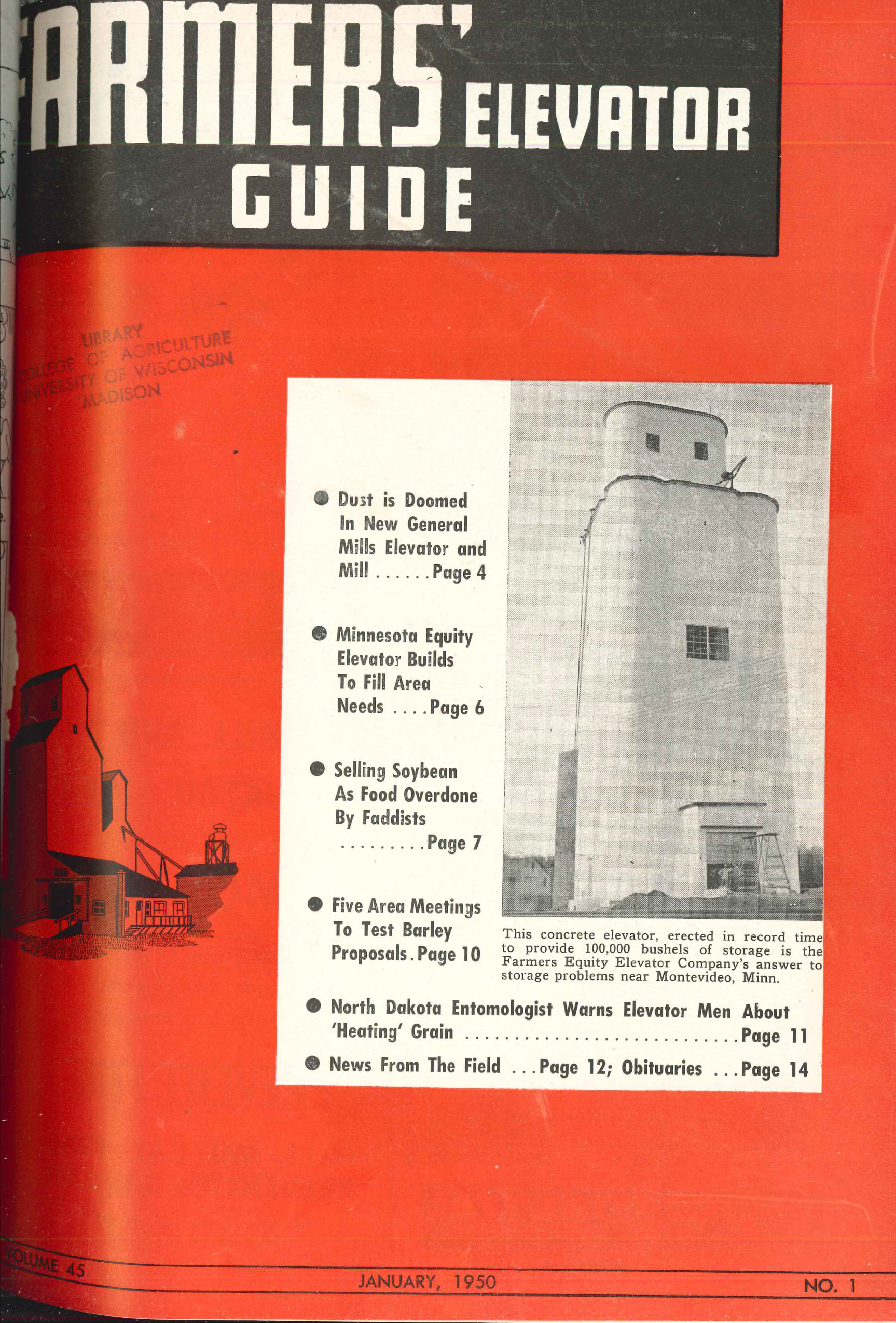
The following story and photos are reproduced from library copies of the January 1950 edition of Farmers’ Elevator Guide:

Complete Service: Minnesota Equity Elevator Builds to Fill Area Needs

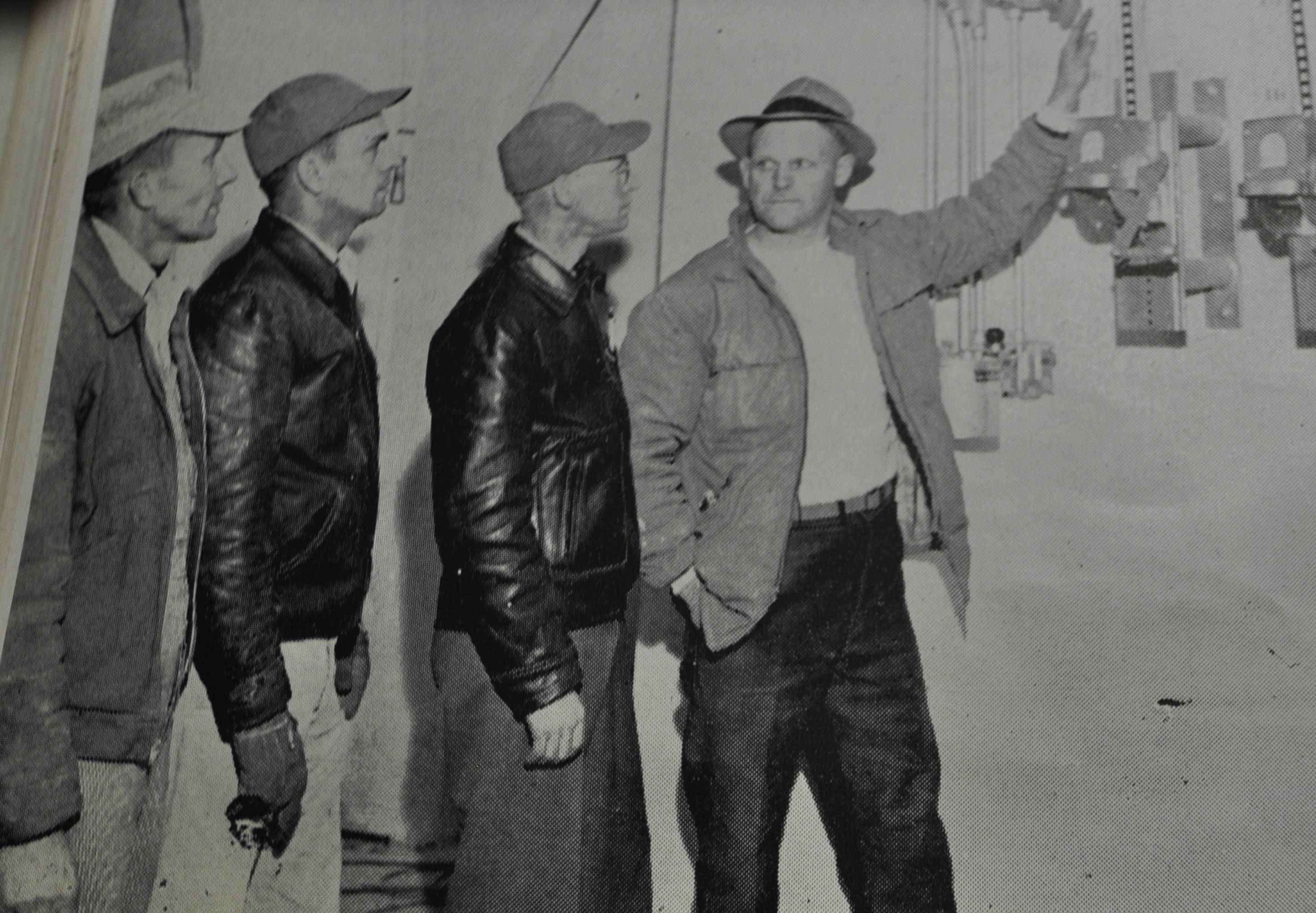
Tillotson Construction's Bill Russell, far right, instructs (from left) Stanley Kittleson, Adrian Dahl, and Merlynn Nelson on operation of the elevator's distributor controls.

Moving quickly to establish itself as the principal district elevator for grain handling, the Farmers Equity Elevator Co. of Montivideo, Minn., has a new 100,000-bushel capacity concrete elevator in full operation after a whirlwind effort to get it built to meet needs of the fall harvest.

When it became apparent that existing facilities in the area left room for a vast expansion to handle grain crops, the Farmers Equity Elevator Company decided to expand its plant which had only 25,000 bushels of capacity.

The project, begun late in August, was rushed to completion by Tillotson Construction Co. of Omaha, Neb, in record time. Concrete pouring by round-the-clock crews was completed in nine days and four hours. This bettered by 18 hours any previous accomplishment for an elevator of this size.

The structure is 102 feet high and has a cupola 29 feet high. It has 17 bins.

Installed during erection was a $15,000 corn drying plant and, on the midway level, a $10,000 grain cleaning installation. This included a large Crippin sieve machine, a large Superior cleaner, a Slurry grain treater and other equipment.

The new building houses a weighing and sampling room but the offices of the company are in the old quarters.

Sliding tubular forms were used to permit the rapid construction.

The plant cost $120,000 including $10,000 for piling costs, but other equipment raised the total to $134,000. Features include a 50-ton, 50-foot long scale with lighted dial and printomatic type registering beam. It has two concrete elevating legs each with 30 h.p. head drive and elevating capacity of 5,000 bushels per hour dumping into a Gerber distributing system. Its dump pit has two sections each built under the driveway and extending 12 feet below ground. All bins are hoppered to discharge into pit.

Two large cleaners installed are a Superior cylinder subterminal size machine for coarse grains and a Crippin screen cleaner for flax. All grains will be commercially cleaned before loading out to add profit to operations. The mills can be adjusted for farm seed cleaning in spring months. Gravity is used to feed mills from above and to distribute grain into bins below before loading to cars.

A 400-bushels-per-hour new type Campbell corn dryer was installed at a cost of $15,000. Some 50,000 bushels of the government loan 1949 corn crop were taken in and dried.

The new elevator was dedicated Dec. 29 with President J.W. Evans, also president of the American Soybean Association, presiding.

A Galveston seaside respite for the Osborns and Salroths in 1945

Kristen muses: Now Mr. and Mrs. Salroth were on this trip, and Mr. Salroth must have worked with my grandfather on the Tillotson Construction Company’s elevator job, the Fairmont Building, in Giddings, Texas.

The first image shows, from left to right, my grandmother Alice Christofferson Osborn, my dad Gerald Osborn, and Emma Salroth.

The second image shows, also from left to right, an unknown man, my dad Gerald Osborn, my grandfather William Osborn, and Iver Salroth.

Finally, there’s the portrait of Gerald by himself.

♦ ♦ ♦

In an email to Kristen, Gerald Osborn recalls:

Emma Salroth was your grandma’s first cousin. Emma and Iver had been pretty close to my parents. They occasionally spent an evening playing pinochle together.

Iver was a carpenter and was in Texas with dad working on the project. Along with your grandma, Emma and I took the train to Giddings for a visit.

When we arrived they had locked Iver in the elevator’s headhouse as a prank so he wouldn’t be there to meet us.

Iver was a scrawny little guy with a heavy Swedish accent and a good sense of humor. He was fourteen years older than my dad. I don’t know of any other job they worked on together.

In 1945, William Osborn worked on Tillotson Construction’s elevator in Giddings, Texas

Map of Texas highlighting Lee CountyThis elevator at Giddings, Texas, called the Fairmont Building, is the only one I have pictures for that my grandfather built when he worked for Tillotson Construction Company of Omaha. It would have been built in 1944 and 1945, when my dad turned eleven years old. Dad went to visit my grandpa William Osborn at Galveston in the spring of 1945 during this project. — Kristen

Note: Nutrena bought Fairmont Foods’ plant in Giddings in 1955.