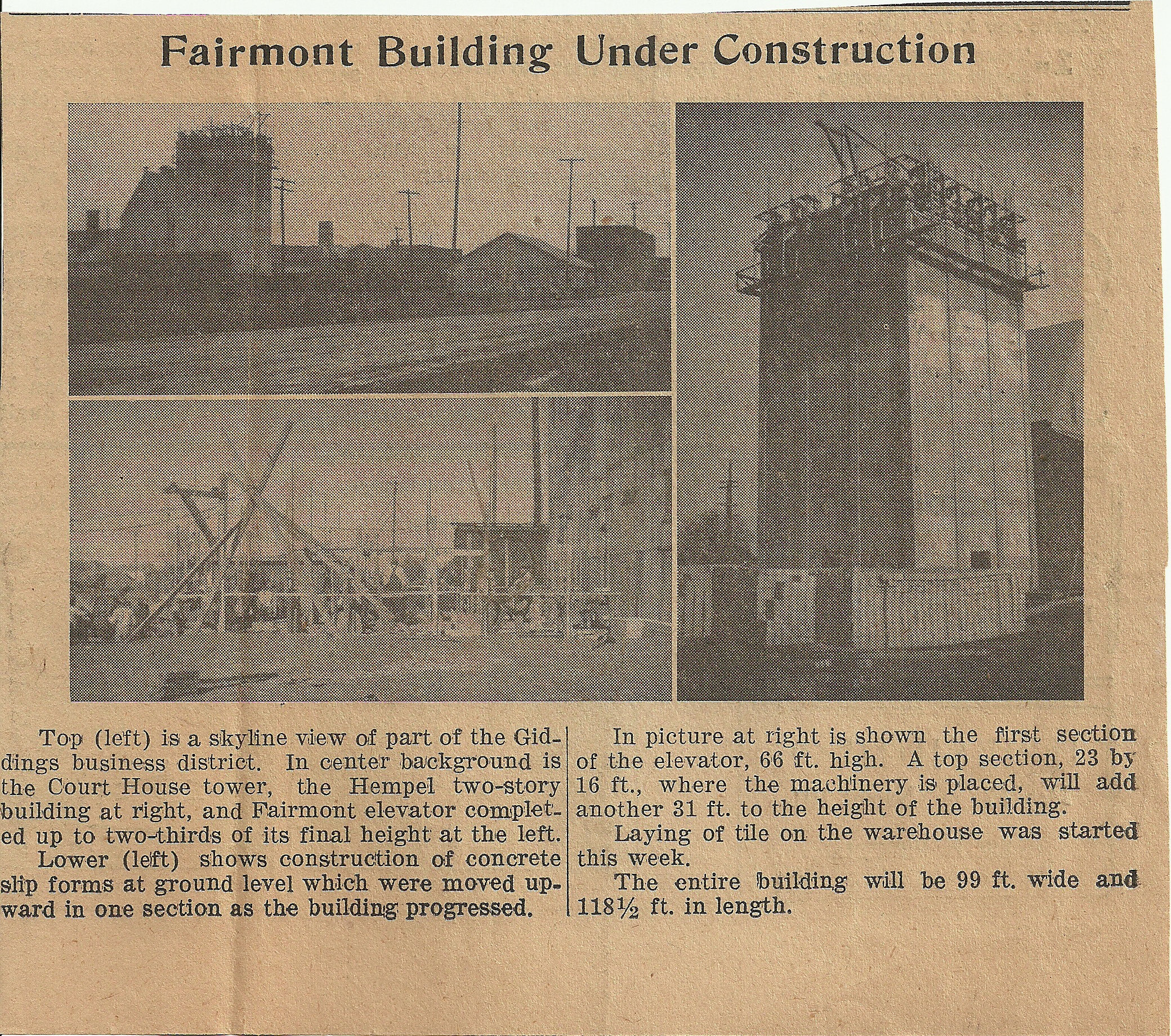
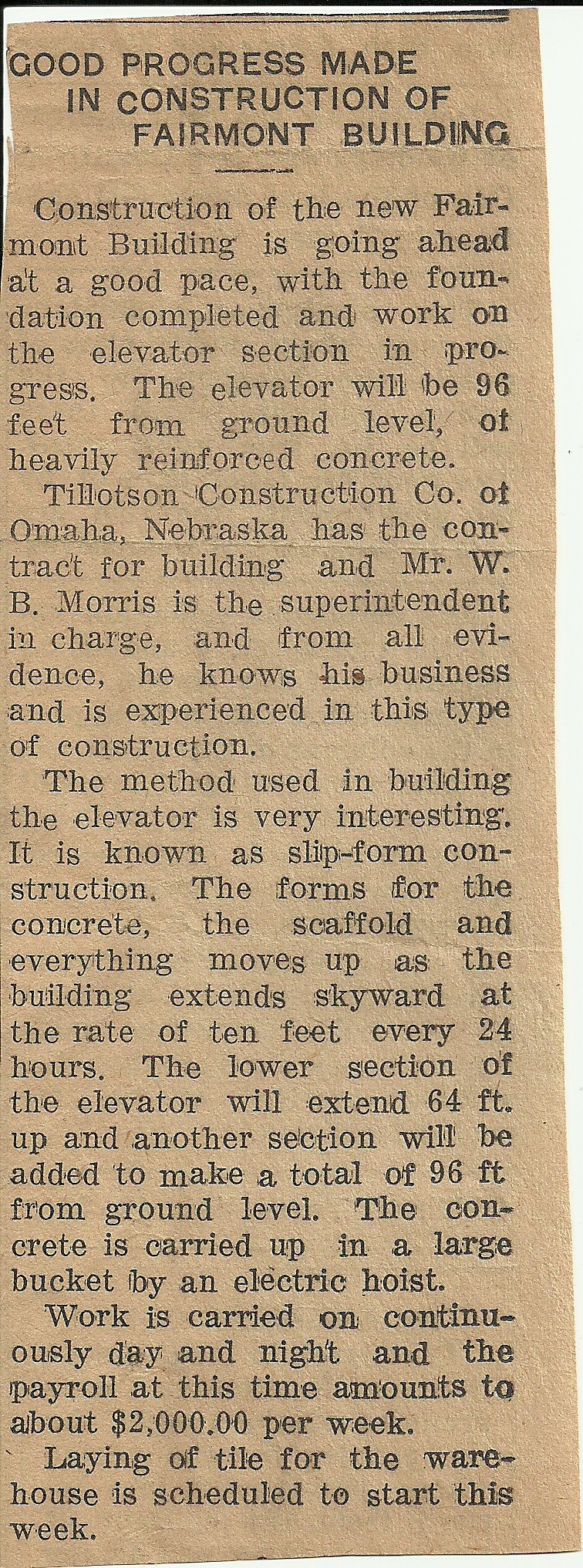
Open house to welcome Tillotson Construction’s large elevator at Rock Valley


Photo by Rock Valley city administrator Tom Van Maanen

Rock Valley, Iowa–In June 1950, Farmers’ Elevator Guide reported a 270,000-bushel, $125,000 concrete grain storage elevator was being put up by Farmers Elevator Company.

In November the same publication reported an October 7 open house at the facility. Final cost and capacity were $150,000 and 310,000 bushels. This was “said to be the second largest in the northwest section of Iowa.”

Other key dimensions:

  • A footprint of 65 by 85 feet
  • Height: 160 feet
  • 34 bins ranging from 300 bushels to 28,000 in capacity

Features included a “cleaner room” and a grain dryer adjacent to the elevator.

Tillotson Construction Company, of Omaha, contracted the work.

Men wanted in Paullina, Iowa, by Tillotson Construction in 1949

Back Alley, Paullina, Iowa, by Jim Hamann

MEN WANTED for construction work on Concrete Grain Elevator, 90¢ per hour, 10 hours a day, 6 and 7 days a week. Time and ½ over 40 hours.

Tillotson Const Co. at Paullina, Ia.

The Alton, Iowa Democrat, Thursday, May 5, 1949

Editor’s note: In 2008, an explosion and fire injured a customer at the new elevator in Alton.

This map shows the incorporated and unincorpor...

Image via Wikipedia

Tillotson Construction wins Rock Valley contract, loses $870 judgment for employee’s injuries

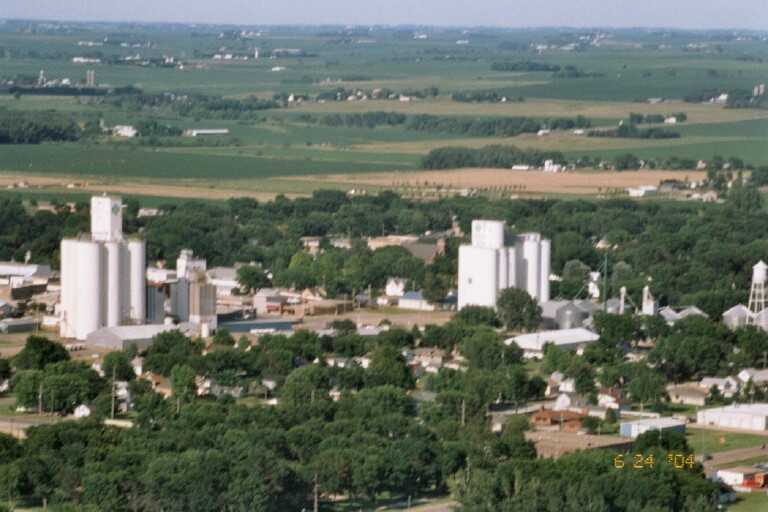
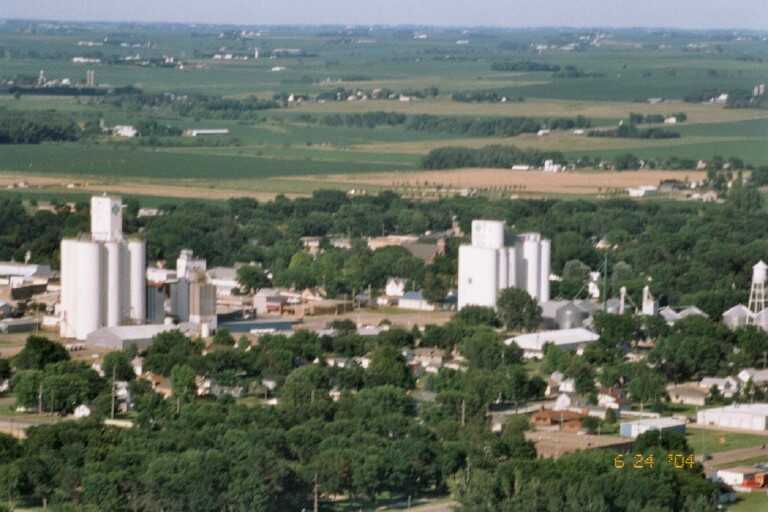
Photo by Rock Valley city administrator Tom Van Maanen

East Elevator To Be Sold At Public Auction Saturday

Directors of the Farmers Elevator company decided last week to sell the red (east) elevator structure to make way for the new concrete storage elevator. Included also will be a feed shed and the driveway office structure.

Various and sundry pieces of equipment are being offered for sale, either before or during the public auction, scheduled to be held this Saturday, starting at 2:00 p.m.

The elevator building to be sold has a 15,000 bushel capacity and Manager Owen Manning has pointed out that the driveway and office would make a good machine shed. The feed shed measures 30 by 48 feet. See the advertisement on another page for the list of machinery and equipment up for sale.

Manager Manning said that the contract for the new concrete storage building had been awarded to the Tillotson Construction company of Omaha and that work on the structure will begin on or about June 1. The building is due to be completed about September 15 and work may be far enough advanced to permit acceptance of grain for storage about September 1.

Rock Valley Bee, Thursday, April 27, 1950 

♦ ♦ ♦

Sioux County Courthouse News 

In the case of Winfield Kenneth Bagley vs Tillotson Construction Company & American Mu. Liability, the court approved the compromise settlement between the parties in which the defendants are to pays $870.00 to plaintiff for injuries he received to his foot, while employed at Rock Valley, Iowa by the Tillotson Construction Co.

Sioux Center News, Thursday, August 16, 1951 


Tillotson Construction’s Ralston, Iowa, project ‘progressing nicely’ in 1939

Ralston, Iowa–The work on the new annex at the Farmers Elevator is progressing nicely. The Tillotson Construction Company of Omaha will soon have it ready to store grain.

Carroll (Iowa) Daily Herald, Wednesday, September 13, 1939

Note: The New York Times visited Ralston in 2006 for a story about inadequate storage capacity in the face of madly expanding corn production.

Tillotson Construction builds new elevator in Glidden, Iowa

Glidden—The Tillotson construction company, Omaha, started work Saturday on a new reinforced concrete elevator for the Farmers Co-Operative elevator at Glidden.

Carroll (Iowa) Daily Times Herald, Monday, April 11, 1949

Glidden—As part of an expansion program at the Glidden Farmers Co-operative company, work begun April 13 on a reinforced concrete elevator with a 100,000 bushel capacity is progressing rapidly toward completion.

About 20 feet higher than the present buildings, the new elevator will be situated east of them. With the additional storage space the company, for several years the largest co-operative elevator owned and operated in Iowa, will be able to take care of a large amount of corn and beans grown extensively in the Glidden area.

The 100-ft.-high main storage part of the new elevator is up, and bin bottoms are being covered with concrete and hopper fill.

Approximately 35 men are working 10 hours a day on construction of the new elevator, which is under the direction of the Tillotson Construction company of Omaha.

It is expected to be completed by July or August.

Carroll (Iowa) Daily Times Herald, Wednesday, June 22, 1949 


Tillotson Construction’s elevator at Dalton, Nebraska, shows unique features

Gary Rich contributed these photos from Dalton, Nebraska, along with the following analysis:

Tillotson Construction’s elevators were unique, with some features that I have not seen from other elevator builders. One major feature was the curved head house. I have only seen one other company that produced an elevator with the curved headhouse. Another feature was that Tillotson put windows for light into the basement. Of course they had electric lights in the basement. I have not seen another builder put windows in the bottom part of the elevator. This must be a Tillotson trademark. This elevator has the year of construction added to the manhole covers. It shows 1958. Tillotson did a great thing by adding this. All the elevators that I have been inside, I have not seen another company put the year on the manhole covers. The date was on each manhole cover inside the elevator.

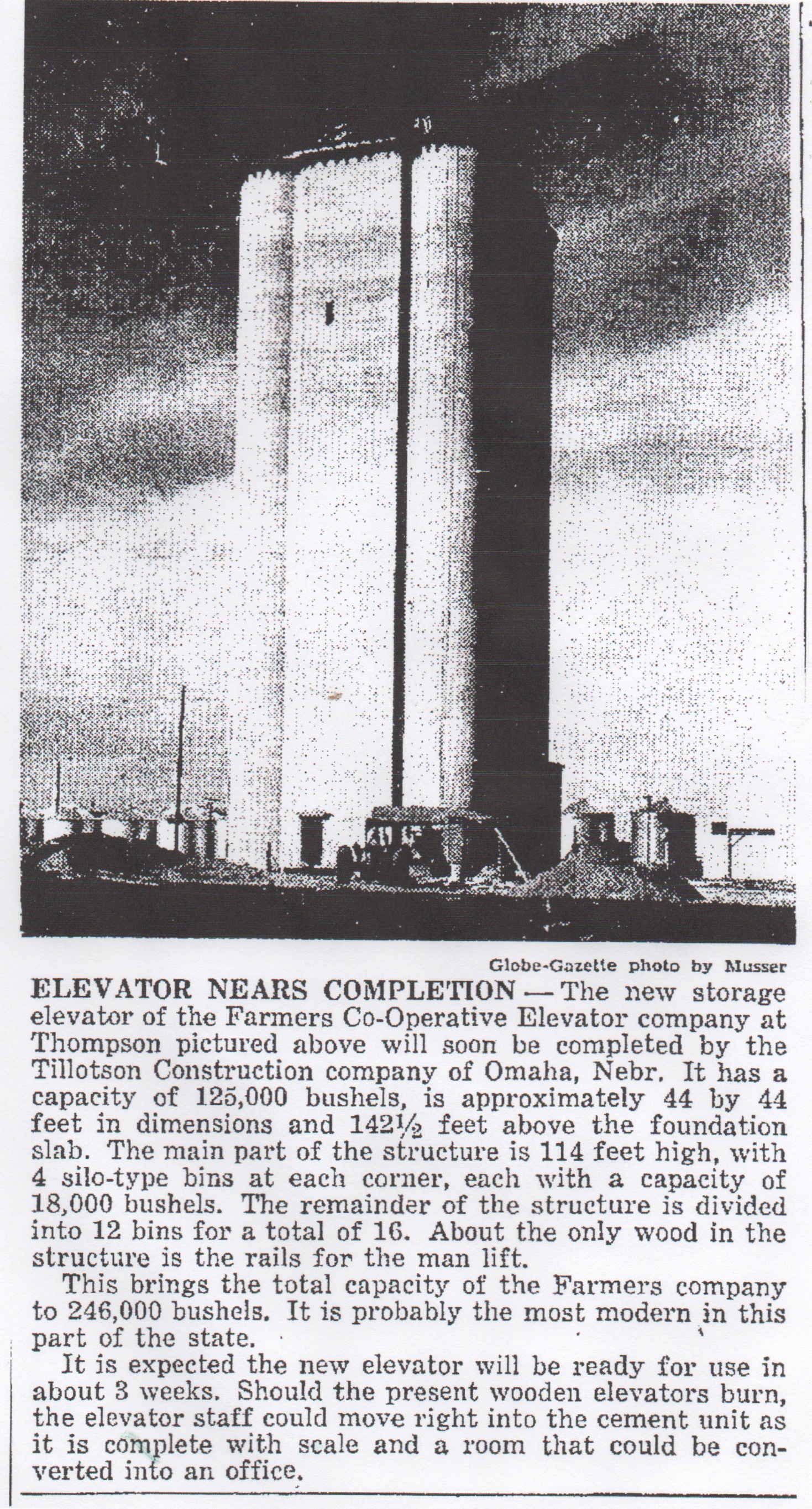
Thompson, Iowa, elevator completed in 1950, torn down in early 1980s

Work Underway on Storage Elevator

Thompson – Work has been started on a 125,000 bushel storage elevator for the local co-operative elevator company by the Tillotson Construction company of Omaha, Nebr.

Mason City (Iowa) Globe-Gazette, June 20, 1950

Mason City Globe-Gazette, September 2, 1950

♦ ♦ ♦

Our call to the Farmers Cooperative elevator in Thompson, Iowa, while preparing this post resulted in a conversation with location manager Lyle Wirtjes, who said he started working at the elevator in 1969. By then, Mr. Wirtjes said, one silo had already “busted out.” After another such incident, a new elevator was constructed across the road and the Tillotson elevator was torn down sometime in the early 1980s.

♦ ♦ ♦

Kristen’s analysis:

This Thompson elevator should not have failed—look at Greenwood, still here after all these years. I would guess there were some corrupt people in the building trades pulling off a scam, and since so many projects were going at once, a few poorly done elevators slipped through. They all looked like carbon copies of one another, so unless soil, water table problems, or fire caused the break, crooked subcontractors could have caused it. Not an uncommon problem when the federal cash spigot is turned on full blast—everyone shows up to the party, whether good or not.  My speculation here.  Nineteen years is not much of a lifetime for an elevator, barring a fire.


Painting a concrete grain elevator in Lincoln, Nebraska

Merle Ahrens, uncle of Ronald Ahrens, has written an account of his summer of 1955, which was spent on a scaffold with another of Ronald’s uncles, Michael Tillotson, youngest son of Reginald and Margaret Tillotson:

After graduating from Omaha North High School in 1955, I went to work for Tillitoson Construction on a grain elevator in Lincoln, Nebraska, with Michael Tillotson. I was paid $1.25 an hour.

Merle at home

Merle Ahrens in 2011, at home in Titusville, Fla.

I remember the first day on the job we had to go to the top of the grain storage tank—at least 100 feet—on a bucket that was used to haul up concrete. The bucket was connected to the swinging boom at the top by a wire cable. The cable went to a stationary, manually operated, rotating spool, which wound up the cable to lift the bucket. The operator let it free-fall down, seeing how close to the ground the bucket and riders could get before hitting the brake. It was a scary ride with four or five other workers standing on the rim of the bucket, especially the free fall down. Thankfully, it didn’t take long to get used to.

At the top, there were no rails around the edges nor any safety provisions like you see today, just one jack rod sticking out of the surface to hold on to as you got on and off of the bucket. The first day, I spent a lot of time holding onto that rod looking over the side.

When Michael and I started work, all the concrete pouring was complete and we were given the task of painting the outside of the whole elevator. We painted it using a lime-base whitewash. We had to crawl over the edge of the top of the tank onto a flying scaffold. The scaffold was held up by a pair of rope block-and-tackles connected to a pair of wood beams that were extended about two feet over the edge of the tank. The wood beams extended about ten feet inboard and were weighed down with sandbags to keep the scaffold from falling. The scaffold was made up of a pair of two-by-twelve boards with a metal frame at each end and two-by-four railings around it. The rope block and tackles were attached to the scaffold on the ground. We had to pull the scaffold up to the top every time for each ten-foot width we painted. There was an old man on the ground who mixed the paint and pulled it up to us in a five gallon bucket. He had a harder job than we had. All we had to do was brush on the paint and pull the rope to release the half hitch that held up the scaffold and let gravity work to lower it. The “flying” part of flying scaffold was when the wind was blowing. You would fly halfway around the tank.

Every night we would take off our Levi’s and stand them in a corner. There was so much paint on them! Yet one pair lasted all summer.

After a couple of months we finished painting the elevator in Lincoln and went to David City to paint another grain elevator. This time we used a new latex paint. It was very slow-drying and the wind kicked up a lot of dust. The elevator ended up white with grey stripes.

We kept hearing of accidents at other sites. One man was said to have fallen from a plank used to walk between the top of two tanks. He was wearing new boots and slipped. Another was killed when roofers removed the sandbags holding the beam for the flying scaffold so they could hot-tar the roof. A couple more were hurt while riding on a bucket and the clamps holding the cable slipped. The clamps were installed wrong. I do know for a fact that one worker at Lincoln was hit in the face when a five-gallon bucket with concrete in it fell while he was using a rope and pulley to lift it overhead.

At the end of the summer, Michael went back to North High, and I went to work for the Union Pacific Railroad.

Merle Ahrens

January 9, 2012

Events leading to Mary V. Tillotson’s death recounted by her niece

In 1989, Ronald Ahrens, partner in this blog, asked his mother, Mary Catherine Tillotson Ahrens, to write an account of the death of her aunt, Mary V. Tillotson, who was Reginald’s partner in Tillotson Construction Company. Mary Catherine’s account follows:

Mary V. Tillotson holds five-month-old Ronald Ahrens early in 1956.

She attempted suicide once by swallowing Lysol & lived & about lost her larnix. She was in the hospital a long time & we were all so discusted with her. That was before we [Ronald’s parents] bought her house [3212 Paxton Boulevard, Omaha] on land contract, $500 down. Then she moved to a home. When the black started moving in we put up the sell sign & she was sooo mad at us—she wouldn’t hardly speak to us after that. Julie was due born in June ’63 & I think Mary died in Ap or May. She was found behind bath door dead—I never did hear why (or was never told I should say) I asked Gram—she didn’t know. She left $67,000 to Catholic church. We all got $2000. That’s what we bought the house on Grant with plus $2000—we made off her house. I’ve never forgiven her for the $67,000—HA. She missed Dad a lot when he died. He was all she really had. I think Dad left us 2000 to. She (Mary) had taken life ins policies out for you & Katie. Katie put herself through school with hers. What did you do with yours? The other kids got left out!