Country elevators in Orienta, Okla., present a Tillotson annex and a puzzle

IMG_9255

By Ronald Ahrens

Tillotson Construction Co. built at a dozen and a half locations in Oklahoma, and I was now trying to see several of then in an afternoon before staying overnight in Enid.

Texas-Okla Logo 04After my impromptu visit to Shattuck, I drove east on U.S. 60 for another hour or so until I reached Orienta. The wind, which must have been blowing 40 mph, was behind me.

Arriving at Orienta, I found an elevator complex at the highway junction with but very little in the way of a town. One of the steel buildings at the complex was labeled W.B. Johnston Grain Co. 

In 2014, Johnston, which must have come after the Orienta Co-op Association, sold its 19 country grain elevators to CGB Enterprises, Inc. I had just come from CGB’s location in Shattuck.

IMG_9251

The south elevator and Tillotson’s storage annex at Orienta, Okla.

Orienta optimistically took its name from the Kansas City, Mexico, and Orient railway, which was called The Orient railroad.

I knew Tillotson had built here in 1954 but was disappointed to find it was only a storage annex. (As usual, I hadn’t studied the construction record too thoroughly beforehand.)

There were two elevators, each with an annex.

The south elevator was put up by Johnson Elevator Construction Co. This house is about as unprepossessing as they come: silos compressed in a small area and a pretty average-looking rectangular headhouse.

IMG_9266

Tillotson’s manhole cover.

Attached to it is Tillotson’s annex of 10 tanks, or silos, of 20 feet in diameter. They are 114 feet 9 inches tall. Capacity was 312,000 bushels.

I had to accustom myself to the notion that Tillotson would build storage silos alone. After all of our grand talk about curved headhouses and a singular style, this job was generic. There’s no glory in annexes, but there was money.

And I find that Tillotson built eight storage annexes in 1954. They were in Iowa, Kansas, Texas, Nebraska, and Oklahoma. Company records for that year list 16 jobs in all, so storage was half of the business.

The annex is holding up much better than the main house. Johnson used a coarse aggregate for its concrete, which is crumbling in some key places. It would be interesting to know when this job was done and the circumstances behind it.

The north elevator has an elegant stepped headhouse with plenty of curves. Some faded lettering can still be read: “Orienta Co-op Ass’n.” (For grammarians among us, that’s nice use of the apostrophe to represent missing letters!) I found Johnson-Sampson on the manhole cover. Kristen and I believe that design philosophy trickled down to this company from Mayer-Osborn.

IMG_9273

On the south face of the crumbling Johnson elevator, visible above the Tillotson annex, the same slogan appears in a burnt sienna color.

I’m seeking more information about this complex and will provide an update when more news is revealed.


In SoCal, an elevator’s tall headhouse reminds us of Vinton Street in Omaha

unnamed-1

I’ve meant for a long time to stop at the grain elevator along Interstate 10 in Colton, California, and finally I did.

The elevator, which appears to date from the 1960s, has an elongated headhouse and reminds me in a way of our Vinton Street elevator in Omaha.

The Colton operation is one of 40 sites run by Ardent Mills, which is based in Denver. The elevator stands along the Union Pacific tracks between Riverside and Ontario. No one was to be seen late on a Sunday afternoon, but there was probably milling activity going on in another building: machinery hummed away. 

The elevator’s silos are multi-sided, which is different from anything Tillotson Construction Co. built. Could it be that the walls have greater bearing pressure with such a configuration?

IMG_4560

The headhouse is stepped and thrusts toward the sky above the Inland Empire. It would be good to know how long the leg is and why such a rise was necessary.

I tried to look from every angle and even climbed up to the top of a rail car for a picture without hurting myself.

More information about this handsome elevator will be shared as it’s revealed.


The Atlanta, Kan., elevator suggests our grandfathers’ signature designs


AtlantaKansas

Photo by Brad Perry

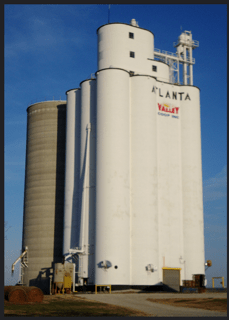
Editor’s note: Contributor Brad Perry sent this photo of Valley Coop’s elevator in Atlanta, Kan. The rounded, stepped headhouse suggests Tillotson and Mayer-Osborn design influences. A call to the elevator put us in touch with Katherine Grow, who runs it with her husband Darren.

“I think it’s a Johnson house. I remember when they built it. All the men in the community helped when they started pouring. Markle was the head of the crew that did it. I think it was ’58 or ’59 when it was constructed. In fact, it’s better designed than a lot of places. We added an outside leg. We used to load out on the rail but don’t any more. We’ve done maintenance and made safety updates. We’ve had it painted once. We were told it is the kind of concrete that has to be kept painted. It’s easy to work with, the way it’s put together with the inside leg. We’ve been pleased with it. I was a teenager or preteen when they built it. Once started, they kept pouring. With the lights at night, it reminded you of when you see a riverboat all lit up going down the river. It was cool. When we built this other bin and they could do it in sections, it was kind of different. They just pour so much and go round and round with a little cart, and come night, why, they’d quit and go home.”

A long-time elevator man sends greetings from Hardy, Iowa, and shares some lore

GilmoreCity01

Story and photos by Larry Larsen

In response to a recent post about Odebolt, Iowa, we heard from Larry Larsen, who works for Gold Eagle Cooperative’s facility in Hardy, Iowa. Larry says Tillotson Construction Company’s elevator, built there in 1956, is “still operating and used daily!”

GilmoreCity08Larry graduated from high school in Gilmore City, Iowa. His father managed an elevator from 1958 to 2008, and Larry remembers high school summers spent cleaning out and painting silos.

After getting in touch with us, Larry took an excursion and delivered some photos of the Gilmore City elevator. It was built in 1949, a year when Tillotson also built elevators in Dalhart, Tex., Hooker, Okla., Hordville, Neb., West Bend, Iowa, and Montevideo, Minn., among other places.

Larry, who served 25 years in the United States Army, shared these additional reminiscences:

“I know a lot of the facilities in my old stomping grounds are [built by] Todd & Sargent. The facilities built in the 1980s and 1990s were done by Lambert & Hamlin.

“Interesting thing–I found out through my dad in early 2000s that Lambert & Hamlin built or started to build two concrete tanks in the town of Rutland, Iowa, and about halfway into that project they went bankrupt, causing Pro Cooperative to find a contractor mid-pour to finish the project.

GilmoreCity06“Pro Cooperative then became receiver of Lambert & Hamlin’s property in Sioux City.

“A lot of interesting history in many of the small towns all around the Midwest with the construction of elevators. Some communities had their population double when crews came to town.

“Reading the blogs, there was also a lot of tragedy involved, with people falling off the partially completed structures. I remember, in the early ’80s, Lambert & Hamlin was doing a slip in the tiny town of Pioneer, Iowa.

“They had a laborer who was smoking pot as he was tying rebar on the night shift. Said individual stopped tying rebar to light a joint, lost his balance, and fell 80 or so feet to his death.

“Slipping never paused for that.”

GilmoreCity04

How an Iowa grain business flourished without a concrete elevator and silos

Story and photos by Kristen Cart

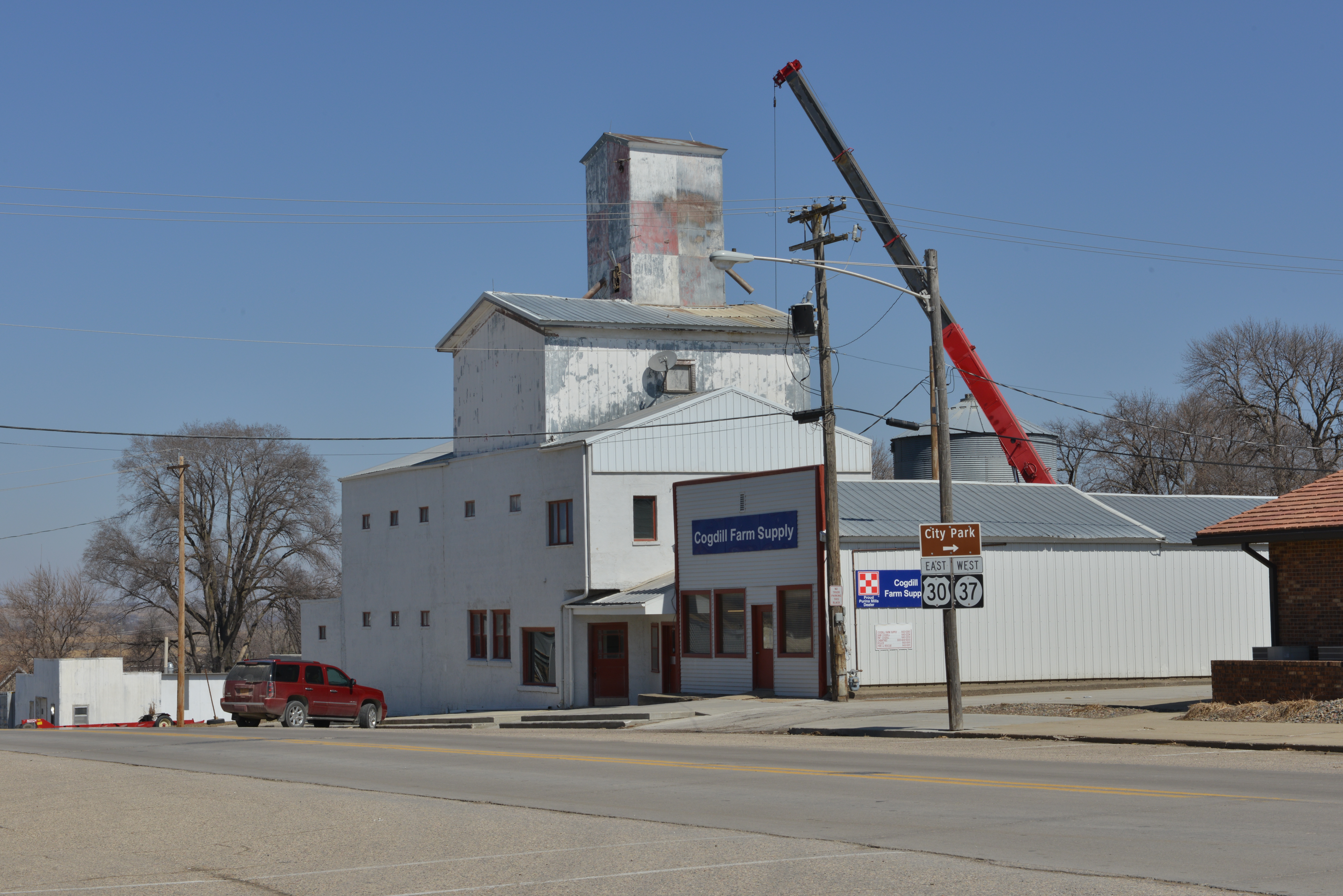
Cogdill Farm Supply Inc. is a family business, founded in 1979. It flourished as the grain business underwent big changes. Gone were the days of government-subsidized concrete grain elevators, but this operation, one step at a time, went from a small feed and grain business, operating a terminal-style wooden elevator, to a full-service farm supply company sprawling across several towns in western Iowa. The business skipped the concrete-elevator stage as it grew without price supports, relying instead on good business practices and a growing economy.

DSC_5821

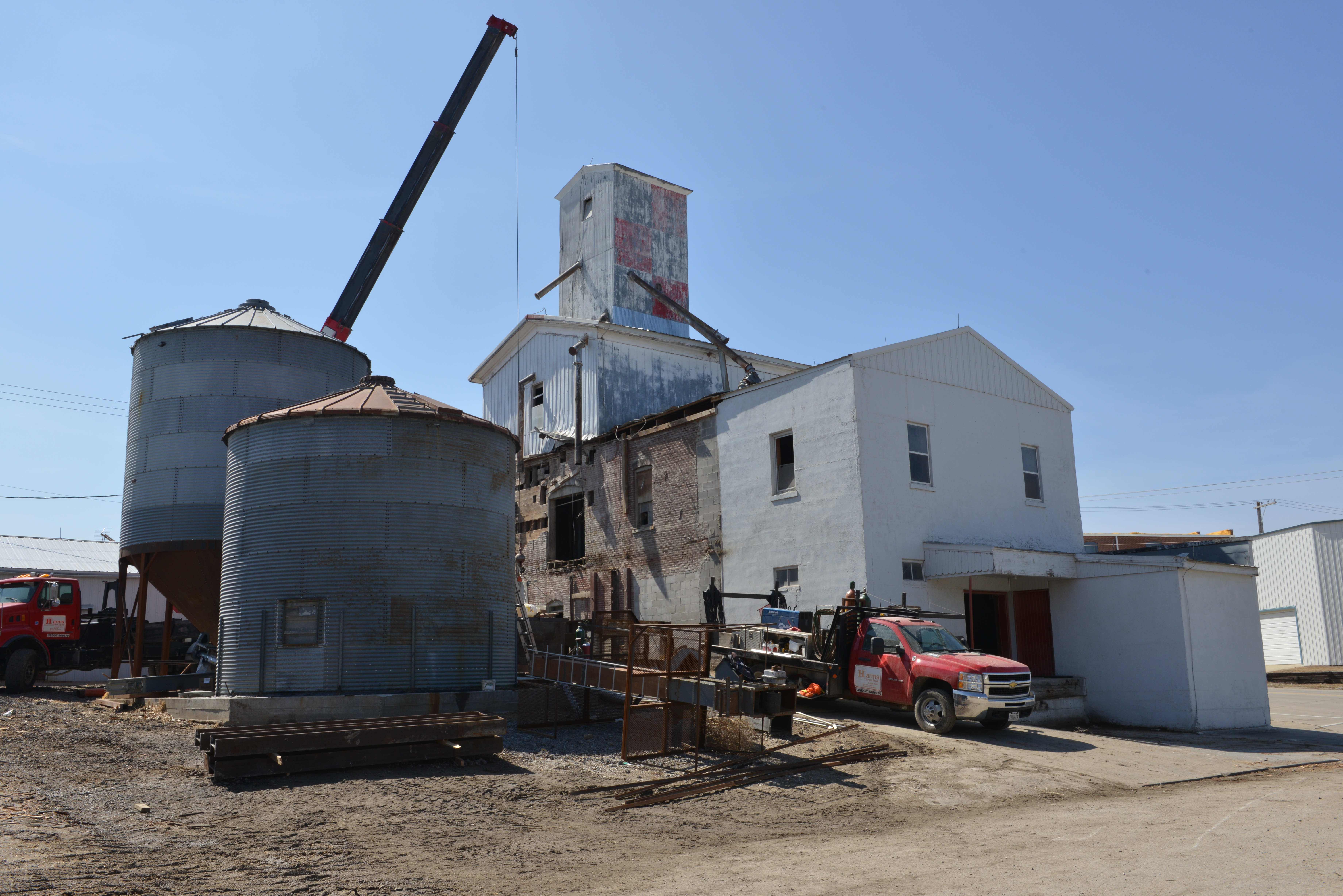
Brand new shiny bins (not shown) stood by to replace the old wooden ones at the mill in Dunlap. The shed roof was gone, exposing the wall for the first time in generations.

The company showed no signs of slowing down as it modernized. When I visited over a year ago, new bins were going in at the Dunlap feed mill.

As I photographed the mill, Rob Cogdill came down and greeted me. He said that temporary feed facilities were set up as the old shed roof came down (animals don’t quit eating for a day while the mill is down for repairs). Steel bins stood by across the street, waiting for installation. He told me that the side of the mill, now bared, had not seen daylight for a hundred years.

DSC_5736

Cogdill feed mill in Logan, Iowa.

The Cogdill feed mill facility in Logan, Iowa, another town along U.S. 30, was idle and slated to come down, according to Rob Cogdill. It was another step to be taken to streamline and modernize the business.

DSC_5811

Old Cogdill elevator in Dunlap, Iowa.

Rob also told me about his plans to replace the older wooden elevators as they became obsolete. He pointed out the elevator in Dunlap and said he hated to operate the thing any more—it had become difficult to keep in working condition. He had spent his youth in that elevator, and he said it was close to time for it to go.

It is easy to appreciate the aesthetic beauty of these old buildings, but when their service life ends, they cannot be saved and must be replaced. However, it is not only the beauty that makes them hard to destroy—sometimes, their history keeps them in service well beyond their heyday. “The crookedest elevator in Iowa,” in Dow City was one such case. That elevator represented the beginnings of Cogdill Farm Supply Inc. I went on down the road to see it, and while there, I met the founder of the company.

DSC_5830

“The crookedest elevator in Iowa” still had its Purina logo, visible from the rail line, in Dow City, Iowa.

Pat Cogdill, Rob’s father, gave me the run of the site to take pictures. Afterward, he gave each of my kids a soda and told me about the old elevator. Clearly, there was a sentimental attachment.

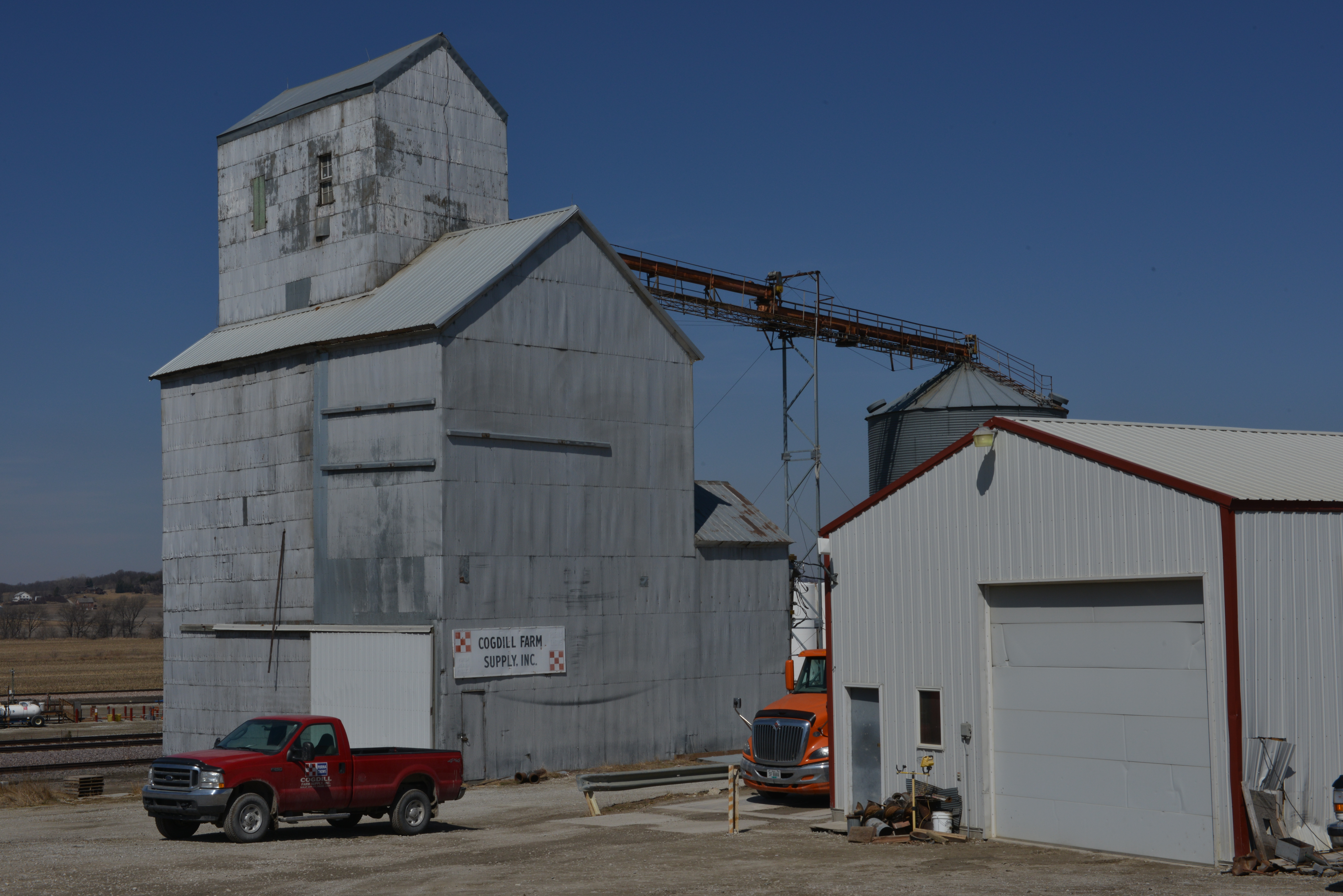
The Cogdill operation took over the old wooden elevators in Dow City, which were built in 1946 and 1953. The larger one had two rows of bins. Conveyors were installed above and below—an arrangement which allowed a custom mix of grain for each individual customer. Pat said it was a “terminal elevator. It can mix anything.”

He said, “It’s the crookedest elevator in Iowa,” describing how the marshy soil allowed one corner to sink during construction.

When I asked if it would be replaced any time soon, Pat said, “This elevator paid for all of this,” indicating the whole operation with a wave of his arm. “It will provide the boards for my coffin.”

dsc_5949

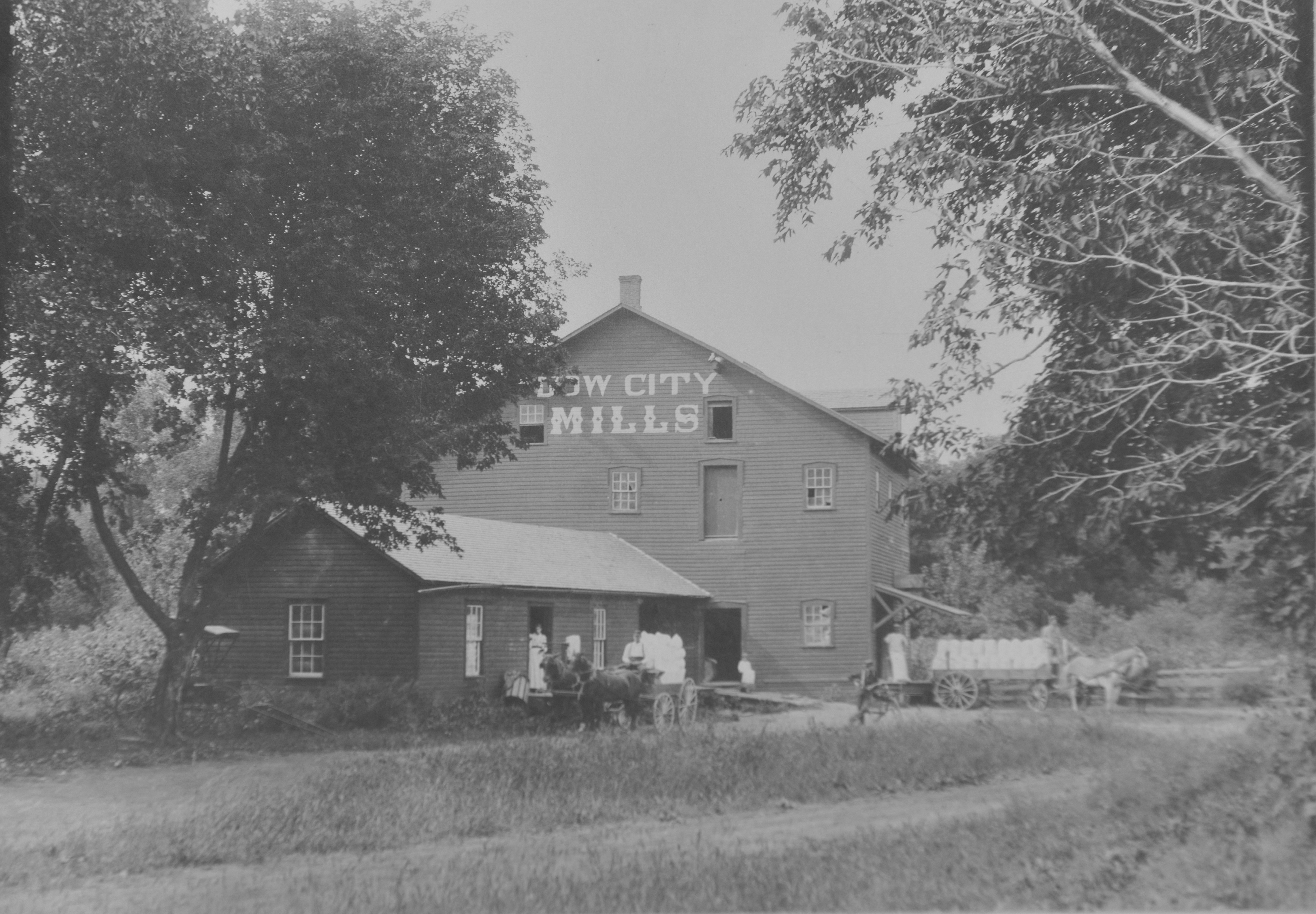
Dow City Mills from an early day, courtesy Pat Cogdill.


How ‘the crookedest elevator in Iowa’ was built

DSC_0416Story and photos by Kristen Cart

It was a terminal elevator, a family operation, capable of supplying a custom mix of feed fine-tuned to the individual farmer’s requirements. It sat along a rail line that ran through Dow City, Iowa, along U.S. 30 in the western part of the state. And it had been crooked as long as it existed.

There were two different explanations offered for its seemingly casual slouch. The first was intended for credulous tourists, and the last was a more scientific tale. But I liked the first story better.

You see, when the wooden elevator was built, the crew employed for nailing the boards was instructed to rotate around the structure as they built it. That way, the fellows who hammered harder would work their way around the elevator, keeping it even. That precaution had been neglected. The slackers on one side of the elevator, by not pounding as hard, left the rising wall noticeably taller on their side than did the guys who could swing a hammer. Thus, the finished elevator gained a noticeable tilt.

dsc_5941I bought every word of it. I imagined the men smacking the boards tightly on one side, and their chagrin when they discovered what they had done. But alas, the truth was far less romantic.

According to the owner, the builders set the foundation in soggy ground left from years of servicing steam locomotives, and the elevator sagged into the bog as soon as it was built.

Humbug.

dsc_5929In the next post, I will explain how this pay-as-you-go family operation skipped the concrete elevator stage of business. The present effort to modernize must do so without the subsidies that characterized the concrete elevator boom.


Near Chelsea, Mich., an elevator introduces us to ‘blisters’

IMG_5902

IMG_5894Story and photos by Ronald Ahrens

In Michigan for some meetings and library research, I drove along the back road in Lima Township between the towns of Chelsea and Dexter and came upon an elevator.

IMG_5896Seeing me taking pictures, an employee asked if he could help me with anything. Identifying myself as a grain elevator buff, I received an invitation to come into the office. So I climbed up a steel ladder, entered a dock area, and passed through two doors leading into a warm office.

Photos on the wall showed the elevator when it must have been new in the mid-1950s. I’d noticed a “B” on the manhole cover, but the name of the builder was unknown. However, I was told that laborers from the state prison in Jackson worked on the construction.

Chelsea Grain LLC has operated the elevator a relatively short time. (It made news in 2013 after the local fire department responded to an incident involving a grain dryer.)

IMG_5899My other question concerned the apparent oval shape of the silos.

The answer: “Blisters.”

“Blisters?”

I dashed back to the car to fetch a business card. By the time I returned, a drawing had been prepared by way of answering.

Yet, this term begs for elaboration, which perhaps our readers can provide.

Meantime, thanks to Chelsea Grain for the hospitality.


A look at the Johnson-Sampson elevator in Grand Island, Nebraska

dsc_1517

Kristen Cart

Sometimes it is instructive to visit an elevator built by one of the competitors of the Tillotson Construction Company of Omaha, Neb., and its offshoots, J. H. Tillotson, Contractor, of Denver, Colo., and Mayer-Osborn Construction, also based in Denver. The elevator built by Johnson-Sampson in Grand Island, Neb. is a good example, for comparison, of a project built by the competition while our grandfathers were active in the business.

One of our readers, Teresa Toland, mentioned the elevator and hoped that we knew something about it, since her father, Darrell Greenlee, had supervised its construction. A couple of years passed before I could follow up on her query. While traveling this fall, I took a detour to see the elevator and take photos. The old grain elevator stands now as a prominent Grand Island landmark, still serving its original purpose. It’s location, just off I-80 in central Neb., made it easy to visit.

The elevator hummed with activity at the height of harvest. On this trip, my dad, Jerry Osborn, was along, so I did not take time to interview the employees–we were all tired after our hunting trip, and were ready to get home. But the elevator was a lovely sight and I was glad for the chance to see it.

dsc_1526The original elevator, flanked by two annexes, was obscured behind a large modern concrete bin, so I got closer for a better look. The headhouse was unlike any I had ever seen. The elevator’s design formed a harmonious whole, much like the attractive Tillotson elevators its builder emulated, but it had taken a different direction and had its own look. It must have been a handsome sight when it stood alone, brand new, and gleaming white–the tallest thing around.

The bin arrangement for the old elevator seemed conventional for storage in the 250,000-bushel class. Adjacent to the main house stood a large capacity metal grain dryer. Including the annexes, the elevator complex was the size of a moderate terminal–the type of storage that would serve as a transit point for a rail or trucking hub.

When Virgil Johnson, an early employee of Tillotson Construction, went out on his own, he built elevators in partnership with his Sampson in-laws for a few years. Darrell Greenlee, who supervised the construction at Grand Island, was one of his superintendents.


DN Tanks builder explains differences between concrete tanks and elevators

DSC_9897

A water tank built by D N Tanks in Cary, Illinois

Story and photos by Kristen Cart

At first glance, a water storage tank and a grain elevator seem to have a few things in common, both in function and appearance, though they present a number of differing engineering challenges. I had the opportunity to interview Joseph Carroll, a project superintendent for D N Tanks, while flying on a commercial airline to start one of my trips. When he realized the lady sitting next to him had some engineering background, and actually was interested in concrete construction methods, he warmed to his subject with enthusiasm.

I wanted to find out how the construction of a tank answered the problems that grain elevator designs had to address–the management of stress (both vertical and lateral), the aging of the tank, interior access, wrecking out, weather considerations, and basic construction methods.

D N Tanks had been in the business since 1949, and some of their tanks (still in service) were built before 1950. During the heyday of elevator building, when our grandfathers operated at the cutting edge of concrete design, water tank builders were innovating right alongside them. The types of problems they had to solve had common elements with those of elevator designers, but their solutions were widely divergent.

After looking at our Tillotson construction specifications, Mr. Carroll commented that the design bearing load (the pressure of the water against the tank walls, expressed in pounds per square inch) of his tanks is about double the bearing load in a grain elevator.  Elevator builders relied on a continuous concrete pour and steel reinforcement to provide the required strength. Obviously, something had to be done differently to build a water tank that would sustain that kind of load.

D N Tanks, instead, builds tank panels which are poured in curved sections separately, then tensioned externally with wire winding as they are assembled on site.

Cold weather also creates a design challenge for concrete construction. I mentioned that in Canada, wood construction for grain elevators was preferred, because rigid concrete could crack under differential heating–an elevator would experience freezing temperatures on one side and solar heating on the other. Water tanks require insulation to prevent freezing, though they can handle surface freezing to the depth of about six inches. The tank walls are built thicker, and an insulating material of styrofoam blankets the tank exterior for installations in Alaska and other northern locations.

After the concrete roof is poured, wrecking-out is required (internal wooden concrete forms are removed). It is a process required for both elevator bins and tanks. Elevators retain the manholes used to remove the wrecking-out debris for later access to bin bottoms for cleaning. For water tanks, an access opening is left at the side to permit this process, but it is sealed afterwards. No access is needed from the side, because under normal use, the tank remains filled with water. Access to electrical systems for the pumps is from the top.

Concrete elevators are subject to much more wear and tear than water tanks. Internal friction is an issue with grain elevators:  filling and emptying of grain bins abrades the inner concrete surfaces, eventually causing cracking and damage after many years.  Tanks suffer from no such problems.

Fire is an ever present danger in grain elevators, and cleanliness is a constant battle. Tanks tend to be cleaner and safer, and if built correctly from the start, will long outlast the most robust grain elevator.

DSC_9898I happened upon one of these water storage facilities, built by D N Tanks, while attending my son’s football game at Cary Junior High School in northern Illinois. It appeared just as Mr. Carroll described as a typical D N Tank project: it was bordered with a two-foot wide lip, and topped with a white vent.

The tanks are built in cities and towns to comply with a requirement for an emergency water supply. The tank or tanks must hold enough water to last for three days after normal municipal service is lost. Unlike the many grain elevators that dot the Midwest, which rise to monumental heights, these tanks are designed to blend seamlessly into the community with as little visual impact as possible. The D N Tank website pictures a number of disguises, including architectural treatments, and fully underground construction.

D N Tanks also produces tanks for glycol used for aircraft deicing, water treatment tanks, and various other tank types.