Book report, Part One: Cargill’s first elevators and the blind-horse phenomenon

By Ronald Ahrens

Good fortune has led to my acquiring a copy of Cargill: Trading the World’s Grain, by Wayne G. Broehl, Jr., published in 1992. I got a like-new copy on Amazon for (he goes to the closet to consult credit card records) $7.99—a screamin’ deal.

The massive, 1,007-page book is just part one of Prof. Broehl’s ambitious and masterful history of Cargill—the company let him look at everything, and the reader is left with a detailed account that’s also based on public sources as specific as records on local water wells.

Reading this behemoth will be like skinning a whale with a pocket knife, but as I progress you can look for periodic posts showing what I’ve learned.

Cargill 01In this volume Prof. Broehl starts with Will Cargill’s reaching his majority after the Civil War. As a young man, Cargill showed a disposition for trading grain. It led to a few elevators but also many “flathouses.” These single-story warehouses proliferated along the railroad tracks in northeastern Iowa and southern Minnesota, where Cargill got his start; they could hold a lot of grain but of course they were subject to fire.

Not only could a flathouse burn down in an instant, but other misfortunes could strike.

“This particular spring of 1874 produced a string of bad luck for Will Cargill; in May, his Albert Lea [Minn.] warehouse collapsed, spilling some 2000 bushels of grain,” the professor tells us.

If that had been the season’s lone calamity, Cargill would have gotten off easy. “It had hardly been cleaned up when reports reached Will that another warehouse, at Ridgeway, Iowa, had burned to the ground, ‘the only piece of property which he had neglected to insure…”

Near Austin, Minn., Cargill lost another flathouse “after a couple of years by overloading.” He built an 18,000-bushel elevator with an eight-horsepower steam engine providing the power.

Screen shot 2018-08-06 at 10.49.59 AM

Screen shot from the Northwestern Miller. Wikimedia Commons say, “The Northwestern Miller (1880–1973) was a periodical founded by the Miller Publishing Company of Minneapolis, Minnesota. A trade publication for the grain and flour industry, it also published short fiction.”

Yes, besides flathouses, we learn of “elevator[s] with power machinery for elevating grain, like the large Cresco [Iowa] operation of Beadle & Slee. “By this time, however, elevating mechanisms were more widespread, sometimes simple ‘cup and belt’ devices run by a horse led in a circle, a ‘blind horse’ elevator, so-called. An old-timer recounted how one elevator ‘had a whip attached above the horse, and there was a hole in the wall where the men … could holler down and the horse … and a string attached to the whip so they could pull and hit the horse.”

Seeking more information about blind-horse elevators I went online and found this passage from the Northwestern Miller as reported in Volume 47, published May 24, 1899:

“By some happy, or otherwise, chance, it was discovered that a blind horse will keep on in his circular path, never seeming to know that he isn’t going anywhere, nor can he tell when the man in charge is out of sight. The poor brute will follow his halter around his little circle from noon till night, thinking all the time that he is getting along in the world.

“This set the elevator men thinking with the result that the blind-horse market immediately began to pick up. Poor old blind nags in the Dakotas, Minnesota, and Iowa were surprised to find themselves in demand. Instead of being allowed to die peacefully in pastures and their bones to be forgotten, they were sought after with an eagerness that made them feel there was really some distinction in being blind. It was not unusual, a few years ago, for an elevator company to buy up a carload of blind horses in Iowa and ship them into Minnesota or the Dakotas. But that time has passed and the day of the blind horse is nearly over. Even now, in the odor of gasoline he can smell, if he can’t see, his finish.”

Blind horses happily acceded this odious role to power machinery. Steam engines producing up to 10 horsepower were used to drive the machinery, and they allowed for construction of larger elevators. In 1873—the year of a financial panic as well as a grasshopper plague—Cargill “decided to increase his operations along the McGregor Western tracks and contracted for a large elevator at Cresco. Its total cost eventually came to over $12,000.”

Anyone who wants to read along will find passages of the book online, thanks to Google Books.

A glimpse of Firth makes us go forth with speculations and an investigation

Firth, NE Cemetery 2012 II

By Ronald Ahrens

As with yesterday’s post, we’re working from a photo sent by Kim Cooper, a friend of this blog who happens to have grain elevators in his heritage, too. He likes to incorporate them into his superb, plein air landscape paintings.

Sometimes Cooper sends pictures.

“Here’s one from Firth, Nebraska,” he said. “Looks like a rounded top.”

Indeed, the rounded headhouse was the signature on Tillotson Construction Co.’s elevators after about 1950.

But other builders could have used this style. We see no mention of Firth in Tillotson’s records. We see Minatare (1941), Rushville (1947), Polk and Richland (1948), Hordville (1949), Bellwood (1950), Cedar Bluffs (1950), Aurora and Omaha and Wahoo (1950), Greenwood and David City and York (1951), Fairfield (1952), Bellwood (340,000 bushels of storage in 1954), and Waverly (1955).

That’s 15 locations. Tillotson built far more elevators in Iowa and Oklahoma than in the company’s home state of Nebraska. But 15 isn’t bad. Based on anecdotal information we also suspect a couple of other locations. 

But after calling up Dennis Kenning, we’ve ruled out Firth as an unrecorded job by Tillotson. Kenning is sales and marketing manager for Farmers Cooperative, which has headquarters in Dorchester, Neb. and dozens of elevators throughout southeastern Nebraska.

Kenning expressed curiosity, looked into the matter, and emailed his findings:

“Here’s what we found out,” he wrote.

  • Constructed sometime in the ’60s
  • Roberts Const Co.
  • Hutchinson Foundry & Steel
  • Sabetha, Kansas

We found Roberts Construction Co. located in Axtell but were unable to reach them. The question arises about Roberts’ design source–were there any Tillotson connections?

Even more views of Buffalo’s terminals and more grain-trade history, Part 3

By Ronald Ahrens

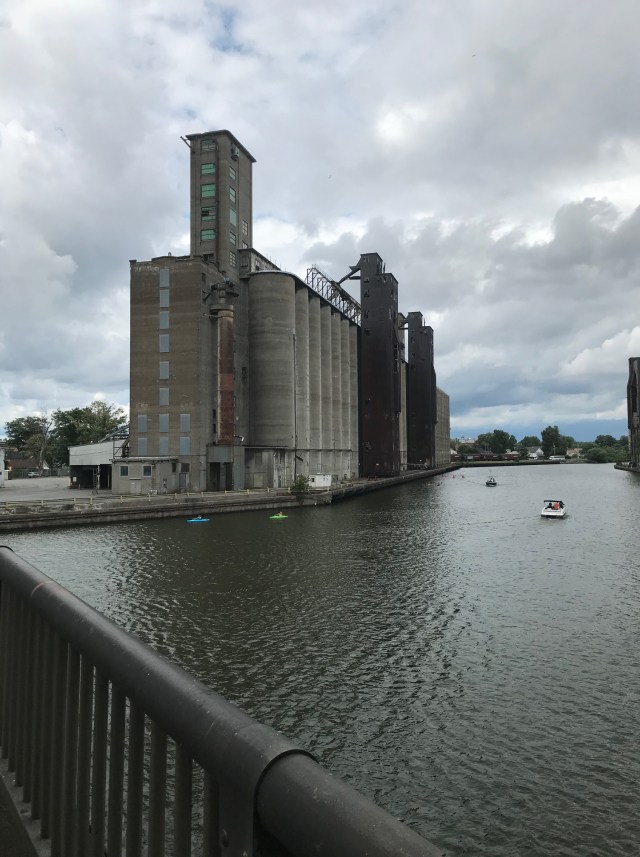
As seen in two previous posts, Kristen was in Buffalo the other day and took photos of the terminal elevators. Here’s the third in the series of three we’re doing with our own commentary as well as some lines from Cargill: Trading the World’s Grain, by Wayne G. Broehl, Jr. These lines show how central Buffalo was to the grain trade.

IMG_7105

“This place has an ADM sign on it but it was deserted over the weekend except for a flock of geese and one of pigeons,” Kristen reported. “It looks pretty worn down too.”

“Quite a headhouse,” I said. “Originally a Cargill elevator?”

* * *

June 7, 1932: “May people connected with Montreal shipping felt quite threatened by the new Albany deep-water port. So too did other communities along the water route to the St. Lawrence, particularly Buffalo.” — p. 536

IMG_7130

“The other side taken from the drawbridge,” Kristen said.

“I do not normally associate kayakers with grain elevators,” I said.

* * *

“Another frequently used routing for Canadian grain was through a Lake Erie port, typically Buffalo, where it might be milled into flour. If the flour was for United States consumption, a duty of 42 cents per bushel of wheat had to be paid. If it was for international sale it could be reloaded under ‘milling-in-transit’ privileges and escape duty.” — p. 541

IMG_7135

“Its neighbor across the water is just as big,” Kristen said. “It also looks quite old.”

“It could use some sprucing up, but that’s not our department,” I said. “Oh, and try this historical view

* * *

1941: “So Cargill too moved once more to increase its own storage capacity … The capacities at Buffalo had been vastly expanded–an addition to the Electric Elevator there increased this one terminal from 1.75 million to over 5.2 million bushels; with the Great Eastern and the Superior, the Company now had over 12.4 million bushels just at that one location.” — p. 582

In another oil painting, Kim Cooper shares his subtle vision of Nebraskaland

October Nebraska 16x20, oil on canvas Sold to Don and Lois Fick, Wahoo, NE

Today is the second of three straight days featuring oil paintings by Kim David Cooper. Here he shares with us a 16 x 20-inch oil depicting an elevator from … he can’t say for sure.

“I don’t even remember where it was from–possibly around Mead, Nebraska,” Cooper commented. “Didn’t write it down, and I’m getting forgetful!” 

In an email he called the work “October, Nebraska.” It was sold to collectors in Wahoo, Neb. (home of a Tillotson elevator).

Often when we see photography or landscape paintings by Nebraska artists we’re stunned by their ability to discern the subtleties (although nothing about a grain elevator is subtle).

This fine landscape hows just how beautiful Nebraskaland can be.

From Elkhorn, Neb., another of Kim Cooper’s wonders of oil on canvas

IMG_4818

Our friend Kim David Cooper has shared more of his work with Our Grandfathers’ Grain Elevators.

Cooper favors the plein air technique, which refers to scenes painted outdoors with the emphasis on spontaneity and seeking to capture the fleeting effects of light and atmosphere.

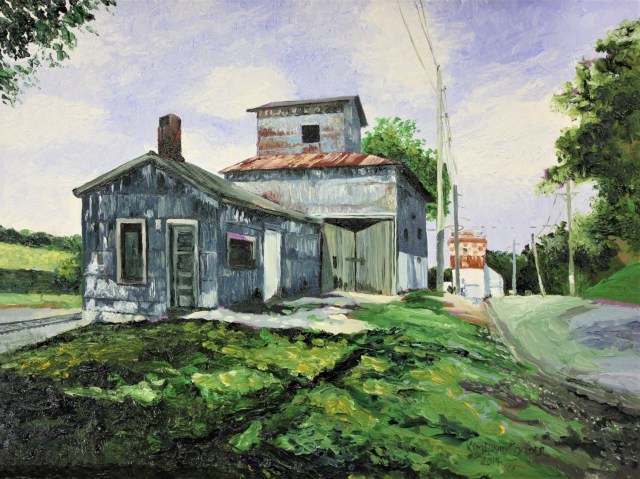
Here you see his vigorous brushwork and deft use of perspective, which makes the office portion of the building jump at the viewer.

Elevator 1“No cement here,” Cooper wrote in an email. “Painted on site, plein air. Buildings still there in Elkhorn, Neb.”

He also provides a photograph from the same point of view. We see how he captured the scene’s essence, adding life and spirit that simply isn’t found in the photo.

This 9 x 12-inch painting has already been sold. To inquire about commissions, call Cooper Studio & Gallery, located at 1526 Silver St. in Ashland, Neb. Phone: 402. 944.2022.  


How a fire 30 miles away threatened the historic mill in Downey, Idaho


Fire4

Preston conflagration photos from 2012 courtesy of Ryan Day.

By Ronald Ahrens

In Franklin County, Idaho, the towns of Downey and Preston are about 30 miles apart on U.S. 91. Downey is small, Preston is large. More than 5,000 people live in Preston. It’s the county seat.

As Ryan Day expresses it, “Downey is the black sheep of the family nobody wants to talk about.” 

Ryan, a follower of Our Grandfather’s Grain Elevators, runs the historic mill and elevator complex in Downey, which is a unit of Valley Wide Cooperative. Competing against the operation in Preston was tough. Preston had 24- and 36-inch rollers for barley, and a board member claimed no one could roll barley as well as they did. Preston flaked corn with the same proficiency that Sammy Cahn churned out timeless romantic songs. Preston could even apply molasses to the feed it produced.

This mill in the metropolis was fancy-schmancy.

“They were always the enemy,” Ryan says. 


Jene Day, who operated Downey for about 50 years, finally lured his son back in 2012 to become his successor. A month before Ryan’s first day on the job, the big mill in Preston caught fire and burned down.

“When I started, the building was still smoking,” he says.

The black cloud that had billowed over Preston had a silver lining, though.

“They had just merged with Valley Wide. Luckily, they were insured and able to build a new state-of-the-art mill.”

In 2014 The Capital Press–“The West’s Ag Weekly Since 1928”–celebrated the reconstituted mill’s opening and extolled its efficiency and convenience. The $3-million facility had everything producers and feeders could want: exotic mixes and the quick loading and unloading of trucks, for example.

Such a powerful allure caused a crisis of faith with some of the organic dairymen who had depended on Downey.

According to the the Capital Press, “Mike Geddes a local organic dairy owner [sic], said about a dozen regional organic dairies who now use a dilapidated mill in Downey have asked Valley Wide to process their feed.”

Dilapidated? A black eye for the black sheep!

Preston may be more efficient, but it’s just another unprepossessing steel building with some small steel bins. It lacks any visual distinction whatsoever. In fact, in the photos we’ve seen, it’s darn near invisible.

DSC_0049

Kristen Cart’s photo captures Downey’s Oz-like quality. L. Frank Baum’s Oz books were contemporaneous with much of Downey’s construction.

As stated in an earlier post, Downey’s buildings belong to Oz. The installation should be in our National Register of Historic Places. For that matter it should be registered in Oz, too.

Four years have passed since Preston re-opened. To find out if anything has been done about its going organic, I called up and spoke to feed manager Shaun Parkinson.

“The only reason that we’d do anything is if something happened to Downey,” he said.

In other words Downey has its niche and is in good hands with Ryan Day.

Nothing had better happen.


Shots rang out at the Downey, Idaho, elevator complex in 1964

By Ronald Ahrens

If you think this blog is all about grain dust and elevator specifications, get ready for a murder mystery.

RyanDay

Ryan Day.

Ryan Day, a reader who manages the mill and elevator complex in Downey, Idaho, tells us what happened in an exchange of gunfire there in 1964.

“My mom and dad used to live in a house right next door north to the place,” Ryan says. “They had come home from shopping–it was late at night.

“Dad had been at the elevator for a few months. He noticed a light like a flashlight. He walked over, and it was a body.

“A local deputy lay dead in the middle of the yard. It was Deputy Woodruff, the first officer in [Franklin] County to die in the line of duty.” 

Downey7

“Dad surmised somebody was breaking into the office, so he hustles up and sees a gas trail on the ground from a car that was parked there.

“Deputy Woodruff had put a couple slugs into their gas tank. And they put a couple of slugs into him.” 

Ryan’s parents called authorities.

From Downey, the chase began. It continued about 75 miles through the mountains to Montpelier, in the very southeastern corner of the state.

Downey5“They cornered three fellows and a gal from Chicago going through the states doing a robbery spree,” Ryan said.

The spree ended before the marauders got to Dingle, the last town before Wyoming.

This is how Downey gained lasting fame.

Embellishing his tale, Ryan says, “A detective mag from 1970s had that story.” 

We hope to find a copy somewhere, somehow.

A new belt for the leg, and the Downey, Idaho, plant is good to go

DSC_0049

Photo by Kristen Cart.

By Ronald Ahrens

Ryan Day, a reader of this blog, shared some details about the mill and elevator complex he manages in Downey, Idaho, for Valley Wide Cooperative.

RyanDay

A selfie by Ryan Day.

“I do not have any info on the wooden crib at all,” Ryan says but notes a 1901 casting date on the iron housing of the 24-inch barley roller

He is quite sure about the rest of it, though. 

The six silos–the 50-footers made of riveted steel plates–preceded 1915, he reckons. They hold 11,293 bushels apiece. 

The two 80-foot silos each hold “23,000 bushels and change.” The middle has an overhead bin with capacity of 1800 bushels. 

“Trucks dump right there in the east side of the elevator,” he said. He has a roll-up garage door on south and a slider on north.

Companyjalopy

“Moving rolled barley around the plant in my company jalopy,” Ryan says. “The mill is in the background with the main entrance visible to the left. The Ford is a ’72. We call her Purple.”

He uses a 32-foot scale with balance beam, a device that always makes the Idaho state inspector marvel. It measures loads up to 60,000 pounds and can scale a tractor, which then pulls ahead in order to weigh the tandems. Then the driver backs up and dumps into the pit. 

Up top in the headhouse, a massive 40-horse motor runs the head pulley. “I’m sure it’s original.” 

Updating the leg, the cooperative had a new belt installed last spring. At 132 feet long it spans the distance between head and boot pulleys; it’s made of multi-ply rubber with fabric cordage. He said it’s not as thick as the old belt. Halverson Co., of Salt Lake City, installed it. 

The tall narrow building has a leg; the stepped pit inside has been converted to a corn grinder. 

The wooden crib still bears the faint marking Globe Elevator Co. No. 6. He points out that Globe was responsible for the largest wooden-crib elevator in the States, built in the 1880s at Superior, Wisc. Use this link to view photos from the Library of Congress. The History Channel documented its dismantling in 2013. 

Ryan Day came home and got ‘hootered’ at his historic elevator


Downey7

By Ronald Ahrens, photos provided by Ryan Day

It’s bad enough the man who runs Valley Wide Cooperative’s landmark elevator and mill complex in Downey, Idaho, has to climb a ladder to the headhouse. Being “hootered” by an owl makes things even more precarious.

“I go up there pretty much every month for inventory,” Ryan Day said when we talked on the phone.

RyanDay

Ryan Day shared a selfie.

Getting started the last time, Ryan surprised a barn owl roosting on the truck lift. Both he and the owl survived the encounter without becoming candidates for a viral video. 

The main elevator with the tall, sleek, gleaming headhouse are made of riveted steel plates and date to at least 1915.

So why does he have to climb to the headhouse instead of using the manlift?

Last year, when Valley Wide looked for new insurance coverage, all the estimators’ walkthroughs resulted in reports flagging the manually operated wooden manlift.  

It needed to be removed, they said. Indeed, it might have presented some hazards. So it was cut out and a ladder installed. 

Before going any farther with our story, get this for coincidence: Ryan Day’s grandmother was Beatrice Tillotson. We don’t know of any relation to the Tillotsons of Tillotson Construction Co., of Omaha.

Here is the link to the obituary for Beatrice Jane Tillotson Day.  

Downey3

The Downey elevator has survived flames and smoke.There was a fire, I don’t know when.” Ryan referred to the photo with men in hats. “There’s fire hoses draped around them. You can see smoke coming out of the door.”

He assumes the leg burned up. In those days, the 80-foot-high silos hadn’t been built.

Lingering evidence of fire is found in heat warpage on a couple of bins.

Besides flames and smoke, there were also bullets. But they’re for another post.

Downey1

Day’s father, Elvin Eugene Day, Jr., known as Jene, went to work running this site in 1964 for Downey Grain Growers. It later became affiliated with Farmer’s Grain Growers and eventually Valley Wide.

Today the facility is devoted to production of organic feed. “The mill survived due to the fact there was a vacuum of organic dairies in our area,” Ryan said. Representatives of an organic dairy came through with their pitch, saying, “We can highball you through the system.”

Ryan works alone at the site, milling feed for the dairy cows from barley, organic soy, canola (not grown locally), ground corn, and depending on the season, a lactation mineral. 

It might seem that a man who grew up in Downey and whose father ran the mill and elevator, would have been foreordained to run it himself.

Trucks3

Ryan Day: “Here’s one of our local farmers and my pit and scale area.”

“Back in junior high, I swept floors, mopped, helped bag grain,” Ryan says. “I wouldn’t do any [barley] rolling, that was always my dad’s job.”

But after high school, when Jene suggested coming to work with him, Ryan said, “No way, dad, I’m going out to see the world.” 

He did leave Idaho. “I made it as far as Laramie.” He went to trade school for auto upholstery but found it unsatisfying to make a hobby into an occupation. Then he got into industrial painting. 

In 2012 he joined Valley Wide and three years ago replaced Jene, who is retired.

“Now I can’t think of a better job I’ve had. Everything in that place is historical. It’s in my blood.” 

Thoughts on the short life of concrete, the man-made stone of the 20th century

IMG_9337

By Ronald Ahrens

Today I ask the reader’s forbearance as I interrupt our road-trip series. We have three more elevators to visit, including Tillotson Construction Co.’s first reinforced-concrete elevator, a little honey in Goltry, Okla. You can see the Goltry elevator complex in the photo above; Tillotson’s 1939 elevator is on the right.

Texas-Okla Logo 04More to come in the next post. 

But today I share some thoughts with an important point about impermanence. This topic came up in bold relief when I got to Pond Creek, the second of the remaining three stops, where the issue arose of an elevator’s rated life.

I had already seen crumbling concrete at the Johnson-Sampson elevator in Orienta. I was discussing this just the other day with Uncle Chuck Tillotson. He reminded me the problem lay with the right recipe for the original mix: cement, sand, and water weren’t blended in the correct proportions. Some 65 or 70 years later, we see the results.

Uncle Chuck recalled his own struggles as a teenager, whose mind was on girls, while being in charge of mixing the concrete on grain elevator construction sites around 1950. Was that the fourth or fifth load he had scooped in the tractor’s bucket and brought over to the batch plant.

(And then the tractor’s clutch would give out as it always did.)

IMG_9275

Uncle Chuck elaborated upon our lunchtime discussion in a subsequent email. “Most people don’t realize that a grain elevator, as is the case with any concrete structure, does not provide an indefinite lifetime,” he wrote. “It is subjected to all the elements of nature–wind, rain, freezing temps, terrific heat, and most of all the internal bearing pressure from the grain on the walls of the storage bins.”

Bearing pressure on the walls of the Goltry elevator was rated at 2.47 tons per square foot.

IMG_4832

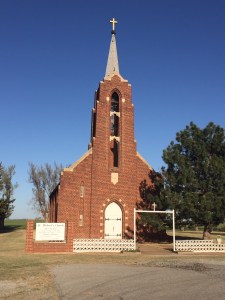
St. Michael’s Church, Goltry, Okla., because I liked it. Hmm, brick will outlast concrete, won’t it?

“Concrete is not a permanent material,” he continued. “Unlike stone it is a man-made material and subject to deterioration over the years and very dependent on the proper amounts of sand, gravel, and cement made into a cementitious mixture and poured into a form to encase steel reinforcing.”

Our conversation received amplification from a June 17 op-ed piece in the Los Angeles Times. The essay is adapted from Vince Beiser’s new book, “The World in a Grain: The Story of Sand and How It Transformed Civilization,” which comes out Aug. 7.

Concrete, Beiser writes, provides “an almost magically cheap way” to build things. But this “man-made stone” brings its own problems.

“Concrete fails and fractures in dozens of ways. Heat, cold, chemicals, salt and moisture all attack that seemingly solid artificial rock, working to weaken and shatter it from within.”

He forecasts 100 billion tons of concrete buildings, roads, and dams need to be replaced. 

And that’s the question at every elevator I visited.

I was happy to discover most were still working and in good condition. But what happens in 20 years? There will probably be even more steel bins, although these have problems of their own.