
By Ronald Ahrens
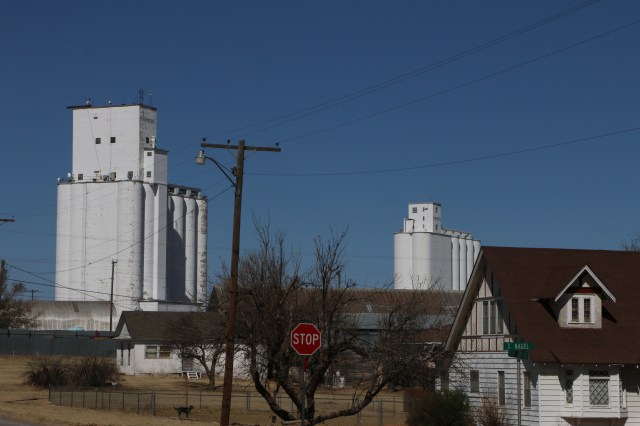
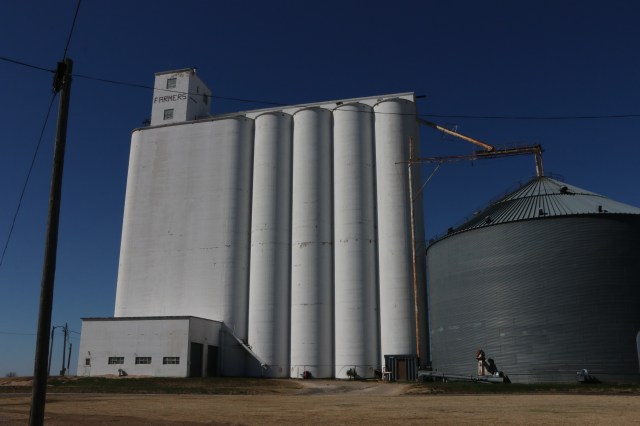
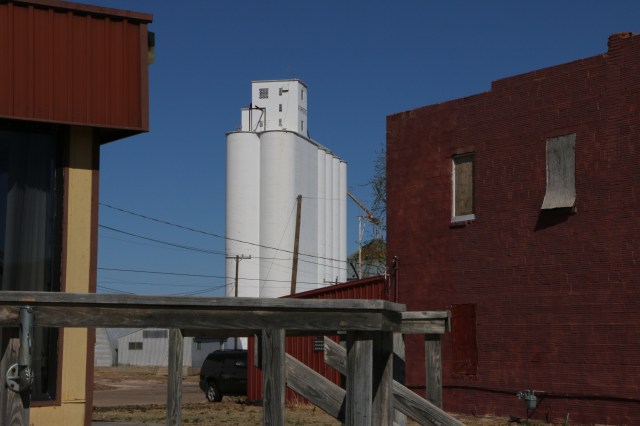
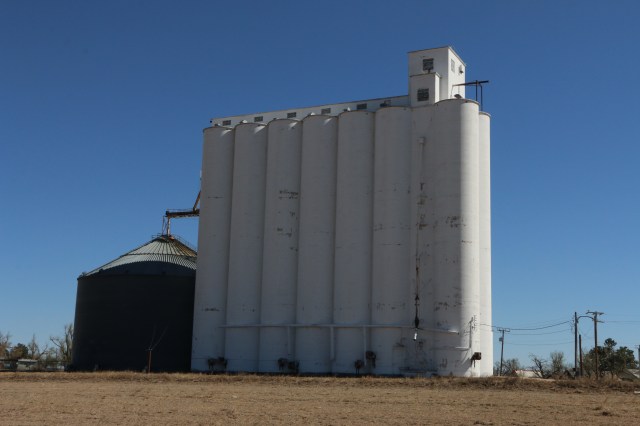
The 212,000-bushel elevator that Tillotson Construction Co., of Omaha, built at Follett, Tex., in 1945, followed the plan that had been established at Medford, Okla., four years earlier.
Follett had the distinction of being a less common twin-leg elevator.
 Farnsworth, not far away, also got two legs that year, but it had its own unique plan and was a much larger house with 350,000-bushel capacity.
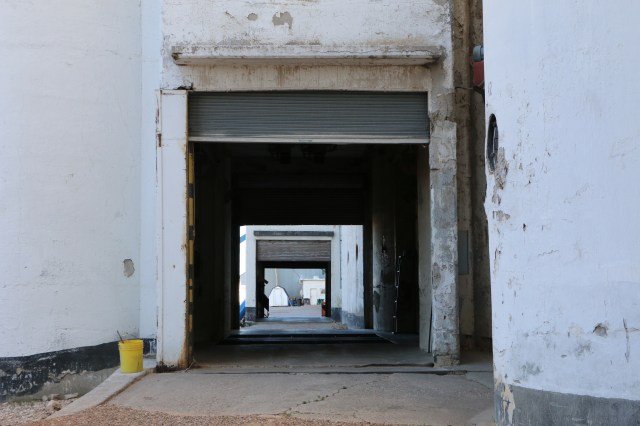
It’s hard to know what the co-op had in mind when placing the order, but evidently they wanted to be able to move grain in a hurry. Another way Follett was unusual was its having a central driveway and outside driveway.
The Follett job required 1,975 cubic yards of reinforced concrete and, for the hoppers, 19 cubic yards of plain concrete.

Follett is a strapping 172-footer! Plenty of symmetry, too.
It used 86.5 tons of reinforcing steel, a material that was now more available as the effort to defeat the Japanese in the Pacific concluded. (The dates of construction are unknown and whether this job took place before or after the surrender announced on Aug. 15.)
We don’t know the total cost less commission, but Burlington, Okla., another 1945 job, another adherent of the Medford plan, had the same dimensions and capacity. Burlington cost $69,819.15. Reginald O. Tillotson didn’t want that dime and nickel to get away.
We do know labor rates. The company paid $1.00 per hour straight and $1.25 overtime. This was up sharply from Burlington and Lamont, Okla., where they paid 70 cents straight and $1.25 overtime. In Cherokee, they got 75 cents straight! The scarcity of male laborers had expanded. I would think anyone going up to the heavens on the drawform would have been crazy; those daring souls would have thought it crazy to make women do that work.
Like Medford–as well as Thomas, Burlington, Cherokee, and Lamont, Okla., Elkhart, Kan., and in neighboring Booker, Tex.–the Follett elevator sat on a 21-inch-thick slab covering an area 51 x 65.5 feet. All are listed at 3,134 square feet, less than the 3,340 square feet our calculations produce. There are confusing notes about the 51 x 65.5 square feet being “outside on ground” and the 3,340 square feet being “actual.”

Give you a 50 cents to climb that ladder!
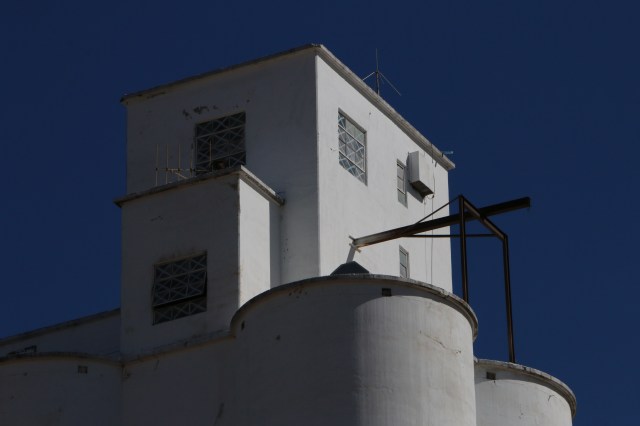
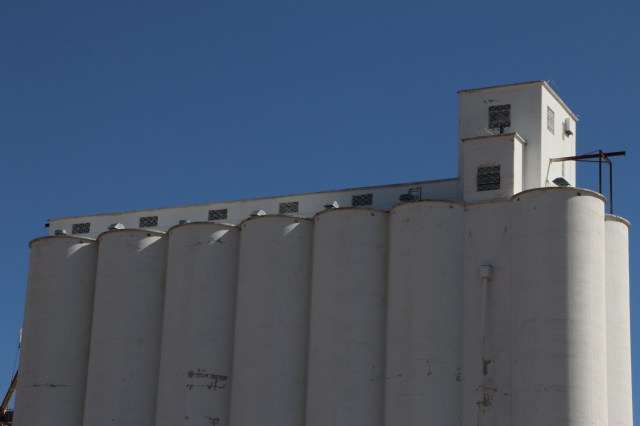
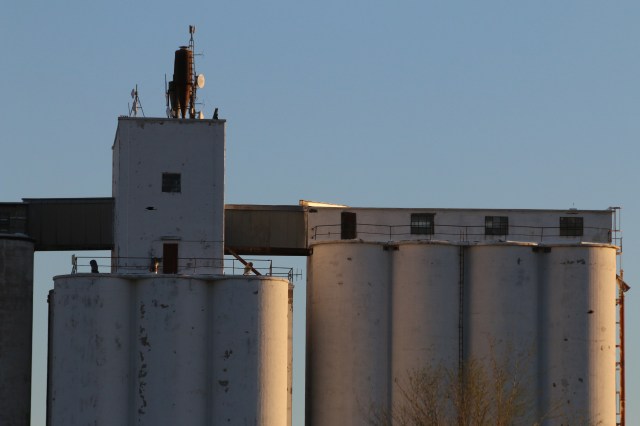
Fully loaded, it weighed 10,798 tons. The silos were 120 feet high, and the headhouse –you see how massive–measured 21.5 feet wide, 50.5 feet wide, and 52 feet high. At 172 feet, this is the tallest Tillotson elevator I’d visited. As my father would have said, “It’s a big ‘un.”
In the leg, the pulley centers stretched to 180.58 feet apart. Again, I hadn’t seen such a big stretch in this period. The boot pulleys were 24 x 14 x 2 3/16 inches. The head was 72 x 14 x 3 15/16 inches. Tillotson would switch to much larger boot pulleys in 1946.
The pulleys turned at 42 rpm. On Follett’s page of records, the speed of pulleys varies from 38 rpm (Douglas, Okla.) to 48 rpm (Minatare, Neb.).


The six-ply Calumet belts were 14 inches wide, and the cups were 12 x 5 inches at nine-inch intervals.
The head drive turned with energy supplied by two 30-horse Howell motors. Theoretical leg capacity, listed at 5,120 bushels per hour, far exceeded actual capacity of 4,100 bushels per hour. So 22.4 horsepower was needed to operate the leg. I’m assuming the bushels-per-hour figure applies to each leg. Yes, it was a co-op in a hurry.
A 3-horse motor–no record of the make–operated the man lift. A 7.5-horse Ehrsam motor operated the truck lift, and a 3-horse motor was for the dust collection system.
No special notes pertain to Follett. Farnsworth’s entry bears the note, “Cupola not built per plans.” One can only imagine!






 Here, it’s necessary to remind you of some basic information. My grandfather on my mother’s side was Reginald O. Tillotson. He and his brother, Joe, took over Tillotson Construction Co. after my great-grandfather, Charles H. Tillotson, died in 1938. They started building concrete elevators, instead of wooden ones, the next year.
 Much to my surprise, t
 Booker was capable of holding 6,480 tons of grain. Fully loaded, the whole shebang weighed 10,798 tons. For the record, a Boeing 747-8 weighs as much as 970,000 pounds, or 458 tons, at takeoff. So a whole lot of big airplanes are represented in the elevator’s maximum gross weight.
 When this single-leg, 216,000-bushel elevator went up over a period of about 10 weeks, it enhanced the skyline of the northeast Texas Panhandle, being one of the first of its type. We don’t know the dates into which that 10-week period fell, but all this happened as the United States was wrapping up the war in the Pacific. Labor was scarce; materials–especially steel–were just becoming available.



 Power originally came from a 2-hp motor, and for all I knew the original unit was still doing its job.
 Additionally, the elevator has served, and may still serve, as a storm shelter. Some big, powerful twisters blow across these plains, and if anyone needed protection, this was the place to find it.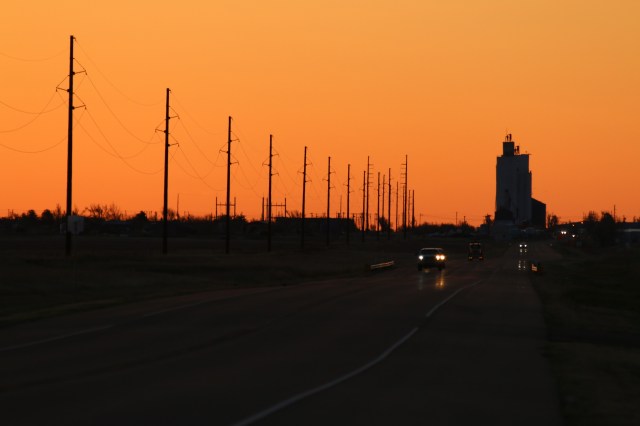
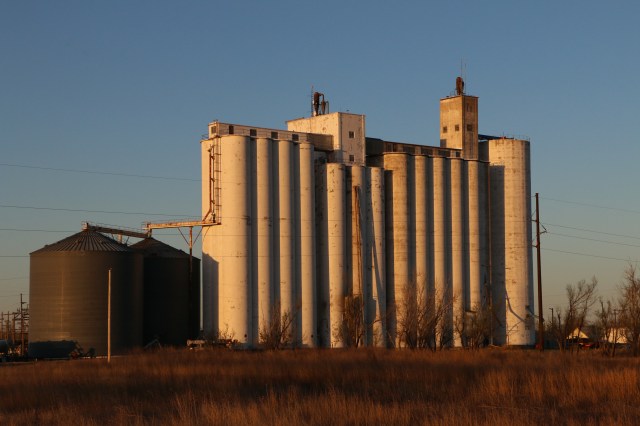
 Medford had tanks, or silos, of 15.5-feet in diameter and a center driveway.


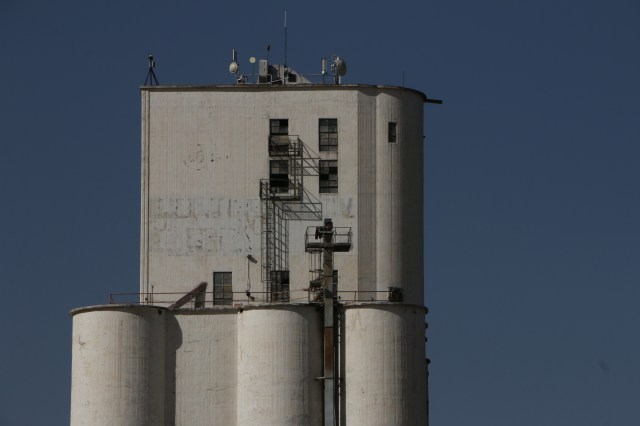 I called up Uncle Chuck Tillotson to ask about the articulation and curved part of the headhouse. Could he imagine how this advance came about? As we saw in the


 Our Grandfathers' Grain Elevators