Even more views of Buffalo’s terminals and more grain-trade history, Part 3

By Ronald Ahrens

As seen in two previous posts, Kristen was in Buffalo the other day and took photos of the terminal elevators. Here’s the third in the series of three we’re doing with our own commentary as well as some lines from Cargill: Trading the World’s Grain, by Wayne G. Broehl, Jr. These lines show how central Buffalo was to the grain trade.

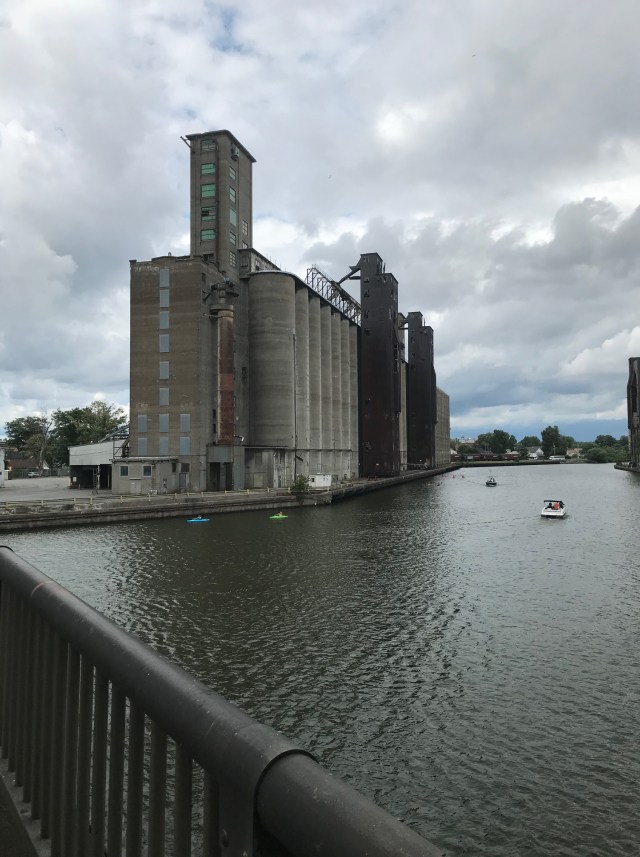
IMG_7105

“This place has an ADM sign on it but it was deserted over the weekend except for a flock of geese and one of pigeons,” Kristen reported. “It looks pretty worn down too.”

“Quite a headhouse,” I said. “Originally a Cargill elevator?”

* * *

June 7, 1932: “May people connected with Montreal shipping felt quite threatened by the new Albany deep-water port. So too did other communities along the water route to the St. Lawrence, particularly Buffalo.” — p. 536
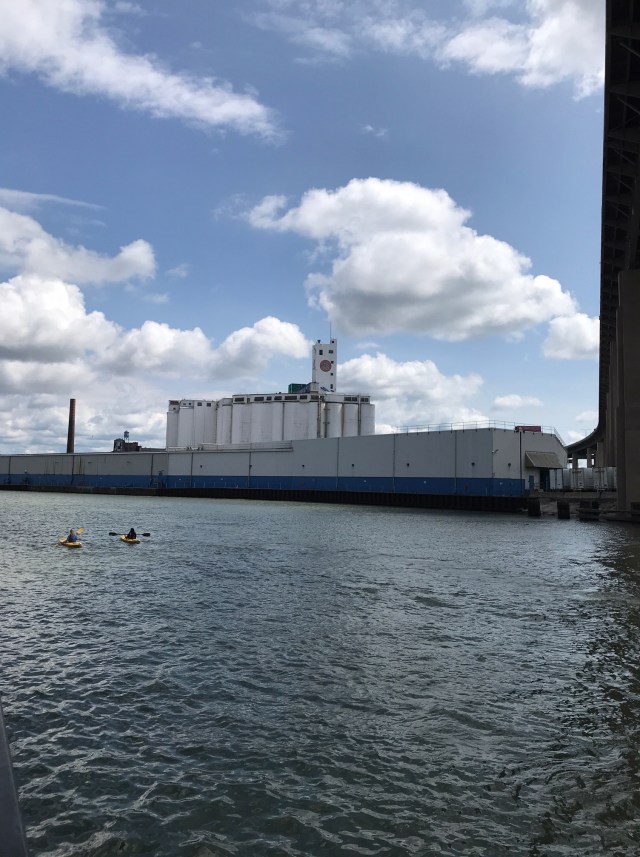
IMG_7130

“The other side taken from the drawbridge,” Kristen said.

“I do not normally associate kayakers with grain elevators,” I said.

* * *

“Another frequently used routing for Canadian grain was through a Lake Erie port, typically Buffalo, where it might be milled into flour. If the flour was for United States consumption, a duty of 42 cents per bushel of wheat had to be paid. If it was for international sale it could be reloaded under ‘milling-in-transit’ privileges and escape duty.” — p. 541

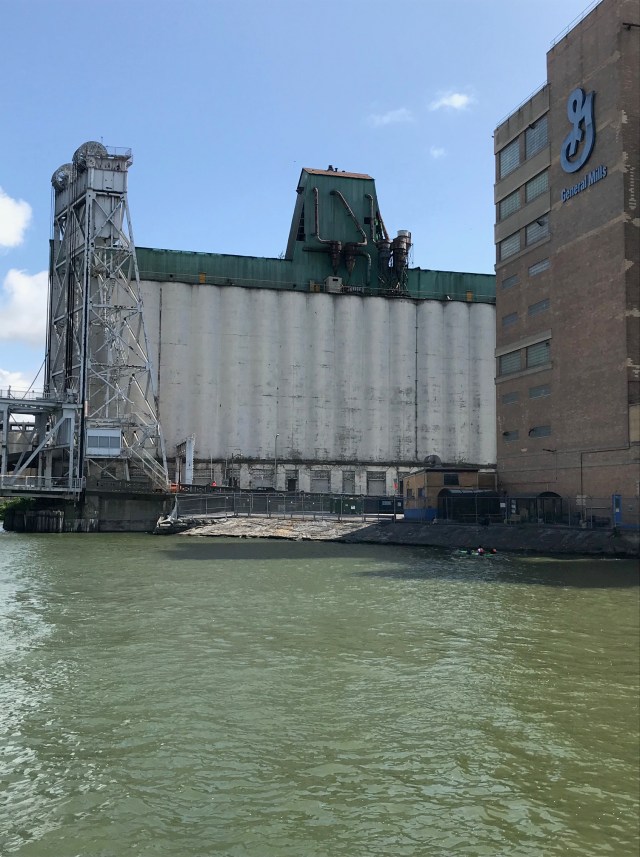
IMG_7135

“Its neighbor across the water is just as big,” Kristen said. “It also looks quite old.”

“It could use some sprucing up, but that’s not our department,” I said. “Oh, and try this historical view

* * *

1941: “So Cargill too moved once more to increase its own storage capacity … The capacities at Buffalo had been vastly expanded–an addition to the Electric Elevator there increased this one terminal from 1.75 million to over 5.2 million bushels; with the Great Eastern and the Superior, the Company now had over 12.4 million bushels just at that one location.” — p. 582
More views of Buffalo’s terminals and some related grain-trade history, Part 2

 By Ronald Ahrens

As mentioned in the previous post, Kristen was in Buffalo the other day and took photos of the terminal elevators. Today’s post is the second in a series of three we’re doing with our own commentary as well as some lines from Cargill: Trading the World’s Grain, by Wayne G. Broehl, Jr. These lines show how central Buffalo was to the grain trade.

55449882966__9DAFF0D4-3DA9-40F5-BF49-9BB5C9F789F3

“It’s the face of Gold Medal flour,” Kristen said.

“It’s a winking face,” I said.

* * *

“The Farm Board created further consternation by its avowed aim to hold its March wheat contracts until the contract terminated, then take actual grain. Thus, physical grain had to be delivered to Chicago by the shorts to fulfill these contracts. Most of these short contracts were held by private-sector grain traders, but a substantial amount of their physical stock of grain already had been moved forward in the pipeline to eastern terminals. Cargill, its Midwest storage already glutted, had shipped large amounts of grain through the Lakes to the Buffalo and Ogdensburg, New York terminals, paying transportation costs to get it there. If this eastern grain had to be used to fulfill the short contracts, either by physical movement back to Chicago or some compensating trade, the grain traders wanted to recover the transportation costs they had already expended on it. The Farm Board refused to allow this … John [MacMillan] Sr., outraged, fired off missives to everyone in Washington about the Farm Board ‘squeeze.'” — p. 349

IMG_7034

“You can smell the cereal from across the canal,” Kristen said.

“If only it were a scratch-and-sniff photo,” I said.

* * *

“In June 1930, Cecil C. Boden from the Omaha office was assigned to a newly opened Cargill branch in Rotterdam, Holland. John [MacMillan] Jr. told him: ‘While ultimately we expect to have you doing a very large business for us … we wish caution to be the keynote.’ He also reiterated the long-standing company credo relating to ethical conduct: ‘We wish particularly to stress the fact that our future success abroad will depend entirely on our standing in the trade. The motto of our Buffalo office ‘We deliver what we sell’ is an excellent one to remember.'”


In Waverly, Neb., a Ford is older than the Tillotson elevator of 1955

IMG_0264

Once again, our friend Kim Cooper provides a photo, this time from Waverly, Neb.

Six miles farther southwest on U.S. 6 than Greenwood, featured yesterday, Waverly is very close to Lincoln.

The Tillotson elevator seen on the left in the photo was built here in 1955, a few years after the Ford you see on the lower right.

Waverly is one of the last elevators in the company records, which cover the period from 1939 to 1955.

The elevator followed the plan established at Drummond, Okla., in 1950. This meant a single-leg, center-drive house of 199,400-bushel capacity.

To have so much integrated storage, the plan provided for eight tanks of 15.5 feet in diameter rising to 120 feet in height. The cupola, or headhouse, added another 35 feet.

We can only guess at the meaning of four notes in the record:

  1. Main slab including 3″ pile cap 33 c.y.
  2. 8 bin aerat’n tubes
  3. Dryer bin
  4. Piling

The pit was 15 feet 3 inches deep. Perhaps a high water table or unconsolidated subsurface material at Waverly made the pilings necessary.

The photo shows the elevator in remarkable condition.

We welcome our readers’ interpretation of the notes.

Atmospheric view of a classic Tillotson elevator in Greenwood, Neb.

IMG_0148

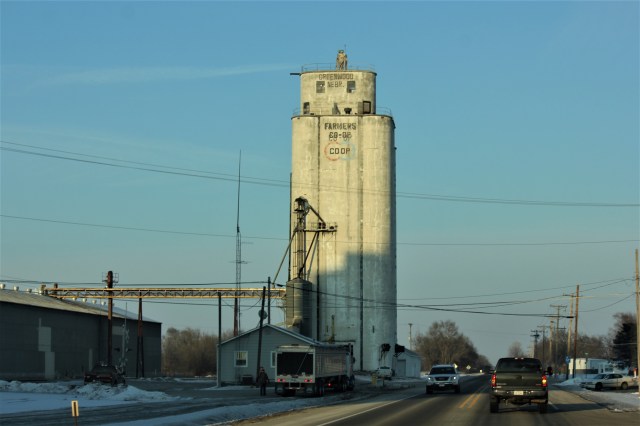
Our friend Kim Cooper sent this atmospheric photo from Greenwood, Neb. We see a classic Tillotson grain elevator: single leg, center driveway, rounded headhouse.

It was built in 1951 on the plan established at Churdan, Iowa, some two years earlier. While Churdan was 102,000 bushels, Greenwood–which sits on U.S. 6 between Omaha and Lincoln–had 129,000-bushel capacity.

Each of the four tanks was of 14.5 feet in diameter and rose 120 feet. The cupola, or headhouse, went up another 22 feet.

A note in the records says, “Rainy @ start.” We can imagine the difficulty of excavating the 12-foot-deep pit, setting forms in the mud, and getting the project off the ground.

An additional note is more cryptic: “30-inch slab proj.” I don’t know how to explain it, especially because the main slab was 18 inches thick, as at Churdan.

Yet another note says, “Inside steps. Dryer prov. (split bin).” That one the reader can interpret for himself.

Calling at Kingfisher, Okla., raises suspicions but leads to answers

By Ronald Ahrens

This past spring we dispatched our indefatigable correspondent, Rose Ann Fennessy, to Kingfisher, Okla., where Tillotson Construction Co., of Omaha, built a 240,000-bushel elevator in 1946.

Kingfisher is a large, multi-faceted complex. Naturally enough, Rose Ann found herself overwhelmed.

Meanwhile, her prowling aroused suspicion.

Without a definitive result–but with Rose Ann managing to avoid a lengthy sentence–we turn to a history of the Kingfisher Cooperative Elevator Association, which fell into our hands a few years ago.

This document was published in 1984 on the Association’s 50th anniversary.

Here we quote from it:

“The association ‘reincorporated’ for $130,000. The previous incorporation was for only $25,000. Also in 1946 the association wrecked the old 34,000 bu. elevator and built a new concrete elevator with a 250,000 bu. capacity. They also wrecked all the other old buildings except the office and scale house which they had built in 1942. It was remodeled into a concrete cleaning and grinding mill and warehouse.” 

There is a discrepancy of 10,000 bushels between Tillotson’s records and the capacity mentioned in the report.

It continues:

“A new skyline was developing on Kingfisher’s horizon. Burrus Mill and Elevator of Kingfisher, perhaps the cooperative’s most unrelenting competition, had built a 1,200,000 bu. facility in the 1930s and it had always loomed large in the farmers’ minds. Now, the farmers had a modern facility and it gave them confidence to know they could compete on a more equitable basis.” 

“For Kingfisher County farmers, who were accustomed to prairie landscapes, concrete elevators looked like skyscrapers, and it made them proud to have erected such a monument to their united efforts.” 

From the photo included in the report we see the Tillotson house in Rose Ann’s photo. As the construction record notes, it was built on an expanded Medford plan from 1941 and has “2 driveways thru center” and a single leg.

We are blessed with the cover photo, which shows the Tillotson elevator in the lower left along with the cleaning-and-grinding mill extending out of frame. The elevator’s rectangular headhouse bears the Kingfisher Coop stamp.

Is it any wonder the farmers felt proud to have a monument to their united efforts?

Another view of Greenwood, Neb., through the eyes of Kim David Cooper

unnamed

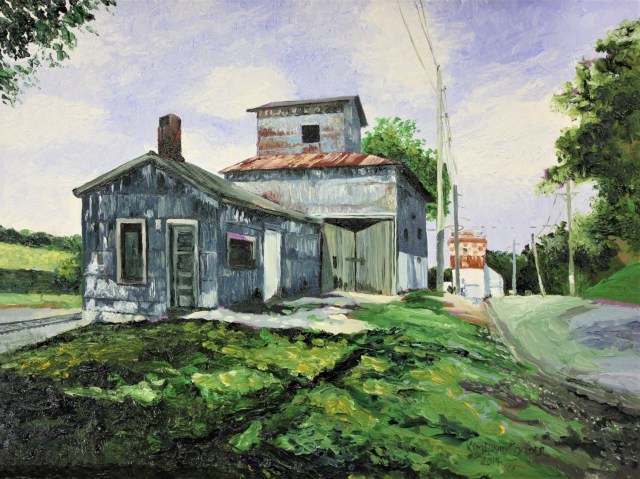
In this oil painting, Kim David Cooper captures the vividness of the landscape around Greenwood, Neb. Through the assertive strokes and lively color tones, we sense the day’s pleasantness, the stirring of the breeze, and the fried chicken and cole slaw in the picnic basket.

“When I was going through my files I found another view of Greenwood elevators–forgot about this one,” Cooper says of the work completed in 2012. “It’s 16×20 and long ago sold.”

The elevator on the right was built by Tillotson Construction Co., of Omaha, in 1951, and it’s unlikely that anyone on the crew imagined the edifice would one day be in a fine-art painting. 

Detail right side

Detail view featuring Tillotson’s 1951 elevator at Greenwood, Neb. and the storage annex.

The 1951 elevator followed the Churdan, Iowa, plan established in 1949. It had four tanks, or silos, of 14.5 feet in diameter rising 120 feet from the ground.

The smallish headhouse measured 17 feet wide, 34 feet long, and 22 feet high.

We have posted about the Greenwood elevator before; all the specs and photos can be found by using this link.

Cooper is proprietor of Cooper Studio & Gallery, at 1526 Silver St. in Ashland, Neb. Phone: 402.944.2022.


From Elkhorn, Neb., another of Kim Cooper’s wonders of oil on canvas

IMG_4818

Our friend Kim David Cooper has shared more of his work with Our Grandfathers’ Grain Elevators.

Cooper favors the plein air technique, which refers to scenes painted outdoors with the emphasis on spontaneity and seeking to capture the fleeting effects of light and atmosphere.

Here you see his vigorous brushwork and deft use of perspective, which makes the office portion of the building jump at the viewer.

Elevator 1“No cement here,” Cooper wrote in an email. “Painted on site, plein air. Buildings still there in Elkhorn, Neb.”

He also provides a photograph from the same point of view. We see how he captured the scene’s essence, adding life and spirit that simply isn’t found in the photo.

This 9 x 12-inch painting has already been sold. To inquire about commissions, call Cooper Studio & Gallery, located at 1526 Silver St. in Ashland, Neb. Phone: 402. 944.2022.  


How a fire 30 miles away threatened the historic mill in Downey, Idaho


Fire4

Preston conflagration photos from 2012 courtesy of Ryan Day.

By Ronald Ahrens

In Franklin County, Idaho, the towns of Downey and Preston are about 30 miles apart on U.S. 91. Downey is small, Preston is large. More than 5,000 people live in Preston. It’s the county seat.

As Ryan Day expresses it, “Downey is the black sheep of the family nobody wants to talk about.” 

Ryan, a follower of Our Grandfather’s Grain Elevators, runs the historic mill and elevator complex in Downey, which is a unit of Valley Wide Cooperative. Competing against the operation in Preston was tough. Preston had 24- and 36-inch rollers for barley, and a board member claimed no one could roll barley as well as they did. Preston flaked corn with the same proficiency that Sammy Cahn churned out timeless romantic songs. Preston could even apply molasses to the feed it produced.

This mill in the metropolis was fancy-schmancy.

“They were always the enemy,” Ryan says. 


Jene Day, who operated Downey for about 50 years, finally lured his son back in 2012 to become his successor. A month before Ryan’s first day on the job, the big mill in Preston caught fire and burned down.

“When I started, the building was still smoking,” he says.

The black cloud that had billowed over Preston had a silver lining, though.

“They had just merged with Valley Wide. Luckily, they were insured and able to build a new state-of-the-art mill.”

In 2014 The Capital Press–“The West’s Ag Weekly Since 1928”–celebrated the reconstituted mill’s opening and extolled its efficiency and convenience. The $3-million facility had everything producers and feeders could want: exotic mixes and the quick loading and unloading of trucks, for example.

Such a powerful allure caused a crisis of faith with some of the organic dairymen who had depended on Downey.

According to the the Capital Press, “Mike Geddes a local organic dairy owner [sic], said about a dozen regional organic dairies who now use a dilapidated mill in Downey have asked Valley Wide to process their feed.”

Dilapidated? A black eye for the black sheep!

Preston may be more efficient, but it’s just another unprepossessing steel building with some small steel bins. It lacks any visual distinction whatsoever. In fact, in the photos we’ve seen, it’s darn near invisible.

DSC_0049

Kristen Cart’s photo captures Downey’s Oz-like quality. L. Frank Baum’s Oz books were contemporaneous with much of Downey’s construction.

As stated in an earlier post, Downey’s buildings belong to Oz. The installation should be in our National Register of Historic Places. For that matter it should be registered in Oz, too.

Four years have passed since Preston re-opened. To find out if anything has been done about its going organic, I called up and spoke to feed manager Shaun Parkinson.

“The only reason that we’d do anything is if something happened to Downey,” he said.

In other words Downey has its niche and is in good hands with Ryan Day.

Nothing had better happen.


Shots rang out at the Downey, Idaho, elevator complex in 1964

By Ronald Ahrens

If you think this blog is all about grain dust and elevator specifications, get ready for a murder mystery.

RyanDay

Ryan Day.

Ryan Day, a reader who manages the mill and elevator complex in Downey, Idaho, tells us what happened in an exchange of gunfire there in 1964.

“My mom and dad used to live in a house right next door north to the place,” Ryan says. “They had come home from shopping–it was late at night.

“Dad had been at the elevator for a few months. He noticed a light like a flashlight. He walked over, and it was a body.

“A local deputy lay dead in the middle of the yard. It was Deputy Woodruff, the first officer in [Franklin] County to die in the line of duty.” 

Downey7

“Dad surmised somebody was breaking into the office, so he hustles up and sees a gas trail on the ground from a car that was parked there.

“Deputy Woodruff had put a couple slugs into their gas tank. And they put a couple of slugs into him.” 

Ryan’s parents called authorities.

From Downey, the chase began. It continued about 75 miles through the mountains to Montpelier, in the very southeastern corner of the state.

Downey5“They cornered three fellows and a gal from Chicago going through the states doing a robbery spree,” Ryan said.

The spree ended before the marauders got to Dingle, the last town before Wyoming.

This is how Downey gained lasting fame.

Embellishing his tale, Ryan says, “A detective mag from 1970s had that story.” 

We hope to find a copy somewhere, somehow.

A new belt for the leg, and the Downey, Idaho, plant is good to go

DSC_0049

Photo by Kristen Cart.

By Ronald Ahrens

Ryan Day, a reader of this blog, shared some details about the mill and elevator complex he manages in Downey, Idaho, for Valley Wide Cooperative.

RyanDay

A selfie by Ryan Day.

“I do not have any info on the wooden crib at all,” Ryan says but notes a 1901 casting date on the iron housing of the 24-inch barley roller

He is quite sure about the rest of it, though. 

The six silos–the 50-footers made of riveted steel plates–preceded 1915, he reckons. They hold 11,293 bushels apiece. 

The two 80-foot silos each hold “23,000 bushels and change.” The middle has an overhead bin with capacity of 1800 bushels. 

“Trucks dump right there in the east side of the elevator,” he said. He has a roll-up garage door on south and a slider on north.

Companyjalopy

“Moving rolled barley around the plant in my company jalopy,” Ryan says. “The mill is in the background with the main entrance visible to the left. The Ford is a ’72. We call her Purple.”

He uses a 32-foot scale with balance beam, a device that always makes the Idaho state inspector marvel. It measures loads up to 60,000 pounds and can scale a tractor, which then pulls ahead in order to weigh the tandems. Then the driver backs up and dumps into the pit. 

Up top in the headhouse, a massive 40-horse motor runs the head pulley. “I’m sure it’s original.” 

Updating the leg, the cooperative had a new belt installed last spring. At 132 feet long it spans the distance between head and boot pulleys; it’s made of multi-ply rubber with fabric cordage. He said it’s not as thick as the old belt. Halverson Co., of Salt Lake City, installed it. 

The tall narrow building has a leg; the stepped pit inside has been converted to a corn grinder. 

The wooden crib still bears the faint marking Globe Elevator Co. No. 6. He points out that Globe was responsible for the largest wooden-crib elevator in the States, built in the 1880s at Superior, Wisc. Use this link to view photos from the Library of Congress. The History Channel documented its dismantling in 2013.