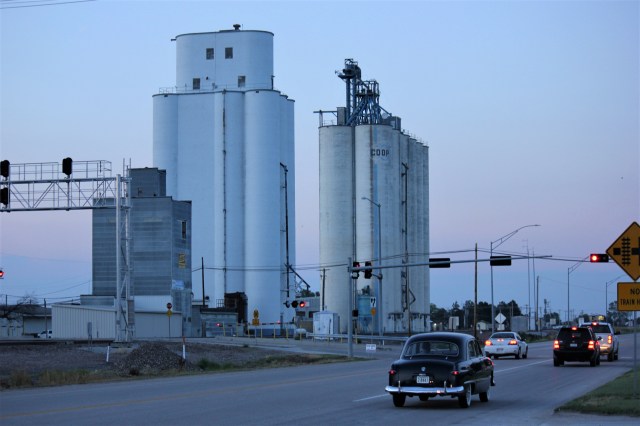
In Waverly, Neb., a Ford is older than the Tillotson elevator of 1955

IMG_0264

Once again, our friend Kim Cooper provides a photo, this time from Waverly, Neb.

Six miles farther southwest on U.S. 6 than Greenwood, featured yesterday, Waverly is very close to Lincoln.

The Tillotson elevator seen on the left in the photo was built here in 1955, a few years after the Ford you see on the lower right.

Waverly is one of the last elevators in the company records, which cover the period from 1939 to 1955.

The elevator followed the plan established at Drummond, Okla., in 1950. This meant a single-leg, center-drive house of 199,400-bushel capacity.

To have so much integrated storage, the plan provided for eight tanks of 15.5 feet in diameter rising to 120 feet in height. The cupola, or headhouse, added another 35 feet.

We can only guess at the meaning of four notes in the record:

  1. Main slab including 3″ pile cap 33 c.y.
  2. 8 bin aerat’n tubes
  3. Dryer bin
  4. Piling

The pit was 15 feet 3 inches deep. Perhaps a high water table or unconsolidated subsurface material at Waverly made the pilings necessary.

The photo shows the elevator in remarkable condition.

We welcome our readers’ interpretation of the notes.

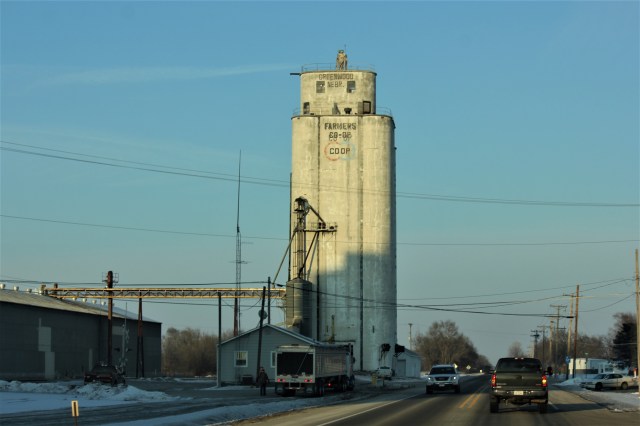
Atmospheric view of a classic Tillotson elevator in Greenwood, Neb.

IMG_0148

Our friend Kim Cooper sent this atmospheric photo from Greenwood, Neb. We see a classic Tillotson grain elevator: single leg, center driveway, rounded headhouse.

It was built in 1951 on the plan established at Churdan, Iowa, some two years earlier. While Churdan was 102,000 bushels, Greenwood–which sits on U.S. 6 between Omaha and Lincoln–had 129,000-bushel capacity.

Each of the four tanks was of 14.5 feet in diameter and rose 120 feet. The cupola, or headhouse, went up another 22 feet.

A note in the records says, “Rainy @ start.” We can imagine the difficulty of excavating the 12-foot-deep pit, setting forms in the mud, and getting the project off the ground.

An additional note is more cryptic: “30-inch slab proj.” I don’t know how to explain it, especially because the main slab was 18 inches thick, as at Churdan.

Yet another note says, “Inside steps. Dryer prov. (split bin).” That one the reader can interpret for himself.

A Tillotson granddaughter connects with family history in Waverly, Neb.

By Kate Oshima

As we drove the Interstate east through Nebraska, a tall grain elevator in the town of Waverly caught my eye. It was shimmering white and rose from the floor of the Great Plains like a lone mountain misplaced by nature. My husband, Roger, offered to stop and explore with me because it was built by my maternal grandfather, Reginald Tillotson.

DSC_0323

Photo by Kristen Cart

I approached the building with excitement at being so close to a place my grandfather had once stood. As I gazed upon the structure I had to crane my neck to view the top. I pictured men working up there to complete it, imagining the winds of the Plains blowing around them to try to topple one of them to the ground.

The building seemed somehow familiar to me. It had the same feeling one got when approaching our grandparents’ home. Grandfather had built a cement house for his family in the 1950s. It was in the style of the grain elevators he constructed.

We enjoyed running around the building looking for the identifying metal markers. The markers were round, rusted, but mostly readable. The name Tillotson Construction and the year of construction were emblazoned upon them.

As I stood before the impressive elevator I could only imagine my grandfather walking this exact spot. I was awed at seeing some of the history from my family surviving.

Driving away I had a better appreciation of the work Grandfather Tillotson had been involved in. A bit of history touched me that day and inspired greater appreciation for those who came before.

Another view of Greenwood, Neb., through the eyes of Kim David Cooper

unnamed

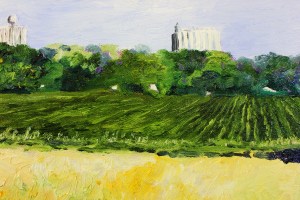
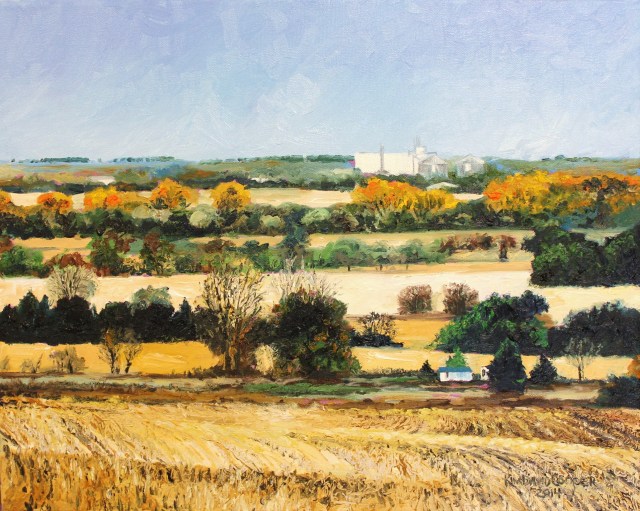
In this oil painting, Kim David Cooper captures the vividness of the landscape around Greenwood, Neb. Through the assertive strokes and lively color tones, we sense the day’s pleasantness, the stirring of the breeze, and the fried chicken and cole slaw in the picnic basket.

“When I was going through my files I found another view of Greenwood elevators–forgot about this one,” Cooper says of the work completed in 2012. “It’s 16×20 and long ago sold.”

The elevator on the right was built by Tillotson Construction Co., of Omaha, in 1951, and it’s unlikely that anyone on the crew imagined the edifice would one day be in a fine-art painting. 

Detail right side

Detail view featuring Tillotson’s 1951 elevator at Greenwood, Neb. and the storage annex.

The 1951 elevator followed the Churdan, Iowa, plan established in 1949. It had four tanks, or silos, of 14.5 feet in diameter rising 120 feet from the ground.

The smallish headhouse measured 17 feet wide, 34 feet long, and 22 feet high.

We have posted about the Greenwood elevator before; all the specs and photos can be found by using this link.

Cooper is proprietor of Cooper Studio & Gallery, at 1526 Silver St. in Ashland, Neb. Phone: 402.944.2022.


In another oil painting, Kim Cooper shares his subtle vision of Nebraskaland

October Nebraska 16x20, oil on canvas Sold to Don and Lois Fick, Wahoo, NE

Today is the second of three straight days featuring oil paintings by Kim David Cooper. Here he shares with us a 16 x 20-inch oil depicting an elevator from … he can’t say for sure.

“I don’t even remember where it was from–possibly around Mead, Nebraska,” Cooper commented. “Didn’t write it down, and I’m getting forgetful!” 

In an email he called the work “October, Nebraska.” It was sold to collectors in Wahoo, Neb. (home of a Tillotson elevator).

Often when we see photography or landscape paintings by Nebraska artists we’re stunned by their ability to discern the subtleties (although nothing about a grain elevator is subtle).

This fine landscape hows just how beautiful Nebraskaland can be.

From Elkhorn, Neb., another of Kim Cooper’s wonders of oil on canvas

IMG_4818

Our friend Kim David Cooper has shared more of his work with Our Grandfathers’ Grain Elevators.

Cooper favors the plein air technique, which refers to scenes painted outdoors with the emphasis on spontaneity and seeking to capture the fleeting effects of light and atmosphere.

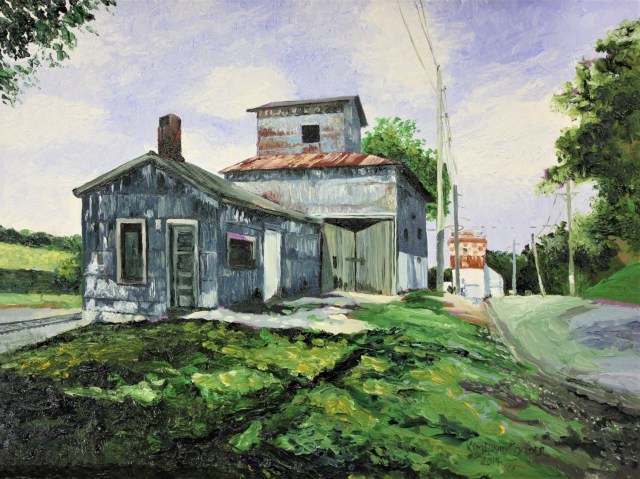
Here you see his vigorous brushwork and deft use of perspective, which makes the office portion of the building jump at the viewer.

Elevator 1“No cement here,” Cooper wrote in an email. “Painted on site, plein air. Buildings still there in Elkhorn, Neb.”

He also provides a photograph from the same point of view. We see how he captured the scene’s essence, adding life and spirit that simply isn’t found in the photo.

This 9 x 12-inch painting has already been sold. To inquire about commissions, call Cooper Studio & Gallery, located at 1526 Silver St. in Ashland, Neb. Phone: 402. 944.2022.  


Tillotson’s Greenwood, Neb., elevator appears in another Cooper oil painting

Corn and Cathedrals, 16x20, oil on canvas, Plein Air, 2015, Kim David Cooper

“Corn and Cathedrals,” used with permission. Copyright Kim David Cooper, 2015.

By Ronald Ahrens

Yesterday we showed you a painting titled “Greenwood Cathedrals,” a 48 x 60 work in oil by Kim David Cooper, a high school classmate.

The Set UpIt depicts the 129,000-bushel single-leg elevator built in 1951 by Tillotson Construction Co.

Here are images of another painting, “Corn and Cathedrals,” a 16 x 20 canvas that Cooper did in 2015.

This time the view is from the Greenwood cemetery and places the Tillotson elevator on the right.

Although “Corn and Cathedrals” was sold, “Greenwood Cathedrals” is on display at Cooper Studio & Gallery, 1526 Silver St., Ashland, Neb.


Tillotson’s 1951 Greenwood, Neb., elevator depicted in oil on canvas

Greenwood Cathedrals Full Painting

This copyrighted image is used with permission of Kim David Cooper.

By Ronald Ahrens

It has come to our attention that high school classmate Kim David Cooper, an artist, has completed a numinous landscape that depicts the Greenwood, Neb., grain elevator built in 1951 by Tillotson Construction Co.

In this view from the north, it’s the elevator on the left of the canvas.

Detail Left Elevator

Detail view. This copyrighted image is used with permission of Kim David Cooper.

Anyone who drives between Omaha and Lincoln on U.S. 6 will notice this elevator, which has a storage annex that was also a Tillotson job.

The 1951 original followed the Churdan, Iowa, plan established in 1949. It had four tanks, or silos, of 14.5 feet in diameter rising 120 feet from the ground.

The smallish headhouse measured 17 feet wide, 34 feet long, and 22 feet high.

We have posted about the Greenwood elevator before; all the specs and photos can be found by using this link.

Cooper, proprietor of Cooper Studio & Gallery, at 1526 Silver St. in Ashland, Neb., titled his painting “Greenwood Cathedrals.”

This oil on a large 48 x 60-inch canvas is now on display.

“We are Cooper Studio & Gallery and have been at this location for almost 17 years,” he wrote in an email. “I do a lot of plein air painting and commission work for customers.  Also framing and some restoration.”

It was my first contact with Cooper since 1972, who was good at baseball as well as art. Nice to come together again after 46 years–all because of a grain elevator.

A through-the-windshield glimpse of Omaha’s Vinton Street elevator

sIMG_4607

Kate Oshima, a granddaughter of Reginald Tillotson, provides this through-the-windshield view of the Vinton Street elevator in Omaha.

We see the unique, tall headhouse and the runs atop the main house and extending to the annexes. We also see that the elevator needs some TLC.

Omahans call I-80 “the Interstate.” Kate says, “It is towering over the Interstate.”

A postcard reveals Tillotson elevator activity before the big changes of 1938

Post Card 01

We have found what may be a rare record of the Tillotson construction enterprise as it existed before 1938. Back then, Charles H. Tillotson led the company, which specialized in wooden elevators. After he died in ’38, his sons Reginald and Joe partnered in Tillotson Construction Co., and started to experiment, and then build, with reinforced concrete.

This card from July 2, 1936 is penned by Sister Mary Concepta, the older sister of Margaret Irene McDunn Tillotson (my grandmother) and sister-in-law to Reginald.

Sr. M. Concepta, born on Sep. 27, 1901, in Emerson, Nebraska, and christened Catherine McDunn, was the second of nine children. (Margaret, born Feb. 9, 1903, was third.) Sr. M. Concepta belonged to the Sisters of the Presentation of the Blessed Virgin Mary, with a motherhouse at Mount Loretto in Dubuque, Iowa.

The parents were William McDunn (b. Feb. 4, 1871, Des Moines, Iowa) and Bridget Loretta Dorcey McDunn (b. March 27, 1872, Luken or Lucan, Ontario). Records show William as a laborer in Omaha in 1891. He became a conductor on the Nebraska Division of the Chicago, St. Paul, Minneapolis & Omaha Railway, and the family became established in Emerson, the town named for Ralph Waldo Emerson, which had come into being in 1881 at a junction on the CSPM&O (known as the Omaha Road). 

The family history comes from These U.S. McDunns: Family Tree of Patrick McDunn and Mary O’Donnell, compiled by John McDunn, of Lodi Wisc., in April 1989. The McDunns homesteaded in Pennsylvania in 1835. 

My Uncle, Charles J. Tillotson, whose name appears in many of this blog’s posts, had kept his grandfather William’s railroad watch–a Hamilton, of course–until a burglar struck in the late-1980s.

Post Card 02Uncle Charles notes that in the mid-1930s Reginald and Margaret lived with the elder Tillotsons at 624 N. 41st Street. They towed a travel trailer to job sites. In early July of 1936 they would also have towed along Uncle Charles, then 18 months old, and my mother Mary Catherine, who was nearly five months old.

On this postcard Sr. M. Concepta addresses her sister Margaret (Mrs. Reginald Oscar Tillotson) at Carlyle, Neb.

Carlisle–note the difference in spelling–is an unincorporated town in Fillmore County.

“I know the name because Mom used to talk about it,” Uncle Charles says.

We presume there was a wooden elevator. Carlisle is an unincorporated community in Fillmore County, about 135 miles southwest of Omaha. It doesn’t appear on our Rand McNally page nor does Google Maps seem to know anything about it. 

MapThe USGS gives coordinates for Carlisle on its Davenport Quadrangle map (named for a town in neighboring Thayer County), and we see a speck on Road X, west of Little Sandy Creek, that could be Carlisle. We called the Fillmore County sheriff’s office, in Geneva, and asked. “Nope,” a very nice woman said. “We don’t have a Carlisle.” 

Whatever.

“Dear Margaret + Reginald + babes,” Sr. M. Concepta begins.

Post Card 03“This card tells you where we are. Saw your Mother and Mary, Reginald. Mary is truly a nice girl and your mother surely is not strong. Won’t be leaving here now until Sat. morning. Just thought you might be coming in for the 4th. Don’t try it just for me though. Love, Sr. M. Concepta.”

Mary Tillotson was Reginald’s sister who became important to the family business and also is named in many posts here.

It’s hard enough to find a trace of Carlisle, but we would love to know if any remnant of a wooden elevator exists there.