Drawings for an elevator of 150,000-bushel capacity with plans for work floor and bins

These drawings reproduced from the records of Tillotson Construction Co., of Omaha, show the general-plan details of a 150,000-bushel, single-leg, reinforced-concrete elevator.

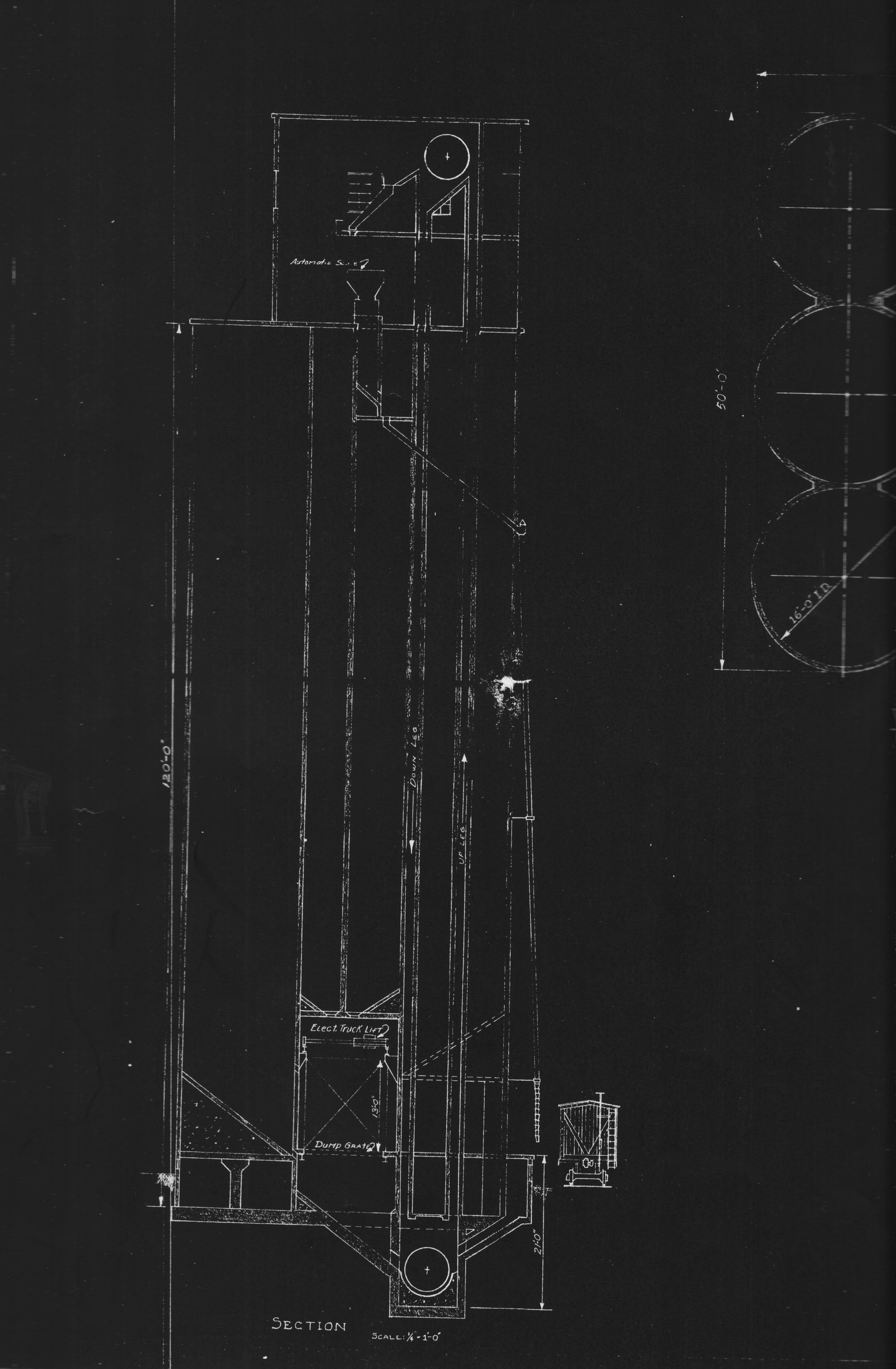
To the left above, seen at the scale of one-quarter inch to one foot, is the cross-section of the structure. The main house has five tanks (silos) with internal diameter of 16.0 feet and achieves a height of 120 feet. No dimensions are shown for the cupola; the only notation in the plan says “automatic scale.”

In the main house are notes saying, “Up Leg” and “Down Leg. Other say, “Elect. Truck Lift” and “Dump Grate.” The driveway door is 13.0 feet high.

A precisely rendered rail car provides a fanciful touch on the far right, where it’s positioned at the load-out spout to receive a cargo.

At the very bottom, we see a 21.0-foot depth below the main slab.

The work floor plan (center) is rendered at the scale of three-sixteenths inch to one foot. We see that the whole structure sits on the slab measuring 50.0 x 47.0 feet. Internal diameter of the tanks is 16.0 feet. Notes show the locations of the electrical room, two manholes, dump grates, and at far right the dock.

The bin plan, also three-sixteenths to one foot, shows the five large tanks with Number 1 in the lower-right and the progression going counter-clockwise to Number 5 on the lower-left.

Sandwiched inside are Bins 6 through 16. We see that Bins 6, 8, 10 and 12-16 are marked as being 10.0 feet wide. Bin 9 is 7 feet 6 inches across. Bin 14, on the far right, is 13 feet 9 inches across. Bin 16 is labeled “Dust Bin.”

The large tanks Numbers 1 to 5 have capacities of 17,650 bushels. The internal bins are as follows:

  • Bins 6-7: 5,300 bushels
  • Bins 8 & 10: 6,790 bushels
  • Bin 9: 6,000 bushels
  • Bin 11: 6,540 bushels
  • Bin 12: 2,640 bushels
  • Bin 13: 5,300 bushels
  • Bin 14: 8,220 bushels
  • Bin 15: 7,980 bushels
  • Bin 16 (Dust Bin): 930 bushels

Unlike any of the other plans we have, this one is dated. One entry in the lower-right says, “Rec’d 3-3-58.” There are two other illegible dates, but at very bottom another date shows 3/31/58.

The initials “TM” would seem to indicate that Tillotson’s Ted Morris executed the drawings.

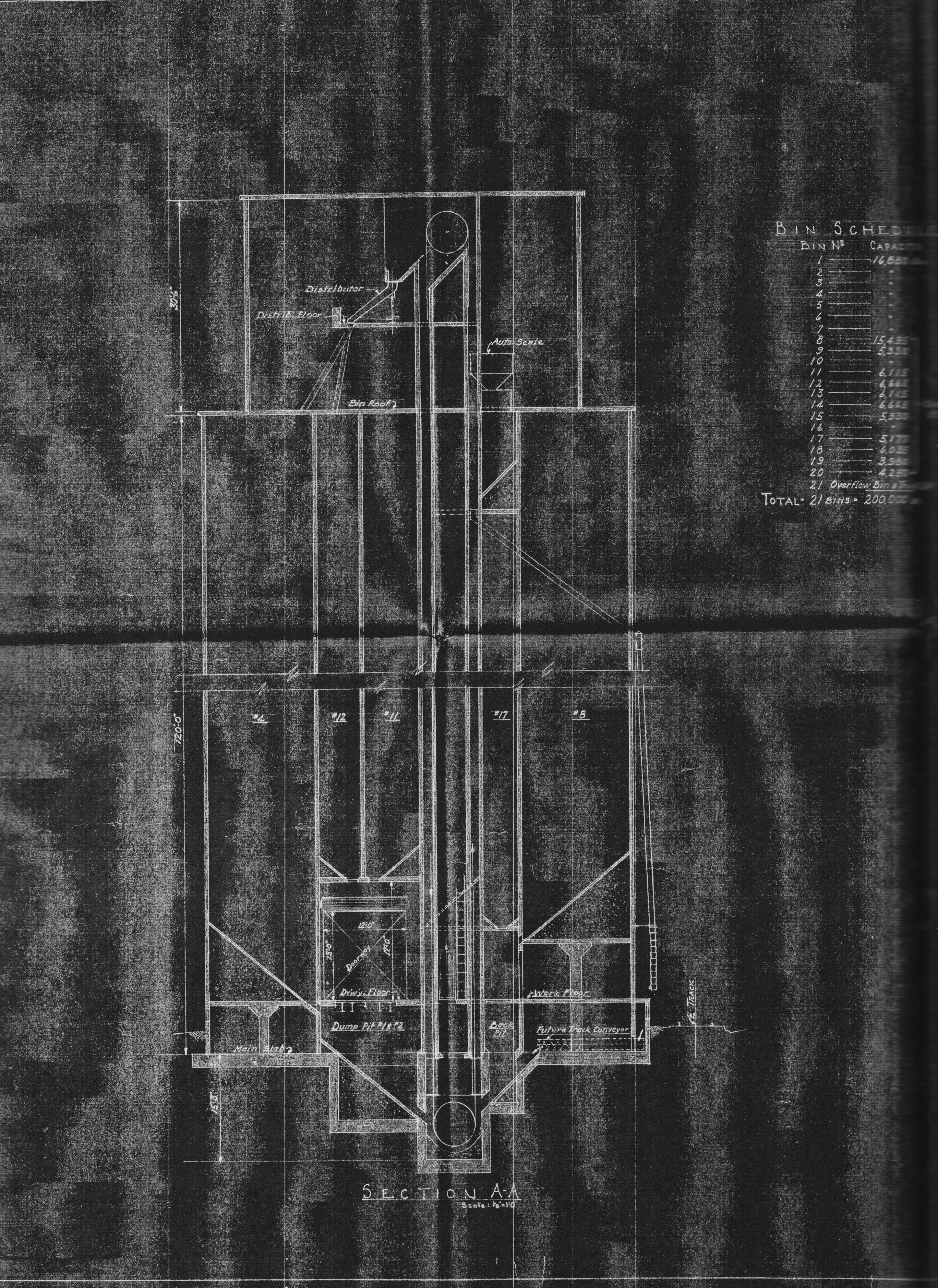
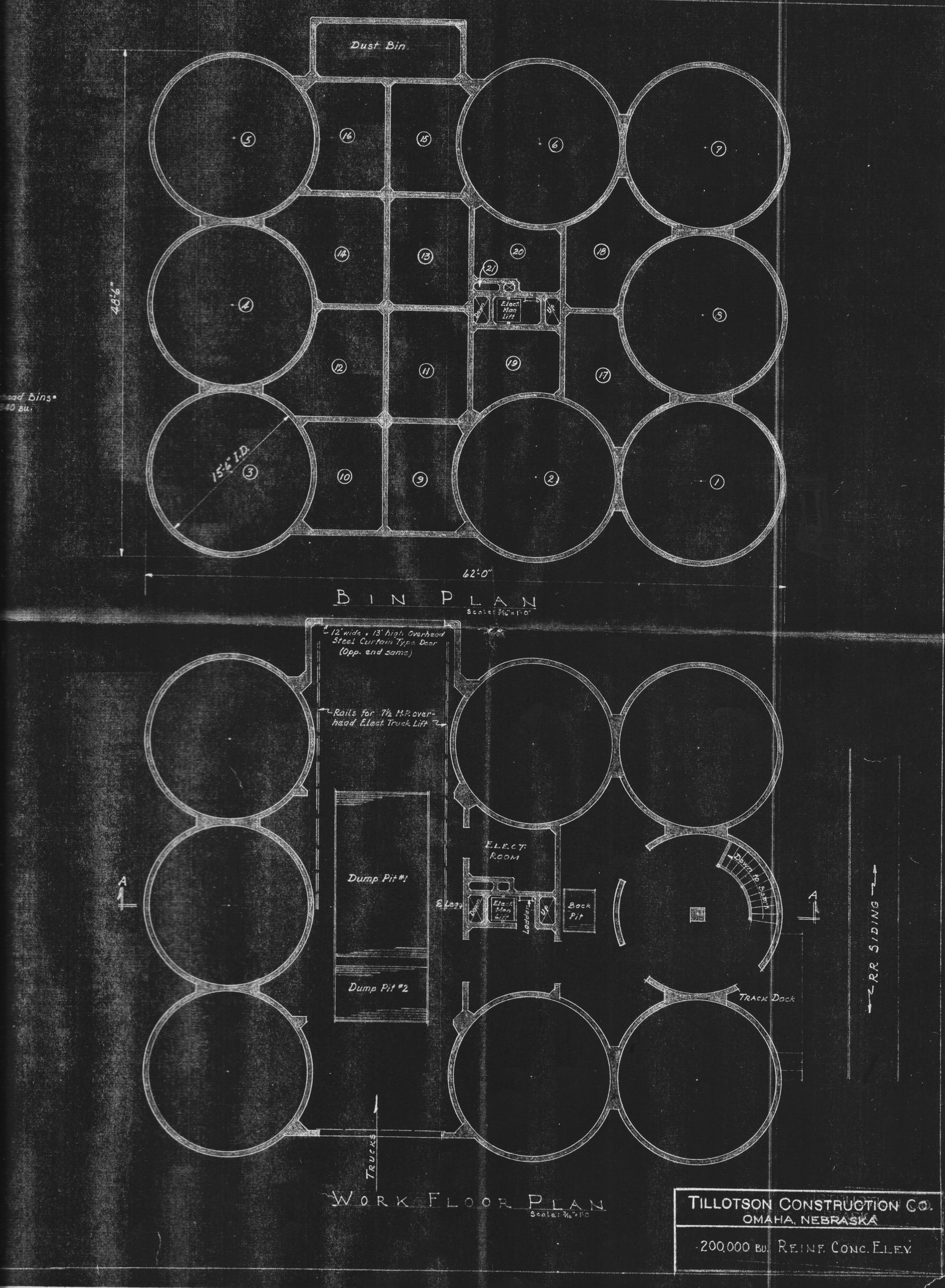
Drawings for an elevator of 200,000-bushel capacity with bin plan and schedule

The present drawings that are reproduced from records of the Tillotson Construction Co., of Omaha, show details of a 200,000-bushel, single-leg, reinforced-concrete elevator

To the left above, seen at the scale of one-eighth inch to one foot, is the cross-section of the structure. The main house has eight tanks (silos) with internal diameter of 15 feet six inches and achieves a height of 120 feet. The cupola is 30 feet six inches high. At the bottom, we see a depth of 15 feet three inches below the main slab.

In the cupola, we see notations for the distributor, distribution floor, and automatic scale.

Below, numbers of the large tanks and smaller interior bins are noted. The driveway and rolling door are shown above dump pits Number One and Two. The driveway is 12 feet wide, the door is 13 feet high, and a 17-foot distance extends between driveway floor and driveway roof.

Other notes in the lower-right indicate the work floor, back pit, and a track conveyor to be installed at a future time.

Outside the elevator’s wall is a load-out spout for rail cars and the inscription “Track,” showing where a car draw up to be filled.

Ratings for the bin schedule are cut off due to the limitations of our scanner bed and the 11×17-inch sheets that were copied from blueprints by Uncle Tim Tillotson.

The schedule has the large tanks, Number One through Seven, at 16,880 bushels each. Number Eight is 15,495 bushels. Internal bins nine through 20 range in capacity from 3,980 bushels (Number 19) to 6,665 bushels (12 and 14).

The whole structure sits on the slab measuring 48.5 x 62.0 feet.

Number 21, which can barely be seen in the Bin Plan, is an ovalized chute that stands just outside the accommodations for the electrically operated man lift. “Down” is inscribed to the left of the lift, and “loader” and “up” are to the right.

The Bin Plan and Work Floor Plan are shown at the scale of three-sixteenths inch to one foot.

From the bottom, notes in the Work Floor plan show “Trucks” entering in the direction of the arrow to the two dump pits. Additional notes say “Rails for the 7 1/2 H.P. overhead Electr. Truck Lift” and “12′ wide x 13′ high Overhead Steel Curtain Type Door (Opp. end same).”

At far right, notes say “Track Door” and “RR Siding.”

The stairway inside Number Eight is indicated with the note “Down to Bsm’t.” And this stairway is the reason for the tank’s capacity of 15,495 bushels as opposed to the 16,880 bushels of the others.

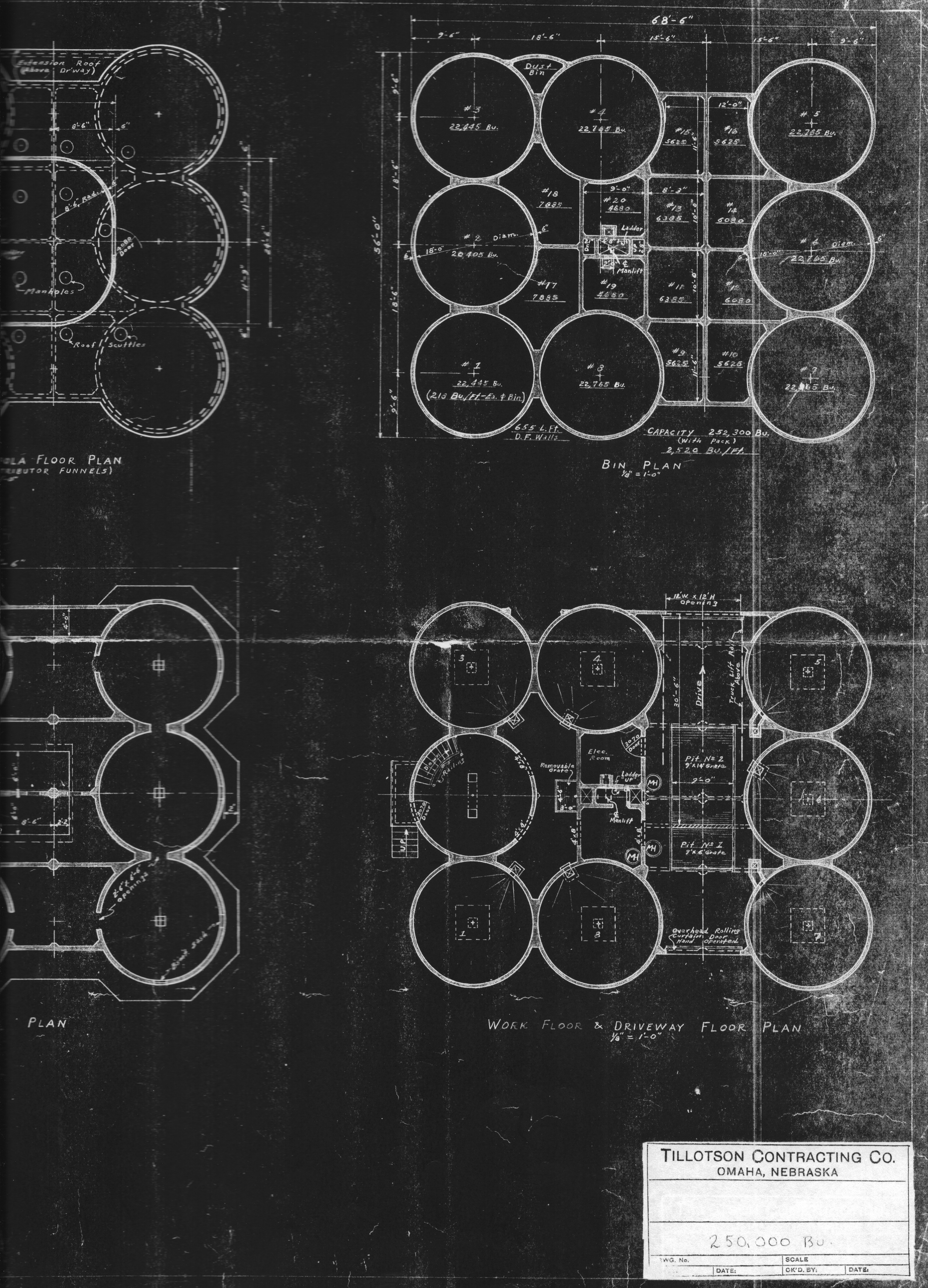
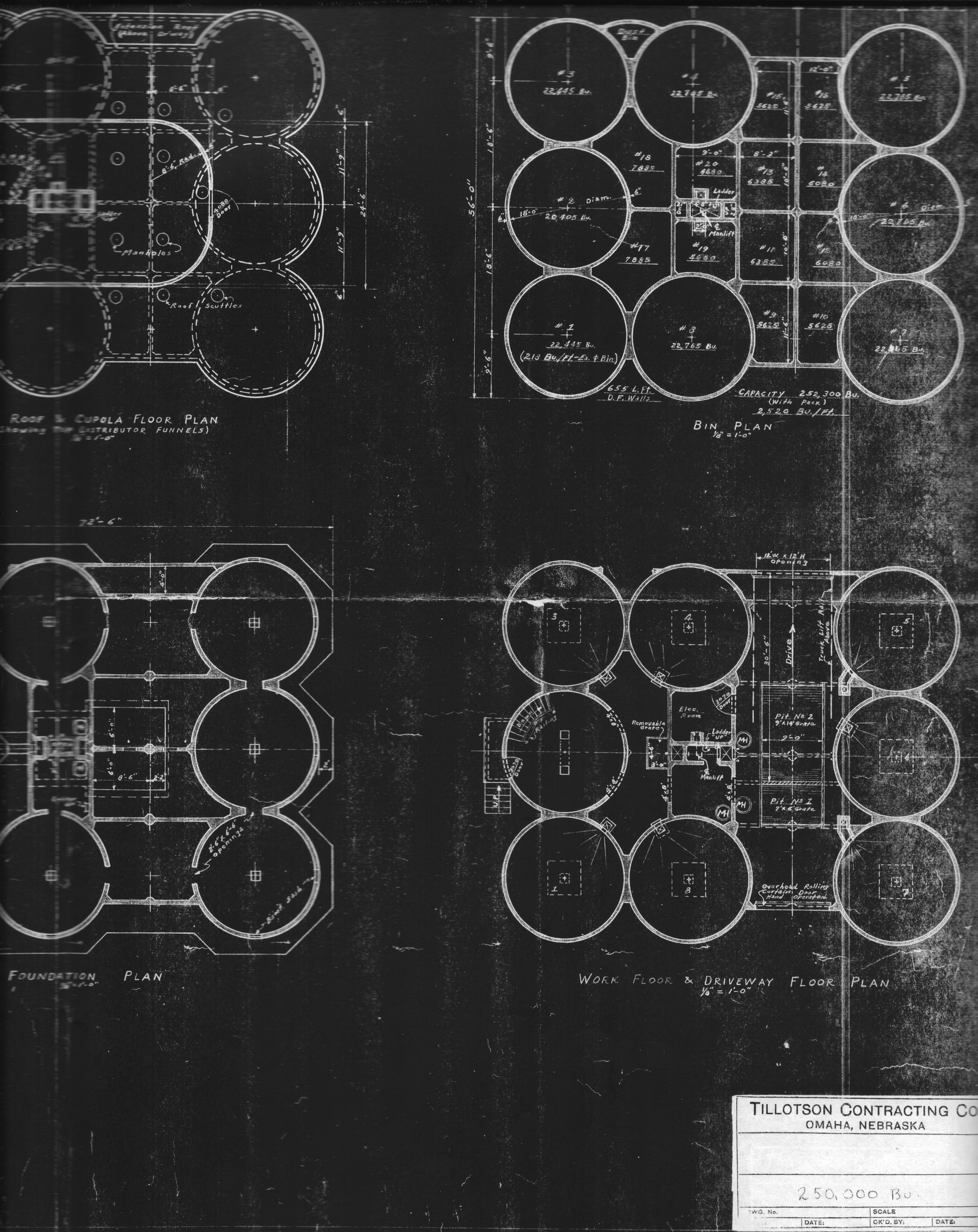
Drawings for an elevator of 250,000-bushel capacity with bin plan and schedule

Here in sharp detail, at the scale of one-eighth-inch to one foot, we have drawings for a 250,000-bushel Tillotson elevator. The bin plan gives capacity at 252,300. Tillotson Construction Co. built many elevators of this capacity, although we can’t determine how many of them adhered to the drawings we see here.

The level of detail is exceptional. In the cross-section, we see a stairway and its railing, an interior ladder (apparently in the manlift channel), basement window sash, 7.5-horsepower Ehrsam truck lift and hand-operated rolling curtain door, port for inspection of the leg, and the 72×14-inch head and boot pulleys. A note on the lower left says “Future 3 hp – 14″ conveyor,” and broken lines indicate its course. Another note to the left indicates “10[-inch] well casing”. Another note near the top of this channel says, “Rad. Dist. to 3 bins & Loading Spout & Driveway.” This we take to mean radial distribution.

The “car” at far left presumably represents a rail car.

The drawform walls of the tanks (silos) are 120 feet high.

The cupola is 40 feet high and 50 feet 3 inches long. We learn that inside it, a 40-horsepower Howell head-drive turns the head pulley at 42 revolutions per minute. The leg’s 14-inch, six-ply belt has cups of 12×6 inches for a leg capacity of 6,300 bushels per hour.

Another note and a zig-zag arrow indicate “Top of Manlift Travel” and two-horsepower Ehrsam manlift.

Detail drawings inside the cupola show the intake and exhaust for the three-horse exhaust fan. Made of 14-gauge steel, the spouting is 10 inches in diameter. Another notation and additional broken lines indicate “Future 2,500 bu. Hopper Scale.” This is near the automatic scale and the grate platform.

Other plans–each with its own details–are for the roof and the cupola floor, bins, foundation, and work floor and driveway.

Drawings for an elevator of 254,000-bushel capacity with bin plan and schedule

The drawings we have in hand from Tillotson Construction Co. include this plan for a 254,000-bushel reinforced-concrete grain elevator.

While the company built a number of elevators rated at 250,000 and 252,000 bushels, these were likely based on different drawings.

Otherwise, the records show just one elevator of 254,000 bushels–that’s 254,104 bushels, to be exact. It was built in 1950 at Palmer, Iowa.

A 252,000-bushel elevator went up the year before at nearby Pocahontas, Iowa.

The Palmer job was a single-leg elevator with 115-foot-tall tanks (silos) and a cupola measuring 23x60x40 feet. Fully loaded, its gross weight was 12,975 tons.

A dryer bin was included at the time of construction.

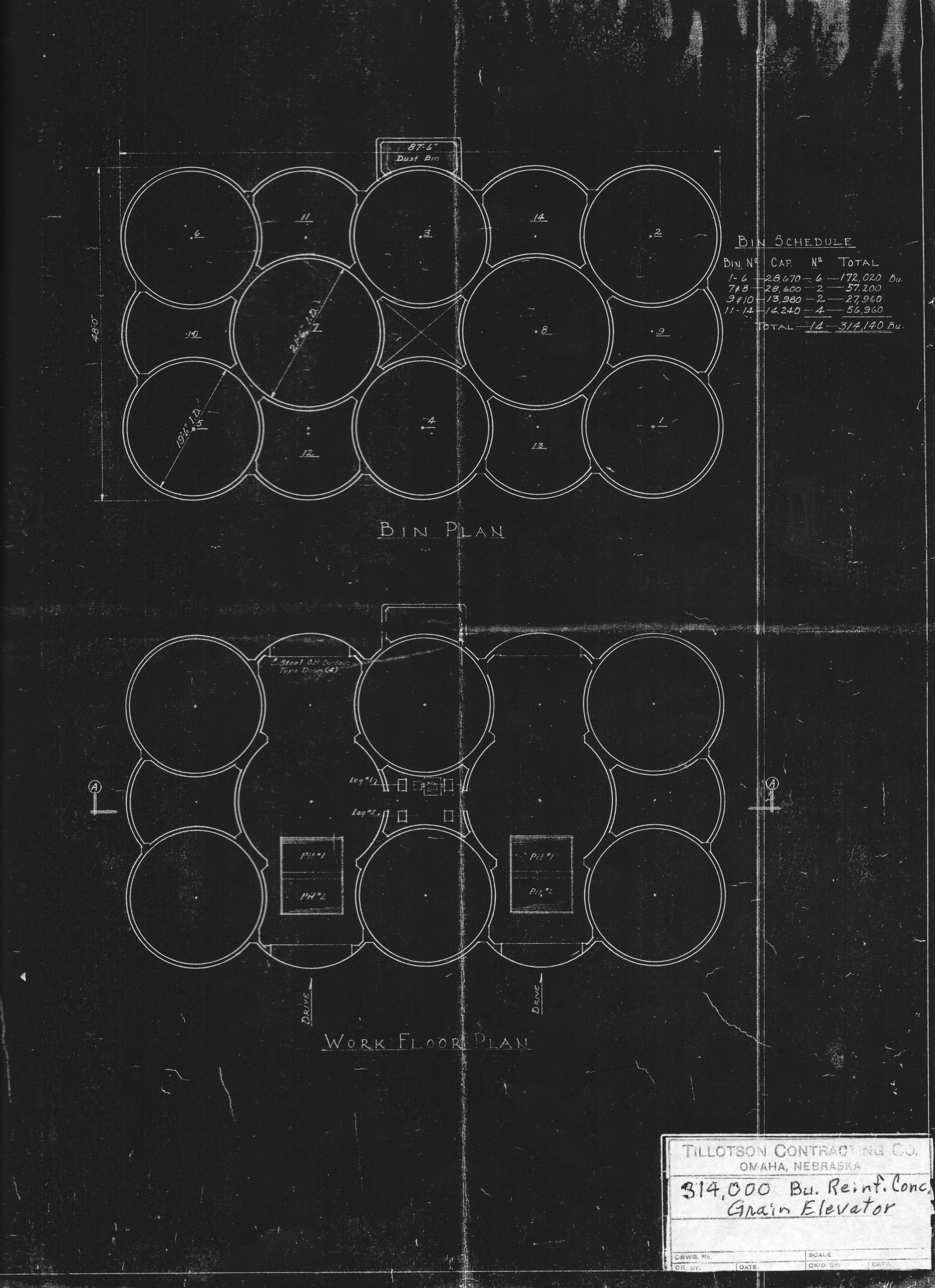
Drawings for an elevator of 314,000-bushel capacity with bin plan and schedule

Records show that Tillotson Construction Co., of Omaha, built a few reinforced-concrete elevators with capacity of more than 300,000 bushels. The drawings posted here depict the outlines of a 314,000-bushel elevator with two legs.

The first was a twin-leg, 350,000-bushel job on an original plan at Farnsworth, Tex., in 1945.

Next–310,000 bushels, also on an original plan–came four years later, in 1949, at Dalhart, Texas.

1950: Canyon, Tex., and Bellwood, Neb., on a shared plan for 320,000 bushels. That same year, Rock Valley, Iowa, came close at 296,130 bushels. And the Vinton Street terminal, in Omaha, was completed at 382,880 bushels.

1951: Sunray, Tex. added a 550,000-bushel annex with 14 tanks (silos) of 20 feet in diameter. Hereford, Tex., welcomed a 300,000-bushel elevator on its own original plan, and York, Neb., did the same–also an original plan–with 336,000 bushels that same year.

1953: Cherokee, Okla. (original plan) 309,400 bushels; Ralston, Iowa (original plan) 537,500-bushel annex with eight tanks of 28 feet in diameter reaching to 115 feet in height; Estill, S.C. (original plan) with 10 tanks of 18 feet in diameter reaching to 120 feet. (The year earlier, Tillotson had built 225,000 bushels of storage at Estill.)

1954: Orienta, Okla. (original plan) 312,000 bushels with 10 tanks of 20 feet in diameter towering 114 feet nine inches; Bellwood, Neb. (original plan) 340,000 bushels with 10 tanks of 20 feet in diameter and 130 feet in height; Iowa Falls, Iowa (Bellwood plan) 321,000 bushels of 122 feet (no other information is included in the records); Glidden, Iowa annex of 331,000 bushels (incomplete entry); Ensign, Kan. annex (original plan) 319,830 bushels with 11 tanks of 19 feet in diameter and 118 feet in height.

Tillotson built no elevators of such great capacity in 1955, the year our records end.

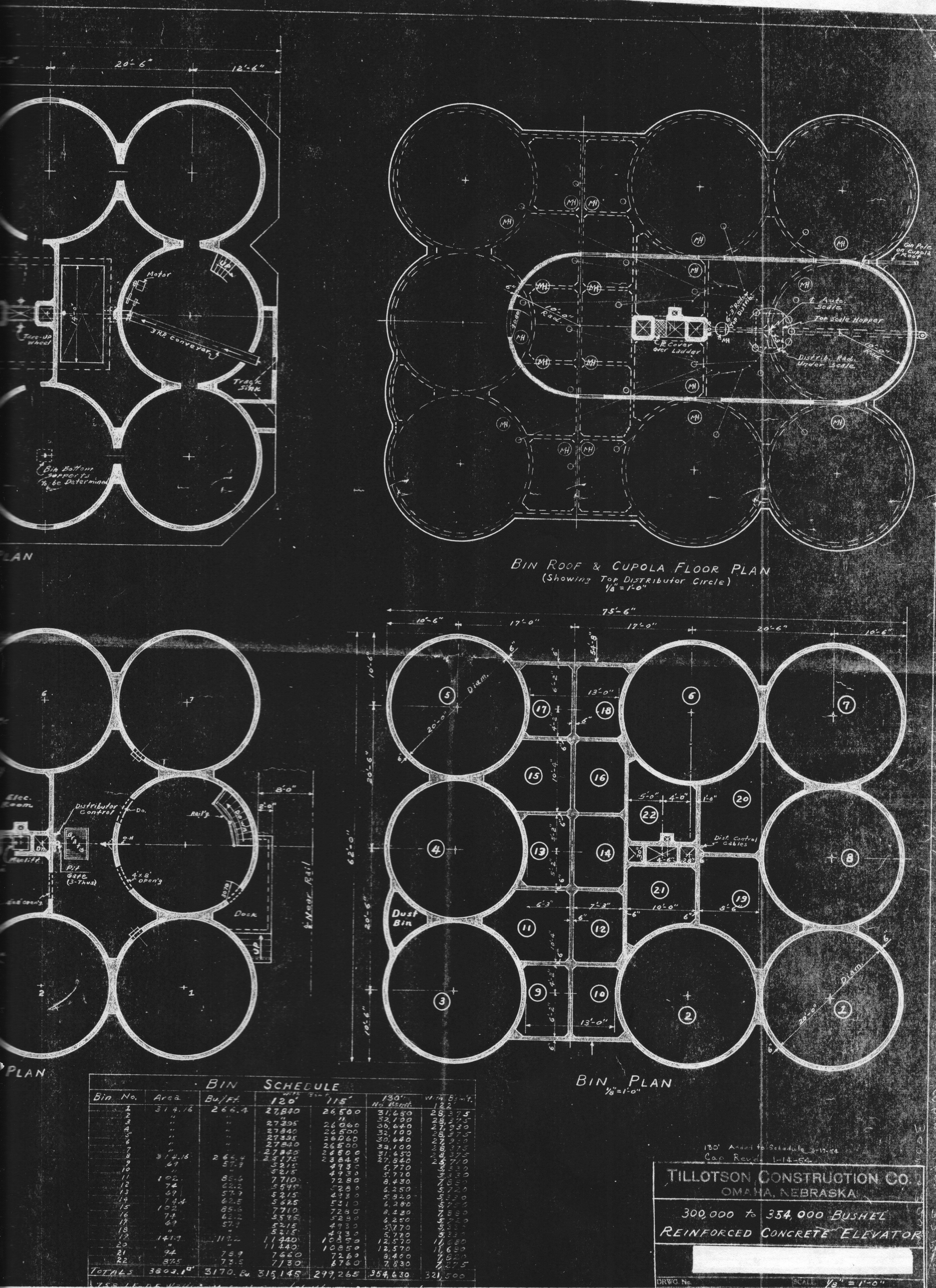
Drawings for an elevator of 300,000- to 354,000-bushel capacity with bin plan and schedule

Records show that Tillotson Construction Co., of Omaha, built a few reinforced-concrete elevators with capacity of more than 300,000 bushels. The drawings posted here depict the outlines of a 314,000-bushel elevator with two legs.

The first was a twin-leg, 350,000-bushel job on an original plan at Farnsworth, Tex., in 1945.

Next–310,000 bushels, also on an original plan–came four years later, in 1949, at Dalhart, Texas.

1950: Canyon, Tex., and Bellwood, Neb., on a shared plan for 320,000 bushels. That same year, Rock Valley, Iowa, came close at 296,130 bushels. And the Vinton Street terminal, in Omaha, was completed at 382,880 bushels.

1951: Sunray, Tex. added a 550,000-bushel annex with 14 tanks (silos) of 20 feet in diameter. Hereford, Tex., welcomed a 300,000-bushel elevator on its own original plan, and York, Neb., did the same–also an original plan–with 336,000 bushels that same year.

1953: Cherokee, Okla. (original plan) 309,400 bushels; Ralston, Iowa (original plan) 537,500-bushel annex with eight tanks of 28 feet in diameter reaching to 115 feet in height; Estill, S.C. (original plan) with 10 tanks of 18 feet in diameter reaching to 120 feet. (The year earlier, Tillotson had built 225,000 bushels of storage at Estill.)

1954: Orienta, Okla. (original plan) 312,000 bushels with 10 tanks of 20 feet in diameter towering 114 feet nine inches; Bellwood, Neb. (original plan) 340,000 bushels with 10 tanks of 20 feet in diameter and 130 feet in height; Iowa Falls, Iowa (Bellwood plan) 321,000 bushels of 122 feet (no other information is included in the records); Glidden, Iowa annex of 331,000 bushels (incomplete entry); Ensign, Kan. annex (original plan) 319,830 bushels with 11 tanks of 19 feet in diameter and 118 feet in height.

Tillotson built no elevators of such great capacity in 1955, the year our records end.

Drawings for an elevator of 50,000- to 100,000-bushel capacity with bin plan and schedule

“Sorry these are printed with margin on wrong end,” write Uncle Tim Tillotson after copying the elevator plans in his possession.

“Was busy unfolding and folding the old originals for the [printshop] guy because he tore the first print I handed him (on fold line) just unfolding it. They came out of printer 3 feet long. Didn’t realize Boo-Boo till I got home. Too much $ to re-do!”

Nevertheless, we benefit from Uncle Tim’s efforts and from our cropping tool, which lead to this series of posts with all plans from that printing session.

Specifications from Alta, Iowa and drawings of a likely model for that elevator

In response to a reader’s question, we are posting some basic specifications of the Alta, Iowa, elevator that Tillotson Construction Co. built in 1950. (Plans alter between “Tillotson Contracting Co.” and “Tillotson Construction Co.”

The drawings seen above are Tillotson’s standard plan for a 250,000-bushel elevator with eight tanks (silos).

Capacity at Alta was 246,070 bushels. The eight tanks of 18 feet in diameter sat on a main slab of 60.0 by 73.5 feet. The driveway was 13 x 15 feet.

The walls of the tanks rose 115 feet from the slab, and they were topped by the cupola measuring 23.0 feet wide, 61.5 feet long, and 39 feet high. That brought the structure up to 154 feet–quite imposing.

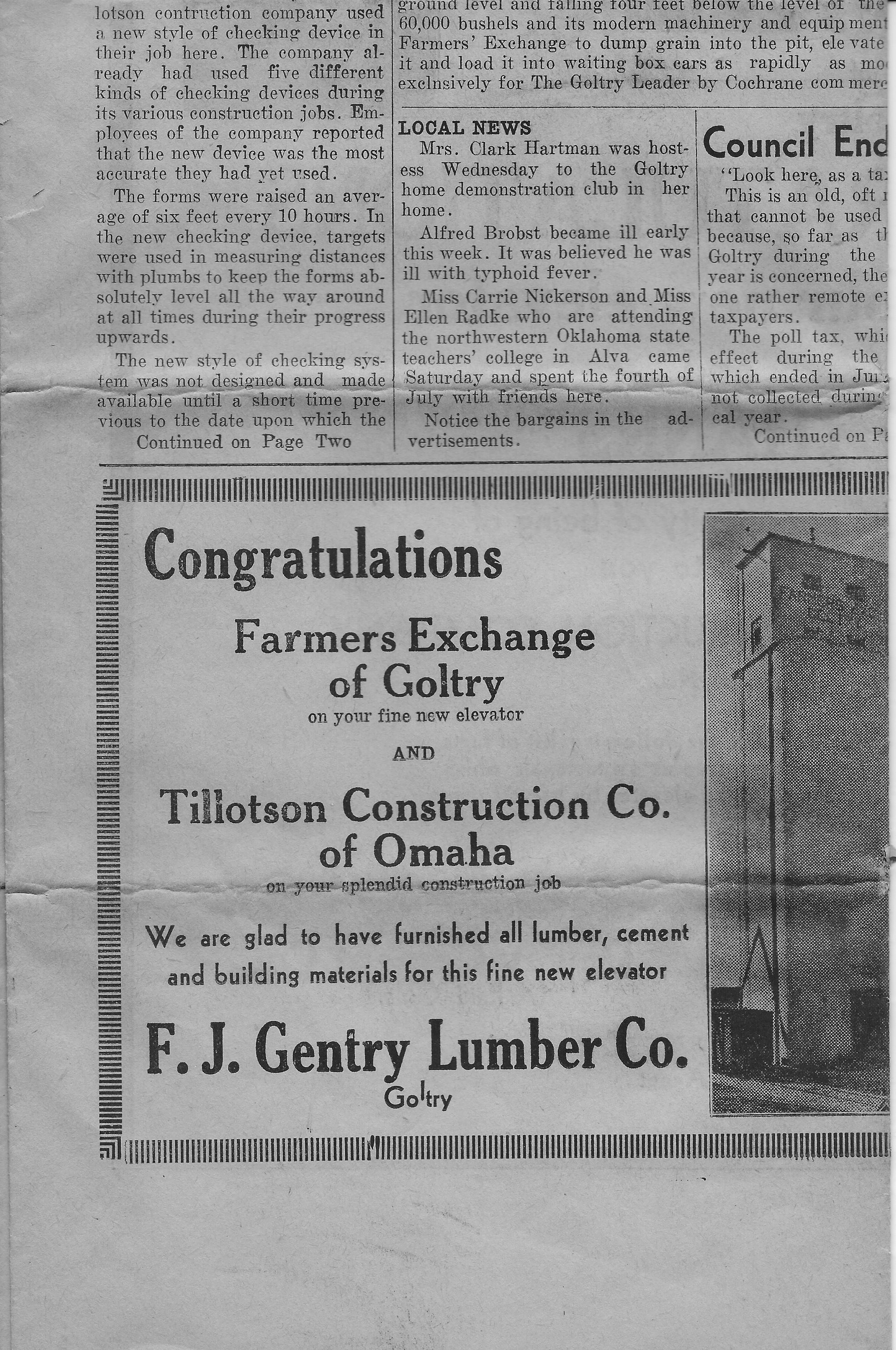
Goltry hails the new grain elevator in July 6, 1939 issue of the Leader newspaper

Grain Building Is the Work Of Omaha Firm

One of the largest wheat crops ever yielded by this section of the northwestern Oklahoma wheat belt was dumped into Goltry’s new 60,000 bushel elevator built for the Farmers’ Exchange of Goltry by the Tillotson construction company of Omaha, Nebraska,

The construction company operated by R.O and J.H. Tillotson, brothers, designers of modern concrete buildings, both of whom were in Goltry at various times during the progress of the building, was awarded the contract March 15. Shortly afterwards a crew of local workers began digging the pit, the first step in the actual construction of the new building.

Wheat was being dumped into the elevator at a time when the harvesting of wheat in this section was only beginning while electricians and skilled workers for the construction company were giving the building its finishing touches.

After the pit had been dug, a crew of 45 men–part of them local persons–was put to work by the company. Carpenters were building slip forms into which concrete was poured. The forms were four feet in height. As concrete was poured, the forms were moved upwards.

The forms were raised with jacks of which there were 48. All 48 jacks were turned by four men. Two turns of the jack screw raised the forms an inch and the jacks were turned in almost continuous operation.

The level of the forms was checked every hour in an effort to insure absolute accuracy. The Tillotson construction company used a new style of checking device in their job here. The company already had used five different kinds of checking devices during its various construction jobs. Employees of the company reported that the new device was the most accurate they had yet used.
The forms were raised an average of six feet every 10 hours. In the new checking device, targets were used in measuring distances with plumbs to keep the forms absolutely level all the way around at all times during their progress upwards.

The new style of checking system was not designed and made available until a short time previous to the date upon which the company began the Goltry job.

Before superintendent W.B. Morris, whose home is in Kansas City, left the job, 150,000 bushels of wheat had been put through the elevator. More than 85 carloads had been loaded from the elevator before Morris left. Each carload amounts to an average of 1,800 bushels. The machinery and equipment in the elevator were operating perfectly before the last of the company’s workers and the superintendent left the job.

“Everything ran smoothly with never a touch of trouble,” Morris, superintendent of the Goltry job for the Tillotson construction company, said.

A large amount of the responsibility for seeing that the day by day progress of the building was not interrupted at any time was delegated to Morris. However, Morris gave a great deal of the credit to the entire group of workers which included a number of local men. Morris said his company had “the best cooperation among the men working for us. We appreciate the interest shown by the people of the community and the efforts the men put forth endeavoring to keep the job going at the proper speed at all times,” Morris said.

The new elevator is 120 feet from the bottom of the basement to the top. The basement is four feet below the ground level and seven and a half feet below the floor. The capacity is 60,000 bushels.
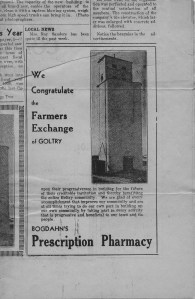
A truck lift on the first floor of the elevator picks up trucks with ease in the process of dumping grain from the trucks into the pits. The new style of truck lift will not catch the radiator or damage the truck in any way.

Two pits into which grain is dumped hold 1,200 bushels. The first pit holds 850, the second 450.

Legs motivate the belt and cups and such a speed that the grain is elevated upwards into the bins at a rate of 60 bushels per minute.

At the top of the building, an automatic scale dumps 60 bushels per minute. The scale hold 10 bushels and automatically drops six times per minute.

A blowing system cleans wheat and sends the dust and chaff and foreign particles down a chute and into a compartment just above the first floor. At intervals this compartment is dumped into a truck and hauled away.

A fast cage type man lift–one of the fastest man lifts to be found in an elevator of the size of the new Goltry building–hoists the workers upward to the top of the building at a time saving rate of speed.

Among the various types of men working on the job–of which there were as many as 45 at the time the crew was running slip forms–were electricians, concrete workers, steel men, jack men, hoisting engineer, concrete mixer operator, finishers who smoothed the walls and the floors, painters, buggy men and wheel barrow men.

Front page caption:

Goltry’s new modern elevator building (above), built for the Farmers’ Exchange of Goltry by the Tillotson construction company of Omaha, Nebraska, is 120 feet in height, rising 116 feet above the ground level and falling four feet below the level of the ground. The capacity of the new building is 60,000 bushels and its modern machinery and equipment, all brand new, enable the operators of the Farmers’ Exchange to dump grain into the pit, elevate it, clean it with a modern blowing system, weigh it and load it into waiting box cars as rapidly as modern high speed trucks can bring it in. Photo exclusively for The Goltry Leader by Cochrane commercial photographers.

Inside page caption:

Approaching Goltry from the west a person would be afforded this view of the new Farmers’ Exchange elevator building (above) towering 116 feet toward the sky, its smooth, white walls reflecting with added brilliance the dazzling rays of the midsummer, afternoon sun. (Photo exclusively for The Goltry Leader by Cochrane commercial photographers).
Rain delays and balky formwork hindered Grain Storage Construction Co. at Ceresco, Neb.

Lincoln Journal Star, Friday, Sep. 18, 1959

Grain Storage Construction Co. benefited from the expertise of Ted Morris, who had been employed by Tillotson Construction Co. As Tillotson’s activities declined in the late-1950s, the GSCC, of Council Bluffs, Iowa, stepped in to undertake construction of new grain elevators.

Here is news from the Fremont (Neb.) Tribune on July 24, 1959 as the company’s crew built an elevator of reinforced concrete next to a traditional wooden elevator at Ceresco, a village just 20 miles north of the Nebraska Capitol building in downtown Lincoln.

Weather, Difficulties Delay Bin Construction at Ceresco

CERESCO–The Farmers Cooperative Association’s new, 250,000-bushel capacity grain elevator being constructed here by Grain Storage Const. Co. of Council Bluffs, Iowa, is expected to be completed by Sept. 1, according to project foreman Doyle Elliott.

The elevator will have 120-foot high storage tanks, topped by a 42 1/2-foot scale house. Tank construction is one third complete.

* * *

Construction of the new elevator started April 1, but work progress was hampered by a lengthy rain spell during the initial weeks. Difficulty with the hydraulic hoists, which raise the movable wood form after concrete has been poured, caused a brief shutdown of pouring operations.

The wood frame held too tightly in some places and left a few unfilled pockets in the concrete shell of the storage tank walls. Construction workers are patching up the pockets and new concrete pouring should begin sometime next week.

Once the pouring begins the tank walls can be built up at the rate of 16 feet every 24 hours. “Most people judge progress in elevator construction by the outside appearance,” said Elliott. “They do not realize how much inside work has to be accomplished before you can proceed safely with the exterior work,” he added.

“We hope the elevator will be ready by Sept. 1,” said Farmers Co-op Assn. manager Leonard Palm. “We would like to get this year’s corn crop in. I think we will make it as there have been no serious construction flaws or delays so far,” he added. 

Editor’s note: Based on the Sep. 18, 1959 date of the Lincoln Journal Star’s photo and caption (top), GSCC did not manage to complete the elevator by the date the Co-op had hoped for.

We thank our friend Susan Allen for unearthing the clippings.