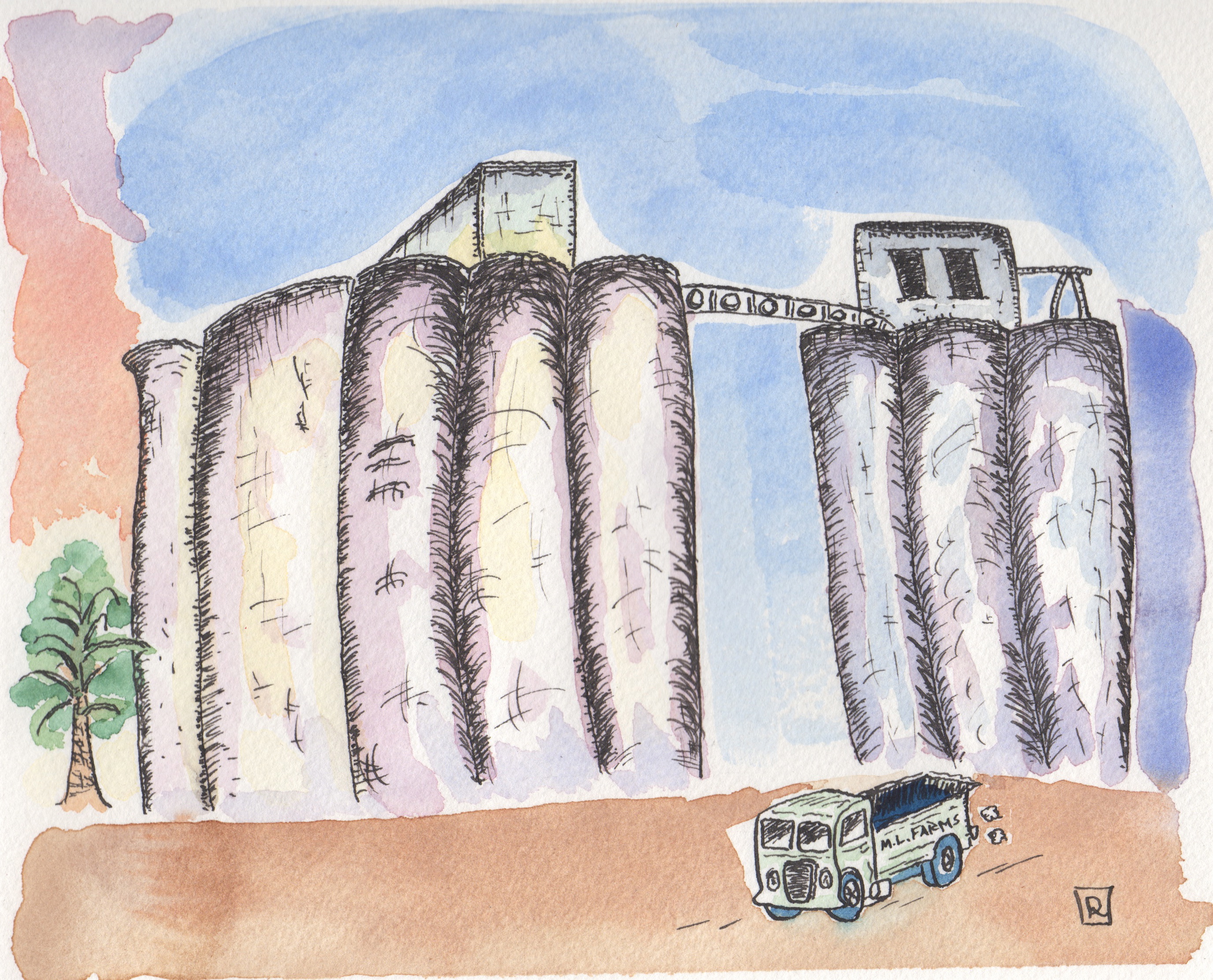
Mayer-Osborn’s new elevator will tower over the Burlington tracks at Roggen

Photos by Gary Rich

Excavation will start Monday morning on a strictly modern 250,000 bushel grain storage plant at Roggen to be constructed for the Farmers Grain & Bean association, a farmers cooperative. The association stores and markets at Roggen the grain grown by hundreds of southeastern Weld county wheat growers.

The new building will tower 160 feet in the air and architects’ drawings show that its beauty will equal its great utility. Mayer Osborn company of Denver has the general contract for the elevator.
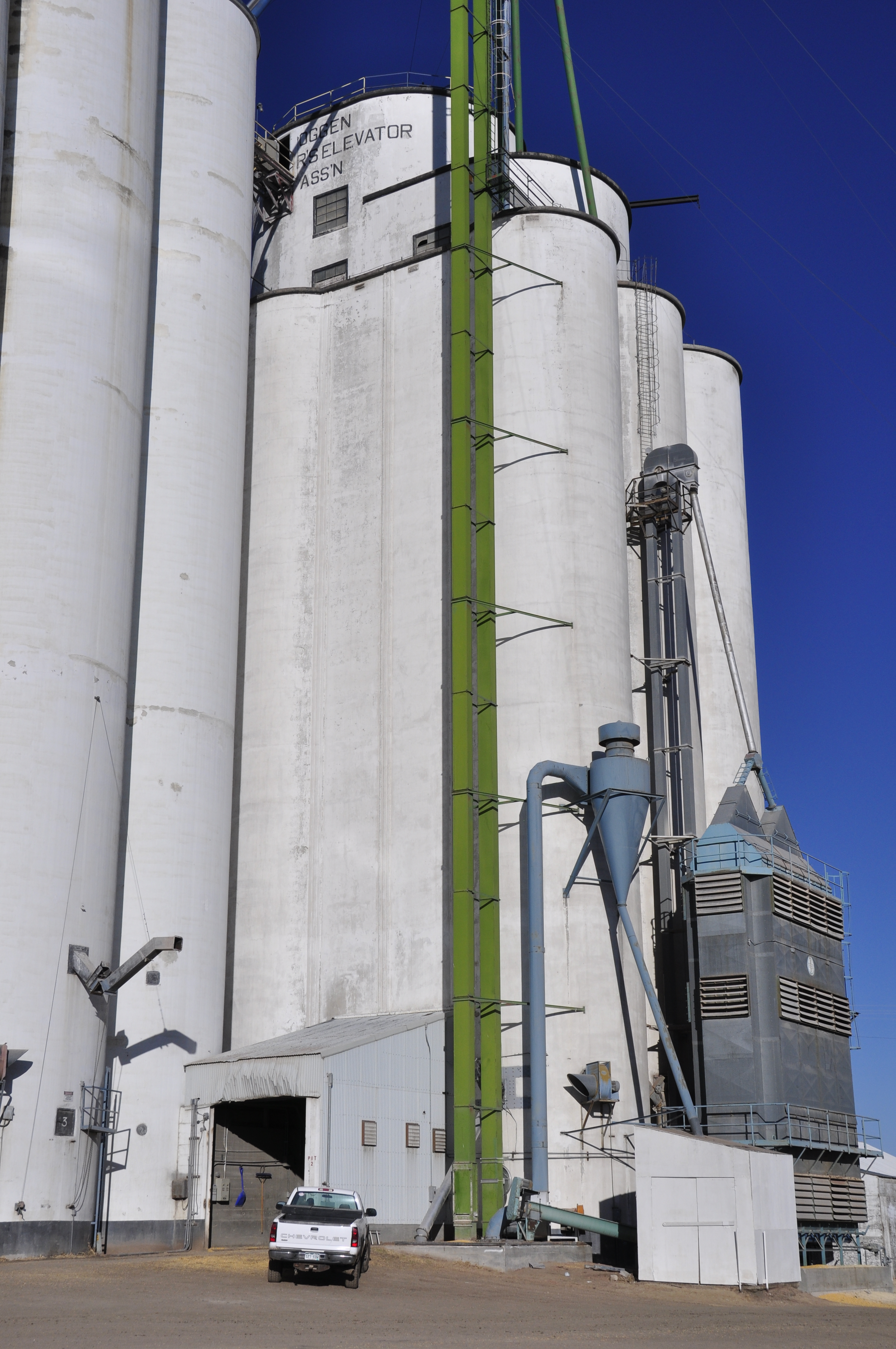
Site is 50 feet east of the present 80,000 bushel elevator of the association. Both elevators are served by the main line of the Burlington railroad.

Construction will be of concrete and steel of multiple slip design. Capacity can be enlarged indefinitely from year to year as need arises.

Marvin Jones, manager of the Farmers Grain & Bean association, said Friday night that the company is also building a similar but smaller structure at Byers on the Denver Kansas City line of the Union Pacific east of Denver. Byers elevator will hold 150,000 bushels.

Jones said that the new elevator will be ready for use by the time the 1950 harvest starts. He said the wheat crop in the Roggen, Kiowa and Prospect districts is looking fine. He said there had been very little damage from wind and that this was confined to the sandier soils of the district.

Present elevator of the association at Roggen will be kept in use giving the association 880,000 bushel storage at Roggen. Allowing 1500 bushels to a carload this is the equivalent of 220 carloads capacity.

The Greeley (Colo.) Daily Tribune, April 6, 1950

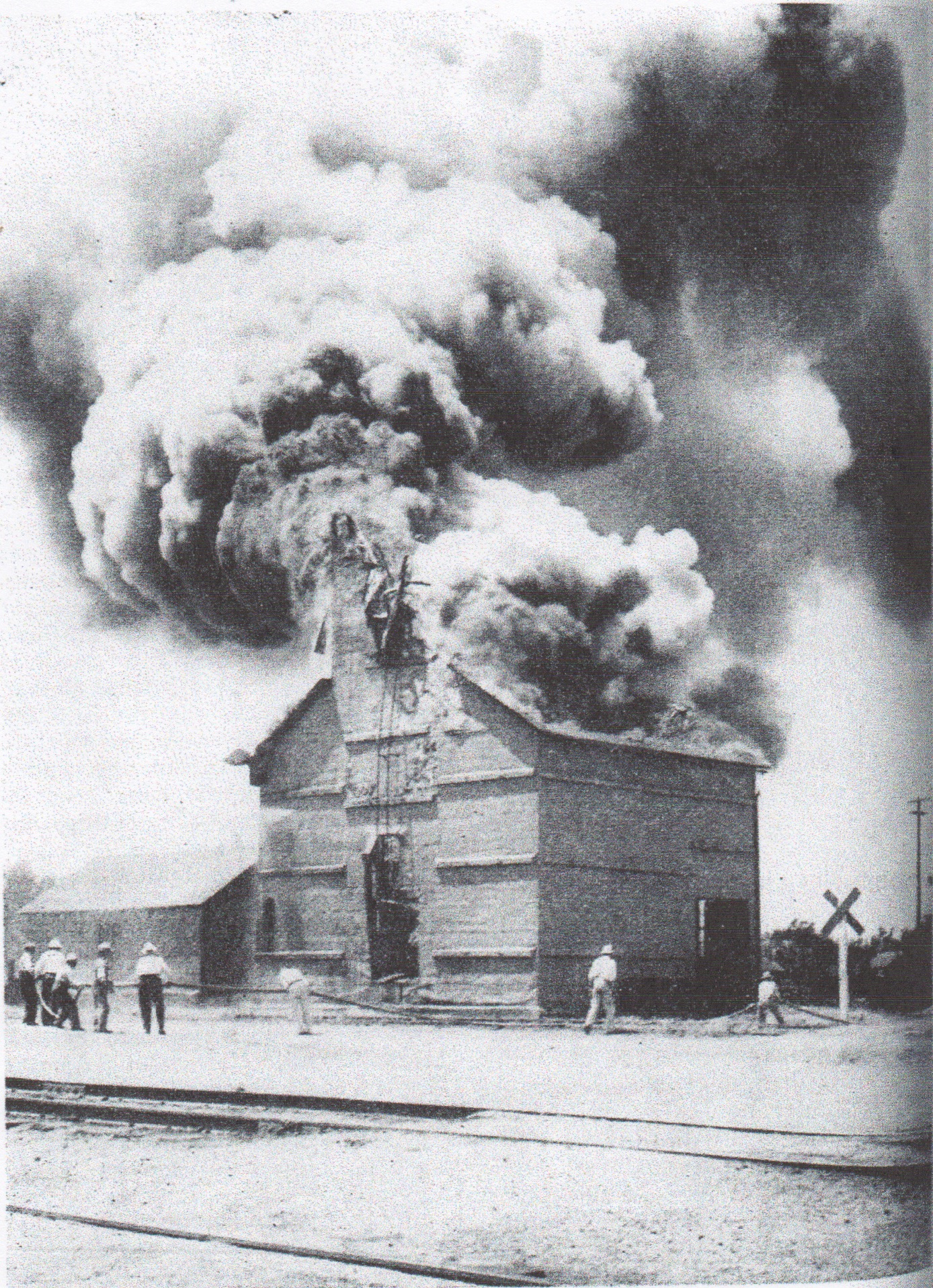
Listing fire perils to wooden elevators highlights pluses of slip-formed concrete

This photo appeared with Mr. Gustafson's cautions in 1939.

By Ronald Ahrens

Concrete grain elevators offered more to the local farmers’ cooperatives than greater storage capacity: the risk of fire was vastly reduced, too. Several of the construction notices on this blog, for instance, one about the new elevator in Wapello, Iowa, point out that the new slip-formed elevator was replacing a wooden one destroyed by fire. A 1957 press photo available on eBay for $15, which is beyond our budget, shows the smoldering ruins of a wooden elevator beside an unscathed concrete one.

An October 5, 1939 article in Farmers’ Elevator Guide listed the gamut of threats to a wooden elevator. The occasion was national Fire Prevention Week. C.W Gustafson, chief engineer of the Mill Mutual insurance company’s Fire Prevention Bureau, wrote that “grain elevators are unfortunately one type of plant in which fire prevention is a year ’round problem rather than one which requires special attention only one week out of the year.”

Mr. Gustafson’s list started with the advice that bearings in the elevator head and conveyor belts should be oiled daily in order not to overheat. “It is not sufficient to simply ‘slop’ oil on the bearing, but the oiler should make certain that the oil actually reaches the interior where it will do some good,” he wrote.

Other important no-no’s:

  • No smoking: “We often see farmers congregated in the elevator driveway or approaches and the tendency to discard cigarette and cigar stubs and matches without regard for their ultimate resting place is evident.”
  • Bad housekeeping: neatness improves safety.
  • Overworked electric motors: they should be cleaned weekly with compressed air, Mr. Gustafson wrote, and if blown fuses are a problem, a “competent electrician” should be called in if available.
  • Elevator legs: check that the head pulley is operating smoothly and the belt isn’t rubbing against the legging.

The following passage deserves to be delivered whole.

When dumping trucks
Request the driver to shut off the motor of his truck. Considerable oil and gasoline is usually spilled in the driveway, particularly from gravity feed truck engines and ignition of this accumulation by sparks from exhaust or backfire would result in a fire difficult to extinguish. Signs calling attention to this rule are available from your Mill Mutual insurance office.

Nowadays, we don’t notice trucks leaking as much fuel as in 1939.

Mr. Gustafson’s practical advice concluded with the suggestion that the elevator operator return in the evening after supper to look in the cupola and basement to see that all is well. “Many fires are detected by observing this rule,” he wrote.

Pulling the switches on lighting and power circuits when leaving was a final recommendation.

Greenwood elevator welcomes 250 at open house

Photo by Kristen Osborn Cart

GREENWOOD (Nebr.)–The Farmers Union Cooperative Association held open house at the new concrete elevator which has capacity for 128,000 bushels of grain. Manager Floyd H. Gove and assistant M.L. Griffith conducted 250 through the plant. Doughnuts, cookies and coffee were served in the basement.Farmers’ Elevator Guide, November 1951

Approval and completion of a concrete elevator in Pocahontas, Iowa

POCAHONTAS–The Farmers’ Cooperative Elevator has approved final plans for construction of a 250,000 bushel storage plant. The new elevator will consist of eight tanks, 20 feet in diameter and 120 feet high with a cupola to project more than 20 feet above the tanks. Each of 17 bins will hold about 15,000 bushels. Their present elevator has a capacity of 60,000 bushels while the Havelock branch elevator holds 40,000. The new plant should be finished about Sept. 1.Farmers’ Elevator Guide, June 1949
POCAHONTAS–The New 250,000-bushel concrete elevator which cost the Farmers Cooperative association $125,000 is completely filled with soybeans stored for customers and corn stored for the government. The structure is 120 feet high. The Pocahontas cooperative, one of the leading groups in northwest Iowa, plans to build a new truck scale, a new office and a new (illegible) house next spring.Farmers’ Elevator Guide, December 1949
Note: Tillotson Construction Company worker Larry Ryan fell to his death here in 1954.

This map shows the incorporated and unincorpor...

Big Springs adds 320,000-bushel storage elevator

Photo by Kristen Osborn Cart

BIG SPRINGS–Work on the 320,000-bushel storage elevator is about completed here, giving the Farmers Cooperative Elevator Association of Denver, Colo., a plant with 20 bins, 130-feet high. The elevator with headhouse is 165 feet high. The building is concrete.

Farmers’ Elevator Guide, September 1951

Note:  It isn’t known at the time of this posting which construction company did the project.

Tillotson Construction completes Big Springs sorghum plant

Photo courtesy of Farmers Elevator Coop Association

BIG SPRINGS–The Tillotson Construction Co., Hastings, Neb., has completed a $40,000 building for the Farmers Cooperative Elevator sorghum plant.

Farmers’ Elevator Guide, August 1951

Note: A conversation today with Larry McCroden, long-time manager of the Big Springs Farmers Coop Elevator, reveals additional information about the facilities. Mr. McCroden consulted tax documents that showed “Elevator A” had a value of $184,432 and “Elevator B” had a value of $25,100. He said the twenty original bins of Elevator A stand about 115 feet tall, and the two-tiered headhouse reaches to 170 feet. The documents give January 15, 1951 as the date of service for the two.

Later additions were made to the original structure, increasing storage capacity by hundreds of thousands of bushels.

Mr. MrCroden said the elevator at Roggen, Colorado, bears many similarities to Big Springs.

Additional note: We don’t know why Hastings, Nebraska is given as the location of Tillotson Construction Co., which had its headquarters in Omaha.

Tillotson gets 50,000-bushel Paullina elevator under way

Paullina elevator complex, Dec. 9, 2009, by Jim Hamann

PAULLINA (IOWA)–A new concrete elevator is under construction to replace the Paullina Grain Co. elevator destroyed by fire. The new one will be 103 feet high, containing 18 bins. All new machinery, including a 50-ton scale, will be installed. Capacity will be 50,000 bushels.

Farmers’ Elevator Guide, June 1949

Government price supports, loan guarantees led to proliferating grain elevators

By Ronald Ahrens

I see why grain elevators proliferated like mad–like mice, actually–starting in 1949.

This happened before Ezra Taft Benson, the crusader against Socialism, became Secretary of Agriculture in 1953, so the trend can’t be attributed to Mormon food-hoarding instincts in the face of Doomsday.

Here’s the story: Section 417 of the Agricultural Act of 1949 made an extra $8 million in cheap loans available to farmers’ cooperatives through the Commodity Credit Corporation.

150

Ezra Taft Benson, Ag Chief

The United States Department of Agriculture figured the private sector wasn’t keeping pace in grain storage as farmers realized increasingly bountiful crop yields. The USDA stepped in to provide the incentive to build storage capacity. The government price supports had resulted in hundreds of millions of bushels going nowhere.

Washington’s policy of building “warehouse” capacity was of enormous benefit to established outfits like Tillotson Construction Company and J.H. Tillotson, Contractor. For the principals, like my grandfather, Reginald O. Tillotson, it became a matter of  dashing between farflung towns in order to make his sales pitch. And the CCC also breathed life into new organizations like Mayer-Osborn Company.

Given certain conditions, the loans–which were extended through the government’s Banks for Cooperatives–were  intended to cover up to eighty percent of construction costs, with the rest funded by local sources. The eighty percent would cover $100,000 of what looks like an  average cost of $125,000 around then, so we’re talking about eighty new elevators in a year’s time.

And that’s in addition to what supposedly would’ve been ordered in normal periods, although who would turn down a government subsidy and pay retail?

Indeed, I’ve already heard one story of a group forming, with maybe five businessmen kicking in $5000 each, to take up the government’s kind offer, not caring about the disposition of the grain after the three-year guarantee (on new storage) ended.

The CCC pledged it would use seventy-five percentof the additional capacity. And farmers were lining up to sell to the CCC. Indeed, build it and they will come. The more of the subsidized canisters that the government provided, the more that was needed.

United States Department of Agriculture buildi...

United States Department of Agriculture

“The possibility that 1950 will present another storage crisis is evidenced by the latest report of the Department of Agriculture, which shows that as of Nov. 1, farmers had put approximately 353,746,480 bushels of 1949-crop[s] … under CCC price support,” reported the Farmers’ Elevator Guide in December of 1949. “This was nearly 100,000,000 bushels more than with 1948-crop produce.”

Meanwhile, the government had frozen construction of commercial buildings other than hospitals, churches, and schools. So while the traditional construction companies were fighting over those slim pickins, the Tillotsons and Mayer-Osborn, with their specialized knowledge in shaping, reinforcing, and pouring concrete, dashed back and forth like bees, covering the land from Alberta to South Carolina.

They knocked together slip-forms and jacked their way up beyond 100 feet, grinning the whole way.

One of Tillotson’s biggest elevators under way in Dallas Center

Photo by Don McLaughlin on April 11, 2010. Click on the photo to visit his photostream.

DALLAS CENTER–Work has started on a 250,000-bushel concrete elevator for Dallas Center Farmers Cooperative Company. It will be 166 feet tall and is being built by Tillotson Construction Company at a cost of $151,000.

Located west of the firm’s south elevator, it is 56×70 in base dimensions.

Aeration equipment will be included in each of the ten 23,000-bushel bins, Manager Don Brown reports.

Farmers’ Elevator Guide, circa September 1955

Dallas Center

Photo by Pete Zarria, April 1, 2011. Click the image to visit his photostream.

See another recent images from Dallas Center: 

January 7, 2012

This map shows the incorporated and unincorpor...

In Hutchinson, foundries create cast of thousands of manhole covers

Castings Plants Held Not Needed

Hutchinson’s industrial development is apparently not wanting in respect to foundries and the manufacture of metal castings.

Interviews with managers of two local firms bear this out. Frank Hulet of M.W. Hartmann Manufacturing Co., 120 North Adams, and Joe O’Sullivan, Sr., of Hutchinson Foundry and Steel Co., Washington and D, both report the Hutchinson market does not near utilize their capacities for production.

“We have more capacity available than is being utilized by local firms,” said Hulet. His company produces gray iron, alloy iron, brass, bronze and aluminum castings. In 1957 they produced 600 tons of gray iron and alloy castings. They did business in Oklahoma, Colorado, Texas, Nebraska and Missouri.

Hulet pointed out that at the present time they are capable of producing over twice that amount. The company has a second plant at 400 West 2nd in Hutchinson.

M.W. Hartmann Manufacturing Co. makes castings for such industries as hydraulic, agricultural, farm equipment, oil field and municipal. “We furnish our own castings, too,” Hulet said.

O’Sullivan said the work of the Hutchinson Foundry and Steel Co. deals principally with municipal and farm implement castings. They also make iron water well screen.

“The local demand is not over 20 per cent of our production for this area,” said O’Sullivan. He felt that production in their field was more than adequate for Hutchinson needs.

Hutchinson Foundry and Steel Co. is equipped for the heavier type casting work. They meet municipal, highway and agricultural needs and do more outlying area business than local business.

Hutchinson has three main foundry firms, the third being Kraus, Inc., 305 South Monroe.

Hulet summed up the job Hutchinson foundries are doing in meeting local needs when he said, “In comparing Hutchinson’s three foundries with other larger cities having less, I feel there is no need for industrial development here along these lines.”

Hutchinson News, January 22, 1958

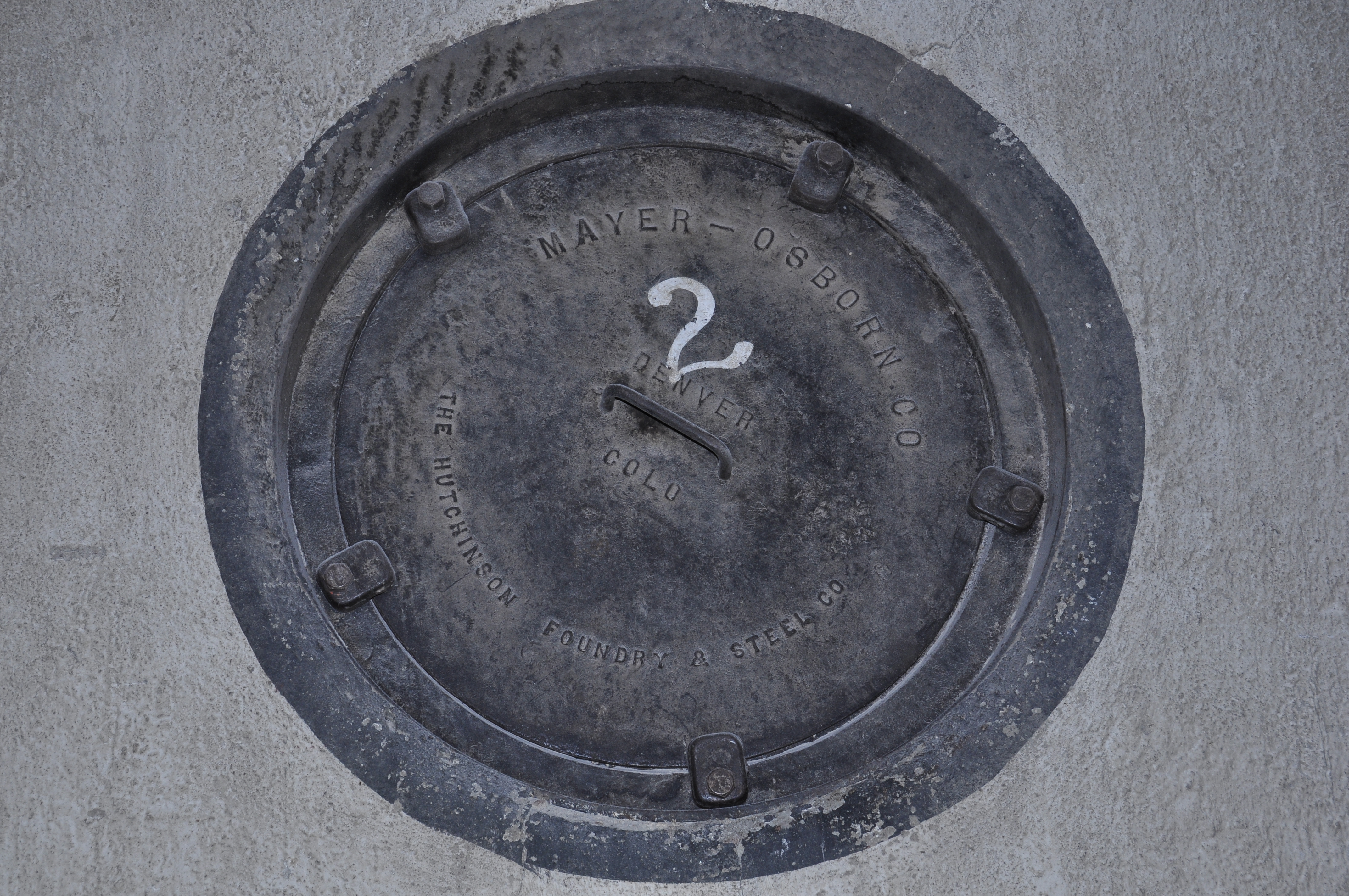
Note: Manhole covers used in elevators built by Mayer-Osborn Company and J.H. Tillotson, Contractor were made by Hutchinson Foundry. In 2011, a new foundry was announced as a complement to Hutchinson’s growing wind energy industry.