More details on the Nebraska elevator site where Jim Russell died

By Kurt Glinn

I was the manager at the Aurora Cooperative Murphy location in central Nebraska. I was told from the old timers in the area that were around when the elevator was built in the late-’50s [that an] accident happened there, shutting down construction for about a week.
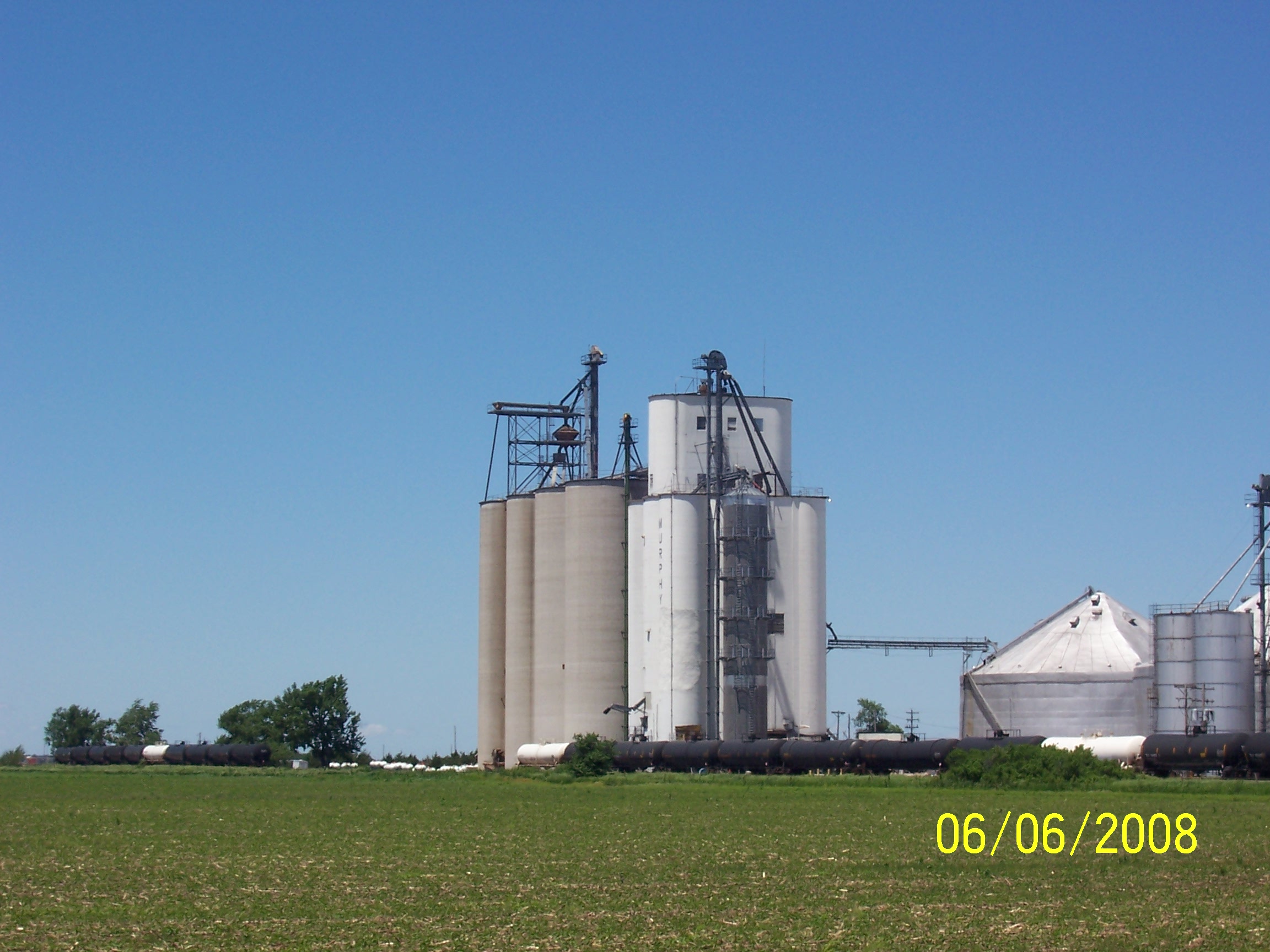
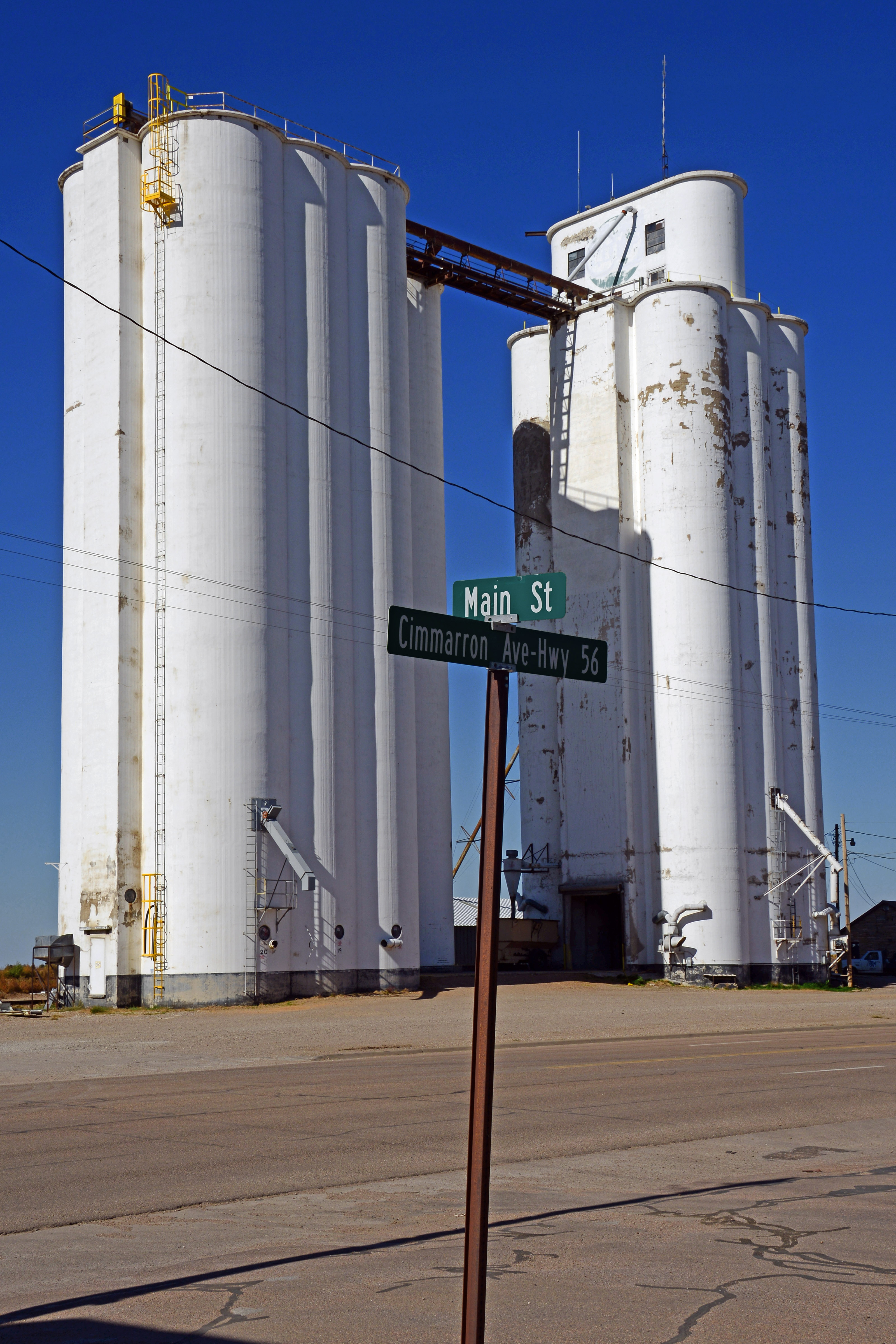
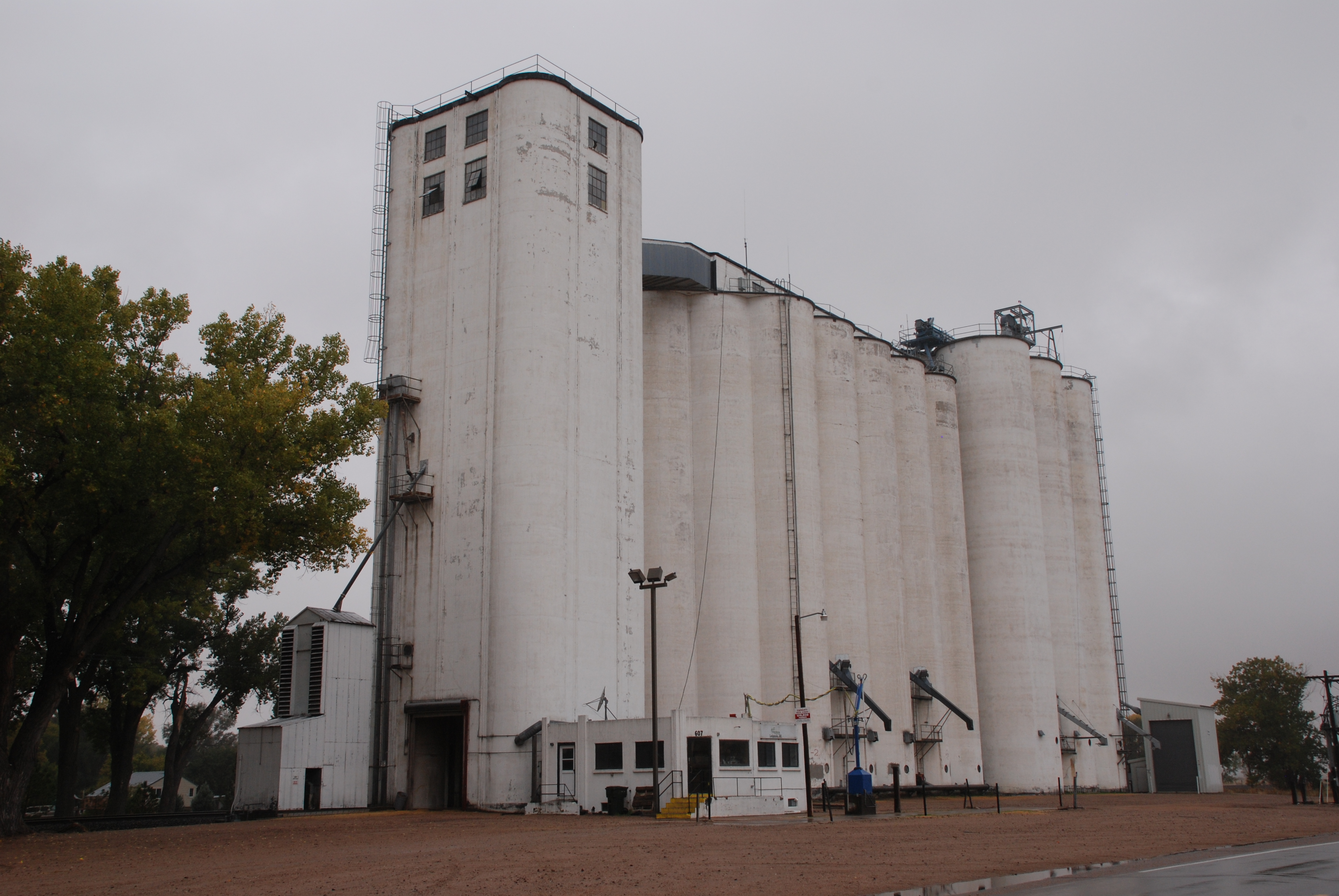
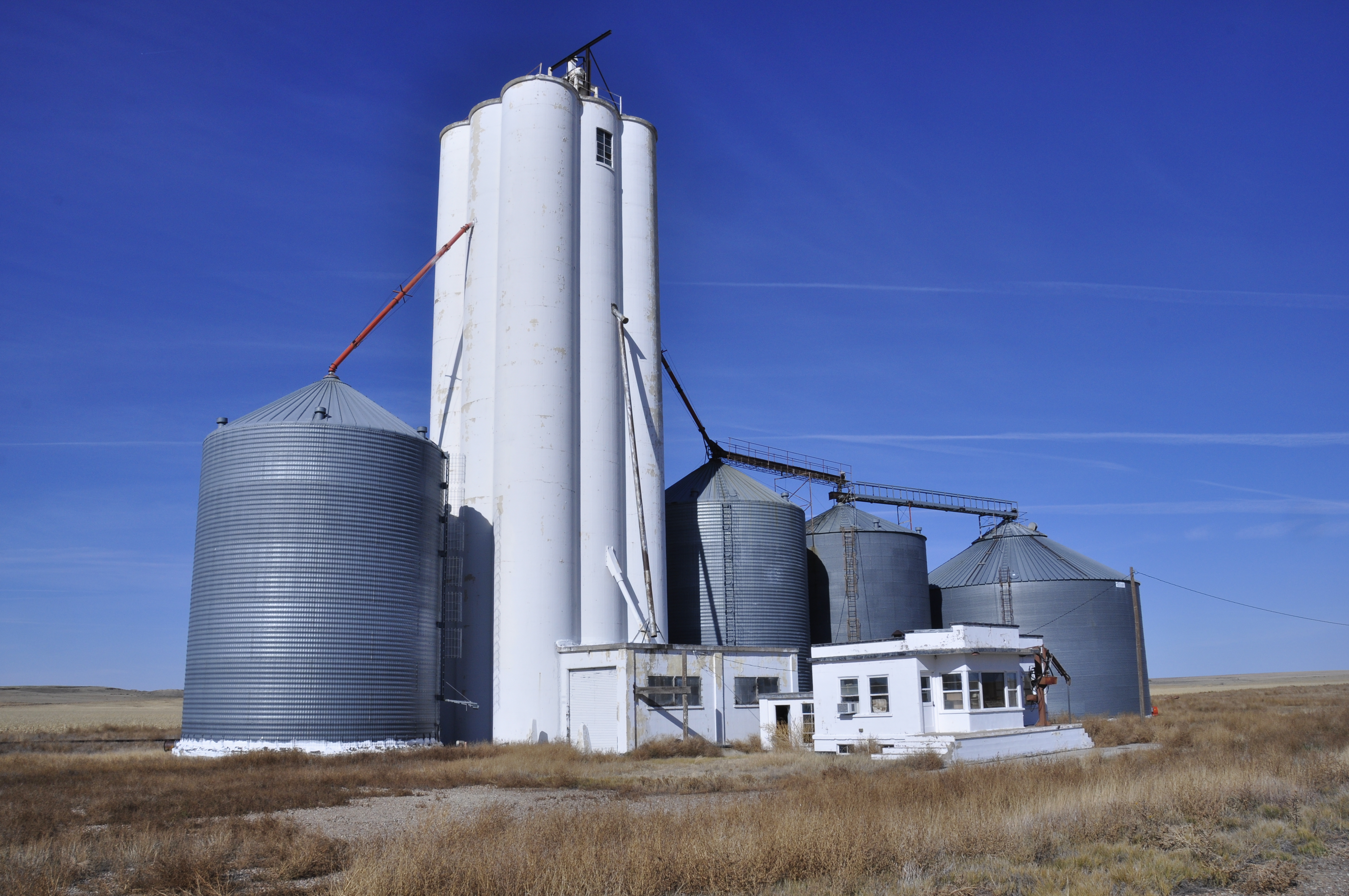
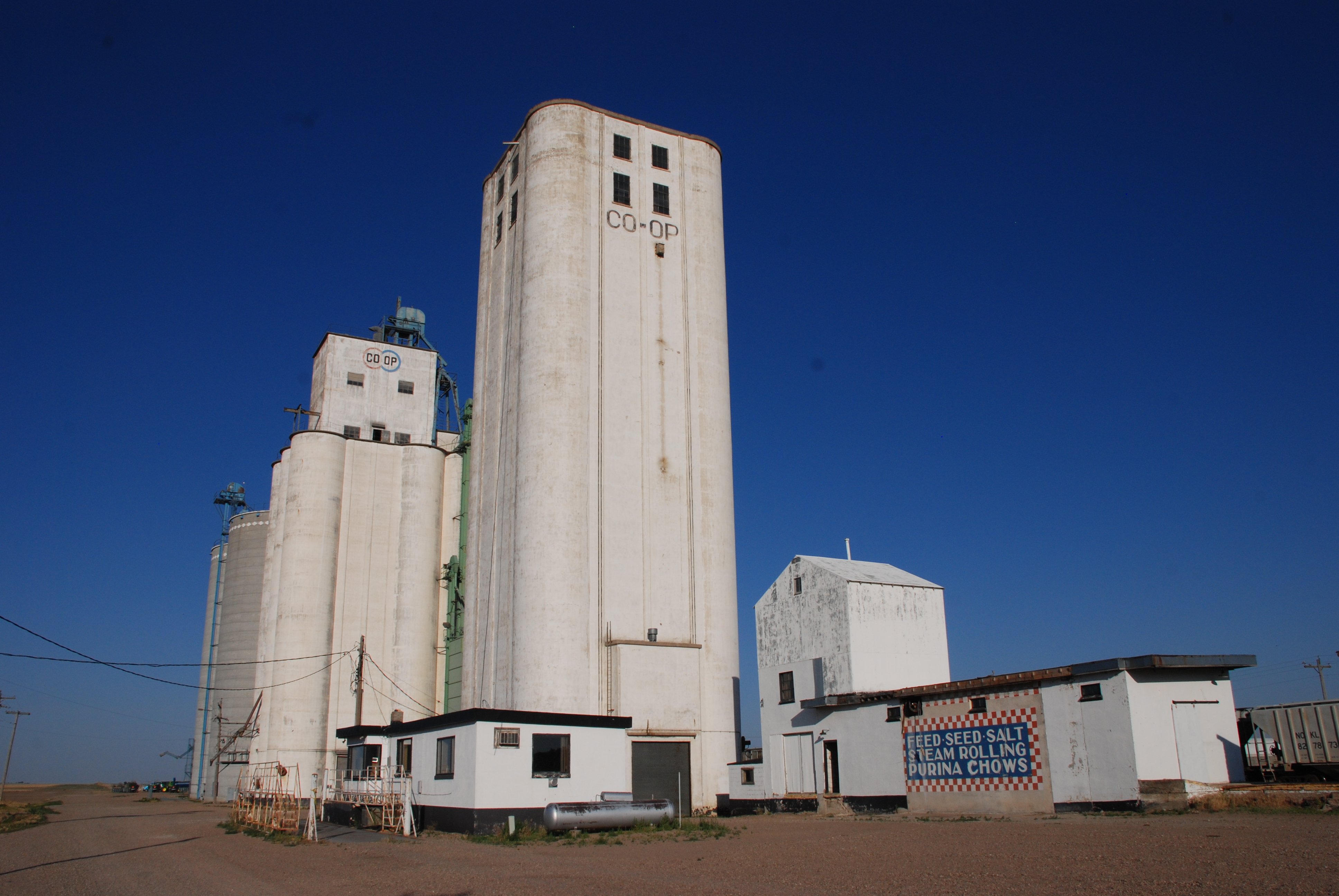
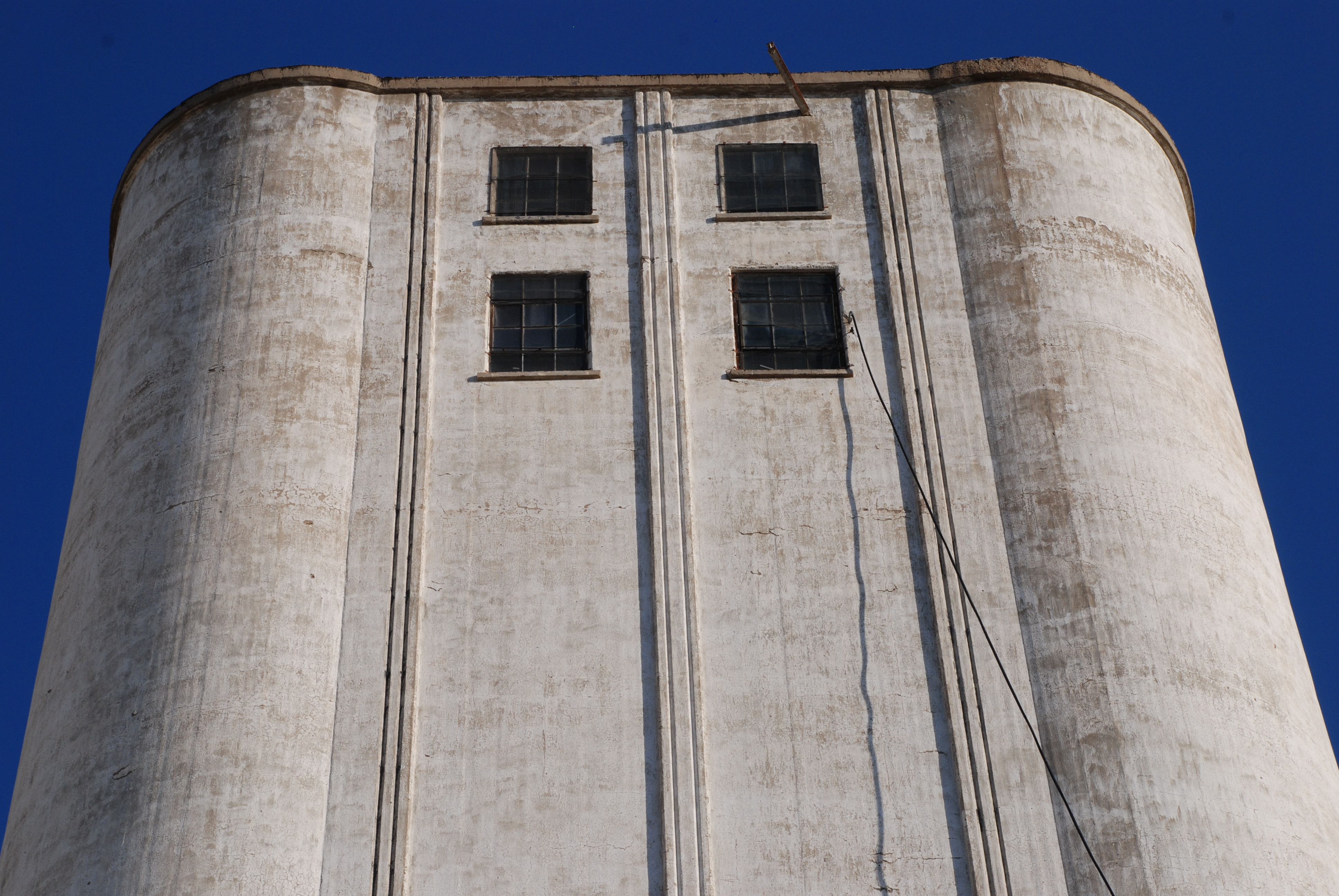
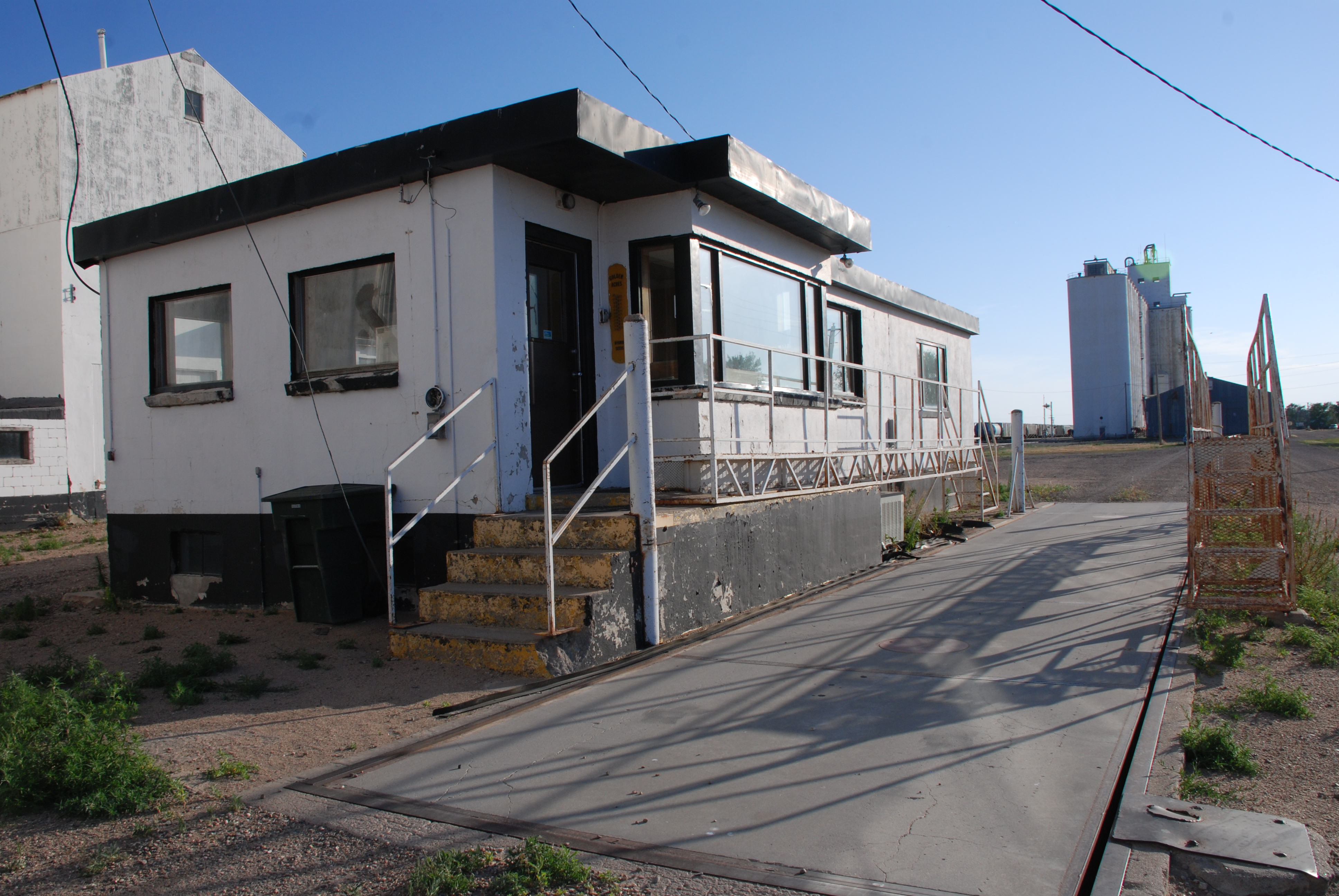
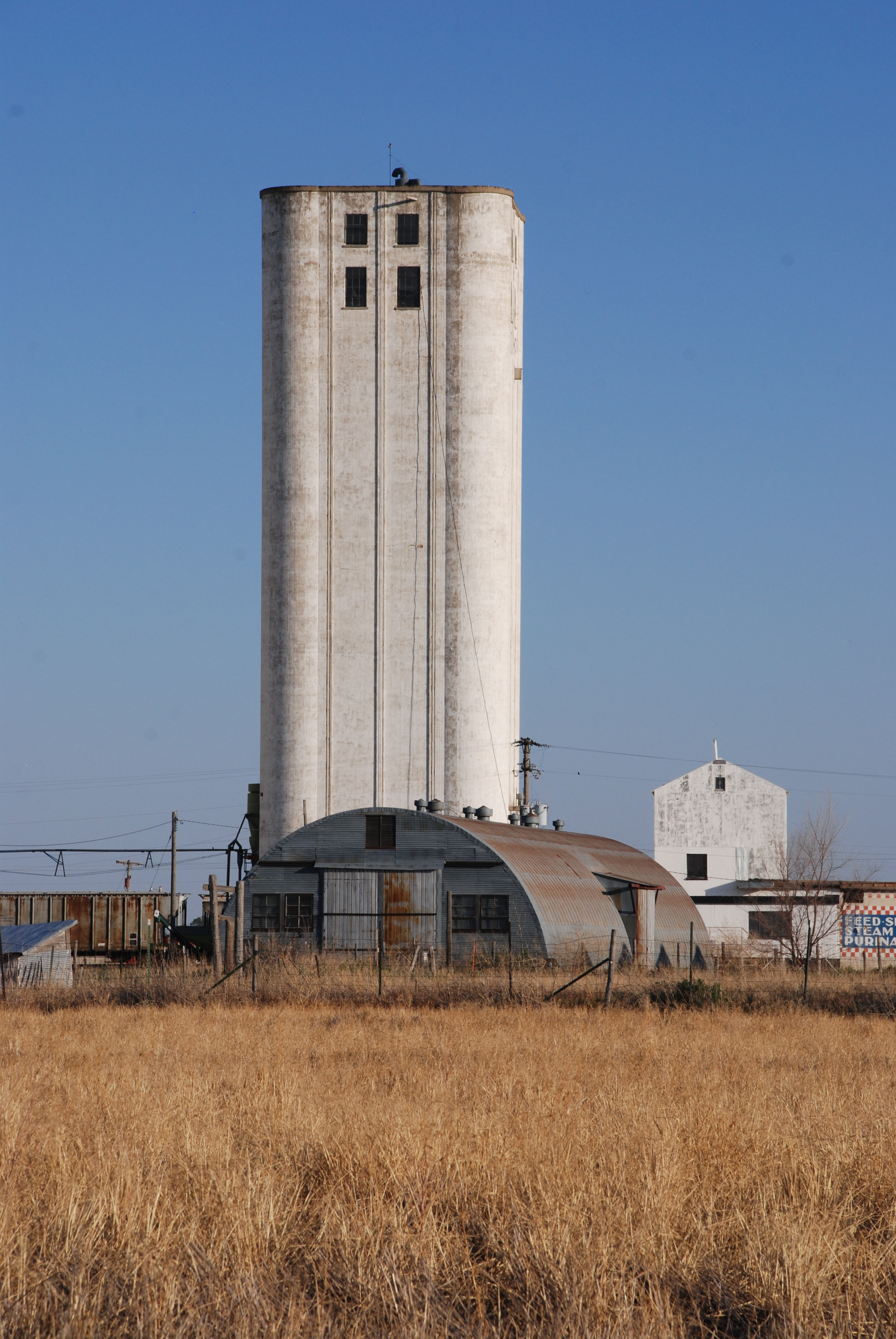
The Aurora Coop's Murphy elevator and annex. Jim Russell died in a fall during the elevator's construction.

The Aurora Coop’s Murphy elevator and annex. Jim Russell died in a fall during construction.

Murphy is no more than an elevator along the railroad now. It is six miles west of Aurora, Neb., or fifteen miles east of Grand Island, Neb.

Thank you for a wonderful site. One of my first bosses was a man by the name of Willis “Bill” Maahs. He was a superintendent for Tillotson into the early ’60s when he stayed in Aurora and  became operations supervisor for Aurora Co-op. He helped build the Murphy elevator and the Aurora elevators. There are two Tillotson houses in town, as well as the feed mill in Aurora.

I have always been intrigued with the workings of the old concrete houses versus the new bigger faster ones, although I know how farming and the grain business view them.

Concrete grain elevators are very highly regarded in the industry as the most permanent. My reference is to the older, smaller, multi-bin elevators of 20,000- to 25,000-bushel bins versus the newer 250,000- to 300,000-bushel bins being built.

The industry has come along way in the last fifty years: the ability to jack the forms with hydraulics, the diameter of the bins, the height and capacity of legs. Putting all the equipment outside of the structures rather than enclosing everything in the house, which has saved many elevators from the disaster of explosions, et cetera.

Farmers are into a newer generation also, thirty-five years and younger. They want fast unload and large unloading pits.
The ag industry as a whole had seen large improvements in the size and capacity of equipment, making some of the smaller, older elevators almost impossible to use.

I find the older ones more interesting because they were what started a new generation from wood houses to concrete. Building work floors and platforms from concrete rather than steel and expanded metal. All is my own opinion as to why I enjoy the first generation of concrete grain elevators in the ag industry.

A freak accident led to the fatal fall of Bill Russell’s son

The Aurora Coop's Murphy elevator and annex. Jim Russell died in a fall during the elevator's construction.

The Aurora Cooperative’s Murphy elevator and annex. Jim Russell died in a fall during the elevator’s construction. Photo by Kurt Glinn.

Story by Ronald Ahrens

My uncle, Tim Tillotson, recalls some details of the death of a son of Bill Russell, a superintendent for Tillotson Construction Company. Russell was the father of eight sons in all. The accident occurred in the 1950s.

Although he can’t remember which job [it was the Aurora Cooperative’s Murphy location in central Nebraska] or when it happened, Uncle Tim, who was not present at the time, recalls from on-the-scene reports that two of Russell’s sons were running the night crew.

The two were working with a storey pole, a measuring device of ancient origin. In this case, the storey pole was a metal tape, and it was used to verify the height of vertical sections. One son was on top, fifty-five feet up, feeding the tape down to the other on the ground.

“It was blowing in the wind, and he was letting it out,” Uncle Tim says. “The wind caught it to some power lines, and it gave him a jolt.”

A fall to the ground ensued.

“One side of him hit the Georgia buggy, which kind of spun him around. He was conscious on the ground, saying he thought he’d broken a leg. But by the time the ambulance got there, he’d died of shock.”

Uncle Tim suggests the likelihood of a brain hemorrhage as well.

The Mayer-Osborn elevator in Tempe, Arizona is a jewel in an upscale setting

DSC_0047Story and photos by Kristen Cart

Phoenix is well out of the way for a pilot based in Louisville, Ky., and living in the Chicago area. It takes a bit of intentional finagling to get into Phoenix with enough time to visit an elevator. Fortunately, the Mayer-Osborn grain elevator in Tempe sits at the foot of a hill, just a few miles off the end of an active runway at Phoenix Sky Harbor International Airport. A steady stream of airplanes flies directly over the elevator, either coming from, or going into the airport, depending on the wind conditions. After seeing it many times from the air, I arranged for a four hour layover in Phoenix, which was just enough of an opportunity to grab a rental car and go see it.

DSC_0067

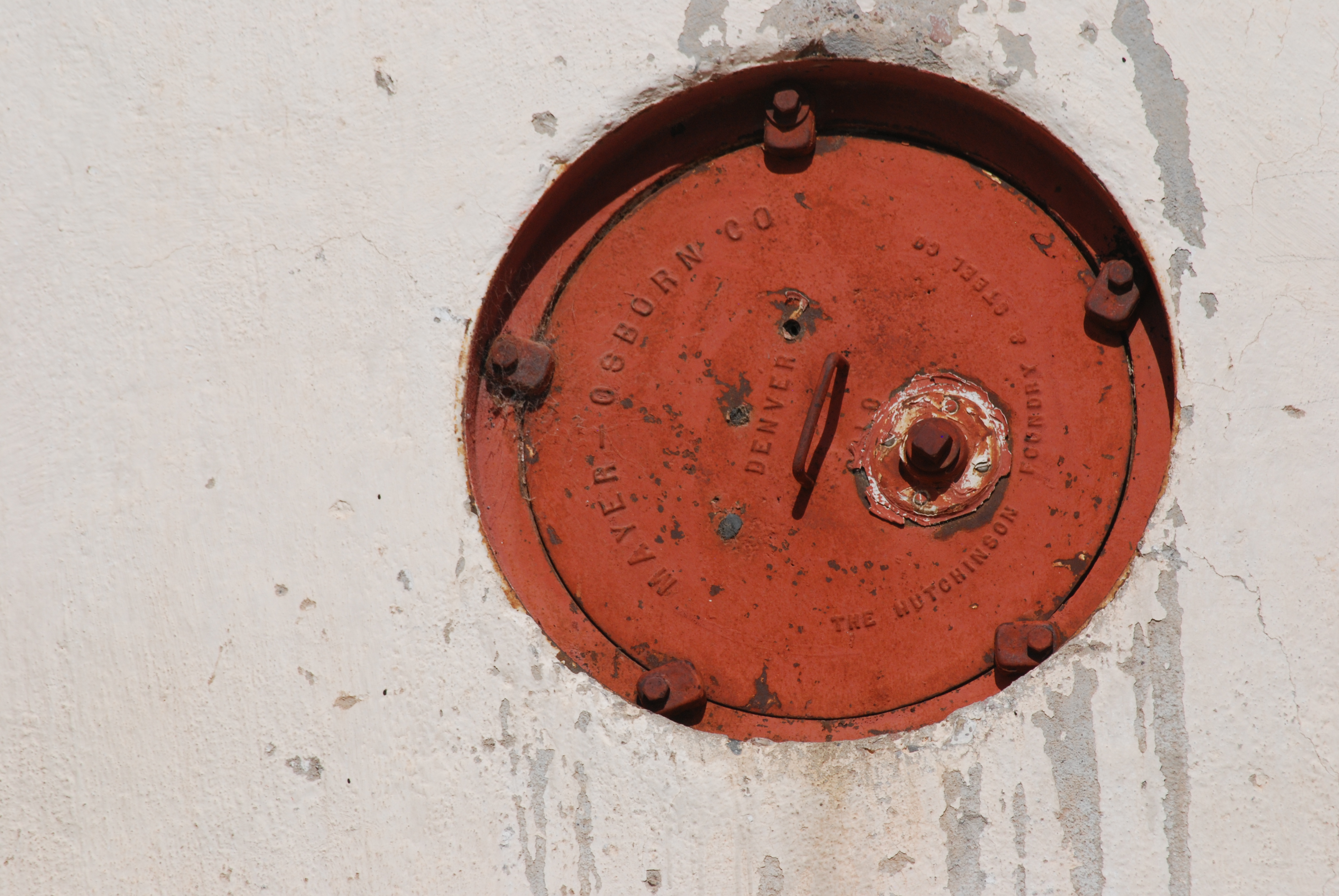
Manhole covers are embossed with the company name. Each annex bin has a manhole cover.

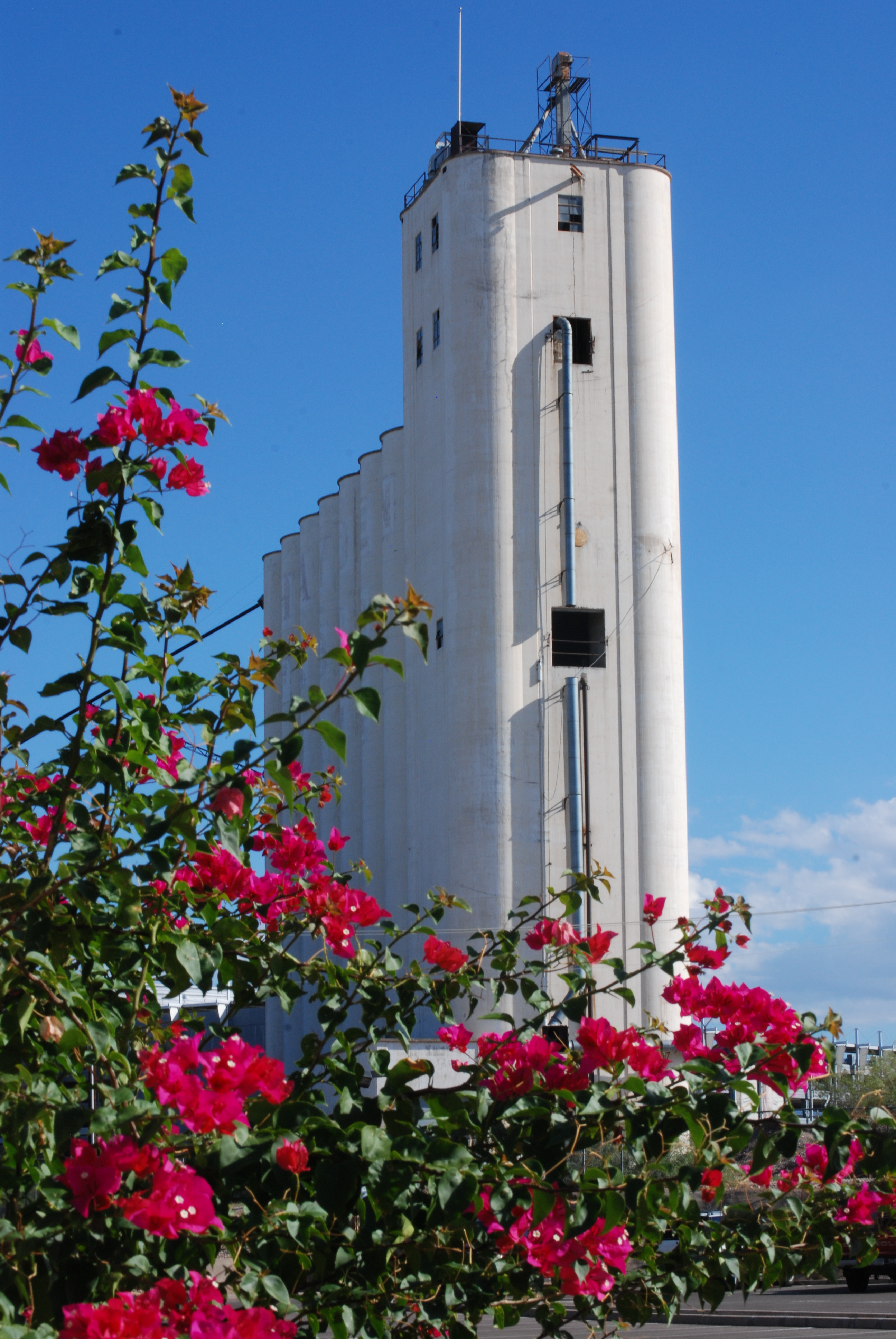
The straight-up styled elevator with its annex was built in 1951 for the Hayden Flour Mill, a Tempe landmark which had already been in operation for decades.  It once proudly displayed the “Hayden Flour Mill” name, painted along the annex side, in lettering that has been painted over at least twice. The white paint has now faded enough for both lettering jobs to show through.

DSC_0057

Hayden Flour Mill


My dad,  Jerry Osborn, remembers when his father worked the Mayer-Osborn job in Arizona. Dad would have been about seven years old. The job was one of many that took Bill Osborn away from his home in Fremont, Neb.

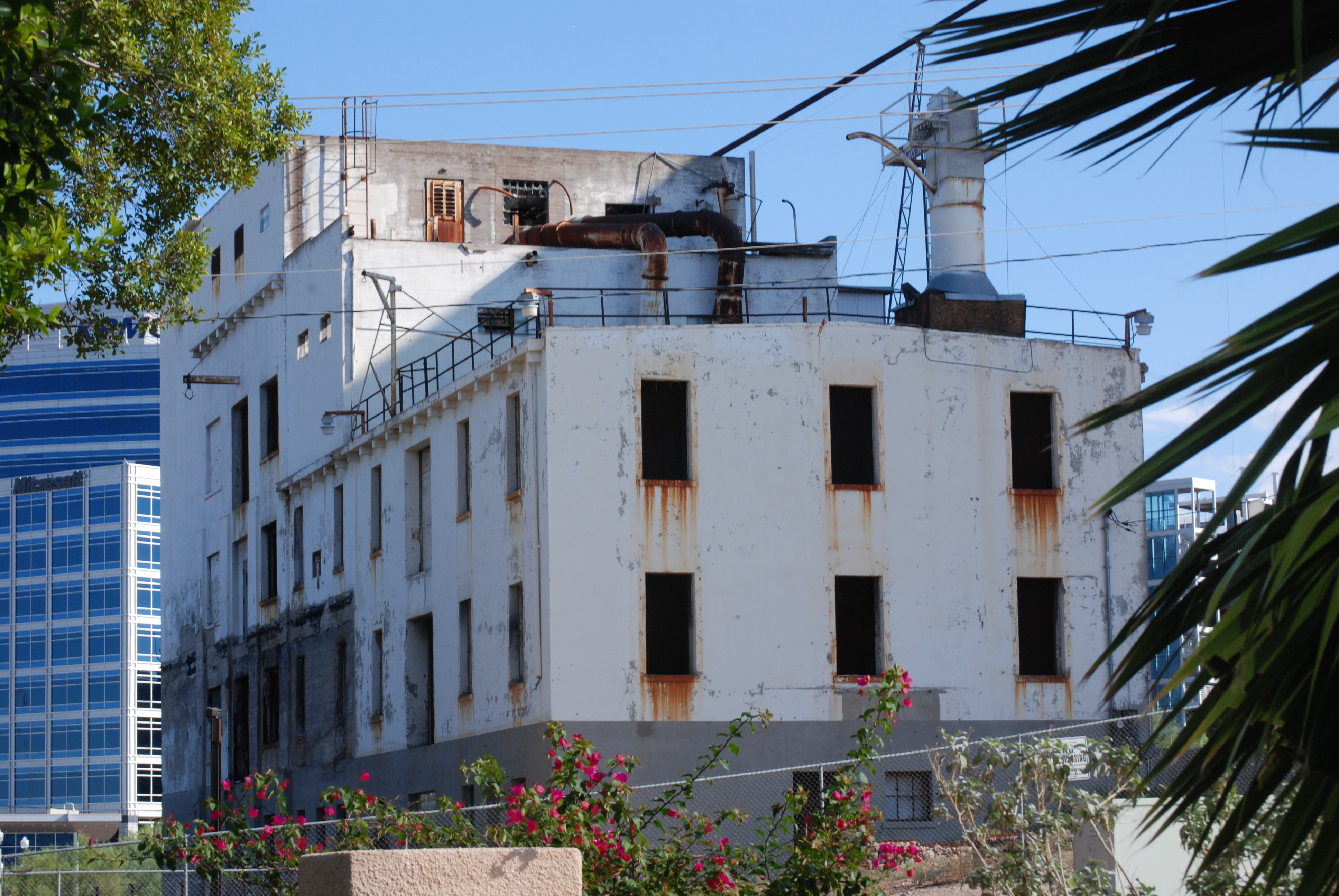
The Mayer-Osborn elevator and annex nestle at the base of a hill, gracing the neighborhood like a white gemstone in a gleaming setting. The Hayden Flour Mill, which has a strong historical significance to the area, is a rather unremarkable looking building, located at the base of the elevator. The neighborhood has grown up around it with shining highrises, shops and hiking trails, erasing the former industrial setting, and replacing it with an upscale ambiance.

It is fortunate that the mill and elevator add character and personality to the place, and that city planners have recognized their value. Now a park and lawn surround the mill. The mill’s windows have been screened so that tourists can look inside, and historical plaques detail its history. The elaborate plans for the mill have been put off after the market crash in 2008, but fortunately the goal of preservation has not been abandoned. It is good to see one of my grandfather’s elevators safely ensconced in a community that values its presence.DSC_0030

Mayer-Osborn elevator contract proposals are preserved at Wauneta, Nebraska

Much of the time on the road was spent marketing. William Osborn at the wheel

William Osborn at the wheel. Much of his time was spent selling elevators to prospective buyers.

Story by Kristen Cart

The Mayer-Osborn Construction Company built their elevators from 1949 until about 1955. To do this, they had to beat out a number of formidable competitors, both large and small, vying for the same jobs. But they did not win the contract every time they tried. One example of their perseverance survives at the Frenchman Valley Co-op at Wauneta, a town in southwestern Nebraska. Mayer-Osborn did not win their bid, but their contract proposals, made over a period of several years, are still kept in the co-op vault among blueprints and records spanning almost 70 years.

The cover letter for the Mayer-Osborn contract proposal at Wauneta, Neb.

The cover letter for the Mayer-Osborn contract proposal at Wauneta, Neb.

When I was first trying to get a handle on the scope of Mayer-Osborn’s business, I asked my dad, Jerry Osborn, which partner did most of the marketing. I was under the mistaken impression that Eugene Mayer was in charge of all that, and I thought that all my grandfather William Osborn had to do was show up and start pouring concrete.

“No,” Dad said, “Gene Mayer took care of the office and accounting, but your grandpa did a lot of the sales.”

This ad for Mayer-Osborn Company ran in Farmers' Elevator Guide over a period of several years in the early 1950s.

This ad for Mayer-Osborn Company ran in Farmers’ Elevator Guide over a period of several years in the early 1950s.

Grandpa put many miles on his cars, visiting prospective clients, when he was not supervising an active construction site. He spent almost all of his time on the road. Dad recalls that he and his mother were home alone during those years, while his brother Dick was in Korea and his sister Audrey was married. We have a few pictures of Dad with both of his parents, but they were taken at a job site. The sales part of Grandpa’s job took much more effort than I had ever imagined.

For a closer look at the Mayer-Osborn plans for Wauneta, Neb., and the final outcome of their efforts, stay tuned.

Concrete problems plagued consecutive elevator projects at Blencoe, Iowa

DSC_0578Story and photos by Kristen Cart

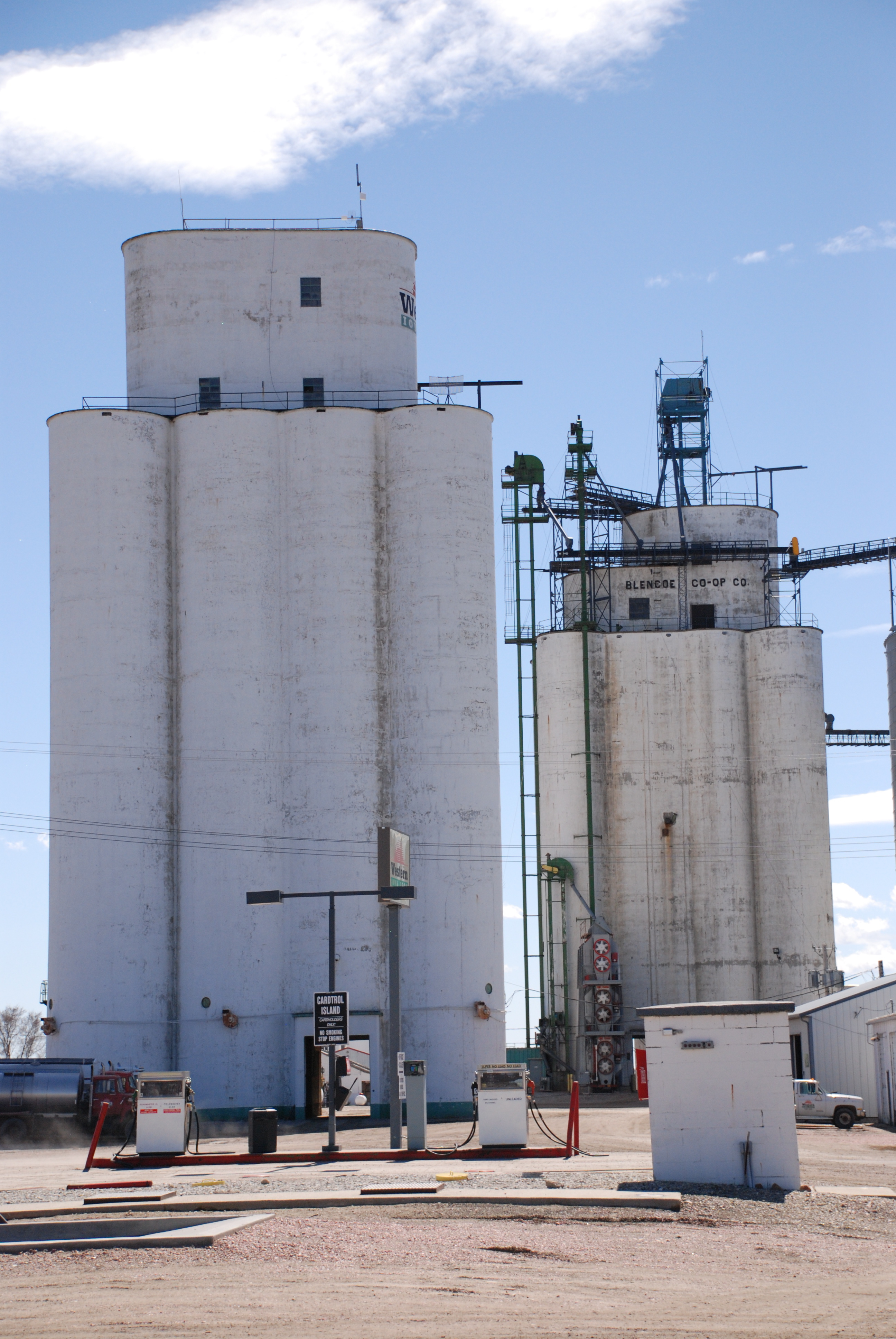
In the summer of 1954, Mayer-Osborn Construction built an elevator with a stepped headhouse in the northwestern Iowa town of Blencoe. As my dad, Jerry Osborn, explained, after the crew poured the first ten feet of concrete in the slip-form process, the concrete sides below the forms showed signs of crumbling. An investigation revealed that the concrete mixture had not been set correctly. It took as many hours to remove the concrete and start over as it did to pour it. Dad worked on the project and saw the fallout first hand.

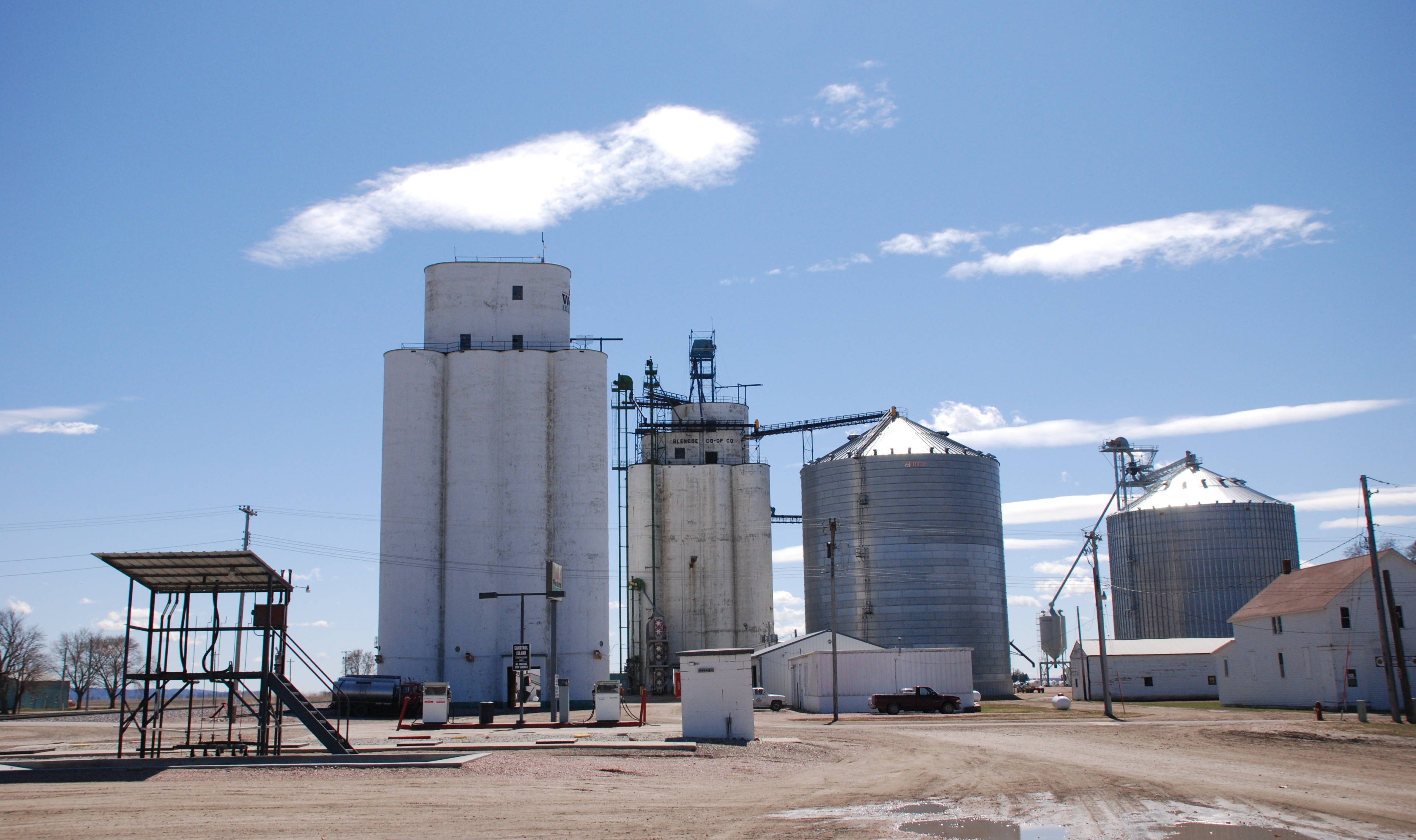
The larger Tillotson elevator stands to the left. The Mayer-Osborn elevator obstructs the view of its large annex which extends behind it.

The larger Tillotson elevator stands to the left. The Mayer-Osborn elevator on the right serves a large annex which extends behind it. Photo by Kristen Cart

Builders were required to do a destructive test on the concrete mix at various stages of curing, to ensure the proper strength for each part of the elevator structure. Engineers tested various mix ratios to decide upon the best one. Naturally, this process was used at Blencoe, but when the mix was finally set and the pour began, it was done incorrectly. I can imagine the blue language wafting from the site as the concrete was taken down. Someone on the site had his ears pinned back pretty fiercely. But the construction continued, and a handsome elevator still stands there today, nearly 60 years later.

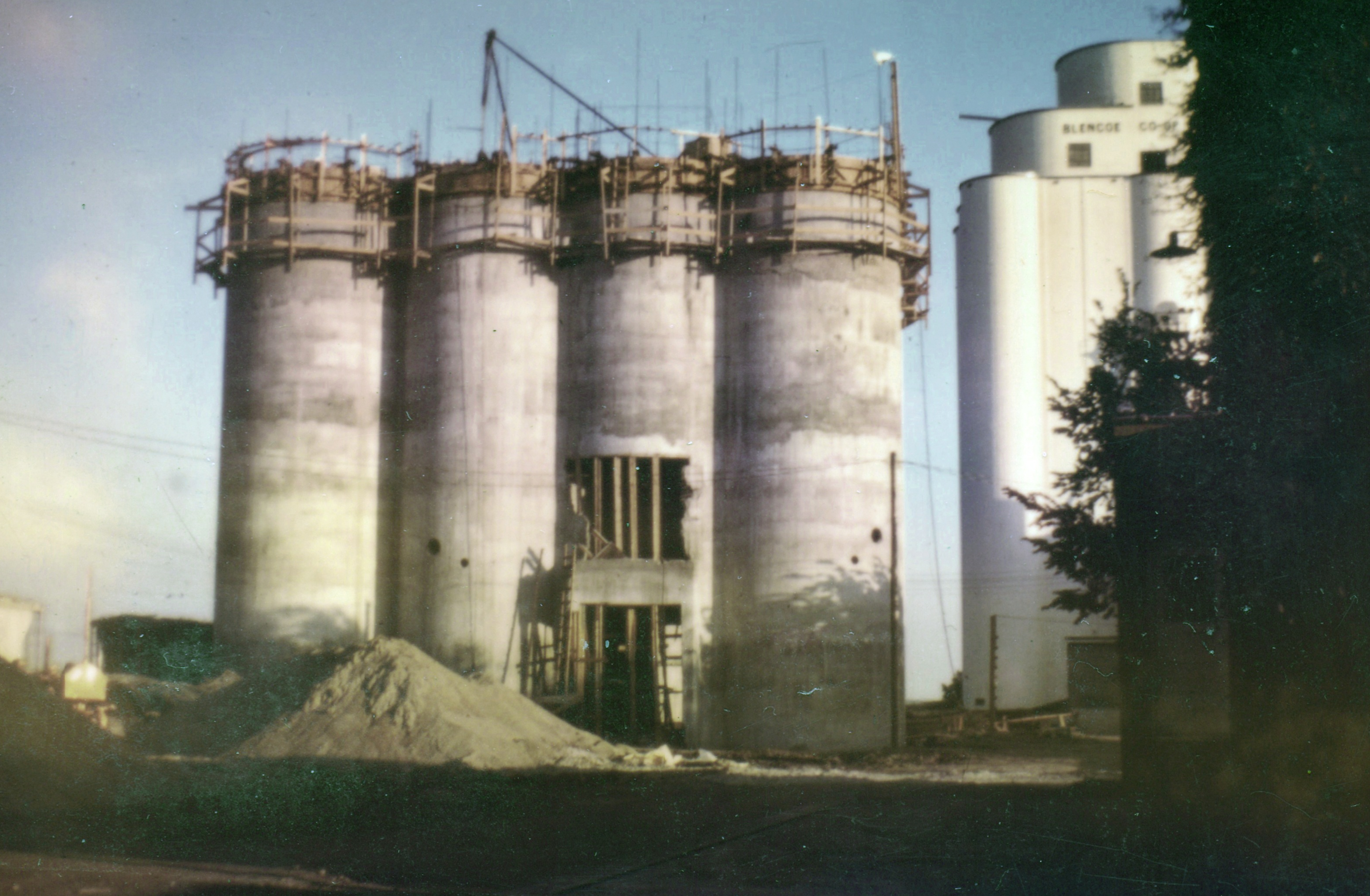
Not until this year, when Tim Tillotson located the Tillotson company records and photographs, did we discover that Tillotson Construction of Omaha faced a similar problem as they built their elevator nearby about a year later. This time, the error was not caught as early, and the consequences became immediately apparent.

Tim Tillotson said he thought the blowout happened in about 1955. Whether Tillotson Construction did the repairs and completed the project, or whether another contractor was brought in, is not known to me, but I hope to revisit the site later this year and learn more. The image below is a rare one. It is amazing that photographic evidence survived, serving as a cautionary note, lest any builder were to become overconfident.

Blencoe_blowout-1 copy

This company photo shows the blowout. On the right the completed Mayer-Osborn elevator may be seen.

Errors were a constant threat in this business. In the best cases, they manifested themselves in embarrassing delays, in the worst, they incurred expensive lawsuits or physical harm.

Tillotson Construction and Mayer-Osborn both recovered from their respective forays into bad concrete and lived to build again, leaving handsome and serviceable elevators at Blencoe and elsewhere. The lessons they learned were priceless.

A chance encounter with a Tillotson elevator in Jamestown, Kansas

DSC_0057

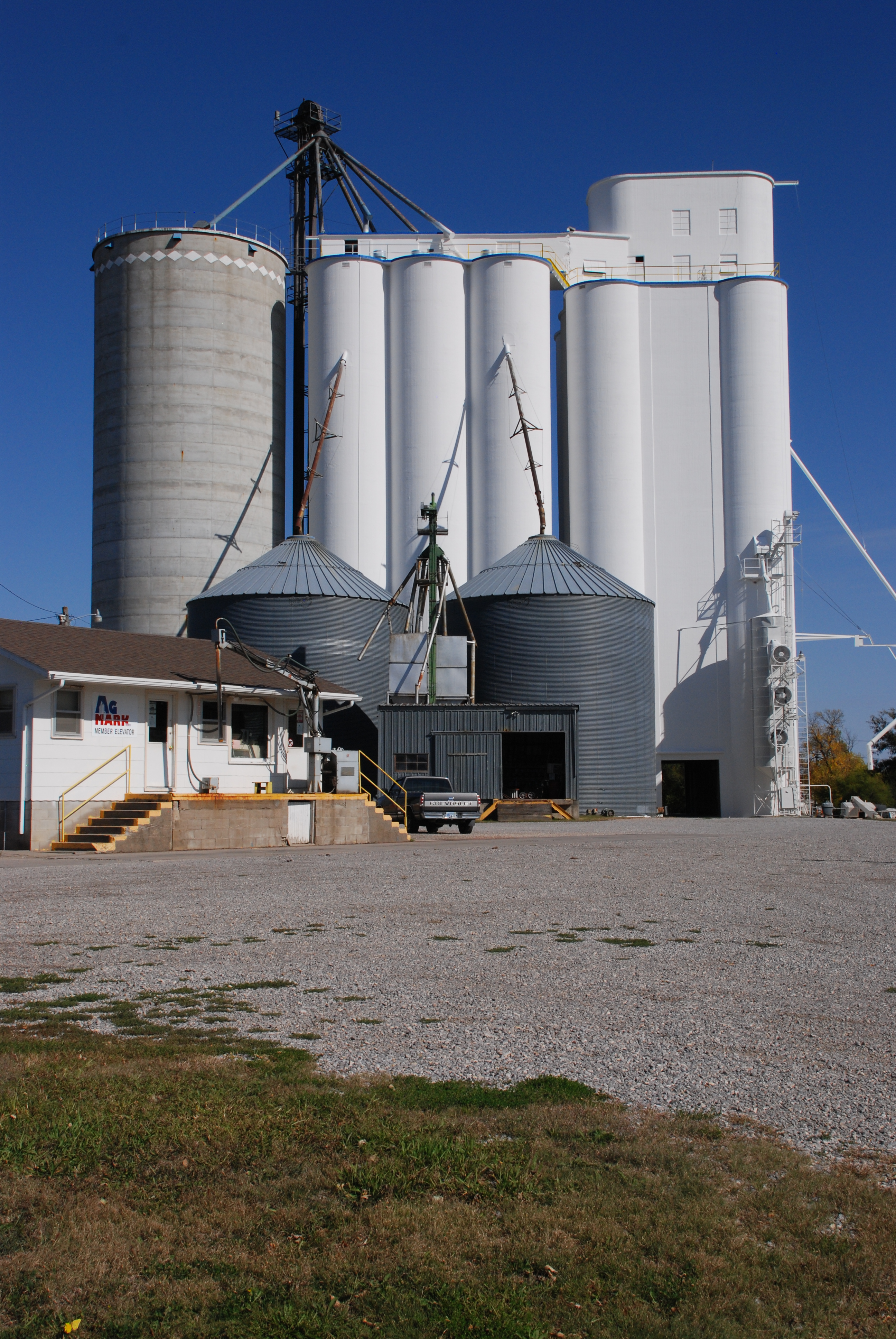
Sporting a fresh coat of paint, the trademark Tillotson elevator with its curved headhouse still operates. 

Story and photos by Kristen Cart

On our last elevator road trip, which our family embarked upon in October 2012, we visited many of our grandfathers’ elevator projects from the 1940s and 50s. But we also amassed a photo collection of elevators we could not place. Either the grain cooperatives were closed for business on a Sunday, or the elevators were retired, or we didn’t have time to stop for an interview. So the photos languished for most of a year, until Ronald Ahrens and I could identify them, even though we strongly suspected that the structures were the works of one of our grandfathers.

One of the mystery elevators was a pure white example, located in the north-central Kansas town of Jamestown. Ronald’s uncle, Tim Tillotson, recently handed us the Omaha builder’s construction specifications, which finally identified this handsome elevator as a project built in 1953 by the Tillotson Construction Company.

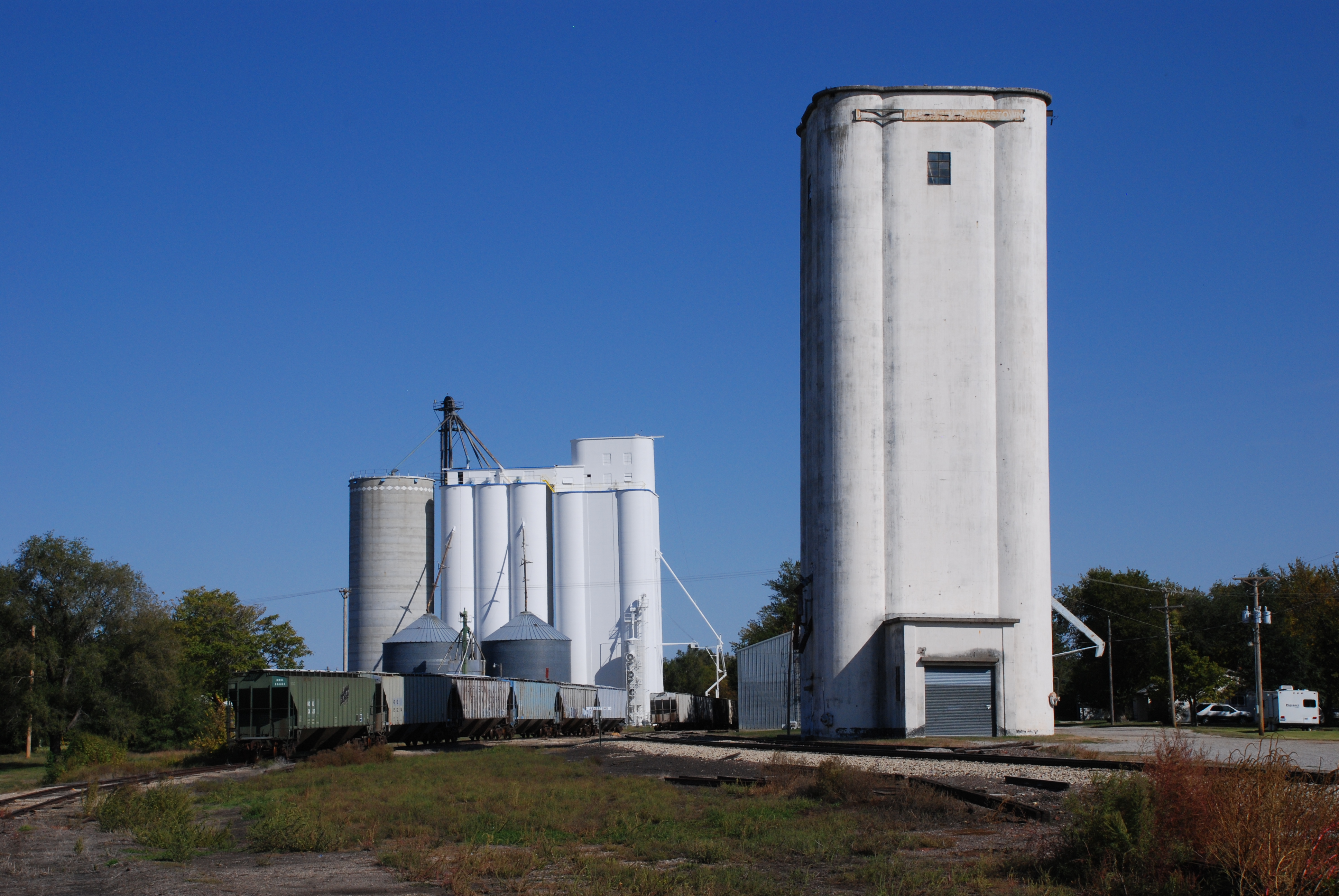
A smaller elevator stands on a branch of the rail line. It's builder is unknown.

A smaller elevator stands on a branch of the rail line. It’s builder is unknown.

The Jamestown elevator stands not far from a companion elevator, rising alone on a fork of the railroad track. The smaller elevator was built in a straight-up style that predates the more common Tillotson style, and it’s provenance is unknown. It is reminiscent of the style of the elevator built by Tillotson Construction in Greenwood, Neb., but without the curved headhouse. But it also recalls several Chalmers and Borton examples.

It is our good fortune to have the detailed specifications for the Jamestown elevator. Thanks to the Tillotson Company’s meticulous record keeping and the decades-long survival of the records, we can share the construction details of this remarkable structure. The specifications, for the engineering-minded among our readers, are presented below.

Capacity per Plans (with Pack) 155,320 bushels

Capacity per foot of height 1581 bushels

Reinforced concrete/plans (Total) 1530 cubic yards

Plain concrete (hoppers & liner) 17 cubic yards

Reinforced steel/Plans (includes jack rods) 69.38 tons

Average steel per cubic yard of reinforced concrete 90.6 pounds


Steel & reinforced concrete itemized per plans

Below main slab 4260 lb/52 cu yd

Main slab 19,427 lb/160 cu yd

Drawform walls 89,400 lb/1107 cu yd

Work & driveway floor (including columns) 1997 lb/18.5 cu yd

Deep bin bottoms 5236 lb/28.5 cu yd

Overhead bin bottoms 3175 lb/24 cu yd

Bin roof & extended roofs (or corner) 5139 lb/37.4 cu yd

Scale floor (complete) 292 lb/4.8 cu yd

Cupola walls 4897 lb/52.5 cu yd

Distributor floor 1530 lb/11 cu yd

Cupola roof 2207 lb/14 cu yd

Miscellaneous (boot, leg, head, track sink, steps, etc.) 1205 lb/20.3 cu yd (excluding track scale)

(At the head of the column on the next page, the Jamestown elevator was described thus: “Clifton Imo plan; Like Meno but split dust bin for Bin #17”)


Construction details

Main slab dimensions (Drive length first dimen.) 54 x 51 feet

Main slab area (actual outside on ground) 2625 square feet

Weight of reinforced (total) concrete (4000#/cu yd + steel) 3130 tons

Weight of plain concrete (4000#/cu yd) 34 tons

Weight hopper fill sand (3000#/cu yd) 684 tons

Weight of grain (at 60# per bushel) 4660 tons

Weight of structural steel & machinery 18 tons

Gross weight loaded 8526 tons

Bearing pressure 3.25 tons per sq ft

Main slab thickness 21 inches

Main slab steel (bent) 1 in diameter at 7 inch o.c.

Tank steel at bottom (round tanks) 0.5 inch diameter at 12 inch o.c.

Lineal feet of drawform walls 514 feet including exterior

Height of drawform walls 120 feet

Pit depth below main slab 15 feet 9 inches

Cupola dimensions (outside W x L x Ht.) 22.25 x 42.5 x 26 feet

Pulley centers 152.66 feet

Number of legs 1

Distributor floor Yes

Track sink Yes

Full basement Yes

Electrical room Yes

Driveway width–clear 13 feet

Dump grate size 2 @ 9 feet wide

Columns under tanks size 16 inches square

Boot — leg & head Concrete

(The remaining specs were noted “same as Meno.” The Meno specifications are given below.)

Machinery Details

Head pulley 72 x 14 x 4 7/16 inches

Boot pulley 72 x 14 x 2 3/16 inches

R.P.M. head pulley 42 rpm

Belt 14 inch 6 ply Calumet

Cups 12 x 6 inch at 9 inch o.c. Howell

Head drive 40 horsepower

Theoretical leg capacity (cup manufacturer rating) 7500 bushels per hour

Actual leg capacity (80 percent of theoretical) 6000 bushels per hour

Horsepower required for leg (based on above actual capacity plus 15 percent for motor) 27.75 hp

Man lift 1.5 horsepower Ehr

Load out scale 10 bushel Rich

Load out spout 10 inch W.C.

Truck lift 7.5 horsepower Ehr.

Cupola spouting 8.25 inch W.C.

Truck lift 7.5 horsepower Ehr

Dust collector system Fan → Bin

Cupola Spouting 10 inch W.C.

Driveway doors Two overhead rolling

Conveyor Not required

(Items below were listed for Meno; it is not clear whether these were also built at Jamestown)


Also Built

60 foot 50 ton scale: 40 cu yd

2 sk’ing spts (scaffolding supports?)

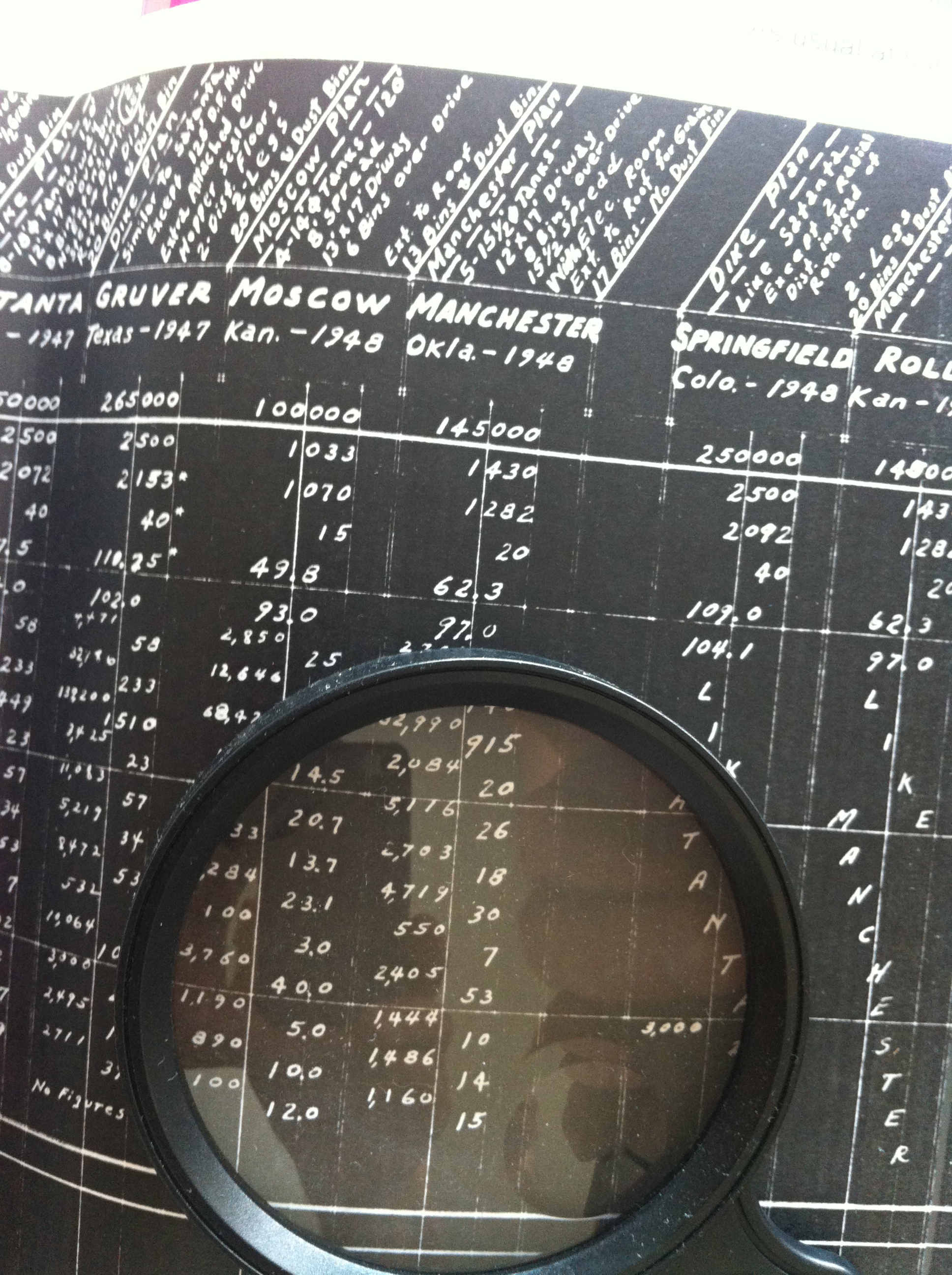
Full specifications of Tillotson Construction’s elevator in Moscow, Kansas

The construction record was written with painstaking attention to detail.

The construction record was written with painstaking attention to detail.

Our friend Linda Laird has asked if the Tillotson Construction Company’s records included any Kansas elevators. The answer is yes, and here’s an example.

In 1948, Tillotson built an elevator of reinforced concrete at Moscow, in the extreme southwestern corner of the Sunflower State. The plan’s basic aspects were as follows: four tanks of 14 feet in diameter, 120 feet in height, and an eight-foot spread. The driveway was was 13 x 17 feet and there were six bins over the drive. Another notation says “Ext. to roof.” This shows up on most other plans and is supplemented by “1/2 grain” or “for grain.” The final item at the head of the plan’s entry in company records notes “13 bins & dust bin.”  Here are all the data:

Capacity per Plans (with Pack) 100,000 bushels

Capacity per foot of height 1033 bushels

Reinforced concrete/plans (Total) 1070 cubic yards

Plain concrete (hoppers) 15 cubic yards

Reinforced steel/Plans (includes jack rods) 49.8 tons

Average steel per cubic yard of reinforced concrete 93.0 pounds


Steel & reinforced concrete itemized per plans

Below main slab 2850 lb/25 cu yd

Main slab 12,646 lb/91 cu yd

Drawform walls 68,424 lb/812 cu yd

Work & driveway floor (including columns) 1790 lb/14.5 cu yd

Deep bin bottoms 3740 lb/20.7 cu yd

Overhead bin bottoms 1733 lb/13.7 cu yd

Bin roof (corner) 2284 lb/23.1 cu yd

Scale floor (complete) 100 lb/3.0 cu yd

Cupola walls 3750 lb/40.0 cu yd

Distributor floor 1190 lb/5.0 cu yd

Cupola roof 890 lb/10.0 cu yd

Miscellaneous (boot, leg, head, track sink, steps) 100 lb/12.0 cu yd

Construction details 

Tillotson's Moscow, Kan., elevator, right, was built in 1948. The annex had to come later. Photo by Kristen Cart.

Tillotson’s Moscow, Kan., elevator, right, was built in 1948. The annex had to come later. Photo by Gary Rich.

Main slab dimensions (Drive length first dimen.) 40 x 45 feet

Main slab area (actual outside on ground) 1712 sqare feet

Weight of reinforced (total) concrete (4000#/cu yd + steel) 2190 tons

Weight of plan concrete (hoppers 4000#/cu yd) 30 tons

Weight hopper fill sand (3000#/cu yd) 260 tons

Weight of grain (at 60# per bushel) 3000 tons

Weight of structural steel & machinery 10 tons

Gross weight loaded 5490 tons

Bearing pressure 3.21 tons per sq ft

Main slab thickness 18 inches

Main slab steel (straight) 1 in diameter at 6 inch o.c.

Tank steel at bottom (round tanks) ⅜ inch diameter at 9 inch o.c.

Lineal feet of drawform walls 382 feet including exterior

Height of drawform walls 120 feet

Pit depth below main slab 11 feet 0 inches

Cupola dimensions (W x L x Ht.) 14 x 36 x 23 feet

Pulley centers 145.5 feet

Number of legs 1

Distributor floor Yes

Track sink Yes

Full basement Yes

Electrical room Yes

Driveway width–clear 12 feet

Dump grate size 2 – 6 x 11 feet

Columns under tanks size 20 inches square

Boot — leg & head Concrete


Machinery Details

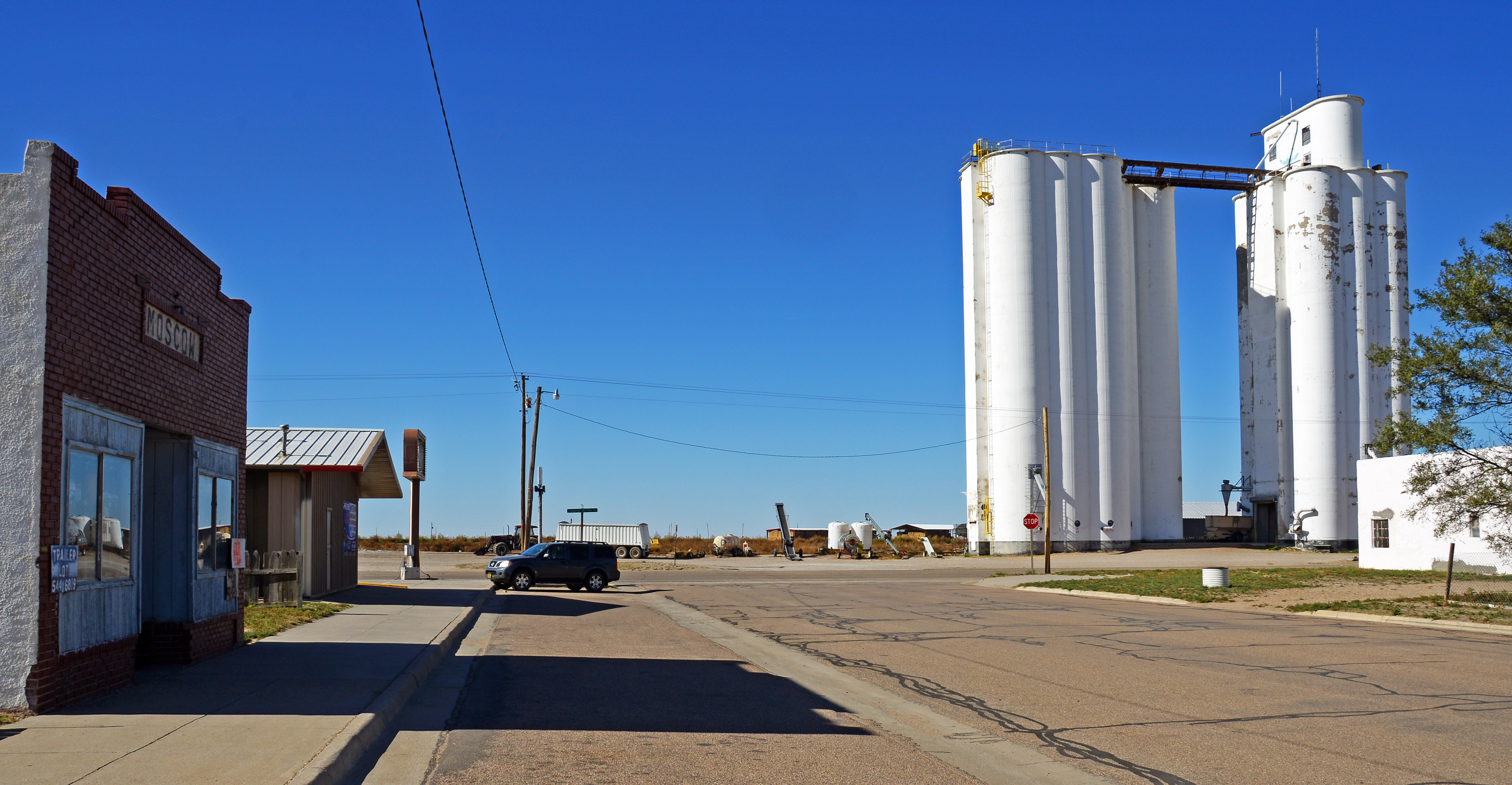
Looking down the crowded streets of Moscow at Tillotson's elevator, far right. Photo by Kristen Cart.

Looking down the crowded streets of Moscow at Tillotson’s elevator, far right. Photo by Gary Rich.

Boot pulley 60 x 14 x 2 3/16 inches

Head pulley 60 x 14 x 3 15/16 inches

R.P.M. head pulley 42 rpm

Belt 14 inch 6 ply Calumet

Cups 12 x 6 inch at 8.5 inch o.c. Howell

Head drive 30 horsepower

Theoretical leg capacity (cup manufacturer rating) 66.0 bushels per hour

Actual leg capacity (80 percent of theoretical) 52.8 bushels per hour

Horsepower required for leg (based on above actual capacity plus 15 percent for motor) 23.3 hp

Man lift 2 horsepower Ehr

Load out scale Two 10 bushel Rich

Load out spout 8.25 inch W.C.

Cupola spouting 8.25 inch W.C.

Truck lift 7.5 horsepower Ehr

Dust collector system Fan → Air

Driveway doors Two overhead rolling

Conveyor Not required


Also Built

Office

Truck scale 45 x 10 feet — 50 ton

J. H. Tillotson, Contractor, built their elevator scale houses with distinctive flair

The scale house at Monument, Kan., above, is almost identical to the one at Lodgepole, Neb.

The details of the scale house at Monument, Kan., above, are almost identical to those at Lodgepole, Neb. Photo by Kristen Cart

Story by Kristen Cart

Elevator construction was driven by stringent engineering requirements, lending a degree of commonality to the buildings. A few distinguishing details could be noticed, but from a distance you would be hard pressed to determine the builder. When contractors built the accompanying buildings, however, they had free reign to build in a style they could call their own. Often the scale houses would be instantly recognizable.

Lodgepole, Neb.

Lodgepole, Neb. Photo by Kristen Cart

J. H. Tillotson’s designs lent themselves well to the addition of a stylish scale house built alongside the main elevator. In some cases, when visiting an elevator, our access was limited. Then the lines of the scale house would be the only clue that we were looking at a J. H. Tillotson elevator.

Below are a few examples, each adapted to its individual setting, but each showing some distinguishing details that were common to all. Each J. H. Tillotson scale house was built of concrete, with a rectilinear floor plan. Usually they incorporated a protruding bay window, on the side facing the scale, for added visibility. Stairs, usually with steel railings, led to a door to accommodate truckers’ entry into the building. Carefully executed details in the concrete expressed the architect’s personal sense of style.

The scale house at the now demolished elevator at McAllister, Kan., is the only clue we have to its builder. Photo by Gary Rich

The scale house at the now demolished elevator at McAllaster, Kan., is a clue to its builder. Photo by Gary Rich

The scale house at Bradshaw, Neb. sports new siding over its concrete walls. Photo by Kristen Cart

The scale house at Bradshaw, Neb., sports new siding over its concrete walls. Photo by Kristen Cart

The scale-house at the Farmers Co-op, Daykin, Neb. shows characteristic corner details. Photo by Kristen Cart

The scale house at the Farmers Co-op, Daykin, Neb., shows characteristic corner details. Photo by Kristen Cart

While the builder of the elevators at McAllaster and Bradshaw has not been established with certainty, a fair case can be made that they were J. H. Tillotson designs based on details of the elevators themselves, the driveways, and the scale houses, when compared with known elevators. The scale house at Daykin, Neb., is included here for comparison.

J. H. Tillotson’s designs were visually appealing, with scale houses that contributed to a harmonious whole. When considering a builder, buyers would judge the quality of the elevator by its beauty, among other things. In this regard, J. H. Tillotson, Contractor, was more successful than most.

Scale houses express graceful utility, epitomize contemporary style

Daykin, Neb. scale house built by J. H. Tillotson, Contractor

Daykin, Neb., scale house built by J. H. Tillotson, Contractor.

Story and photos by Kristen Cart

An often unnoticed feature of every grain elevator is the scale house. The scale house is home to the cooperative site office, and is the place where the elevator conducts its primary business. It is usually an unassuming building where empty grain trucks pull up to be weighed before filling up. The trucks make a second visit when laden with grain, and the difference in weight is tallied in the office. Conversely, when a full grain truck pulls up to deposit its grain, it must return after unloading to determine how much has been loaded into the elevator. Inside the scale house, a small sample of the grain is tested for quality and moisture content.

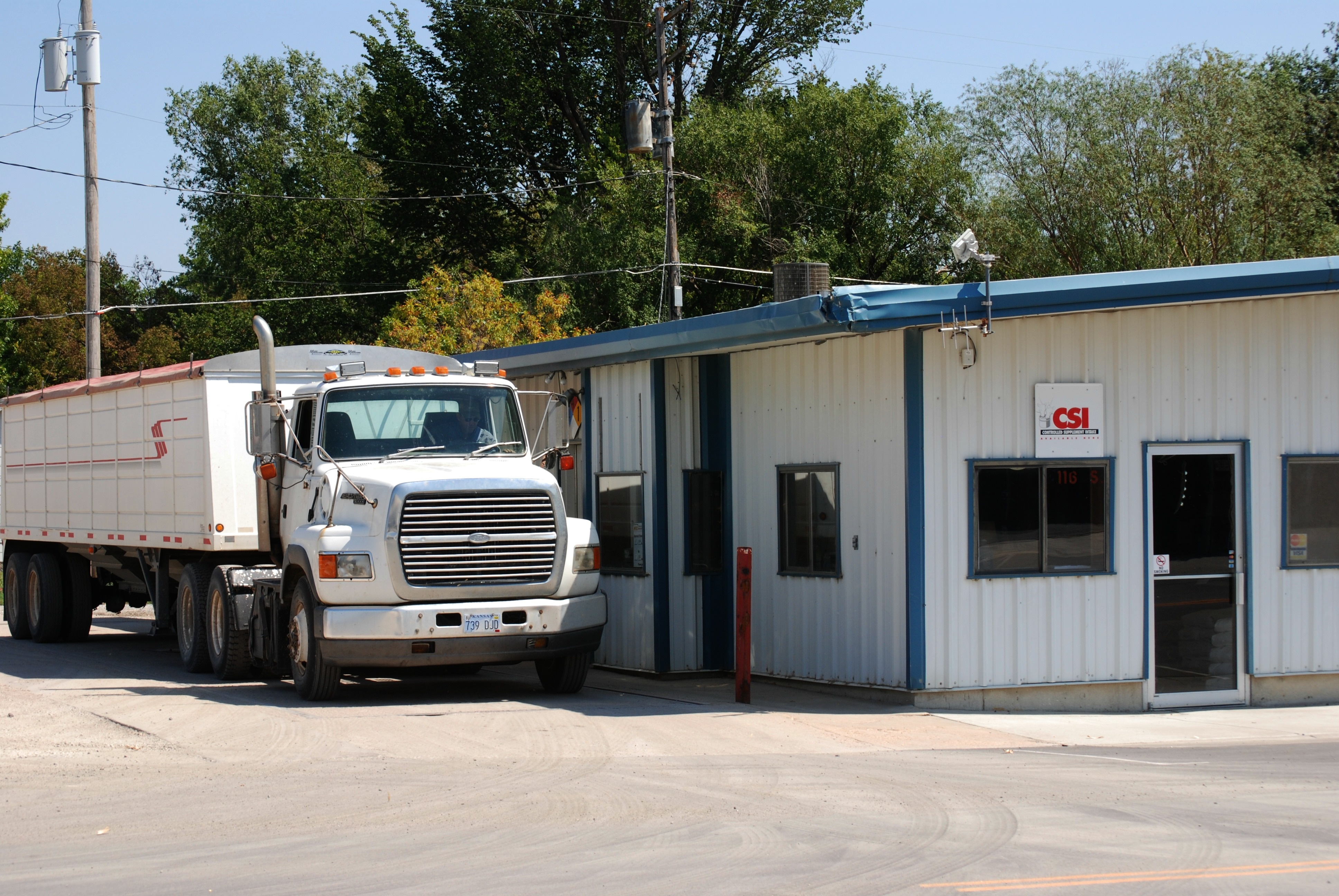
The scale house in Benton, Kan.

The scale house in Benton, Kan.

Many scale houses are metal or brick buildings, often unattached to the elevator and some distance away. Most are  unremarkable. But some of the old concrete scale houses have unique charm. The scale houses that accompanied J. H. Tillotson elevators were particularly attractive, and are one of the first things to look for when identifying their elevators.

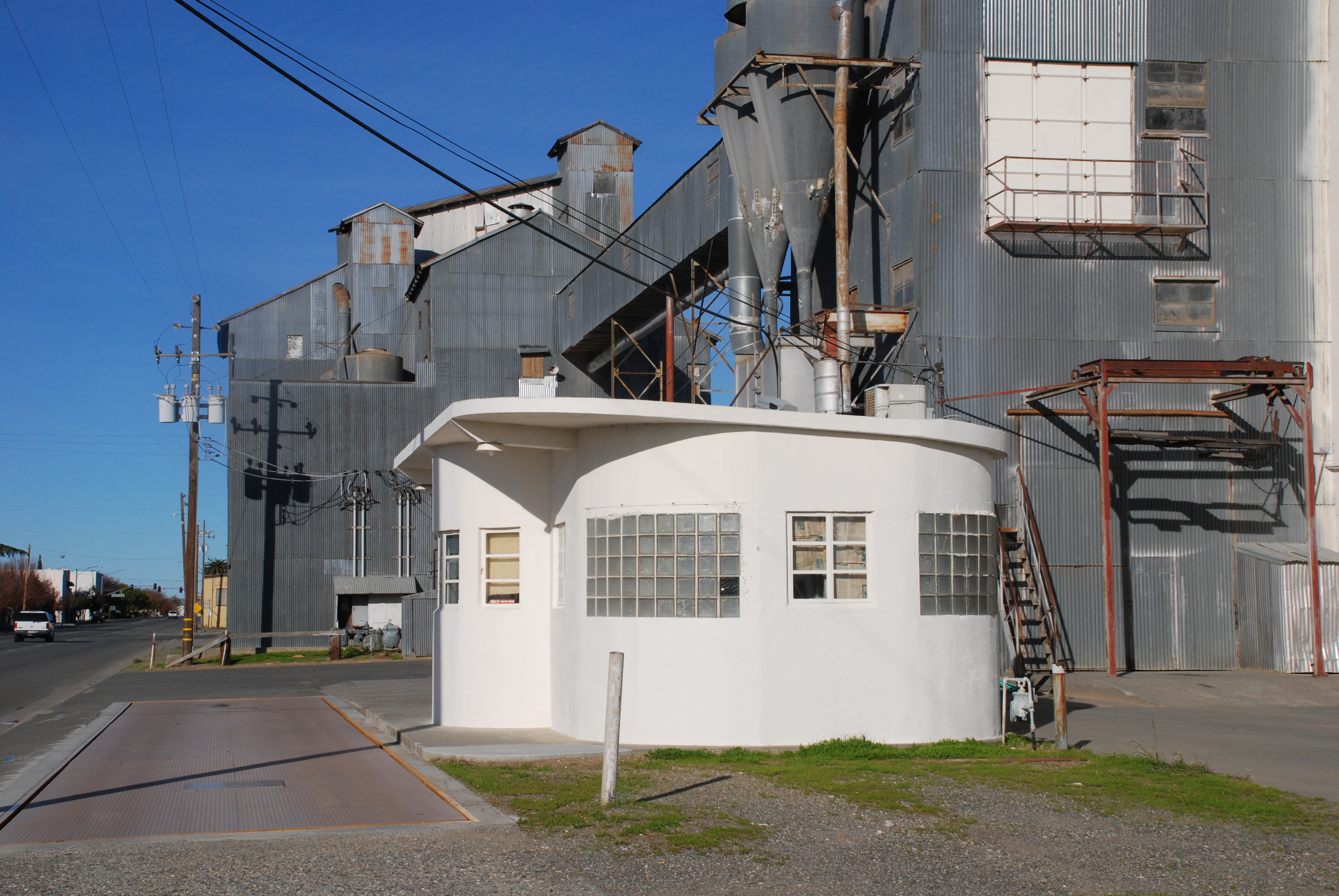
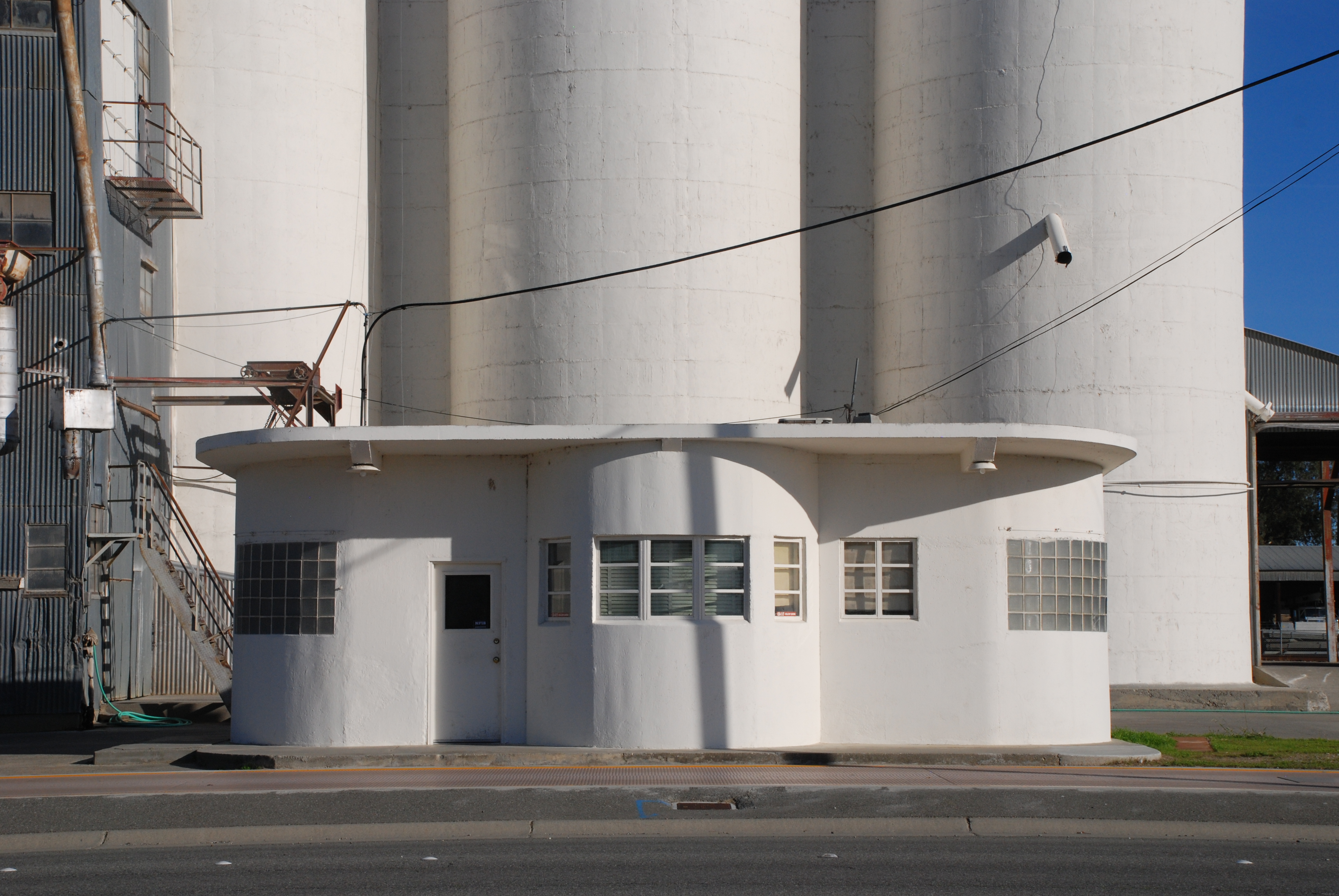
Scale house in Willows, Calif.

Scale house in Willows, Calif.

DSC_0538

Other builders also produced some remarkable scale houses. Elevator building was driven by engineering and economical constraints, but in some cases the scale houses received special attention. In Willows, Calif., I photographed an example that had to take first prize. This dandy building recalls a 1960s drive-in burger joint, complete with car-side speakers and root beer floats. While it is not an example of our grandfathers’ work, it deserves notice.

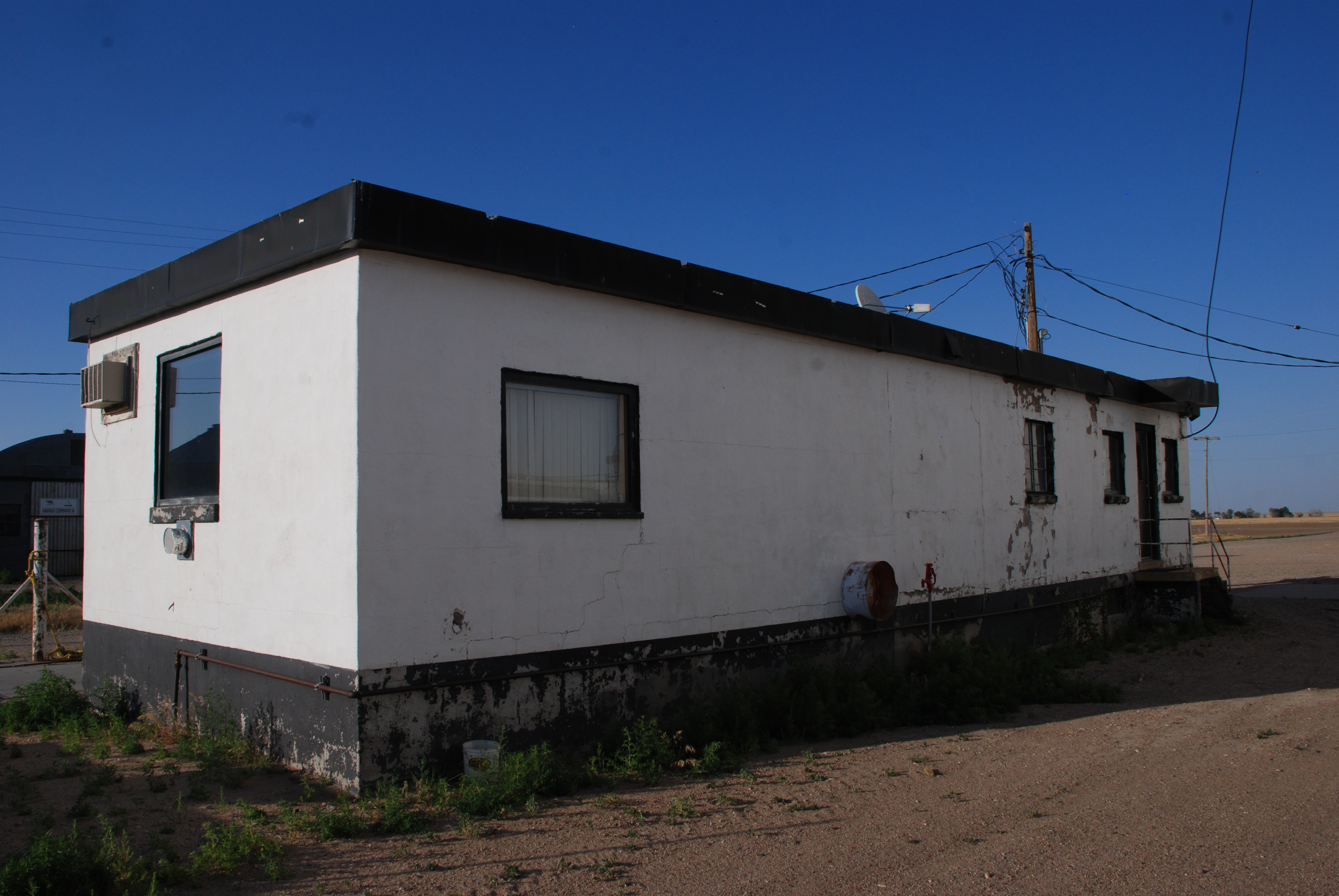
The simple lines of the back of the scale house at Kanorado, Kan.

The simple lines of the back of the scale house at Kanorado, Kan.

Joseph H. Tillotson developed a characteristic style for the scale houses his company built. Those I have visited appeared to be concrete, and many had attractive details. For more typical examples of his work, stay tuned.

A photo tour at Kanorado, Kansas, reveals subtle J. H. Tillotson design details

DSC_0642Story and photos by Kristen Cart

One of the best stops on my elevator tour last October was Kanorado, Kan. It was a fortuitous visit, made in the golden hour of photographic light. We have profiled the elevator before, based upon a visit by Gary Rich while the elevator was operating and open for an impromptu tour. But I wanted to see for myself the elevator my grandfather William Osborn built.

No one was there when we arrived, but I was able to get a good look at all sides of the structure. The straight up, classic lines were unique to  J. H. Tillotson elevators.

DSC_0664

A view of the integral headhouse with windows to admit light

Other companies built similarly styled elevators, such as the Greenwood, Neb. elevator built by Tillotson of Omaha in 1951. But those differed in shape and concrete detailing. The elevator at Kanorado was an earlier effort, and should be compared with those at Traer, Kan., Goodland, Kan., and Wauneta, Neb., among others.

DSC_0655

Late afternoon shadows are cast across the drive-through scale


Another design element that seems to be unique to Joseph H. Tillotson’s Denver-based company is the squat concrete scale house, a deceptively simple building with lovely proportions, as can also be seen with the J. H. Tillotson elevator at Daykin, Neb.

DSC_0687It is good to see another 1940s vintage elevator still doing its job nearly 70 years later. It is a testament to a work ethic that seems quaint in our present day, and a personal investment in quality beyond the next payday. My grandfather would be proud.