Insights from a Ralston, Iowa, elevator maintenance worker

DSC_5966

At the far left edge of the photo, the annex can be seen behind the similarly sized elevator.

Story and photos by Kristen Cart

Each time we travel to Nebraska to see our family, I try to investigate elevators, and the kids groan and roll their eyes, pulling electronic entertainment out of their backpacks.

In March, our trip home warranted a stop at Ralston, Iowa, where we hoped to see an annex built by Tillotson Construction Company of Omaha as we trekked eastbound along U.S. Highway 30. Ralston is about midway across the state and lies south of the highway, and is the site of one of the projects documented in Tillotson company records.

The West Central Cooperative elevator complex, silent and lofty, rimmed the edge of town as we approached on a bright Sunday afternoon. Not a soul was in sight as we entered the parking lot near the cooperative headquarters. But a car in front of the office building was open with a shopvac beside it. Someone had to be around.

DSC_6016

A much larger group of elevators was behind me, away from the town, as I took the photo.

The elevator group in Ralston is dominated by a large squarish elevator, a multi-bin elevator, and a large, multi-bin, rectangular annex snugged in beside the latter. Between the first elevator and the second is an old wood elevator which immediately attracted my attention. It made a fine photographic subject. While shooting the scene, I looked for signs of a Tillotson project. Nowhere was there any manhole cover with the name of a builder. And no one was present who could give me a look inside.

The annex, slightly narrow than the elevator, is on the left

The annex, slightly narrower than the elevator, is on the left.

In fact, the deserted elevator group so dominated the town, along with its companion group of elevators a mile or so down the tracks, that it seemed intimidating to go near it. So I stood off and took photos from across the street.

DSC_6001Heavy rail traffic attended the tracks alongside the elevators in spite of the sleepy Sunday. I counted several trains, blaring their arrival as they passed through town.

At last, a fellow emerged from the cooperative building and commenced vacuuming the company car. I approached him to ask him about the elevators. Ron Hickey, of Farnhamville, Iowa, waved a friendly greeting. He said he was a bit of a newcomer to the Ralston site, but had worked at Boxholm, Iowa, the site of another Tillotson elevator, for two years before coming here. He said that Boxholm’s elevator had 96 florescent light bulbs, and until recently, he was responsible for cleaning every one of them.

Presently, he was cleaning one of several company vehicles parked in front of the nicely appointed offices. The place had every sign of prosperity. Ron said West Central was one of the largest cooperatives in Iowa, and was very successful.

Once we arrived home, I had to resort to the company records to positively identify Tillotson Construction’s contribution to the site. The specifications for Ralston fit the size of the annex I had seen–a massive structure about twice the size of the average elevator project. Since this structure was an annex, many items normally included in a complete elevator build were not required. The Tillotson construction details are reproduced below.

The Ralston storage was built in 1953 using the “Ralston Plan,” which had eight 28′ diameter, 115′ tall bins with a 2′ spread, flat bottoms, and a screw conveyor.

Capacity per plans: 537,000 bushels

Capacity per foot of height: 4,838 bushels

Reinforced concrete per plans (total): 2,779 cubic yards

Plain concrete (4″ hoppers and liner): 9 cubic yards

Reinforcing steel per plans (includes jack rods): 168.18 tons

Average steel per cubic yard of reinforced concrete: 121.00 lbs.

Steel and reinforced concrete itemized per plans

Below main slab: steel 3,128 lbs.; concrete 29 cubic yards

Main slab: steel 102,340 lbs.; concrete 606 cubic yards

Draw form walls: steel 203,034 lbs.; concrete 1,920 cubic yards

Driveway and work floor: not installed

Deep bin bottoms: not installed

Overhead bin bottoms: steel 4,666 lbs.; concrete 24 cubic yards

Bin roofs and extension roofs: steel 14,284 lbs.; concrete 112 cubic yards

Cupola walls: steel 8,907 lbs.; concrete 20 cubic yards

Distributor floor: concrete 2 cubic yards (steel included in above total)

Cupola roof: concrete 3 cubic yards (steel included in above total)

Miscellaneous (boot, leg, head, track sink, steps, etc.): not installed

Attached driveway (in this plan, a gallery, with cross tunnel not included): concrete 63 cubic yards (steel included in above total)

DSC_6010Construction details

Main slab dimensions: 66 2/3′ x 121 2/3′

Main slab area (actual outside on ground): 7,738 square feet

Weight reinforced concrete (4,000 lbs. per cubic yard plus steel): 5,726 tons

Weight plain concrete (4,000 lbs. per cubic yard): 18 tons

Weight hopper fill sand (3,000 lbs. per cubic yard): 154 tons

Weight of grain (60 lbs. per bushel): 16,125 tons

Weight structural steel and machinery: 20 tons

Gross weight loaded: 22,043 tons

Bearing pressure: 2.86 tons per square foot

Main slab thickness: 24 inches

Main slab steel (size and spacing): straight; 1 1/4 square inches and 8 inches o. c.

Tank steel and bottom (round tanks): 5/8 inch diameter and 6 inches

Lineal feet of draw form walls and extension: 717 feet 7 inches; 39 feet 6 inches

Height of draw form walls: 115 feet

Pit depth below main slab: 9 feet 6 inches

Cupola dimensions (outside width and length and height): 12′ x 14′ x 20′

Pulley centers: 137 1/2 feet

Number of legs: 1 main (see pulley center above) and 1 jack

Distributor flow: yes

Track sink: no

Full basement: no

Electrical room: no.

Driveway width-clear: not installed

Dump grate-size: not installed

Columns under tanks: not installed

Boot–leg and head: steel

Machinery details

Head pulley (main leg): 48″ x 16″ x 4 15/16″

Boot pulley: 48″ x 13″ x 2 3/16″

RPM head pulley: 48 rpm

Belt: 15″-6 ply calumet

Cups: 14″ x 7″ at 10″

Head drive: Howell 40 horsepower: 3

Theoretical leg capacity (cup manufacturer’s rating): 7,950 bushels per hour

Actual leg capacity (80% of theoretical): 6,350 bushels per hour

Horsepower required for leg (based on above actual capacity): 26.4 horsepower

Man lift: not installed

Load out scale: not installed

Load out spout: not installed

Truck lift: not installed

Dust collector system: fan into bin

Cupola spouting: not installed

Driveway doors: not installed

Conveyor: 24 inch screws

Also built

Track scale: 50 foot, 50 ton: concrete 35 cubic yards


The vanished Glidden elevator, a concrete giant, has gone the way of the wood

Story by Kristen Cart

It is tremendously disappointing when you realize an elevator should be there, and isn’t. I recently passed through the north-central Iowa town of Glidden, a small place mostly on the south side of Highway 30. I knew from Tillotson construction records that an elevator and an annex were built in Glidden back during the elevator boom. But though I leaned over to that side of the car to peer at the skyline, hoping to see the familiar white Tillotson elevator outline, all I saw were two hulking bins of another more modern sort.

You learn to expect old wooden elevators to disappear. But the 1940s and ’50s vintage concrete elevators usually are not so quick to go.

Glidden, IA 51443 - Google MapsThis situation would require some investigation, but not on a day when I had to get home, with another 400 miles or so to go. I had at least one more stop planned to see an elevator, at Ralston, a town just a few miles further east, and my three kids tolerated the stops, hanging in there at the frazzled edges of their patience.

When I got home, I resorted to the Internet. Satellite images have become so good that you can virtually identify a builder from above. But in the case of Glidden, there was no sign of an old elevator, only a bulldozed area where the forms for two circular bins had been laid out. Apparently I had not overlooked the desired elevator–it was gone.

NEW Cooperative Inc - Google MapsI didn’t count on being able to date the demolition, but the map’s “street view” came to the rescue. An uploaded photo, watermarked 2013, showed a view of the site from an intersection down the street. From that perspective, the old elevator stood as it always had, since it was built. So the old elevator was probably retired after the last of its grain was out, in time for new bins to be built for the next harvest, sometime in 2013 before winter set in.

I missed my grandfather’s (alleged) McAllaster, Kan., elevator by a couple of months when it was torn down over a year ago. But in the satellite image that was available at the time, you could see where the destruction had begun. Several round bins were newly absent, and holes appeared in the top of the headhouse.

I don’t imagine that satellite engineers envisioned this use for their images.


Charles H. Tillotson straddled the divide between wood and concrete

Charles H. Tillotson

By Ronald Ahrens

My Great-grandfather Charles H. Tillotson may have been following his trade by instinct, but he opened the way for descendants to distinguish themselves in the business of elevator construction.

I know the Tillotsons saw themselves primarily as carpenters. My Uncle Charles J. Tillotson went to work as an apprentice carpenter for Tillotson Construction, which was founded after the death of his grandfather Charles. My Uncle Michael Tillotson learned carpentry on through the family business and worked as a carpenter throughout his career. When I helped him finish concrete sidewalks on a couple of side jobs in the 1970s, he preached a gospel that carpenters could do it all, whether it be concrete or painting. And in elevator construction, it was true.

Charles H. Tillotson was born in Brunswick, Mo., in 1880. He married Rose Brennan in Riverside, Iowa.

He and my Great-grandmother Rose had an apparently cozy life in Omaha with their three grown children, Joseph, Reginald, and Mary, all of whom became involved in elevator construction. Kristen Cart’s research has found the Tillotsons listed in the 1930 census. They lived at 624 N. 41st.

A 1936 city directory listed Charles H. as president of Van Ness Construction, a company that built mills and elevators. Joseph served as secretary-treasurer and Reginald was a foreman. Mary worked as a clerk-typist at the Federal Land Bank.

Charles_Tillotson_Obit__The_Nebraska_State_Journal__Lincoln__Nebr___19_June_1938

By then, Reginald was married to my grandmother, Margaret Irene McDunn Tillotson. Their firstborn Charles J., had arrived in 1935, followed the next year by my mother, Mary Catherine.

Uncle Tim Tillotson, the middle of their three sons between Charles J. and Michael (who was born in a home-built house trailer at a Smith Center, Kan., job site), says a story exchanged among the uncles was that Great-grandfather Charles H. would tell Reginald, “Put out that cigarette,” when they were working on jobs. The danger of fire was constant. How ironic, then, that Charles H. held a cigarette for his portrait.

After the death of paterfamilias Charles H., the Tillotson Construction Company was formed by Reginald, Joseph, and Mary. We would love to learn more about how this proceeded.

Meanwhile, the transition to slip-formed concrete construction was under way, with the Tillotsons’ carpentry skills being readily applied to the formwork.

The 1945 vintage elevator at Lodgepole, Nebraska, and the death of Bill Morris

DSC_0446Story and photo by Kristen Cart

A newspaper article recently came to light that upended our elevator construction timeline, causing us to reconsider the story of the Lodgepole, Neb., elevator and the careers of Joseph H. Tillotson and my grandfather William Arthur Osborn.

My dad, Jerry Osborn, said that the death of Bill Morris, the superintendent on the Lodgepole job, and that of Joe Tillotson, the owner of J. H. Tillotson, Contractor, came within a month or so of each other. Now it appears likely that the season was the same, but both fatal car accidents occurred in different years–1945 and 1947–a fact easily misunderstood by the young boy my father was at the time, as he listened to the adults talk about business.

elevator021

We believe this photo by William Osborn is from Lodgepole, Neb.

The article appeared in the Nebraska State Journal on Oct. 8, 1945:

Omahan dies after car accident

SIDNEY, Neb. (AP). W. B. Morris, 36, an employee of the Tillotson Construction company, of Omaha, was fatally injured Saturday night when struck by a car driven by Howard B. Kirk, 48, of Lodgepole, Neb., Deputy Sheriff Arnold Braasch said Sunday.

The deputy sheriff reported Morris was changing a tire on his car about ten miles east of here when the accident occurred. He died in a hospital about five hours later.

Braasch said Morris’ home was in Texas, but that he was living in Lodgepole while working on the construction of a new grain elevator.

County Attorney R. P. Kepler said he will decide on Monday whether an inquest is to be held.

We attributed the Lodgepole elevator’s construction to J. H. Tillotson, Contractor, the independent company Joe Tillotson started after his parting of the ways with Tillotson Construction of Omaha. We wrongly believed that both Bill Morris and Joe Tillotson had died in 1947 while working on the Lodgepole job. Now we know that Bill Morris died in 1945 while working for Joe Tillotson. The new fact pins down the date of Joe’s departure from the Omaha company–a move my grandfather made at the same time.

When interviewed in 1949 about his first, independent, Mayer-Osborn Construction venture in McCook, Neb., William Osborn named a number of elevators he had built before. We still believe all of the elevators Bill Osborn listed were J.H. Tillotson elevators.

According to the McCook article, Bill Osborn said the elevators in Maywood, Traer, Wauneta, and Lodgepole were built in 1945. If the reporter was right about Bill Morris’ employment, all of the 1945 elevators would be too early to be J. H. Tillotson elevators. However, none of them were recorded in the Tillotson Construction specifications and none built in the Omaha company’s style.

The reporter writing about Bill Morris’ death in 1945 was unaware of the freshly minted company Joe Tillotson had started, and wrongly identified Bill Morris as a Tillotson Construction of Omaha employee.

DSC_0369

An early photo of the Lodgepole elevator was kept at the location.

The fact that in 1945, Bill Morris went from a superintendent job at a verified Tillotson Construction project in Giddings, Tex to a superintendent position at the Lodgepole elevator job, a project demonstrably not built by the Omaha company, precisely dates the time Joe Tillotson chose to go out on his own.

The 1945 construction date of the Lodgepole elevator gives us a much more accurate understanding of the birth of J. H. Tillotson, Contractor, a venture that lasted about four years, until my grandfather built the McCook elevator for Mayer-Osborn Construction in 1949.

A tragedy took Morris in his prime, but my grandfather stepped into his place, gaining valuable experience as a builder. To this day, the graceful Lodgepole elevator serves as a fitting monument to Morris’ productive career.

Wrecking out details are provided in drawings from Tillotson records

Charles H. Tillotson

By Ronald Ahrens

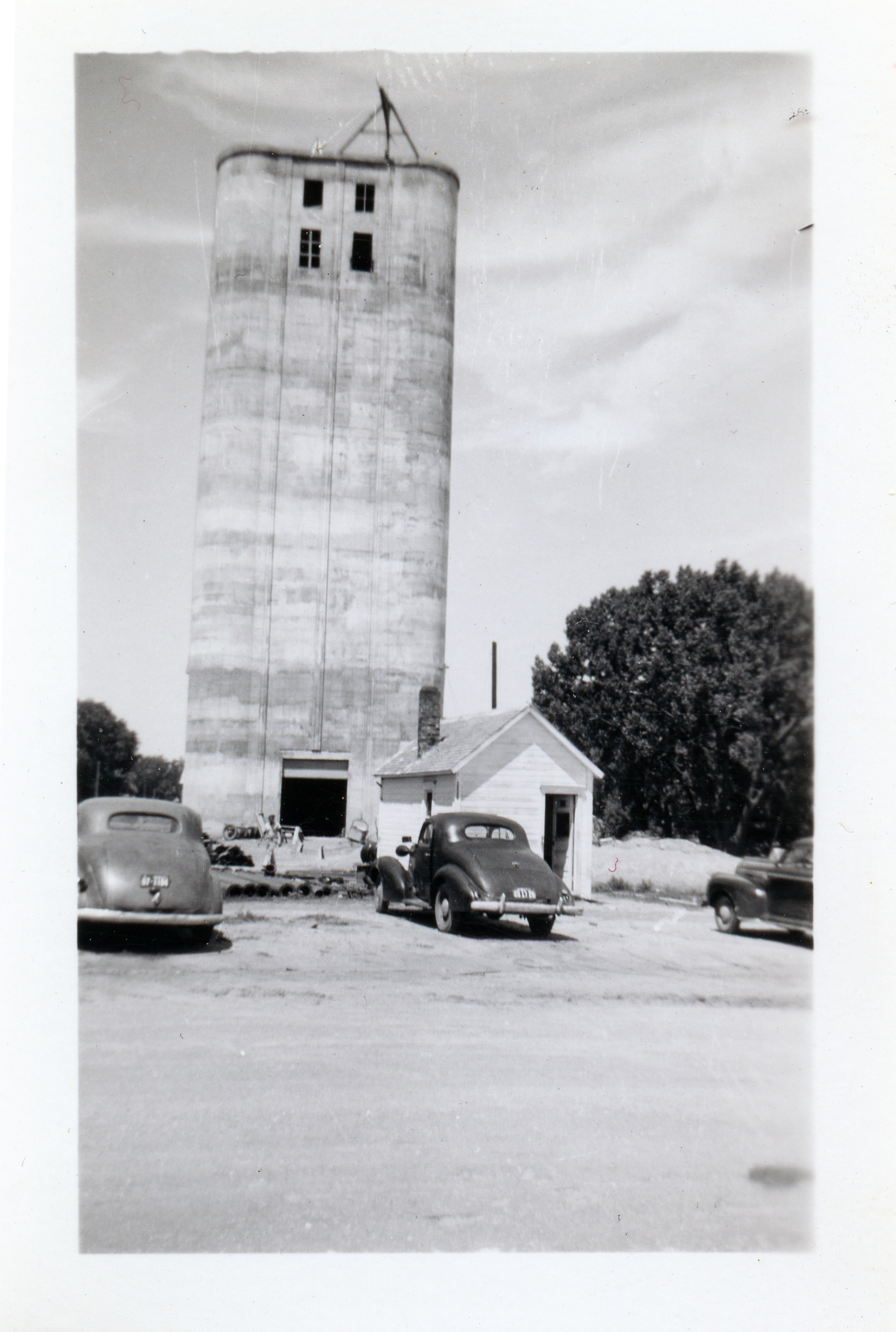
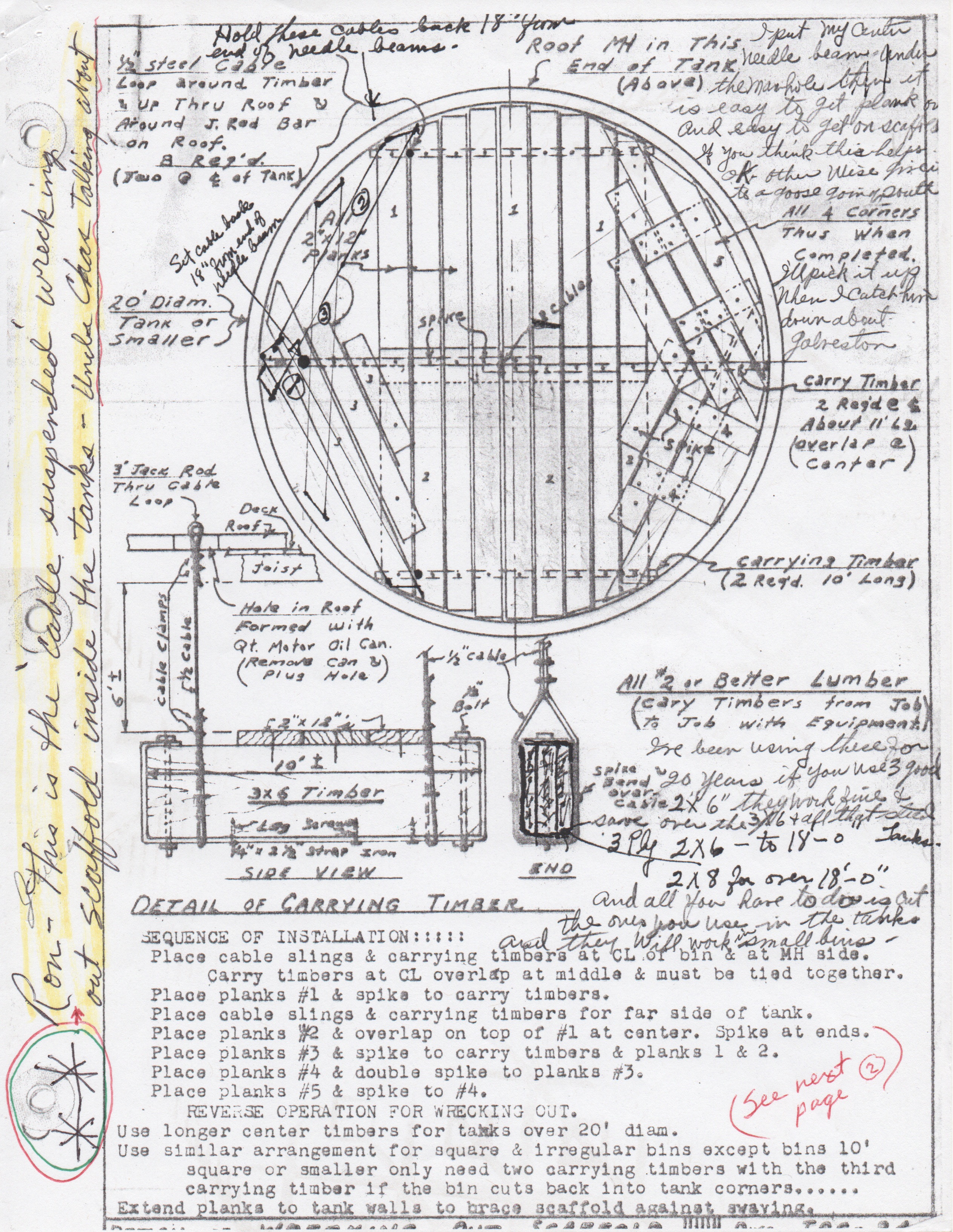
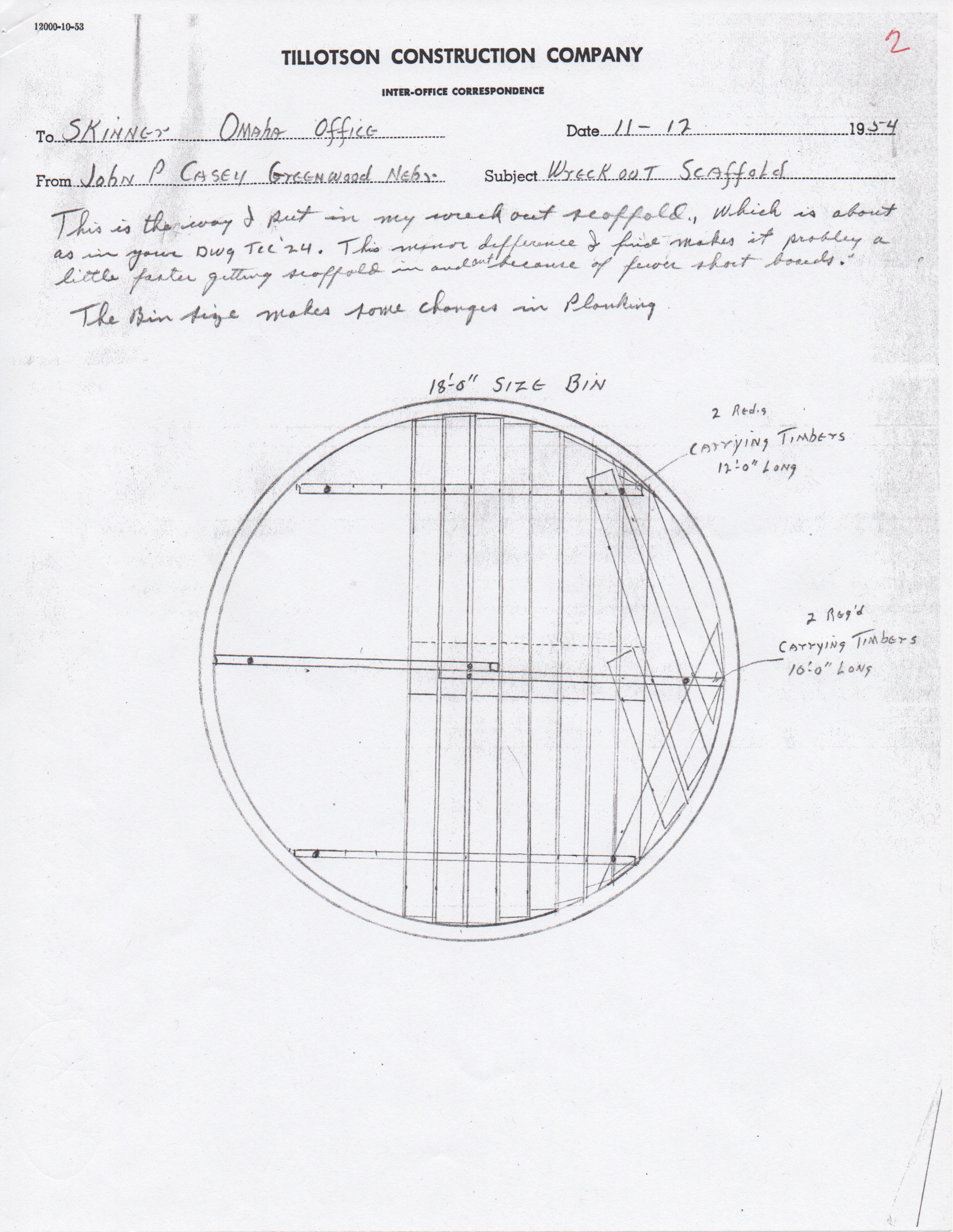
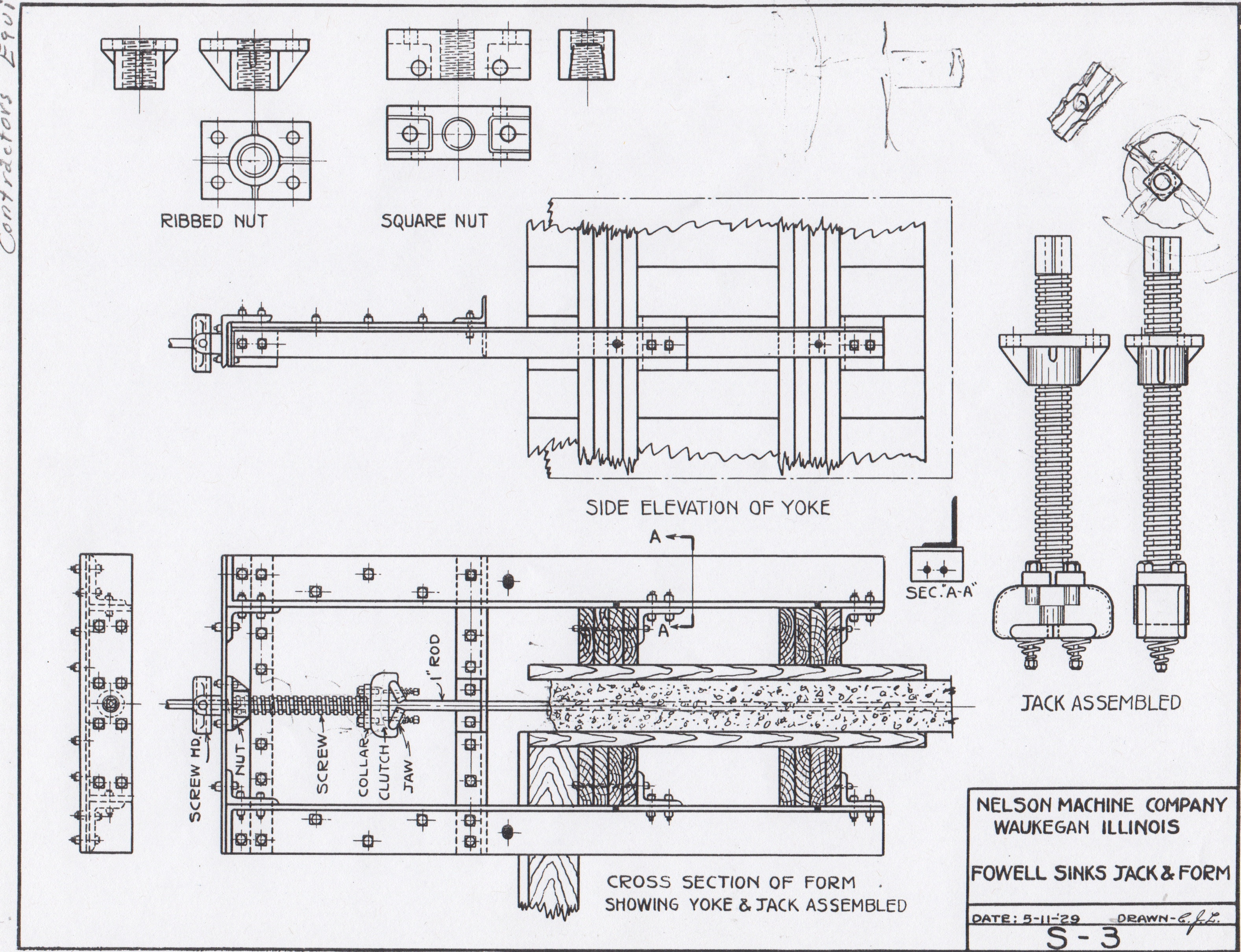
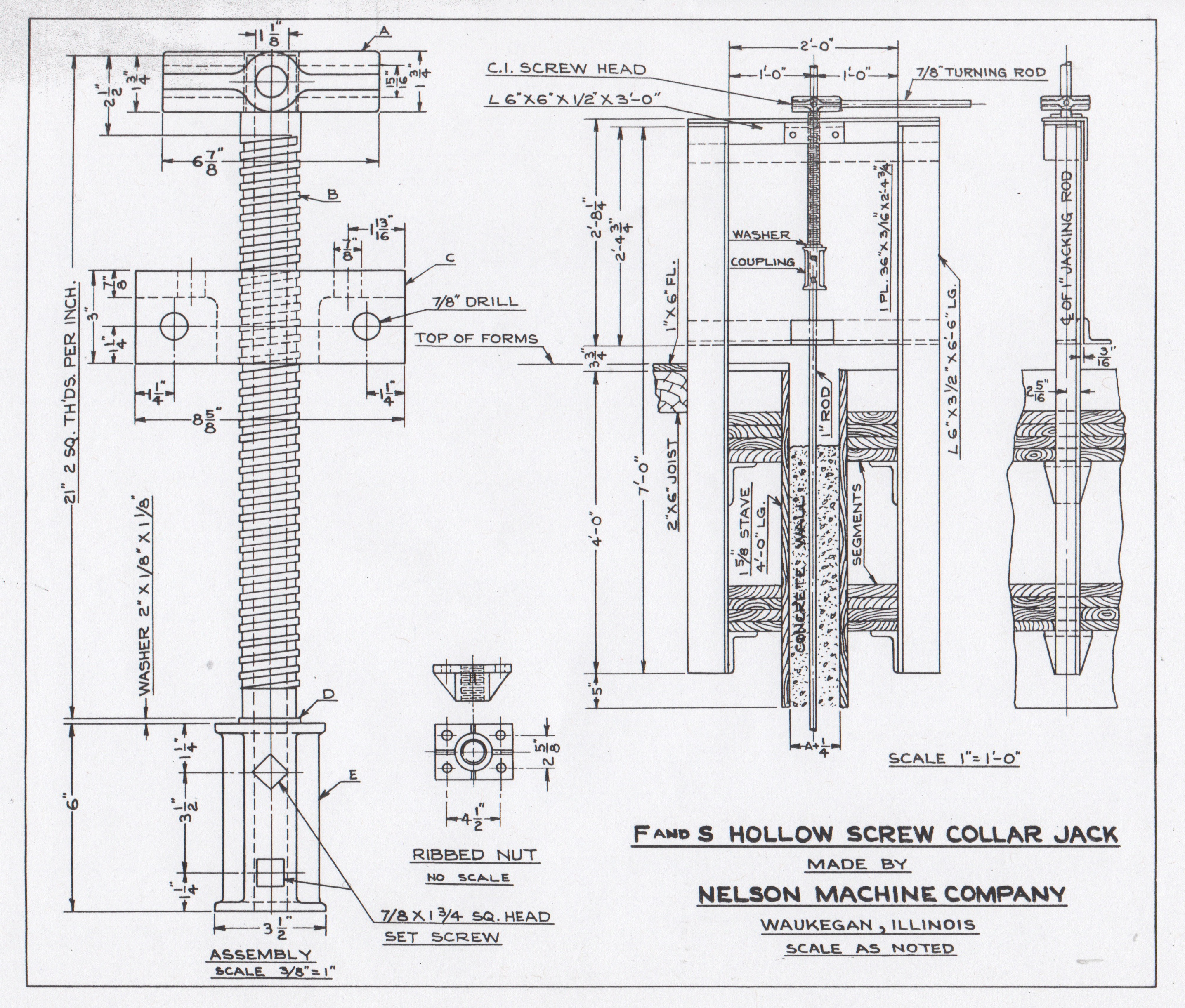
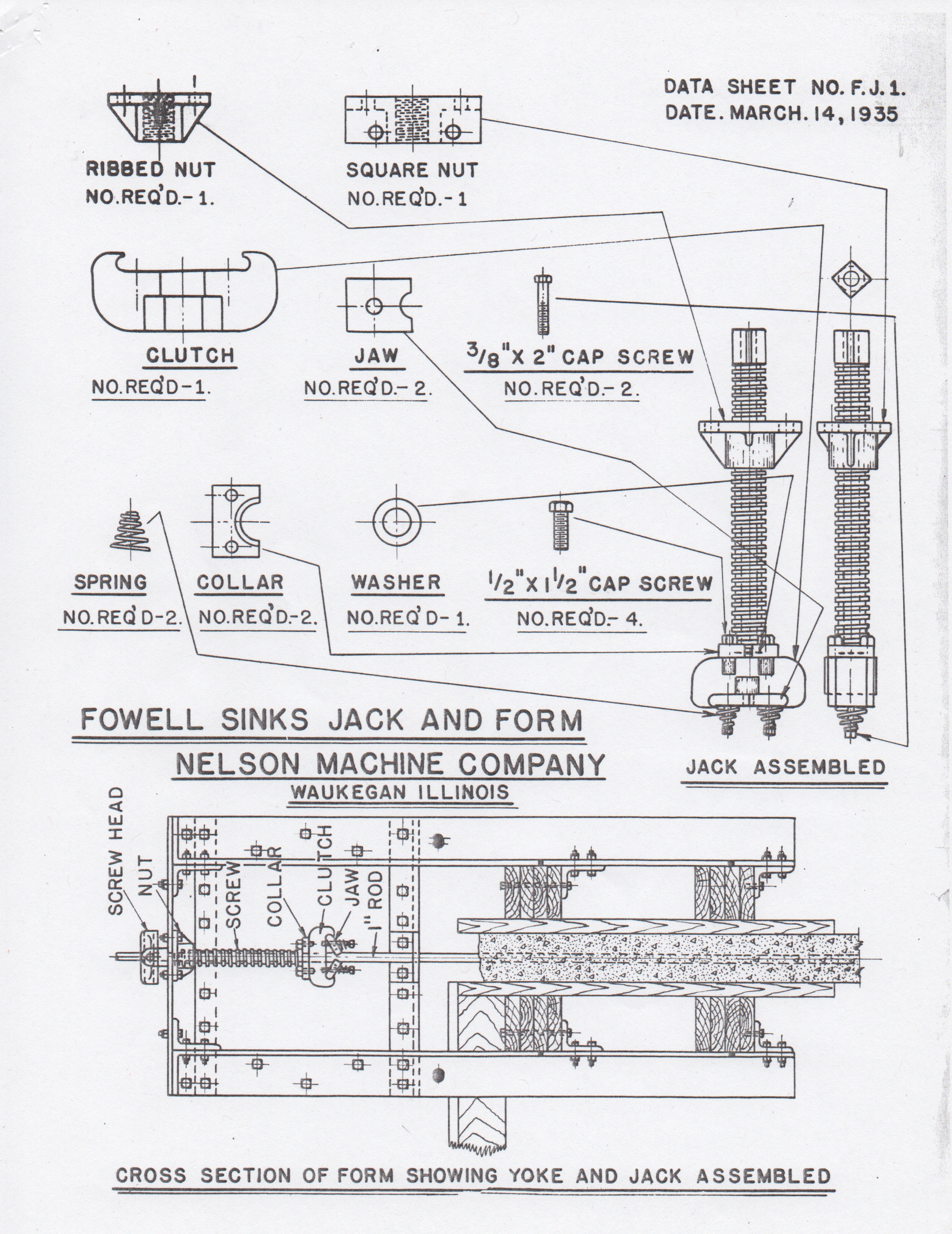
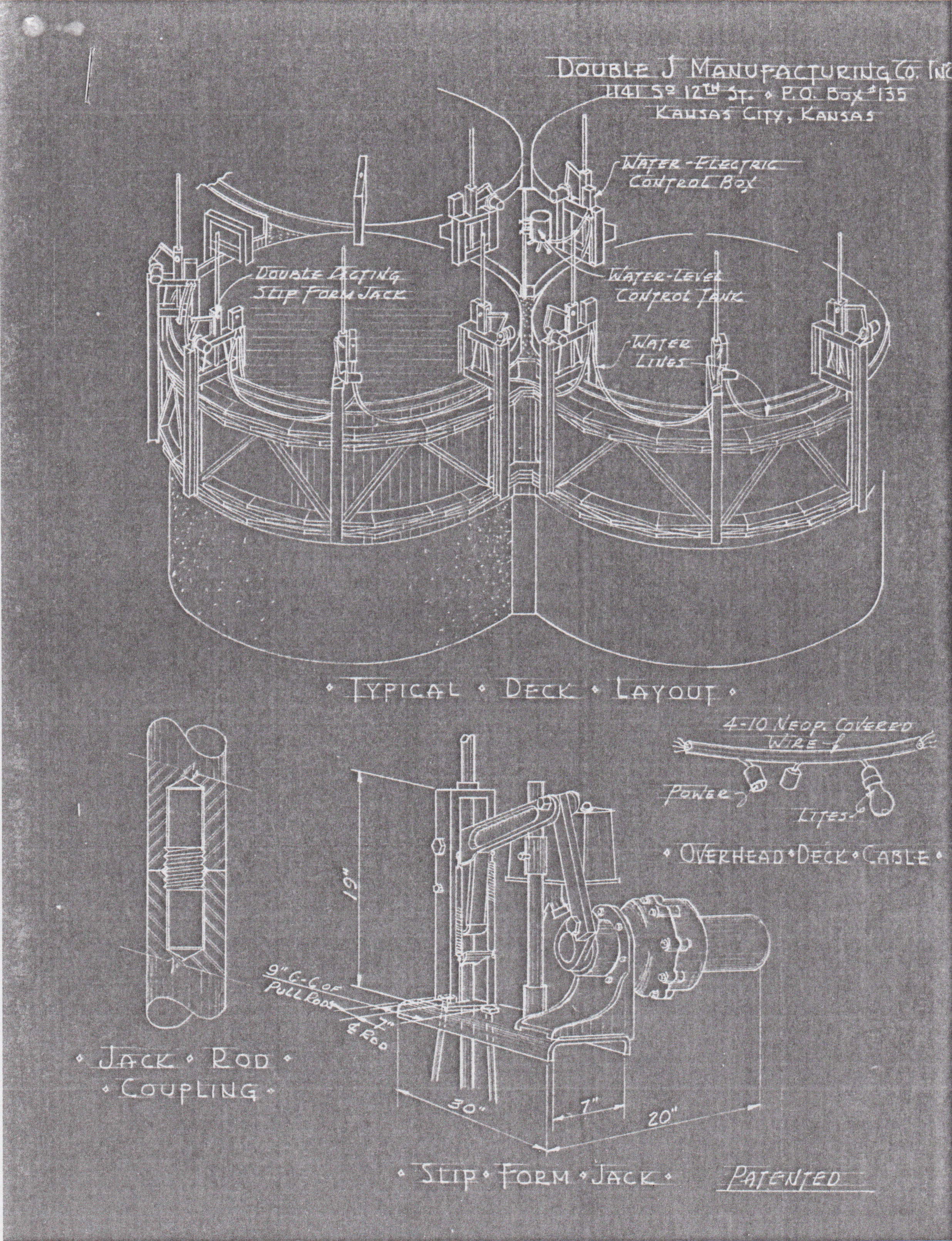
The papers we received from my Uncle Tim Tillotson included not only the record of Tillotson Construction Company’s building activities, but also these pages showing details of building a wrecking-out platform as well as jack rod assemblies and formwork details. Page two is dated November 12, 1954.

A wrecking-out platform was needed as workers disassembled the formwork on the inside of the completed elevator.

Charles H. Tillotson 1

Uncle Charles Tillotson has previously written about his close call when cable clamps failed.

In that post he described a wrecking-out platform this way:

The final scaffold then becomes a square platform suspended in a round tank.

The void on each side of the scaffold is used for lowering or throwing the wood material into the tank’s dark abyss. After all the overhead wrecking has been accomplished, another team gains access to the tank’s bottom via a manhole in the side of the tank at or near ground level.

Charles H. Tillotson 3

The drawings and details presented in the notes included here are invaluable. For example: The hole in the roof is formed with a one-quart motor oil can. (“Remove can & plug hole,” the addendum reminds.)

Charles H. Tillotson 5

The handwritten note in the upper right corner of the first page says, “I put my center needle beam under the manhole then it is easy to get plank on and easy to get on scaffold. If you think this helps O.K. other wise [illegible] to a goose going south.”

“I’ll pick it up when I catch him down about Galveston,” this section concludes.

Charles H. Tillotson 4

Another note is on the quality of timbers: “I’ve been using these for 20 years if you use 3 good 2 x 6 they work fine and save over the 3 x 6 & all that steel and all you have to do is cut the ones you use in the tanks and they will work in small bins.”

We look forward to readers’ comments on the pages.

Charles H. Tillotson 7

An airplane crash ends Gandy Construction, an early elevator player

WAO3

The Mayer Osborn company brochure mentions Gaddy (sic) Construction of Omaha

Story by Kristen Cart

My father remembers the grain elevator construction business from earliest childhood. But his childish memories did not distinguish one job from another, so until recently we did not know about the company where my grandfather William Osborn began his career as a carpenter.

Dad said they still lived on the farm when his father went to Kansas City in pursuit of a better opportunity, which dated the event to before 1944. That job was likely with the Tillotson Construction Company of Omaha. Before then, Grandpa’s Mayer Osborn Construction brochure said he worked for Gaddy (sic) Construction of Omaha. It was difficult to come up with any information about them, until we located a clipping that marked a tragedy.

The newspaper account related:

Plane Crashes at Lexington, Omahan Killed

Lexington, Neb., (AP). Ralph Arden Gandy, 41, head of an Omaha construction firm, died Saturday night after the light plane he was piloting crashed near here.

Tommy Johnson, a Gandy construction company foreman, was injured in the crash.

W. H. Pfiefer, Lexington funeral director, said Gandy’s plane took off from a field on the farm of Dennis O’Connor, a cattle feeder who lives six miles northeast of here.

After the takeoff, the funeral director said, the plane stalled and crashed on a road. Both men were thrown free of the wreckage.

Gandy died a short time after the crash in the Community hospital of Lexington.

Johnson received a broken jaw and chest injuries. He was removed to the Methodist Hospital in Omaha by ambulance Sunday night.

The Gandy firm had built a grain elevator on the O’Connor farm, Pfiefer said, and Gandy and Johnson had been at the farm inspecting it. The plane was taking off to return to Omaha when it crashed.

Gandy is survived by his widow, Clara, and four children.

The Nebraska State Journal, Lincoln, Neb.,  Aug. 1, 1949.

William Osborn worked with Loren Saunders, his brother-in-law, at a job in Omaha before he took the opportunity in Kansas City, according to my dad. It seems likely that the Gandy company was that job.

A reader recalls his youthful days at the grain elevator in Emmetsburg, Iowa

This T.E. Ibberson elevator, foreground, keeps company with a Tillotson elevator, right, in Dallas Center, Iowa. Photo by Kristen Cart

This T.E. Ibberson elevator, foreground, keeps company with a Tillotson elevator, right, in Dallas Center, Iowa. Photo by Kristen Cart

By Paul Grage

Editor’s note: Paul Grage (pronounced “GREGG-ee”) of Rockwell City, Iowa, is a 39-year-old supervisor at North Central Correctional Facility there. In his free time he surfs the Web looking for elevator sites.

I would like to share some memories of Cargill in Emmetsburg, Iowa, during the 1980s.

My fondest memory is of Old Number 2, built by T.E. Ibberson, of Minneapolis. My dad was the manager from 1979 until about 1996, and I would often call after school at harvest to see if I could come hang around. If they were accepting grain at Number 2, that is where I would be.

The alleyway [driveway] was huge. It had one  main grate and two side grates for overflow that all emptied into one  pit. It had a large horn like a fire alarm buzzer. This  sounded for phone calls, when the leg was up to speed, or when a bin ran full. The side entrance inside was flanked by two large aerator fans that roared. As a kid, it was kind of terrifying to exit between these two.

The Ibberson nameplate. Photo by Kristen Cart

The Ibberson nameplate. Photo by Kristen Cart

I remember the rippling of the grates as semis crossed them. I still remember the old portable, homemade, electrically powered, hydraulic pump that raised the old barge box wagons pulled by pickup trucks.

I remember the old gate at the bottom of the pit that accessed the leg. It was moved by a large lever next to the pit, right next to the leg button. You had to hear the buzzer before you opened that gate unless you wanted to plug the leg before it got up to speed. My dad tells horror stories about unplugging the leg. A test of your manhood was to go to the headhouse and hold back the anti-rollback dogs, like a one-way clutch, with a wrench or bar. The whole trunking would shake. The distributor crank was right next to the leg and man lift. It was a lever brake and crank-style bin selector that had belt pulley webbing on it to indicate which bin you had selected.

I remember the first trip to the headhouse with my brother. He was an employee with Cargill before they had nepotism rules. It was a sight to behold: the big open headhouse with all of its huge spouts, the huge gearbox and chain-drive leg and the big distributor. Inside this headhouse was a huge plywood shack. It was explained to me that it was a tripper scale used for loading railroad cars. It was long out of use, as this elevator had no rails and the new elevator did. This tripper scale did have long rods that extended down the man lift shaft to the alley below.

I remember the ride up the man lift with my brother. The dust was so thick on the walls the people had stopped along the way and scratched rather colorful sayings in the dust. (This was long before the days of dust control, so that dust was a good three inches thick in that man lift shaft. Now they have an air chuck so they can blow the dust down.) When I say man lift shaft I mean man lift onlythe leg shafting was built into the concrete.

The T.E. Ibberson name on the manhole cover.

The T.E. Ibberson name on the manhole cover.

The metal trunking only existed between the boot pit up to ceiling of the alleyway and then from the bin deck to the leg-drive pulley in the headhouse. The rest of the leg trunking was made of a cement column inside. The shaft that the rest of the bucket was built into was hopper-bottomed just like all the overhead bins.

If I remember right, this elevator had eighteen overhead bins, one of which was used for rail car/tripper scale.

After learning the elevator inside out, the ironic thing is that I could never go to work in the grain business because I’m allergic to soybean dust. It’s almost lethal to me. When I was a kid, it didn’t faze me a bit. But my last year I hung around there, around 1988, I had to wear a respirator. 

Something else: They don’t paint this elevator any longer because it’s stress-cracked. They quit painting it because it was making the concrete rot. I like the aged look.

The Kansas City firm of Horner & Wyatt, Engineers, designed grain terminal giants

DSC02466Story and photo by Kristen Cart

Often a reader will turn our blog in a whole new direction by revealing a facet of the grain business we had not explored. In the case of Horner & Wyatt, an engineering and design firm out of Kansas City, reader David Chatt piqued our interest by asking us to locate some of their work. His grandfather, Oliver Howard Horner, a partner in the company, died  in the late 1930s.  David wanted to know more about the sites he had helped design. The quest seemed to be right up our alley.

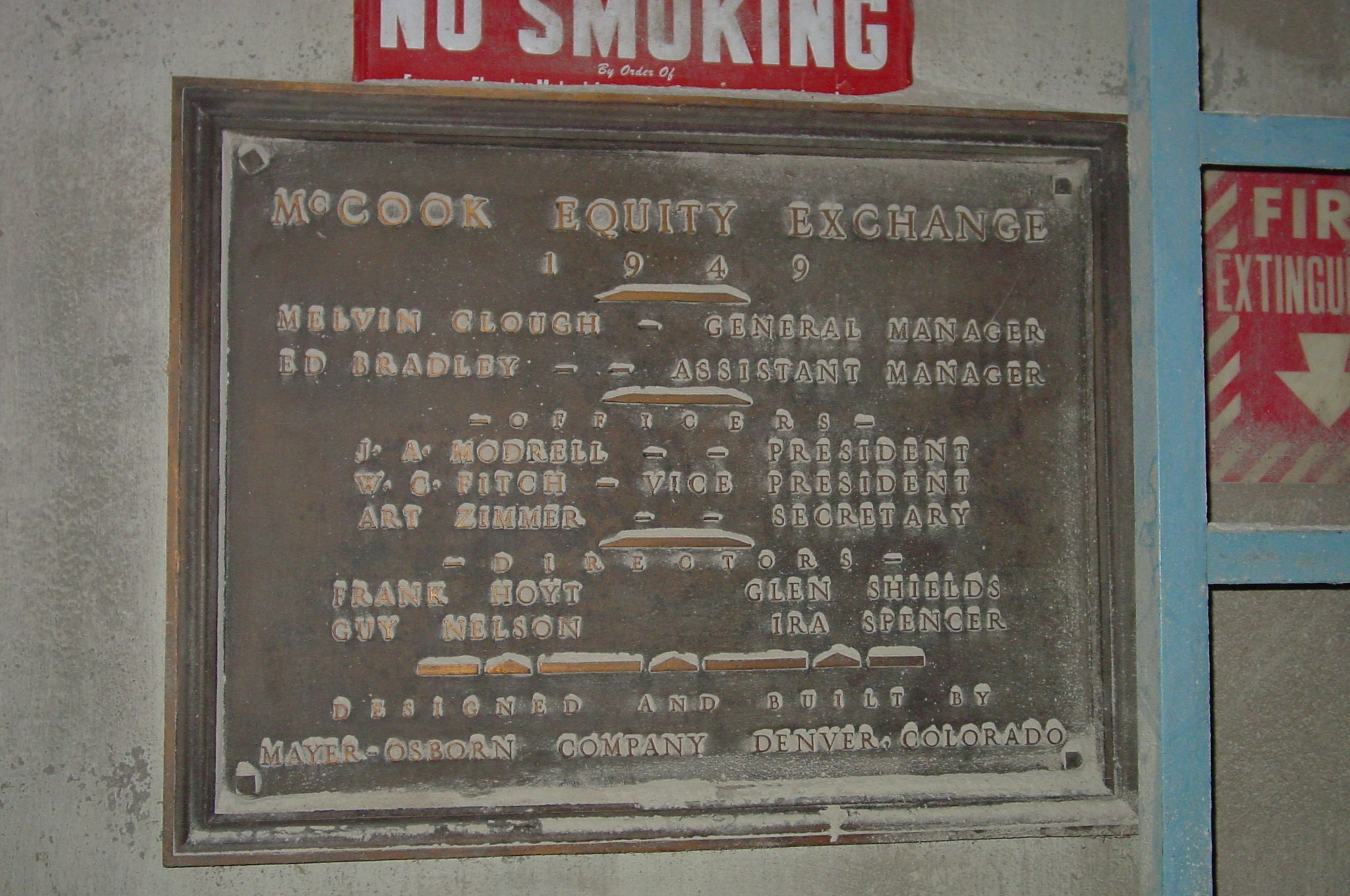
It might be possible to discover the identity of the architects at elevator offices, but the common method of checking for the builder’s name on elevator manhole covers would only reveal the guys who poured the concrete. At McCook, Neb., a plaque inside the elevator names the designers. But newspaper accounts, journals, or local histories are the best way to learn about the architects of most elevators, especially for the large projects that changed the face of their communities.

David told us  the Galveston elevator, which was destroyed some years ago, was the only Horner & Wyatt site he could find. Further investigation revealed the company as a major player in elevator architecture, active as early as the 1920s. Our search for their projects revealed a completely different side of grain storage requirements: the end of the logistics trail, or the terminal elevator. We located a few of them, and most appeared to be massive.

Oliver H. Horner was an electrical engineer working for Black & Veach at the time he registered for the draft in 1917. By 1921, he was a partner in his own firm, based in Kansas City. In the 1930s he was engineering some of the biggest elevator projects in the country. He was still listed in that capacity in the city directory as late as 1939. Newspaper accounts described Horner & Wyatt as “consulting engineers” on various projects, which became increasingly complex as time went on.

Some of the sites we found, which were completed during Oliver’s lifetime, were elevators at El Reno, Okla., the Gooch Feed Mill at Lincoln, Neb., and the levee terminal at Kaw Point in Kansas City, Kan. The company continued to design massive elevators into the 1950s at sites such as Happy and Lubbock, Tex., and the port terminal at Corpus Christi, Tex. Doubtless the designs for the later projects built upon the experience and ideas that went before and bore the unmistakable imprint of the company’s earlier engineers.

Oliver H. Horner left a legacy to be proud of, with elevators and mills still standing and operating in premier locations around the country. Horner and Wyatt was one of the top engineering companies working during the twentieth-century elevator boom. It’s very nice that one of our readers took the time to point them out.

In 1954, near the boom’s end, Albert City, Iowa, had a gleaming concrete elevator

Albert City, Iowa

By Ronald Ahrens 

Looking at this photo of Tillotson Construction Company’s 252,000-bushel elevator, completed in 1954, it’s easy to imagine the pride and awe of a small town’s few hundred residents.

Albert City is in northwest Iowa on a spur from Route 3, not far from Storm Lake in Buena Vista County. The Tillotson’s had also built that same year in nearby Pocahontas, where there was tragedy.

The Albert City job went more smoothly as the structure rose far above the tallest elms, although Uncle Charles Tillotson, who recently dug up this photo, has written about his frightening dismount from the formwork during a storm.

Uncle Michael Tillotson has also recollected about working here:

“The following summer (1954) we went to Albert City, Iowa, 75 miles North of Council Bluffs. We rented rooms in a private home. We worked with a 20 something guy that ran the winch pulley bucket to the top of the elevator as it progressed, and brought building materials down. We also rode the bucket up and down to get on deck. The elevator bens were 125 feet to the top with a Head-House of 75 on top of that.”

Company records show the elevator was built according to the same plan used in Pocahontas. This entailed eight outer bins that were eighteen feet in diameter and, contrary to Uncle Mike’s reckoning, 120 feet tall. Altogether, some 2091 cubic yards of concrete were reinforced by 106.57 tons of steel.

The bins rose from a main slab 21 inches thick and 60 x 72.5 square feet in area. It supported a gross loaded weight of 12,974 tons.

The cupola, or headhouse, was 23 feet wide, 58 feet tall, and 40 feet long.

Albert City was a single-leg elevator. Its head pulley was 72 inches in diameter and turned at 42 rpm. A 40-horsepower Howell motor supplied more than enough energy to turn it.

Twelve-inch-wide cups on a six-ply, 14-inch-wide belt carried up the grain that was dumped by incoming trucks. The 12-foot-wide driveway had two dump grates: 9 x 6 feet and 9 x 14 feet.

In 1954, Tillotson also built in Dacoma, Lahoma, Orienta, and Weatherford, Okla.; Booker, Tex.; Ensign and Montezuma, Kan.; Bellwood, Neb.; and Glidden, Goldfield, Newell, Manson, Pocahontas, and Iowa Falls, Iowa.

These were among Tillotson’s last elevators–the records close out with work in 1955–and they represented nearly everything the company knew about building.

A visit to Google Maps shows the elevator is still standing, which is to be expected given the Herculean effort needed to knock down all that reinforced concrete. But it appears idle. Given what we’ve learned about the limitations of midcentury elevators and today’s need for greater storage capacity and quicker unloading, that would make sense.

Nevertheless, it endures as a handmade monument, and a rich human history goes with it.

This ‘continuous pour’–and the marching band–would delight our grandfathers

By Ronald Ahrens

Photo by AC Martin.

Photo by AC Martin.

A  USA Today insert in my Feb. 6 edition of the Desert Sun newspaper carried this story about the new tower under construction in Los Angeles. The news will be of interest to the concrete enthusiasts among our readers.

The report on the 1100-foot Wilshire Grand project describes how the the foundation slab will be laid on Feb. 15: “The project will attempt to set a Guinness World Record with the largest continuous concrete pour ever… More than 2,100 truckloads will deliver 21,200 cubic yards of concrete weighing 82 million pounds.”

A typical Tillotson elevator–for example, Albert City, Iowa–needed 2091 cubic yards of reinforced concrete. That’s just under one percent of what’s going into the 100-foot-deep hole on Wilshire Boulevard. I’m trying (without success) to picture 100 grain elevators compressed in there.

The USC band will precede the first truck to the site.  It is not recorded that any band ever marched to the opening of an elevator job.

Nor is it believed a swimming pool topped any elevator, as will be the case at Wilshire Grand.

Technical complications will arise during the pour, and a quite amazing means of addressing them has been devised, as you will read in the story.

I mentioned all this to Uncle Chuck Tillotson and shared the clipping with him. He said that my grandfather Reginald had foreseen for Tillotson Construction Company a commercial future beyond elevator construction.

Applying their expertise with concrete in different applications would only have been natural, but it’s doubtful  he foresaw anything quite this big.

And I’m sure he didn’t think about anyone taking a dip while 1100 feet above the city.