Tillotson’s Bushland, Tex., elevator was the scene of a scary, non-fatal fall in 1950

IMG_8901

Besides yesterday’s story about getting off-level when building the Bushland, Tex., elevator in 1950, the late Niel Lieb supplied another one that illustrates how dangerous elevator construction could be. 

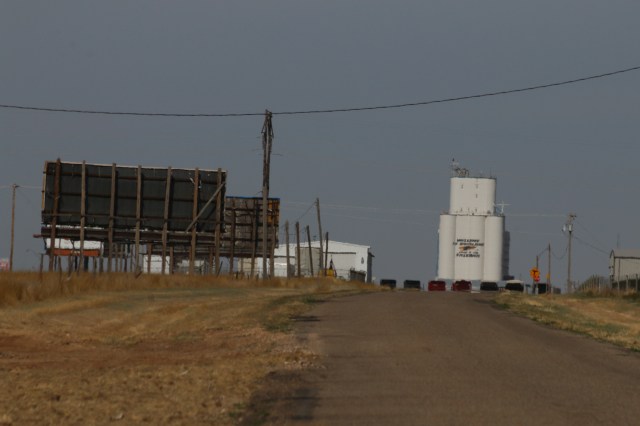
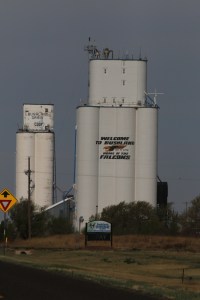
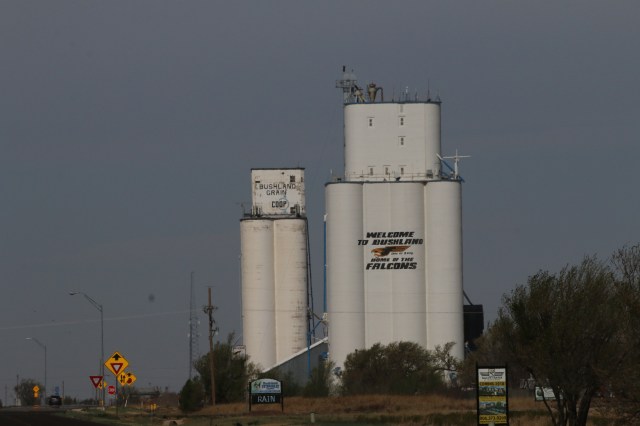
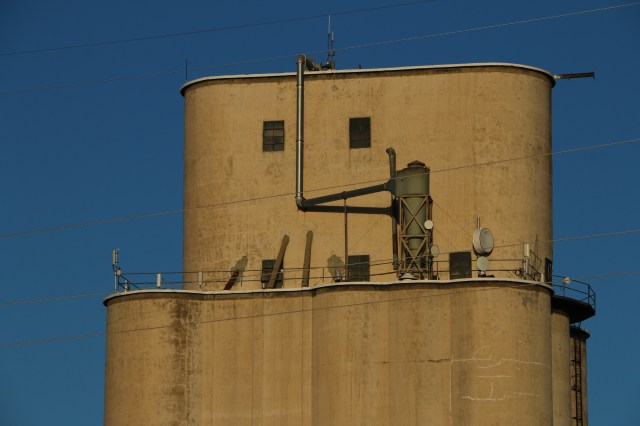
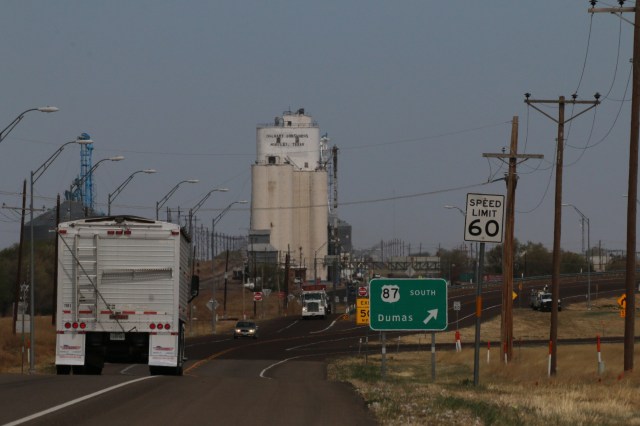
Texas-Okla Logo 04I recalled it during my road trip when approaching the 252,000-bushel Bushland elevator that gleamed in the midmorning Monday sun. A second one on the site looked a little tattered in comparison to the classic Tillotson with its fine curved headhouse.

Lettering on the east side’s upper-middle part proclaimed, “Welcome to Bushland, Home of the Falcons.” The Class of 2010 was responsible.

IMG_8923But the drama of the elevator’s construction might have eluded the Class of 2010.

“Every job had a peculiarity,” Lieb said.

“The guy in Bushland jumped off the top. He started to fall, so he jumped. He jumped out far enough to land on the sand pile. We were probably 40 to 50 feet [above ground on the slipform]. He landed on the side of the sand pile and slid to the bottom.

We said, “How you doing?”

He said, “Oh, I’m fine. I’ll be a little stiff and sore.”

“There were seven guys that I worked with. Baker was one and Bill Russell. All of ’em fell or got killed somewhere along the line.

“When you’re working in the air, you become careless because it’s like walking on the ground, but you’re not walking on the ground.”

IMG_8911Indeed, we can hardly count the human cost to building an elevator, or any tall structure, in the early and middle decades of the 20th century.

Sometime afterward, we figured out more specifics about safety procedures and equipment.

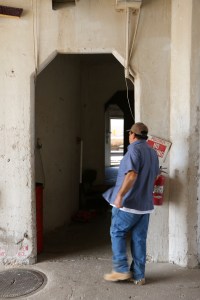
At last I drove onto the grounds. The elevator was open. Chalk up another score for me–the second elevator in a row I could enter and inspect. No one seemed to notice me even though the Ag Producers Co-op office was just to the north.

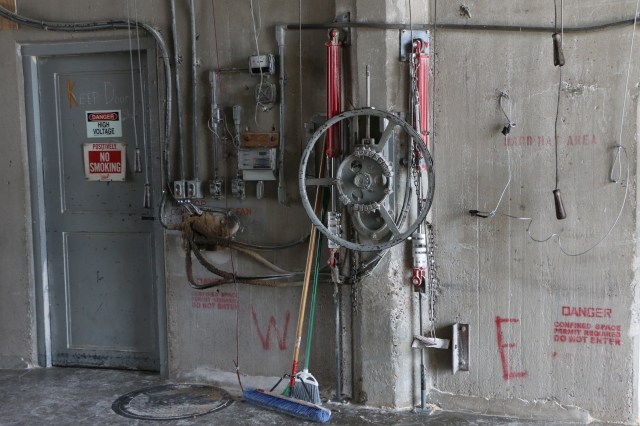
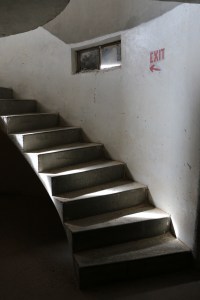
Admitting myself, I went in and out through open doorways and up and down stairs. Not only was the elevator well painted outside, but it was meticulously clean inside.

Sports arenas and shopping centers go up with much acclaim but sometimes are torn down before 68 years go by. But the Tillotson elevator in Bushland was fit and trim.

As the grandson of builder Reginald Tillotson, I felt pride in his work and gratitude to the owners who have kept it so well.

Tomorrow, a meeting with a co-op executive.


Tillotson’s Bushland, Tex., elevator reveals how ‘every job had a peculiarity’

IMG_8891

By Ronald Ahrens

Leaving Canyon, the home of West Texas A&M University, after a cheese omelet at KJ’s coffee shop, I drove north and soon skirted the west-side sprawl of Amarillo, the largest city in the Texas Panhandle. There were housing tracts, car dealerships, and Westgate Mall.

The land was dead flat, the sky blue, and the wind gusted with vehemence.

Texas-Okla Logo 04A few of Amarillo’s 275,000 residents may sometimes think about the importance of grain elevators, but it’s likely many more are preoccupied with the Toyotas and Fords I was seeing on lots along the way and with the Bath & Body Works and Hot Topic shops in Westgate Mall. They can afford to shop here because they work in factories building V-22 Osprey aircraft and, on an atomic reserve northeast of the city, nuclear bombs.

And of course there are cattle to be slaughtered. 

At I-40, I turned west and continued across the plain.

IMG_8923Of course, I was thinking about the late Neil Lieb’s stories. Readers of Our Grandfathers’ Grain Elevators may remember that Lieb tracked us down three and a half years ago and told tales about the jobs he worked, and the people he worked with, when he was with Tillotson Construction.

Company records show the 252,000 Bushland elevator was built in 1950, the same year as Canyon, and it followed the Dike, Iowa, plan from the year before. That means eight tanks measuring 18 feet in diameter and 120 feet high. The 12 x 17-foot driveway had eight bins above. Altogether, there were 20 bins for grain and one dust bin.

When I sighted Bushland, I thought of Lieb’s statement that “every job had a peculiarity.” In this case, he provided an account of the struggle to maintain accuracy during the continuous pour.

“Somewhere between checking the water level when we started and checking it in the middle, the forms became about 3.5 inches off level,” Lieb said.

“That’s because one guy who was running the jacks on one side wasn’t making his rounds as he was supposed to. The guy was fired on the spot.

“Now you had to get the decks level again. When you’re going off-level, you’re going at an angle. So what happened, you got a little swerve in the tanks. It’s only an inch. You can’t see it. The only time is if you go up and down on a hoist. So the bottom and top are not exactly over each other.

“It had no effect. Not enough to be significant. We were about 65 or 70 feet in the air when it happened.”


It might be news to Ag Producers Co-op, which runs this and about two-dozen other Panhandle elevators.

But when I sighted Bushland, the elevator gleamed like nobody’s business in the sun. There were seven narrow, tall windows in the east side of the headhouse. Everything looked impeccable, and indeed this would turn out to be one of the nicest elevators I’d visit on my road trip through the Panhandle and western Oklahoma.

Tomorrow, Niel Lieb’s account of a leap into the sand pile.


The 320,000-bushel Tillotson elevator in Canyon, Tex., followed the Bellwood plan


IMG_8860The year 1950 was a busy one for Tillotson Construction Co.  The Omaha outfit (my grandfather Reginald Tillotson’s company) built 25 grain elevators–an amazing number. They were in Oklahoma, Texas, Colorado, Kansas, Nebraska, and Iowa. The next year they would build one in Missouri.
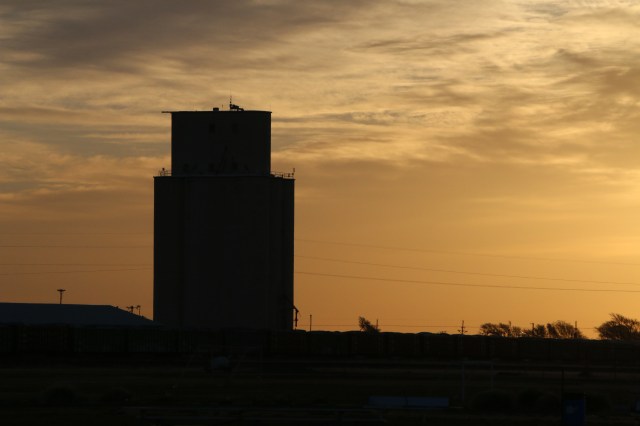
Texas-Okla Logo 04The Canyon, Texas, elevator operated by Consumer’s Supply Co-Op was built on the same single-leg plan developed for Bellwood, Nebraska, in that year. It incorporated eight tanks, or silos, of 20 feet in diameter and 120 feet in height. Capacity was 320,000 bushels.

Measuring 13 x 17 feet, the driveway was underneath 10 bins. A note in the construction record mentions “5 bin Dist. Under Scale.” In all, there were 22 bins and a dust bin as well. 

IMG_8855While the Bellwood plan was used for five elevators, it’s interesting to note the slight differences in materials used. For example, Canyon took 2,463 cubic yards of reinforced concrete while Burlington, Colorado, also on the Bellwood plan, took 2,436 cubic yards (the exact same amount as the mother elevator in Bellwood and the one in Hartley, Texas, which is coming soon in this series). Rock Valley, Iowa, though, took 2,394 cubic yards.

In all, this reinforced concrete weighed 5,069 tons.

Canyon required another 20.3 cubic yards of plain concrete for hoppers. It weighed 40.3 tons.

IMG_8868

Looking up the tracks at Consumer’s Supply Co-Op’s East elevator.

There were 143.3 tons of steel used to reinforce the concrete.

This amount also includes the jack rods used to move the formwork. 

The main slab was 66 x 77.5 feet, for an area (a note says “Act. outside on ground”) of 4,806 square feet.

  • When the tanks were fully loaded, the grain weighed as much as 9,600 tons.
  • Additional structural steel and machinery weighed another 28 tons.
  • This means that the elevator’s gross weigh when loaded was14,964 tons.
  • The pit depth below the main slab was 15 feet and 9 inches.

Up above the main house, the cupola, or headhouse, measured 23 feet wide, 63.75 feet long, and 39 feet high. So the structure’s total height was 159 feet. Look closely at the headhouse photo, top of page, and tell us if it doesn’t seem to be smoking some sort of Turkish pipe.

Pulley centers of the leg were 166 feet apart. The boot pulley was 72 x 14 x 2 3/16 inches. The head pulley was shared the first two dimensions but was wider at 3 15/16 inches. It turned at 42 rpm.

The six-ply belt was 14 inches wide, and the cups were 12 inches wide and six inches deep.

IMG_8881Altogether, 34 hp was required to operate the leg; the record says two 40-hp Howell motors were installed. Theoretical capacity of the leg, based on the cup manufacturer’s rating, was 7,920 bushels per hour. But the leg operated at an actual capacity of 80 percent the theoretical capacity, or 6,350 bushels per hour.
The truck lift had a 7.5-hp Ehrsam motor, and the conveyor had a 3-hp motor.

In all, it was state-of the art in 1950, and the elevator remains in everyday use now.


The surprise in Canyon, Texas, is how the Tillotson elevator survived a blowout

IMG_8884By Ronald Ahrens

Too many bad things can happen at a grain elevator. For one, construction crews and elevator workers face the risk of falling. For another, grain dust can explode. And it’s even possible for a worker to be trapped in a silo.

Texas-Okla Logo 04Then there’s the problem of blowouts. We have written before on Our Grandfathers’ Grain Elevators about blowouts.

One had occurred on a Tillotson Construction Co. job, probably in 1955, at Blencoe, Iowa.

And it turned out, during our visit to the 1950 Tillotson elevator run by Consumer’s Supply Co-op in Canyon, Texas, there was the story to tell of a blowout.

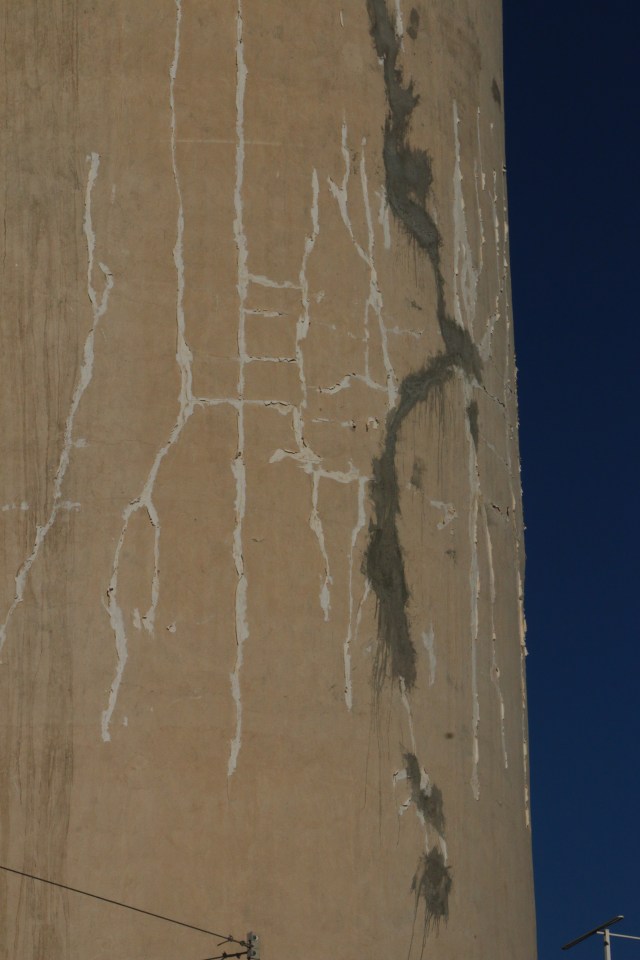
Those weren’t just stretch marks on that corner silo. Well, actually, yes, they were. 

IMG_8859

As Dewayne Powell explained when he showed me around, the blowout in a single silo had occurred sometime before his tenure, which goes back eight years.

Tillotson Construction Co.’s records specify the bearing pressure of the walls at 3.1 tons per square foot. Somehow, the concrete must have deteriorated, leading to the failure.

The elevator’s importance to the Co-op is underscored by the fact that repairs were made. Powell said Gunite was used. I searched for a definition of Gunite and found this passage from the Shotcrete entry on Wikipedia:

IMG_8876

Dewayne Powell leads the way into the elevator’s basement.

“Shotcrete, then known as gunite (/ˈgənīt/), was invented in 1907 by American taxidermist Carl Akeley to repair the crumbling façade of the Field Columbian Museum in Chicago (the old Palace of Fine Arts from the World’s Columbian Exposition).[1]

“He used the method of blowing dry material out of a hose with compressed air, injecting water at the nozzle as it was released.

“In 1911, he was granted a patent for his inventions, the “cement gun”, the equipment used, and ‘gunite,’ the material that was produced.”

Whatever the term, the repair was nicely done. But Powell said he’d heard stories of chaos the blowout caused. Aside from this disaster, the 68-year-old elevator has held up quite well.

Catching the Canyon, Texas, Tillotson elevator at its doggonedest dawn glory

IMG_8858To make it by dawn to the Tillotson elevator in Canyon, Texas, I hit the road at 6.30 a.m. and hightailed out of Hereford, covering the 30 miles across the plain, traveling east-northeast on U.S. 60.

Texas-Okla Logo 04I was happy at last to see the elevator’s distinguished bulk on the faint horizon. And even happier there was no storage annex–just the classic 320,000-bushel job from 1950.

No one was around to chase me away. The elevator looked very well kept, like a 68-year-old with a natty haircut and fine clothes.

I prowled over the grounds to get my photos, as well as going up and down 6th and 7th streets in the neighborhood looking for a street-view. People inside their bungalows might have thought I was some kind of nut. I wondered if they ever pondered much upon their gigantic concrete neighbor.

IMG_8859By the time I finished with photos, the Consumer’s Supply Co-op store on the premises had opened up. I went inside and introduced myself, feeling proud to say, “My grandfather built your elevator.”

I elaborated about Tillotson Construction Co., of Omaha, and my mission to visit the 10 Tillotson elevators in the Texas Panhandle.

Scott Smith, general manager, and Dewayne Powell were interested to hear it. These bright-faced gents explained, among other things, that the Co-op’s charter goes back to 1926.

Two elevators are on the site. “This is our best elevator here,” Smith said of the Tillotson. The other needs repairs to the floor, among other places.

Much of this, the West Elevator, was original. Alas, the truck lift had been removed “before my time,” Smith said. 

I went out to the truck for the construction record. After my explanation of some of the specifications, Smith took it to the copier.

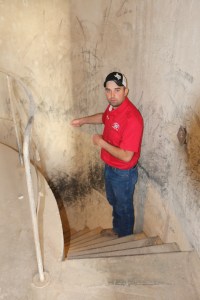
Powell showed me around, explained how things worked, even posed for some pictures.

The basement was clean and tidy, and Powell mentioned that at one point some of it had been used for office space. It was sure bright enough down there.

Something else that had changed: the augur below ground level had been filled in with concrete.

We went back up, and I made one more circuit around the elevator. The driveway door was open, and the Co-op’s yellow Mack truck sat in the driveway.

IMG_8883The quality of the Co-op’s operation was evident. The only things with the elevator that seemed out of order was a broken basement window, and one of the back doors had been splattered with glop.

Otherwise, things were in nice shape.

When I was ready to leave, they presented me with a cap and T-shirt with the Co-op’s emblem–a real honor. Smith recommended KJ’s Coffee and Cafe for breakfast, so I found my way across town to have an omelet.

Then, a-wondering where Palo Duro canyon–the town’s eponym–was, I set out for Bushland.

In our next post, watch for a surprise about the Tillotson elevator in Canyon.


Specs show capacities of the Tillotson elevator in Hereford, Texas

IMG_8833The single-leg elevator built at Hereford, Texas, by Tillotson Construction Company in 1951 had capacity for 300,000 bushels, according to company records. That worked out to 2,640 bushels per foot of height. The drawform walls of the silos, or tanks, rose 125 feet.

Texas-Okla Logo 04Our calculation produces a total of 330,000 bushels at this rate. There were 2,104 cubic yards of reinforced concrete, 28 cubic yards of plain concrete for hoppers, and 121.47 tons of reinforcing steel including jack rods.

The concrete would be mixed on-site, while the reinforcing steel and the lumber used for scaffolding were probably delivered by train.

IMG_8832

The elevator’s main slab covered an area of 76.5 x 56 feet and was 24 inches thick. Below it, the pit depth was 26 feet–unusually deep in comparison to that of other elevators built that year in Greenwood and David City Nebraska and (12 and 17 feet, respectively) and Malta Bend, Missouri (9 feet 3 inches).

The headhouse, or cupola, was 17 feet wide, 36.75 feet long, and 27 feet high. So the structure crested at 152 feet.

That the pulley centers of the leg were 169.5 feet apart reflected the positioning of the lower boot pulley below ground level. That one measured 72 x 14 x 4 15/16 inches. The head pulley was 72 x 14 x 2 3/16. IMG_8823

The head pulley turned at 42 rpm.

The six-ply Calumet belt was 14 inches wide. Cups were 12 x 6 inches and 8.5 inches deep. A 40-hp Howell head-drive turned the leg, and the cups bore a theoretical capacity of 79.2 bushels per hour, although actual capacity–80 percent of theoretical–was 63.4 bushels per hour.

The man-lift operated with a 1.5-hp electric motor.


Horizontal member on Hereford elevator adds civilizing touch for employees

IMG_8824

As we see in these photos from Hereford, Texas, a Tillotson elevator is more than just a collection of tanks and the mechanisms to move grain around inside the structure.

Texas-Okla Logo 04A Tillotson elevator can also come with amenities.

Here we see a lintel above the rear door of the main house. A lintel is a horizontal member that usually bears a load above an opening.

I asked Uncle Chuck Tillotson about it. (He’s also known in these posts as Charles J. Tillotson, son of Reginald Tillotson, of Tillotson Construction Co.)

He responded: “These concrete ‘eyebrows,’ or ‘headers,’ were added above doorways sometimes to provide a bit of shielding from the rainfall sheet flow coming down the vertical face of the wall over the doorway/opening in a rainstorm.”

IMG_8827

So it’s a thoughtful touch. An employee won’t get water down his neck when he opens the door. Think of the increased productivity!

“They were not poured integrally with the concrete bin wall during slipping but were added afterwards,” Uncle Chuck continued.

Not only is there the lintel but also the electric light. I saw the same combination over and over at the Tillotson elevators I visited in the Texas Panhandle and Oklahoma.

“I don’t recall these eyebrows being standard elements,” Uncle C. says. “I think they were added after the fact but whether Tillotson did the work, or the owner, I’m not sure.”

We do think the electric light was a standard item.

In the uppermost photo, the iron or steel hook and dangling cable remain a bit of a mystery, though.

And the rabbit-eared paintwork is beyond guessing.

Texas and Oklahoma road trip takes us to 20 elevators (so get ready)

By Ronald Ahrens

This Ford Ranger violated Tesla parking en route to Texas and Oklahoma.

Get ready for a series of posts on Our Grandfathers’ Grain Elevators.

On April 15, I set out on a road trip to the Texas Panhandle and Oklahoma to see elevators built there between 1939 and the mid-1950s by Tillotson Construction Co.

This was a long-desired destination, as my grandfather, Reginald Tillotson, and his brother Joe Tillotson (until their partnership dissolved), built at least 10 reinforced-concrete elevators in the Panhandle and closer to 20 in Oklahoma. 

Texas-Okla Logo 04The company’s first concrete elevator, dating to 1939, was built in Goltry, Okla., and I was able to visit it.

So as I say, get ready.

I have 410 photos on one memory card and haven’t even counted those on the other card that’s still in the camera.

I saw a nice range of elevators including a surprise Mayer-Osborn one in Follett, Texas–built by my partner Kristen Osborn Cart’s grandfather after he worked for my grandfather.

Our Grandfathers’ Grain Elevators gets inside the main house at Booker, Texas.

I got inside some elevators, met interesting people whom you will also meet, and even have a few trip notes to share.

For example, avoid the Hereford Inn, in Hereford, Texas. Yes, it’s right across the street from the Tillotson elevator. No, you shouldn’t stay there. The owners have done nothing to update the rooms; flimsy mattress, wilted pillow, skimpy towel. And it sounded like the trains were coming through the room. At least there was hot water.

For the same $60 price, I stayed the next night at the Nursanickel Motel in Spearman, Texas. That place was quite nice and cast its shadow on the dump in Hereford.

And here’s a culinary tip: Smrcka’s Dairy Shack, in Medford, Oklahoma, serves a fantastic Czech sausage sandwich with sauerkraut. And the fries are incredible.

The Czech sausage sandwich in question.

With limeade, it came to $8.38.

If you have the same counter-attendant that I had, don’t try to make small talk because she’s super-crabby.

So stay with us for our Texas-Oklahoma series over the next few weeks.

A visit to Omaha’s Vinton Street elevator reveals recent activity by muralists

IMG_4613

Our friend Rose Ann Fennessy lives near the Vinton Street elevator in South Omaha. On a recent spring day she took a stroll and recorded these views.

Above we see the elevator and storage annex in a long gaze from the Field Club trail. The Field Club, which bills itself as the oldest private club west of the Mississippi River, is about a mile away from the elevator.

IMG_4614

Rose Ann also discovered the silos of the annex are being used by muralists. She calls it “the current artwork.” Since the Stored Potential banners came down in July of 2014, the silos have become more available to artists.

IMG_4615

“I like this one,” Rose Ann says.

It’s good indeed. In a way, these murals are like stained glass but at the the wrong end of the towers.

We don’t mind the silos of the annex being painted, but we hope the artists leave the elevator’s main house alone.


Home-built travel trailers and the demise of a tricked-out ’53 Ford in Iowa

HomemadeThe topic of staying in a travel trailer while working at grain elevator construction sites has prompted Charles J. Tillotson (“Uncle Chuck”) to do some reminiscing and dig through his archive of photos.

He writes:

The first one is a photo of the last trailer Dad built in 1937, which was an upgrade to the one that your mom and I are standing in the doorway of. He had covered the exterior of this trailer with some kind of protective fabric, which doesn’t seem to be attached very well.

The previous trailer had an exposed plywood exterior that was either stained or painted and it evidently didn’t hold up. The focus should be on the small size of the trailers which were probably about 15 feet long, much like the size of the early camper trailers of the 1950s and 1960s. If you allow room for the stove, toilet, closet and even a fold-down tabletop with a little settee, where did we all sleep?

The photo [below] was taken in late summer in Albert City, Iowa, and shows my Dad and me standing along side of my 1953 Ford with another older gentleman who I assume was the Albert City superintendent packing something into the trunk. We had finished up our work on Albert City, and Dad had assigned the three of us to travel across the state to a job he was starting in Clinton, Iowa.

Reg&Chas

Soon after the photo was taken we three boys [Chuck, Tim, and Mike] left Albert City and took along with us a couple of men who wanted to continue working for Tillotson Co. We took off in my beautiful ’53 Ford, which I had modified with a two-tone paint job, a Continental fake-spare-tire kit (remember those?) and lowering blocks among other things. I was driving very fast and in a pattern learned from my Dad, taking short cuts via the old one-mile graveled country roads through the tall cornfields. Zooming along and approaching an intersection ahead I spotted a dust trail from a vehicle approaching the same intersection on my right. With the road being gravel I decided that rather than stop for the oncoming vehicle (that had the right of way) to instead outrun it.

I had almost made it through the intersection when the oncoming vehicle clipped my rear bumper and put me into a sideways spin. I countered the spin by yanking the wheel in the opposite direction which brought me out of the spin, but the action was so fast it put me into another spin in the opposite direction. We zigzagged back and forth for a bit and eventually headed into a huge irrigation ditch, which we entered, rolled over, and flipped upside down. I remember my bro Mike standing up in the back seat hollering at me to ‘straighten out the car’ but to no avail. I think there were five of us in the car including my bros, none of which had seat belts fastened but by some miraculous ending, we were all able to crawl out of the car without a scratch.

The farmer who hit me was a local fellow, and he rounded up a tractor with an operator and the car was pulled back upright and out of the ditch, whereby it was towed off to a local mechanic’s shop.

I don’t remember who came to rescue us, but somehow we continued on to the Clinton job where we put in some closing days of the summer, laboring there. 

Ford&trailer

When it came time to go home, my bro Tim and I went and picked up the Ford which still was operable (a testimonial to Ford), but the vehicle had multiple dents and bruises including missing a windshield which had been knocked out in the crash.

Tim and I bought a pair of goggles and proceeded to hit the trail (in a light drizzle) to Omaha with the wind and rain in our hair and elsewhere. My Dad knew of the accident but he had never seen the car until we got home whereby he came out of the house and I’m sure almost had a heart attack when he viewed the pile of junk that once was my beautiful ’53 Ford. As I recall, he had the car towed away to the junk yard.

It’s funny how viewing old photos can bring back memories of both the exciting and dull days gone by. It’s too bad the photographs taken today are no longer hard-copied by most people and their memories no longer documented to tell the stories of days gone by for both their own revisitation as well as their offspring.