Newly discovered photos emerge of a 1950 blowout at a Tillotson ‘clone’ elevator in Bird City, Kansas

For a 2013 post, we visited the elevator at Bird City, Kan. to learn more about its provenance. Bird City (pop. 447) is in Cheyenne County, in the northwestern corner of Kansas. The county population is about 2,500.

“It has been demonstrated that the curved headhouse was a Tillotson signature,” we wrote after the site visit. “Did someone leave the Tillotson operation and branch out on his own, or were the plans sold to Vickroy-Mong?”

Later, we followed up with the story of a blowout that occurred there in 1950, not too long after the elevator was built by Vickroy-Mong Construction Co., of Salina, Kan.

Thanks to reader Steve Wilson, who grew up in St. Francis some 15 miles from Bird City, we have new views of the aftermath of that blowout, and these give a clue as to why the name Vickroy-Mong has otherwise disappeared from history.

The elevator was announced in January of 1950. The Omaha World-Herald reported as follows:

The Bird City Equity has voted to build a 250-thousand bushel storage elevator this spring. The government will assist in the finance to the extent of 80 per cent of the cost. It will also guarantee storage income for a three-year period. A drive to raise 50 thousand dollars in capital will be staged. Total cost of the elevator is estimated to be around 160 thousand dollars.

Photos courtesy of Steve Wilson

Soon after the tanks were loaded with grain, the blowout occurred. On Aug. 24, 1950, The Herndon (Kan.) Nonpareil reported: 

Approximately 15,000 bushels of the 1950 Cheyenne County wheat crop spilled out on the ground about 6 a.m. Friday when a 30′ by 8′ section of the newly constructed Bird City Equity elevator caved in. The section of wall giving way was over the loading bins on the railroad. A train was in Bird City at the time and was sent to St Francis to be turned after wheat augers brought in from the surrounding countryside had cleared a path through the grain on the tracks. More than six boxcars of wheat were loaded with the augers after the engine returned, but between 6,000 and 7,000 bushels of wheat still remained on the ground the next day, A.A. Gillispie veteran St. Francis newspaperman reported. The elevator which has a capacity of 250,000 bushels was finished shortly before harvest this year.

Chalmers & Borton received the contract for the repair work. In 1958, they also won the contract for an addition of 241,000 bushels.

W. Stephen “Steve” Wilson retired as professor of mathematics at Johns Hopkins University and lives in Baltimore. His father, Charles Wm. Wilson, M.D., served the people of Cheyenne County “doing everything from glasses to babies to surgery.” And Dr. Wilson was a photography buff. Steve Wilson provides this addendum regarding the blowout:

I was only 4, or almost 4, but it was a big deal. Lots of grain elevators in that part of the country, and they don’t usually fall apart. Worth the drive to see it!

In 2009, I took my kid out to see where I was from (the year before he graduated from high school). We went out to one of the elevators in St. Francis, the county seat. This was an elevator [where] they would take us kids up to the top, and we would throw model airplanes with cherry bombs in them.

However, when my son and I started walking towards the elevator, someone ran out of the office and told us we couldn’t get close to the elevator. Homeland security rules. What a waste of resources! If a terrorist wants to blow up a grain elevator in a town of 1,500 where you still have to drive 175 miles to get to a town of 25,000, that’s not a bright idea. Spending money to prevent it is even stupider.

The Parable of the Grain Inspector, as told by David Hatch

Story and drawing by David Hatch

David Herbert Hatch is senior pastor at Our Savior Lutheran Church in Green Bay, Wisc. He worked slip-form construction on elevators throughout Iowa in the early to mid-1970s.

I would like to tell you a story.

Word is that one fall, after a grain elevator had serviced the community harvest, a federal inspector came for a look at the facility.

Unable to find the elevator manager, he took the liberty to climb a ladder outside a tank, all the way to the top. He opened a manhole cover, stepped through with his flashlight, and walked over the grain.

Using a re-rod, he probed around, checking the grain. Its high level in the tank at this time of year was a surprise.

“It should have gone to market by now,” he thought.

When he returned to the bottom the manager had arrived.

“Why is it that you have so much grain in the elevator?” the inspector asked.

“There’s no grain in it whatsoever,” the manager said.

He opened a steel door.

The inspector peered into an empty tank.

They shone the flashlight beam to the top and, even to the manager’s shock, saw a frozen ring of grain.

If the inspector had fallen through, with his probe, it would have been the end of his life.

David Hatch was born and raised in Ames, Iowa. Prior to college studies, Pastor Dave worked construction and had hopes of serving in law enforcement until his partial color-blindness prevented that. He did not know what to do with his life. Through God’s Providence and a phone call from his sister, who was a kindergarten teacher in Milwaukee, he enrolled in a college where, unknown to him, many of his future classmates were studying to be pastors. He received his education at Concordia College in Milwaukee; Concordia Teacher’s College, River Forest, Ill.; and Concordia Theological Seminary, Fort Wayne, Ind. His pastoral career began in 1982, following seminary, when he served as an admissions counselor at Concordia College in Bronxville, N.Y. and parish pastor at Love Lutheran Church outside of Albany, N.Y.

Slip-forming relied on grace from above, but there was devil’s play, as David Hatch recalls

Story and drawings by David Hatch

David Herbert Hatch is senior pastor at Our Savior Lutheran Church in Green Bay, Wisc. He worked slip-form construction on elevators throughout Iowa in the early to mid-1970s.

Our operations back in the1970s had many vulnerabilities. That is, there were a lot of, “What ifs?”

The whole operation depended on a constant pour. If we had to shut down, we would have, what I remember them calling, a cold seam. That’s when the whole jacking system stopped. The concrete sat in the forms and dried, and everything had to be restarted again at a later time. 

One absolutely ugly seam would be left around the perimeter of an otherwise beautiful structure. Not only that, but the drying concrete might hang up and attach itself to the forms, and they would not go up. So that’s what we tried to avoid.

Remember, I just ran a winch, and I only had hearsay. I was 18 or 19 and trying to gather information. I can only speak from what I know, and that’s not much.

What things could happen to cause such a shutdown?

  • What if an electrical storm lasted several hours and we had to get off the decks because we were a giant lightning rod?
  • What if the power went out in the city? There would be no electricity to run the jack pumps or the lights around the perimeter of the deck or to operate the electric-powered concrete vibrators!
  • What if only a bare-bones part of the crew showed up for work one day? Would there be enough manpower to lay the steel and push the concrete in ratio to how fast the forms had to be jacked?
  • What if the engine on the winch died? There was no back-up winch. (Setting the winch in place was no small matter. It had to be anchored into the ground just right, and angled perfectly so that the cable would wind properly on the spool. If the cable didn’t wrap right, it would rub against itself during wrapping and begin to fray, and then it would not be reliable.
  • Up on the deck was the jack house, where the jack pumps were kept. If I remember right, there were two of them, a primary and a back-up. The chance of going down, it seems, was low.

There were 1,000 other possible troubleshooting challenges. For example, concrete setting up too fast, hanging up in the form during normal operation and “pulling a hole” that would appear below as the forms began to rise. That would not stop the operation, but it sure would be a problem requiring later patching.  If I remember right, the forms were oiled down prior to the start to help prevent this.

David Hatch was born and raised in Ames, Iowa. Prior to college studies, Pastor Dave worked construction and had hopes of serving in law enforcement until his partial color-blindness prevented that. He did not know what to do with his life. Through God’s Providence and a phone call from his sister, who was a kindergarten teacher in Milwaukee, he enrolled in a college where, unknown to him, many of his future classmates were studying to be pastors. He received his education at Concordia College in Milwaukee; Concordia Teacher’s College, River Forest, Ill.; and Concordia Theological Seminary, Fort Wayne, Ind. His pastoral career began in 1982, following seminary, when he served as an admissions counselor at Concordia College in Bronxville, N.Y. and parish pastor at Love Lutheran Church outside of Albany, N.Y.

At a slip-form site, ground stations supported the rising formwork: David Hatch’s recollections, Part Two

Story and drawings by David Hatch

During the slip operation, the ground was an exciting place to be. The viewing experience would be a little like watching Devil’s Tower rise out of the earth to its finished height in seven days–or the lights going on at the Field of Dreams. “If you build it they will come.” Especially at night, the farmers came. They stood, they watched. Without trying, we stepped out of their cornfields, and they beheld a sight they would never forget. 

David Herbert Hatch is senior pastor at Our Savior Lutheran Church in Green Bay, Wisc. He worked slip-form construction on elevators throughout Iowa in the early to mid-1970s.

At night, the gatherers saw lights, heard a roaring winch engine, and saw concrete trucks lined up. They heard shouts from the deck to the ground: “More vertical rebar!” They could see concrete finishers go around and around the structure, lit with strings of incandescent bulbs. But silent to them were the jacks, lifting the whole unit several inches a minute.

Out in the flatlands, night travelers who were miles away could see a slip going up.

Ground support was by means of various components.

The Steel Pile–There was a steel pile on the ground. The guy running the steel gin pole called down for vertical or horizontal re-rod. He also called down for jack rods or a large drinking-water container with cups. Perhaps he sent up parts or hydraulic oil. Mostly, he sent up steel using a cable choker.

The Concrete Truck and Driver–Here is an important guy, the concrete-truck driver. He filled the concrete bucket as fast as he could, got out of the way, and watched it go up. As the gin pole operator pulled the bucket in for dumping, it went out of sight of the driver below. Then it reappeared in free fall to the ground and the cycle repeated.

I believe concrete-truck drivers had a dangerous job for many reasons. What if the winch operator did not stop the free fall in time? What if a pulley failed or snapped at its axle? What if someone dropped something from above, like the finisher’s bucket or brush? What if a Georgia buggy driver overfilled the form just above the concrete truck?

There were always one or two trucks lined up when the current one was out of mud. Sometimes we had to ask the driver to add more water to the mix as it was too thick. Sometimes we asked them for more calcium to have it set quicker, perhaps if the mud was too thin. Tricky business. They have come out with trucks that unload the concrete from the front. I believe that it is easier for the driver to control his parking and dumping. Those were not legal in Iowa back then as they were too heavy. No clue about the law today.

The Boom Truck–What a cool old truck! Resembling a tow truck, this cob-job lifter moved things around the job site. It was as fun to drive as it was deadly. Every driver was warned, “Don’t drive under low hanging power lines, you will snag them, and it will kill you!”

The Job Superintendent’s Office–This was often a large mobile home. There were blueprints everywhere and concrete dust all over. It couldn’t be helped. That is where you got your new hardhat if you needed one. 

The Townspeople–Putting up an elevator in a small town made for a big gathering. This would be their elevator. Their grain would go into it. Their bread and butter depended on this concrete and steel. And so they came and watched. Seeing a slip-form operation working at night is better than visiting the midway at the state fair. The sights, the sounds, the whole event–wow!

The Winch–The winch that lifted the concrete bucket was powered by a Ford industrial engine. I had always thought it was a six-cylinder inline engine, but it may have been a four. The winch was anchored into the ground, several hundred feet away from the base of the elevator. I never studied the anchoring into the earth, but it must’ve been substantial. 

The engine shroud was red. The operator stood up while running the winch. The throttle was a small wire with a piece of wood as the handle running through the shroud to the carburetor. There was a large foot-brake for the operator’s right foot. It had a hand clutch for the right arm. The hand clutch was tall, like a walking cane or taller, bent over to the right at the top. There were no gears, just single speed. There was no tachometer visible. It would’ve been fun to have a tachometer.

The winch operator had to be alert at all times. He had to have good eyesight for distance. The goal was to get the concrete bucket filled with mud and send it up to the gin-pole operator at the hopper. That gin pole operator would swing the bucket in, dump it as fast as he could into the hopper, and push it back out in the open air. Then the winch operator would begin to free fall the bucket to the ground. Obviously everything I just described cannot be done from at 10 feet off the ground. Once you hit 20 feet and up, things got exciting.

The winch operator had a lot of responsibility, because if he wasn’t being careful, he could run the bucket up into the top gin pole at full speed, knocking the hopper guy off. If he wasn’t careful, when free-falling the bucket to ground and braking late, he could injure folks on the ground–especially the concrete truck driver. 

The winch operator had to keep an eye on the cable winding (spool wrap) so that it did not overlap and pinch itself, causing a frayed cable.

For myself, this job was so intense that when I was not working, I would sit up in bed and run the winch in my sleep. The guys working with me got the biggest kick out of that. We were all piled up in motel rooms as we moved from town to town.

In conclusion, it was a blast! I absolutely loved this job–especially the roar of that engine at full speed under load. 

David Hatch was born and raised in Ames, Iowa. Prior to college studies, Pastor Dave worked construction and had hopes of serving in law enforcement until his partial color-blindness prevented that. He did not know what to do with his life. Through God’s Providence and a phone call from his sister, who was a kindergarten teacher in Milwaukee, he enrolled in a college where, unknown to him, many of his future classmates were studying to be pastors. He received his education at Concordia College in Milwaukee; Concordia Teacher’s College, River Forest, Ill.; and Concordia Theological Seminary, Fort Wayne, Ind. His pastoral career began in 1982, following seminary, when he served as an admissions counselor at Concordia College in Bronxville, N.Y. and parish pastor at Love Lutheran Church outside of Albany, N.Y.

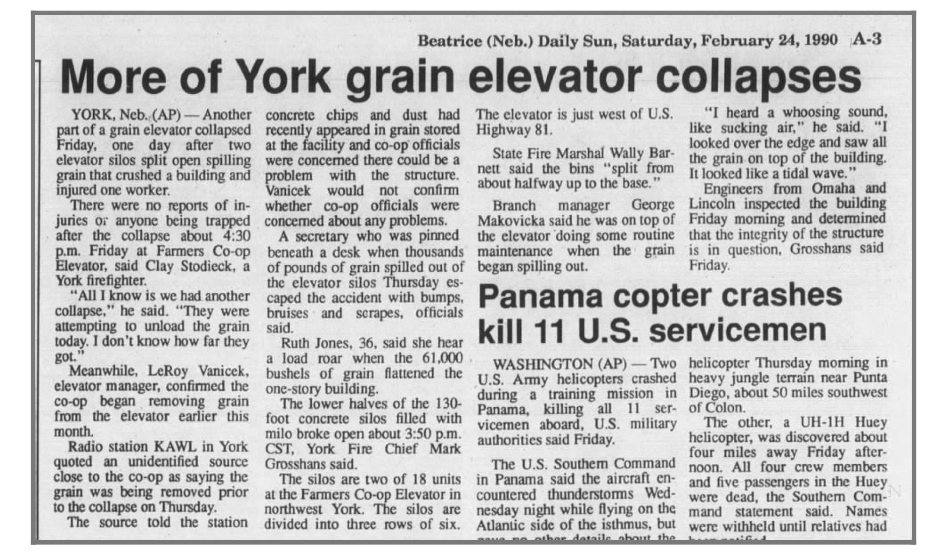
A 1990 collapse at Tillotson’s York, Neb., elevator causes minor injury

Beatrice (Neb.) Daily Sun, Saturday, Feb. 24, 1990

YORK, Neb. (AP)–Another part of a grain elevator collapsed Friday, one day after two elevator silos split open spilling grain that crushed a building and injured one worker.

There were no reports of injuries or anyone being trapped after the collapse about 4:30 p.m. Friday at Farmers Co-op Elevator, said Clay Stodieck, a York firefighter.

“All I know is we had another collapse,” he said. “They were attempting to unload the grain today. I don’t know how far they got.”

Meanwhile, LeRoy Vanicek, elebator manager, confirmed the co-op began removing grain from the elevator earlier this month.

Radio station KAWL in York quoted an unidentified source close to the co-op as saying the grain was being removed prior to the collapse on Thursday.

The source told the station concrete chips and dust had recently appeared in grain stored at the facility and co-op officials were concerned there could be a problem with the structure. Vanicek would not confirm whether co-op officials were concerned about any problems.

A secretary who was pinned beneath a desk when thousands of pounds of grain spilled out of the elevator silos Thursday escaped the accident with bumps, bruises and scrapes, officials said.

Ruth Jones, 36, said she heard a loud roar when the 61,000 bushels of grain flattened the one-story building.

The lower halves of the 130-foot concrete silos filled with milo broke open about 3:50 p.m. CST, York Fire Chief Mark Grosshans said.

The silos are two of 18 units at the Farmers Co-op Elevator in northwest York. The silos are divided into three rows of six. The elebator is just west of U.S. Highway 81.

State Fire Marshal Wally Barnett said the bins “split from about halfway up to the base.”

Branch manager George Makovicka said he was on top of the elevator doing some routine maintenance when the grain began spilling out.

“I heard a whooshing sound, like sucking air,” he said. “I looked over the edge and saw all the grain on top of the building. It looked like a tidal wave.”

Engineers from Omaha and Lincoln inspected the building Friday morning and determined that the integrity of the structure is in question, Grosshans said Friday.

1981 report: 1 dies, 2 critical as Bellwood explosion destroys headhouse

Lincoln Journal Star, April 8, 1981

BELLWOOD–One man died under tons of grain and concrete and two others were listed in critical condition Wednesday in an explosion that ripped through the Farmers Co-Op grain elevator late Tuesday afternoon, authorities said.

The body of Gary Roh, 20, of Linwood was pulled from the debris Tuesday by rescue teams working under floodlights and using heavy equipment, including a bulldozer.

Hospital and elevator officials said Joe Stastny, 58, a rural Bellwood farmer who was unloading grain when the blast was triggered, and elevator employee Larry Navrkal, 28, of Bellwood were in critical condition Wednesday morning at Lincoln’s St. Elizabeth Community Health Center’s burn center.

“It was a pretty big boom,” the elevator’s grain department manager Bob Bell said in a telephone interview Wednesday. “I was here in the office, which is about 50 yards from the elevator. It looked like night outside and we just dived on the floor until the debris stopped flying. Then we called the emergency number.”

Roh was reported missing after the blast, which destroyed parts of the elevator and hurled huge chunks of concrete into nearby streets and homes. Elevator officials had hoped Roh might be trapped alive, but optimism faded as the hours passed.

His body was found about 9:45 p.m.–more than five hours after the blast–in an alleyway pit inside the elevator where Stastny was unloading grain.

John Navrkal of Bellwood, an elevator supervisor and Larry Navrkal’s father, also was injured, but did not require hospitalization.

“We had a farmer (Stastny) in the elevator in a truck unloading grain,” said co-op office manager Maxine McDonald. “We had three employees there, too. The farmer was covered with grain, and they had to dig him out.”

Rescue workers used the Jaws of Life to remove him from his truck.

Witnesses said the blast apparently was triggered somewhere in the south end near Stastny’s unloading truck.

Mrs. McDonald said the 1.5 million-bushel structure was about half full of a mixture of grains and that there had been no fires. She said damage was extensive.

The blast’s cause had not been determined Wednesday morning, and damage estimates were unavailable.

Bell said insurance investigators, State Patrol officers and State Fire Marshall’s office investigators were at the scene Wednesday to try to determine the blast’s cause and whether the facility is structurally sound enough to remove remaining grain.

State Fire Marshall Wally Barnett said Wednesday the cause never may be determined “because it went from one end to the other, blew out the top and even blew out some of the bins.”

Joe Wilson, who owns a barbershop near the elevator, said there were holes measuring 25-by-50 feet in the elevator’s walls.

“The north headhouse is completely blown off,” he said. “A tank on the northeast side of the elevator was split from top to bottom.”

Wilson said the blast shook the area around the elevator, damaging homes on both sides and sending concrete fragments flying for two blocks.

“The house on the east side was riddled with concrete chunks the size of basketballs, and windows were broken,” he said. “Another house a half a block away has holes the side of footballs in the walls.”

The damage to the elevator was so extensive that at one point, the search for Roh was called off because rescue workers feared moving the grain would cause the damaged structure to collapse. Mrs. McDonald said digging resumed after a structural engineer brought in by the co-op’s insurance company examined the elevator.

There were no reports of other serious injuries.

Bellwood’s elevator is the third Nebraska elevator to explode in 1 1/2 months. In late February, an explosion rocked the Southeast Nebraska Farmers Co-op in Beatrice, injuring three men. Then slightly more than two weeks ago, a series of explosions and fires extensively damaged the McMaster Grain Co. in South Sioux City. No one was injured, but damage was estimated at $1 million.

Bellwood, a community of 361 residents, had another explosion Feb. 19 when an explosion and fire at the Farmer’s Co-op service station injured three employees and flattened the garage. None of the men were injured seriously, and the station was back in business soon after the explosion.

Mrs. McDonald said she had worked at the Bellwood elevator for 24 years, and there was another explosion there in 1959.

“But it wasn’t anywhere like this one,” she said. “We are just all in a state of shock. This is a terrible thing–one that you hope you never have to see again.”

Thank you to Susan Allen for providing this article.

1959 news photo shows rounded headhouse of Tillotson's Bellwood, Neb., elevator

Lincoln Journal Star, Saturday, March 28, 1959

BELLWOOD BLAST–A basement explosion in the Bellwood grain elevator knocked out windows and a door at the top of the tubes. One spokesman speculated it might have been a dust blast, sparked by a hot motor. Two men were injured.

Editors’ note: Thank you to Susan Allen for providing the clipping.

History of Tillotson’s massive Bellwood, Neb., elevator includes details of 1959 explosion that injured two


By Ronald Ahrens

At 320,000 bushels, Bellwood, Neb., and Canyon, Tex. were the second-biggest jobs for Tillotson Construction Co. when they were built in 1950, some 12 years after the company’s first elevator of reinforced concrete.

There was the early, huge 350,000-bushel facility at Farnsworth, Tex., in 1945.

Otherwise, the 310,000-bushel elevator at Dalhart, Tex., in 1949, was next-largest.

We now find this welcome history of the Bellwood elevator complex–which presents slightly different figures from those in the company record–from a local source:

The first concrete elevator was built in 1950 with a capacity of 324,000 bushels and a cost of $141,000. The first addition followed in 1954 costing $133,000 and holding 344,000 bushels. The second annex of 343,000 bushels followed in 1958 with a price tag of $116,000. The third annex, being the north elevator with the headhouse, was built the next year for $179,000 and has a capacity of 290,000 bushels. Twenty years later, in 1979, two large diameter tanks each holding 165,000 bushels, were built at a total cost of $333,000. This brings the companies (sic) licensed storage capacity to 1,685,000 bushels.

As reported in the previous post, we found the Frontier Cooperative location to be surviving quite nicely after 70 years and two explosions.

Here is this detail of the first one:

An explosion ripped through the first concrete elevator on March 27, 1959 causing considerable damage to the basement and headhouse areas. Seriously injured in this explosion were Jim Mick and Walker Meyers, both employees of the Farmers Co-op Grain Co.

The original house was built with 2,436 cubic yards of reinforced concrete and 20.3 yards of plain concrete for the hoppers.

Reinforcing steel amounted to 143.3 tons, which worked out to 115.3 pounds per cubic yard.


The structure sits on a main slab of 66 x 77.5 feet. We work that out to 5,115 square feet, but the construction details in the company records note, “Act. Outside on Ground” and give the figure of 4,806 square feet.

The reinforced concrete and steel weighed in at 5,069 tons, and the tanks could accommodate 9,600 tons of grain. Incorporating other factors like 28 tons of structural steel and machinery, as well as 40.3 tons of concrete for the hoppers, the gross weight loaded was an impressive 14,964 tons.

All this massiveness was quite a testament of progress. We have to remember that just 12 years before–with the period of inactivity during World War Two intervening–the Tillotsons were building cribbed wooden elevators.

The main slab covers a pit of 15 feet 9 inches deep.

Way above the pit, the cupola (headhouse) was quite a specimen at 23 feet wide, 63.75 feet long, and 39 feet high–identical to Canyon and pretty comparable to the 300,000-bushel elevators that were also built in 1950 at Burlington, Colo., and Hartley, Texas. All of these elevators were built on the same plan that was original to Bellwood, yet the tanks at Burlington and Hartley rose to 115 feet instead of 120 feet and the cupolas were five feet taller than those at Bellwood and Canyon.

The single-leg Bellwood house boasted 72-inch-diameter head and boot pulleys that were 166 feet apart; the 14-inch, six-ply Calumet belt stretched an impressive 360 feet. The record shows that the belt’s cups, of 12 x 6 inches, were spaced 8.5 inches “o.c.”

Powered by a 40-horsepower Howell drive, the head pulley could turn a 42 rpm. It provided a theoretical leg capacity of 7,920 bushels per hour. Actual leg capacity at 80 percent of theoretical used 32 horsepower for 6,350 bushels per hour.

The 1981 explosion destroyed the cupola and, we presume, all its contents. We hope to find period photos of before and after.

Records show the 1954 annex with capacity of 340,000 bushels. It consumed 2,129 cubic yards of reinforced concrete and 119.5 tons of steel.

The 24-inch-thick slab–same thickness as at the main house–spread over 45.5 x 107 feet for “Act. Outside on Gd.” of 4,569 square feet.

The 10 tanks of 20 feet in diameter reaching 130 feet high required 4,377.5 tons of reinforced concrete and yielded a gross loaded weight (with 10,200 tons of grain) of 15,628.5 tons.

The cupola, or run, atop this annex was 13 feet wide, 100 feet long, and 8.4 feet high.

Top and bottom belts were 30 inches wide and moved at 600 feet per minute. A 10-horsepower drive at top and 7-horse drive at bottom enabled movement of 9,000 bushels per hour.

As we saw for ourselves, the second annex, a 1958 job, bears manhole covers embossed with the Tillotson Construction Co. stamp. Alas, our records stop at 1955.
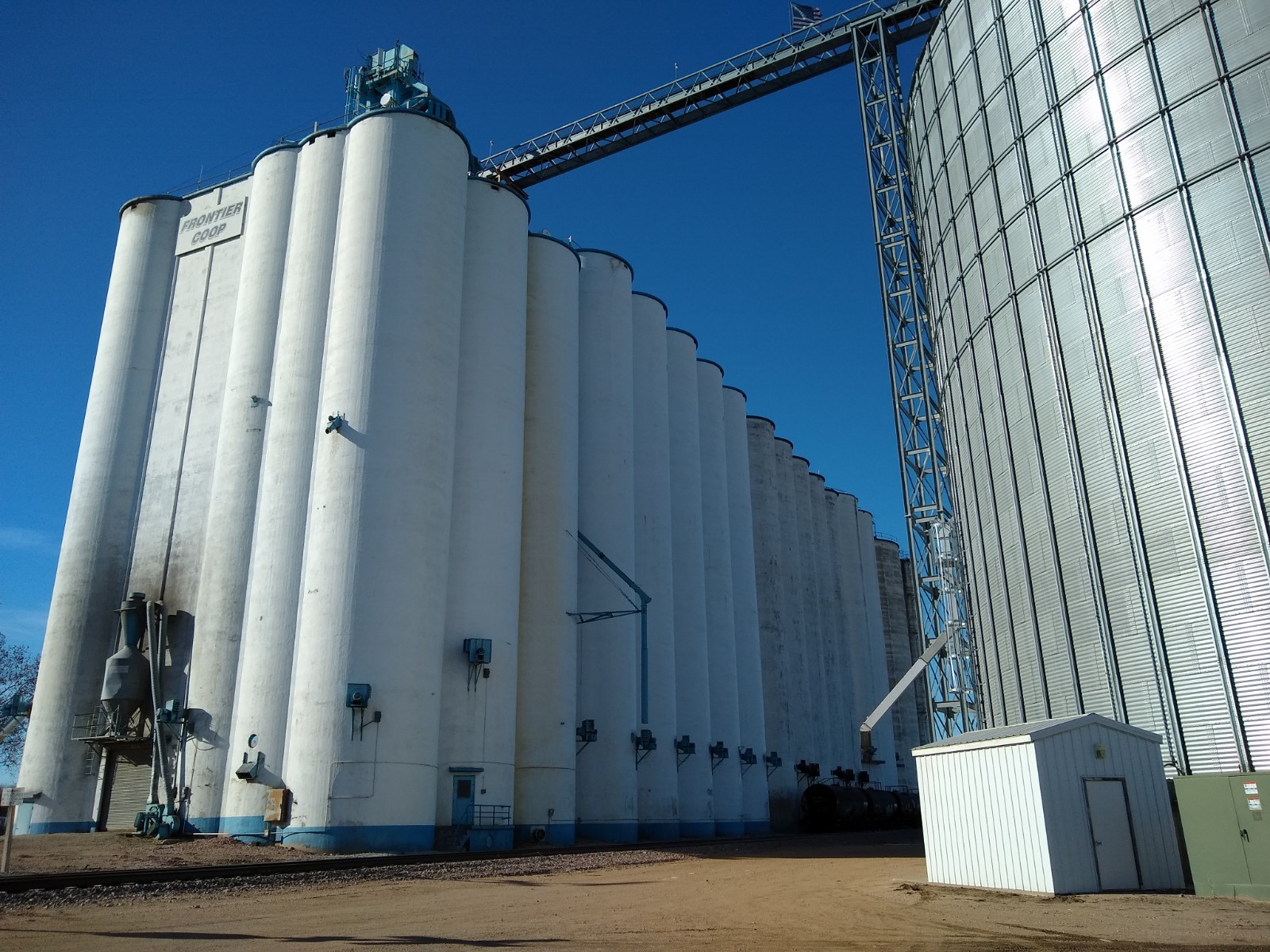
The headhouse is long gone, but the Frontier Cooperative elevator at Bellwood, Neb., may be Tillotson’s largest build

IMG_20200104_135327918

By Ronald Ahrens

We arrived on a quiet Saturday afternoon at the Frontier Cooperative elevator in Bellwood, Neb., knowing a 1981 explosion had taken off the headhouse. By the account of Uncle Tim Tillotson, we were also alerted to the possibility of another explosion there in the late-1950s.

Nebraska 2020Nevertheless, we expected to see an elevator with a replacement structure at its crown.

We found an impressive complex: mighty, smart-looking, and meticulously maintained. Yet it operates with external legs to serve the huge complex–no headhouse whatsoever. The leg over the main house is mantis-like and a little spooky. 

Of course, there was no hint whether the original headhouse was a squared-off rectangle or a curved volume in keeping with the characteristic Tillotson style that was developing after World War Two.

Tillotson Construction Co. built the main house, a 320,000-bushel elevator, in 1950 and followed up with a 340,000-bushel annex in 1954. The main house followed an original plan with eight tanks (silos) of 20 feet in diameter and reaching 120 feet high.

There was the typical central driveway, 13 x 17 feet, for unloading trucks.

Other notes in the company record say “5 bin dist. under scale” and “Prov. for hopper scale.” There were 22 bins and a dust bin.

The 1954 annex, also on an original plan, featured 10 tanks of 20 feet in diameter and reaching 130 feet high. It had a basement, 30-inch belt conveyors, and a tripper.

We also found the Tillotson name embossed on the manhole covers of the second annex, which appears to match the first annex in size and capacity. But company records make no mention of this second annex.

Nevertheless, it appears possible to credit Tillotson with an even 1 million bushels of capacity.

A close look at surfaces on the main house shows patchwork that must represent filled holes from the big blowout.

While preparing this post, I phoned Frontier Cooperative branch manager Justin Riha, who knew of this 1981 explosion.

The elevator works fine with the external legs. “I think it’s better,” Riha said. 

Overall capacity at the location is 2.4-million bushels, a tidy amount at such a small town.

How a Tillotson family member escaped the Omaha ax murderer’s attack in 1928

By Charles J. Tillotson

Another tidbit of info on the Tillotson family I wanted to mention was about the attack in November of 1928 by the ax murderer otherwise known as the Chopper.

picture4

Mom used to tell the story of how Grandpa’s sister Mary Alice‘s daughter, Mary, and her husband, Harold “Guy” Stribling, were attacked by the Chopper in the middle of the night in their home near Carter Lake.

Harold was beaten severely about the head with a blunt instrument thought to be an ax, an Mary was also struck by the intruder with the same instrument.

Harold suffered a huge head depression and other lacerations, and Mary was beaten and cut up–but both of them survived.

Mary begged the intruder to save her baby girl, Minerva and somehow talked him into leaving the house.

The intruder, later on named as Jake Bird, agreed to let them all live if Mary would walk with him. It is said that after about three miles of walking, Jake let Mary go.

Jake Bird was accused and convicted of other Chopper murders in and around Omaha.

Both Harold and Mary eventually recovered, but Mom used to say that Guy was never the same.

She knew how to scare us with stories like this. I’m sure it was as a means of making us realize that danger lurks everywhere. She was so right!

Note: Thanks to blogger Brianna Wright for delving into the archives of the Omaha World-Herald to revive this story.