By Ronald Ahrens
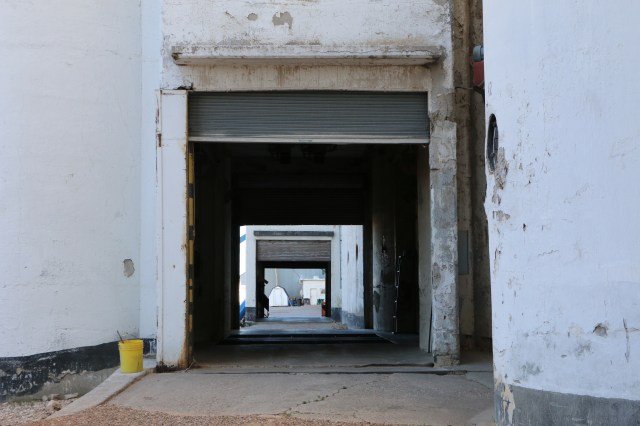
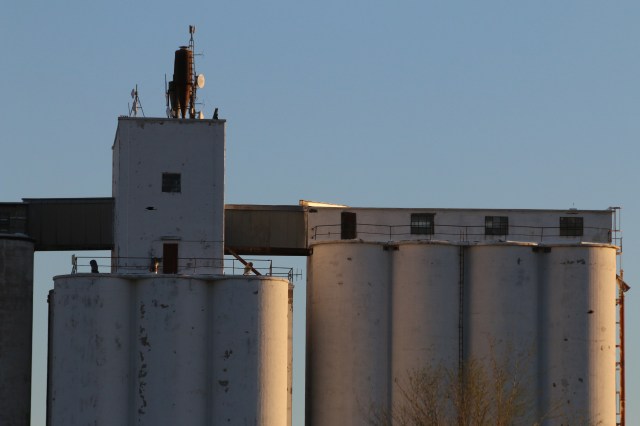
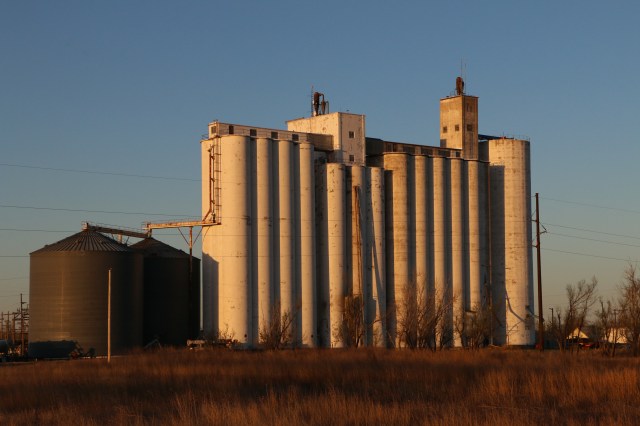
I have to say it was something of a thrill to see the Tillotson elevator at work in Booker, Tex. My grandfather, Reginald O. Tillotson, was 37 years old when his company built it. He would be so pleased about its continued operation, and the modifications and markings, in the crazy far-off future of 2018.
 Long ago, most people stopped staring in wonder at these towering grain elevators. As they proliferated, elevators became almost invisible. We stare at our phones now, even while driving. On roads as straight as Route 15 leading into Booker, that’s not much of a trick.
If anything, people use the elevators as navigational points and hardly give them another thought.
It should be remarked that a crew from Tillotson Construction Co. strove mightily, risking their lives, to put up this elevator in 1945. We wish we knew the names of those men. We hope to find more records.
 When this single-leg, 216,000-bushel elevator went up over a period of about 10 weeks, it enhanced the skyline of the northeast Texas Panhandle, being one of the first of its type. We don’t know the dates into which that 10-week period fell, but all this happened as the United States was wrapping up the war in the Pacific. Labor was scarce; materials–especially steel–were just becoming available.
Booker followed the plan established for Medford, Okla., in 1941. This entailed a 21-inch-thick slab over a pit 13 feet 9 inches deep.
The tanks, or silos, rose 120 feet. Unlike elevators soon to come, they were 15.5 feet in diameter (if indeed they followed the Medford plan). Elevators to come would have silos of 20 feet in diameter.
This behemoth consumed 1,875 cubic yards of reinforced concrete, another 20 cubic yards of plain concrete for the hoppers, and 83.25 tons of reinforcing steel.


It’s interesting to note the company records include costs for 10 of the first 16 elevators that Tillotson built. Alas, Booker, which is among them, is in a group of five elevators for which these figures are omitted. A note in that space says “Not Completed 10-10-46.”
What we can say is that in ’45 Tillotson completed similar elevators in Burlington and Cherokee, Okla. Burlington’s total cost, less commission, was $69,819.15. Cherokee was slightly more expensive: $73,973.90.
In that year, the difference between them of $4,154.75 represented a lot of dough.
Before the auto industry suspended production of passenger cars, switching to war production, a ’42 Chrysler New Yorker eight-passenger limousine set you back all of $3,065. The U.S. Census Bureau says in 1940 the average price of a house in Texas was $17,600. One can imagine a lower figure for the Panhandle with its one-dimensional economy and sparse population.
Labor rates of 75 cents per hour and $1.25 for overtime at Cherokee more than doubled the 30 to 35 cents per hour Tillotson was paying on jobs undertaken from 1939 to through 1941. Overtime rates reached a lofty 60 cents per hour.
Alas, even though a line item for costs appears on subsequent pages of the records, the totals are only recorded through 1946.
 Power originally came from a 2-hp motor, and for all I knew the original unit was still doing its job.
 Additionally, the elevator has served, and may still serve, as a storm shelter. Some big, powerful twisters blow across these plains, and if anyone needed protection, this was the place to find it.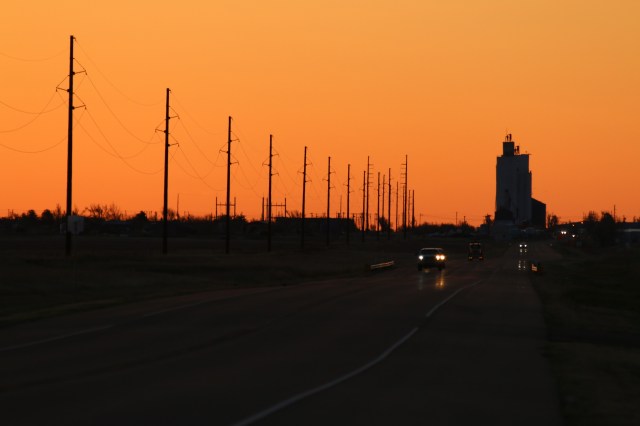
 Medford had tanks, or silos, of 15.5-feet in diameter and a center driveway.


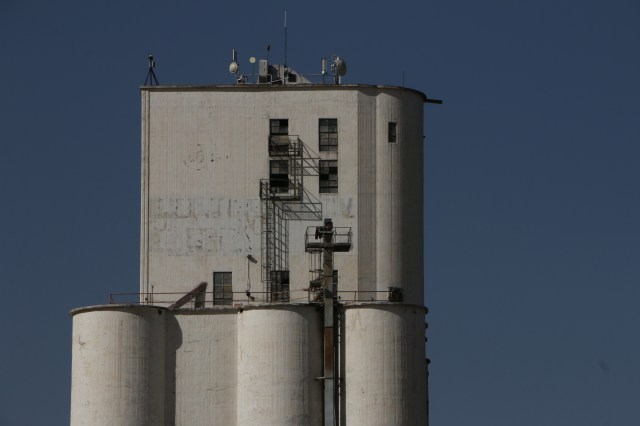 I called up Uncle Chuck Tillotson to ask about the articulation and curved part of the headhouse. Could he imagine how this advance came about? As we saw in the


 Records kept by Tillotson Construction Co. reveal this single-leg elevator was built in 1947 and was, as a note says, “Similar to




 Up in the run, a conveyor belt turned on two pulleys, one being 16 x 32 inches and the other being 18 x 32 inches. The pulley turned at 127 rpm, so the 30-inch, four-ply belt moved at the rate of 600 feet per minute.
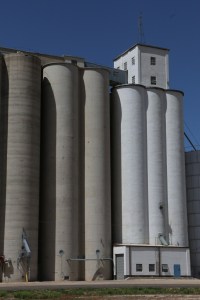 Tillotson Construction Co. had yet to perfect its signature style of


 After departing Hartley, my next stop, just 15 miles northwest on U.S. 87/385, was Dalhart, a market town with brick streets in the business district and, along the railroad tracks, a whole lot of buildings by Tillotson Construction Co. Dalhart is so remote in the Texas Panhandle that six other state capitals are closer than the Texas capital of Austin. For example, it’s 28 miles shorter distance to Lincoln, Neb., than to Austin.
 Anyway, on that trip, it was getting close to sunset as we approached Dalhart, so Dad had me stop in Amarillo where he secured a hotel room.
 Our Grandfathers' Grain Elevators