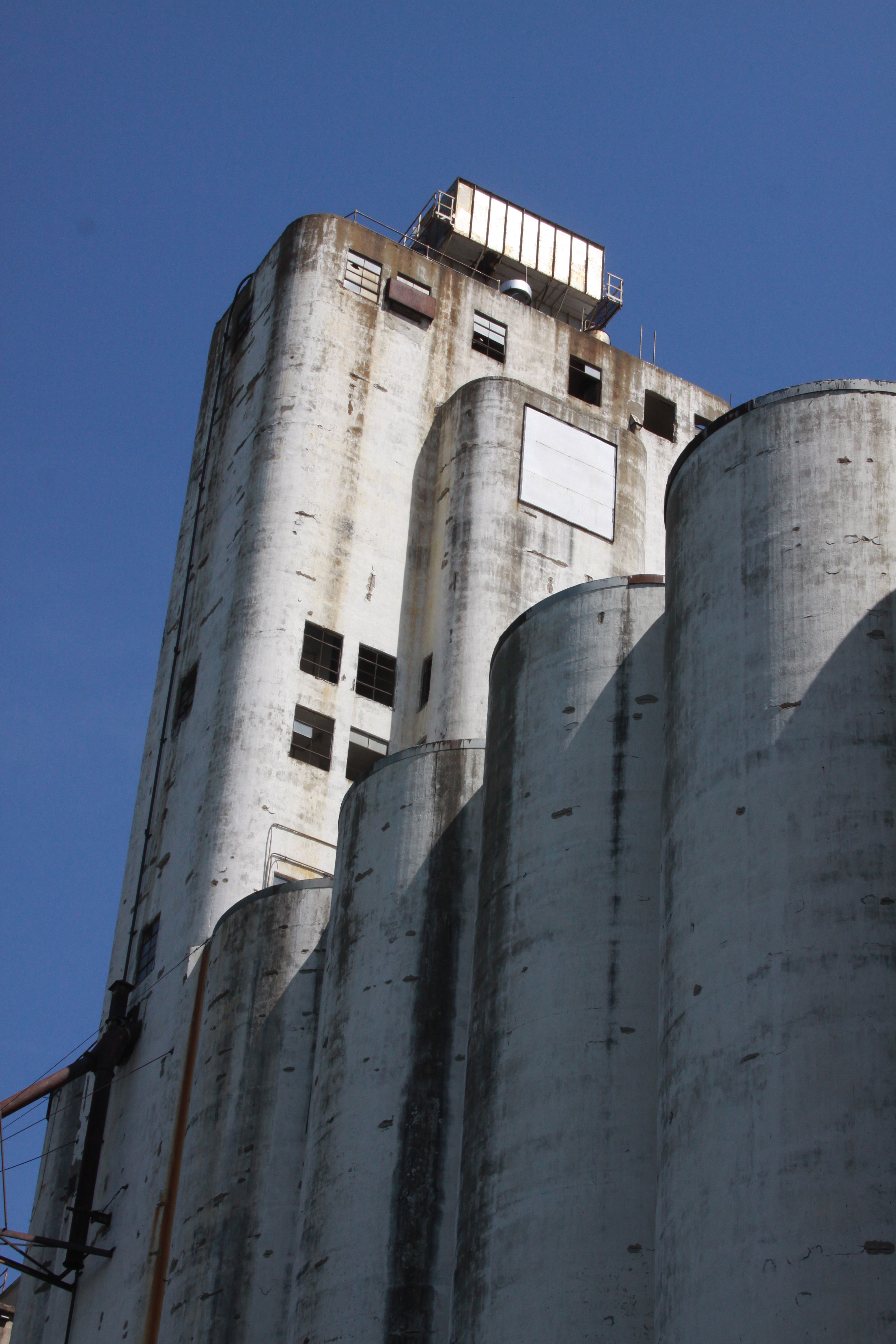
Elevator work included a quick and painful education in the use of a chain fall

Image

Story by Charles J. Tillotson

Grain elevator construction brought with it the need for hoists that placed and set mechanical equipment for the grain-moving distribution systems. Most of headhouse mechanicals had to be placed via the use of manual chain hoists, in those days called chain falls.

ScanThese hoists consisted of a series of pulley wheels and chains that used leverage for moving heavy equipment up and down in precise increments. The hoist system was often used in conjunction with an overhead track so equipment could be adjusted horizontally as well.

The headhouse mechanicals were first lifted more than 100 feet to the top of the grain tanks using the main construction hoist. Once the equipment reached the top deck, a dolly cart moved each piece to the place of use. Most big pieces were mounted on preset anchor bolts. In order to hoist the equipment over the bolts and into horizontal position, the chain fall was rigged.

My lesson in using the manual chain hoist came one day in 1947 when I was working with an experienced workman named Fred on the Vinton Street job in Omaha. As a twelve- or thirteen-year old carpenter’s apprentice and hod carrier, I had never even been near a chain fall system, but this day I was assigned to help set a grain dryer.

After the rigging was finished, Fred had me guiding the dryer for alignment with the anchor bolts while he yanked the leverage end of the chain fall.

Scan 4While he operated the vertical location, I nudged the dryer ever so slightly back and forth as it swung above the anchor bolts. To accomplish this feat, I pushed on the chains with my hands placed right above the pulley wheel. When the dryer reached its spot, I hollered to Fred to lower it over the bolts.

Concentrating so much on the dryer’s placement, I neglected to release at the key moment. Consequently, my hand followed the chain into the sheave as Fred lowered the dryer, and my fingers slipped between the chain and wheel.

I yanked my hand back–but not before the tips of my index and middle fingers were crushed, skin and fingernails pulled off, leaving me with bloody stumps. As I was about to collapse from shock, Fred grabbed me, guided me to the man lift, and lowered me to the ground. My destination was the Super’s office, which was previously built for the grain company.

The Super, a rough dude from the old school, took one look at my bleeding fingers and told me to sit down on a chair next to his reference table, which was covered with plans and paperwork. He asked for a minute to get some first aid treatment and then told me to turn my head and look out the office window. I heard him pouring something into a little bowl on the table. He took my hand, saying he would dip my fingers and it might hurt a little.

Scan 2Well, after he scraped me off of the ceiling, controlled my sobbing, and began resuscitation, I was hurting more than ever. My fingertips felt like they had been burned off! As an antiseptic he had used Merthiolate, administered in those days to treat abrasions and cuts.

Next he wrapped my fingers in gauze and tape. “Keep the bandages on for a few days, and you’ll be as good as new,” he said. It turned out more like six months before my skin and nails miraculously healed to their original appearance.

Of course, through this experience, I gained a valuable lesson in the use of chain falls. Even though such systems today have better safety shields and braking devices, I still shudder when I see a chain fall system being used.

I have related this experience to many people over the years and learned I was fortunate to survive the ordeal–not only the accident, but also the first aid.

Merthiolate, the marketing name coined by Eli Lilly and Company for the antiseptic Thimerosal, is compounded of fifty percent mercury and the caustic chemicals alcohol and benzalkonium chloride.

Because of Thimerosal’s toxicity, Merthiolate was essentially banned from general usage as a topical treatment by the 1990s.

Looking back to those days of such primitive medicine, I often reflect on why we lived through such treatments. I guess one of the main reasons is, we didn’t have crowded doctor’s offices and hospitals, which today bring along their own set of detrimental toxic bacteria and contamination to contend with.

Timeline for Tillotson Const., J.H. Tillotson, and Mayer-Osborn companies and jobs

Ronald Ahrens and Kristen Cart cofounded this blog. Gary Rich is a primary contributor. We have visited elevators around the United States and Canada.

Ronald’s maternal grandfather was Reginald Oscar “Mike” Tillotson.

Kristen’s paternal grandfather was William Arthur Osborn.

Reginald O. Tillotson

R. O. Tillotson

Reginald’s company was Tillotson Construction Co., of Omaha. The company had been building and repairing wooden elevators since the 1920s, when it was led by Reginald’s father Charles H. Tillotson. Before his death, experiments were made with slip-form concrete construction techniques.

1938: Charles dies, and the company passes to his sons Reginald and Joseph H. Tillotson and daughter Mary V. Tillotson. They begin to perfect slip-forming and refine their design strategy, which includes a rounded headhouse.

1945: Tillotson Construction builds a concrete elevator in Giddings, Tex. William Osborn works on this project. He is probably employed by the company by late in ’44. Tillotson Construction wins the contract to build in Elkhart, Kan., and starts construction.

1946: The 225,000-bushel elevator in Elkhart is completed. “Shortly after the war, my Dad and Joe decided they couldn’t see eye to eye, so they split,” writes Charles J. Tillotson in “The Tillotson Construction Story” on this blog. Joe forms J.H. Tillotson, Contractor in Denver. William Osborn works for Joe Tillotson.

William A. Osborn in 1965

William A. Osborn in 1965

1947: Tillotson Construction builds  the Vinton Street elevator in Omaha. Joe Tillotson dies in a car accident in March. J.H. Tillotson, Contractor builds at Daykin and Fairbury, Neb., and Hanover and Linn, Kan., with William Osborn supervising the projects. Maxine Carter leaves Tillotson Construction on Oct. 7 to wed Russell L. Bentley.

1948: Formed in September from the residue of J.H. Tillotson, Contractor, the Mayer-Osborn Company builds its first elevator at McCook, Neb. Joe Tillotson’s wife Sylvia was a Mayer, and her brother Eugene Mayer is one of the partners. William Osborn is the other. Meanwhile, Reginald begins to use a light airplane for business travel in the postwar years. Reginald’s nephew John Hassman joins Tillotson Construction in September; among many other duties, he pilots the company plane to jobs in Nebraska, Kansas, and Oklahoma. Tillotson’s projects that year are in Paullina, Iowa, and Montevideo, Minn.

1949: John Hassman’s father Ralph, Reginald’s cousin, joins Tillotson Construction in sales and stays through 1952.

1950: Construction begins in November on the Tillotson house, which is built of concrete. It still stands north of Omaha. Tillotson employee Jess Weiser weds Lavonne Wiemers on Dec. 22.

1951: Drafted into the Air Force, John Hassman leaves Tillotson Construction in January.

Related articles

At Tillotson’s Albert City, Iowa, job, a deckhand’s pendulous moments

This photo, provided by Kristen Cart from Osborn family archives, shows a deckhand standing nonchalantly on elevator formwork. Kristen believes the picture may have been taken in Giddings, Texas, in 1945.

This photo, provided by Kristen Cart from Osborn family archives, shows a deckhand standing nonchalantly on elevator formwork. Kristen believes the picture may have been taken in Giddings, Texas, when Tillotson Construction Co. built there in 1945.

Story by Charles J. Tillotson

Reinforced-concrete grain elevators used the slip-form method of construction, whereby a wooden form system was built on the ground, having the footprint required to configure the grain-storage tanks.

Once the forms were in place and the vertical lifting and jacking system assembled, laborers began installing rebar and pouring cement into these forms.

When the forms were filled to the top–about four feet–the lifting and slipping commenced by turning screw jacks placed strategically throughout the formwork. After this procedure of vertical form lifting and rebar setting and cement pouring began, it never stopped until the structure reached its intended height, usually between 100 and 120 feet.

thThis process was the intended norm but was oftentimes interrupted by a myriad of problems, which caused the form-slipping to come to a halt. One of these instances occurred one night when I was eighteen or nineteen, working as a deckhand in Albert City, Iowa, for the family’s construction company.

The structure had reached about eighty feet in height when the electrical power supplying the lighting system and other machinery was cut off by a huge summer storm distributing lots of rain and wind throughout the area.

All personnel, including myself, were stranded on the stationary deck with little else to do but wait out the storm and the return of power.

A few hours of waiting produced a carload of my friends that had arrived on the surface. They were yelling for me to come down and join them. The only possible way to get off the tower was the vertical “ship’s ladder” that was installed in sections on the side of the rising structure.

Access to this emergency ladder was gained by going over the side of the formwork to the finishing scaffold below. Here, a rope was suspended down to the uppermost section of the ship’s ladder. The length of the rope was normally long enough so that a person could slide down it and gain hold of the ladder’s top rung.

I say normally the rope was long enough, based on the fact that the ladder sections were routinely placed sufficient to keep pace with the ever-vertical movement of the concrete structure.

However, as I soon discovered on this particular stormy night, the norm didn’t prevail. I hopped over the side of the formwork and reached for the rope hanging from the finishing scaffold’s frames. It was pitch black, and the wind was blowing to go along with heavy rain, but I was able to find the rope and swing off the side.

The first thing I discovered was that the wind was so strong, it blew me sideways and shoved me around the bin tank.

When the gusting stopped, I was able to line up vertically above the supposed location of the ship’s ladder.

So, undeterred, I slid down the rope—but not very far before another gust of wind blew. I had to stop sliding down and let it subside.

This process went on for a number of iterations, and as I slowly went down the rope, I began to wonder where the top of the ladder was exactly.

I was running out of rope.

With about three feet left, I really started sweating–I still couldn’t see the top of the ladder.

Because I had become somewhat exhausted while sliding down, swinging back and forth like a teabag, I knew I couldn’t crawl back up to the scaffold.

Now I reached the very end of the rope, and a big blast of wind blew me away and around the tank. When that gust stopped, I flew back around and by sheer luck found purchase with my foot on the top rung of the ladder. Another blast hit me, but with my foot hooked under the top rung, I stabilized myself.

With my strength ebbing, if I was going to survive, I had to make an attempt to release the rope, drop down along the ladder, and catch a rung. (Any rung would do.) So, with trepid emotions, I let go of the rope and dropped.

The testimony of my luck (and strength and skill of course) is that I am able today to relate this harrowing story.

As I released the rope I yelled up to the top of the tower to alert other personnel that they shouldn’t attempt to do what I had done. I’m sure I saved someone else’s life besides my own that night.

But the message of this story is that constructing grain elevators in the early days was filled with these types of unsafe conditions where protection of life was not as important and took a back seat to getting the job done.

There was grain being harvested in the fields, and it needed a place to be stored. The nation was on the upswing, growing by leaps and bounds, and in need of being fed.

A house of slip-formed concrete was Reginald Tillotson’s pet project in 1950

Tillotson Home

By Ronald Ahrens

An early post on this blog included John Hassman’s recollection of design and construction of the house Reginald Tillotson built on a hilltop north of Omaha’s Florence neighborhood:

“While in the office I [was] trained by the office engineer to design buildings and was the major designer with R.O. to build his new home in Florence, Neb. Many mornings he would arrive with new ideas of what he wanted changed in the house, and we would start all over. Starting in Nov. 1950 we began construction on the new house. The foremen were kept busy in the winter doing that work. All using a concrete house with the ideas we used in Elevator Const. That was the coldest, windiest place to work in December. I left to go the the Air Force because I was about to be drafted in the middle of the Korean War.” 

The house, of course, still stands, and is the home of Michael Tillotson, youngest son of Reginald and Margaret.

It did not incorporate Tillotson Construction’s signature rounded headhouse!

As a grandchild who spent a lot of time there, I always though it was remarkable because of the use of glass blocks as a design feature. The entire second floor was reserved as a music and game area. And despite the single garage door, there was a second “lane” to the right when you drove in.

But Uncle Mike always had it blocked with his relics.

How we know Tillotson Construction built the Burlington, Colorado, grain elevator

_DSC0033_9425

Story by Charles J. Tillotson and photos by Gary Rich

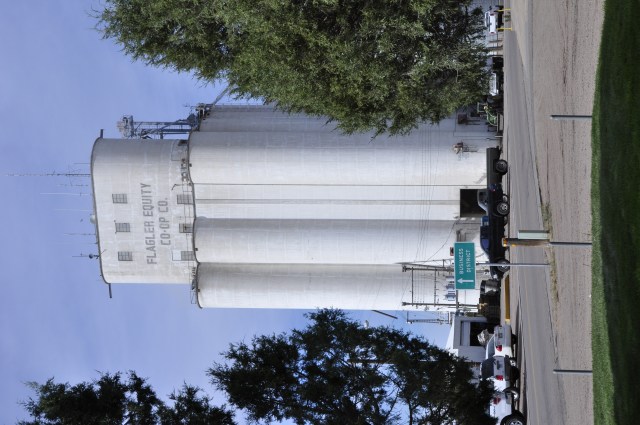
Editor’s note: Chuck Tillotson had just finished high school in Omaha when he and his two younger brothers, Tim, 16, and Mike, 13, were dispatched by their father, Reginald, to work on the family construction company’s grain elevator project in Flagler, Colo. Chuck had drawn up the plans himself in the preceding months during breaks from school. They drove out together in a 1953 Ford, towing the twenty-eight-foot travel trailer in which they would live for the duration. To the best of Uncle Chuck’s recollection, they subsisted on beans and wieners when they weren’t dining in the Flagler cafe. “That was when Tim and I weren’t screaming over to Elitches Park outdoor pavilion, in Denver, some 120 miles to the west, to squeeze in a night of dancing and return at daybreak to assume our work shift—no sleep of course.” Uncle Mike fended for himself, alone, in Flagler. 

When we were building the Flagler job in 1953, Tillotson also commenced the construction of a new elevator in Burlington, Colo. The thing I remember about that job is a story regarding a cement mixer.

We had contracted with a local hauler with a pickup truck to relocate one of our mixers to the Burlington job, which was about forty-five miles to the east on US-24.

He came one day, hitched it up to the back end of his pickup, and started off down the road. Just about where the Flagler town sign is, the road made a ninety-degree turn, and then it crossed the tracks to the south.

The hauler made the turn and started southward. Just as he crossed the tracks, his truck ran out of gas.

He ended up stalled—with the mixer straddling the tracks.

Every afternoon about 3:00 p.m., the eastbound passenger train came roaring along toward Kansas.

Well, the hauler jumped out of his truck and started running, ’cause he heard the train a-comin’, comin’ down the track, clickety-clack, like Johnny Cash sings.

The train barely slowed down as it passed through town, and it ended up smashing the mixer to smithereens.

The engine, and, as I recall at least, one of the first cars behind, were derailed.

It was a mess, but no one was injured.

That’s how I know we built Burlington.

Mid Kansas and Farmers Co-op employees enjoy their jobs

The Mid Kansas Cooperative elevator at Walton, Kan., produced a new acquaintance and the offer to return.

Story and photos by Kristen Cart

An elevator trip sometimes begs for a detour. While driving along the secondary roads that follow the rail lines connecting our grandfathers’ elevators, sometimes I see an intriguing elevator that doesn’t quite look like a Tillotson or Mayer-Osborn structure, but needs to be investigated anyway. Curiosity always wins the day.

Quad-States Construction’s elevator at Waverly, Neb.

Both Waverly, Neb., and Walton, Kan., have elevators unlike those our grandfathers built. I met with employees at both elevators and came away impressed. The people working at these co-ops come from the countryside, where generations of my family farmed, so their stories resonate with a deep familiarity.

Waverly, Neb., has two elevator complexes. The first includes an elevator built by Tillotson Construction of Omaha, Neb., in their trademark style with a curved headhouse. A little further north is an elevator with a partially rounded headhouse which caught my eye. It seemed an oddity, so my mother and I stopped to visit.

Mike Aufenkamp of Farmers Cooperative Company

Mike Aufenkamp greeted us at the fence as I peered over the gate with my camera. He said the Farmers Cooperative elevator manager was not there, but he was eager to tell us what he knew about the construction of the elevator.

No manhole covers on the outside of the elevator identified the builder, but a single steel plate covering the entry into the pit was embossed “Quad States Const. 1971, Des Moines, IA.” When Farmers Cooperative Company bought the elevator, Mike said they found a pile of discarded rebar in the field behind the elevator. Uh-oh. That could not be good. He said the cooperative had since reinforced the driveway with steel I-beams to prevent problems.

Mike wondered what sparked our interest in elevators, and I told him about my grandfather, William Osborn, and our interest in genealogy that got the whole elevator project going. He laughed and said he’d researched the Aufenkamp family once and found an old cousin in Alaska. Their kinship hadn’t been firmly established yet when the old man died and was flown back to Nebraska for burial, just down the road from Mike’s folks.

“I guess he was my cousin,” Mike said. “There aren’t many Aufenkamps around here.”

An elevator enthusiast and history buff, he directed us to a working wooden elevator in Cook, Neb. He said the Cook elevator was one of the few wooden elevators that kept up its certification. He also mentioned an intriguing set of elevator ledgers, dating from the 1940s, located at Pleasant Prairie, Neb.

Mike exemplifies the kind of sharp, hard working people who work for the co-op. He also likes his job.

Loading a farm truck with grain at Walton, Kan.

An initial visit and the offer to return 

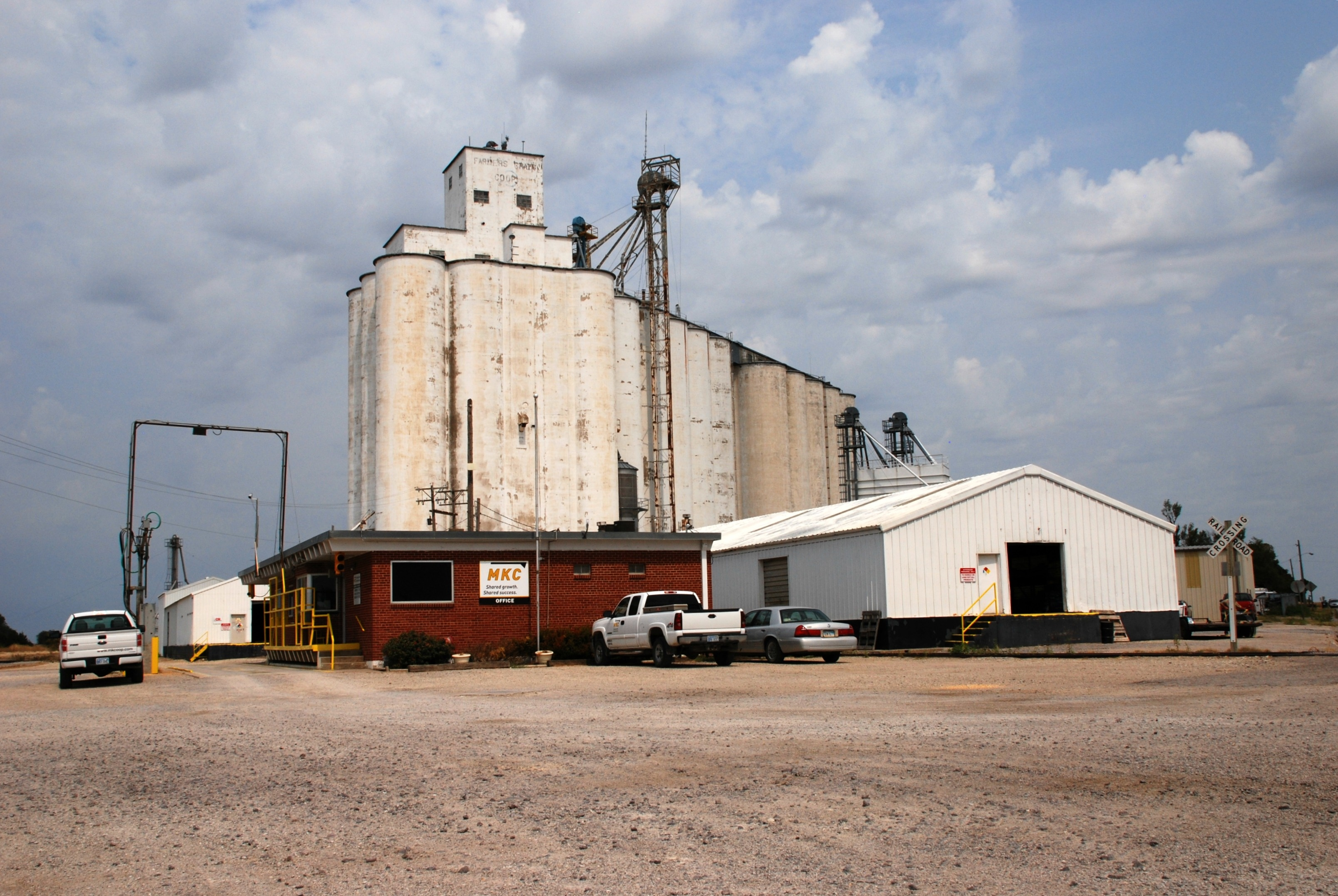
On another trip I had the pleasure of meeting Jeff Snyder, the location manager at Walton, Kan., for Mid Kansas Cooperative (MKC). The elevator was such a beauty I could not drive by it, so when I stopped to investigate which company built it, Jeff came out to meet me. He had a similar infectious enthusiasm for his job.

Jeff came from a military family. His grandfather fought in World War Two, in the 82nd Airborne Division, and was captured by the Germans, spending time in a Nazi prisoner of war camp. Jeff’s father served in the Air Force as a fighter pilot, flying F-105s, F-4s, and F-16s. Naturally, when it came his turn, Jeff also served his country. He joined the Navy and became a Navy swimmer. He mentioned that on September 11, 2001, he was aboard the USS Pearl Harbor, LSD-52, an amphibious warship.

Chalmers and Borton’s elevator at Walton, Kan.

When he left the service, he came home and worked for local law enforcement, a job he did not enjoy. So he changed careers, and has worked for Mid Kansas Cooperative ever since. It is a happy arrangement.

The Walton elevator was built in 1958 by Chalmers and Borton Construction Company, and Mel Jarvis Construction finished the first annex in 1961. Another annex was built later on. Jeff told me about MKC’s wooden elevator in Benton, Kan., and said I should visit. While on a layover in Wichita a few weeks later, I did just that. Jeff also said I should come back on a weekend and tour the Walton elevator.

That is an offer too good to refuse.

A look at the inside of a concrete elevator in Wichita, Kansas

Story by Kristen Cart

The run, at the top of the annex, has a conveyor to deliver grain to the bins. A tripper pushes the grain off the conveyor into the correct bin. Photo by Christopher

Benton, Kansas, was an interesting place to visit if you wanted to learn about elevators. Christopher, a worker for Mid Kansas Co-op at the Benton elevator, had previously worked at their Wichita, Kansas, concrete elevator. He took a few minutes to explain the differences between elevator types when I stopped in to visit during harvest. He also sent me some photos of the Mid Kansas Co-op’s concrete elevator in Wichita taken from the top and from the inside. I had a rough idea how elevators worked, but I had never seen these parts for myself.

The man lift, seen from above, has a platform to stand on and a hand-hold above it. It is essentially a conveyor belt. Photo by Christopher.

The elevator was conspicuously clean. Dust could not be tolerated because of the explosive hazard, and cleaning took place before and during each harvest. This elevator was taking corn from the smaller Benton elevator on the day I stopped in Benton.

The photos show a few of the numerous large elevators in an area north of the city, which leads me to believe that Wichita is a major hub for grain storage and shipment in the Midwest. Except for a few very old elevators in the area they all appear to be in use.

I appreciate seeing some of the inner workings of an elevator. If you get the chance to work at an elevator and get out on top, the view is breathtaking.

A view of one of the huge Wichita elevators from the top of the MKC elevator, giving a true sense of its height. Photo by Christopher

McCook’s J. H. Tillotson-built elevator is still all original, down to the light fixtures

J. H. Tillotson built this attractive elevator at McCook, Neb. in 1948.

Story and photos by Kristen Cart

Kelly Clapp explains how levers and pulleys are used to distribute grain.

The straight-up elevator at McCook, Nebraska, was built for a private owner in 1948. J. H. Tillotson, Contractor, of Denver, Colorado, was tapped for the project, and it was completed just a year before the Mayer-Osborn Construction Company of Denver built the nearby Frenchman Valley Cooperative elevator. My grandfather, William Osborn, was a superintendent for Joe Tillotson at the time, just before going on to form the Mayer-Osborn Company with Gene Mayer, so both projects were his.

Kelly Clapp, a Frenchman Valley Co-op employee, opened up the elevator so I could look inside. A trapped pigeon stood  in the doorway when it opened, blinking in the unaccustomed light. It fluttered off when we went in. What I saw was state of the art for 1948.

The elevator leg, which lifts grain from the pit to the top of the bins.

The elevator stands by itself and is unique since no renovation has ever been done to it. The elevator is original, right down to the light bulbs, Kelly said. It operates as it always has. It only takes corn when the other McCook elevators are full. The elevator is cleaned right before harvest, so the manhole covers, stamped “J. H. Tillotson, Denver,” were off and the bins were open.

The elevator has basic electrical functions such as lighting, and the conveyors and the leg are motor-operated, but all of the controls for it are manual. Levers and pulleys operate in the driveway to direct grain chutes to load corn into a waiting truck, and a similar arrangement at the top of the man-lift directs grain into the proper bin while loading the elevator.

The interior of the driveway, with the leg to the right.

This elevator is a completely intact example of our agricultural past–as fascinating as a water-driven grist mill from the century before. Structures of concrete and steel, built for industrial purposes, don’t merit a historical marker or national designation, but they are just as significant as an ancient town hall or a dignified farm house. I think I prefer the plain functionality of the grain elevator.

Jerry McBride worked at Wauneta’s elevator in the ’60s before repairing cars

Jerry McBride at Bob’s Repair Service in Wauneta, Nebraska

Story and photos by Kristen Cart

On the way out of town after visiting the Wauneta, Nebr., elevator complex, we noticed a rather striking old building, which was an auto repair garage, currently owned by Robert Jones, and called Bob’s Auto Repair and Service, at 512 S. Tecumseh.

I stopped to take pictures. A man came out, introducing himself as Jerry McBride, and asked if I liked old buildings. I said I did, and that I had a particular interest in old elevators, having visited Wauneta’s that day. He invited me in to see the shop. It had been built in the 1920s, Jerry said, and mostly knocked down by a tornado sometime before the 1950s, when it was rebuilt and an extension added.

All of this happened before Jerry was employed there.

Wauneta’s original elevator

He said that he had been hired by Ivo Valentine Pennington in about 1962. Before that he was employed as a “broom man” at the Wauneta elevator for six months or so, making fifty cents an hour. Cleanliness was of utmost importance at the elevator. Wauneta gained the reputation for having the cleanest elevator in the state, Jerry said. Unclean elevators would catch fire, or worse, blow up. He kept the elevator clean, as dust free as possible, but it was nevertheless hard and dirty work and did not pay well, so he quit and looked into the possibility of going to school. Then I.V. Pennington offered him a job and all the training he would need to become a mechanic.


The shop today is an old-fashioned one that doesn’t take new cars. Parts could be machined there, and many of the tools had been manufactured by hand, to accommodate old cars.

Even the cash register was old–as Jerry pointed out, he did not have to close for a power outage, because the register still worked.

It struck me that Jerry McBride had first worked in this shop when the Wauneta elevator was less than ten or fifteen years old and the first annex was new. The repair shop was already old by then. Except for some modern tooling, the shop does not appear to be very different than in the 1960s.

How to build an elevator: Jerry Osborn’s firsthand account from Blencoe, Iowa

Story by Jerry Osborn and photos by Kristen Cart

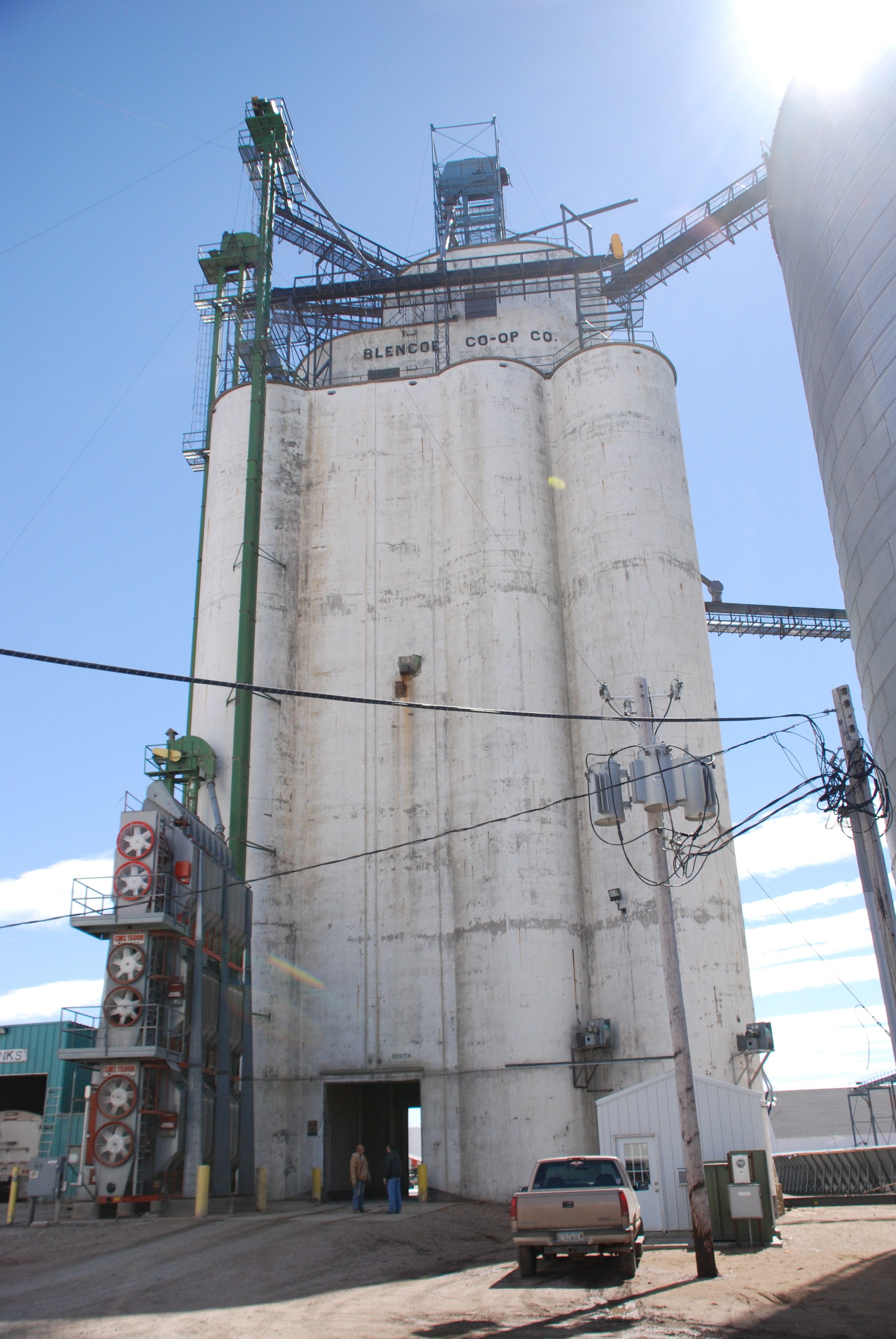
The summer of 1954, before my senior year, I started working at the Hormel plant again, but after a few weeks my dad asked me to work on the elevator his company, Mayer-Osborn Company, was building at Blencoe, Iowa. This would be a different experience. Since I had no transportation of my own he took me to Blencoe and set me up in a motel near the site. He also took me to a shoe store to buy work shoes so I would be set to go to work. The wages weren’t great. They were $1 an hour just like all the other grunts on the job. No nepotism on this job. My job was to select the correct steel and see that it was laid properly as the slip forms were filled and jacked. Fortunately, I had enough engineering drawing work that I could read the blueprints. The slip operation had just begun when I arrived, so it was learn-on-the-run for me.

Things seemed to be progressing nicely until we were about twenty feet in the air. At that point it was noticed that some of the exposed concrete was crumbling and falling to the ground. This can’t be good. The operation was shut down immediately to determine what the problem was. It became obvious that the mix ratio of cement to sand and gravel was too low. The work to that point had to be torn down. The demolition was done over the weekend, and we were setting up to slip again on Monday. The concrete was mixed on the job and the appropriate mix weights were to be locked into the scales. Somehow the proper amount of cement was not designated. My brother, who had been on a lot of these jobs, was a supervisor on this job and should have checked the setting for the proper mix.

When operating properly, the concrete was mixed next to the elevator; each mix was dumped into a bucket hoist, which was lifted to the deck level. The mud was fed into two-wheel mud buggies. The buggies were then wheeled to and dumped at the place needing concrete. As this process took place another mix was in process, so when the hoist bucket was returned, it was once again filled and the whole process was repeated over and over until a height of more than 100 feet was reached. As the forms were filled, steel was laid and other features such as portholes were laid in place as the forms were jacked upward, exposing freshly set concrete at the bottom of the forms and providing more space at the top for more mud. A scaffold was built below but connected to the forms so men with trowels could smooth the fresh concrete as it was exposed below.

I had hoped to work until the slip was finished, but the restart didn’t leave enough time prior to football practice.