A Mayer-Osborn superintendent’s budget, from the back of a notepad

Ed Christoffersen papers008Story by Kristen Cart

On a slip-formed concrete elevator job, the superintendent was not expected to be deskbound. So it wasn’t a complete surprise to find a pay account jotted down on the back of Edwin Christoffersen’s handy notepad. His letters home probably came out of this paper supply, assuming he had time to write them.

The Cordell, Okla., elevator was built in 1950, when Edwin  Christoffersen took charge of the job for Mayer-Osborn Construction.

Dick Osborn0001

Richard “Dick” Osborn

It is easy to forget that times were so dramatically different then.

We were entering a frightening time, with the Korean War looming. Edwin’s nephew, my dad’s brother Dick Osborn, was putting on a uniform to go fight, taking a break from building elevators for the company.

Our country was pulling out of a period of deep recession and unemployment. Air travel was a luxury, but in no sense was it the comfortable experience we have now. Airplanes were loud and flew through the ugly weather, instead of over it. In the book “Fate is the Hunter,” Ernest K. Gann recounted the very real perils of flight in those days. He made it seem all too real in his excellent book.

Ed’s notepad recalls a bit of aviation history. Deco style was modern then. In small print, it even says “Made in U.S.A.”

Ed Christoffersen papers009a

Ed’s accounting.

On the reverse of this nearly empty pad of stationery, which miraculously survived for over sixty years among Edwin’s papers, is what appears to be an account of a monthly budget. It seems pretty clear that Ed would have been paid decently. The “coolies,” as they were called, did the physical labor and made $1 an hour. My dad, Jerry Osborn, got that job for one summer, and he didn’t get any special favors, either. The term was not a racial one in those days–it described the work, mostly done by local farm boys.

Edwin added up a sum exceeding $40 per month–perhaps it was what he had left over, after paying the bills. He came up with $170. Was this tally a payroll for his workers? Or was it a budget for his personal use? Did it record expenses for the Cordell project? It is hard to say.

In 1950, you could drive a good used car off the lot for a few hundred dollars, though a new Cadillac would have been out of reach for most people at over $3000. Maybe Ed had money left over to go get rowdy after work. Or maybe he could buy a good shotgun for his favorite pastime, which was hunting.

dick with man0001

Dick Osborn and Edwin Christoffersen nab a coyote.

I wish to thank Diane Osborn Bell for the pictures of her father, Richard “Dick” Osborn. Ed Christoffersen also kindly shared some of his dad’s personal papers, for which I am grateful.

It’s a truly illuminating way to look at man’s life and his work.

Successful concrete tests yielded an enduring elevator at Cordell, Oklahoma

Cordell concrete tests002

Story by Kristen Cart

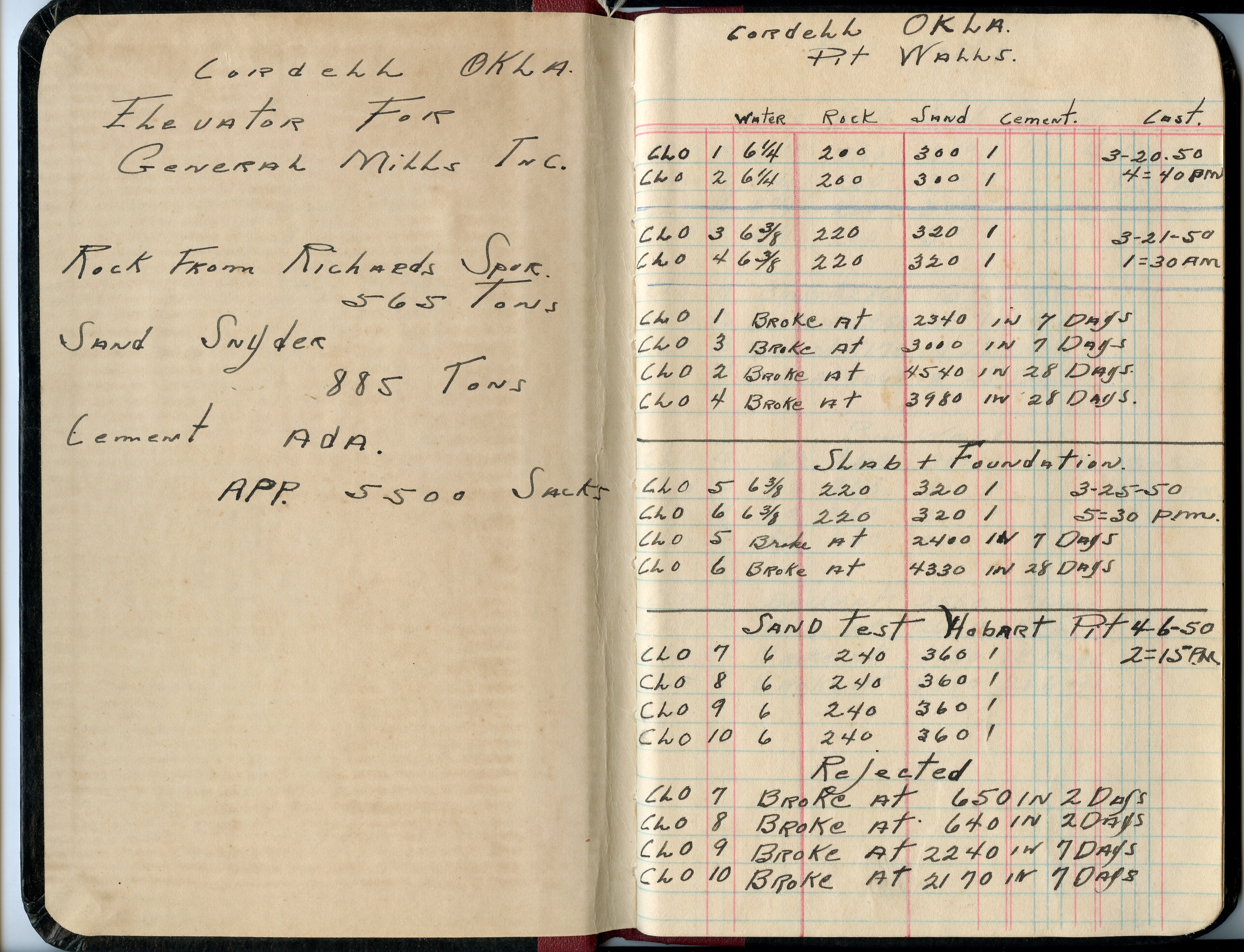
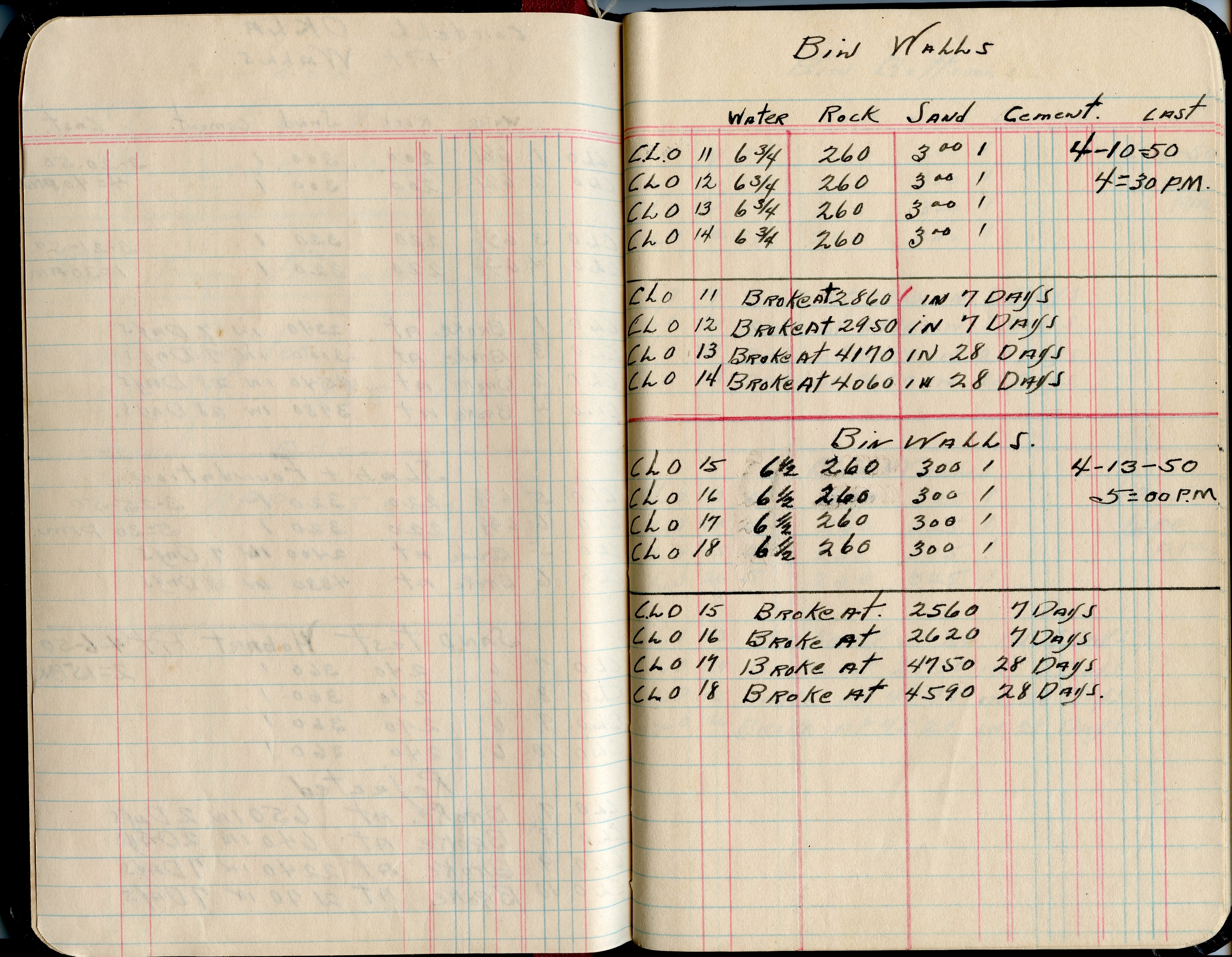
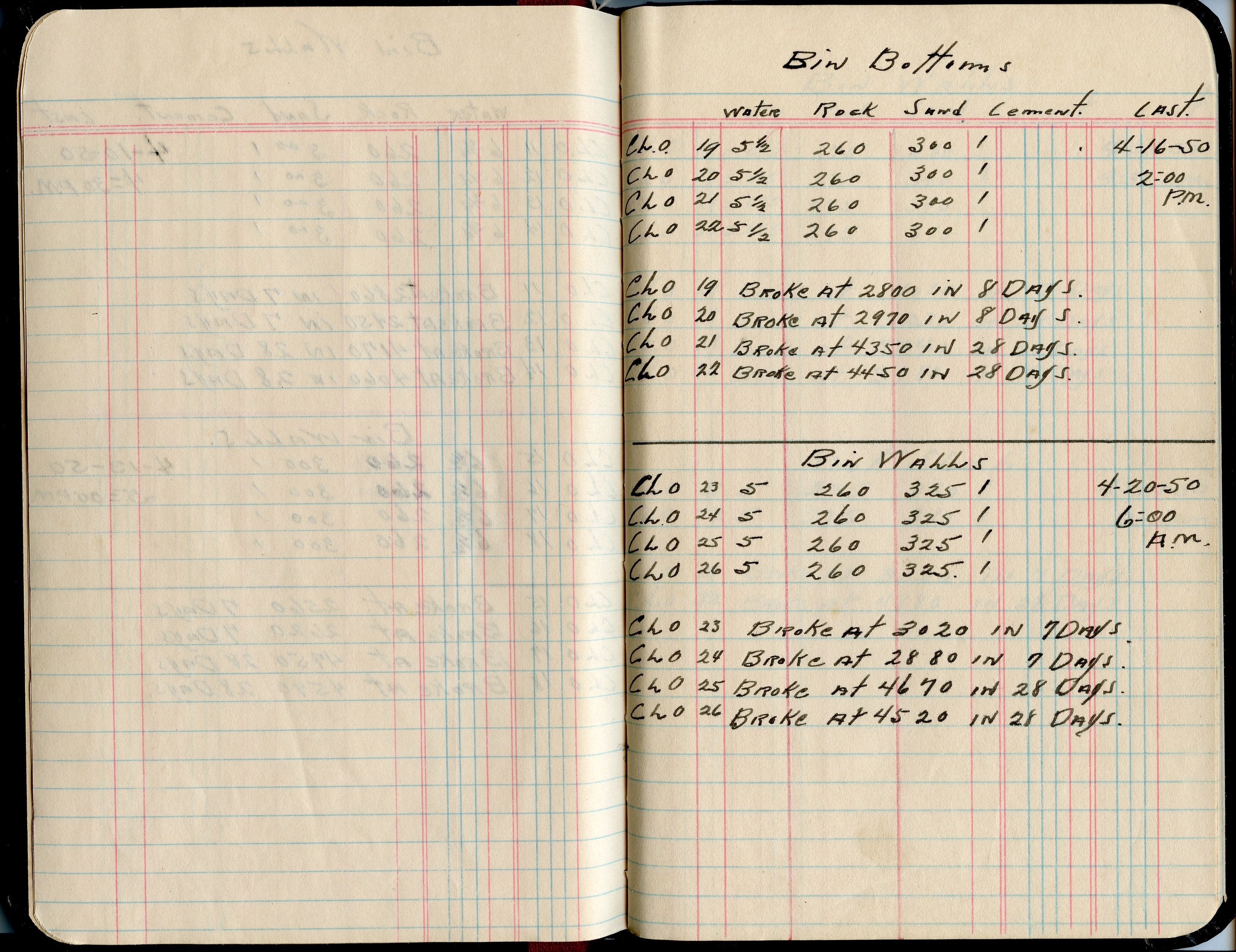
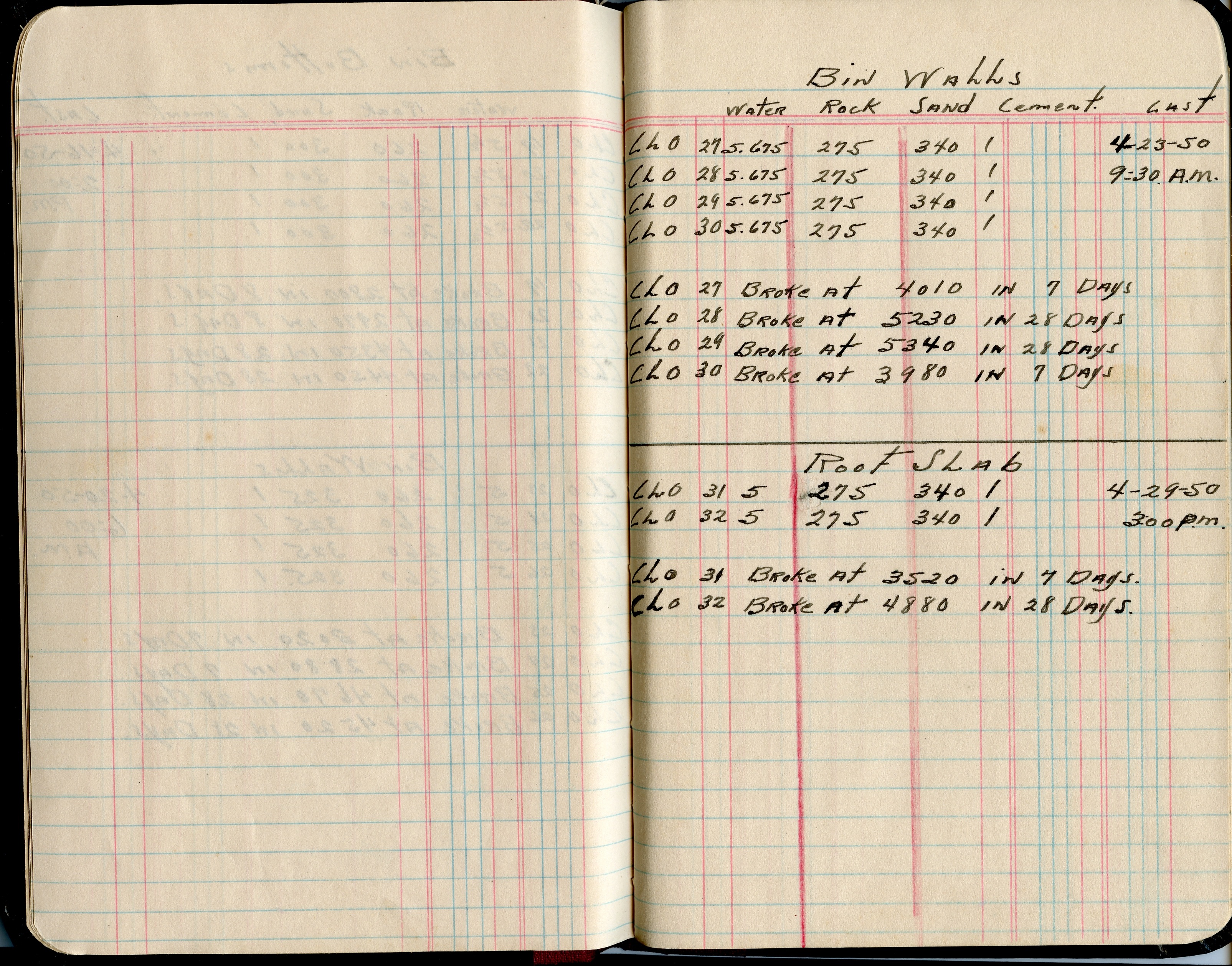
During a recent visit to Nebraska, Dad and I met with the son of Edwin Louis Christoffersen to go through family pictures. Young Ed produced a treasure from among his father’s personal effects. Edwin Christoffersen was superintendent for the Mayer-Osborn Construction job at Cordell Okla., and among his duties was the engineering of a safe and durable elevator. Testing the concrete from a given supplier was of paramount importance.

This logbook shows the results of the testing for each part of the elevator’s structure. It is a fascinating bit of engineering history, and it speaks for itself.

Cordell concrete tests003

Cordell concrete tests004

Cordell concrete tests005

Cordell concrete tests006You will notice that the date and time of day was included in the calculations for each test. This is how we were able to determine when the Cordell elevator was built.

While a number of factors were recorded for each test, it is not clear to us what each term meant. Perhaps some of our readers can explain the process to us.

It is a true privilege to see some of the engineering practices in use during the 1950s, at a time when slide rules did the work of computers, yielding sufficient precision to send our astronauts to the moon in the following decade.

These builders, engineers, and innovators were pioneers, working at the pinnacle of their profession. We wish to thank Ed Christoffersen for sharing this priceless piece of history.

Newspaper clippings of the Lincoln, Nebraska, elevator show standard construction methods

Story by Kristen Cart

christofferson042

Omaha World-Herald

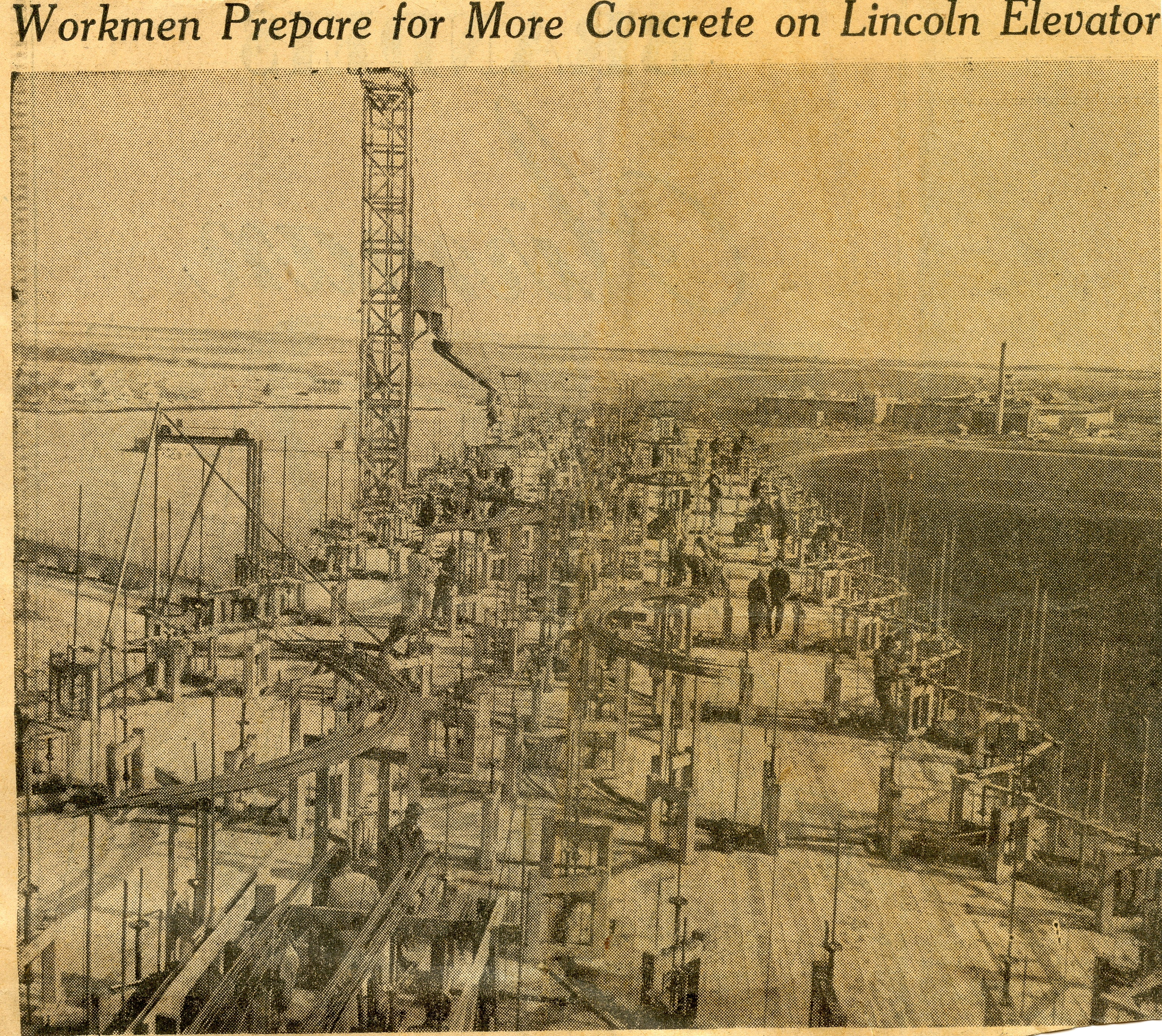
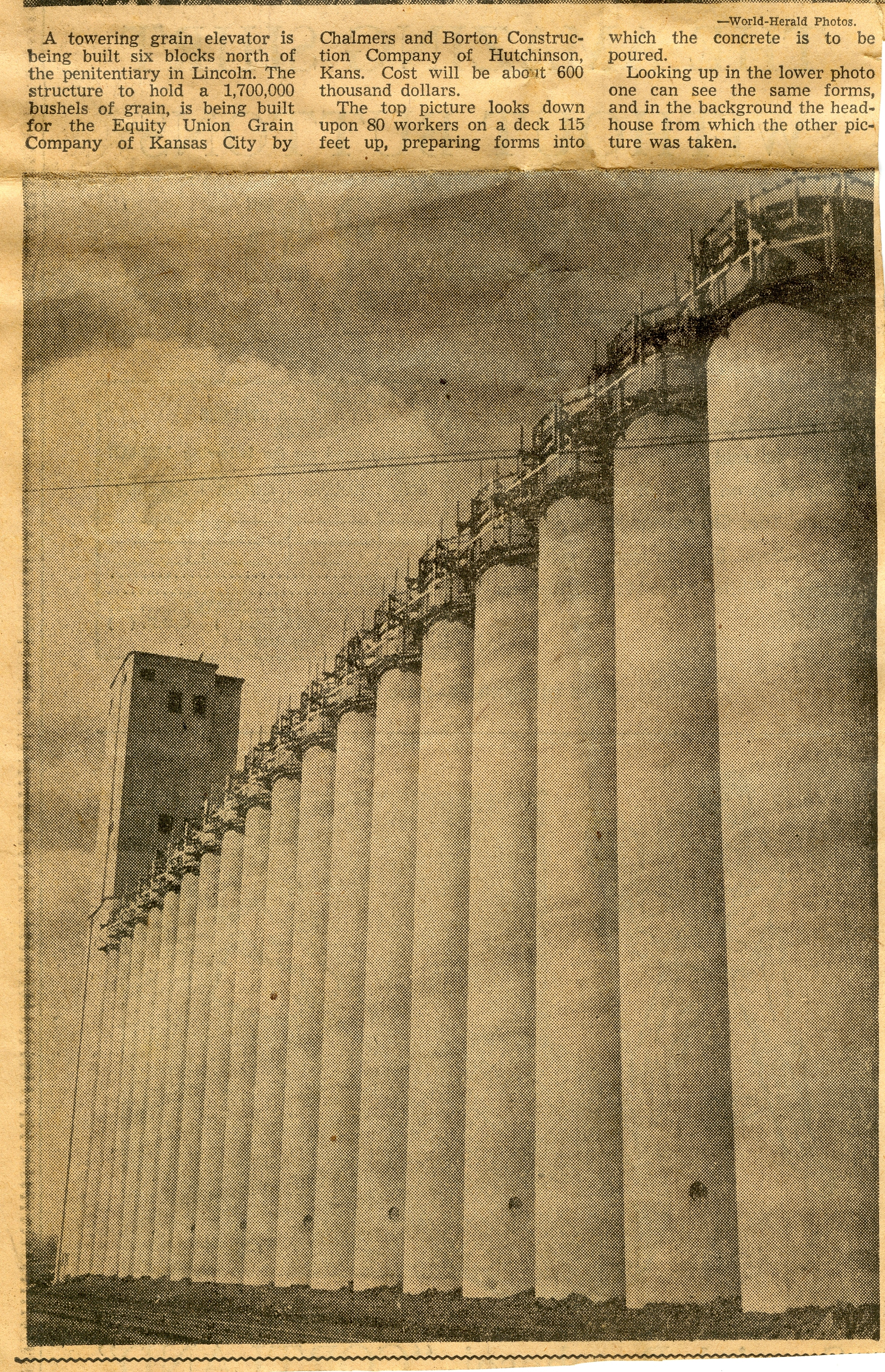
Among Edwin Christoffersen’s papers were clippings from the Lincoln, Neb., elevator construction site. While this was a Chalmers & Borton project, the clippings showed an impressively large elevator in the last stages of construction.

The story of a competitor’s biggest local project would have been of great interest to Ed, a superintendent for the Mayer-Osborn Construction Company. There is little doubt that Mayer-Osborn would have tried to get this contract. However, Chalmers & Borton frequently built the largest elevators.

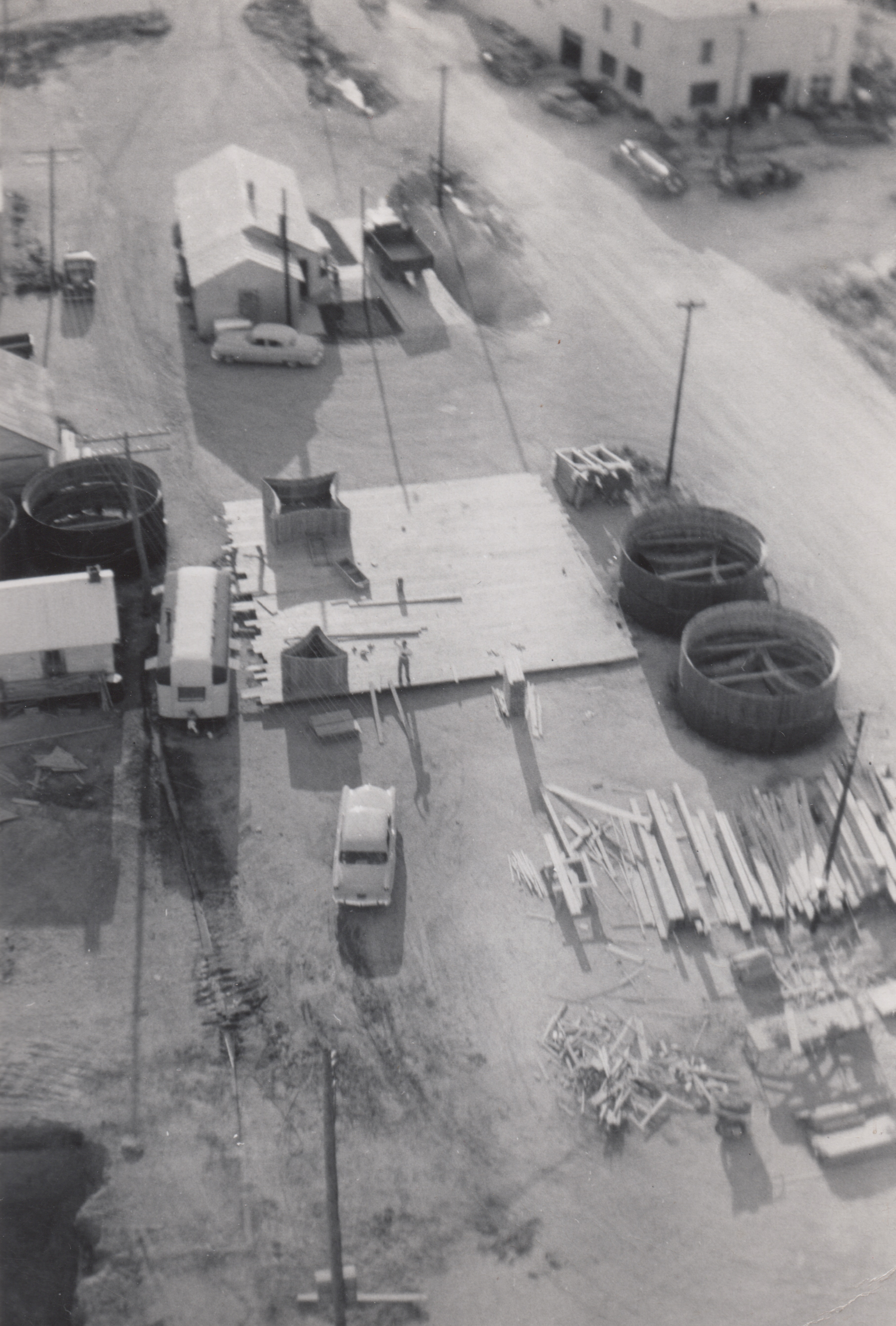
It appears that the continuous pour was nearly complete for the huge structure, and that the planks were installed either for decking for the crews, or for the final pour which would cover each bin with a concrete cap. Once the concrete cured, final “wrecking out” would remove the forms.

christofferson043

Omaha World-Herald

The headhouse was already in place, so the elevator was very close to completion. What cannot be seen is whether equipment that would come from subcontractors for installation in the headhouse and pit had yet arrived, and of course the run that would top the elevator and provide for grain distribution was yet to be finished.

The images provide a rare glimpse of the process, one that Edwin Christoffersen saw fit to preserve, much to our delight. This is a breathtaking view of a moment in time when America built with intrepidity and confidence, and left us with a towering legacy in the Plains.

Mike Tillotson remembers Flagler (1953), Albert City (1954), and Lincoln (1955)

By Mike Tillotson

I don’t have access to a computer nor know how to use one. I barely get a radio signal, and my tin-can barb-wire phone is not always clear here in the hills either.

As for the elevators I was thirteen on my first summer with my brothers. I just graduated from Grade School. Our Father helped his Father build Wood Elevators, and often was told to put out that cigarette.

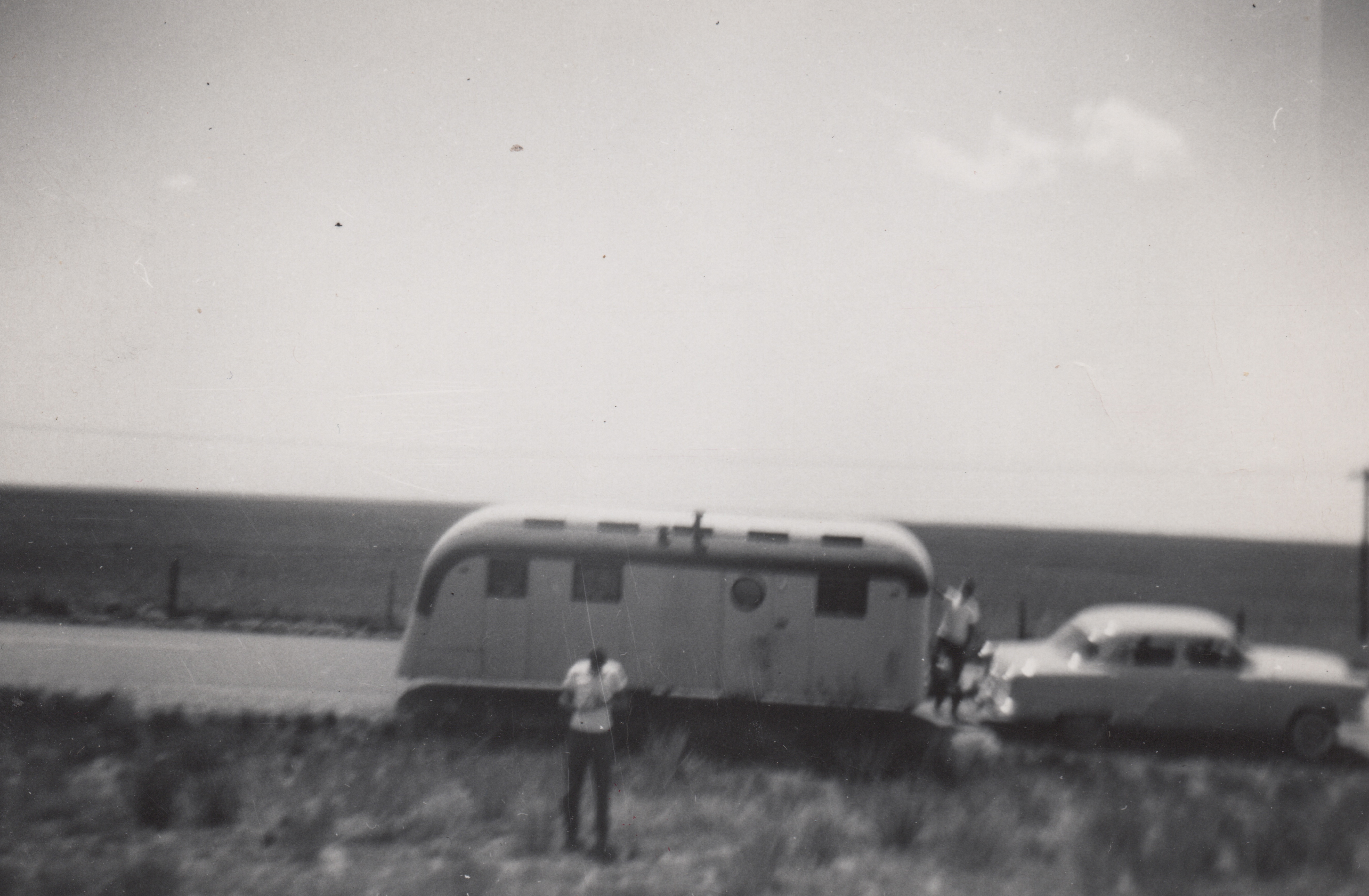
Mike stands at the center of the frame while Tim captures Charles just after he has taken a rest break on the way to Flagler.

Mike stands center-frame while Tim Tillotson captures Charles after a rest break en route to Flagler with the ’53 Ford and mystery trailer.

We headed for Flagler, Colorado; seventy five miles East of Denver. Charles was driving a 53 Ford 4-door our Father bought for him. Two-tone tan that Charles had nosed, and added fender skirts, and a continental kit. We were pulling a sixteen foot trailer that we lived in for the summer.

We were paid $1.00/Hr.–60 Hrs./Week with time and one half over 40 hours. I was the time keeper, and drove a tractor with a front-end loader. I filled up the three-bag concrete mixer with sand. Someone else put the cement and limestone in the hopper. We mixed our own concrete because we were in the middle of no-where.

I remember the Super catching me putting pennies on the rail track, and helping me with the time-sheet so I could go to Denver with my brothers for the week-end.

Tillotson Home

The Tillotson home in the Ponca Hills north of Omaha. Mike still lives there. 

I remember Charles had a girl-friend, and when we came back to Omaha in September; she came in to visit him. When Charles went to meet her at the place she was staying; Sharon went with him. When Charles and Sharon met her she said she forgot something in her room, and went back to get it. After waiting about one half hour Charles sent the door man to the room. He returned and said the room was empty, and the window was open.

You have to remember this was 1953 when we were at the age of innocence, and life was pure and simple.

The following summer (1954) we went to Albert City, Iowa, 75 miles North of Council Bluffs. We rented rooms in a private home. We worked with a 20 something guy that ran the winch pulley bucket to the top of the elevator as it progressed, and brought building materials down. We also rode the bucket up and down to get on deck. The elevator bens were 125 feet to the top with a Head-House of 75 on top of that.

The winch guy went to work on another elevator the Company had going in a town about 30 miles away. This was an addition to an existing elevator–an add-on.

At noon one day he went to the top with new boots on. There were four or five planks at the top from old to new grain bens.

No hand rails or anything. They were not required at the time. I doubt OSHA even existed. He either fell or jumped going from old to new.

Some said he might have tripped with the new boots.

Charles and I bought a nice 40 Ford sedan for $75.00 off a used car lot. He didn’t want to use the 53 any more than necessary. Coming back to Omaha one week end we were zipping down a country road with corn as high-as-a-sky and started through an intersection with no stop signs.

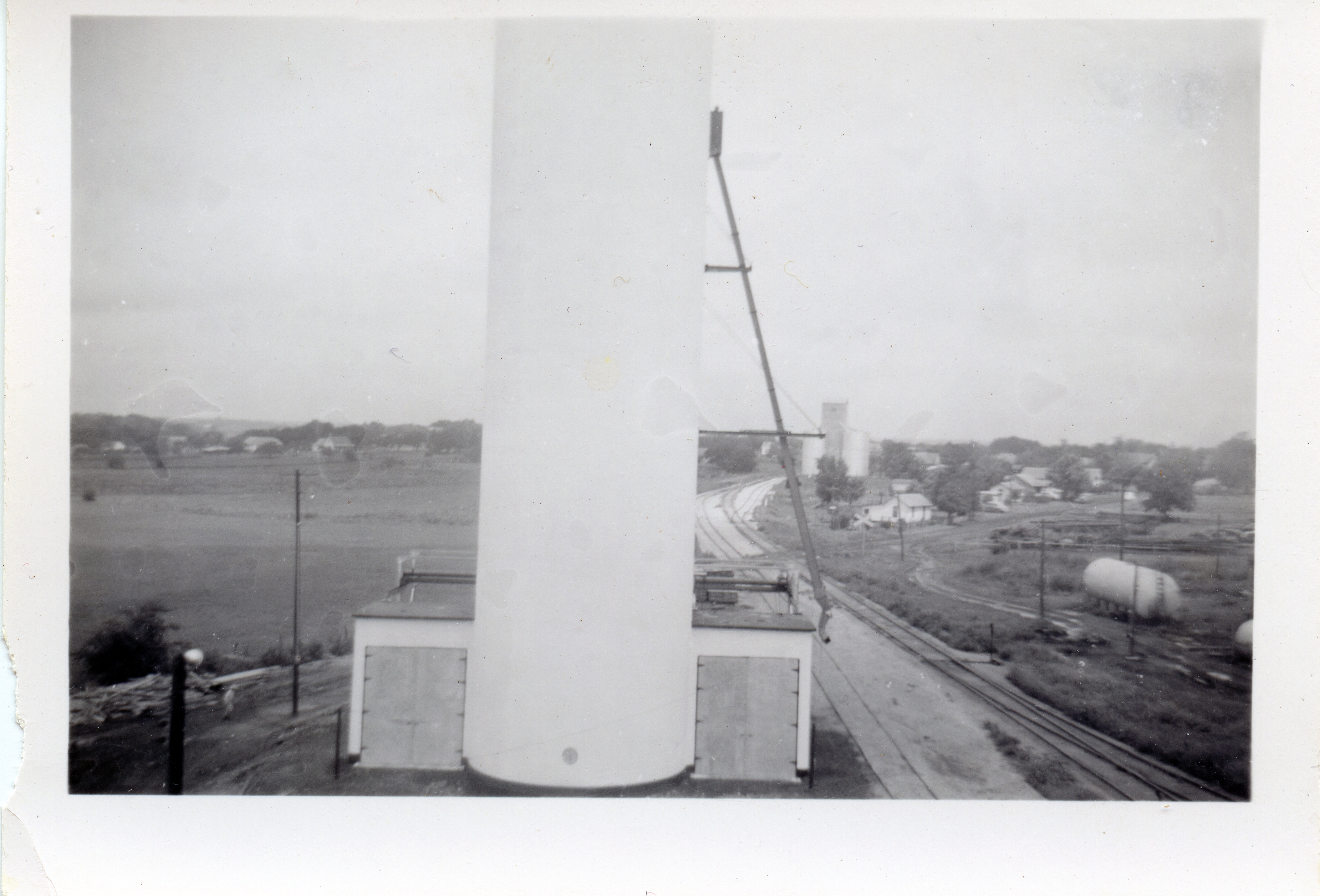
It could be Mike waving at the photographer in this photo from atop the Flagler annex. The Ford and 16-foot trailer are also evident.

It could be Mike waving at the photographer, who is perched atop the Flagler elevator, built in 1950. The foundation for the new annex is seen at lower left.

We got broad-sided by some farmer who put us in a ditch; up side down. Later in the day when we crossed the Mormon Bridge in North Omaha; one of us reached through the front of the car to pay the Toll. The windshield was gone.

The next summer (1955) I worked in Lincoln, Nebr. by myself. My sister Mary’s future brother-in-law Merle worked on the job also.

The Elevators at that time required about 12-15 men per shift. Two shifts per day–twenty four hour continuous pour. Usually about 18-20 days to get to the top of the tanks. The jacks that raised the forms were all manually operated. Today with the advanced electrical operated jacks the number of men required is probably half.

That is the story of my teenage years in MAYBERRY.

The Cordell, Oklahoma elevator project fused engineering prowess with family ties

Story by Kristen Cart

christofferson041

Edwin Christoffersen was the superintendent on the Mayer-Osborn Construction project in Cordell, Okla. in 1950. His son and namesake kindly provided a notebook that gave a glimpse of the concrete engineering that went into the elevator. By trial and error, the company learned best practices, creating an enduring structure which would still operate more than sixty years later.

Edwin Louis Christofferson was the son of Jens “James” Lauritz Christoffersen, a first generation American who farmed and operated a farm stand in Fremont, Neb. Edwin was one of nine children. Ed’s sister Alice married William Osborn in 1923.

When the Mayer-Osborn enterprise was in full swing, Bill Osborn tapped relatives to manage projects or to provide manual labor. He followed a common practice.

Sons Dick and Jerry Osborn worked at various times building elevators. Bill Osborn entered partnership with Eugene Mayer, the brother of Joseph H. Tillotson’s wife Sylvia. At the Tillotson Construction Company of Omaha, Bill Osborn worked with Iver Salroth, husband of Emma, a Christoffersen cousin.

Naturally, when the opportunity arose, Ed Christoffersen found employment with his brother-in-law’s company an attractive proposition.

christofferson019(1)

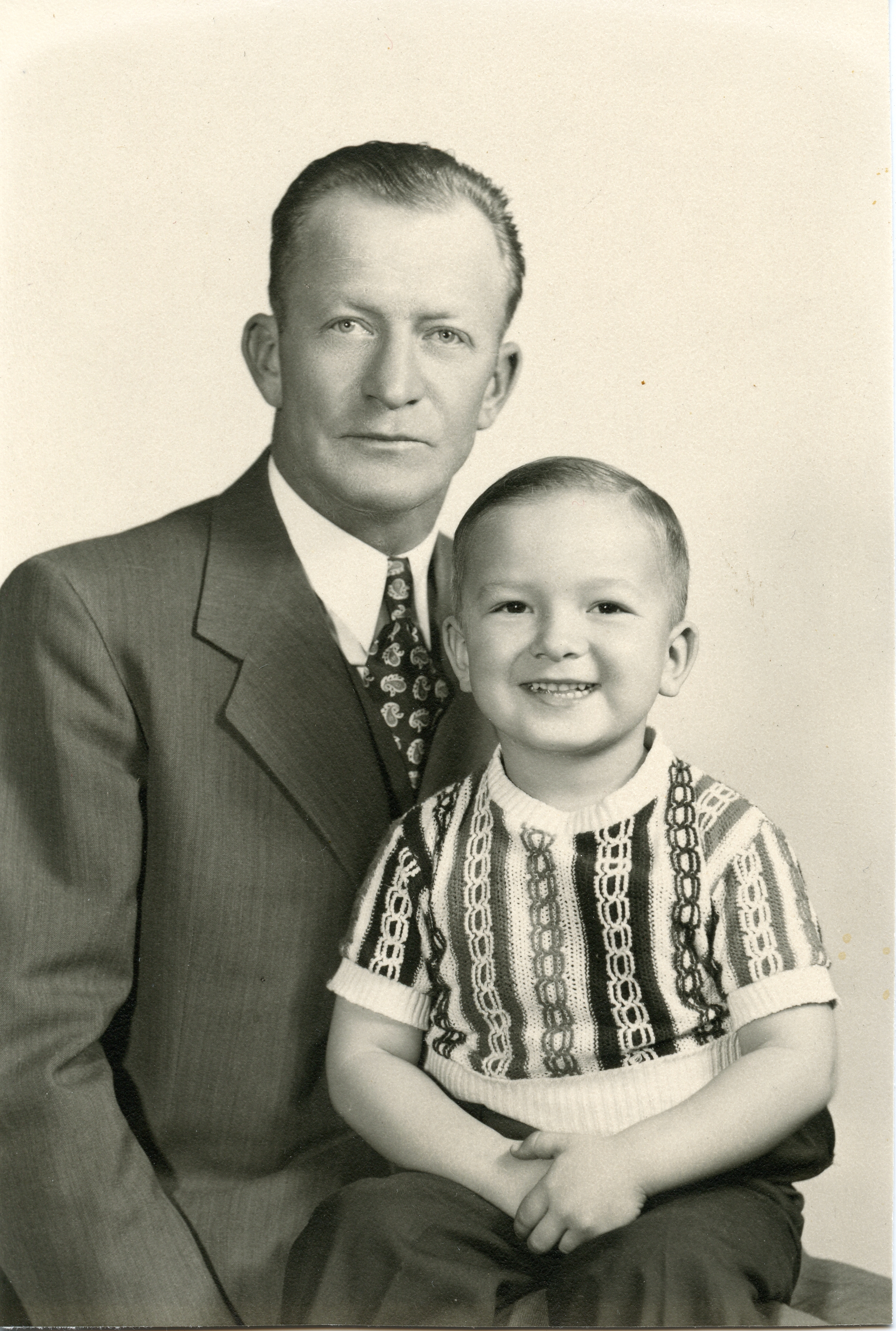
Edwin Louis Christoffersen with his only child.

Ed’s son has kept a number of Mayer-Osborn keepsakes, in memory of his dad, who died when he was still quite young. One intriguing item was the logbook that Ed kept for the Cordell, Okla. elevator, recording concrete tests.

Various sand, gravel, and concrete mixtures were tested to a failure point to determine the ideal formula for a given project. The date and time of day was recorded for each test. In this journal, we discovered the year of construction for the Cordell elevator.

The elevator business brought families together to accomplish a common goal, and now, many years later, writing about the elevators brings the builders and their sons and daughters together again. The memories are kept in small personal repositories of clippings, photos and documents, and in tales of the job, and are captured fleetingly before the witnesses leave us.

Looking up at these great landmarks, we also look up to the patriarchs who built them, with respect, and awe.

Go West, young men, to Flagler, Colorado, and build a grain elevator!

Scan 1

What could help the three teenaged sons of Reginald and Margaret Tillotson sons to grow up? Nothing better than going from Omaha, Neb., where Tillotson Construction Company was located, to Flagler, Colo., to build the annex to a grain elevator in 1953.

Charles, 18, Tim, 16, and Mike, 13, drove across the Great Plains in a new Ford, towing the trailer that would serve as their home and the job office.

Having started for the company as an assistant carpenter when he was 12, Charles was already quite skilled in elevator construction techniques.

But how did they fare for themselves? For instance, what did they eat during their weeks on the job?

“Regarding what we ate, I really don’t remember but it was probably beans and wieners,” Charles recalls. “We also ate at the local cafe in Flagler. That was when Tim and I weren’t screaming over to Elitches Park Outdoor pavilion in Denver (some 120 miles to the west) to squeeze in a night of dancing and return at daybreak to assume our work shift–no sleep of course. I think we left Mike alone in Flagler to fend for himself.

Mike spent many hours in the trailer, serving as timekeeper and reading hot rod magazines when he could.

Mystery elevator identified as Mayer-Osborn’s Cordell, Oklahoma project

William Osborn photo provided by his granddaughter Diane Osborn Bell

William Osborn photo provided by his granddaughter Diane Osborn Bell.

By Kristen Cart

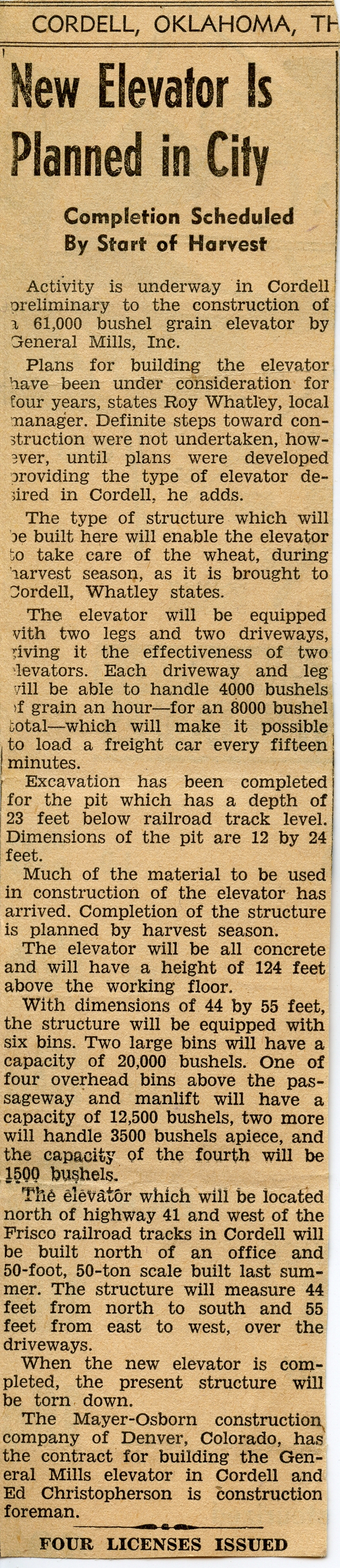
christofferson040This photograph has left us scratching our heads for over a year. Gary Rich knew of no such elevator from all of his travels, so he rummaged through his photographs for any hint of it. He looked for an elevator with a single bin-width and two driveways, with a curve of track and a second elevator around the bend, all to no avail. The photo sat in my files waiting for serendipity to step in. Sometimes, it is best to bide your time, and if you are lucky you get more than a location and a name. We hit the jackpot in this case.

When Dad and I visited his first cousin, we sorted through boxes of hundred-year-old family pictures. Midway through the second box, we found a newspaper clipping about an elevator, with a photo I instantly recognized. There it was, plain as day.

This unique elevator was built in Cordell, Okla., a town almost directly south of Wichita, Kan., well within the territory served by Mayer-Osborn Construction. The superintendent on the job was Ed Christoffersen, brother-in-law to my grandfather William Osborn.

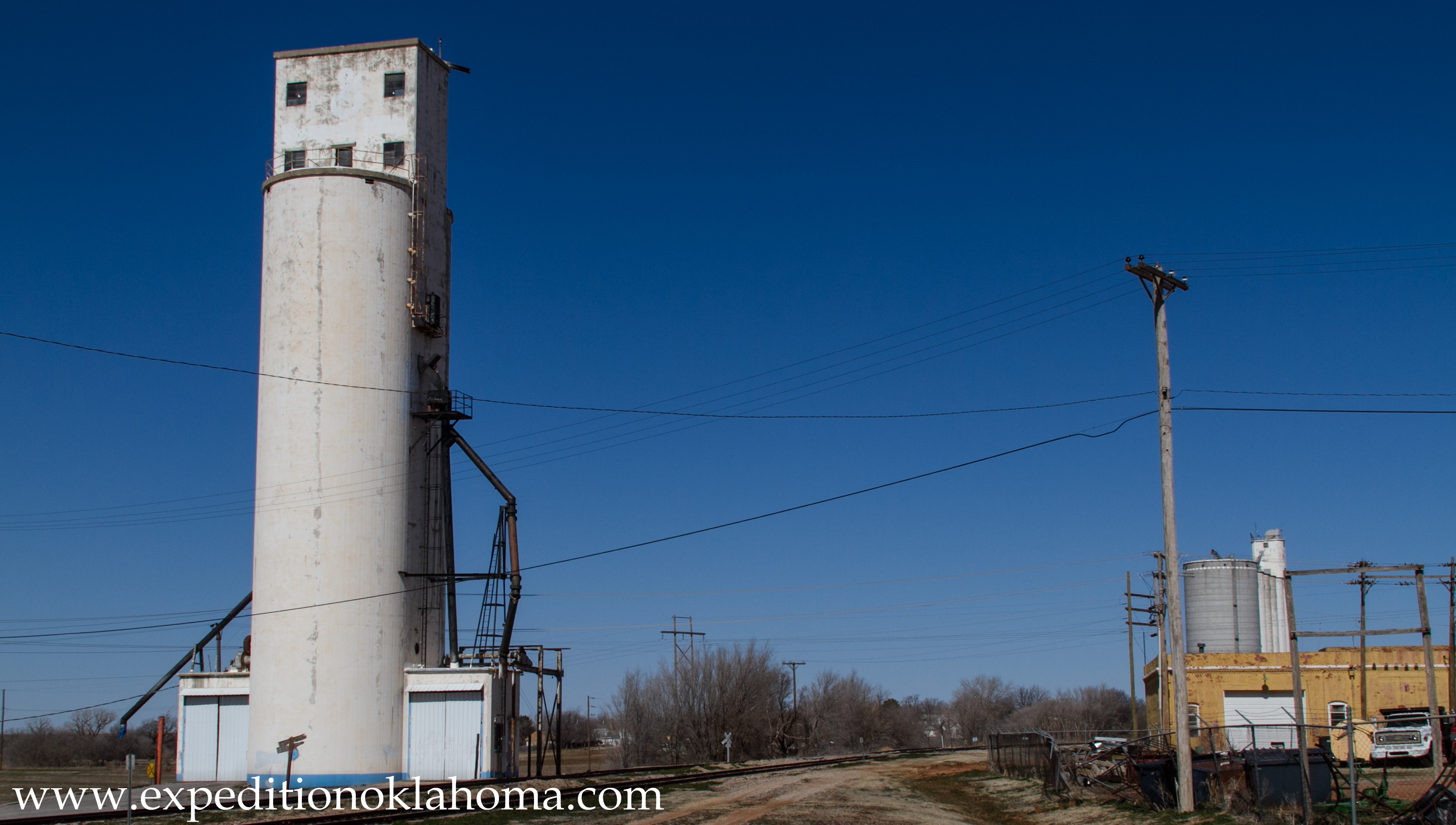
Cordell Oklahoma Elevator

In this photo by Joy Franklin, you can see two driveways, built for faster grain loading during harvest. The curve of train track is evident here.

After making the identification, I looked online and found Expedition Oklahoma, where Joy Franklin posted a beautiful current photo of the elevator. With her kind permission, it is posted below. She said the elevator is owned by the Wheeler Brothers Grain Company, founded in 1917, which presently owns eighteen grain elevators. It is a happy surprise to see that one of Mayer-Osborn’s most innovative elevators not only survives, but is still in use today.


Iowan Frank Nine recalls working for Tillotson Construction in the mid-1950s

This photo showing the aftermath of a grain dryer explosion at the Boxholm elevator was uploaded to KCCI by u local contributor hmuench.

This 2009 photo showing the aftermath of a grain dryer explosion at Tillotson’s Boxholm elevator was uploaded to KCCI by u local contributor hmuench.

The following two-part memoir was recently written by Frank Nine, who worked for Tillotson Construction Company in 1954 and 1955 and now lives near Sedalia, Missouri:

I first worked for Tillotson in Dayton, Iowa. Jay Wiser was superviser. We finished there and moved to Bancroft, Iowa, and finished late-fall 1954.

Frank Nine is seen in this recent photo.

Frank Nine, in a recent photo.

Early 1955 we started the Boxholm elevator, where I was from. G.T. Christensen, Jay Wiser, and I became friends and often hung out together when not working. I attended George’s funeral. I was 19 at the time. We went to Dallas Center, Iowa. George’s wife and family [lived] for some time in Boxholm. I later helped her with some minor repair, etc, on their trailerhouse. The children were very young then.

I am now 77 years old.

♦ ♦ ♦

I started out on the tractor-loader filling the hopper for the cement mixer. Some as carpenter helper, on-deck pouring cement, and most of time wherever needed. This was in Dayton, Iowa.

Jay Wiser’s brother–Bud is what they called him, I think Harold was his name–was foreman or boss.

Then we moved to Bancroft, Iowa, where Jay was supervisor, his brother Jesse was a foreman, and George T. Christensen was also.

I worked with Bobby Wheeler and his brother Billy. (I think that was his name.) Also with Jerry Gustafson and his dad and a man they called Cowboy. I think Carlson was his last name.

Bobby and I were friends and hung out often. Jerry and I did the same.

We finished job October-November 1954. Early 1955 we started the job in Boxholm, Iowa, where I met Jim Sheets, and we became friends. I worked the master jacks and run jack crew. Later on, finished cement with Jim–among other jobs as needed. This is where George, Jay, and an old welder, Jesse, became friends.

Bobby, Jerry, Jim, George, Jay, Jesse, and others hung out often. We lost George this year.

‘Walking the plank’ on the new Pocahontas, Iowa, elevator in 1954

pocahontasgrainelevator

By Charles J. Tillotson

Safety and the preservation of life have become much more important in today’s world of construction. However, during the 1940s and 1950s, the urgent need to build grain storage coupled with the fact that most elevators were built in very rural areas meant that safety was secondary to getting the job done.

A case in point was a personal experience I had while working in Pocahontas, Iowa.

As with most small towns, the labor pool was rather limited to itinerant farmhands and workmen passing through town. Scaffolding and access walkways were pieced together in a very haphazard way–the means to an end.

One day I was working “up top” of the newly built grain tanks and needed to cross over from the new tanks to the deck of the existing elevator. The distance between the two structures was probably eight feet. To span the gap, two 2×12 planks were placed down between the two structures.

As I began my “walk the planks,” I stubbed my toe on the butt end of one of them. Accordingly, I stumbled forward–but was fortunate enough to regain my footing and continued on across to the other structure.

I realized then how easy it would be to make a misstep and end up at the bottom of the chasm.

Map of Iowa highlighting Pocahontas County

Map of Iowa highlighting Pocahontas County (Photo credit: Wikipedia)

While working in Pocahontas I met a young man, a few years older than I, who had been passing through town on his way back to his home in Hinton, Iowa. His name was Marv, and he had signed on as a carpenter. It was refreshing to me when I met Marv, as he seemed to be a person who was not only a good worker but an intelligent one as well.

When the summer came to an end I had to return to school, and so I said my good-byes to Marv and all the crew on the job. Later that year I learned that Marvin Richards had fallen to his death on the Hinton job (Tillotson-built) while attempting to cross over between two structures.

Hearing the news of his death, I assumed he was the same person I had encountered.

That same summer, Larry Ryan, the hoist operator working for Tillotson Construction Company on the Pocahontas job, had a similar mishap. During Larry’s break from the hoist, he decided to go up through the existing elevator terminal and cross over to the new construction to deliver a piece of angle iron needed by someone up top.

Again, somehow he lost his balance on the planking, and he, too, fell to his death.

It was eerie to think about how, more than once, I had come so close to doing the same thing and just how dangerous an act this was. On the other hand, the concept was fairly simple and straightforward: two 2×12 planks, side by side, laid down between two structures and spanning a distance of only six or eight feet. Not much to it – but only if you don’t slip, stumble, or in some way lose your balance!

At minimum, there should have been a safety railing on one or both sides of the planking.

But, back then, there just wasn’t enough attention given to safety and the value of human life.

Of course, I learned a valuable lesson in precaution and safety from these incidents, which I carried with me throughout my construction career.

J. H. Tillotson’s project at Lodgepole, Neb., was the end of the line for Supt. Bill Morris

DSC_0380

The Lodgepole, Neb. elevator viewed through a rainy windshield on a blustery day.

Story and photo by Kristen Cart

It was the heyday of elevator construction, and J. H. Tillotson, Contractor, of Denver, was riding the crest of the building wave, when a new elevator was begun along Highway 30 (the Lincoln Highway), in the sand hill country of western Nebraska. Lodgepole was a sleepy town along the rail line that connected Sidney to the west, with Chappell and Big Springs to the east.

My grandfather, William Osborn, had been building for several years, and he accompanied Joe Tillotson to Denver when Joe made his break with the family business, Tillotson Construction of Omaha, and set out on his own. The new company had several projects under its belt, and several others ongoing in 1947, when Lodgepole’s elevator was started.

Bill Morris, an employee poached from the parent company, was superintendent for the job.

The dangers of the business were well known. But for the J. H. Tillotson company, fate was especially cruel, though the disasters that befell the builders were of a more mundane sort. In about March of 1947, Bill Morris was changing a tire on the side of Highway 30 near Lodgepole when a car struck him, and he was killed.

Of course the construction project went forth, and my grandfather played a role, since he had the experience to step in where Bill Morris left off.

It was not long afterward that Joe Tillotson met his maker in a car accident–only a matter of a few weeks. In those days safety in vehicles was an afterthought, and the Grim Reaper was guaranteed a regular harvest.

Joe’s death opened doors for my grandfather, since there were elevators to build and contracts to fulfill. By September of 1948, Bill Osborn had joined with Eugene Mayer, Joe’s brother-in-law, and together they formed the partnership of Mayer-Osborn Construction Company. My dad said Grandpa had to put up some money to opt into the business, and then he continued as before, building elevators as fast as they would go up.

The McCook, Neb., elevator marked their first joint effort.