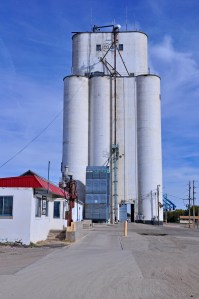
‘Walking the plank’ on the new Pocahontas, Iowa, elevator in 1954

pocahontasgrainelevator

By Charles J. Tillotson

Safety and the preservation of life have become much more important in today’s world of construction. However, during the 1940s and 1950s, the urgent need to build grain storage coupled with the fact that most elevators were built in very rural areas meant that safety was secondary to getting the job done.

A case in point was a personal experience I had while working in Pocahontas, Iowa.

As with most small towns, the labor pool was rather limited to itinerant farmhands and workmen passing through town. Scaffolding and access walkways were pieced together in a very haphazard way–the means to an end.

One day I was working “up top” of the newly built grain tanks and needed to cross over from the new tanks to the deck of the existing elevator. The distance between the two structures was probably eight feet. To span the gap, two 2×12 planks were placed down between the two structures.

As I began my “walk the planks,” I stubbed my toe on the butt end of one of them. Accordingly, I stumbled forward–but was fortunate enough to regain my footing and continued on across to the other structure.

I realized then how easy it would be to make a misstep and end up at the bottom of the chasm.

Map of Iowa highlighting Pocahontas County

Map of Iowa highlighting Pocahontas County (Photo credit: Wikipedia)

While working in Pocahontas I met a young man, a few years older than I, who had been passing through town on his way back to his home in Hinton, Iowa. His name was Marv, and he had signed on as a carpenter. It was refreshing to me when I met Marv, as he seemed to be a person who was not only a good worker but an intelligent one as well.

When the summer came to an end I had to return to school, and so I said my good-byes to Marv and all the crew on the job. Later that year I learned that Marvin Richards had fallen to his death on the Hinton job (Tillotson-built) while attempting to cross over between two structures.

Hearing the news of his death, I assumed he was the same person I had encountered.

That same summer, Larry Ryan, the hoist operator working for Tillotson Construction Company on the Pocahontas job, had a similar mishap. During Larry’s break from the hoist, he decided to go up through the existing elevator terminal and cross over to the new construction to deliver a piece of angle iron needed by someone up top.

Again, somehow he lost his balance on the planking, and he, too, fell to his death.

It was eerie to think about how, more than once, I had come so close to doing the same thing and just how dangerous an act this was. On the other hand, the concept was fairly simple and straightforward: two 2×12 planks, side by side, laid down between two structures and spanning a distance of only six or eight feet. Not much to it – but only if you don’t slip, stumble, or in some way lose your balance!

At minimum, there should have been a safety railing on one or both sides of the planking.

But, back then, there just wasn’t enough attention given to safety and the value of human life.

Of course, I learned a valuable lesson in precaution and safety from these incidents, which I carried with me throughout my construction career.

J. H. Tillotson’s project at Lodgepole, Neb., was the end of the line for Supt. Bill Morris

DSC_0380

The Lodgepole, Neb. elevator viewed through a rainy windshield on a blustery day.

Story and photo by Kristen Cart

It was the heyday of elevator construction, and J. H. Tillotson, Contractor, of Denver, was riding the crest of the building wave, when a new elevator was begun along Highway 30 (the Lincoln Highway), in the sand hill country of western Nebraska. Lodgepole was a sleepy town along the rail line that connected Sidney to the west, with Chappell and Big Springs to the east.

My grandfather, William Osborn, had been building for several years, and he accompanied Joe Tillotson to Denver when Joe made his break with the family business, Tillotson Construction of Omaha, and set out on his own. The new company had several projects under its belt, and several others ongoing in 1947, when Lodgepole’s elevator was started.

Bill Morris, an employee poached from the parent company, was superintendent for the job.

The dangers of the business were well known. But for the J. H. Tillotson company, fate was especially cruel, though the disasters that befell the builders were of a more mundane sort. In about March of 1947, Bill Morris was changing a tire on the side of Highway 30 near Lodgepole when a car struck him, and he was killed.

Of course the construction project went forth, and my grandfather played a role, since he had the experience to step in where Bill Morris left off.

It was not long afterward that Joe Tillotson met his maker in a car accident–only a matter of a few weeks. In those days safety in vehicles was an afterthought, and the Grim Reaper was guaranteed a regular harvest.

Joe’s death opened doors for my grandfather, since there were elevators to build and contracts to fulfill. By September of 1948, Bill Osborn had joined with Eugene Mayer, Joe’s brother-in-law, and together they formed the partnership of Mayer-Osborn Construction Company. My dad said Grandpa had to put up some money to opt into the business, and then he continued as before, building elevators as fast as they would go up.

The McCook, Neb., elevator marked their first joint effort.

Is it a Tillotson elevator in the Idaho Potato Commission’s TV ad?

IMG_1560

Story by Ronald Ahrens

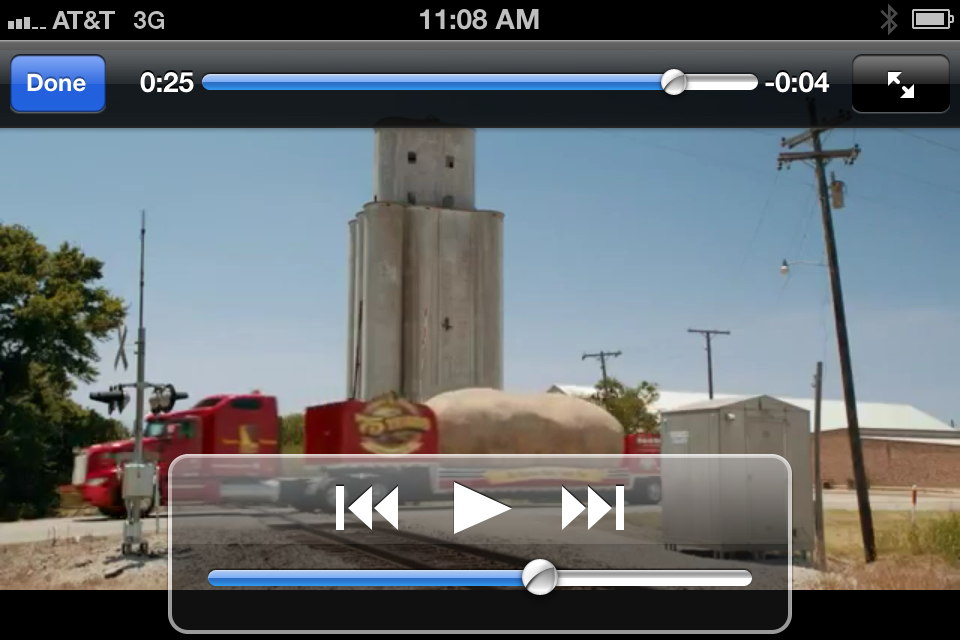
In a television ad for the Idaho Potato Commission, which last year observed its diamond jubilee, a flatbed truck goes missing while on tour with a giant potato. Among the many American landmarks visited in the twenty-five-second spot is a railroad crossing with a concrete grain elevator in the background.

The spot, called “Missing Truck,” was created by Evans, Hardy & Young. Its debut came Aug. 31, 2012, during the Boise State-Michigan State football game on ESPN. The storyline and airing schedule were detailed in a press release on the Idaho Potato Commission’s website.

Although we find nothing in the scene to indicate the exact location, the elevator sure looks to us like a Tillotson Construction job. The rounded headhouse and symmetrically placed windows tell as much. The slot for the driveway also is indicative.

So we phoned the Santa Barbara, Calif., office of EH&Y and left a voice message with Max Martens, vice president for public relations. Replying by email, Mr. Martens wrote, “As close as the art director can pinpoint, the location with the grain elevator was a rural area about a half hour west of Dallas, Texas.”

That’s more than we had to go on.

Meanwhile, we hope the truck and potato made it back to Idaho.

Timeline for Tillotson Const., J.H. Tillotson, and Mayer-Osborn companies and jobs

Ronald Ahrens and Kristen Cart cofounded this blog. Gary Rich is a primary contributor. We have visited elevators around the United States and Canada.

Ronald’s maternal grandfather was Reginald Oscar “Mike” Tillotson.

Kristen’s paternal grandfather was William Arthur Osborn.

Reginald O. Tillotson

R. O. Tillotson

Reginald’s company was Tillotson Construction Co., of Omaha. The company had been building and repairing wooden elevators since the 1920s, when it was led by Reginald’s father Charles H. Tillotson. Before his death, experiments were made with slip-form concrete construction techniques.

1938: Charles dies, and the company passes to his sons Reginald and Joseph H. Tillotson and daughter Mary V. Tillotson. They begin to perfect slip-forming and refine their design strategy, which includes a rounded headhouse.

1945: Tillotson Construction builds a concrete elevator in Giddings, Tex. William Osborn works on this project. He is probably employed by the company by late in ’44. Tillotson Construction wins the contract to build in Elkhart, Kan., and starts construction.

1946: The 225,000-bushel elevator in Elkhart is completed. “Shortly after the war, my Dad and Joe decided they couldn’t see eye to eye, so they split,” writes Charles J. Tillotson in “The Tillotson Construction Story” on this blog. Joe forms J.H. Tillotson, Contractor in Denver. William Osborn works for Joe Tillotson.

William A. Osborn in 1965

William A. Osborn in 1965

1947: Tillotson Construction builds  the Vinton Street elevator in Omaha. Joe Tillotson dies in a car accident in March. J.H. Tillotson, Contractor builds at Daykin and Fairbury, Neb., and Hanover and Linn, Kan., with William Osborn supervising the projects. Maxine Carter leaves Tillotson Construction on Oct. 7 to wed Russell L. Bentley.

1948: Formed in September from the residue of J.H. Tillotson, Contractor, the Mayer-Osborn Company builds its first elevator at McCook, Neb. Joe Tillotson’s wife Sylvia was a Mayer, and her brother Eugene Mayer is one of the partners. William Osborn is the other. Meanwhile, Reginald begins to use a light airplane for business travel in the postwar years. Reginald’s nephew John Hassman joins Tillotson Construction in September; among many other duties, he pilots the company plane to jobs in Nebraska, Kansas, and Oklahoma. Tillotson’s projects that year are in Paullina, Iowa, and Montevideo, Minn.

1949: John Hassman’s father Ralph, Reginald’s cousin, joins Tillotson Construction in sales and stays through 1952.

1950: Construction begins in November on the Tillotson house, which is built of concrete. It still stands north of Omaha. Tillotson employee Jess Weiser weds Lavonne Wiemers on Dec. 22.

1951: Drafted into the Air Force, John Hassman leaves Tillotson Construction in January.

Related articles

Hanging by a thread on the ‘wrecking-out’ scaffold, a young workman faces mortality

By Charles J. Tillotson

Editor’s note: Uncle Chuck here recalls one of the more harrowing experiences of his young life, when he was building grain elevators for Tillotson Construction Company. It occurred on what is called a wrecking scaffold–or to be more precise, during the scramble off one heading into the void.

From left, Tim Tillotson, Chuck Tillotson, and La Rose Tillotson Hunt, posing in June 2012 in Victorville, California.

From left, Tim Tillotson, Chuck Tillotson, and La Rose Tillotson Hunt, posing in June 2012 in Victorville, California.

When the slip-form process reached the intended height of construction, all wood form-work and other equipment and devices were removed from the structure via an external hoist.

The final portion of the demolition process, the removal of the wood forms, involved the most difficult and dangerous part of the operation, that being the “wrecking out” of the wood forms and decking material that is, by design, trapped inside each of the grain tanks.

All of this wooden material must be removed, and it must be done from the inside.

This is accomplished by utilizing a temporary platform, or wrecking-out scaffold, suspended within each tank.

Elevator design preconceived the need for a ‘wrecking-out’ platform

In preparation for the building of a temporary platform, cutout sleeves and manhole forms are strategically placed to allow cable and scaffold planking to be inserted into the tanks after the concrete roof deck has been poured. The cutouts, usually four round holes per tank, are each large enough in diameter for insertion of a cable with a preconstructed loop end.

Via the manhole, planks are slid through to a workman who is suspended on a rope with a bosun’s chair, allowing him to have a hands-free position.

He takes the planking being passed down to him and extends the two major beam planks through the hanging cable loops.

After the beam planks are in place, scaffold planking is installed perpendicular to the beams in such a way as to create a solid plank platform.

The final scaffold then becomes a square platform suspended in a round tank.

The void on each side of the scaffold is used for lowering or throwing the wood material into the tank’s dark abyss. After all the overhead wrecking has been accomplished, another team gains access to the tank’s bottom via a manhole in the side of the tank at or near ground level.

The noon whistle as harbinger of doom

This description of building the wrecking-out scaffold sets the stage on another personal experience with the perils of constructing grain elevators.

It took place when I was assigned duty on the wrecking-out scaffold. The morning of labor with two other workmen had passed without incident, and when the town’s noon whistle blew, we three stopped for lunch.

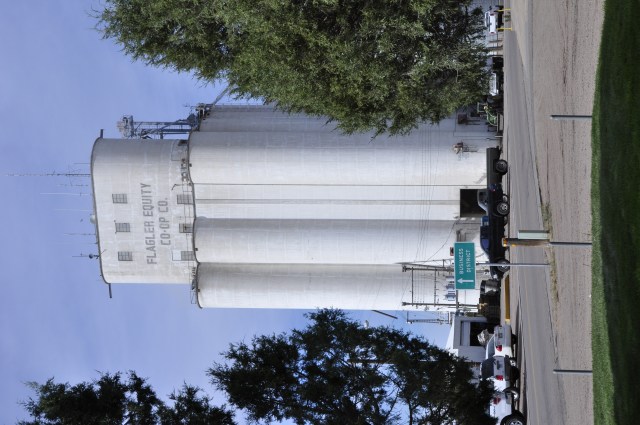
The beginning of Tillotson Construction's job in Flagler, Colo.

The beginning of Tillotson Construction’s job in Flagler, Colo.

Typically, rather than have the wrecking crew go through the process of crawling or being lifted back up through the manholes and then go in reverse to gain access to the platform again, the workmen just brought their lunches down to the platform and ate them there.

As we sat on the planking in this semi-dark and dank grain tank, eating our lunches and telling war stories, I heard a plunking noise that sounded like someone had dropped a rock onto the scaffold. It seemed to come from the corner behind me. I didn’t pay much attention and soon rejoined the important conversation taking place.

About five minutes later, I noticed another similar sound and asked the other two workmen if they had heard it, too. Neither of them had. They went back to talking. But within minutes another “rock” hit the scaffold and simultaneously one corner tilted down.

A precarious situation soon becomes a mortal threat

We suddenly realized the nut fasteners of the cable clamps–which were U-shaped and bolted around the main cable drop and the end of the cable loop–had somehow unwound. (Two cable clamps were used per loop, each clamp having two fastener nuts turned sufficiently tight to form a bond on the loop.)

So only one nut remained on the cable clamp to hold the loop and that corner of the scaffold.

To save ourselves from this sinking ship, we quickly helped one another by doing a foot-up maneuver, with the first man out through the manhole above. Once he crawled to safety on the deck, he reached down for the next one and yanked him through.

I had been sitting the furthest away from the manhole, so I was the last man out.

Again, as with my previously described narrow escape (see the link below), God was watching after me.

Just as I punched through to safety on the roof, I heard the cable loop fail and the scaffolding crash into the tank’s deep dark recesses.

Why worker safety was a secondary consideration

In those days, there were many similar incidents that occurred during the construction process.

Contributing to the lack of safety precautions was the use of unskilled labor. Most of it came from the surrounding farm community, and these men had no background in construction.

Lives were lost, and assumptions were made that this would occur, as the ultimate goal was building grain storage as quickly as possible. Safeguarding life and limb took a secondary position to that effort.

At Tillotson’s Albert City, Iowa, job, a deckhand’s pendulous moments

This photo, provided by Kristen Cart from Osborn family archives, shows a deckhand standing nonchalantly on elevator formwork. Kristen believes the picture may have been taken in Giddings, Texas, in 1945.

This photo, provided by Kristen Cart from Osborn family archives, shows a deckhand standing nonchalantly on elevator formwork. Kristen believes the picture may have been taken in Giddings, Texas, when Tillotson Construction Co. built there in 1945.

Story by Charles J. Tillotson

Reinforced-concrete grain elevators used the slip-form method of construction, whereby a wooden form system was built on the ground, having the footprint required to configure the grain-storage tanks.

Once the forms were in place and the vertical lifting and jacking system assembled, laborers began installing rebar and pouring cement into these forms.

When the forms were filled to the top–about four feet–the lifting and slipping commenced by turning screw jacks placed strategically throughout the formwork. After this procedure of vertical form lifting and rebar setting and cement pouring began, it never stopped until the structure reached its intended height, usually between 100 and 120 feet.

thThis process was the intended norm but was oftentimes interrupted by a myriad of problems, which caused the form-slipping to come to a halt. One of these instances occurred one night when I was eighteen or nineteen, working as a deckhand in Albert City, Iowa, for the family’s construction company.

The structure had reached about eighty feet in height when the electrical power supplying the lighting system and other machinery was cut off by a huge summer storm distributing lots of rain and wind throughout the area.

All personnel, including myself, were stranded on the stationary deck with little else to do but wait out the storm and the return of power.

A few hours of waiting produced a carload of my friends that had arrived on the surface. They were yelling for me to come down and join them. The only possible way to get off the tower was the vertical “ship’s ladder” that was installed in sections on the side of the rising structure.

Access to this emergency ladder was gained by going over the side of the formwork to the finishing scaffold below. Here, a rope was suspended down to the uppermost section of the ship’s ladder. The length of the rope was normally long enough so that a person could slide down it and gain hold of the ladder’s top rung.

I say normally the rope was long enough, based on the fact that the ladder sections were routinely placed sufficient to keep pace with the ever-vertical movement of the concrete structure.

However, as I soon discovered on this particular stormy night, the norm didn’t prevail. I hopped over the side of the formwork and reached for the rope hanging from the finishing scaffold’s frames. It was pitch black, and the wind was blowing to go along with heavy rain, but I was able to find the rope and swing off the side.

The first thing I discovered was that the wind was so strong, it blew me sideways and shoved me around the bin tank.

When the gusting stopped, I was able to line up vertically above the supposed location of the ship’s ladder.

So, undeterred, I slid down the rope—but not very far before another gust of wind blew. I had to stop sliding down and let it subside.

This process went on for a number of iterations, and as I slowly went down the rope, I began to wonder where the top of the ladder was exactly.

I was running out of rope.

With about three feet left, I really started sweating–I still couldn’t see the top of the ladder.

Because I had become somewhat exhausted while sliding down, swinging back and forth like a teabag, I knew I couldn’t crawl back up to the scaffold.

Now I reached the very end of the rope, and a big blast of wind blew me away and around the tank. When that gust stopped, I flew back around and by sheer luck found purchase with my foot on the top rung of the ladder. Another blast hit me, but with my foot hooked under the top rung, I stabilized myself.

With my strength ebbing, if I was going to survive, I had to make an attempt to release the rope, drop down along the ladder, and catch a rung. (Any rung would do.) So, with trepid emotions, I let go of the rope and dropped.

The testimony of my luck (and strength and skill of course) is that I am able today to relate this harrowing story.

As I released the rope I yelled up to the top of the tower to alert other personnel that they shouldn’t attempt to do what I had done. I’m sure I saved someone else’s life besides my own that night.

But the message of this story is that constructing grain elevators in the early days was filled with these types of unsafe conditions where protection of life was not as important and took a back seat to getting the job done.

There was grain being harvested in the fields, and it needed a place to be stored. The nation was on the upswing, growing by leaps and bounds, and in need of being fed.

A house of slip-formed concrete was Reginald Tillotson’s pet project in 1950

Tillotson Home

By Ronald Ahrens

An early post on this blog included John Hassman’s recollection of design and construction of the house Reginald Tillotson built on a hilltop north of Omaha’s Florence neighborhood:

“While in the office I [was] trained by the office engineer to design buildings and was the major designer with R.O. to build his new home in Florence, Neb. Many mornings he would arrive with new ideas of what he wanted changed in the house, and we would start all over. Starting in Nov. 1950 we began construction on the new house. The foremen were kept busy in the winter doing that work. All using a concrete house with the ideas we used in Elevator Const. That was the coldest, windiest place to work in December. I left to go the the Air Force because I was about to be drafted in the middle of the Korean War.” 

The house, of course, still stands, and is the home of Michael Tillotson, youngest son of Reginald and Margaret.

It did not incorporate Tillotson Construction’s signature rounded headhouse!

As a grandchild who spent a lot of time there, I always though it was remarkable because of the use of glass blocks as a design feature. The entire second floor was reserved as a music and game area. And despite the single garage door, there was a second “lane” to the right when you drove in.

But Uncle Mike always had it blocked with his relics.

Good corn is good news at Altoona, Iowa

DSC_0378(1)

“Nice corn” goes straight into storage without a stop in the dryer.

Story and photos by Kristen Cart

One of the elevators on my list to see was the facility built in Altoona, Iowa by Tillotson Construction Company. It was reported to be the near-twin of the elevator in Mitchellville, Iowa. It is located about a half-mile south of I-80 in Altoona, just east of Des Moines, off an exit prominently marked by a Bass Pro Shops Outdoor World. Its business partner, the Bondurant elevator, stands about a mile away, on the north side of the Interstate. Farmers Cooperative operates both elevators.

Farmers Co-op, instantly recognizable by its trademark “FC”, is the largest Co-op in Iowa with more than sixty locations. It employs four full-time truckers in the local area serving Altoona in addition to the farm trucks that serve the location.

DSC_0372

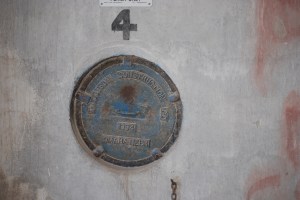
The manhole cover on bin number 4 indicates the builder and year of construction.

The Altoona elevator was built in 1954. The manhole covers, furnished by the Hutchinson Foundry, of Hutchinson, Kan., indicate the builder and the year of construction. Most of the covers are inside the elevator, but there is one also on the outside near the ground, which is typical of Tillotson elevators. A large grain dryer flanks the elevator on the east side.

DSC_0399

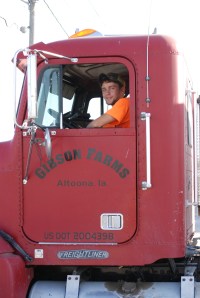
Jacob Holloway, driver for Gibson Farms, paused for a photo after delivering grain.

When I stopped to visit in October, Pat Printy, a thirty-year employee of the Farmers Co-op, shared some of the history of the elevator. He also explained the elevator’s operations during harvest and the significance of good corn.

Sam Wise, former mayor of Altoona, owned the elevator before the cooperative purchased it in 1963 for $175,000. Farmers Co-op began operating the elevator in 1964. About ten years ago, the elevator headhouse had to be rebuilt because of cracking concrete, but it still retains its Tillotson-style rounded contours. The elevator is currently used for beans and corn.

A truck came up to deliver corn while I visited. Pat Printy vacuumed a sample into the building and tested it for moisture content. He placed a scoop of it on the counter for me to see.

“Nice corn,” Pat commented. I asked why. He said it was dry enough to store, at about 14 percent moisture content. Corn with a moisture content of 14 percent or less was dry enough to go into storage without drying, and depended on the right weather conditions to arrive already dry from the field. If the moisture content was over 15.5 percent, the corn would be in danger of spoilage if it was not dried right away.

Exceptionally wet corn could become a problem because the dryer could only treat 2,500 bushels per hour. Each truck holds about 950 bushels, so during a wet harvest the dryer would become a bottleneck. Pat said the dryer at Altoona was an old one, but the dryer at Bondurant was newer and much faster.

The elevator was busy the day I stopped by, both accepting corn and moving beans out for transfer into the larger Bondurant elevator about a mile away. Ninety-five percent of the bean harvest was already in, and the Altoona elevator needed to make room for some nice, dry corn.

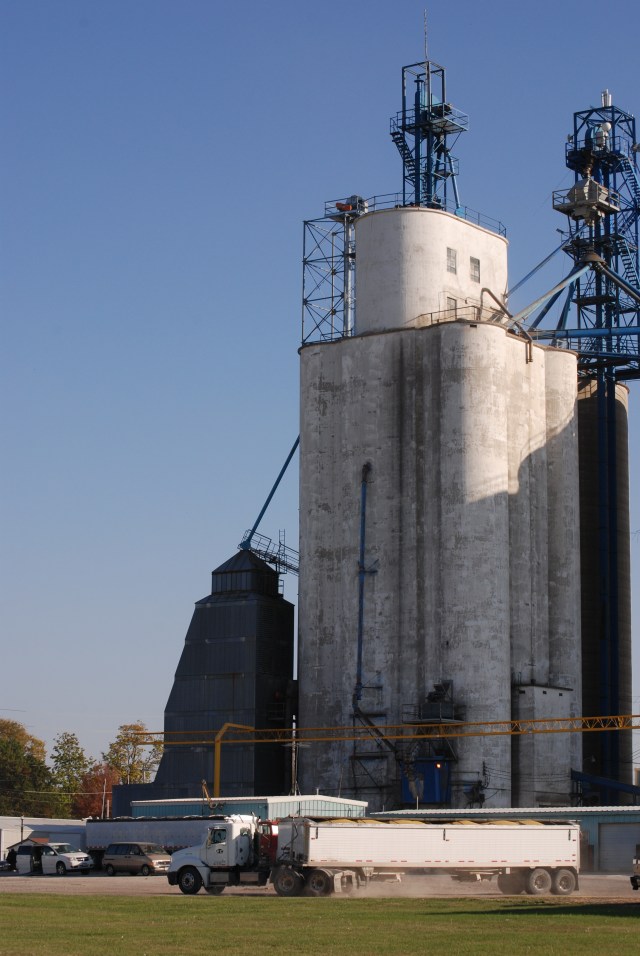
The Altoona, Iowa elevator built by Tillotson Construction of Omaha

A grain truck driver pointed out that Tillotson Construction Company’s Altoona, Iowa, elevator, seen here, is very similar to another of the company’s creations, which is found in Mitchellville, Iowa.

Tillotson Construction’s postwar business card, in full color, is a story in itself

Scan0005

By Ronald Ahrens

Reginald Tillotson’s business card from the years after World War Two demands some interpretation.

The splashy color side—perhaps a bit of an extravagance, although surely effective when handed to a co-op manager in a remote district—presents the image of what we’re sure is the Vinton Street elevator. Completed in 1947, this South Omaha elevator with its unusual, towering headhouse, would be a showcase for any builder.

On the back, above the rule, the range of Tillotson Construction’s services is spelled out. We don’t yet know much about the mills and warehouses but hope some information will turn up.

Below the rule, we find the six-character telephone number from the alphanumeric dialing days. Local exchanges were assigned prefix names from Bell Telephone’s mostly generic list. Besides Atlantic, Omaha exchanges were named Jackson, Prospect, Regent, and so on.

Seven-digit numbers replaced Omaha’s alphanumeric plan in 1960. The Atlantic exchange received the numerical prefix of 341.

Numerical postal zones, introduced during World War Two, were replaced when the national zip code system was introduced in 1963.

Reginald Oscar Tillotson was widely known as Mike. It could have been that Reginald was too exotic for the time and place, so he picked the nickname for himself.

How we know Tillotson Construction built the Burlington, Colorado, grain elevator

_DSC0033_9425

Story by Charles J. Tillotson and photos by Gary Rich

Editor’s note: Chuck Tillotson had just finished high school in Omaha when he and his two younger brothers, Tim, 16, and Mike, 13, were dispatched by their father, Reginald, to work on the family construction company’s grain elevator project in Flagler, Colo. Chuck had drawn up the plans himself in the preceding months during breaks from school. They drove out together in a 1953 Ford, towing the twenty-eight-foot travel trailer in which they would live for the duration. To the best of Uncle Chuck’s recollection, they subsisted on beans and wieners when they weren’t dining in the Flagler cafe. “That was when Tim and I weren’t screaming over to Elitches Park outdoor pavilion, in Denver, some 120 miles to the west, to squeeze in a night of dancing and return at daybreak to assume our work shift—no sleep of course.” Uncle Mike fended for himself, alone, in Flagler. 

When we were building the Flagler job in 1953, Tillotson also commenced the construction of a new elevator in Burlington, Colo. The thing I remember about that job is a story regarding a cement mixer.

We had contracted with a local hauler with a pickup truck to relocate one of our mixers to the Burlington job, which was about forty-five miles to the east on US-24.

He came one day, hitched it up to the back end of his pickup, and started off down the road. Just about where the Flagler town sign is, the road made a ninety-degree turn, and then it crossed the tracks to the south.

The hauler made the turn and started southward. Just as he crossed the tracks, his truck ran out of gas.

He ended up stalled—with the mixer straddling the tracks.

Every afternoon about 3:00 p.m., the eastbound passenger train came roaring along toward Kansas.

Well, the hauler jumped out of his truck and started running, ’cause he heard the train a-comin’, comin’ down the track, clickety-clack, like Johnny Cash sings.

The train barely slowed down as it passed through town, and it ended up smashing the mixer to smithereens.

The engine, and, as I recall at least, one of the first cars behind, were derailed.

It was a mess, but no one was injured.

That’s how I know we built Burlington.