By Ronald Ahrens
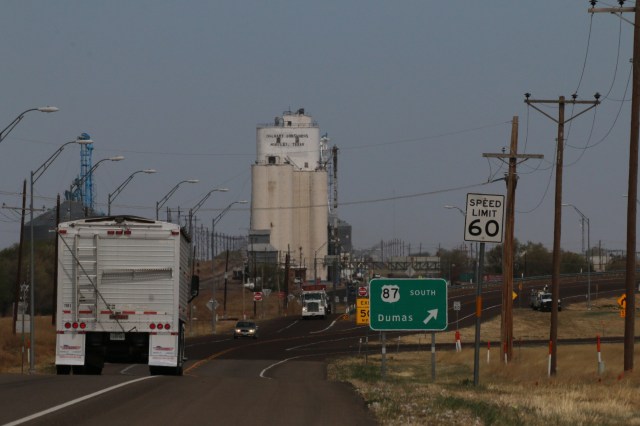
The elevator at Bushland was the third of 10 Tillotson jobs I intended to visit in the Texas Panhandle. It was still midmorning when I hightailed it out of there, heading 58 miles north and a little west through the rolling scrub country of Potter, Oldham, and Hartley Counties.
 The next destination was Hartley, a town of about 500 people where U.S. 385 meets U.S. 87. Tillotson Construction Co., of Omaha, built a twin-leg, 300,000-bushel elevator here in 1950.
Like several others that year–Rock Valley, Iowa; Burlington, Colo.; and Canyon, Tex., where I had been at sunrise–Hartley was built on the Bellwood, Neb., plan. This entailed eight tanks, or silos, measuring 20 feet in diameter and here reaching to 115 feet in height. (Bellwood itself had 120-foot silos.)
 Schoolchildren were at recess as I drove through side streets looking for a good view of the elevator.
Arriving on the scene, I found a big operation. Of course I had recognized the Tillotson elevator’s curved headhouse. This elevator, as it turned out, has a substantial storage annex that likely more than doubles capacity. And there is a second concrete elevator onsite.


A pleasant surprise was the metal-clad wooden elevator that pre-dated everything else. Wooden elevators often went up in flames because of grain dust explosions, sparks from passing trains or short circuits. Finding one standing in good condition is a rare event.
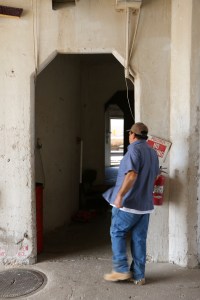
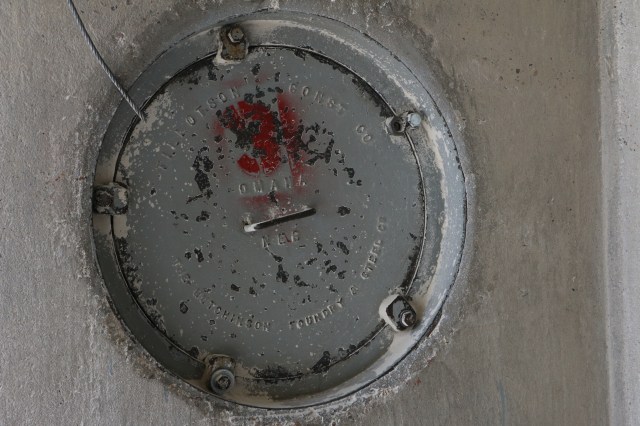
Getting out of the truck with my camera, I chatted a bit with an employee and showed him my grandfather’s name on a manhole cover.
Then I looked around, finding the elevator in pretty nice shape after so many years. A previous logo on the headhouse had been covered up and replaced with simple lettering that said, “Dalhart Consumers, Hartley, Texas.”
My notes show that I also peeked into the office and met an employee named Yvette, who said they store corn, wheat, and milo.
The elevators in Canyon and Bushland, Tex., have more dramatic stories to tell. This one in Hartley merely keeps its head up and goes about its job every day.


 By Ronald Ahrens
 The job 68 years ago required the careful mixing of 2,066 cubic yards of concrete from the sand pile on the site. It would be reinforced with 109.37 tons of steel. At least I think that’s the number in the company records. That line got pinched in the copying process. But 109 tons is consistent with the amount used in other elevators of similar size. The 252,000-bushel elevator built the same year in Pond Creek, Okla.–another on the Dike plan and one of two dozen Tillotson jobs in that bounteous year–used 112.91 tons of steel.


 It turned at 42 rpm, cranking the 14-inch, six-ply belt and it’s cups that measured 12 x 6 inches at 8.5 inches o.c. The head drive had a 40-horsepower Howell motor.
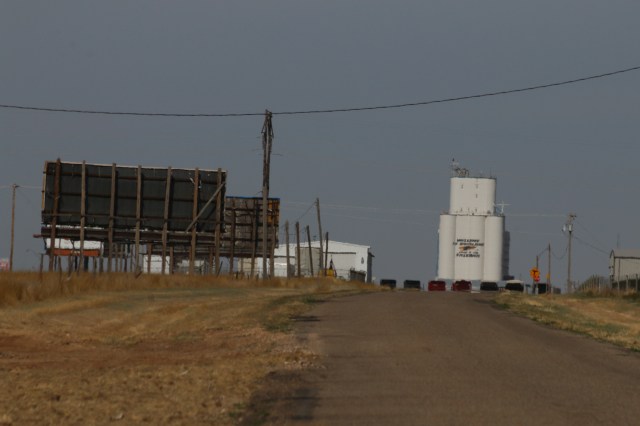
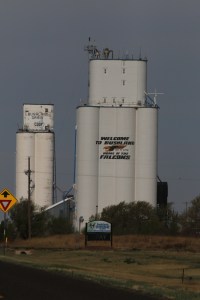
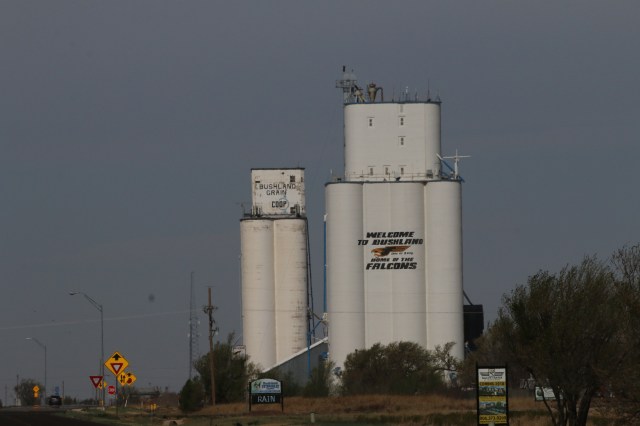
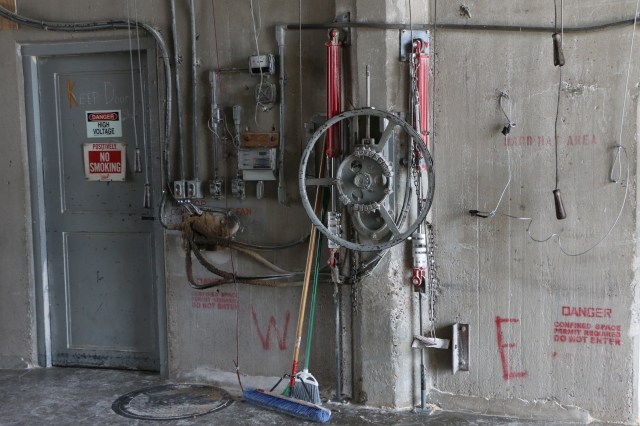 After prowling in and out, up and down, and finding the Ag Producers Co-op elevator at Bushland, Texas, to be spotless and more than serviceable after 68 years, I struggled in the ambitious crosswind and went over the the co-op’s office just to the installation’s north. It’s just north of I-40.
 I remarked on the elevator’s excellent condition and the glistening paint job.


 But the drama of the elevator’s construction might have eluded the Class of 2010.
 Indeed, we can hardly count the human cost to building an elevator, or any tall structure, in the early and middle decades of the 20th century.




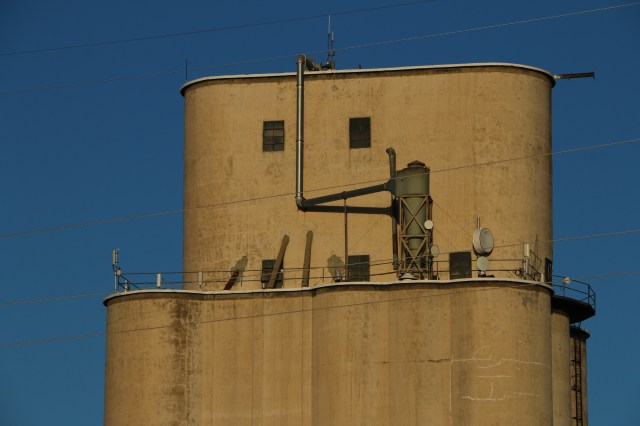 The year 1950 was a busy one for Tillotson Construction Co. The Omaha outfit (my grandfather Reginald Tillotson’s company) built 25 grain elevators–an amazing number. They were in Oklahoma, Texas, Colorado, Kansas, Nebraska, and Iowa. The next year they would build one in Missouri.
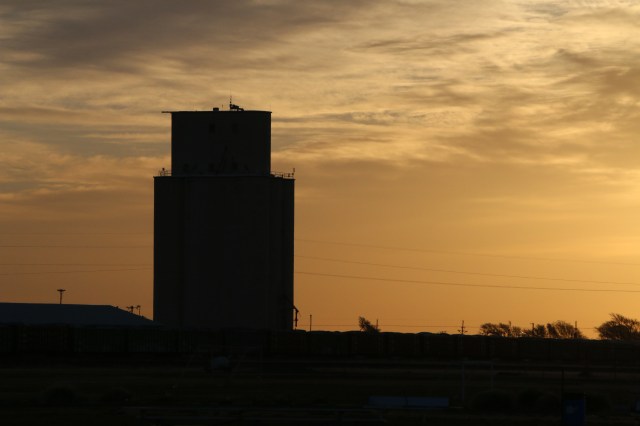 While the Bellwood plan was used for five elevators, it’s interesting to note the slight differences in materials used. For example, Canyon took 2,463 cubic yards of reinforced concrete while Burlington, Colorado, also on the Bellwood plan, took 2,436 cubic yards (the exact same amount as the mother elevator in Bellwood and the one in Hartley, Texas, which is coming soon in this series). Rock Valley, Iowa, though, took 2,394 cubic yards.


 Altogether, 34 hp was required to operate the leg; the record says two 40-hp Howell motors were installed. Theoretical capacity of the leg, based on the cup manufacturer’s rating, was 7,920 bushels per hour. But the leg operated at an actual capacity of 80 percent the theoretical capacity, or 6,350 bushels per hour.
 By Ronald Ahrens
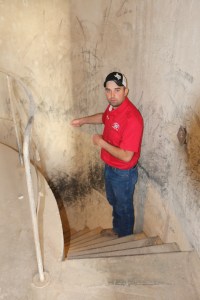
 The single-leg elevator built at Hereford, Texas, by Tillotson Construction Company in 1951 had capacity for 300,000 bushels, according to company records. That worked out to 2,640 bushels per foot of height. The drawform walls of the silos, or tanks, rose 125 feet.
 Our Grandfathers' Grain Elevators